
 Download PDF
 Download PDF
Market Overview
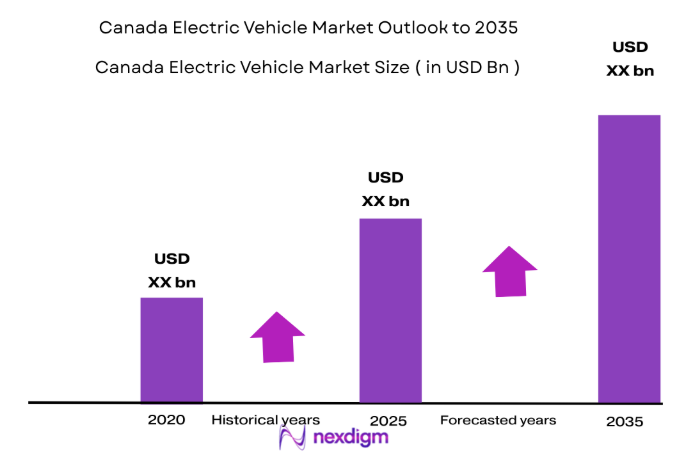
The electric vehicle (EV) market is projected to reach USD ~ billion by 2025, driven by increasing consumer demand for eco-friendly vehicles, government incentives, and advancements in battery technologies. The market is propelled by rising fuel costs, environmental regulations, and shifting consumer preferences toward sustainable transportation. The rapid adoption of EVs is supported by the development of efficient charging infrastructure and the decreasing costs of electric vehicle production, particularly in regions with strong environmental policies.
North America, Europe, and China dominate the global electric vehicle market due to robust government policies, infrastructure investments, and technological advancements. These regions benefit from strong consumer demand, government subsidies, and policies aimed at reducing carbon emissions. In North America, California leads with its aggressive EV adoption policies, while China’s growing demand for EVs is driven by government-backed incentives and its leading position in battery manufacturing.
Market Segmentation
By Product Type
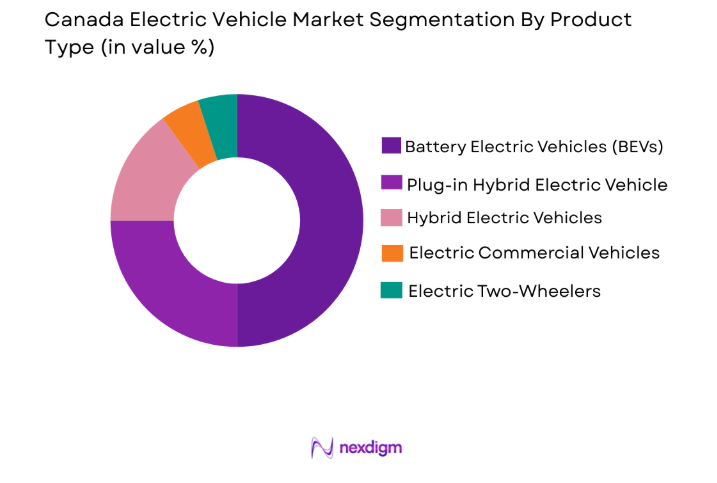
The Canada electric vehicle market is segmented by product type into battery electric vehicles (BEVs), plug-in hybrid electric vehicles (PHEVs), and hybrid electric vehicles (HEVs). Recently, BEVs have taken a dominant market share due to factors such as improved battery technology, longer driving ranges, and lower total cost of ownership. The growing interest in zero-emission vehicles, coupled with government incentives and expanding charging infrastructure, has led to a surge in BEV sales, positioning them as the preferred choice for consumers.
By Platform Type
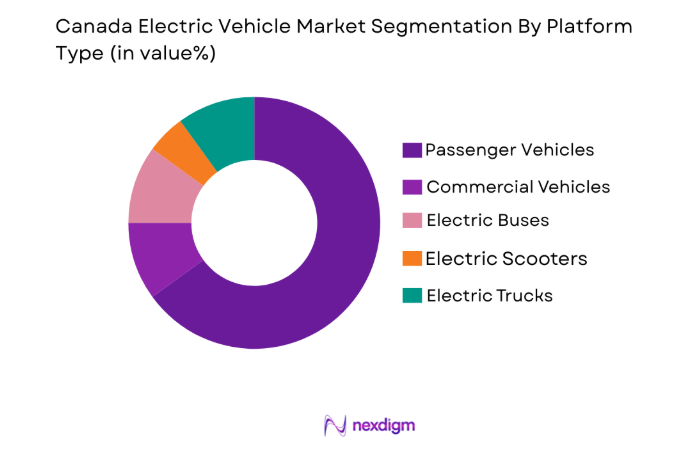
The Canada electric vehicle market is segmented by platform type into passenger vehicles, commercial vehicles, electric buses, electric scooters, and electric trucks. Recently, passenger vehicles have dominated the market share due to the increasing demand for personal electric transportation, particularly in urban areas. The consumer shift towards electric cars, driven by the availability of more affordable models and improved infrastructure, has resulted in the widespread adoption of passenger EVs, making them the largest segment in the market.
Competitive Landscape
The electric vehicle market in Canada is highly competitive, with significant consolidation happening as major automotive manufacturers and new entrants battle for market share. Established companies are rapidly adopting electric vehicle technologies, and new players are entering with innovative products. This landscape is characterized by the constant evolution of battery technology, expanding EV infrastructure, and regulatory pressures to meet environmental targets.
| Company Name | Establishment Year | Headquarters | Technology Focus | Market Reach | Key Products | Revenue (USD) | Additional Parameter |
| Tesla | 2003 | Palo Alto, CA | ~ | ~ | ~ | ~ | ~ |
| Ford | 1903 | Dearborn, MI | ~ | ~ | ~ | ~ | ~ |
| Rivian | 2009 | Plymouth, MI | ~ | ~ | ~ | ~ | ~ |
| Nissan | 1933 | Yokohama, Japan | ~ | ~ | ~ | ~ | ~ |
| General Motors | 1908 | Detroit, MI | ~ | ~ | ~ | ~ | ~ |
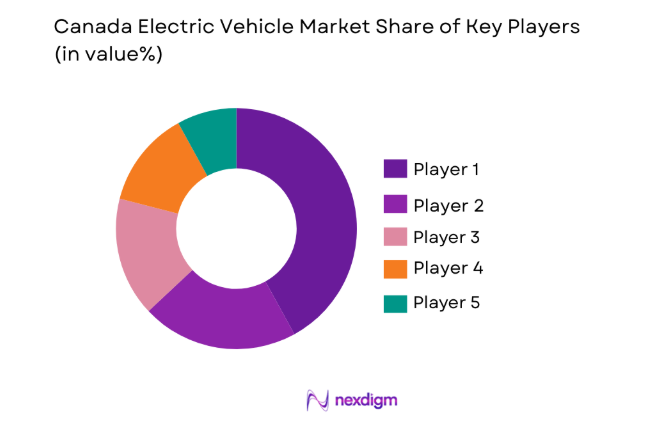
Canada Electric Vehicle Market Analysis
Growth Drivers
Government Incentives
They play a significant role in driving the growth of the electric vehicle market. Subsidies, rebates, and tax incentives make EVs more affordable, thus encouraging consumers to make the switch from internal combustion engine vehicles to electric vehicles. These incentives also provide support for businesses to incorporate EVs into their fleets, increasing the demand across the commercial segment. Furthermore, government commitments to reducing carbon emissions and the introduction of stricter emission standards create a favorable environment for EV growth. As governments worldwide work toward meeting their climate goals, they are increasingly offering incentives to promote EV adoption. In many countries, tax credits, grants, and subsidies lower the purchase price of electric vehicles, making them more competitive with traditional vehicles. Such measures foster market expansion by reducing the initial cost barrier. In addition, these initiatives help promote green technologies, aligning with national and international sustainability targets. These government-backed initiatives are vital in accelerating EV adoption, especially for consumers and businesses that might otherwise hesitate due to the higher upfront costs of EVs. Additionally, supportive infrastructure investment, including the installation of public and private charging stations, further drives EV adoption. Governments are not only offering financial incentives but are also introducing policies that demand automakers to transition towards greener, zero-emission vehicle production. The growing legislative momentum reinforces the shift towards electric transportation and provides further validation for long-term investment in EV technologies.
Technological Advancements
Technological advancements in battery storage, charging infrastructure, and overall vehicle design have played a pivotal role in the growing adoption of electric vehicles. Innovations such as fast-charging stations, longer battery life, and improved energy efficiency make EVs more practical for consumers. As battery technology continues to improve, both in terms of cost and performance, the total cost of ownership of EVs will decrease, leading to increased adoption across various market segments, including personal and commercial vehicles. The development of solid-state batteries, which promise even greater energy density and faster charging times, is particularly exciting, as it can significantly reduce range anxiety and provide consumers with more confidence in transitioning to electric mobility. With the global push towards sustainable energy solutions, the integration of renewable energy sources, like solar power, with EV charging infrastructure presents a huge opportunity to further decrease the carbon footprint of EV ownership. Moreover, as battery storage technology improves, the lifespan and efficiency of EV batteries continue to increase, addressing previous concerns around battery degradation. The expanded availability of fast-charging networks also alleviates concerns about long charging times, ensuring that consumers can use EVs as reliably as traditional vehicles. As innovation continues in this sector, electric vehicles will become increasingly efficient, affordable, and practical for a wide range of consumers.
Market Challenges
Charging Infrastructure Limitations
One of the key challenges to widespread EV adoption is the insufficient charging infrastructure. Despite the growing number of charging stations, the availability of charging points remains limited, especially in rural areas. This creates anxiety among potential consumers regarding the range of their vehicles and the convenience of recharging. The lack of standardized charging solutions also hinders the seamless adoption of electric vehicles across various regions and manufacturers. Consumers often find themselves limited to specific charging networks, and the disparity in charging speeds further exacerbates concerns about EV usability. The perception of inconvenience is a major barrier that must be addressed to ensure mass adoption. To overcome these challenges, significant investments in public and private charging infrastructure are necessary, especially in underserved areas, where charging stations are sparse. Standardization of charging protocols would also simplify the EV experience for consumers, enabling the interoperability of charging networks across different vehicle manufacturers. As the infrastructure expands, it will be critical to ensure charging stations are distributed evenly and integrated with urban planning and transportation networks to alleviate consumer concerns. Additionally, the development of ultra-fast charging solutions can further help to overcome infrastructure challenges, making it easier and faster for consumers to recharge their vehicles.
High Upfront Costs
Although the total cost of ownership for electric vehicles is expected to decrease over time, the high initial purchase price remains a significant barrier for many consumers. The cost of EVs is higher than traditional internal combustion engine vehicles, mainly due to the expensive battery technology. While government incentives help mitigate these costs, the high upfront investment required for EVs is still a major challenge for price-sensitive buyers. As EV adoption grows, economies of scale in production are expected to lower these costs, but the initial financial barrier is still a significant challenge for consumers looking to transition to electric mobility. This issue is particularly pronounced in the mass-market segment, where many consumers prioritize affordability. Additionally, the cost of replacing batteries in electric vehicles remains a point of concern, though improvements in battery life and warranty coverage are gradually addressing these worries. For the electric vehicle market to expand, efforts must be made to reduce the upfront cost of EVs, either through further advances in manufacturing efficiency, battery technology, or more aggressive financial incentives from governments.
Opportunities
Expanding Fleet Adoption
There is a significant opportunity for the expansion of electric vehicles in the fleet market, particularly for logistics companies, ride-sharing services, and public transportation networks. Many corporations and government agencies are looking to meet sustainability goals by incorporating electric vehicles into their fleets. With the expansion of charging infrastructure and advancements in fleet management technology, electric fleet adoption is poised to grow rapidly in the coming years. Fleets present an opportunity for large-scale EV adoption as they often operate on predictable routes, which makes them ideal for electric vehicles with limited range. Fleet owners benefit from lower operating costs due to the lower cost of electricity compared to fuel, as well as maintenance savings, since EVs have fewer moving parts than traditional vehicles. Additionally, the growing environmental concerns and emissions regulations push fleet owners to adopt green solutions. Commercial fleets, including delivery services, taxi operators, and government fleets, can take advantage of EVs’ operational cost advantages, making the transition both economically and environmentally beneficial. Furthermore, governments are increasingly adopting electric vehicles for public transportation, further boosting demand for electric buses and other commercial vehicles. The integration of fleet-specific software, such as route optimization and charging management, will also aid in the smooth transition to electric fleets.
Advancements in Battery Recycling
As electric vehicle adoption grows, the need for battery recycling technologies will become more crucial. The development of efficient, scalable battery recycling methods will not only help address environmental concerns but also reduce the cost of new batteries by reusing materials. Companies that invest in this area could become leaders in the EV supply chain and capitalize on the growing demand for sustainable solutions. Battery recycling can help to alleviate the environmental impact of mining raw materials for new batteries, providing an environmentally friendly alternative while reducing the dependency on scarce resources like lithium and cobalt. Furthermore, as the number of end-of-life electric vehicles increases, the demand for battery recycling infrastructure will rise significantly. Recycling technologies such as direct recycling and hydrometallurgical processing can enable the extraction of valuable materials like lithium, nickel, and cobalt, which can then be reused to produce new batteries. This creates a closed-loop system for the EV industry, reducing its carbon footprint and ensuring the long-term sustainability of the sector. The advancement of battery recycling infrastructure presents an opportunity for companies to reduce production costs and contribute to the circular economy, making EVs even more attractive to consumers and businesses alike.
Future Outlook
The Canada electric vehicle market is expected to continue its rapid growth, driven by technological advancements in battery storage, expanded infrastructure, and strong government support. Demand for electric vehicles is projected to increase, especially in urban areas where sustainability is prioritized. Innovations in charging infrastructure, such as ultra-fast charging stations, will enhance the convenience of EV adoption. Government regulations pushing for stricter emission standards will further bolster the transition towards electric vehicles in the coming years.
Major Players
- Tesla
- Ford
- Rivian
- Nissan
- General Motors
- BMW
- Hyundai
- Kia
- Volkswagen
- Mercedes-Benz
- Audi
- Lucid Motors
- BYD
- Toyota
- Porsche
Key Target Audience
- Investments and venture capitalist firms
- Government and regulatory bodies
- Automotive manufacturers
- EV fleet operators
- Electric vehicle infrastructure developers
- Charging station providers
- Automotive supply chain companies
- Environmental NGOs
Research Methodology
Step 1: Identification of Key Variables
Identify the critical drivers, challenges, and growth factors that impact the electric vehicle market in Canada.
Step 2: Market Analysis and Construction
Analyze and segment the market using historical data, focusing on product types, platform types, and consumer behavior.
Step 3: Hypothesis Validation and Expert Consultation
Validate hypotheses by consulting industry experts and stakeholders to ensure the accuracy of data and assumptions.
Step 4: Research Synthesis and Final Output
Synthesize the findings and prepare a comprehensive report outlining the market dynamics, trends, and forecasts.

- Executive Summary
- Research Methodology (Definitions, Scope, Industry Assumptions, Market Sizing Approach, Primary & Secondary Research Framework, Data Collection & Verification Protocol, Analytic Models & Forecast Methodology, Limitations & Research Validity Checks)

- Market Definition and Scope
- Value Chain & Stakeholder Ecosystem
- Regulatory / Certification Landscape
- Sector Dynamics Affecting Demand

- Growth Drivers
Government Incentives for EV Adoption
Rising Fuel Prices
Increased Environmental Awareness - Market Challenges
High Upfront Costs of EVs
Limited EV Charging Infrastructure
Battery Life and Range Limitations - Market Opportunities
Growing EV Adoption in Urban Areas
Development of Fast Charging Solutions
Increasing Investments in Green Technology
- Trends
Shift Towards Autonomous Electric Vehicles
Integration of Renewable Energy in EV Charging - Government Regulations & Defense Policy
- SWOT Analysis
- Stakeholder and Ecosystem Analysis
- Porter’s Five Forces

- By Market Value, 2020-2025
- By Installed Units, 2020-2025
- By Average System Price, 2020-2025
- By System Complexity Tier, 2020-2025

- By System Type (In Value%)
Battery Electric Vehicles (BEVs)
Plug-in Hybrid Electric Vehicles (PHEVs)
Hybrid Electric Vehicles (HEVs)
Electric Commercial Vehicles
Electric Two-Wheelers - By Platform Type (In Value%)
Passenger Vehicles
Commercial Vehicles
Electric Buses
Electric Scooters
Electric Trucks - By Fitment Type (In Value%)
Original Equipment Manufacturer (OEM) Systems
Aftermarket Systems
Custom Electric Vehicles
Commercial Fleet Solutions
Conversion Kits for Vehicles - By End User Segment (In Value%)
Individual Consumers
Fleet Operators
Government Agencies
Corporate Fleets

- Market share of major players
- Cross Comparison Parameters (Price, Range, Charging Infrastructure, Brand, Vehicle Type, Battery Life, Consumer Preferences, Technological Innovation)
- SWOT Analysis of Key Competitors
- Pricing & Procurement Analysis
- Key Players
Tesla
Ford
Chevrolet
BMW
Hyundai
Kia
Volkswagen
Nissan
Rivian
Audi
Mercedes-Benz
BYD
Toyota
Lucid Motors
Porsche

- Government Agencies’ Role in Promoting EVs
- Individual Consumers’ Focus on Cost and Range
- Fleet Operators’ Shift Towards Sustainability
- Public Sector Investment in Electric Transport

- Forecast Market Value, 2026-2035
- Forecast Installed Units, 2026-2035
- Price Forecast by System Tier, 2026-2035
- Future Demand by Platform, 2026-2035


 Request a Sample
 Ask for Customization
 Get a Quote
 Enquire Now