
 Download PDF
 Download PDF
Market Overview
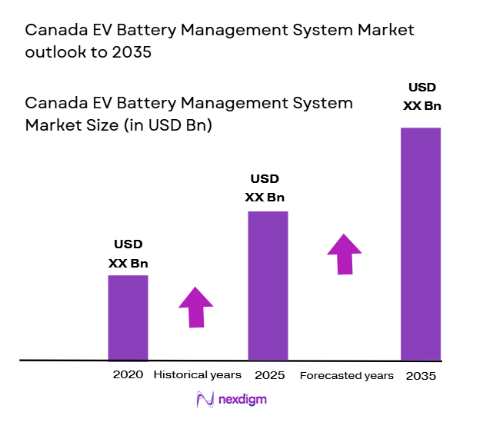
The Canada EV Battery Management System market is valued at approximately USD ~ billion, driven by an increasing demand for electric vehicles, government incentives, and advancements in battery technologies. The growing focus on reducing carbon emissions, coupled with the shift towards electric transportation, supports the market growth. Furthermore, the rise in renewable energy adoption and battery storage solutions is expected to continue fueling market demand for advanced battery management systems.
Canada remains a dominant player in the market due to strong government support for electric vehicles, including incentives for both manufacturers and consumers. Cities like Toronto, Vancouver, and Montreal have seen significant infrastructure growth, supporting the rise in EV adoption. These cities’ focus on reducing greenhouse gas emissions and improving air quality has led to high investments in EV infrastructure and technology, positioning them at the forefront of the EV battery management system market.
Market Segmentation
By Product Type:
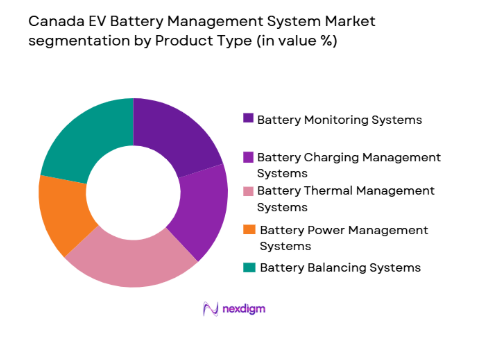
The Canada EV Battery Management System market is segmented by product type into Battery Monitoring Systems, Battery Charging Management Systems, Battery Thermal Management Systems, Battery Power Management Systems, and Battery Balancing Systems. Recently, Battery Thermal Management Systems have a dominant market share due to increasing demand for maintaining optimal operating temperatures for EV batteries, which directly affects battery performance and lifespan. This demand is driven by technological advancements in thermal management systems that offer enhanced efficiency, particularly in regions with extreme temperatures. The adoption of these systems is further supported by the necessity of improving overall battery safety and performance in electric vehicles.
By Platform Type:
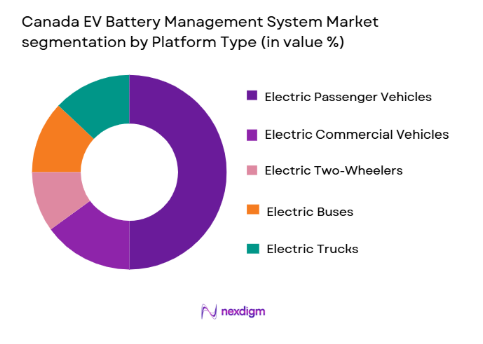
The Canada EV Battery Management System market is segmented by platform type into Electric Passenger Vehicles, Electric Commercial Vehicles, Electric Two-Wheelers, Electric Buses, and Electric Trucks. Recently, Electric Passenger Vehicles have a dominant market share due to the increasing demand for eco-friendly personal transportation and advancements in EV technologies. The shift toward electric passenger vehicles is being driven by strong consumer preference for energy-efficient, low-emission vehicles, coupled with growing urbanization. The widespread adoption of electric passenger vehicles is supported by government incentives and policies, including tax credits and rebates, making EVs more affordable for consumers.
Competitive Landscape
The competitive landscape of the Canada EV Battery Management System market is shaped by both established automotive and technology players, along with new entrants pushing the boundaries of innovation in battery management technologies. The market is experiencing consolidation as larger companies acquire or partner with smaller tech firms to strengthen their EV product offerings and battery management capabilities. These collaborations allow for faster deployment of innovative solutions in the growing EV market, solidifying their competitive positions.
| Company Name | Establishment Year | Headquarters | Technology Focus | Market Reach | Key Products | Revenue (USD Billion) | Market-Specific Parameter |
| Tesla | 2003 | Palo Alto, USA | ~ | ~ | ~ | ~ | ~ |
| LG Chem | 1947 | Seoul, South Korea | ~ | ~ | ~ | ~ | ~ |
| Panasonic | 1918 | Osaka, Japan | ~ | ~ | ~ | ~ | ~ |
| BYD | 1995 | Shenzhen, China | ~ | ~ | ~ | ~ | ~ |
| Eaton | 1911 | Dublin, Ireland | ~ | ~ | ~ | ~ | ~ |
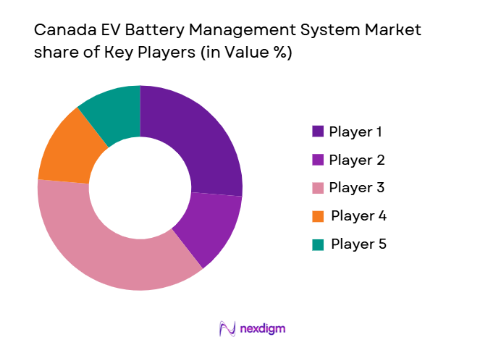
Canada EV Battery Management System Market Analysis
Growth Drivers
Government Support for EV Adoption:
Government incentives for EV adoption are a critical growth driver for the Canada EV Battery Management System market. The Canadian government has introduced numerous programs aimed at increasing the adoption of electric vehicles by offering tax incentives, rebates, and grants to both consumers and manufacturers. These measures are designed to reduce the initial cost of EVs, making them more accessible to the general population. As a result, more consumers are willing to switch from traditional internal combustion engine vehicles to electric ones, which in turn drives the demand for efficient EV battery management systems. Moreover, these policies support the development of charging infrastructure, further enhancing the convenience and attractiveness of electric vehicles. Additionally, government initiatives aimed at reducing carbon emissions and meeting climate targets are expected to continue providing a robust foundation for EV growth. The increasing push towards carbon neutrality by both local and federal governments adds momentum to the adoption of electric vehicles, directly impacting the EV battery management market.
Technological Advancements in Battery Systems:
Technological advancements in battery systems are another significant driver for the growth of the Canada EV Battery Management System market. Innovations in battery management technologies, such as improvements in energy density, charging speed, and overall battery lifespan, are creating more attractive options for electric vehicle manufacturers and consumers. The development of new battery chemistries, including solid-state and lithium-sulfur batteries, is expected to revolutionize the EV market by offering superior performance and efficiency compared to traditional lithium-ion batteries. Additionally, improvements in battery thermal management systems are making EVs more reliable in extreme temperature conditions, a critical factor in regions with cold winters. These technological advancements not only enhance the performance of EVs but also address long-standing concerns related to battery safety, charging times, and range anxiety, which have previously hindered the adoption of electric vehicles. As these technologies mature, they are anticipated to lower the cost of EV battery management systems, further promoting the shift toward electric vehicles.
Market Challenges
High Cost of EV Batteries:
One of the main challenges facing the Canada EV Battery Management System market is the high cost of EV batteries. Despite technological advancements and the increasing adoption of electric vehicles, the production cost of batteries remains a significant barrier. EV batteries, which account for a substantial portion of the total cost of an electric vehicle, are still expensive due to the high costs of raw materials such as lithium, cobalt, and nickel. The supply and pricing of these materials are subject to fluctuations in the global market, further increasing uncertainty for manufacturers. Additionally, the technology required to manage and maintain EV batteries, such as battery management systems, adds to the overall cost. While economies of scale are expected to reduce these costs in the future, the current high price of batteries remains a key challenge for both consumers and manufacturers. As such, efforts to develop more cost-effective and sustainable battery technologies will be crucial in addressing this challenge.
Battery Recycling and Sustainability Issues:
Another challenge facing the Canada EV Battery Management System market is the lack of robust battery recycling infrastructure and the growing concern over the sustainability of battery production. As the number of electric vehicles on the road increases, the demand for lithium-ion batteries will continue to rise, exacerbating concerns about the long-term environmental impact of battery disposal. Currently, the recycling of EV batteries is limited, and the process is expensive and inefficient. The high cost and lack of standardized recycling processes hinder the widespread adoption of sustainable practices in the EV battery supply chain. Furthermore, the extraction of raw materials for batteries raises environmental and ethical concerns, particularly in developing countries where mining operations often have negative social and environmental impacts. Addressing these sustainability issues requires the development of more efficient recycling technologies and the implementation of policies to promote the responsible sourcing and disposal of batteries. This challenge presents a significant hurdle to the continued growth of the Canada EV Battery Management System market.
Opportunities
Expansion of Charging Infrastructure:
The expansion of electric vehicle charging infrastructure presents a significant opportunity for the Canada EV Battery Management System market. As electric vehicles become more prevalent, the demand for accessible and efficient charging solutions is expected to grow exponentially. The Canadian government and private sector players are investing heavily in expanding the national network of EV charging stations to support the growing fleet of electric vehicles. This expansion is crucial to reducing charging time, increasing convenience for EV owners, and alleviating range anxiety. Moreover, the development of fast-charging and ultra-fast-charging technologies is expected to enhance the overall EV ownership experience, making electric vehicles more attractive to consumers. The growth of EV charging infrastructure also creates opportunities for the integration of advanced battery management systems that ensure the safe and efficient operation of charging stations, as well as the optimization of energy usage. As the charging network expands, the demand for innovative and scalable battery management solutions will continue to rise, creating new business prospects in the market.
Integration of Renewable Energy Solutions:
The integration of renewable energy solutions with electric vehicle charging stations presents another promising opportunity for the Canada EV Battery Management System market. As the focus on sustainable energy grows, the demand for clean energy sources to power EV charging stations is increasing. Solar power, wind energy, and other renewable sources are being incorporated into EV charging infrastructure to reduce reliance on the grid and minimize the carbon footprint of electric vehicle charging. This integration is particularly relevant in remote areas or regions with limited access to centralized electricity, as it offers a decentralized and environmentally friendly charging solution. By coupling EV charging with renewable energy systems, it is possible to create a more sustainable energy ecosystem that supports both the growth of electric vehicles and the transition to clean energy. The integration of renewable energy solutions not only improves the environmental impact of EV adoption but also presents new opportunities for EV battery management systems to enhance energy efficiency, battery lifespan, and overall system performance.
Future Outlook
The future of the Canada EV Battery Management System market looks promising, with continued growth expected over the next few years. Technological advancements in battery management, coupled with rising government support for electric vehicle adoption, will drive the market forward. The increasing shift towards renewable energy solutions and the expansion of EV charging infrastructure will also support market growth, enhancing the demand for efficient and reliable battery management systems. As battery technologies continue to improve and the cost of EVs decreases, the market will likely see increased adoption of electric vehicles, further fueling the demand for battery management systems. However, challenges related to battery cost, recycling, and sustainability will require continued innovation to address. The overall outlook remains positive, with strong growth anticipated in the coming years.
Major Players
- Tesla
- LG Chem
- Panasonic
- BYD
- Eaton
- General Motors
- Nissan
- BMW Group
- Ford Motor Company
- Johnson Controls
- Schneider Electric
- Samsung SDI
- ABB
- Hitachi
- CATL
Key Target Audience
- Electric Vehicle Manufacturers
- Battery Manufacturers
- Automotive Suppliers
- Government and Regulatory Bodies
- Fleet Operators
- Charging Infrastructure Providers
- Renewable Energy Companies
- Technology Providers
Research Methodology
Step 1: Identification of Key Variables
Identification of key variables such as market size, growth trends, and technological advancements that will shape the future of the market.
Step 2: Market Analysis and Construction
Analysis of current market trends, data collection from industry reports, and construction of market forecasts.
Step 3: Hypothesis Validation and Expert Consultation
Validation of market hypotheses through consultation with industry experts, including manufacturers, suppliers, and regulatory bodies.
Step 4: Research Synthesis and Final Output
Synthesis of research findings into a comprehensive report with actionable insights, market forecasts, and strategic recommendations.

- Executive Summary
- Research Methodology (Definitions, Scope, Industry Assumptions, Market Sizing Approach, Primary & Secondary Research Framework, Data Collection & Verification Protocol, Analytic Models & Forecast Methodology, Limitations & Research Validity Checks)

- Market Definition and Scope
- Value Chain & Stakeholder Ecosystem
- Regulatory / Certification Landscape
- Sector Dynamics Affecting Demand
- Strategic Initiatives & Infrastructure Growth

- Growth Drivers
Government incentives for EV adoption
Technological advancements in battery management
Increasing demand for electric vehicles
Rising environmental concerns and regulatory pressures
Development of advanced battery technologies - Market Challenges
High cost of battery management systems
Limited availability of raw materials for EV batteries
Lack of standardization in battery management systems
Infrastructure challenges for EV charging
Battery degradation and lifespan issues - Market Opportunities
Growth in commercial EV applications
Partnerships for battery recycling and second-life applications
Expansion of EV infrastructure and charging networks - Trends
Increase in battery energy density
Integration of artificial intelligence in battery management
Shift towards solid-state battery technology
Focus on reducing EV charging times
Growth of vehicle-to-grid (V2G) systems - Government Regulations & Defense Policy
EV adoption mandates
Battery recycling regulations
Subsidies and incentives for EV infrastructure - SWOT Analysis
- Stakeholder and Ecosystem Analysis
- Porter’s Five Forces Analysis
- Competition Intensity and Ecosystem Mapping

- By Market Value, 2020-2025
- By Installed Units, 2020-2025
- By Average System Price, 2020-2025
- By System Complexity Tier, 2020-2025

- By System Type (In Value%)
Battery Monitoring Systems
Battery Charging Management Systems
Battery Thermal Management Systems
Battery Power Management Systems
Battery Balancing Systems - By Platform Type (In Value%)
Electric Passenger Vehicles
Electric Commercial Vehicles
Electric Two-Wheelers
Electric Buses
Electric Trucks - By Fitment Type (In Value%)
On-board Systems
Off-board Systems
Integrated Systems
Aftermarket Solutions
Custom Systems - By EndUser Segment (In Value%)
Automotive Manufacturers
Battery Manufacturers
Electric Vehicle Owners
Fleet Operators
Technology Providers - By Procurement Channel (In Value%)
Direct Procurement
Government Tenders
Third-party Distributors
Online Platforms
Automaker Partnerships - By Material / Technology (in Value%)
Lithium-Ion Battery Technology
Solid-State Battery Technology
Graphene-Based Battery Technology
Nickel-Metal Hydride Batteries
Sodium-Ion Batteries

- Market structure and competitive positioning
- Market share snapshot of major players
- CrossComparison Parameters (System Type, Platform Type, Procurement Channel, End User Segment, Fitment Type, Technology, Cost, Charging Speed, Energy Efficiency, Scalability)
- SWOT Analysis of Key Players
- Pricing & Procurement Analysis
- Key Players
Tesla
ABB
Siemens
Panasonic
LG Chem
BYD
Nissan
General Motors
BMW Group
Ford Motor Company
Schneider Electric
Johnson Controls
Honeywell
Eaton Corporation
Samsung SDI

- Increasing adoption of EVs by fleet operators
- Government support for EV infrastructure
- Automotive manufacturers pushing for innovation
- End-user concerns about battery performance and costs

- Forecast Market Value, 2026-2035
- Forecast Installed Units, 2026-2035
- Price Forecast by System Tier, 2026-2035
- Future Demand by Platform, 2026-2035


 Request a Sample
 Ask for Customization
 Get a Quote
 Enquire Now