
 Download PDF
Market Overview
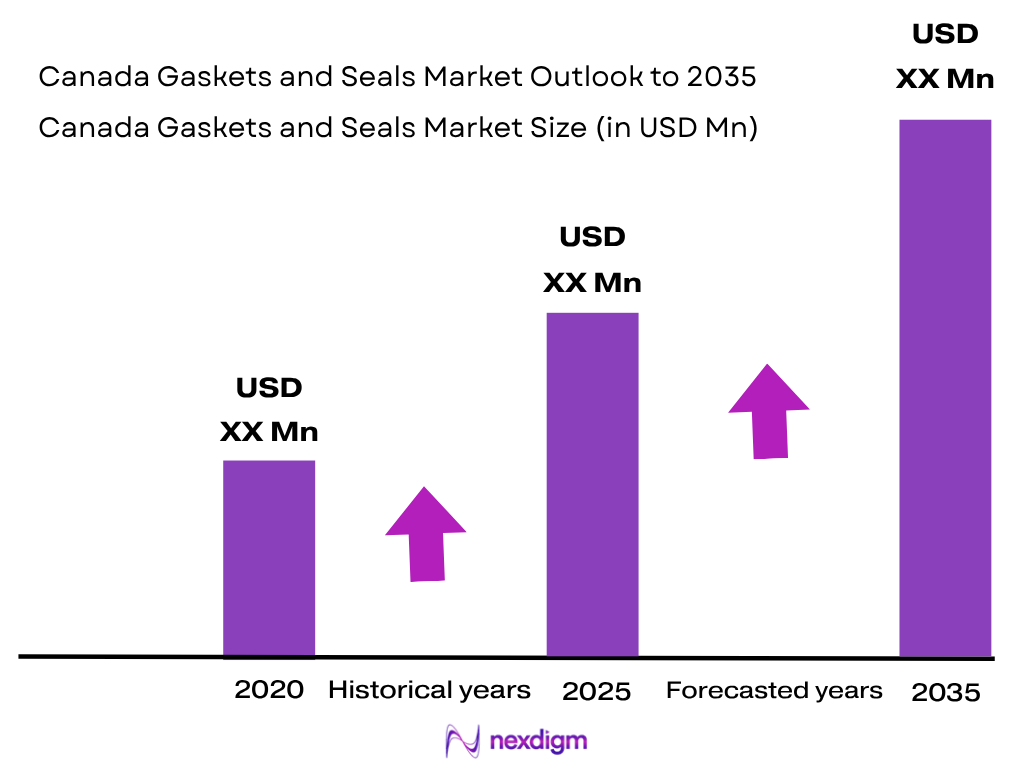
The Canada Gaskets and Seals Market is valued at approximately USD ~X.X million, based on historical market assessment. Demand is supported by oil and gas, pipelines, refining, mining, automotive and industrial manufacturing. Canadian crude-oil and equivalent production increased from 4.93 million barrels/day to 5.13 million barrels/day, while manufacturing generated CAD 874.6 billion in manufactured-goods revenue, sustaining replacement requirements for flange gaskets, mechanical seals, hydraulic seals and rotating-equipment sealing systems.
Alberta, Ontario, Quebec and British Columbia dominate the Canada Gaskets and Seals Market because they concentrate oil sands, refineries, pipelines, mining, automotive plants, pulp mills, power assets and LNG infrastructure. Alberta crude production reached a record 4.53 million barrels/day in the preceding operating period, while Canada subsequently produced 5.13 million barrels/day. Ontario’s automotive ecosystem forms another major demand center, and British Columbia gained additional importance through the 890,000-barrel/day expanded Trans Mountain system.
Market Segmentation
By Product Category
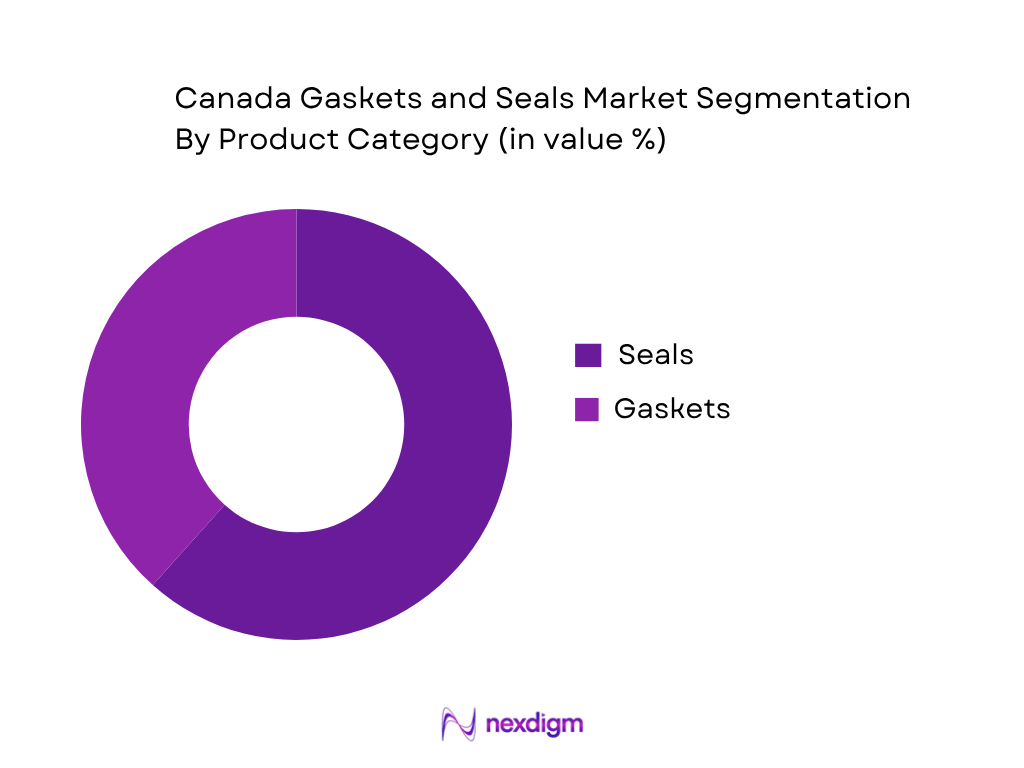
The Canada Gaskets and Seals Market is segmented into seals and gaskets, with seals encompassing mechanical, hydraulic, pneumatic, rotary and specialized dynamic sealing products. Seals hold the dominant position, reflecting Canada’s extensive installed base of pumps, compressors, turbines, hydraulic equipment and rotating machinery across oil sands, mining, pipelines, pulp and paper, power generation and manufacturing. Published market evidence identifies seals as the largest Canadian product segment. This structure is reinforced by crude-oil and equivalent production of 5.13 million barrels/day, 17 operating refineries with approximately 1.93 million barrels/day of total capacity, and mineral production spanning almost 200 mines. These industries rely extensively on mechanical and dynamic seals because rotating equipment requires continuous leakage control and periodic replacement. Mechanical seals are especially important for hydrocarbon pumps, pipeline pumping stations and mineral-processing equipment, while hydraulic seals have substantial exposure to mining, construction and mobile machinery.
By End-Use Industry
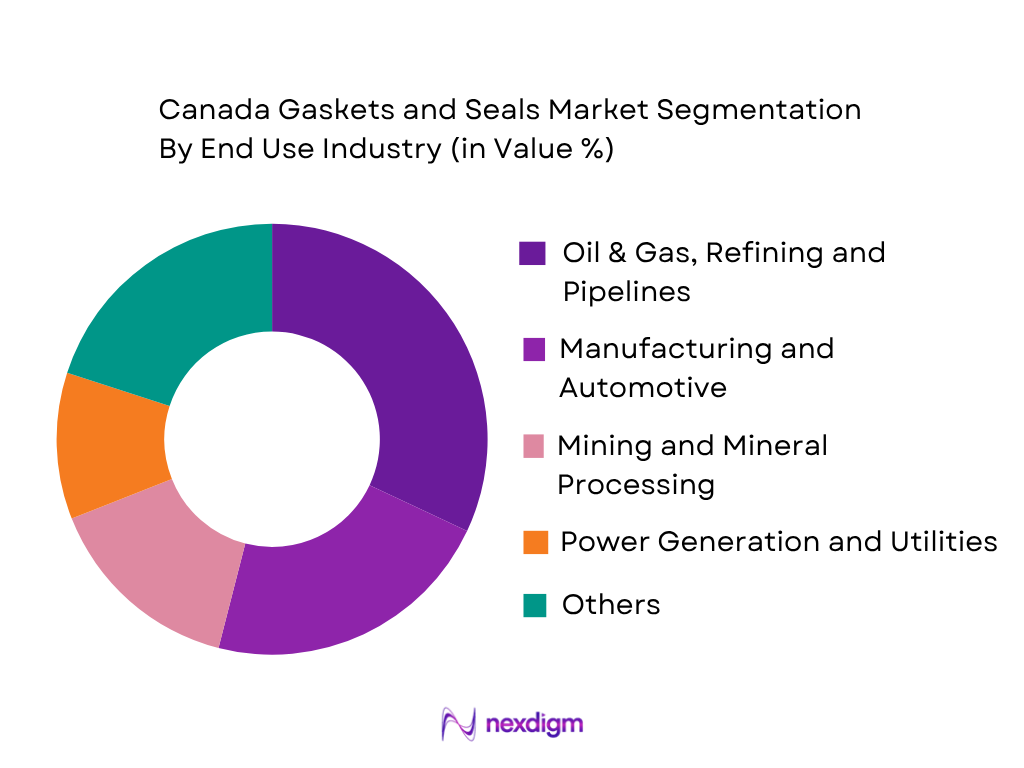
The Canada Gaskets and Seals Market is segmented into oil and gas and pipelines, manufacturing and automotive, mining and mineral processing, power generation and utilities, pulp and paper, and other industrial applications. Oil and gas and pipeline applications represent the dominant analytical demand segment because Canada combines high crude production with extensive gathering, transmission, refining and export infrastructure. Crude-oil and equivalent production averaged 5.13 million barrels/day, while the expanded Trans Mountain system increased nameplate capacity from approximately 300,000 barrels/day to 890,000 barrels/day. Canada also operates 17 refineries with approximately 1.93 million barrels/day of capacity. This equipment base generates recurring demand for spiral-wound and ring-joint gaskets, graphite sealing, mechanical seals, compressor sealing systems and flange-isolation products. High-pressure pipelines, pumps, compressors, heat exchangers and refinery process units also require planned replacement during shutdowns and maintenance cycles, making energy applications particularly sealing-intensive.
Competitive Landscape
The Canada Gaskets and Seals Market combines specialized domestic gasket manufacturers and distributors with multinational mechanical-seal and engineered-sealing suppliers. Competition differs significantly by application: oil sands and refineries require high-temperature and high-pressure gasket capability; pipelines and LNG facilities emphasize mechanical and compressor sealing; mining requires abrasion-resistant solutions; and nuclear, pulp and water applications demand application engineering and reliable MRO support. Domestic inventory, emergency turnaround response, seal refurbishment and technical engineering therefore materially influence supplier positioning.
| Company | Establishment Year | Headquarters | Industrial Gaskets | Mechanical/Dynamic Seals | Oil & Gas/Pipeline Exposure | Mining/Pulp Exposure | Canada Manufacturing/Service | MRO & Engineering Capability |
| A.R. Thomson Group | 1967 | Surrey, Canada | ~ | ~ | ~ | ~ | ~ | ~ |
| Garlock | 1887 | Palmyra, USA | ~ | ~ | ~ | ~ | ~ | ~ |
| Flexitallic | 1912 | Houston, USA | ~ | ~ | ~ | ~ | ~ | ~ |
| John Crane | 1917 | Chicago, USA | ~ | ~ | ~ | ~ | ~ | ~ |
| EagleBurgmann | 1884 heritage | Wolfratshausen, Germany | ~ | ~ | ~ | ~ | ~ | ~ |
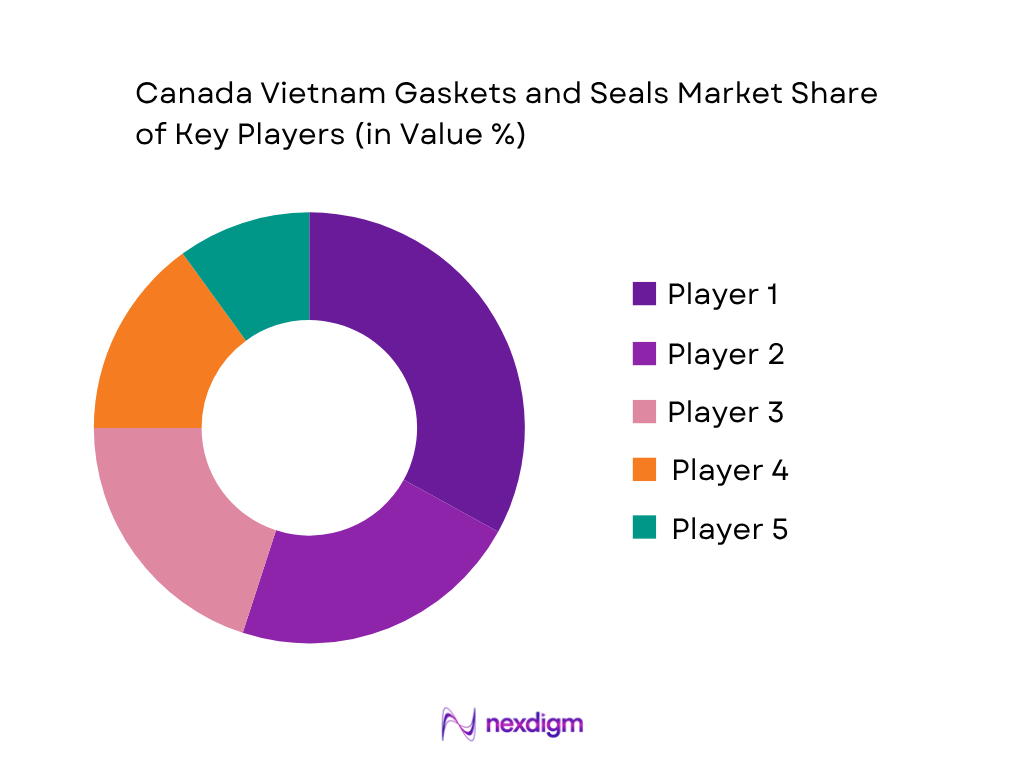
Canada Gaskets and Seals Market Analysis
Growth Drivers
Record Oil Production and Expansion of Pipeline Transportation Infrastructure
Canada’s expanding oil-production and transportation system is increasing recurring demand for industrial gaskets, mechanical seals, valve seals, compressor seals and flange-integrity products. Canadian crude oil and equivalent production averaged 5.13 million barrels per day in 2024, compared with 4.93 million barrels per day in 2023, and increased further to 5.35 million barrels per day in 2025. Alberta alone added 182,000 barrels per day of production during 2025. Pipeline infrastructure simultaneously expanded when the Trans Mountain Expansion entered service in 2024, raising system capacity from approximately 300,000 barrels per day to 890,000 barrels per day across a 1,492 km regulated network. Higher throughput increases operating loads on pumps, valves, compressor auxiliaries, terminal equipment and thousands of flanged connections, strengthening replacement demand for mechanical seals, spiral-wound gaskets, graphite products, RTJ gaskets and flange-isolation components. The wider industrial environment is also supportive: Canada’s manufacturing sector generated CAD 874.6 billion in manufactured-goods revenue in 2024. At the macroeconomic level, Canada recorded GDP of USD 2.24 trillion and GDP per capita of USD 54,340.3 in 2024, providing a substantial economic base for energy-infrastructure maintenance and industrial MRO spending.
Large Mining, Manufacturing and Rotating-Equipment Installed Base
Canada’s extensive mining and manufacturing base is another important driver for gaskets and seals because these industries operate pumps, crushers, slurry systems, hydraulic cylinders, compressors, turbines and processing equipment subject to continual wear, vibration and abrasive exposure. Canada produced more than 60 minerals and metals from almost 200 mines in 2024, with mineral production valued at CAD 64.3 billion and minerals-sector capital investment reaching CAD 22 billion, including CAD 17 billion in mining and related support activities and CAD 5 billion in mineral processing. The broader minerals sector directly employed 438,000 people, highlighting the operating scale of equipment-intensive activities requiring slurry seals, hydraulic seals, O-rings and customized gasket materials. Manufacturing added another major demand base, generating CAD 874.6 billion in manufactured-goods revenue in 2024. Canada also assembled more than 1.31 million light-duty vehicles through 5 OEMs supported by nearly 700 parts suppliers, sustaining requirements for elastomeric seals, rotary seals and precision-engineered components. Canada’s 2024 GDP reached USD 2.24 trillion, while GDP per capita stood at USD 54,340.3, reinforcing capital-intensive industrial maintenance and replacement activity.
Market Challenges
Extreme Service Conditions and Complex Qualification Requirements
Canada’s gaskets and seals suppliers must address demanding operating environments across oil sands, pipelines, mining, LNG and nuclear power, making qualification and material selection significantly more complex than standard industrial sealing applications. Crude oil and equivalent production reached 5.13 million barrels per day in 2024 and 5.35 million barrels per day in 2025, exposing pumps, compressors and pipeline systems to sustained operating loads. Mining adds abrasive conditions across almost 200 mines, while mineral production reached CAD 64.3 billion, requiring mechanical seals and hydraulic components capable of handling slurry, solids and severe wear. Nuclear applications impose another layer of technical qualification: Darlington operates 4 CANDU reactors with installed capacity of 3,512 MW, and Unit 1 returned to service after refurbishment in late 2024 while Unit 4 progressed through regulatory return-to-service milestones into 2026. These assets require documented materials, quality assurance and rigorous equipment verification. Suppliers therefore face longer approval cycles for critical gaskets, elastomers and mechanical seals than for general-purpose products. Canada’s 2024 GDP of USD 2.24 trillion underscores the economic scale of industries dependent on reliable sealing, but failure consequences make testing, traceability and engineering support substantial barriers for new entrants.
Geographic Dispersion, Inventory Complexity and Emerging Material-Regulation Uncertainty
Canada’s geographically dispersed industrial base creates a major service and inventory challenge because sealing suppliers must support oil sands in Alberta, mining operations across multiple provinces, pulp mills in forest-producing regions, LNG infrastructure in British Columbia and manufacturing concentrated in Ontario and Quebec. Canada operated almost 200 mines producing more than 60 minerals and metals, while mineral-sector investment reached CAD 22 billion in 2024, requiring regional access to hydraulic seals, slurry seals, gasket materials and repair capability. The Trans Mountain system alone spans 1,492 km between Edmonton and British Columbia and now accommodates approximately 890,000 barrels per day, increasing the importance of localized emergency MRO support. Pulp infrastructure is similarly dispersed: Canadian wood-pulp output reached 12.30 million tonnes in 2024, alongside 3.81 million tonnes of graphic paper, supporting numerous pumps, refiners, digesters and steam systems requiring specialized sealing. Material regulation also requires monitoring: federal authorities published a PFAS assessment in 2025 and initiated phased risk-management measures, while fluoropolymers were specifically reserved for separate assessment. Because PTFE and fluoropolymer materials are important in high-performance seals and gaskets, future material decisions may require additional technical evaluation. Canada’s USD 2.24 trillion GDP in 2024 highlights the large industrial base suppliers must service efficiently.
Market Opportunities
LNG, Pipeline and Low-Leakage Critical Sealing Applications
Canada’s emerging LNG export infrastructure and expanded pipeline capacity create a strong future opportunity for manufacturers of cryogenic seals, dry-gas seals, cartridge mechanical seals, flange gaskets and low-emission packing systems. LNG Canada loaded its first export cargo in 2025 from its Kitimat facility, which operates 2 liquefaction trains with combined initial capacity of 14 million tonnes per annum. LNG processing requires specialized sealing around cryogenic valves, compressors, pumps, loading systems and process piping where conventional materials cannot reliably tolerate extreme low-temperature service. Pipeline opportunities are also expanding following the Trans Mountain Expansion, which increased system capacity from approximately 300,000 barrels per day to 890,000 barrels per day across 1,492 km of regulated pipeline. National crude-oil and equivalent production subsequently reached 5.35 million barrels per day in 2025, further supporting utilization of pipeline, terminal and processing assets. These operating conditions create future scope for engineered graphite gaskets, compressor seals, bearing isolators and emissions-control sealing solutions combined with field engineering and refurbishment services. Canada’s 2024 GDP of USD 2.24 trillion provides a strong macroeconomic foundation for continued investment in energy logistics and critical industrial infrastructure.
Nuclear Refurbishment, Mining MRO and Domestic Precision-Seal Manufacturing
Canada’s nuclear refurbishment and mineral-processing activity create future opportunities for suppliers capable of delivering qualified mechanical seals, high-integrity gaskets, abrasion-resistant products and locally machined replacement components. Darlington Nuclear Generating Station has 4 CANDU reactors with 3,512 MW of installed capacity; Unit 1 completed its refurbishment return-to-service process in 2024, while Unit 4 advanced through regulatory hold points in 2025 and 2026. The wider refurbishment environment increases demand for traceable sealing materials, pump seals, valve packing and engineered components capable of meeting strict nuclear quality requirements. Mining provides an additional high-frequency aftermarket: Canada produced more than 60 minerals and metals from almost 200 mines, with production valued at CAD 64.3 billion in 2024 and capital investment of CAD 22 billion. These operations require continuous replacement of slurry-pump seals, hydraulic seals, rotary seals and wear-resistant sealing components. Local CNC machining and seal refurbishment can therefore address emergency downtime and reduce dependence on long replacement lead times. Canada’s manufacturing sector already generated CAD 874.6 billion in manufactured-goods revenue, while national GDP reached USD 2.24 trillion in 2024, supporting development of domestic precision-sealing and MRO capabilities.
Future Outlook
The Canada Gaskets and Seals Market is projected to expand at approximately ~X.X% CAGR during 2026-2035. Growth is expected to be supported by sustained oil production, LNG infrastructure, pipeline operations, mining investment, power-system maintenance and industrial equipment replacement. The market should simultaneously shift toward engineered, lower-emission and application-specific sealing products rather than conventional commodity components. Canada’s energy infrastructure provides a substantial recurring aftermarket base. Crude-oil and equivalent production averaged 5.13 million barrels/day, compared with 4.93 million barrels/day previously, and averaged 5.19 million barrels/day during the first half of the following period. Higher production increases operating hours and maintenance requirements for pumps, compressors, pipelines, valves and processing equipment.
Major Players
- A.R. Thomson Group
- Garlock Canada
- Flexitallic Canada
- John Crane Canada
- EagleBurgmann Canada
- AESSEAL Canada
- Trelleborg Sealing Solutions Canada
- A.W. Chesterton Canada
- Flowserve Canada
- Parker Hannifin Canada
- SKF Canada
- Quest Gasket & Supply
- Lamons Canada
- Progressive Sealing
- Fluidseal
Key Target Audience
- Industrial Gasket and Engineered Sealing Product Manufacturers
- Mechanical Seal, Hydraulic Seal and Rotary Seal Manufacturers
- Oil Sands, Oil and Gas, Pipeline and LNG Operators
- Mining, Pulp and Paper and Heavy Industrial Companies
- Refinery, Petrochemical, Power and Water Utility Operators
- Investments and Venture Capitalist Firms
- Private Equity Firms and Strategic Industrial Investors
- Government and Regulatory Bodies (Canada Energy Regulator, Natural Resources Canada, Canadian Nuclear Safety Commission, Environment and Climate Change Canada, Innovation Science and Economic Development Canada, provincial pressure-equipment regulators)
Research Methodology
Step 1: Identification of Key Variables
The initial phase constructs a comprehensive ecosystem map of the Canada Gaskets and Seals Market, covering gasket manufacturers, mechanical-seal suppliers, hydraulic-seal companies, distributors, repair centres, OEMs and industrial users. Critical variables include installed rotating equipment, flange populations, product replacement frequency, material requirements, plant shutdown cycles, domestic manufacturing, imports, application criticality and regional industrial concentration.
Step 2: Market Analysis and Construction
Historical demand is analyzed through complementary top-down and bottom-up approaches. Top-down calculations assess sealing intensity across oil and gas, pipelines, refining, mining, pulp and paper, power, automotive and manufacturing, while bottom-up analysis evaluates supplier sales, product volumes, replacement cycles, installed equipment and MRO consumption. Trade and manufacturing indicators are subsequently used to reconcile domestic supply with imported products.
Step 3: Hypothesis Validation and Expert Consultation
Market hypotheses are validated through structured discussions with gasket manufacturers, seal engineers, distributors, rotating-equipment specialists, reliability engineers, MRO contractors and industrial procurement teams. These consultations assess material selection, mechanical-seal replacement, turnaround demand, emergency inventory, customer qualification, failure modes, refurbishment activity and competitive positioning, allowing preliminary demand assumptions to be tested against actual industrial operating practices.
Step 4: Research Synthesis and Final Output
Primary findings are triangulated with information from the Canada Energy Regulator, Statistics Canada, Natural Resources Canada, company disclosures and industry standards. Supplier-level estimates are reconciled with application-level demand and industrial production indicators. The final framework determines market value, product segmentation, end-use structure, competitive positioning, regional demand concentration and long-term opportunities across the Canada Gaskets and Seals Market.

- Executive Summary
- Research Methodology (Market Definition and Scope, Canada Gaskets and Seals Market Classification, Industrial Gasket Demand Assessment, Mechanical Seal Consumption Mapping, Hydraulic and Pneumatic Seal Demand Assessment, Oil Sands Equipment Sealing Assessment, Pipeline Pump and Compressor Seal Mapping, Refinery and Petrochemical Turnaround Demand Assessment, LNG and Gas Processing Seal Assessment, Mining Slurry Equipment Seal Mapping, Pulp and Paper Mill Sealing Assessment, Nuclear Power Mechanical Seal Assessment, Domestic Manufacturing Capacity Assessment, Import Dependency Analysis, Graphite PTFE Elastomer Metallic and Engineered Polymer Material Assessment, Gasket Cutting Winding CNC Machining and Seal Refurbishment Technology Mapping, Installed Rotating Equipment Base Assessment, Replacement and MRO Demand Assessment, Plant Turnaround and Shutdown Demand Mapping, Application-Level Demand Assessment, End-Use Industry Demand Mapping, Primary Industry Interviews, Top-Down Market Sizing, Bottom-Up Company Revenue and Sales Volume Assessment, Trade Flow Analysis, Data Triangulation, Pricing Assessment, Forecasting Framework)

- Definition and Scope
- Canada Gaskets and Seals Industry Evolution
- Canada Gaskets and Seals Value Chain Analysis
- Canada Gaskets and Seals Supply Chain Analysis

- Growth Drivers (Record Canadian Crude Oil Production, Large Alberta Oil Sands Equipment Installed Base, Expansion of Pipeline Transportation Capacity, LNG Processing and Export Infrastructure, Refinery and Petrochemical Maintenance Demand, Mechanical Seal Demand from Pumps and Compressors, Mining and Mineral Processing Equipment Replacement, Pulp Mill Reliability Requirements, Nuclear Power Refurbishment and CANDU Equipment Maintenance, Water Infrastructure Renewal, Automotive and Aerospace Manufacturing Demand, Industrial Plant Turnaround and Shutdown Activity)
- Market Challenges (Dependence on Imported Specialty Seal Materials, Long Qualification Cycles for Critical Energy Applications, Extreme Temperature and Pressure Conditions in Oil Sands Processing, Abrasive Slurry Exposure in Mining, Sour Hydrocarbon and Corrosive-Service Requirements, Fugitive Emission Compliance, Inventory Complexity Across Sizes Materials and Pressure Classes, Geographic Dispersion of Resource Projects, Emergency Shutdown Lead-Time Requirements, Skilled Mechanical Seal Repair Requirements, Price Competition in Standard Gasket Categories, Fluoropolymer and PFAS Regulatory Uncertainty)
- Market Opportunities (Oil Sands High-Temperature Gaskets, Pipeline Pump Mechanical Seals, LNG Cryogenic Sealing Solutions, Dry Gas Compressor Seals, Low-Emission Refinery Gaskets and Packings, Nuclear-Qualified Mechanical Seals, Mining Slurry and Abrasion-Resistant Seals, Pulp and Paper Mechanical Seal Upgrades, Rapid CNC Hydraulic Seal Manufacturing, Turnaround Gasket Management Services, Mechanical Seal Refurbishment Centres, Flange Integrity Services, Hydrogen-Compatible Sealing Materials, Carbon Capture Compression and Pipeline Seals, Domestic Manufacturing of Critical MRO Sealing Products)
- Market Trends (API 682 Cartridge Mechanical Seal Adoption, Dry Gas Seal Technology, Low-Emission Gasketing, High-Purity Flexible Graphite, ePTFE Sealing Materials, Bearing Isolators, Predictive Seal Condition Monitoring, Local Mechanical Seal Refurbishment, CNC-On-Demand Seal Manufacturing, Flange Management and Controlled Bolting, Advanced Seal Support Systems, High-Performance FKM and HNBR Elastomers, PFAS-Free Material Development, Hydrogen-Compatible Sealing, Localization of Critical Replacement Components)
- Regulatory and Standards Landscape (Canada Energy Regulator Pipeline Requirements, Provincial Pressure Equipment Requirements, CSA Standards, ASME B16.20 Metallic Gasket Requirements, ASME B16.21 Nonmetallic Gasket Requirements, ASME PCC-1 Bolted Flange Joint Requirements, API 6A Ring Joint Requirements, API 682 Mechanical Seal Requirements, CSA N299 Nuclear Supply Quality Assurance Requirements, Fugitive Emission Requirements, NSF ANSI CAN Drinking Water Requirements, Occupational Health and Safety Requirements, Environmental Release and Leakage-Control Requirements)
- SWOT Analysis
- Porter’s Five Forces Analysis
- PESTLE Analysis
- Stakeholder Ecosystem
- Competition Ecosystem

- By Market Value (2020-2025)
- By Industrial Gasket Consumption Volume (2020-2025)
- By Mechanical Seal Consumption Volume (2020-2025)
- By Hydraulic and Pneumatic Seal Consumption Volume (2020-2025)
- By Rotary Shaft and Oil Seal Consumption Volume (2020-2025)
- By Domestic Gaskets and Seals Production Value (2020-2025)

- By Product Category (In Value %)
Industrial Gaskets
Mechanical Seals
Hydraulic Seals
Pneumatic Seals
Rotary Shaft and Oil Seals
O-Rings and Backup Rings
Compression and Gland Packings
Bearing Isolators
Seal Support Systems and Auxiliary Components
Custom Machined and Engineered Sealing Components - By Gasket Type (In Value %)
Spiral Wound Gaskets
Ring Type Joint Gaskets
Kammprofile and Grooved Gaskets
Metal Jacketed Gaskets
Corrugated Metal Gaskets
Heat Exchanger Gaskets
Compressed Non-Asbestos Fibre Gaskets
Flexible Graphite Gaskets
PTFE and ePTFE Gaskets
Rubber and Elastomeric Gaskets
Flange Insulation Gasket Kits
Large-Diameter Custom Gaskets - By Seal Type (In Value %)
Single Mechanical Seals
Dual and Double Mechanical Seals
Cartridge Mechanical Seals
Dry Gas Compressor Seals
Split Mechanical Seals
Agitator and Mixer Seals
Slurry Mechanical Seals
Hydraulic Piston and Rod Seals
Pneumatic Seals
Rotary Shaft and Oil Seals
Bearing Isolators and Labyrinth Seals - By Material Type (In Value %)
Flexible Graphite
Expanded PTFE and Filled PTFE
Compressed Non-Asbestos Fibre
Stainless Steel
Carbon Steel and Soft Iron
Nickel-Based and Corrosion-Resistant Alloys
NBR
HNBR
EPDM
FKM and Fluoroelastomers
Polyurethane
Engineered Thermoplastics
Silicon Carbide
Tungsten Carbide
Carbon-Graphite Seal Faces
High-Performance Polymer Composites - By End-Use Industry (In Value %)
Oil Sands Extraction and Upgrading
Conventional Upstream Oil and Gas
Pipeline Transportation
Natural Gas Processing and LNG
Petroleum Refining
Petrochemicals and Chemicals
Mining and Mineral Processing
Pulp and Paper
Nuclear Power Generation
Hydroelectric and Thermal Power Generation
Water and Wastewater Treatment
Automotive and Transportation Equipment - By Application Type (In Value %)
Pumps
Compressors
Pipeline Flanges
Heat Exchangers
Pressure Vessels
Reactors
Valves
Agitators and Mixers
Hydraulic Cylinders

- Market Share of Major Players (By Canada Revenue, Industrial Gasket Sales Volume, Mechanical Seal Sales Volume, Hydraulic and Pneumatic Seal Sales Volume, Product Category, Material Type, End-Use Industry, Canada Manufacturing and Distribution Footprint, Repair and Service Coverage)
- Cross Comparison Parameters (Canada Gaskets and Seals Revenue, Industrial Gasket and Dynamic Seal Portfolio Breadth, Oil Sands High-Temperature Abrasive and Corrosive-Service Capability, Pipeline LNG Refinery and Major Energy Customer Qualification Coverage, Canada Manufacturing CNC Machining and Seal Refurbishment Capability, Mining Pulp Nuclear Water and Heavy-Industry Customer Exposure, Canada Distribution Emergency Shutdown and MRO Service Footprint, Seal Engineering Failure Analysis Flange Integrity and On-Site Technical Support Capability)
- SWOT Analysis of Major Players (Product Breadth, Canada Footprint, Engineering Capability, Manufacturing Localization, Customer Qualification, Service Network)
- Detailed Profiles of Major Companies
A.R. Thomson Group
Garlock Canada
Flexitallic Canada
John Crane Canada
EagleBurgmann Canada
AESSEAL Canada
Trelleborg Sealing Solutions Canada
A.W. Chesterton Canada
Flowserve Canada
Parker Hannifin Canada
SKF Canada –
Quest Gasket & Supply
Lamons Canada
Progressive Sealing
Fluidseal

- Oil Sands Producer Gasket and Mechanical Seal Procurement Assessment
- Pipeline Operator Pump Seal and Flange Gasket Requirement Analysis
- Refinery Gasket and Mechanical Seal Requirement Assessment
- Natural Gas Processing and LNG Sealing Requirement Analysis
- Petrochemical and Chemical Plant Sealing Requirement Assessment
- Mining Operator Slurry and Hydraulic Seal Procurement Analysis
- Pulp and Paper Mill Mechanical Seal and Packing Requirement Assessment

- By Market Value (2026-2035)
- By Industrial Gasket Consumption Volume (2026-2035)
- By Mechanical Seal Consumption Volume (2026-2035)
- By Hydraulic and Pneumatic Seal Consumption Volume (2026-2035)
- By Rotary Shaft and Oil Seal Consumption Volume (2026-2035)
- By Domestic Gaskets and Seals Production Value (2026-2035)


 Request a Sample
 Ask for Customization
 Get a Quote
 Enquire Now