

 Download PDF
Market Overview
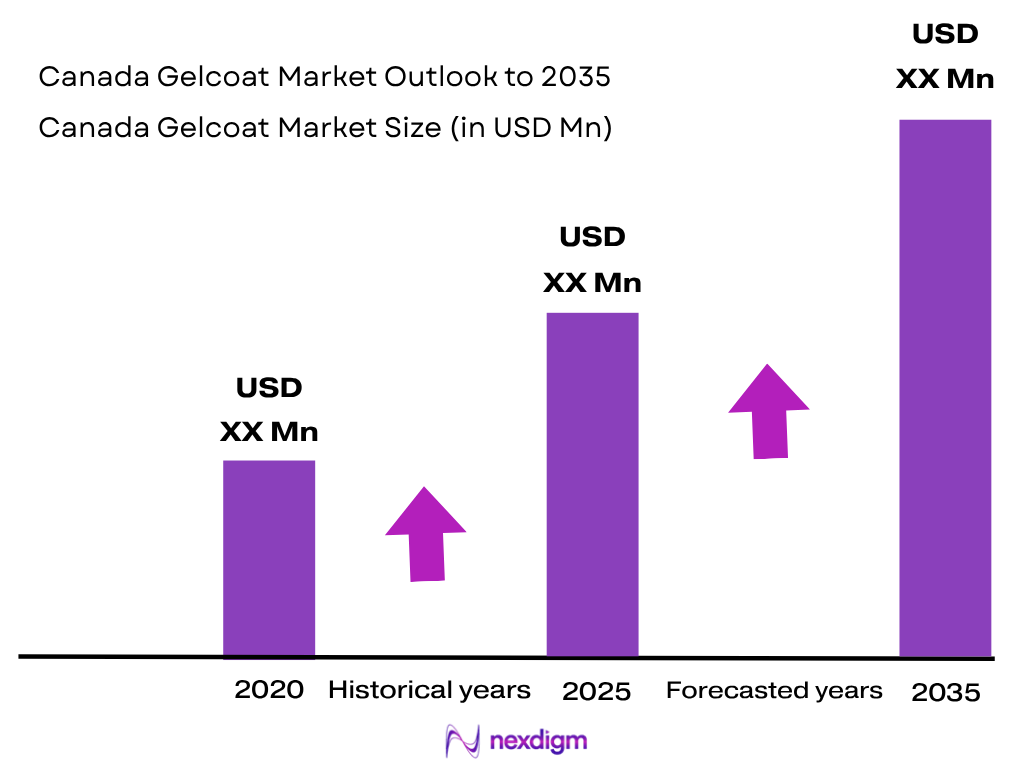
The Canada Gelcoat Market is valued at approximately USD ~XX million, based on historical demand analysis. Demand is supported by marine manufacturing, transportation composites, construction, FRP tanks and specialty moulded products. Canadian building-construction investment increased from approximately CAD 239.9 billion to CAD 253.8 billion, while transportation-equipment manufacturing remained a major industrial base. Domestic formulation capabilities in polyester, ISO-NPG, vinyl ester and specialty gelcoats further support consumption across composite fabrication applications.
Ontario and Quebec dominate the Canada Gelcoat Market because they combine composite manufacturing, transportation production, gelcoat formulation and large downstream industrial markets. Polynt operates resin and gelcoat blending facilities in Brampton, Ontario and Drummondville, Quebec, while Sogel operates from Quebec and DITECH has manufactured composite materials since 1983. British Columbia and Atlantic Canada are additionally important because of boatbuilding, marine repair and shipbuilding activities requiring weather-, moisture- and UV-resistant composite surfaces.
Market Segmentation
By Resin Chemistry
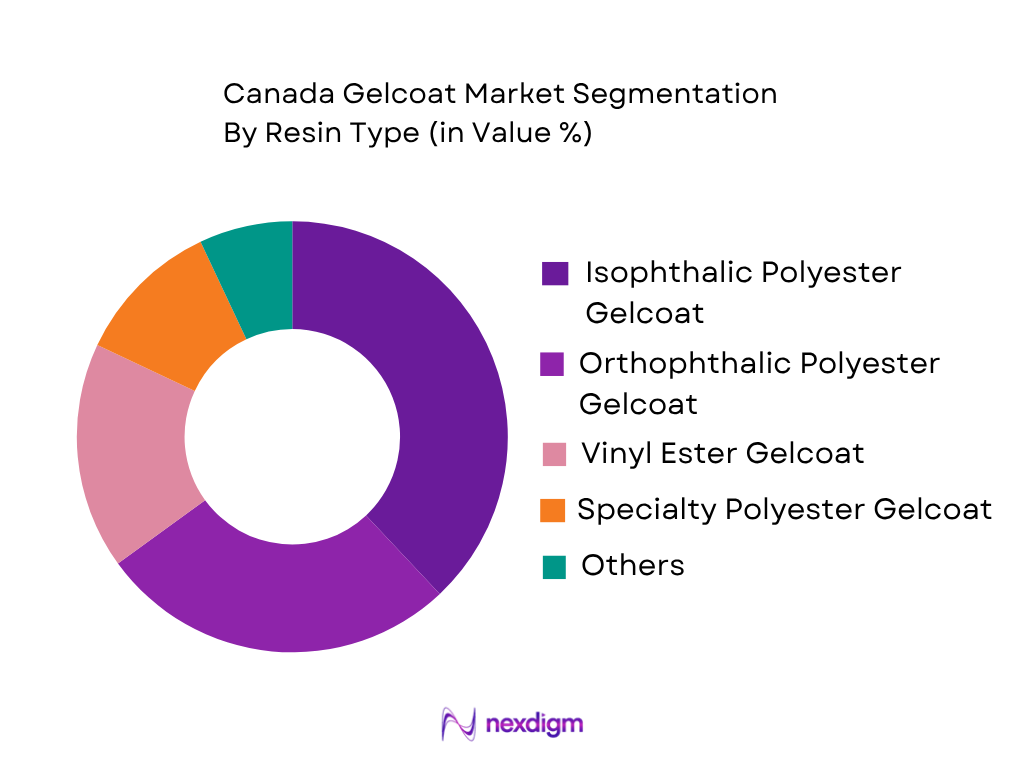
Canada Gelcoat Market is segmented by resin chemistry into isophthalic/ISO-NPG polyester, orthophthalic polyester, vinyl ester, low-styrene polyester and other specialty systems. Isophthalic/ISO-NPG polyester gelcoat holds the dominant share because Canadian demand is strongly exposed to marine, recreational, transportation and outdoor composite products. ISO-NPG formulations offer the weathering, gloss retention, UV stability and hydrolysis resistance required for these applications. Canadian manufacturers specifically commercialize ISO-NPG marine systems designed to resist blistering, osmosis, yellowing and cracking. Polynt’s Canadian portfolio similarly positions ISO-NPG gelcoat for marine, recreational and transportation applications. Vinyl ester products maintain an important specialist position where corrosion and chemical resistance are more critical, including tanks, industrial FRP equipment and barrier layers. Orthophthalic systems remain relevant in less demanding general-purpose fabricated composite products where premium exterior durability is not the principal specification.
By End-Use Industry
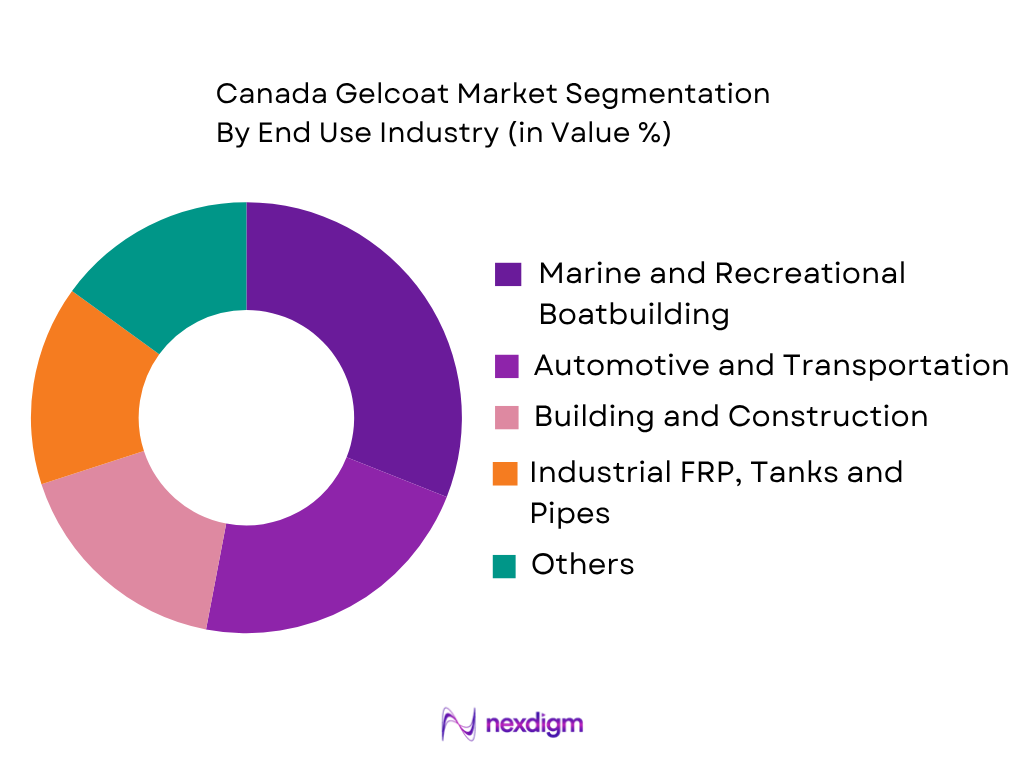
Canada Gelcoat Market is segmented into marine and recreational boatbuilding, automotive and transportation, building and construction, industrial FRP, sanitary and recreational products, and renewable-energy applications. Marine and recreational boatbuilding represents the dominant segment because gelcoat is integral to exposed fibreglass surfaces requiring gloss retention, moisture resistance, UV durability and resistance to blistering. Canada has established freshwater and coastal recreational boating activity together with commercial vessel fabrication and repair. Gelcoat suppliers operating in Canada maintain dedicated marine portfolios incorporating ISO-NPG gelcoats, polyester and vinyl ester barrier coats, repair gelcoats and tooling systems. Transportation forms another substantial application because Canadian suppliers offer gelcoats for truck components, trailers and other exterior moulded parts. Industrial applications require chemical-resistant gelcoats and vinyl ester systems for tanks, pipes, scrubbers and corrosion-resistant equipment, creating a smaller but technically demanding segment.
Competitive Landscape
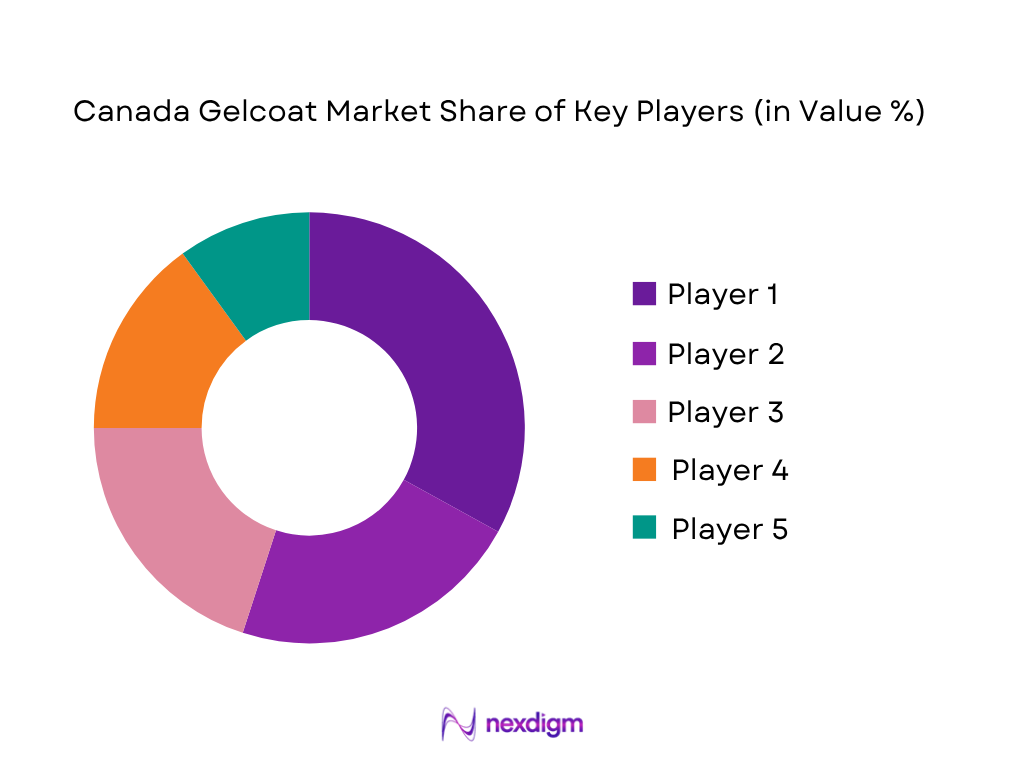
The Canada Gelcoat Market combines established domestic formulators with large North American composite-resin manufacturers. Polynt has a particularly significant Canadian manufacturing position through its Ontario and Quebec operations, while DITECH and Sogel provide domestic formulation, colour development and specialty products. Competition therefore extends beyond scale and increasingly depends on ISO-NPG performance, marine exposure, low-styrene technology, custom colour matching, barrier-coat capability and direct technical support for composite fabricators.
| Company | Establishment Year | Headquarters | Key Gelcoat Chemistry | Major Canadian Applications | Low-Emission Capability | Marine Exposure | Tooling/Specialty Capability |
| Polynt Composites | ~1950s heritage | Scanzorosciate, Italy; Canadian operations in Ontario and Quebec | ~ | ~ | ~ | ~ | ~ |
| DITECH Plastco | 1983 | Quebec, Canada | ~ | ~ | ~ | ~ | ~ |
| Sogel | 2000 | Longueuil, Quebec, Canada | ~ | ~ | ~ | ~ | ~ |
| Scott Bader | 1921 | Wollaston, UK | ~ | ~ | ~ | ~ | ~ |
| AOC | 1994 | Tennessee, USA | ~ | ~ | ~ | ~ | ~ |
Canada Gelcoat Market Analysis
Growth Drivers
Marine, Boatbuilding and Transportation Composite Demand
Canada’s gelcoat demand is structurally supported by marine manufacturing, recreational boatbuilding, transportation components and composite repair activities that require durable exterior surfaces. Canadian manufacturing data show CAD 303 million in seasonally adjusted ship and boat building sales in November 2024, while the same month recorded CAD 499 million in motor vehicle body and trailer manufacturing sales. In 2025, ship and boat building sales reached CAD 389 million in March and CAD 395 million in July, demonstrating continued activity in downstream sectors that use moulded fiberglass and composite structures. Transportation equipment manufacturing also generated CAD 55.1 billion in motor vehicle sales and CAD 33.7 billion in motor vehicle parts sales during 2024. These industries require surface systems capable of providing gloss retention, UV resistance, moisture protection and cosmetic consistency, supporting demand for marine-grade ISO-NPG and specialty polyester gelcoats. The macroeconomic environment provides additional support: Canada generated approximately USD 2,243.6 billion in GDP in 2024, while GDP per capita stood at USD 54,340.3, indicating a high-value industrial and recreational economy capable of sustaining specialized composite consumption. A domestic population of roughly 41.1 million also supports recreational boating, transportation and infrastructure demand. The relevance of gelcoat is particularly strong in Ontario, Quebec, British Columbia and Atlantic Canada, where marine fabrication, transportation production and composite repair activities intersect. As composite components replace heavier traditional materials in selected applications, Canadian gelcoat suppliers can benefit from recurring requirements for exterior appearance, water resistance, repair compatibility and moulded-surface durability.
Construction, Industrial FRP and Corrosion-Resistant Composite Applications
Construction and industrial infrastructure provide a second major demand engine for the Canada Gelcoat Market because gelcoats are used on fiberglass tanks, pipes, architectural components, balconies, enclosures, pools, sanitary products and corrosion-resistant industrial equipment. Canada recorded CAD 253.8 billion in total building-construction investment during 2024, including CAD 102.4 billion in residential construction on a constant-dollar basis. Construction activity remained substantial in 2025, when total building investment reached CAD 272.1 billion, including CAD 178.0 billion in residential construction, CAD 37.6 billion in commercial construction, CAD 23.1 billion in institutional construction and CAD 15.3 billion in industrial construction. These figures represent a broad installed base of buildings and facilities where FRP products are used for corrosion resistance, architectural finish, water handling and low-maintenance exterior systems. Industrial composite demand is also supported by chemical, mining, wastewater and process industries, where vinyl ester and chemically resistant gelcoats protect tanks, scrubbers, ducts and molded FRP structures. Canadian plastics and rubber manufacturing sales were approximately CAD 3.3 billion per month across several 2024 reporting periods, indicating a sizable downstream polymer-processing ecosystem. Canada’s 2024 GDP of approximately USD 2,243.6 billion and GDP per capita of USD 54,340.3 provide a macroeconomic base for continued capital-intensive construction and industrial activity. For gelcoat manufacturers, this demand profile favors product differentiation around chemical resistance, UV stability, fire performance, potable-water compatibility and cold-weather durability rather than dependence solely on general-purpose marine formulations.
Market Challenges
Styrene Exposure, VOC Control and Processing Compliance
Styrene management remains a material challenge for Canadian gelcoat suppliers because traditional unsaturated polyester gelcoats use styrene as a reactive diluent, creating worker-exposure, ventilation, storage and emissions-management requirements during spraying and open-mould processing. The challenge is commercially important because Canadian gelcoat users operate within a large chemical and polymer-processing base: monthly chemical manufacturing sales were approximately CAD 5.6 billion in several 2024 reporting periods, while plastics and rubber products manufacturing recorded roughly CAD 3.3 billion per month. Large-scale downstream manufacturing means emissions controls, occupational safety procedures and curing consistency must be maintained across many fabrication environments, from boatyards to transportation-component facilities. Low-styrene and styrene-free technologies can mitigate exposure, but reformulation must preserve spray characteristics, sag resistance, gel time, colour stability and adhesion to laminate systems. This creates technical barriers for smaller fabricators that rely on established conventional formulations and open-mould equipment. Canadian macroeconomic conditions add another layer of pressure: GDP growth was 1.6 percentage points in 2024 in annual growth terms, while inflation was 2.4 percentage points, meaning manufacturers were operating in a relatively moderate-growth environment while still managing labour, ventilation, compliance and equipment requirements. The country’s approximately 41.1 million population and large geographic footprint also increase the complexity of supplying technical products consistently across regions. As regulatory and customer expectations move toward lower emissions, suppliers must support reformulation, catalyst optimization, application training and process control without compromising the surface quality demanded in marine, transportation and architectural composites.
Cold-Climate Performance, Surface Defects and End-Use Qualification Requirements
Canadian climate conditions raise the technical performance threshold for gelcoat because exterior composite products must tolerate repeated temperature cycling, freeze-thaw exposure, moisture, UV radiation and seasonal storage conditions. This is especially important for boats, balconies, architectural FRP, tanks, transportation components and outdoor industrial equipment. Ship and boat building sales stood at CAD 303 million in November 2024 and reached CAD 389 million in March 2025, while motor vehicle body and trailer manufacturing sales reached CAD 662 million in March 2025. These sizeable downstream manufacturing activities expose gelcoat suppliers to applications where blistering, cracking, fibre print-through, colour variation or loss of gloss can generate expensive warranty and repair requirements. Building exposure is equally significant: Canada recorded CAD 253.8 billion in building-construction investment during 2024 and CAD 272.1 billion during 2025. In December 2025 alone, non-residential construction investment totaled approximately CAD 6.9 billion, including CAD 3.5 billion in commercial buildings, CAD 2.1 billion in institutional buildings and CAD 1.3 billion in industrial facilities. These applications increasingly require suppliers to prove weatherability, adhesion, chemical resistance and fire performance rather than supplying general-purpose cosmetic coatings. Canada’s GDP per capita of USD 54,340.3 in 2024 also implies end users have relatively high expectations for finish quality and product durability. Consequently, suppliers must maintain tight control over film thickness, catalyst ratios, pigment dispersion, curing behavior and substrate compatibility, raising technical-service requirements and making product qualification more demanding.
Market Opportunities
Expansion of ISO-NPG, Vinyl Ester and Specialty Marine Gelcoat Systems
A strong opportunity exists for higher-performance ISO-NPG, vinyl ester and specialty marine gelcoats as Canadian boatbuilders and repair facilities seek surfaces with improved hydrolysis resistance, UV durability, blister resistance and long-term gloss retention. The opportunity is supported by active marine manufacturing: ship and boat building sales were CAD 303 million in November 2024, CAD 389 million in March 2025, CAD 395 million in July 2025 and CAD 366 million in September 2025. This ongoing production creates recurring requirements for mould-applied gelcoats, barrier coats, repair materials and colour-matching systems. Canada’s marine demand is geographically diverse, spanning freshwater recreational markets in Ontario and Quebec and coastal applications in British Columbia and Atlantic Canada, making products with broad moisture and weather resistance particularly relevant. The country’s wider economic base strengthens the commercial potential: GDP reached approximately USD 2,243.6 billion in 2024, GDP per capita stood at USD 54,340.3, and the population was about 41.1 million. These indicators support continued demand for recreational assets, specialized vessels and higher-value manufactured products. Future gelcoat growth can therefore come from replacing basic orthophthalic systems with ISO-NPG grades, expanding vinyl ester barrier products for demanding hulls, supplying small-batch colour-matched repair gelcoats and developing lower-styrene marine formulations. Suppliers that combine formulation flexibility with field technical support can also address refit and refurbishment demand, extending the opportunity beyond original boat production into the installed fleet and marine-repair ecosystem.
Specialty Gelcoats for Construction, Industrial FRP and Transportation Applications
Canada provides a broader future opportunity for specialty gelcoats outside traditional marine applications, particularly in architectural FRP, industrial corrosion equipment, water infrastructure, transportation components and exterior composite products. Building-construction investment reached CAD 253.8 billion in 2024 and increased to CAD 272.1 billion in 2025. Within the 2025 total, residential construction accounted for CAD 178.0 billion, commercial construction CAD 37.6 billion, institutional construction CAD 23.1 billion and industrial construction CAD 15.3 billion. This scale provides a substantial downstream base for composite balconies, facade elements, sanitary products, tanks, enclosures, pools and corrosion-resistant structures requiring UV-stable or chemically resistant surfaces. Transportation applications create another potential growth path. Motor vehicle body and trailer manufacturing sales reached CAD 662 million in March 2025, while the broader transportation equipment sector recorded approximately CAD 12.0 billion in monthly manufacturing sales during the same period. These applications can support higher-value Class-A gelcoats, colour-matched exterior systems, tooling gelcoats and fire-performance formulations. Canada’s approximately USD 2,243.6 billion economy and USD 54,340.3 GDP per capita in 2024 provide a strong macroeconomic foundation for advanced material adoption. Future suppliers can therefore target application-specific products rather than relying on commodity gelcoat, including cold-climate weathering systems, fire-retardant grades, potable-water-compatible surfaces, chemically resistant vinyl ester products, custom pigmentation and low-styrene formulations for automated or controlled spray processing.
Future Outlook
The Canada Gelcoat Market is expected to expand at approximately ~XX.X% CAGR during 2026–2035, supported by demand for durable composite surfaces across marine, transportation, construction and industrial applications. Product development will increasingly emphasize lower styrene emissions, higher UV stability, chemical resistance and improved hydrolysis performance. Canadian formulators are positioned to benefit from demand for customized colour and specialty formulations, while imported North American and European technologies will continue competing in premium applications.
Major Players
- Polynt Composites
- DITECH Plastco Inc.
- Sogel Inc.
- Scott Bader
- AOC
- Interplastic Corporation
- HK Research
- BÜFA Composite Systems
- INEOS Composites
- Composites One
- Composites Canada
- N-B Fiberglass
- Distribution Composites
- Revchem Composites
- Allzone Trading
Key Target Audience
- Gelcoat and Unsaturated Polyester Resin Manufacturers
- Marine and Recreational Boat Manufacturers
- FRP Tank, Pipe and Industrial Composite Manufacturers
- Automotive, Transportation and Specialty Vehicle Component Manufacturers
- Composite Raw Material Distributors and Specialty Chemical Suppliers
- Investments and Venture Capitalist Firms
- Government and Regulatory Bodies (Innovation, Science and Economic Development Canada; Environment and Climate Change Canada; Health Canada; Transport Canada; Canadian Centre for Occupational Health and Safety)
- Building, Infrastructure and Architectural Composite Product Manufacturers
Research Methodology
Step 1: Identification of Key Variables
The initial phase involves constructing a complete ecosystem map for the Canada Gelcoat Market, covering resin producers, gelcoat formulators, distributors, composite fabricators, boatbuilders and industrial end users. Secondary research is used to identify variables including gelcoat consumption, domestic formulation capacity, resin chemistry, imports, end-use exposure and regional manufacturing concentration.
Step 2: Market Analysis and Construction
Historical Canadian gelcoat demand is analyzed using domestic production indicators, composite-material supply, manufacturing activity, international trade and downstream industry performance. A bottom-up framework evaluates consumption across marine, transportation, construction, industrial FRP and sanitary applications. This is reconciled with supplier-level information to establish the overall market structure.
Step 3: Hypothesis Validation and Expert Consultation
Market hypotheses are validated through computer-assisted telephone interviews with gelcoat manufacturers, composite distributors, FRP fabricators, marine manufacturers and technical specialists. These discussions examine product chemistry, application volumes, purchasing patterns, supplier relationships, formulation requirements and changes in low-styrene and specialty gelcoat adoption.
Step 4: Research Synthesis and Final Output
Primary findings are triangulated with manufacturer information, government manufacturing statistics, trade indicators and downstream demand variables. Supplier-level estimates are reconciled against application-level consumption using both top-down and bottom-up approaches. The final analysis establishes market segmentation, competitive positioning, demand drivers, risks and the long-term outlook for the Canada Gelcoat Market.

- Executive Summary
- Research Methodology (Market Definition and Scope, Canada Gelcoat Market Classification, Orthophthalic-Isophthalic-ISO-NPG-Vinyl Ester Gelcoat Demand Assessment, Gelcoat Consumption Mapping, Domestic Gelcoat Formulation Capacity Assessment, Import Dependency Analysis, Styrene and Polyester Feedstock Assessment, Pigment and Additive Supply Mapping, Marine Composite Demand Assessment, Industrial FRP Fabricator Mapping, Application-Level Demand Assessment, Primary Industry Interviews, Top-Down Market Sizing, Bottom-Up Company Revenue and Volume Assessment, Trade Flow Analysis, Data Triangulation, Pricing Assessment, Forecasting Framework)

- Definition and Scope
- Canada Gelcoat Value Chain Analysis
- Canada Gelcoat Supply Chain Analysis
- Ontario-Quebec Gelcoat Manufacturing and Distribution Cluster Assessment
- British Columbia and Atlantic Canada Marine Gelcoat Demand Ecosystem Assessment
- Domestic Gelcoat Manufacturing Versus Imported Specialty Product Supply Structure

- Growth Drivers (Large Recreational Boatbuilding and Marine Repair Base, Expansion of Shipbuilding and Industrial Marine Activity, Transportation Composite Applications, Demand for Corrosion-Resistant FRP Equipment, Building and Balcony Composite Applications, Domestic Gelcoat Formulation Capability, Growth of UV-Resistant Exterior Composite Surfaces, Wind Blade Repair Requirements, Demand for Low-Maintenance Composite Products)
- Market Challenges (Styrene Exposure and VOC Management, Specialty Feedstock Import Dependency, Petrochemical Feedstock Volatility, Gelcoat Blistering and Osmosis Risk, Freeze-Thaw and Cold-Climate Weathering Requirements, Colour-Matching Complexity, Skilled Spray Applicator Requirements, Fire Performance Compliance, Imported Premium Gelcoat Competition, Alternative Coating System Substitution)
- Market Opportunities (ISO-NPG Marine Gelcoat Expansion, Vinyl Ester Chemical-Resistant Gelcoats, Fire-Retardant Gelcoat Development, Low-Styrene and Styrene-Free Technology, Cold-Climate UV-Weathering Formulations, Wind Turbine Repair Coatings, Transportation Class-A Surface Applications, Custom Colour Matching, Domestic Specialty Formulation, Marine Repair and Re-Gelcoating, Potable Water and Infrastructure Applications)
Market Trends (ISO-NPG Adoption, Low-Styrene Formulations, Improved Hydrolysis Resistance, High UV-Stability Systems, Fire-Retardant Surface Technologies, Custom Pigmentation, Barrier Coat Integration, High-Gloss Marine Finishes, Vinyl Ester Corrosion Barriers, Automated Spray Application, Sustainable Composite Surface Systems) - Regulatory and Standards Landscape (Health Canada Chemical Product Requirements, Environment and Climate Change Canada VOC and Chemical Management Requirements, WHMIS and Safety Data Sheet Compliance, Transport Canada Marine Requirements, Canadian Construction and Fire Performance Requirements, Potable Water Contact Requirements, Occupational Styrene Exposure Management, Provincial Environmental Regulations)
- SWOT Analysis
- Porter’s Five Forces Analysis
- PESTLE Analysis

- By Market Value (2020-2025)
- By Gelcoat Consumption Volume (2020-2025)
- By Domestic Gelcoat Production Volume (2020-2025)
- By Domestic Gelcoat Production Value (2020-2025)
- By Gelcoat Import Value (2020-2025)
- By Gelcoat Import Volume (2020-2025)

- By Resin Chemistry (In Value %)
Orthophthalic Polyester Gelcoat
Isophthalic Polyester Gelcoat
ISO-NPG Gelcoat
Vinyl Ester Gelcoat
Acrylic-Modified Gelcoat
Epoxy-Compatible Surface Coat
Low-Styrene Gelcoat
Styrene-Free Gelcoat
Specialty Hybrid Gelcoat - By Product Function (In Value %)
General Purpose Gelcoat
Marine Grade Gelcoat
Tooling Gelcoat
Fire-Retardant Gelcoat
Chemical-Resistant Gelcoat
UV- and Weather-Resistant Gelcoat
Potable Water Application Gelcoat - By Application Method (In Value %)
Hand Lay-Up Gelcoat
Brush-Applied Gelcoat
Roller-Applied Gelcoat
Conventional Spray Gelcoat
Air-Assisted Spray Gelcoat
Airless Spray Gelcoat
Automated Spray Gelcoat
Mould-Applied Gelcoat
Repair and Refinish Gelcoat - By End-Use Application (In Value %)
Recreational Boats and Yachts
Fishing Boats and Workboats
Truck and Trailer Components
Automotive Composite Components
GRP Water Tanks
Chemical Storage Tanks
FRP Pipes and Fittings
Architectural and Building Components
Balconies and Exterior Composite Surfaces
Swimming Pools and Water Features - By End-Use Industry (In Value %)
Marine and Recreational Boatbuilding
Commercial Marine and Vessel Repair
Automotive and Transportation
Building and Construction
Water and Wastewater Infrastructure
Chemical and Petrochemical
Industrial Manufacturing
Oil and Gas
Mining and Mineral Processing
Renewable Energy
Pools and Recreational Infrastructure
Sanitary and Consumer Composite Products - By Performance Grade (In Value %)
General Purpose Grade
Marine and Hydrolysis-Resistant Grade
High UV-Resistance Grade
Chemical-Resistant Grade
Fire-Retardant Grade
Low-Styrene Grade
Styrene-Free Grade
High-Gloss Cosmetic Grade
Tooling and High-Hardness Grade
Osmosis-Resistant Grade
Cold-Climate Weathering Grade

- Market Share of Major Players (By Canada Revenue, Gelcoat Sales Volume, Resin Chemistry, Marine Exposure, Transportation Exposure, Industrial FRP Exposure, Manufacturing Footprint, Distribution Coverage)
- Cross Comparison Parameters (Canada Gelcoat Revenue, Domestic Gelcoat Formulation and Manufacturing Capability, Orthophthalic-Isophthalic-ISO-NPG-Vinyl Ester Portfolio Breadth, Marine-Transportation-Construction-Industrial FRP Application Coverage, Low-Styrene and Styrene-Free Formulation Capability, Custom Pigmentation and Colour-Matching Capability, Canada Manufacturing and Distribution Footprint, Application Laboratory and Composite Technical-Service Capability)
- SWOT Analysis of Major Players
- Detailed Profiles of Major Companies
Polynt Composites – Polyester and Vinyl Ester Resins, Marine and Industrial Gelcoats, Barrier Coats, Tooling Systems and Canadian Blending Operations
DITECH Plastco Inc. – Canadian Gelcoat and Coloured Resin Manufacturing, UV- and Chemical-Resistant Gelcoats, Marine, Pool, Transportation and Potable Water Applications
GELCO – Canadian Gelcoat, Barrier Coat and Resin Formulation, General Purpose, ISO-NPG, Fire-Retardant and Customized Surface Systems
Sogel Inc. – Canadian High-Technology Gelcoat and Unsaturated Resin Formulation, Styrene-Free Surface Technologies, Specialty and Custom Gelcoat Development
Scott Bader Canada – Crystic Gelcoats, Polyester and Vinyl Ester Resins, Marine, Building, Transportation and Renewable Energy Composite Systems
Composites Canada – Gelcoat, Resin, Tooling Coating and Composite Material Distribution Across Marine, Automotive, Industrial, Transportation and Wind Energy Applications
N-B Fiberglass – Orthophthalic, Isophthalic, ISO-NPG, Vinyl Ester, Fire-Resistant, UV-Resistant and Specialty Gelcoat Supply
Distribution Composites – Gelcoat, Polyester and Vinyl Ester Resin, Fiberglass Reinforcement and Composite Application Materials for Marine and Industrial Customers
Interplastic Corporation – COR-Grip and Gelcoat Technologies, Polyester and Vinyl Ester Composite Systems, Marine, Transportation and Industrial Applications
HK Research – Marine, Transportation, Cultured Marble, Tooling and Specialty Gelcoat Technologies, High-Performance Surface Finish Systems
AOC – VIBRIN Gelcoat and Composite Resin Technologies, ISO-NPG, Vinyl Ester, Marine, Industrial and Corrosion-Resistant Applications
BÜFA Composite Systems – Gelcoats, Topcoats, Pigment Pastes, Fire-Retardant Systems, Tooling Materials and Marine-Industrial Surface Technologies
INEOS Composites – Unsaturated Polyester and Vinyl Ester Resin Technologies, Corrosion-Resistant Composite Systems and Industrial Applications
Revchem Composites – Gelcoats, Pigments, Tooling Coatings, Marine Composite Materials and North American Technical Distribution
Allzone Trading – Polyester Gelcoat, Composite Tooling and Canadian Industrial Gelcoat Supply Across Ontario, Quebec and Western Canada

- Boatbuilder Gelcoat Procurement Assessment
- Marine Repair Yard Requirement Analysis
- Transportation Composite Manufacturer Assessment
- FRP Tank and Pipe Manufacturer Assessment
- Architectural FRP Fabricator Assessment
- Composite Mould Maker Assessment

- By Market Value (2026-2035)
- By Gelcoat Consumption Volume (2026-2035)
- By Domestic Gelcoat Production Volume (2026-2035)
- By Domestic Gelcoat Production Value (2026-2035)
- By Gelcoat Import Value (2026-2035)
- By Gelcoat Import Volume (2026-2035)


 Request a Sample
 Ask for Customization
 Get a Quote
 Enquire Now