

 Download PDF
Market Overview
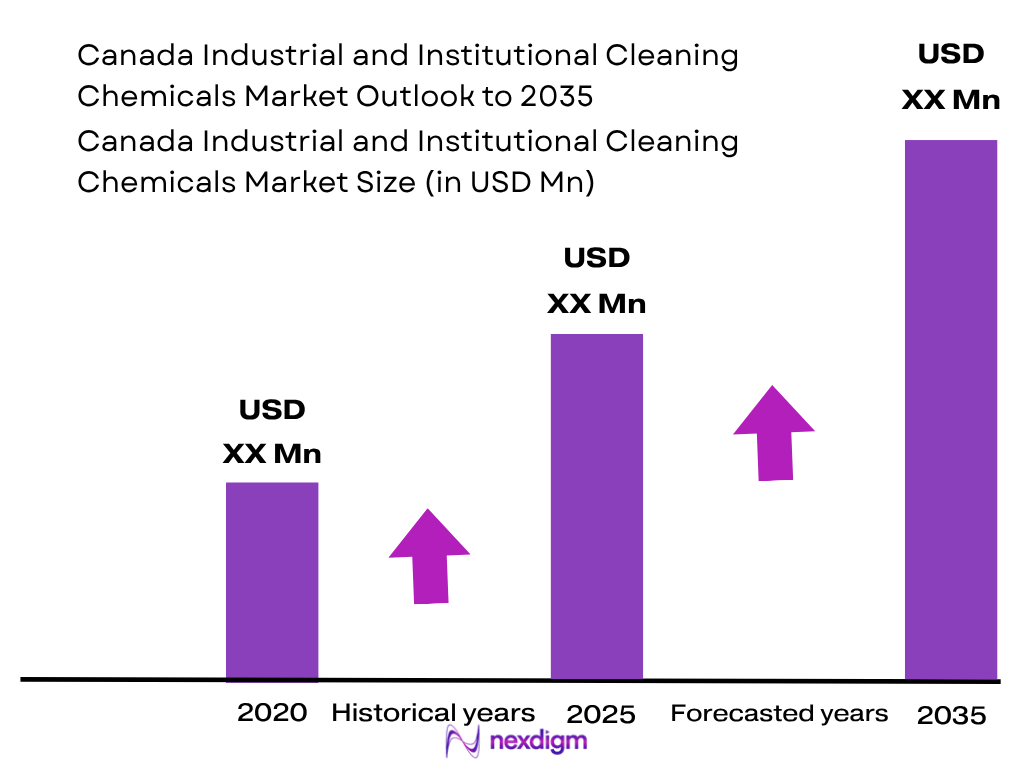
The Canada Industrial and Institutional Cleaning Chemicals Market is valued at approximately USD ~ billion, supported by recurring cleaning, sanitation and maintenance requirements across manufacturing facilities, hospitals, long-term care facilities, food-processing plants, hotels and commercial establishments. Canada recorded manufacturing revenue from goods of CAD 884.8 billion in the preceding annual period and CAD 874.6 billion in the latest annual period, while food manufacturing alone generated CAD 160.7 billion, creating substantial recurring requirements for sanitation and process-cleaning chemistry.
Toronto, Montréal and Vancouver represent the principal demand centres for professional cleaning chemicals because they combine large commercial populations with major manufacturing, healthcare, foodservice and hospitality infrastructure. Their metropolitan populations stand at 7,106,379, 4,615,154 and 3,108,941, respectively. Manufacturing sales in Toronto and Montréal reached approximately CAD 11.6 billion and CAD 9.2 billion in the latest December observation, reinforcing their importance for industrial degreasers, sanitizers, institutional detergents and specialty maintenance chemicals.
Market Segmentation
By Product Type
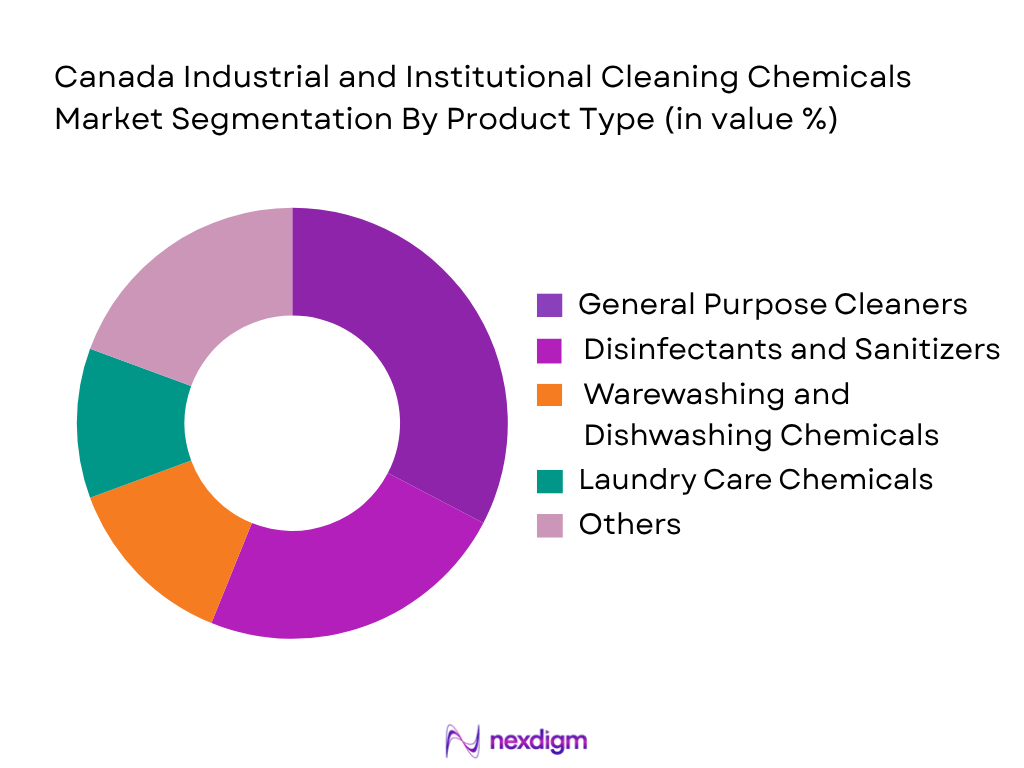
The Canada Industrial and Institutional Cleaning Chemicals Market is segmented by product type into general-purpose cleaners, disinfectants and sanitizers, warewashing and dishwashing chemicals, laundry care chemicals, industrial degreasers and specialty cleaning chemicals. General-purpose cleaners dominate the product-type segment because they are used across a broader installed base than highly application-specific products. Hospitals, offices, schools, hotels, retail facilities, warehouses and factories require regular hard-surface and floor cleaning, creating repeat consumption. Their compatibility with controlled-dilution systems also allows large facilities to standardize cleaning operations across multiple sites. Disinfectants and sanitizers remain particularly important within healthcare, long-term care and food processing because Canadian regulations distinguish antimicrobial products requiring demonstrated efficacy. Foodservice activity further supports demand: Canadian food services and drinking places generated CAD 99.6 billion in operating revenue, while accommodation services generated CAD 35.9 billion, creating large institutional environments requiring continuous kitchen, floor, washroom and surface sanitation.
By Raw Material Type
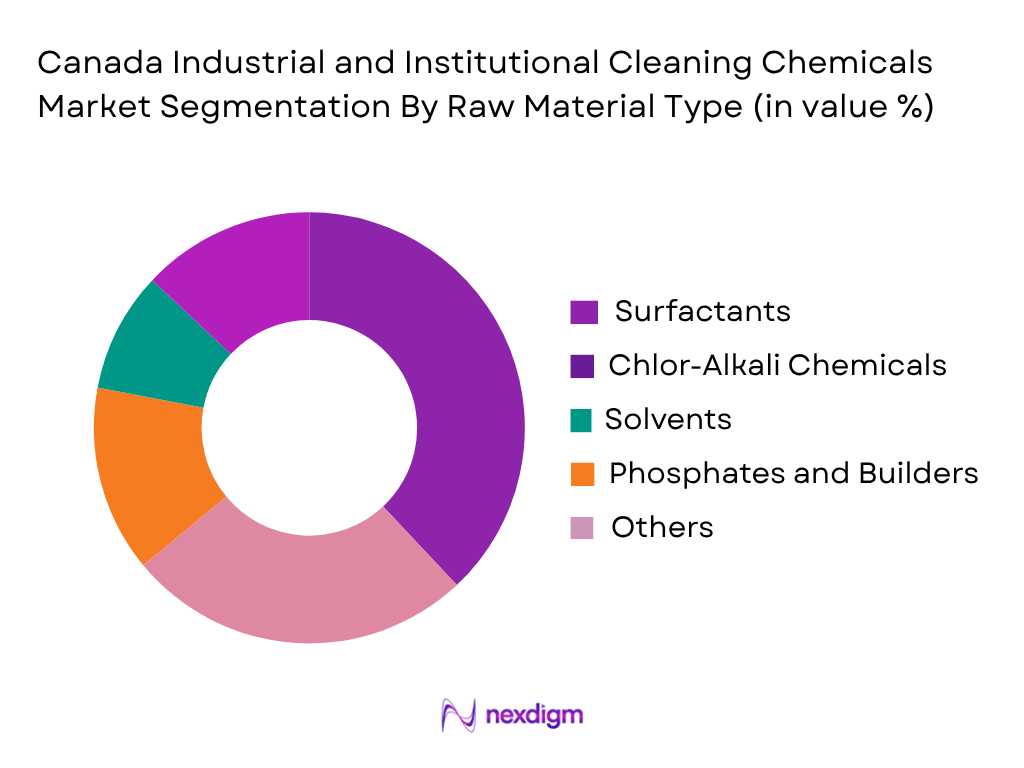
The Canada Industrial and Institutional Cleaning Chemicals Market is segmented by raw material into chlor-alkali chemicals, surfactants, solvents, phosphates, acids and biocides. Chlor-alkali chemicals represent the dominant raw-material category, reflecting extensive use of alkaline and chlorine-based chemistry in industrial degreasing, institutional sanitation, food-processing cleaning and bleaching applications. Caustic and alkaline systems are particularly relevant in processing environments where fats, proteins, oils and carbonized residues must be removed from equipment and production surfaces. Surfactants form another major category because wetting, detergency, emulsification and soil suspension are required across virtually all cleaning applications. Solvents retain importance in industrial facilities for oils, greases and difficult soils, while biocides are essential where microbial control is the principal performance requirement. Canada’s extensive manufacturing infrastructure reinforces consumption: total manufacturing revenue reached CAD 931.2 billion, including CAD 160.7 billion from food manufacturing, a particularly sanitation-intensive subsector.
Competitive Landscape
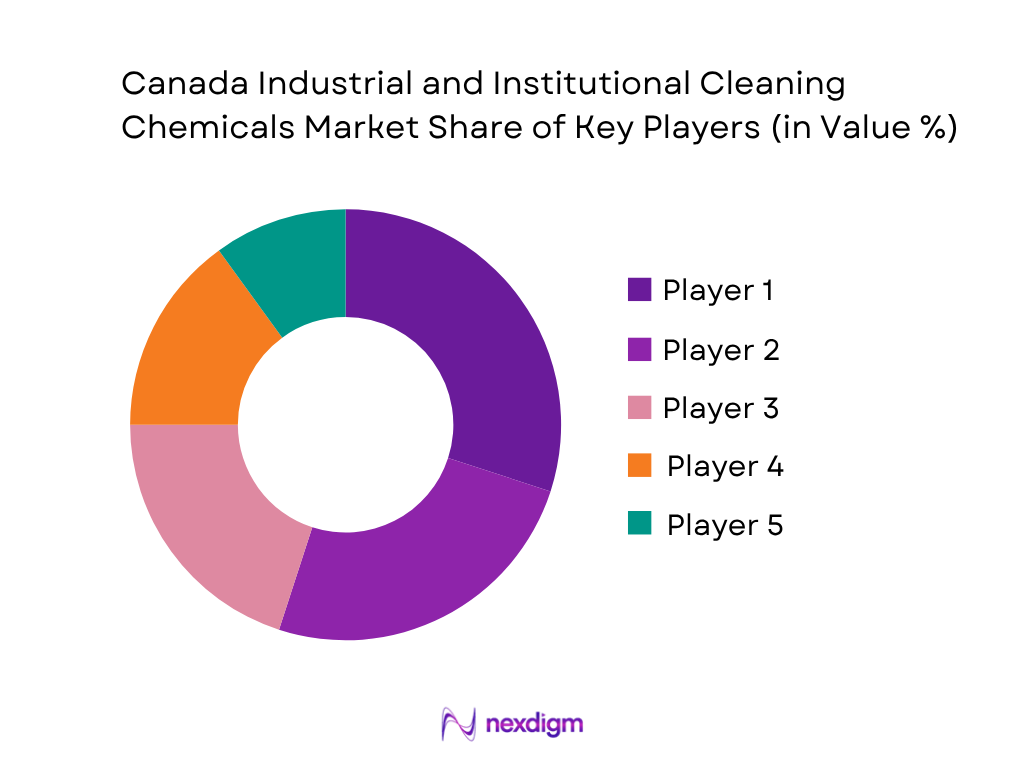
The Canada Industrial and Institutional Cleaning Chemicals Market features a combination of multinational professional-hygiene companies and established Canadian manufacturers. Ecolab and Diversey/Solenis compete strongly through integrated chemicals, dispensing equipment and technical-service models, while domestic participants such as Avmor, Dustbane and Sani Marc compete through Canadian formulation capabilities, janitorial-sanitation distribution relationships and localized customer support. Competitive differentiation increasingly depends on efficacy, sustainability credentials, dilution control, regulatory compliance and total cleaning-program performance rather than chemical supply alone.
| Major Player | Establishment Year | Headquarters | Professional Cleaning Portfolio | Core End-Use Coverage | Canada Market Footprint | Dosing / Dispensing Capability | Sustainable Cleaning Capability | Technical Service Strength |
| Ecolab | 1923 | St. Paul, USA | ~ | ~ | ~ | ~ | ~ | ~ |
| Diversey / Solenis | 1923 / 1907 | USA | ~ | ~ | ~ | ~ | ~ | ~ |
| Avmor | 1948 | Laval, Quebec | ~ | ~ | ~ | ~ | ~ | ~ |
| Dustbane Products | 1908 | Ottawa, Ontario | ~ | ~ | ~ | ~ | ~ | ~ |
| Sani Marc | 1969 | Victoriaville, Quebec | ~ | ~ | ~ | ~ | ~ |
Canada Industrial and Institutional Cleaning Chemicals Market Analysis
Growth Drivers
Manufacturing Sector Expansion
Canada’s extensive manufacturing infrastructure creates recurring demand for industrial degreasers, alkaline cleaners, acid descalers, food-contact sanitizers, machinery cleaners, floor-care chemicals and clean-in-place formulations. Total manufacturing-sector revenue reached CAD 931.2 billion in 2024, while revenue from manufactured goods stood at CAD 874.6 billion. Food manufacturing generated CAD 160.7 billion, making it a particularly important demand centre because production facilities require continuous removal of proteins, fats, oils, scale and microbial residues from equipment and processing surfaces. Transportation equipment manufacturing generated another CAD 143.7 billion, supporting requirements for metal cleaners, solvent-based formulations, degreasers and maintenance chemicals. Canada’s nominal GDP reached CAD 3,108.55 billion in 2024, while GDP was equivalent to approximately USD 2.24 trillion, demonstrating the scale of economic activity supporting professional chemical consumption. This combination of large industrial output and food-processing activity provides cleaning-chemical suppliers with an extensive installed customer base requiring repeat sanitation, maintenance, equipment-cleaning and production-hygiene programs.
Institutional, Foodservice and Accommodation Expansion
Canada’s institutional economy creates substantial repeat demand for disinfectants, multi-surface cleaners, commercial kitchen chemicals, laundry formulations, warewashing products, floor-care chemicals and restroom sanitation systems. Food services and drinking places generated CAD 99.6 billion in operating revenue in 2024, including CAD 44.9 billion from limited-service eating places, CAD 44.2 billion from full-service restaurants and CAD 7.8 billion from special food services, including caterers and foodservice contractors. Accommodation services generated another CAD 35.9 billion, of which hotels, motor hotels and motels accounted for CAD 30.0 billion. Commercial real-estate activity further broadens the addressable cleaning base, with non-residential leasing generating CAD 76.5 billion and combined rental, leasing and property-management industries generating CAD 150.2 billion. These facilities require frequent cleaning of kitchens, guest rooms, dining areas, offices, washrooms and common spaces, resulting in recurring chemical consumption. Canada’s CAD 3,108.55 billion nominal GDP further supports these service-intensive institutional environments and their professional hygiene requirements.
Market Challenges
Imported Input Exposure and Regulatory Transition Increase Formulation and Compliance Complexity
Canadian industrial and institutional cleaning-chemical suppliers operate within a large import-dependent economy while simultaneously adapting antimicrobial portfolios to a revised regulatory framework. Canada recorded CAD 624.021 billion in real imports of goods in 2024, compared with CAD 572.505 billion in real exports of goods, demonstrating the substantial scale of foreign products and production inputs flowing through Canadian supply chains. Professional cleaning formulators depend on internationally traded surfactants, biocides, specialty solvents, chelating agents and functional additives, meaning supply interruptions can affect formulation continuity and product availability. Regulatory complexity also increased with the introduction of Canada’s Biocides Regulations, which came into force on May 31, 2025. Approximately 65 pest-control products were identified as directly affected by the transition, while surface disinfectants and sanitizers increasingly move into a unified authorization framework. This is particularly relevant for healthcare, foodservice and institutional suppliers because efficacy claims, authorization, labelling and documentation determine commercial eligibility. Canada’s CAD 3,108.55 billion nominal GDP supports large regulated end-user industries, increasing the importance of supply-chain resilience and regulatory readiness.
Canada’s Geographic Scale Creates Distribution, Inventory and Technical-Service Challenges
Industrial and institutional cleaning chemicals require regular replenishment, controlled storage, dispensing support and technical servicing, making Canada’s interprovincial logistics structure an important operating challenge. Interprovincial trade in manufactured goods reached CAD 167.4 billion in 2024, while interprovincial wholesale trade reached CAD 562.5 billion, demonstrating the extensive movement of products required to connect manufacturers, warehouses, distributors and regional customers. The Ontario–Quebec corridor alone handled CAD 55.3 billion in two-way manufactured-goods trade, while Ontario–Alberta trade reached CAD 15.3 billion. Food manufacturing represented CAD 12.0 billion of Ontario–Quebec flows, while chemical manufacturing accounted for CAD 1.9 billion in Ontario–Alberta trade. Cleaning-chemical suppliers serving hospitals, food plants, hotels, mines, commercial buildings and factories across distant provinces therefore require regional inventories and distributor coverage. Canada also imported CAD 624.021 billion in real goods, adding port-to-inland logistics requirements for imported chemistry. These conditions increase the importance of inventory planning, distributor partnerships, supply continuity and nationwide technical-service capabilities.
Market Opportunities
Professional Foodservice and Hospitality Hygiene Systems Offer Significant Expansion Potential
Canada’s existing foodservice and accommodation infrastructure provides a strong platform for greater adoption of concentrated cleaning chemicals, automated dilution systems, commercial warewashing products and standardized kitchen sanitation programs. Food services and drinking places generated CAD 99.6 billion in operating revenue in 2024. Limited-service eating establishments generated CAD 44.9 billion, full-service restaurants generated CAD 44.2 billion, and special food services generated CAD 7.8 billion. Accommodation services contributed another CAD 35.9 billion, including CAD 30.0 billion from hotels, motor hotels and motels. These are operationally intensive facilities where cleaning occurs continuously across food-contact surfaces, kitchens, dining spaces, washrooms, guest rooms and laundry operations. The commercial-property ecosystem expands the opportunity further, with non-residential leasing generating CAD 76.5 billion in operating revenue. Suppliers can target this installed facility base with concentrated detergents, closed-loop dispensing systems, rinse aids, kitchen degreasers, laundry formulations and environmentally preferable products. Canada’s CAD 3,108.55 billion nominal GDP provides a substantial economic foundation for continued adoption of integrated professional hygiene programs.
Healthcare and Long-Term Care Facilities Create Scope for Advanced Disinfection and Controlled-Dosing Solutions
Canada’s healthcare and residential-care infrastructure creates an important opportunity for suppliers of hospital-grade disinfectants, hard-surface sanitizers, washroom chemicals, floor-care formulations and controlled-dilution systems. National health expenditure reached approximately CAD 372 billion in 2024, equivalent to CAD 9,054 per Canadian, demonstrating the scale of healthcare activity requiring continuous environmental hygiene. Private nursing and residential care facilities generated CAD 20.6 billion in operating revenue in 2024, while operating expenses reached CAD 18.1 billion and salaries, wages, commissions and employee benefits totaled CAD 10.2 billion. These facilities operate continuously and require repeated cleaning of resident rooms, treatment environments, washrooms, dining facilities and high-touch surfaces. Canada’s Biocides Regulations came into force on May 31, 2025, increasing the importance of appropriately authorized disinfectants and sanitizers. The opportunity therefore extends beyond commodity chemicals toward validated antimicrobial formulations, automated dispensing equipment, concentrated products, staff training and standardized cleaning protocols that can improve consistency across hospitals, long-term care facilities and healthcare networks.
Future Outlook
The Canada Industrial and Institutional Cleaning Chemicals Market is forecast to expand at approximately ~5.0% CAGR during 2026-2035. Future expansion will be driven by persistent healthcare infection-control requirements, food-safety sanitation, professionalization of facility management and adoption of concentrated cleaning products. Suppliers are expected to place greater emphasis on automated dispensing, environmentally preferable formulations and measurable cost-in-use performance. Demand should increasingly favour integrated chemical-and-service solutions rather than standalone commodity cleaners.
Food processing will remain a critical source of demand because Canadian food manufacturing generated CAD 160.7 billion in manufactured goods, representing the country’s largest manufacturing subsector. The industry requires detergents, foaming cleaners, caustic formulations, acids and sanitizers for production lines, vessels, conveyors and food-contact surfaces. Growing focus on standardized sanitation programs should support suppliers capable of combining chemical formulations with dispensing equipment, documentation and technical audits.
Major Players
- Ecolab Canada
- Diversey / Solenis Canada
- Avmor
- Swish Maintenance
- Charlotte Products
- Dustbane Products
- Sani Marc
- Zep Canada
- Spartan Chemical Company
- Betco Corporation
- SC Johnson Professional Canada
- 3M Canada
- Reckitt Pro Solutions CanadaM2 Professional Cleaning Products
- Wood Wyant
Key Target Audience
- Industrial and Institutional Cleaning Chemical Manufacturer
- Janitorial-Sanitation Product Distributors and Importers
- Specialty Chemical and Cleaning Ingredient Manufacturers
- Facility Management and Contract Cleaning Companies
- Healthcare, Food Processing, Hospitality and Industrial Procurement Organizations
- Investments and Venture Capitalist Firms
- Banks, Private Equity Firms and Institutional Investors
- Government and Regulatory Bodies (Health Canada, Environment and Climate Change Canada, Canadian Centre for Occupational Health and Safety, Public Services and Procurement Canada, Competition Bureau Canada)
Research Methodology
Step 1: Identification of Key Variables
The initial phase involves developing an ecosystem map of the Canada Industrial and Institutional Cleaning Chemicals Market covering manufacturers, formulators, ingredient suppliers, janitorial-sanitation distributors, facility-management companies and institutional buyers. Secondary research identifies the core variables governing demand, including facility concentration, cleaning frequency, product penetration, sanitation requirements, domestic manufacturing, import dependence, raw-material availability and regulatory authorization.
Step 2: Market Analysis and Construction
Historical market information is compiled and assessed using top-down and bottom-up approaches. Demand is mapped across healthcare, food processing, manufacturing, hospitality, education, commercial real estate and public facilities. Supply-side analysis evaluates domestic production, imports, manufacturer revenues, distribution networks and product availability. The resulting information is reconciled to construct market-level and segment-level estimates.
Step 3: Hypothesis Validation and Expert Consultation
Market hypotheses are validated through computer-assisted telephone interviews and structured discussions with manufacturers, jan-san distributors, facility-management organizations, procurement professionals and cleaning-operations specialists. Primary discussions examine product consumption patterns, concentrate penetration, purchasing behaviour, supplier-selection criteria, regulatory requirements and technological adoption. Findings are compared against secondary evidence and adjusted where discrepancies emerge.
Step 4: Research Synthesis and Final Output
The final stage integrates demand-side consumption analysis with manufacturer, distributor, regulatory and trade information. Product and raw-material segmentation is cross-validated against end-use industries and provincial demand centres. Competitive positioning, future growth assumptions and market opportunities are subsequently assessed to produce a comprehensive view of the Canada Industrial and Institutional Cleaning Chemicals Market.

- Executive Summary
- Research Methodology (Market Definition and Scope, Canada Industrial and Institutional Cleaning Chemicals Taxonomy, Industrial Cleaning Chemical Classification, Institutional Cleaning Chemical Classification, Professional Hygiene Solution Mapping, Cleaning Chemical Application Framework, Raw Material Assessment, Sustainable Cleaning Chemistry Evaluation, Market Sizing Framework, Top-Down Analysis, Bottom-Up Analysis, Domestic Manufacturing Assessment, Import Dependency Assessment, Demand-Side Assessment, Supply-Side Assessment, Industrial Consumption Mapping, Institutional Usage Assessment, Primary Industry Interviews, Manufacturer Validation, Distributor Network Assessment, Trade Flow Analysis, Data Triangulation, Forecasting Framework, Scenario Analysis, Assumptions and Limitations)

- Definition and Scope
- Canada Industrial and Institutional Cleaning Chemicals Industry Evolution and Professional Hygiene Development
- Industrial and Institutional Cleaning Chemicals Manufacturing and Formulation Process
- Cleaning Chemicals Value Chain Analysis
- Canada Industrial and Institutional Cleaning Chemicals Supply Chain Analysis
- Cleaning Chemical Raw Material Ecosystem Analysis
- Canada Cleaning Chemicals Import Dependency and Localization Assessment
- Industrial Cleaning Application Architecture and Institutional Hygiene Solution Framework

- Growth Drivers (Expansion of Food and Beverage Processing Industry, Increasing Hygiene Standards in Healthcare and Long-Term Care Facilities, Growth of Manufacturing and Industrial Activity, Rising Demand for Professional Facility Management Services, Increasing Adoption of Sustainable Cleaning Solutions, Growth of Commercial Infrastructure, Workplace Hygiene Requirements, Demand for Concentrated Cleaning Formulations)
- Market Challenges (Raw Material Price Volatility, Dependence on Imported Specialty Chemicals, Complex Regulatory Compliance Requirements, High Cost of Advanced Cleaning Formulations, Interprovincial Distribution Costs, Labour Availability in Commercial Cleaning, Competition from Private-Label and Regional Manufacturers, Technical Service Requirements)
- Market Opportunities (Bio-Based Cleaning Chemicals, ECOLOGO-Certified Cleaning Solutions, Automated Chemical Dispensing Systems, Digital Hygiene Monitoring Platforms, Customized Food Processing Sanitation Programs, Healthcare Infection Prevention Solutions, Enzyme-Based Cleaning Technologies, Expansion of Concentrated and Closed-Loop Cleaning Systems)
- Market Trends (Low-VOC Cleaning Chemicals, Concentrated Product Adoption, Eco-Friendly Formulations, Automated Dosing Systems, Water-Efficient Cleaning Technologies, Hydrogen Peroxide-Based Cleaning Solutions, Sustainable Packaging, Advanced Hygiene Monitoring Systems)
Regulatory and Standards Landscape (Health Canada Biocides Regulations, Biocide Market Authorization Requirements, Workplace Hazardous Materials Information System Requirements, Hazardous Products Regulations, Safety Data Sheet Requirements, Provincial Occupational Health and Safety Regulations, Environmental Protection Requirements, ECOLOGO Environmental Certification Standards) - SWOT Analysis
- Porter’s Five Forces Analysis
- PESTLE Analysis
- Stakeholder Ecosystem
- Competition Ecosystem

- By Market Value (2020-2025)
- By Cleaning Chemical Consumption Volume (2020-2025)
- By Domestic Production Volume (2020-2025)
- By Import Volume (2020-2025)
- By Export Volume (2020-2025)
- By Average Selling Price (2020-2025)
- By Industrial Facility Chemical Consumption Intensity (2020-2025)
By Institutional Facility Chemical Consumption Intensity (2020-2025)

- By Product Type (In Value %)
General Purpose Cleaners
Disinfectants and Sanitizers
Industrial Degreasers and Heavy-Duty Cleaners
Warewashing and Dishwashing Chemicals
Laundry Care Chemicals
Floor Care Chemicals
Vehicle Wash Chemicals
Food Processing Cleaning Chemicals
Healthcare Cleaning Chemicals
Specialty Industrial Cleaning Chemicals
Surface and Glass Cleaning Chemicals - By Raw Material Type (In Value %)
Surfactants
Chlor-Alkali Chemicals
Solvents
Biocides
Phosphates
Enzymes
Acids and Alkalis
Chelating Agents
Fragrances and Preservatives
Bio-Based Raw Materials - By End-Use Industry (In Value %)
Food and Beverage Processing
Healthcare Facilities
Manufacturing and Industrial Plants
Hospitality and Commercial Establishments
Educational Institutions
Retail Facilities
Transportation and Logistics Facilities
Pharmaceutical Manufacturing
Mining and Energy Facilities
Government and Public Institutions - By Distribution Channel (In Value %)
Direct Manufacturer Sales
Industrial Chemical Distributors
Professional Cleaning Product Distributors
Facility Management Companies
Janitorial Supply Providers
B2B Digital Platforms
Institutional Procurement Contracts
Specialty Hygiene Solution Providers - By Region (In Value %)
Ontario
Greater Toronto Area
Southwestern Ontario
Eastern Ontario
Quebec
Greater Montreal
Quebec City Region
British Columbia
Greater Vancouver
Alberta
Calgary
Edmonton
Prairie Provinces
Manitoba
Saskatchewan
Atlantic Canada
New Brunswick
Nova Scotia
Newfoundland and Labrador
Prince Edward Island
Northern Canada
Yukon
Northwest Territories
Nunavut

- Market Share of Major Players (By Revenue, Volume, Product Category, Raw Material Type, End-Use Industry, Market Type, Distribution Channel)
- Cross Comparison Parameters (Product Portfolio Breadth, Industrial Cleaning Chemical Capability, Institutional Hygiene Solution Coverage, Canadian Manufacturing and Formulation Capacity, Janitorial-Sanitation Distribution Network Reach, Automated Dosing and Dispensing Technology Capability, Sustainable and ECOLOGO-Certified Cleaning Portfolio, Technical Service and Hygiene Support Strength)
- SWOT Analysis of Major Players
- Competitive Positioning Matrix
- Pricing and Distribution Network Benchmarking
- Detailed Profiles of Major Companies
Ecolab Canada
Diversey / Solenis Canada
Avmor
Swish Maintenance
Charlotte Products
Dustbane Products
Sani Marc
Zep Canada
Spartan Chemical Company
Betco Corporation
SC Johnson Professional Canada
3M Canada
Reckitt Pro Solutions Canada
M2 Professional Cleaning Products
Wood Wyant

- Buyer Segmentation
- Procurement Behaviour
- Supplier Selection Criteria
- Buyer Pain Points
- Technology Adoption Assessment
- Replacement and Repurchase Behaviour

- By Market Value (2026-2035)
- By Cleaning Chemical Consumption Volume (2026-2035)
- By Domestic Production Volume (2026-2035)
- By Import Volume (2026-2035)
- By Export Volume (2026-2035)
- By Average Selling Price (2026-2035)
- By Industrial Facility Chemical Consumption Intensity (2026-2035)
- By Institutional Facility Chemical Consumption Intensity (2026-2035)


 Request a Sample
 Ask for Customization
 Get a Quote
 Enquire Now