

 Download PDF
Market Overview
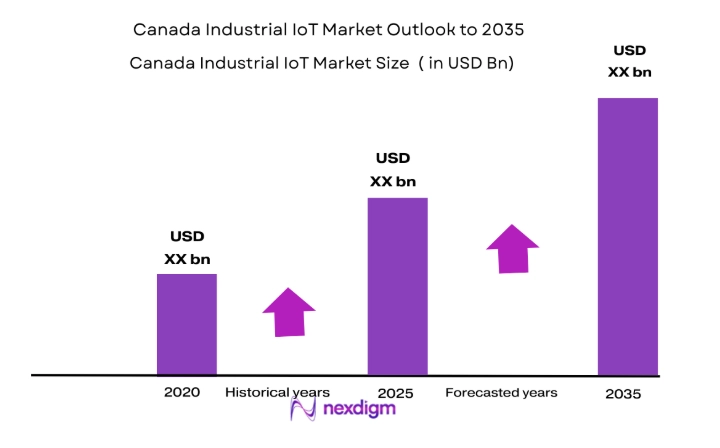
The Canada Industrial IoT market is witnessing significant growth, with a market size of approximately USD ~ billion, driven by increasing adoption of connected devices across industries such as manufacturing, energy, and transportation. Factors such as the need for enhanced operational efficiency, cost reduction, and real-time data analytics are contributing to this growth. The deployment of advanced technologies, including artificial intelligence (AI) and machine learning (ML), is also accelerating the market’s expansion. As industries shift towards automation and smart infrastructure, the market continues to see a surge in investments and technological advancements, supporting its robust growth trajectory.
The dominance of major cities like Toronto, Vancouver, and Montreal can be attributed to their well-developed industrial ecosystems and strong technological infrastructure. These cities have become key hubs for Industrial IoT adoption due to their proximity to leading technology providers, research institutions, and a highly skilled workforce. Additionally, Canada’s government support for smart city initiatives and digital transformation projects has further enhanced the country’s position as a leader in the Industrial IoT space. The nation’s commitment to sustainability and automation continues to foster demand for IoT solutions across diverse sectors, particularly in manufacturing and logistics.
Market Segmentation
By Product Type:
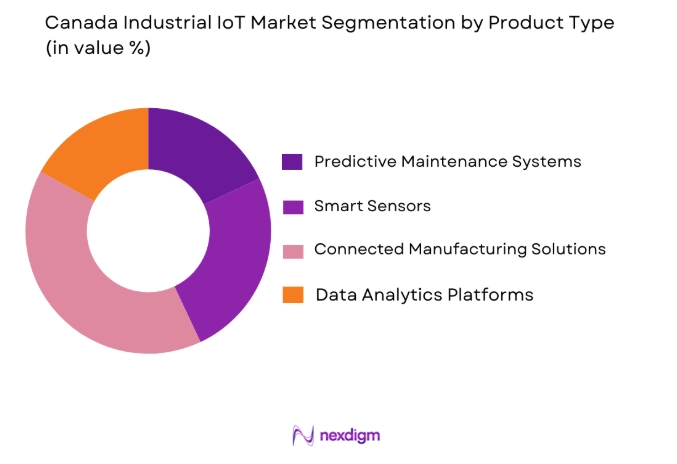
The Canada Industrial IoT market is segmented by product type into predictive maintenance systems, smart sensors, connected manufacturing solutions, and data analytics platforms. Among these, connected manufacturing solutions have a dominant market share due to increasing demand for operational efficiency, real-time monitoring, and reduced downtime in manufacturing plants. Companies in automotive, aerospace, and electronics are the primary adopters of connected manufacturing solutions, as they facilitate real-time data exchange and process optimization. The seamless integration of connected systems across the supply chain and production floor has made it an indispensable technology in these industries, driving its widespread adoption across Canada.
By End-User Segment:
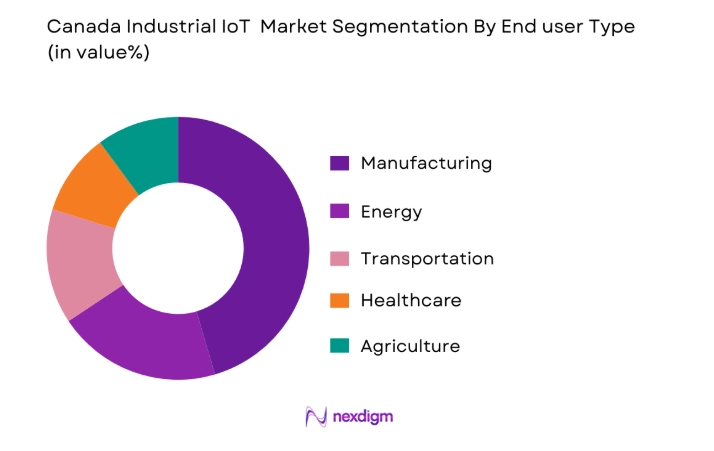
The Canada Industrial IoT market is segmented by end-user segment into manufacturing, energy, transportation, healthcare, and agriculture. The manufacturing sector has a dominant market share, driven by the need to optimize operations, improve product quality, and enhance supply chain efficiency. Manufacturers are leveraging IoT technologies such as sensors, predictive maintenance, and automation to streamline operations, reduce downtime, and improve the bottom line. With the ongoing trend of Industry 4.0 and smart factories, IoT adoption in the manufacturing sector is expected to continue to grow, reinforcing its leading position in the market.
Competitive Landscape
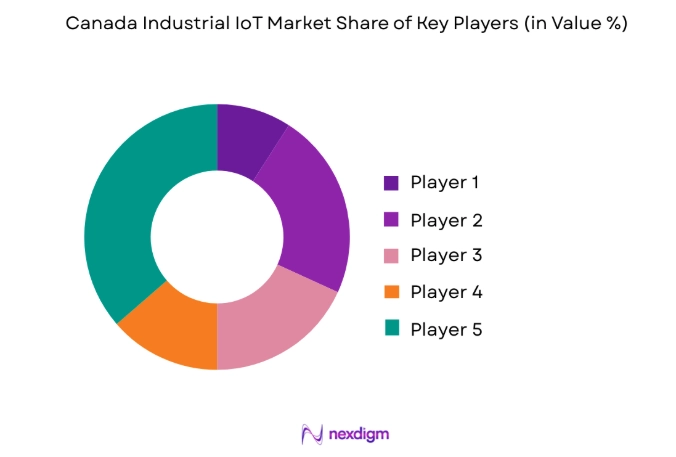
The competitive landscape of the Canada Industrial IoT market is marked by the presence of both established global players and local technology firms. Companies are focusing on developing innovative solutions, integrating AI, cloud computing, and edge technologies to enhance their product offerings. The market has witnessed consolidation in recent years, as larger companies acquire smaller, innovative firms to expand their capabilities and reach. Leading players in the market are constantly evolving their strategies to maintain a competitive edge, offering end-to-end solutions that cater to a broad range of industries.
| Company Name | Establishment Year | Headquarters | Technology Focus | Market Reach | Key Products | Revenue | Additional Parameter |
| Siemens AG | 1847 | Munich, Germany | ~ | ~ | ~ | ~ | ~ |
| Rockwell Automation | 1903 | Milwaukee, US | ~ | ~ | ~ | ~ | ~ |
| Honeywell International | 1906 | Charlotte, US | ~ | ~ | ~ | ~ | ~ |
| Schneider Electric | 1836 | Rueil-Malmaison, France | ~ | ~ | ~ | ~ | ~ |
| ABB Ltd. | 1988 | Zurich, Switzerland | ~ | ~ | ~ | ~ | ~ |
Canada Industrial IoT Market Analysis
Growth Drivers
Government Support for Industrial IoT Initiatives:
The Canadian government is heavily investing in smart city projects and the digital transformation of industries, which is driving the demand for Industrial IoT solutions. With initiatives such as the “Smart Cities Challenge,” Canada aims to create sustainable urban environments using IoT technologies, thereby creating significant market growth opportunities for IoT providers. These investments promote the adoption of smart infrastructure, energy-efficient systems, and connected transportation solutions. Additionally, government funding for research and development in IoT technologies further accelerates the market’s growth, as companies develop more advanced, scalable solutions.
Technological Advancements in IoT Solutions:
The continuous evolution of IoT technologies, including advancements in sensors, connectivity, and cloud computing, has made IoT solutions more affordable and accessible to businesses. The increasing use of AI and machine learning in IoT applications enhances operational efficiency and decision-making. These innovations allow industries such as manufacturing, energy, and healthcare to improve their processes, reduce operational costs, and deliver better services. As IoT devices become more intelligent and capable of real-time data processing, the market is seeing rapid adoption across sectors, further driving its growth.
Market Challenges
Cybersecurity Risks in Industrial IoT Systems:
One of the major challenges hindering the widespread adoption of Industrial IoT in Canada is the increasing risk of cybersecurity threats. As more devices are connected to the internet, the potential for cyberattacks on critical infrastructure increases, leading to significant financial and data security risks. Industrial IoT systems are often targeted by cybercriminals looking to exploit vulnerabilities in connected networks, resulting in system downtime, loss of sensitive data, and operational disruptions. Companies are therefore focusing on strengthening their cybersecurity frameworks to ensure the secure deployment of IoT systems. However, the complexity of securing interconnected devices and networks remains a major challenge.
High Initial Capital Expenditure for IoT Deployment:
Despite the long-term benefits, the initial capital expenditure required to implement Industrial IoT solutions is often a barrier for small and medium-sized enterprises (SMEs). The costs associated with purchasing IoT devices, setting up connectivity infrastructure, and developing secure, scalable solutions can be prohibitive for many organizations. While the cost of IoT devices is gradually decreasing, the integration of these technologies with legacy systems and the need for specialized expertise still result in high upfront costs. SMEs often struggle to justify such large investments, slowing the pace of adoption in certain sectors.
Opportunities
Smart Manufacturing and Automation Adoption:
As manufacturers in Canada continue to embrace Industry 4.0 technologies, there is a growing opportunity for the deployment of Industrial IoT solutions in the smart manufacturing sector. The integration of IoT technologies, including connected devices and predictive maintenance systems, enables manufacturers to optimize operations, reduce downtime, and improve product quality. As competition intensifies, manufacturers are increasingly turning to IoT to gain a competitive edge, driving demand for advanced manufacturing technologies. This shift towards smart factories presents a significant growth opportunity for IoT providers in Canada.
Growth of IoT Solutions in the Energy Sector:
With Canada’s focus on sustainability and reducing its carbon footprint, there is an increasing demand for IoT solutions in the energy sector. The adoption of smart grids, energy management systems, and predictive maintenance technologies is driving growth in this segment. IoT-enabled solutions help energy companies monitor energy consumption, optimize resource use, and improve operational efficiency. As Canada continues its transition to renewable energy sources, IoT solutions will play a critical role in enhancing the management and distribution of energy, presenting a key growth opportunity for companies providing these technologies.
Future Outlook
The Canada Industrial IoT market is expected to continue its growth trajectory over the next five years, driven by ongoing technological advancements and strong government support for digital transformation. As IoT adoption accelerates across industries such as manufacturing, energy, and transportation, we can expect a shift towards more connected, intelligent systems. New developments in AI, machine learning, and 5G technologies will enable faster, more reliable connectivity and data processing, further fueling market expansion. With increasing focus on sustainability and operational efficiency, Industrial IoT will become even more integral to Canada’s industrial landscape.
Major Players
- Siemens AG
- Rockwell Automation
- Honeywell International
- Schneider Electric
- ABB Ltd.
- GE Digital
- Cisco Systems
- IBM Corporation
- Oracle Corporation
- Intel Corporation
- Microsoft Corporation
- PTC Inc.
- Emerson Electric Co.
- Yokogawa Electric Corporation
- Mitsubishi Electric
Key Target Audience
- Investments and venture capitalist firms
- Government and regulatory bodies
- Manufacturers and industrial operators
- Technology service providers
- Energy and utility companies
- Transportation companies
- Healthcare providers
- Agriculture and smart farming enterprises
Research Methodology
Step 1: Identification of Key Variables
Identifying key market variables such as technology trends, regulatory factors, and consumer demands that impact the market’s growth.
Step 2: Market Analysis and Construction
Conducting a detailed market analysis, including segmentation, growth drivers, and challenges based on current data.
Step 3: Hypothesis Validation and Expert Consultation
Validating findings through consultations with industry experts and stakeholders to ensure accuracy.
Step 4: Research Synthesis and Final Output
Synthesizing research findings into a comprehensive report that includes insights, forecasts, and recommendations for stakeholders.

- Executive Summary
- Research Methodology (Definitions, Scope, Industry Assumptions, Market Sizing Approach, Primary & Secondary Research Framework, Data Collection & Verification Protocol, Analytic Models & Forecast Methodology, Limitations & Research Validity Checks)

- Market Definition and Scope
- Value Chain & Stakeholder Ecosystem
- Regulatory / Certification Landscape
- Sector Dynamics Affecting Demand

- Growth Drivers
Government Investments in Digital Infrastructure
Advancements in IoT and AI Technologies
Demand for Operational Efficiency in Manufacturing - Market Challenges
High Initial Capital Investment
Cybersecurity Risks and Data Privacy Concerns
Integration Complexities Across Legacy Systems - Market Opportunities|
Expansion of Smart Cities and IoT-enabled Infrastructure
Increased Adoption in Agriculture and Smart Farming
Rising Demand for Predictive Maintenance Solutions - Trends
Integration of AI and Machine Learning in IoT Solutions
Growth of Edge Computing for Real-time Data Processing
Increasing Use of 5G for IoT Connectivity - Government Regulations
- SWOT Analysis of Key Competitors
- Pricing & Procurement Analysis

- By Market Value, 2020-2025
- By Installed Units, 2020-2025
- By Average System Price, 2020-2025
- By System Complexity Tier, 2020-2025

- By System Type (In Value%)
Predictive Maintenance Systems
Industrial Automation Systems
Connected Manufacturing Systems
Smart Sensors and Devices
Data Analytics and Control Systems - By Platform Type (In Value%)
Edge Computing Platforms
Cloud Platforms
On-premise Platforms
Hybrid Platforms
IoT Integration Platforms - By Fitment Type (In Value%)
On-premise Solutions
Cloud-based Solutions
Hybrid Solutions
Modular Solutions
Integrated Solutions - By EndUser Segment (In Value%)
Manufacturing Industry
Energy & Utilities Sector
Transportation and Logistics
Oil & Gas Industry

- Market Share Analysis
- CrossComparison Parameters (System Type, Platform Type, Procurement Channel, EndUser Segment, Fitment Type)
- SWOT Analysis of Key Competitors
- Pricing & Procurement Analysis
- Porter’s Five Forces
- Key Players
Siemens AG
General Electric
Honeywell International
Schneider Electric
Rockwell Automation
Cisco Systems
ABB Ltd.
Microsoft Corporation
Oracle Corporation
IBM Corporation
Cisco Systems
Intel Corporation
Huawei Technologies
Amazon Web Services
PTC Inc.

- Increased Adoption in Manufacturing Sectors
- Focus on Energy Efficiency in Utilities
- Rising Demand for IoT Solutions in Healthcare
- Growth of Smart Agriculture Applications

- Forecast Market Value, 2026-2035
- Forecast Installed Units, 2026-2035
- Price Forecast by System Tier, 2026-2035
- Future Demand by Platform, 2026-2035


 Request a Sample
 Ask for Customization
 Get a Quote
 Enquire Now