
 Download PDF
Market Overview
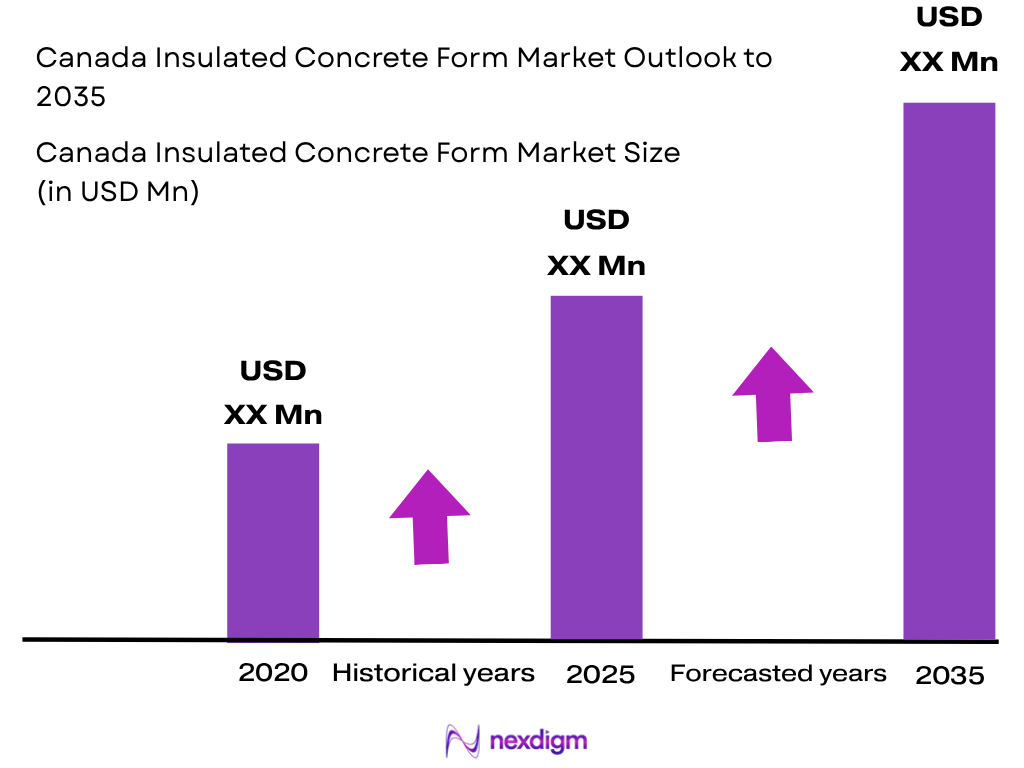
The Canada Insulated Concrete Form Market is valued at approximately USD ~XX million, supported by demand for thermally efficient foundations, basements and above-grade reinforced-concrete envelopes. The underlying construction environment remains substantial: total building-construction investment increased from CAD 229.1 billion in the preceding annual observation to CAD 253.8 billion in the latest annual observation, while nationwide housing starts reached 245,120 units, supporting ICF demand across residential and institutional construction.
Ontario, Alberta, British Columbia and Quebec form the principal Canadian demand centres, particularly around Toronto, Calgary, Edmonton, Vancouver and Montréal. Toronto recorded 37,718 housing starts, Calgary 24,369, Edmonton 18,384, Vancouver 28,112, and Montréal 17,570 in the latest annual dataset. Ontario benefits from a deep contractor and distributor ecosystem, Alberta combines strong detached-home construction with local ICF production, while British Columbia and Quebec benefit from stringent building-envelope requirements and substantial multifamily activity.
Market Segmentation
By ICF System Type
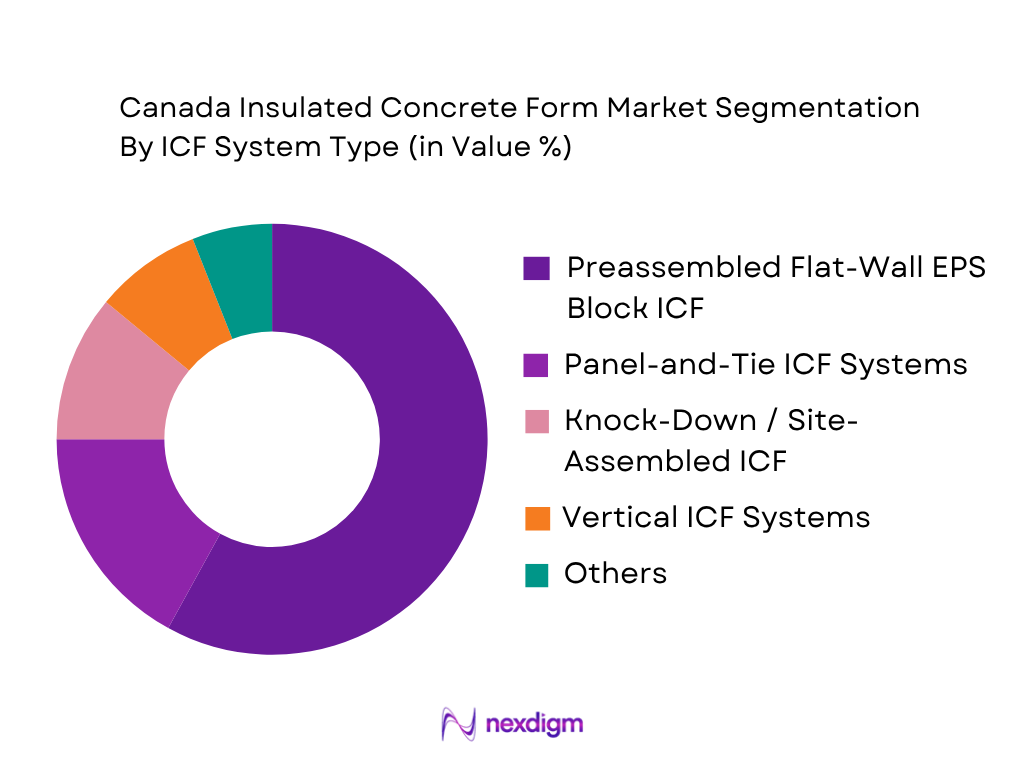
The Canada Insulated Concrete Form Market is segmented into preassembled flat-wall EPS blocks, panel-and-tie systems, knock-down systems, vertical systems and specialty composite configurations. Preassembled flat-wall EPS block ICF represents the dominant segment because it aligns closely with Canadian residential foundation and full-height wall construction. Systems supplied by Nudura, Amvic, SuperForm, Fox Blocks and other established brands allow contractors to combine permanent insulation, concrete forming and attachment surfaces within one installation sequence. Standardized blocks also simplify bracing, reinforcing-steel placement and pumped-concrete installation. Product familiarity among Canadian ICF contractors and building-material dealers further supports adoption. Core-width flexibility makes these systems suitable for basements, detached homes, multifamily developments and commercial projects. Their established technical literature, code-evaluation documentation, corner configurations and accessories reduce specification barriers compared with less familiar specialty formats. Consequently, flat-wall EPS block systems remain the principal platform through which ICF technology is specified and installed across Canada.
By End-Use Application
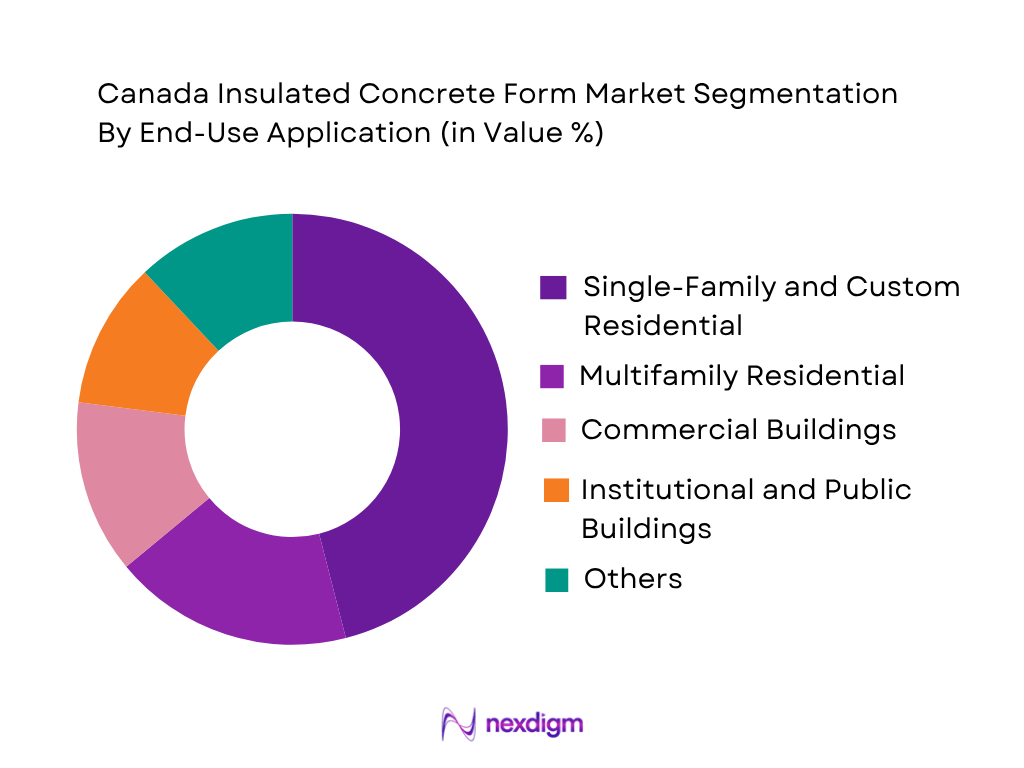
The Canada Insulated Concrete Form Market is segmented into single-family and custom residential, multifamily housing, commercial, institutional, industrial and specialty applications. Single-family and custom residential construction accounts for the leading share because Canadian ICF technology has historically been closely associated with foundation walls, basements and full-height high-performance homes. Cold winters, basement-intensive residential architecture and demand for continuous insulation strengthen the technical case for EPS-concrete wall assemblies. Custom homeowners also tend to place greater value on airtightness, thermal comfort, sound attenuation, resilience and durability than commodity housing projects. Canadian manufacturers maintain extensive dealer and installer networks targeted toward this segment, allowing contractors to source standard forms, corners, fastening strips, waterproofing accessories and bracing equipment relatively efficiently. Increasing interest in Net-Zero Energy Ready homes, Passive House-type envelopes and disaster-resilient residential construction further strengthens the residential segment’s position within the Canadian ICF industry.
Competitive Landscape
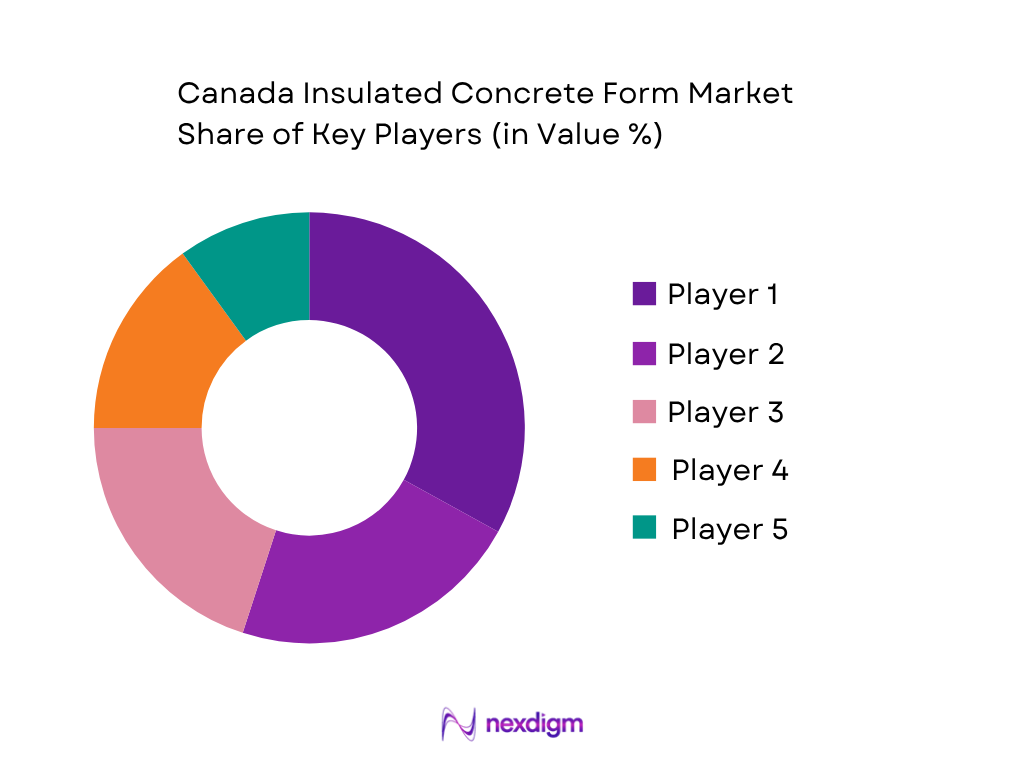
The Canada Insulated Concrete Form Market is characterized by a combination of long-established Canadian manufacturers, Canadian-origin technologies and major North American ICF suppliers. Competition centres less on basic EPS-form availability and increasingly on effective thermal performance, concrete-core flexibility, distribution density, contractor training, BIM and engineering support, accessory ecosystems and supply reliability. Nudura and Amvic have particularly strong Canadian recognition, while SuperForm, Plasti-Fab, Fox Blocks and several specialty systems expand buyer choice across provincial markets.
| Company | Establishment / Brand Origin | Headquarters / Base | Primary ICF Format | Concrete Core Capability | Thermal / Insulation Positioning | Key Canadian Applications | Canadian
Manufacturing / Presence |
Distribution & Technical Support |
| Nudura / Tremco CPG | 2001 | Originally Barrie, Ontario | ~ | ~ | ~ | ~ | ~ | ~ |
| Amvic Building System | 1997 | Toronto, Ontario | ~ | ~ | ~ | ~ | ~ | ~ |
| SuperForm Products | 1998 | Pincher Creek, Alberta | ~ | ~ | ~ | ~ | ~ | ~ |
| Fox Blocks | ICF production since 2005 | Omaha, Nebraska | ~ | ~ | ~ | ~ | ~ | ~ |
| Plasti-Fab / Advantage ICF | 1968 | Calgary, Alberta | ~ | ~ | ~ | ~ | ~ | ~ |
Canada Insulated Concrete Form Market Analysis
Growth Drivers
Cold-Climate Thermal Performance and Higher Building Envelope Requirements
Canada’s cold climate makes continuous insulation and reduced thermal bridging central to wall-system selection, directly supporting ICF adoption because EPS forms remain in place around the reinforced-concrete core. The National Building Code’s energy framework for houses contains 5 performance tiers, with the highest tier designed to deliver at least 70 units of energy reduction for every 100 units consumed under the baseline reference, creating a stronger technical case for high-performance wall assemblies. This requirement sits within a large construction economy: Statistics Canada recorded CAD 253.8 billion of building-construction investment in 2024, including CAD 102.4 billion in constant-dollar residential investment. Residential building permits represented CAD 52.5 billion in constant dollars, while 287,100 dwelling units were authorized for construction. The broader macroeconomic environment also provides substantial demand capacity: World Bank data places Canadian GDP at USD 2.244 trillion and GDP per capita at USD 54,340.3 in 2024. These conditions favour ICF systems in basements, exterior structural walls and whole-house envelopes where insulation, concrete structure, airtightness and thermal-mass performance can be integrated into one wall assembly.
Housing Construction, Multifamily Expansion and Construction Productivity Requirements
Canada’s active housing pipeline provides a substantial addressable construction base for ICF suppliers, particularly as the industry seeks wall systems capable of combining forming, insulation and structural functions while reducing separate site operations. Canada Mortgage and Housing Corporation recorded 245,120 housing starts across Canada in 2024, comprising 227,697 starts in centres with populations of at least 10,000 and an estimated 17,423 rural starts. Statistics Canada separately recorded 287,100 dwelling units authorized for construction, including an additional 22,900 multi-family units compared with the preceding annual total. Multi-family building permits reached CAD 34.1 billion in constant dollars, while multi-dwelling construction investment reached CAD 54.6 billion. Labour availability increases the relevance of construction systems that streamline site workflows: Housing, Infrastructure and Communities Canada reported a construction vacancy rate of 4.2 workers per 100 positions in the second quarter of 2024, while approximately 85,500 workers could constitute the retirement-recruitment gap by 2033. This combination supports greater consideration of ICF for foundations, rental housing, multifamily developments and standardized high-performance residential projects.
Market Challenges
Entrenched Conventional Construction and ICF-Specific Skilled-Labour Requirements
ICF suppliers operate within a Canadian construction industry where wood framing and conventional cast-in-place concrete already have mature labour pools, procurement channels and contractor familiarity. Transitioning projects to ICF requires competencies in block alignment, reinforcing-steel placement, bracing, openings, concrete pumping and consolidation, making skilled-labour availability particularly important. Federal housing-industry analysis reported that Canada’s construction vacancy rate reached 4.0 workers per 100 positions in March 2024, compared with 3.4 workers per 100 positions across the overall economy. Housing, Infrastructure and Communities Canada additionally identified a potential 85,500-worker retirement-recruitment gap by 2033. The challenge becomes more significant against the scale of construction requiring labour: Canada recorded 245,120 housing starts and 287,100 dwelling units authorized for construction in 2024. Residential construction investment reached CAD 102.4 billion in constant dollars, including CAD 54.6 billion in multi-dwelling construction. For ICF manufacturers, therefore, market expansion depends not merely on supplying EPS forms but on increasing the availability of trained installers, bracing systems, engineering support and concrete-placement expertise capable of competing with established Canadian construction workflows.
Regional Logistics, Severe Climate and Complex Building-Performance Requirements
Canada’s geographic scale creates a difficult distribution environment for bulky EPS ICF blocks and accessories, particularly when suppliers must serve smaller construction markets across northern, rural and remote communities. At the same time, the wall assembly must address thermal performance, moisture management, waterproofing, fire protection and severe-weather resilience rather than functioning solely as permanent concrete formwork. The challenge is reinforced by Canada’s climatic exposure. Natural Resources Canada recorded 5,844 wildland fires and 5,374,344 hectares burned in 2024, substantially above the 2.9 million-hectare 25-year average for burned area. The Jasper wildfire alone forced approximately 25,000 people to evacuate and consumed roughly one-third of the town’s buildings, illustrating the growing importance of resilient envelope design. Meanwhile, Canada’s construction pipeline remains geographically dispersed, with 17,423 rural housing starts recorded in 2024 alongside 227,697 starts in larger population centres. ICF suppliers consequently face the combined task of maintaining economical regional inventories while providing compatible waterproofing membranes, fire-protective finishes, reinforcement, bracing and technical detailing. This increases execution complexity relative to established locally available framing and foundation systems.
Market Opportunities
Multifamily, Rental and High-Performance Residential ICF Expansion
Canada’s shift toward multi-unit housing creates an opportunity for ICF manufacturers to move beyond their traditional foundation and custom-home base into larger repeatable wall packages for rental apartments, townhouses and low- to mid-rise residential developments. Statistics Canada recorded 287,100 dwelling units authorized for construction in 2024, the second-highest annual level in its series, with the increase driven by 22,900 additional multi-family units. Multi-family building permits reached CAD 34.1 billion in constant dollars, while investment in multi-dwelling residential construction reached CAD 54.6 billion. CMHC also recorded 245,120 housing starts, including historically high rental construction activity and increased starts in Alberta, Quebec and Atlantic Canada. The opportunity is reinforced by a substantial macroeconomic base: World Bank data places Canadian GDP at USD 2.244 trillion and GDP per capita at USD 54,340.3 in 2024. These current indicators provide ICF suppliers with a platform to target standardized multifamily wall designs, complete foundation-to-roof systems, engineering packages and contractor training, positioning ICF as an integrated structural-and-insulation solution rather than primarily a basement-wall product.
Wildfire-Resilient, Net-Zero-Ready and Institutional Building Applications
Resilient and high-performance construction represents a significant future expansion route for the Canada Insulated Concrete Form Market because reinforced-concrete cores and continuous insulation can address multiple building-envelope objectives within one system. The immediate need is demonstrated by Natural Resources Canada’s recording of 5,844 wildland fires covering 5,374,344 hectares in 2024. The Jasper event alone triggered the evacuation of approximately 25,000 people, damaged roughly one-third of the town’s buildings and generated about CAD 1.23 billion in insured losses. Simultaneously, Statistics Canada reported CAD 36.6 billion in constant-dollar non-residential building permits, while industrial construction intentions added CAD 182.4 million and reached a series high. Canada’s National Building Code energy framework also provides 5 increasingly stringent performance tiers, strengthening demand for envelopes capable of delivering continuous insulation and airtightness. These current conditions create opportunities for ICF suppliers in wildfire-exposed residential communities, schools, fire stations, community facilities, commercial buildings and energy-efficient public infrastructure. Product strategies integrating higher-performance EPS, fire-protective finishes, waterproofing, engineered reinforcement and complete wall-to-roof detailing can expand ICF adoption beyond conventional residential foundations.
Future Outlook
The Canada Insulated Concrete Form Market is expected to expand steadily through the forecast period as provinces progressively emphasize higher-performance building envelopes, improved energy efficiency and resilient construction. Growth will increasingly extend beyond basement walls into complete above-grade structures, multifamily housing, schools, commercial buildings and institutional projects. Expansion of housing supply and continued contractor familiarization with ICF construction will support adoption. The market is forecast to grow at approximately ~X.X% CAGR during 2026–2035.
Major Players
- Nudura / Tremco Construction Products Group – Flat-wall folding ICF systems and complete building-envelope solutions.
- Amvic Building System – Canadian EPS manufacturer with ICF, insulated floor and building-envelope products.
- SuperForm Products Ltd. – Alberta-based ICF and EPS insulation manufacturer.
- Plasti-Fab / Advantage ICF – Canadian EPS producer and insulated concrete forming-system supplier.
- Element ICF / Logix Brands Ltd. – Canadian-origin integrated ICF platform and successor to the Logix system.
- IntegraSpec – Panel-style ICF technology with a Canadian market presence.
- Quad-Lock Building Systems – Canadian-origin panel-and-tie ICF construction system.
- Fox Blocks – North American preassembled ICF supplier serving Canadian contractors and dealers.
- BuildBlock Building Systems – Reversible ICF products for residential and commercial projects.
- LiteForm Technologies – Folding and panelized insulated concrete forming solutions.
- TF Forming Systems – Vertical insulated concrete forming technology.
- Central ICF – Western Canadian ICF distributor and technical-support provider.
- Prairie ICF – Prairie-region ICF supply and contractor-support participant.
- My ICF House / Ontario ICF – Ontario-based ICF distribution and contractor-support participant.
- ICF Supply Canada – Canadian ICF material distribution and project-supply participant.
Key Target Audience
- Insulated Concrete Form Manufacturers
- EPS and Graphite EPS Manufacturers
- Residential and Multifamily Real Estate Developers
- General Contractors and ICF Specialist Contractors
- Building Material Distributors and Dealer Networks
- Investments and Venture Capitalist Firms
- Architecture, Engineering and Construction Technology Companies
- Government and Regulatory Bodies (National Research Council Canada, Canada Mortgage and Housing Corporation, Natural Resources Canada, Canadian Construction Materials Centre, Provincial Building Code Authorities)
Research Methodology
Step 1: Identification of Key Variables
The initial phase involves developing the complete ecosystem of the Canada Insulated Concrete Form Market, covering ICF manufacturers, EPS suppliers, ready-mix concrete producers, reinforcement suppliers, distributors, contractors, developers and regulatory bodies. Secondary and proprietary research is used to establish critical variables such as installed wall area, block shipments, concrete-core configuration, end-user applications and geographic demand concentration.
Step 2: Market Analysis and Construction
Historical construction indicators are mapped against ICF-specific demand variables to develop the market model. Housing starts, residential and non-residential construction expenditure, basement construction activity, high-performance building projects and provincial development trends are assessed alongside manufacturer capacities, dealer footprints and product availability. Top-down construction expenditure is reconciled with bottom-up ICF shipment and installation assumptions to establish revenue and volume estimates.
Step 3: Hypothesis Validation and Expert Consultation
Market hypotheses are validated through computer-assisted telephone interviews and structured discussions with ICF manufacturers, distributors, specialist contractors, architects, structural engineers and building-envelope professionals. Interviews focus on product penetration, typical concrete-core dimensions, residential versus non-residential demand, provincial adoption, product pricing, installer availability and competitive positioning. Expert feedback is used to challenge and refine assumptions generated through secondary research.
Step 4: Research Synthesis and Final Output
The final stage triangulates manufacturer-level estimates, contractor project activity, construction statistics and expert interviews to produce the market assessment. Company revenues, installed wall volumes, end-use shares and regional demand are cross-checked against Canadian housing and construction indicators. The validated dataset is subsequently used to derive segmentation, competitive positioning, future growth outlook and strategic recommendations for participants in the Canada Insulated Concrete Form Market.

- Executive Summary
- Research Methodology (Market Definition and Scope, Canada Insulated Concrete Form Market Classification, EPS ICF Block and Panel Demand Assessment, Installed ICF Wall Area Mapping, Domestic ICF Manufacturing Capacity Assessment, Imported ICF System Assessment, EPS and Graphite EPS Feedstock Mapping, Concrete Core Consumption Assessment, Reinforcement Requirement Analysis, Foundation and Above-Grade Wall Demand Assessment, Residential and Commercial Project Mapping, Distributor and Dealer Network Mapping, Primary Industry Interviews, Top-Down Housing and Construction Activity Assessment, Bottom-Up Company Revenue and Installation Volume Assessment, CCMC Product Evaluation Mapping, Provincial Building Code Assessment, Data Triangulation, Pricing Assessment, Forecasting Framework)

- Definition and Scope
- Canada Insulated Concrete Form Industry Evolution
- ICF Block Manufacturing, EPS Moulding
- Canada Insulated Concrete Form Value Chain Analysis
- Canada Insulated Concrete Form Supply Chain Analysis

- Growth Drivers (Cold-Climate Thermal Insulation Requirements, Housing Supply Expansion, Higher Building Envelope Performance Standards, Net-Zero Energy Ready Construction, Demand for Continuous Insulation, Residential Basement Construction, Increasing Airtightness Requirements, Resilient Construction Demand, Wildfire and Extreme Weather Concerns, Labour Productivity Requirements, Expansion of Multifamily Housing, Strong Domestic EPS and ICF Manufacturing Base)
- Market Challenges (Competition from Wood-Frame Construction, Conventional Cast-in-Place Concrete Foundation Competition, Precast Concrete Competition, Contractor Familiarity with Traditional Methods, Higher Upfront Material Requirement, Bracing and Concrete Pouring Skill Requirements, Regional Dealer Availability, Winter Construction Logistics, Complex Opening and Service Detailing, EPS Fire Protection Requirements, Waterproofing Requirements, Long-Distance Distribution in Northern Markets)
- Market Opportunities (Full-Height ICF Residential Construction, Multifamily Rental Housing, Net-Zero Energy Ready Homes, Passive House Projects, Northern and Remote Housing, Wildfire-Resilient Housing, Commercial ICF Buildings, Schools and Community Buildings, High-Performance Basements, Graphite EPS ICF, Hybrid ICF Systems, One-Sided ICF Applications, ICF Swimming Pools, Agricultural Buildings, Domestic Manufacturing Expansion)
- Market Trends (Hybrid Preformed and Knock-Down ICF Systems, Graphite EPS Integration, Higher R-Value Forms, Full-Height ICF Homes, ICF Foundation-to-Roof Construction, Net-Zero-Oriented Building Envelopes, Whole-Building Airtightness, ICF-Compatible Waterproofing Systems, Micro-Reinforcement Integration, BIM-Based ICF Design, Contractor Training Networks, Regional Dealer Expansion)
- Government Regulations and Standards (National Building Code of Canada, National Energy Code of Canada for Buildings, Provincial Building Codes, Canadian Construction Materials Centre Evaluations, CAN/ULC-S717.1 ICF Material Requirements, Structural Concrete Requirements, Fire Performance Requirements, Energy Performance Tiers, Building Envelope Thermal Transmittance Requirements, Airtightness Requirements, Provincial Energy Codes)
- SWOT Analysis
- Porter’s Five Forces Analysis
- PESTLE Analysis

- By Market Value (2020-2025)
- By ICF Block and Panel Consumption Volume (2020-2025)
- By Installed ICF Wall Area (2020-2025)
- By Domestic ICF Production Volume (2020-2025)
- By Domestic ICF Production Value (2020-2025)
- By EPS Consumption in ICF Applications (2020-2025)
- By Graphite EPS Consumption in ICF Applications (2020-2025)

- By ICF System Architecture (In Value %)
Flat-Wall ICF Systems
Interlocking EPS Block ICF Systems
Panel-and-Tie ICF Systems
Knock-Down ICF Systems
Fixed-Web ICF Systems
Variable-Web ICF Systems
Hybrid Preformed and Site-Assembled ICF Systems
One-Sided ICF Systems
Grid-Wall ICF Systems
Composite ICF Systems - By Insulating Form Material (In Value %)
Standard Expanded Polystyrene ICF
High-Density EPS ICF
Graphite-Enhanced EPS ICF
Flame-Retardant EPS ICF
Recycled-Content EPS ICF
High-R-Value EPS ICF
Cement-Bonded EPS Composite ICF
Cement-Bonded Wood-Fibre ICF
Hybrid Insulated Concrete Forms - By Concrete Core Configuration (In Value %)
4-Inch Concrete Core Systems
6-Inch Concrete Core Systems
8-Inch Concrete Core Systems
10-Inch Concrete Core Systems
12-Inch Concrete Core Systems
Variable Concrete Core Systems - By Building Element (In Value %)
Foundation Walls
Basement Walls
Above-Grade Exterior Walls
Interior Structural Walls
Party and Demising Walls
Retaining Walls
Crawl Space Walls
Swimming Pool Walls
Elevator and Stair Cores - By End-Use Construction (In Value %)
Single-Family Residential
Custom Homes
Low-Rise Multifamily Residential
Mid-Rise Multifamily Residential
Rental Housing
Affordable Housing
Commercial and Office Buildings
Schools and Educational Buildings
Government and Municipal Buildings - By Building Performance Requirement (In Value %)
High-R-Value ICF Systems
Net-Zero Energy Ready ICF Systems
Passive House-Oriented ICF Systems
High-Airtightness ICF Systems
Fire-Resistant ICF Systems
High-Acoustic-Performance ICF Systems
Flood-Resistant ICF Applications
Wildfire-Resilient ICF Applications - By Province and Region (In Value %)
Ontario
Quebec
Alberta
British Columbia
Saskatchewan
Manitoba
New Brunswick
Nova Scotia
Newfoundland and Labrador

- Market Share of Major Players (By Canada Revenue, ICF Block and Panel Volume, Installed ICF Wall Area, Foundation Project Exposure, Above-Grade ICF Exposure, Residential and Commercial Project Exposure, Canadian Manufacturing Footprint, Dealer and Installer Network)
- Cross Comparison Parameters (Canada ICF Revenue, ICF Block Panel Hybrid and Knock-Down Product Portfolio Breadth, Concrete Core Width and Structural Configuration Flexibility, EPS Graphite EPS and Whole-Wall Thermal Performance Capability, CCMC CAN/ULC and Canadian Code Compliance Coverage, Canadian Manufacturing Warehouse and Dealer Footprint, Foundation Residential Multifamily Commercial and Institutional Project Exposure, Structural Design Installer Training BIM and On-Site Technical Support Capability)
- SWOT Analysis of Major Players
- Detailed Profiles of Major Companies
Nudura / Tremco Construction Products Group – Canadian-Manufactured Flat-Wall EPS ICF Systems, 4–12 Inch Concrete Core Options, High-Performance Building Envelope Products and Authorized Distributor Network
Element ICF / Logix Brands – Hybrid ICF Systems, Preformed and Site-Assembled Forms, Canada-Wide Dealer Coverage, Installer Training and Residential-Commercial Applications
Amvic Building System – Canadian ICF Systems, EPS Stay-in-Place Forms, Reinforced Concrete Walls, High-Thermal-Performance Building Applications
Fox Blocks – EPS ICF Systems, Residential and Commercial Wall Forms, Canadian Manufacturing and Broad Dealer Network Across Multiple Provinces
SuperForm Products – Canadian-Manufactured ICF, EPS+ Insulation, Graphite Polystyrene Max+ Systems, Accessories and Residential-Commercial-Industrial Applications
Plasti-Fab / Advantage ICF – Canadian ICF Forming Systems, EPS Insulation Manufacturing, Active CCMC-Listed Advantage ICF System and Building Envelope Solutions
IntegraSpec – Canadian ICF System, Knock-Down Wall Forms, Interlocking EPS Panels, Reinforced Concrete Construction and Residential-Commercial Applications
Quad-Lock Building Systems – Panel-and-Tie ICF Architecture, Variable Wall Thickness, High-Insulation Wall Systems and Canadian-Origin Building Technology
BuildBlock Building Systems – Reversible EPS ICF Blocks, Reinforced Concrete Wall Systems, Multiple Concrete Core Widths and North American Distribution
LiteForm Technologies – Folding and Panelized ICF Systems, Reinforced Concrete Wall Forms and Residential-Commercial Applications
TF Forming Systems – Vertical ICF Systems, Reinforced Concrete Wall Construction and High-Performance Building Applications
Form Solutions / Logix Manufacturing Network – EPS Moulding, ICF Manufacturing, Logix and Building Envelope Product Production in Ontario
Central ICF – British Columbia ICF Distribution, Nudura Systems, Micro-Rebar Integration and Technical Project Support
Prairie ICF – Saskatchewan Nudura Distribution, Residential and Commercial ICF Projects, Contractor Support and Prairie Market Coverage
My ICF House / Ontario ICF – Ontario Fox Blocks Distribution, Contractor Training, ICF Material Supply and Residential Construction Support

- Residential Developer ICF Adoption Assessment
- Custom Homebuilder ICF Requirement Analysis
- Multifamily Developer Assessment
- Commercial Developer ICF Adoption Assessment
- Institutional Building Procurement Assessment

- By Market Value (2026-2035)
- By ICF Block and Panel Consumption Volume (2026-2035)
- By Installed ICF Wall Area (2026-2035)
- By Domestic ICF Production Volume (2026-2035)
- By Domestic ICF Production Value (2026-2035)
- By EPS Consumption in ICF Applications (2026-2035)
- By Graphite EPS Consumption in ICF Applications (2026-2035)


 Request a Sample
 Ask for Customization
 Get a Quote
 Enquire Now