
 Download PDF
Market Overview
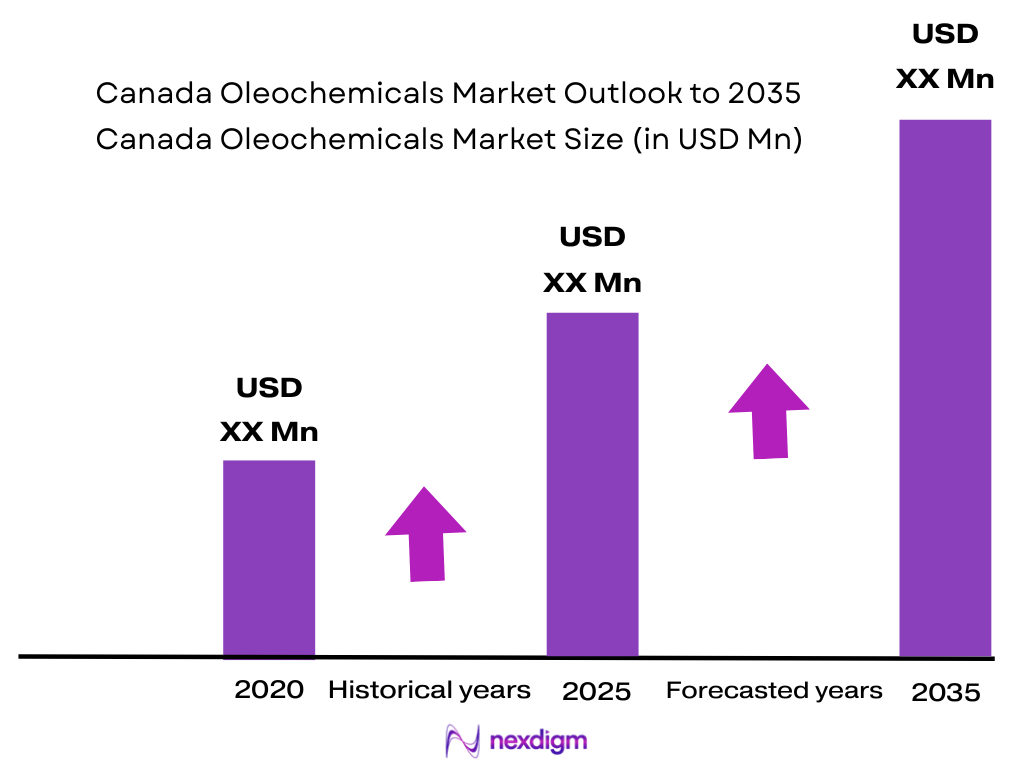
The Canada Oleochemicals Market was valued at approximately USD 3,251.17 million in 2024, according to published market estimates, with fatty acids identified as the largest product category. The market is supported by Canada’s large renewable feedstock base, particularly canola and soybean processing. Statistics Canada reported 11.4 million tonnes of canola crushed in 2024, producing 4.8 million tonnes of canola oil, while soybean crushing reached 1.6 million tonnes, generating 287,000 tonnes of soybean oil. Canola crushing increased 8.1% from 2023, reinforcing domestic feedstock availability.
The Canada Oleochemicals Market is concentrated around Saskatchewan, Alberta, Manitoba, Ontario and Quebec, reflecting the country’s oilseed production, crushing infrastructure, chemical manufacturing and downstream industrial base. In 2024, Saskatchewan accounted for 54.9% of Canada’s canola production, followed by Alberta at 28.5% and Manitoba at 15.6%. Canadian canola production totaled 17.8 million tonnes, while the country seeded approximately 8.9 million hectares. The concentration of feedstock production across the Prairie provinces supports reliable access to vegetable oils for downstream chemical processing.
Market Segmentation
By Product Type
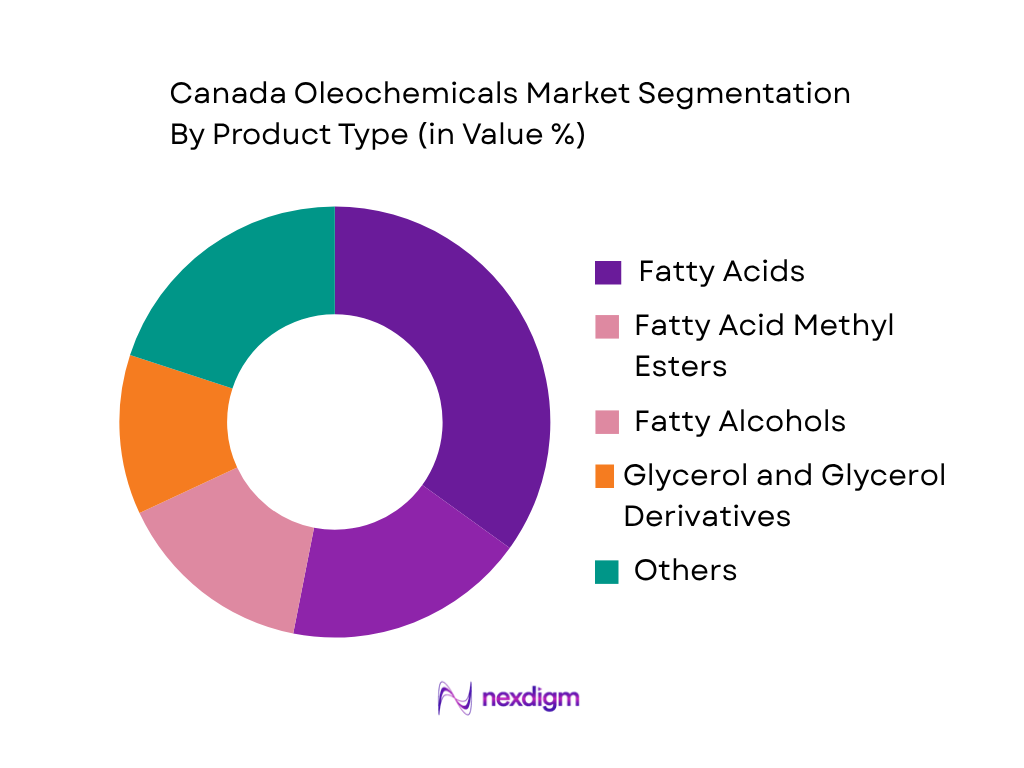
The Canada Oleochemicals Market is segmented by product type into fatty acids, fatty alcohols, methyl esters, glycerol, specialty esters, fatty amines, alkoxylates and other oleochemical derivatives. Fatty acids represent the dominant product category because they serve as versatile intermediates across soaps and detergents, personal care, lubricants, plastics, coatings, rubber processing and chemical manufacturing. Their broad functionality allows producers to serve multiple downstream applications using different chain lengths and saturation profiles. Published market analysis identifies fatty acids as the largest product segment in Canada. Domestic feedstock availability further supports this category, with Statistics Canada reporting 11.4 million tonnes of canola crushed in 2024 and 4.8 million tonnes of resulting canola oil. The scale of Canadian oilseed processing creates an important renewable lipid platform for producing fatty-acid derivatives and specialty oleochemicals.
By Feedstock Type
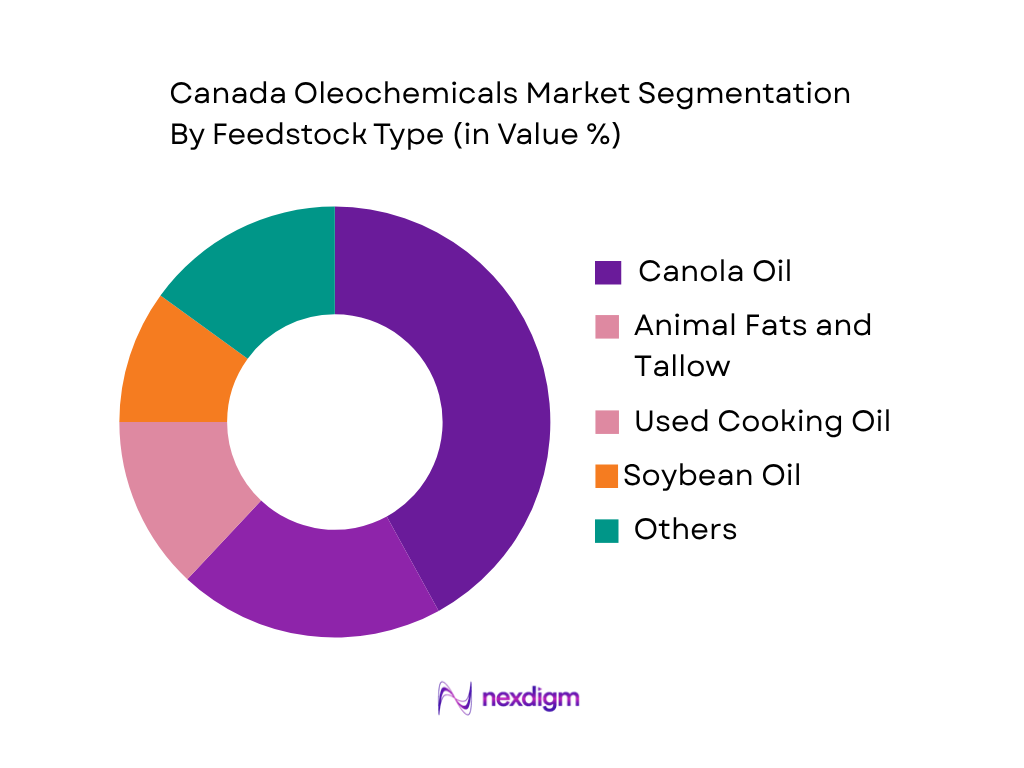
The Canada Oleochemicals Market is segmented by feedstock type into canola oil, animal fats and tallow, used cooking oil, soybean oil, other vegetable oils, tall oil and recycled lipid feedstocks. Canola oil represents the dominant feedstock category because Canada has an extensive canola cultivation, crushing and transportation ecosystem. Statistics Canada recorded 17.8 million tonnes of Canadian canola production in 2024, while domestic processors crushed 11.4 million tonnes and produced 4.8 million tonnes of canola oil. Saskatchewan contributed 54.9% of national canola production, Alberta contributed 28.5%, and Manitoba contributed 15.6%, creating a concentrated Prairie feedstock base. The established crushing infrastructure enables vegetable oil to be converted into fatty acids, esters and other oleochemical intermediates, supporting downstream applications across personal care, detergents, lubricants and specialty chemicals.
Competitive Landscape
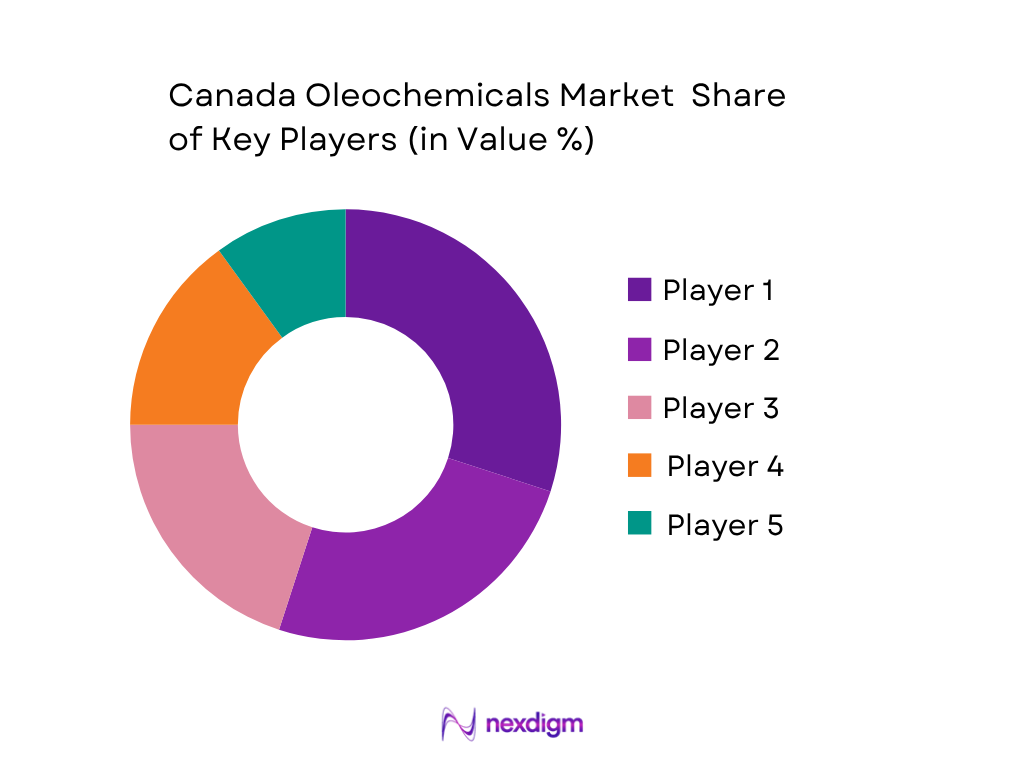
The Canada Oleochemicals Market includes global oleochemical producers, specialty chemical manufacturers and integrated feedstock processors competing through product breadth, specialty derivative capabilities, feedstock flexibility, manufacturing footprint and sustainability credentials. Companies supplying Canadian downstream industries compete across fatty acids, fatty alcohols, esters, glycerine, surfactants and specialty derivatives. The competitive environment is also influenced by the availability of domestic canola and other renewable feedstocks, North American supply-chain integration and demand from personal care, detergents, lubricants, food, pharmaceutical and industrial applications.
| Company | Establishment Year | Headquarters | Fatty Acid Portfolio | Glycerin Capability | Specialty Esters | Key Applications | Feedstock Position | Canadian Market Position |
| Cargill | 1865 | Minneapolis, USA | ~ | ~ | ~ | ~ | ~ | ~ |
| Vantage Specialty Chemicals | 1938 | Chicago, USA | ~ | ~ | ~ | ~ | ~ | ~ |
| Emery Oleochemicals | 1840 | Cincinnati, USA | ~ | ~ | ~ | ~ | ~ | ~ |
| BASF | 1865 | Ludwigshafen, Germany | ~ | ~ | ~ | ~ | ~ | ~ |
| Kao Corporation | 1887 | Tokyo, Japan | ~ | ~ | ~ | ~ | ~ | ~ |
Canada Oleochemicals Market Analysis
Growth Drivers
Canola Crushing Expansion and Availability of Domestic Vegetable-Oil Feedstocks
Canada’s expanding oilseed-processing base provides a direct structural advantage for the domestic oleochemicals industry because canola oil can serve as a renewable feedstock for fatty acids, esters, fatty alcohols, surfactants and other derivatives. Canadian processors crushed a record 11.4 million tonnes of canola in 2024, compared with 10.5 million tonnes in 2023, while canola-oil production reached 4.8 million tonnes and soybean-oil production reached 287,000 tonnes. Domestic canola crushing therefore provides a substantial pool of vegetable oil that can potentially support higher-value chemical conversion alongside food and fuel applications. The feedstock base continued expanding in 2025, when Canadian processors crushed 11.6 million tonnes of canola and produced 4.9 million tonnes of canola oil. National canola production also reached a record 21.8 million tonnes in 2025, compared with 17.8 million tonnes in 2024, strengthening the agricultural foundation available to processors. The importance of this ecosystem is reinforced by the fact that domestic crushers accounted for 50.5% of total canola disposition during the 2024/2025 crop year. For oleochemical manufacturers, this combination of large-scale cultivation, crushing capacity and domestic oil production supports feedstock availability, shorter procurement chains and opportunities to convert Canadian agricultural outputs into higher-value specialty chemical intermediates.
Demand for Bio-Based Chemicals and Renewable Fuel Feedstock Utilization
The Canadian transition toward lower-carbon fuels and renewable chemical inputs is strengthening the industrial environment for oleochemical feedstocks. The federal Clean Fuel Regulations require gasoline and diesel suppliers to progressively reduce fuel carbon intensity, with the requirement reaching 14 gCO₂e/MJ in 2030, creating a regulatory framework that supports renewable fuels and low-carbon feedstocks. The regulations specifically recognize biodiesel, renewable diesel and hydro-treated vegetable oil among eligible low-carbon fuel pathways. In 2024, Canadian production and imports under the Clean Fuel Regulations included 164 million litres of hydrogenation-derived renewable diesel, biodiesel and other liquid low-carbon-intensity fuels produced domestically, alongside 1,299 million litres of hydrogenation-derived renewable diesel and 448 million litres of biodiesel and other liquid low-carbon-intensity fuels imported. The feedstock implications are important because vegetable oils, animal fats and recovered lipid streams can compete between oleochemical conversion and renewable-fuel applications. Canadian canola processing already demonstrates this industrial pull: 11.4 million tonnes of canola were crushed in 2024, and canola-oil exports reached 3.5 million tonnes. Domestic canola disappearance also reached 11.5 million tonnes in the crop-year data reported for 2024. Consequently, the expansion of renewable fuels creates both additional demand for lipid processing infrastructure and a larger ecosystem of suppliers capable of handling renewable feedstocks, supporting the development of higher-value oleochemical derivatives.
Market Challenges
Feedstock Yield Volatility and Canola Crop Weather Exposure
The Canada Oleochemicals Market remains exposed to agricultural variability because canola is an important domestic vegetable-oil feedstock. Weather conditions can alter seed availability, crushing economics and the volume of oil available for downstream conversion. National canola production declined to 17.8 million tonnes in 2024, compared with 19.2 million tonnes in 2023, with Statistics Canada attributing the decline to lower yields associated with hot and dry conditions in parts of Western Canada during July and August. The challenge is particularly relevant because canola is concentrated geographically across the Prairie provinces, making regional weather conditions an important supply variable. Canola stocks were 11.4 million tonnes on December 31, 2024, down from the previous year, while exports reached 4.4 million tonnes during the comparable period. At the same time, domestic processors still crushed a record 11.4 million tonnes of canola in 2024, demonstrating that strong processing demand can coexist with tighter agricultural availability. Conditions improved substantially in 2025, when national canola production reached a record 21.8 million tonnes and domestic processors crushed 11.6 million tonnes, but this improvement also demonstrates the year-to-year variability inherent in agricultural feedstocks. Oleochemical manufacturers therefore face potential fluctuations in feedstock availability, composition and procurement requirements, particularly when food, export and renewable-fuel industries compete for the same vegetable-oil resources.
Feedstock Competition, Imported Specialty Derivative Dependency and Cross-Border Supply Exposure
Canadian oleochemical manufacturers operate within a feedstock and chemical supply system where vegetable oils can be directed toward food, animal feed, exports, biofuels and industrial applications, creating competition for suitable raw materials. In the 2024/2025 crop year, domestic crushers accounted for 50.5% of total canola disposition while seed exports represented 41.5%, illustrating the competing channels for Canadian canola. In 2024, Canadian canola-oil exports reached 3.5 million tonnes, meaning substantial quantities of domestically processed oil moved into international markets rather than exclusively toward Canadian downstream chemical conversion. Renewable-fuel demand adds another competing outlet: the Clean Fuel Regulations recorded 1,299 million litres of imported hydrogenation-derived renewable diesel in 2024, alongside 448 million litres of imported biodiesel and other liquid low-carbon-intensity fuels. This creates an interconnected North American market in which feedstock and finished-product flows can respond to regulatory incentives, processing economics and trade conditions. For Canadian oleochemical producers, dependence on imported specialty derivatives can further expose procurement to border logistics, exchange-rate movements, foreign manufacturing capacity and supply interruptions. The challenge is therefore not simply availability of raw materials; it is securing consistent specifications and volumes while competing with food, fuel and export markets for the same lipid resources.
Market Opportunities
Canola-Derived Specialty Oleochemicals and Domestic Oleochemical Manufacturing
Canada’s exceptionally large canola-processing ecosystem creates an opportunity to move beyond commodity oil production toward higher-value oleochemical derivatives. Domestic processors produced 4.8 million tonnes of canola oil in 2024 and 4.9 million tonnes in 2025, while canola crushing reached 11.4 million tonnes and 11.6 million tonnes, respectively. These volumes provide a large renewable lipid platform that can potentially support specialty fatty acids, esters, emulsifiers, surfactants, lubricant intermediates and personal-care ingredients. The opportunity is strengthened by the scale of Canada’s broader manufacturing ecosystem: Canadian manufacturing generated CAD 875 billion in revenue from goods manufactured in 2024, providing a substantial industrial customer base for specialty chemical inputs. Domestic conversion could allow Canadian companies to capture additional value between agricultural production and downstream formulations while reducing reliance on imported specialty oleochemical intermediates. Canola-derived products can also provide differentiated feedstock characteristics for applications where renewable origin, traceability and fatty-acid composition are commercially important. The existing Prairie crushing infrastructure provides a foundation for feedstock aggregation, while Ontario and Quebec offer established downstream manufacturing clusters. The opportunity therefore lies in developing integrated supply chains that connect Canadian canola production and crushing with domestic fatty-acid, ester and specialty-ingredient manufacturing, rather than exporting a large proportion of processed oil without further chemical conversion.
Waste Lipid Valorization, Bio-Based Lubricants and Circular Feedstock Processing
Canada’s expanding low-carbon fuel framework and existing lipid-processing infrastructure create an opportunity to convert waste and recovered lipid streams into higher-value oleochemical and renewable-fuel products. The Clean Fuel Regulations recognize biodiesel, renewable diesel and hydro-treated vegetable oil as eligible low-carbon pathways, while the 2024 regulatory data recorded 164 million litres of domestically produced hydrogenation-derived renewable diesel, biodiesel and other liquid low-carbon-intensity fuels and 1,299 million litres of imported hydrogenation-derived renewable diesel. The regulatory framework therefore establishes an active industrial ecosystem around low-carbon lipid conversion. The opportunity extends beyond fuels because used cooking oil, animal fats and other recovered lipids can potentially serve as feedstocks for fatty-acid methyl esters, specialty esters, lubricants and other oleochemical derivatives. Canada’s existing industrial scale provides an additional platform: national manufacturing generated CAD 875 billion in goods-manufacturing revenue in 2024, while Canadian oilseed processors crushed 11.4 million tonnes of canola and generated 4.8 million tonnes of canola oil. Developing collection, pre-treatment and conversion infrastructure for waste lipids can connect food-service waste, rendering streams, renewable fuels and specialty chemicals within a circular carbon system. This creates an avenue for oleochemical producers to diversify feedstocks, reduce dependence on virgin vegetable oils and develop renewable products for lubricants, personal care, cleaning chemicals and industrial formulations.
Future Outlook
The Canada Oleochemicals Market is expected to expand as manufacturers increase the use of renewable and bio-based chemical inputs. Domestic oilseed processing provides a strong feedstock foundation, with 11.4 million tonnes of canola crushed and 4.8 million tonnes of canola oil produced in 2024. The market is expected to benefit from increasing demand for fatty acids, esters, glycerine and specialty oleochemicals across personal care, detergents, lubricants, polymers and industrial applications. Waste-derived feedstocks, including used cooking oil and recycled lipid streams, are also expected to create opportunities for circular oleochemical production.
Major Players
- Emery Oleochemicals
- Vantage Specialty Chemicals
- KLK OLEO
- Oleon
- BASF
- Wilmar International
- IOI Oleochemical Industries
- Kao Corporation
- Evonik Industries
- Croda International
- Godrej Industries
- Eastman Chemical Company
- PCC Group
- Ecogreen Oleochemicals
- Evyap Oleo
Key Target Audience
- Oleochemical Manufacturers and Specialty Chemical Producers — fatty-acid, fatty-alcohol, ester, glycerine, fatty-amine and specialty-derivative producers
- Oilseed Crushers and Vegetable-Oil Processors — canola and soybean processors evaluating downstream oleochemical conversion
- Personal Care and Cosmetics Manufacturers — manufacturers purchasing fatty acids, fatty alcohols, esters, glycerine and surfactants
- Soap, Detergent and Home-Care Manufacturers — producers using fatty acids, surfactants, esters and glycerine
- Lubricant, Polymer and Industrial Chemical Manufacturers — manufacturers using specialty esters, fatty acids and bio-based intermediates
- Investments and Venture Capitalist Firms — bioeconomy funds, renewable-chemistry investors, specialty-chemical investors and circular-economy investment firms
- Government and Regulatory Bodies — Environment and Climate Change Canada, Agriculture and Agri-Food Canada, Natural Resources Canada, Innovation, Science and Economic Development Canada
- Biofuel and Renewable-Fuel Producers — biodiesel, renewable-diesel and waste-lipid processing companies
Research Methodology
Step 1: Identification of Key Variables
The initial phase involves constructing a Canada-specific oleochemical ecosystem covering 7 major stakeholder categories, including oilseed producers, crushers, rendering companies, oleochemical manufacturers, chemical distributors, downstream manufacturers and regulatory bodies. Product chemistry, feedstock availability, processing capacity, trade flows and end-use demand are mapped to establish the principal market variables.
Step 2: Market Analysis and Construction
Historical information is compiled across product types, feedstock categories and end-use applications. The supply-side model incorporates Statistics Canada data covering 11.4 million tonnes of canola crushing and 4.8 million tonnes of canola-oil production in 2024. (Statistics Canada) Production, imports, exports and apparent consumption are subsequently reconciled through a bottom-up market model.
Step 3: Hypothesis Validation and Expert Consultation
Market hypotheses are validated through structured discussions with oleochemical producers, oilseed processors, chemical distributors, personal-care manufacturers, detergent producers, lubricant formulators and renewable-fuel companies. The consultation framework evaluates 6 principal areas: feedstock procurement, product specifications, production utilization, downstream applications, supplier selection and future capacity requirements.
Step 4: Research Synthesis and Final Output
The final stage triangulates production, trade, feedstock and downstream-demand information. Government statistics, company disclosures, industry data and primary insights are reconciled to establish the market structure. The final analysis covers 7 major dimensions: market size, segmentation, feedstocks, applications, competition, supply chain and future outlook.

- Executive Summary
- Research Methodology (Market Definition and Scope, Oleochemical Product Taxonomy, Feedstock Mapping, HS-Code and Trade-Flow Mapping, Top-Down Market Sizing, Bottom-Up Market Sizing, Production-Capacity Assessment, Domestic Consumption Assessment, Import-Export Reconciliation, Demand-Side Analysis, Supply-Side Analysis, Primary Industry Interviews, Manufacturer and Distributor Validation, Data Triangulation, Forecasting Framework, Sensitivity Analysis, Assumptions and Limitations)

- Definition and Scope
- Oleochemicals Industry Evolution and Canadian Market Development
- Canada Oleochemicals Ecosystem and Value Chain
- Oleochemical Feedstock-to-Derivative Conversion Chain
- Canola-Based Oleochemical Production Landscape
- Canada–U.S. Oleochemical Trade Corridor Analysis

- Growth Drivers (Canola Crushing Expansion, Availability of Domestic Vegetable-Oil Feedstocks, Demand for Bio-Based Chemicals, Renewable Fuel Feedstock Utilization, Personal Care and Detergent Consumption, Oleochemical Substitution for Petrochemical Inputs)
- Market Challenges (Feedstock Yield Volatility, Canola Crop Weather Exposure, Imported Specialty Oleochemical Dependency, Feedstock Competition with Food and Biofuels, Cross-Border Supply Chain Exposure, Product Specification and Purity Requirements)
- Market Opportunities (Canola-Derived Specialty Oleochemicals, Waste Lipid Valorization, Bio-Based Lubricants, Renewable Diesel and Biodiesel Feedstock Integration, Domestic Oleochemical Manufacturing, High-Purity Pharmaceutical and Cosmetic Derivatives, Circular Feedstock Processing)
- Market Trends (Canola-Based Oleochemical Development, Bio-Based Surfactants, Specialty Ester Expansion, Renewable Feedstock Traceability, Waste-Oil Utilization, Low-Carbon Chemical Manufacturing, Biodegradable Lubricants, Bio-Based Personal Care Ingredients)
- Regulatory and Standards Landscape (Environmental Protection Regulations, Chemical Management Requirements, Food-Grade Requirements, Pharmaceutical-Grade Requirements, Cosmetic Ingredient Requirements, Biofuel Regulations, Renewable Feedstock Requirements, Product Labelling and Safety Requirements)
- Porter’s Five Forces Analysis
- PESTLE Analysis
- SWOT Analysis

- By Market Value (2020-2025)
- By Production Volume (2020-2025)
- By Consumption Volume (2020-2025)
- By Domestic Production Volume (2020-2025)
- By Import Volume (2020-2025)
- By Export Volume (2020-2025)
- By Average Realized Selling Price (2020-2025)
- By Feedstock Conversion Volume (2020-2025)

- By Product Type (In Value %)
Fatty Acids
Fatty Acid Methyl Esters
Glycerol Esters
Fatty Alcohols
Fatty Amines
Alkoxylates
Specialty Esters
Other Oleochemical Derivatives - By Feedstock Type (In Value %)
Canola Oil
Soybean Oil
Animal Fats and Tallow
Used Cooking Oil
Tall Oil
Other Vegetable Oils
Recycled and Waste Lipid Feedstocks - By Application (In Value %)
Personal Care and Cosmetics
Soap and Detergents
Food and Beverages
Pharmaceuticals and Nutraceuticals
Lubricants and Metalworking Fluids
Plastics and Polymers
Agricultural Chemicals
Oilfield Chemicals - By Grade (In Value %)
Industrial Grade
Technical Grade
Food Grade
Pharmaceutical Grade
Cosmetic Grade
High-Purity Grade - By Sales Channel (In Value %)
Direct Sales
Distributors and Chemical Traders
Specialty Chemical Distributors
Online B2B Chemical Platforms - By Region (In Value %)
Ontario
Quebec
Alberta
Saskatchewan
Manitoba
British Columbia
Atlantic Canada

- Market Share of Major Players (By Revenue, Production Volume, Product Category, Feedstock Type, Application, Distribution Channel)
- Cross Comparison Parameters (Oleochemical Product Portfolio Breadth, Fatty Acid Production Capability, Glycerine Processing Capability, Specialty Ester Portfolio, Feedstock Flexibility, Production and Processing Capacity, Canadian Distribution Network, Bio-Based and Renewable Feedstock Capability)
- Pricing and Contract Structure Analysis (Product Grade, Feedstock Origin, Contract Volume, Delivery Terms, Product Specification, Import Exposure)
- SWOT Analysis Of Major Players
- Detailed Profiles of Major Companies
Emery Oleochemicals
Vantage Specialty Chemicals
Oleon
KLK OLEO
Wilmar International
IOI Oleochemical Industries
Kao Corporation
BASF
Evonik Industries
Croda International
Godrej Industries
Eastman Chemical Company
PCC Group
Ecogreen Oleochemicals
Evyap Oleo

- Household Cleaning and Personal Care Consumption
- Sustainability-Oriented Purchasing Behaviour
- Preference for Bio-Based and Environmentally Responsible Products
- Personal Care and Cosmetics Consumers
- Greater Attention to Ingredient Transparency

- By Market Value (2026-2035)
- By Production Volume (2026-2035)
- By Consumption Volume (2026-2035)
- By Domestic Production Volume (2026-2035)
- By Import Volume (2026-2035)
- By Export Volume (2026-2035)
- By Average Realized Selling Price (2026-2035)
- By Feedstock Conversion Volume (2026-2035)


 Request a Sample
 Ask for Customization
 Get a Quote
 Enquire Now