

 Download PDF
Market Overview
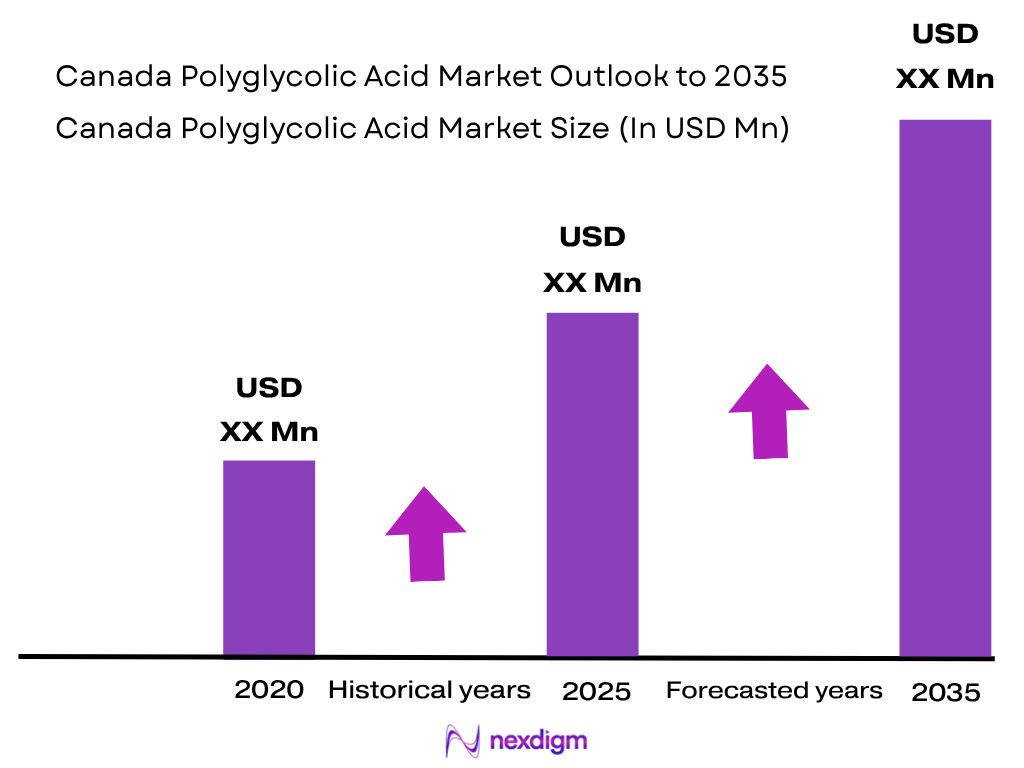
The Canada Polyglycolic Acid Market is valued at approximately USD ~ million, based on historical demand analysis. Demand is supported by absorbable sutures, bioresorbable devices, orthopedic products, drug-delivery systems and specialized industrial applications. Canada’s medical-device manufacturing sector generated CAD 24.4 billion in economic output and 88,394 full-time-equivalent positions, while the country’s medical-device imports subsequently reached CAD 14 billion, supporting demand for advanced medical materials and finished PGA-containing products.
Ontario, Quebec and Alberta are the principal commercial centers influencing the Canada Polyglycolic Acid Market. Ontario generated CAD 14.3 billion of medical-device manufacturing output and Quebec generated CAD 5.4 billion, making them important locations for medical-grade PGA applications, biomaterials and device development. Alberta’s importance arises from oilfield applications: Canadian crude-oil and equivalent production reached 298.8 million cubic metres, creating a substantial addressable industrial ecosystem for specialized dissolvable PGA downhole components.
Market Segmentation
By Grade
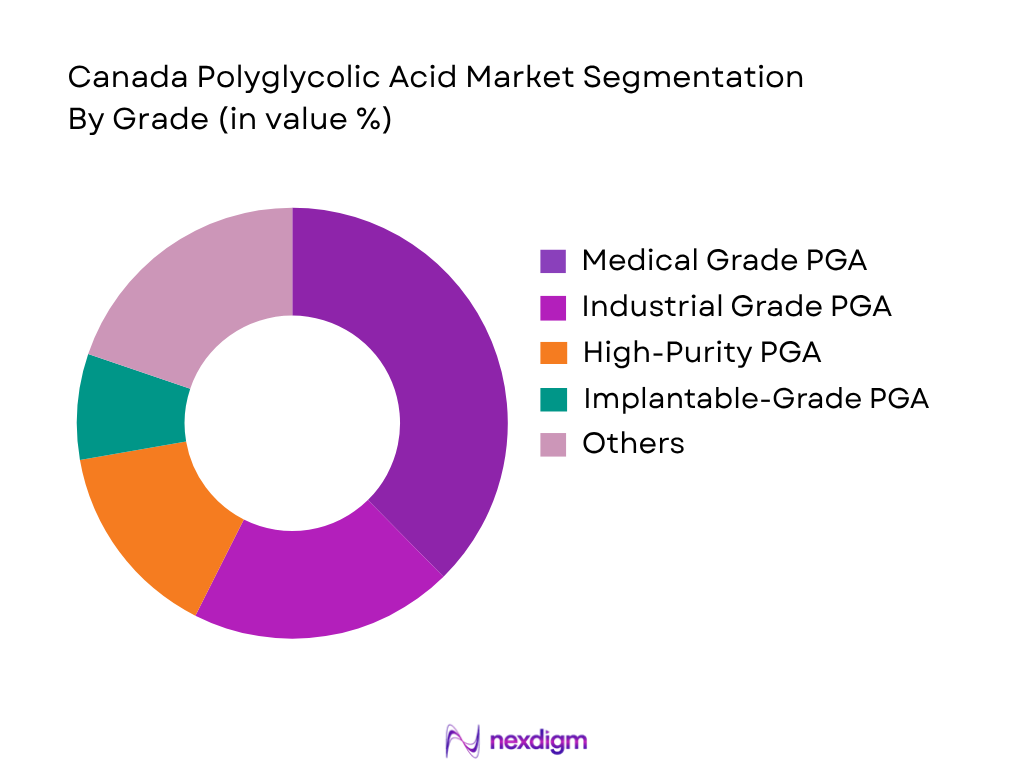
The Canada Polyglycolic Acid Market is segmented by grade into medical-grade PGA, industrial-grade PGA, high-purity PGA, implantable-grade PGA, pharmaceutical and drug-delivery-grade PGA, and research and specialty-grade PGA. Medical-grade PGA holds the dominant market share because PGA has established functionality in absorbable sutures, temporary wound-closure products and bioresorbable medical applications. Canada has a sophisticated medical-device ecosystem with strong manufacturing concentrations in Ontario and Quebec, providing an established customer base for high-purity polymers and finished products incorporating PGA. Medical-grade applications also command greater material-performance requirements than general industrial applications, including molecular-weight consistency, controlled hydrolysis, sterilization compatibility, biocompatibility and documentation supporting device qualification. Industrial-grade PGA has an important position in barrier packaging and oilfield dissolvables, particularly in Western Canada, while implantable and pharmaceutical grades serve specialized applications such as orthopedic fixation, regenerative medicine and controlled drug delivery. The combination of clinical applications and regulated manufacturing therefore supports the leading position of medical-grade PGA.
By Application Type
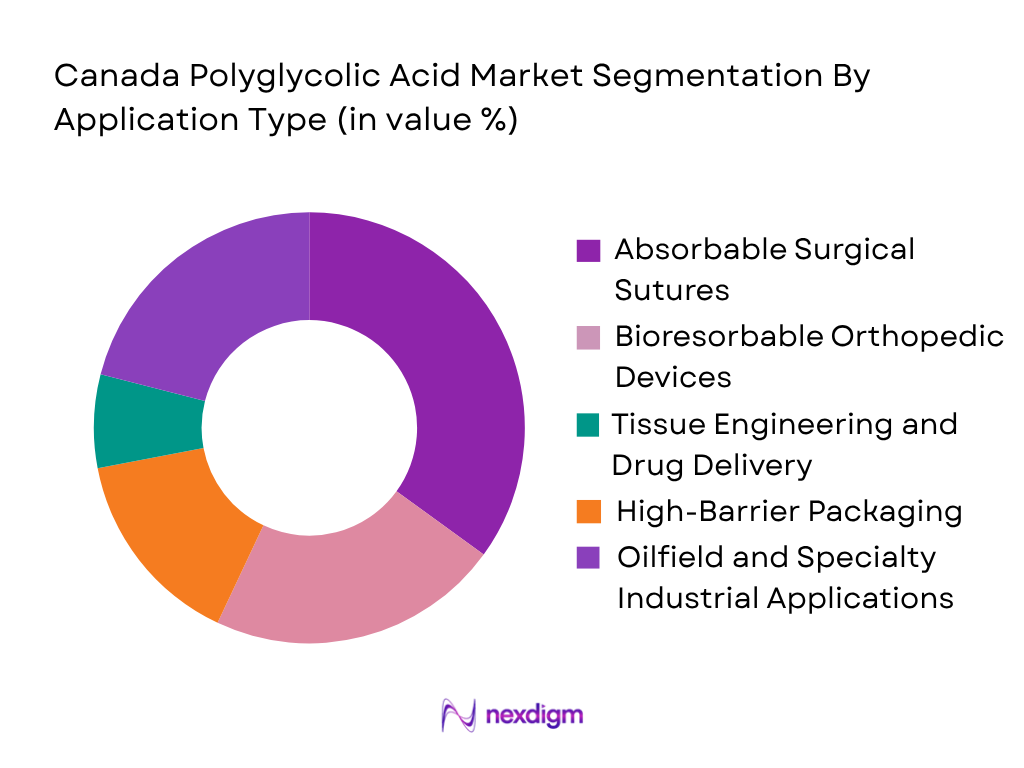
The Canada Polyglycolic Acid Market is segmented by application into absorbable surgical sutures, bioresorbable orthopedic devices, tissue engineering and drug delivery, high-barrier packaging, and oilfield and specialty industrial applications. Absorbable surgical sutures hold the dominant market share because PGA combines high initial tensile strength with predictable hydrolytic degradation, allowing wound support to be provided temporarily without permanent implantation. Canada’s developed hospital system and medical-device ecosystem reinforce the commercial relevance of this application. Bioresorbable orthopedic devices represent a technologically advanced segment involving temporary fixation products and implantable polymer systems, while tissue-engineering and drug-delivery applications require specialized material purity and controlled degradation profiles. Industrial applications are differentiated by geography and performance requirements. Alberta’s large upstream energy sector creates a particularly relevant environment for PGA-based dissolvable frac balls, plugs and temporary downhole components, while Canadian packaging converters provide an additional route for PGA through high-barrier multilayer structures and specialty biodegradable polymer systems.
Competitive Landscape
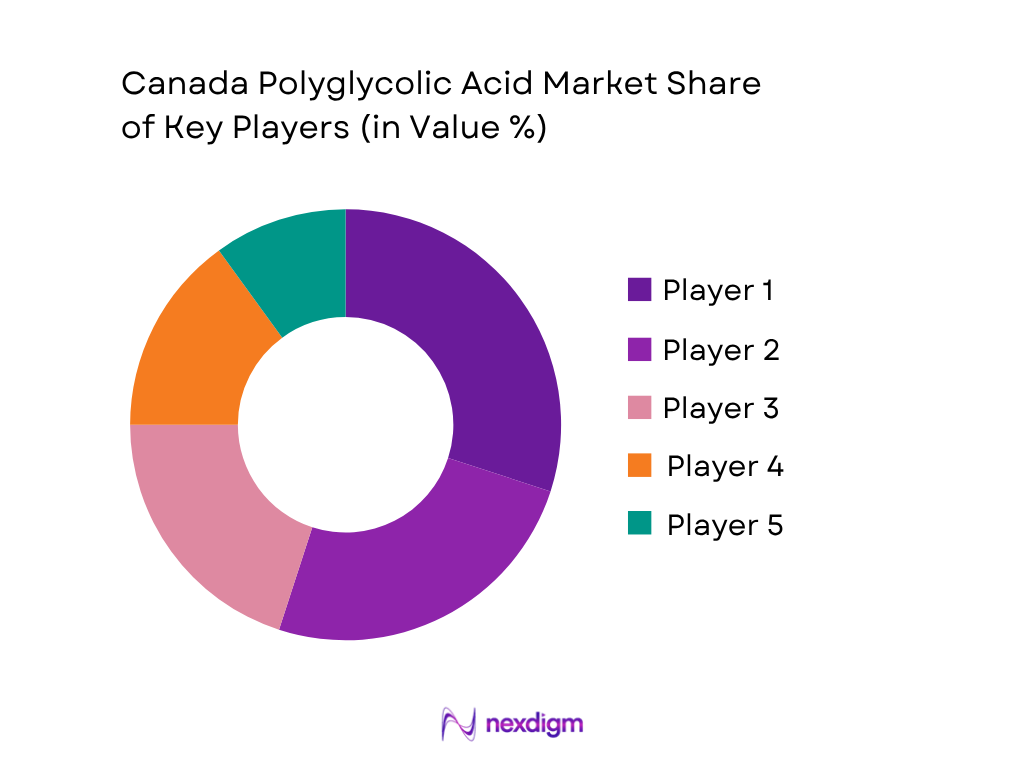
The Canada Polyglycolic Acid Market is characterized by international PGA resin manufacturers, resorbable biomaterial specialists and medical-device companies supplying products into Canada through North American distribution and regulatory channels. Kureha Corporation is differentiated by high-molecular-weight PGA technology and industrial applications, while Evonik and Corbion have established positions in resorbable medical polymers. Ethicon and Teleflex strengthen the downstream competitive landscape through surgical and wound-closure applications. Competitive differentiation depends on material purity, molecular-weight control, degradation performance, regulatory documentation, application engineering and supply reliability.
| Major Player | Establishment Year | Headquarters | PGA/Biomaterial Focus | Medical Application Capability | Industrial Application Capability | Core Technology | Canada/North America Reach | Key Differentiation |
| Kureha Corporation | 1944 | Tokyo, Japan | ~ | ~ | ~ | ~ | ~ | ~ |
| Evonik Industries AG | 2007 | Essen, Germany | ~ | ~ | ~ | ~ | ~ | ~ |
| Corbion N.V. | 1919 | Amsterdam, Netherlands | ~ | ~ | ~ | ~ | ~ | ~ |
| Johnson & Johnson MedTech / Ethicon | 1886 | New Jersey, USA | ~ | ~ | ~ | ~ | ~ | ~ |
| Teleflex Incorporated | 1943 | Pennsylvania, USA | ~ | ~ | ~ | ~ | ~ | ~ |
Canada Polyglycolic Acid Market Analysis
Growth Drivers
Expanding Surgical and Hospital Activity Supporting Medical-Grade PGA Demand
Canada’s sustained hospital and surgical activity provides a strong demand foundation for medical-grade polyglycolic acid used in absorbable sutures, wound-closure products and bioresorbable medical components. Canadian Institute for Health Information data recorded 3.14 million acute inpatient hospitalizations during 2024–2025, compared with 3.05 million during the preceding reporting period. Caesarean section remained the country’s most common inpatient surgical procedure, while knee and hip replacements ranked among the leading inpatient surgeries, directly supporting consumption of surgical closure and implant-related materials. CIHI also reported higher procedure volumes during 2024 for several priority surgeries, including hip and knee replacement procedures, reinforcing demand for surgical consumables and advanced biomaterials. Canada’s broader medical-device supply system is equally substantial: Innovation, Science and Economic Development Canada recorded CAD 14 billion of medical-device imports and CAD 5.5 billion of exports in 2024, demonstrating significant movement of regulated medical products through the Canadian healthcare ecosystem. From a macroeconomic perspective, the IMF recorded Canada’s 2024 nominal GDP at CAD 2,934 billion, equivalent to USD 2,173 billion, GDP per capita of USD 54,531, and population of 41.1 million, supporting continued healthcare expenditure and medical-material utilization.
Strong Medical Device Trade and North American Supply-Chain Integration
Canada’s highly integrated medical-device supply chain strengthens the commercial environment for PGA-containing sutures, resorbable implants and specialty biomaterials because manufacturers and distributors can access large North American procurement and regulatory networks. Innovation, Science and Economic Development Canada reported CAD 14 billion in Canadian medical-device imports and CAD 5.5 billion in exports during 2024. Imports originating from the United States reached CAD 5.9 billion, while Canadian medical-device exports to the United States reached CAD 4.08 billion, illustrating the scale of cross-border movement relevant to surgical products, implantable devices and their material inputs. Such integration enables Canadian medical-device companies to qualify specialized PGA resin, fibers and bioresorbable polymer systems through established North American sourcing channels rather than relying solely on small domestic material networks. The same ecosystem provides potential routes for Canadian-developed PGA medical products to reach neighboring markets. Underlying economic capacity remains substantial: IMF data place Canadian nominal GDP at CAD 2,934 billion, equivalent to USD 2,173 billion, with GDP per capita of USD 54,531 and a population of 41.1 million in 2024. These conditions support medical manufacturing, regulatory compliance expenditure and specialist biomaterial procurement required for PGA commercialization.
Market Challenges
Reliance on Imported Specialty Medical Materials and Finished Devices
The Canada Polyglycolic Acid Market faces a supply-chain challenge because high-purity PGA and many finished medical products incorporating specialized biomaterials are sourced through international networks rather than a large domestic PGA polymerization base. Public Canadian trade statistics do not separately identify medical-grade PGA resin as an independent trade category, but the broader medical-device supply structure demonstrates substantial import dependence relevant to PGA-containing products. Innovation, Science and Economic Development Canada recorded CAD 14 billion of medical-device imports in 2024 against CAD 5.5 billion of exports, producing an import-export difference of CAD 8.5 billion. Imports from the United States alone reached CAD 5.9 billion, showing the importance of external suppliers within Canadian medical procurement. For PGA users, this dependence can translate into longer material qualification chains, international logistics exposure and reliance on overseas production of high-molecular-weight or implantable-grade polymers. The macroeconomic scale of Canada does not remove this specialized supply constraint: IMF figures show nominal GDP of CAD 2,934 billion, GDP per capita of USD 54,531, and population of 41.1 million in 2024. Consequently, expanding Canadian PGA use requires reliable international resin sourcing alongside stronger domestic conversion, technical support and inventory capabilities.
Stringent Medical Device Licensing and Material Qualification Requirements
Regulatory qualification represents a significant challenge for PGA-based medical products because absorbable sutures, resorbable implants and other devices must satisfy Canadian safety, quality and licensing requirements before commercial sale. Health Canada requires manufacturers of Class II, III and IV medical devices to maintain appropriate device licences, while quality-management-system compliance is assessed through ISO 13485 certification under the Medical Device Single Audit Program. Regulatory enforcement is material rather than procedural: following the April 1, 2024 annual licence review deadline, Health Canada reported cancelling 145 Medical Device Establishment Licences because holders had not submitted required annual review applications. Health Canada also introduced updated medical-device compliance and enforcement guidance effective December 14, 2024, strengthening the framework governing regulated parties. For PGA applications, these requirements sit alongside technical issues such as degradation consistency, molecular-weight retention, sterilization compatibility and moisture-sensitive processing, making qualification more demanding than for conventional commodity polymers. Canada’s IMF-recorded 2024 economic indicators—CAD 2,934 billion nominal GDP, USD 54,531 GDP per capita and 41.1 million people—support a sophisticated healthcare system, but they also imply high expectations for documented safety, quality control and regulatory traceability across advanced PGA medical products.
Market Opportunities
Expansion of Bioresorbable Surgical and Orthopedic PGA Applications
Canada offers a substantial future opportunity for PGA suppliers through expansion into absorbable sutures, temporary orthopedic fixation devices, surgical meshes and other bioresorbable medical products. Current healthcare activity demonstrates an established clinical base capable of supporting these applications. Canadian Institute for Health Information data recorded 3.14 million acute inpatient hospitalizations during 2024–2025, increasing from 3.05 million in the preceding reporting period. Caesarean section was the most common inpatient surgery, followed by procedures including knee and hip replacement, applications where wound closure and orthopedic biomaterials are commercially relevant. CIHI’s 2025 release covering 2024 procedure activity also reported increased volumes for major priority procedures, indicating sustained utilization of surgical infrastructure. Canada’s medical-device trade ecosystem further supports future localization and application development, with CAD 14 billion of imports and CAD 5.5 billion of exports recorded in 2024 by Innovation, Science and Economic Development Canada. IMF data show a 2024 population of 41.1 million, nominal GDP of CAD 2,934 billion, and GDP per capita of USD 54,531. These present-day healthcare, trade and macroeconomic conditions provide a credible platform for future PGA adoption in higher-value bioresorbable products without relying on speculative future-volume assumptions.
PGA-Based Dissolvable Components for Canada’s Oil and Gas Sector
Canada’s upstream petroleum industry creates a differentiated future-growth opportunity for industrial-grade PGA in dissolvable frac balls, plugs, temporary completion tools and other downhole components engineered to disappear after performing a mechanical function. Canada Energy Regulator data show that Canadian crude-oil and equivalent production averaged 5.13 million barrels per day in 2024, compared with 4.93 million barrels per day in the prior period, while production reached 5.44 million barrels per day in December 2024. During the first six months of 2025, output averaged 5.19 million barrels per day, confirming sustained operational scale. Alberta alone added 172,000 barrels per day of production during 2024, while British Columbia added 25,000 barrels per day, making Western Canada particularly relevant for PGA-based completion technologies. These operating conditions create opportunities for materials designed around controlled hydrolysis, pressure resistance, temperature tolerance and predictable dissolution after well-completion operations. Canada’s broader economic capacity further supports technology deployment: IMF data record CAD 2,934 billion in nominal GDP, USD 54,531 GDP per capita and a population of 41.1 million in 2024. Current energy activity therefore provides a tangible industrial base for future commercialization of specialized PGA downhole applications.
Future Outlook
The Canada Polyglycolic Acid Market is expected to expand at approximately ~XX% CAGR during 2026-2035, supported by medical biomaterial development, absorbable surgical applications, bioresorbable orthopedic technologies and specialized industrial uses. Future development is expected to extend beyond conventional sutures toward higher-value implantable devices, controlled drug-delivery platforms, engineered packaging structures and dissolvable oilfield components.
Medical and Bioresorbable Applications: Medical-grade PGA is expected to remain central to market development because Canada has an established medical-technology ecosystem capable of supporting advanced biomaterials, product development and regulatory commercialization. Opportunities exist in absorbable sutures, temporary orthopedic fixation, surgical mesh, tissue scaffolds and drug-delivery systems. Suppliers offering tightly controlled degradation profiles, high material purity and comprehensive regulatory documentation should have an advantage in medical applications.
Major Players
- Kureha Corporation
- Evonik Industries AG
- Corbion N.V.
- Johnson & Johnson MedTech / Ethicon
- Teleflex Incorporated
- B. Braun
- Medtronic
- Meta Biomed Co., Ltd.
- Samyang Biopharmaceuticals Corporation|
- WEGO Group
- Healthium Medtech
- Corza Medical
- Advanced Medical Solutions / Peters Surgical
- BMG Incorporated
- Polysciences, Inc.
Key Target Audience
- Polyglycolic Acid Resin and Specialty Biopolymer Manufacturers
- Medical Biomaterial and Bioresorbable Polymer Manufacturers
- Absorbable Suture and Wound Closure Product Manufacturers
- Orthopedic Implant and Medical Device Manufacturers
- Oilfield Equipment, Completion Tool and Dissolvable Component Companies
- Packaging Converters and Specialty Polymer Compounders
- Investments and Venture Capitalist Firms
- Government and Regulatory Bodies (Health Canada, Innovation, Science and Economic Development Canada, Environment and Climate Change Canada, Canada Energy Regulator)
Research Methodology
Step 1: Identification of Key Variables
The initial phase involves constructing a detailed ecosystem map covering PGA resin producers, biomaterial suppliers, medical-device companies, suture manufacturers, polymer converters, packaging companies, oilfield service providers and distributors operating in or supplying Canada. Secondary research is used to identify critical variables including PGA grade, molecular weight, product form, application, processing technology, import dependency, regulatory status and downstream consumption.
Step 2: Market Analysis and Construction
Historical market development is analyzed through simultaneous top-down and bottom-up approaches. The top-down model evaluates medical-device manufacturing, healthcare, specialty polymers, packaging and upstream energy activity, while the bottom-up assessment measures potential PGA consumption across sutures, implants, drug delivery, packaging and oilfield components. Import dependency, supplier presence, application penetration and domestic conversion capabilities are reconciled to construct the market framework.
Step 3: Hypothesis Validation and Expert Consultation
Market hypotheses are validated through computer-assisted telephone interviews with medical-device manufacturers, biomaterial suppliers, specialty polymer distributors, surgical product companies, packaging converters and oilfield technology providers. Discussions focus on material procurement, grade requirements, supplier qualification, degradation characteristics, processing constraints, regulatory documentation and application development. Primary responses are triangulated against secondary information to refine demand assumptions and competitive positioning.
Step 4: Research Synthesis and Final Output
The final phase integrates secondary databases, government information, company disclosures and primary interviews into a consolidated Canada Polyglycolic Acid Market model. Bottom-up application consumption is cross-validated against top-down industrial indicators and supply-side availability. Competitive benchmarking evaluates polymer technology, medical-grade capability, application expertise, regulatory positioning, distribution reach and technical support to establish the final market outlook and strategic recommendations.

- Executive Summary
- Research Methodology (Market Definition and Scope, Canada Polyglycolic Acid Classification, Glycolide-to-PGA Value Chain Mapping, Medical-Grade and Industrial-Grade Assessment, PGA Resin Import Mapping, Demand-Side Consumption Analysis, Supply-Side Availability Assessment, Application-Level Consumption Assessment, Medical Device Licence Mapping, Primary Industry Interviews, Top-Down Market Sizing, Bottom-Up Demand Validation, Data Triangulation, Forecasting Framework, Regulatory Assessment, Limitations and Future Conclusions)

- Definition and Scope
- Canada Polyglycolic Acid Industry Evolution and Development of Bioresorbable and High-Performance Polymer Ecosystem
- Polyglycolic Acid Chemistry, Glycolide Ring-Opening Polymerization and Material Performance Structure
- Canada Polyglycolic Acid Value Chain Analysis
- Canada Polyglycolic Acid Supply Chain Analysis
- Glycolic Acid, Glycolide, PGA Resin, Medical Biomaterial, Surgical Device, Polymer Converter and Specialty Chemical Distribution Ecosystem Analysis
- PGA Integration Assessment Across Absorbable Sutures, Bioresorbable Implants, Drug Delivery, High-Barrier Packaging and Dissolvable Oilfield Components

- Growth Drivers (Expansion of Canadian Medical Device Manufacturing, Increasing Bioresorbable Medical Material Adoption, Absorbable Surgical Product Demand, Growth of Orthopedic and Implantable Device Applications, Development of Specialty Polymer Technologies, Expansion of Dissolvable Downhole Technologies)
- Market Challenges (Dependence on Imported High-Molecular-Weight PGA, Limited Domestic Glycolide-to-PGA Polymerization Capacity, Medical-Grade Material Qualification Requirements, Moisture-Induced Hydrolysis, Narrow Melt Processing Window, Specialized Oilfield Material Qualification, Health Canada Device Licensing Requirements)
- Market Opportunities (Bioresorbable Orthopedic Devices, PGA-Based Wound Closure Products, Controlled Drug Delivery Platforms, High-Barrier Sustainable Packaging, PGA/PLA Specialty Compounds, Dissolvable Frac Balls and Plugs, Temporary Downhole Completion Components)
- Market Trends (High-Purity Resorbable Polymer Adoption, Synthetic Absorbable Suture Development, PGA-Based Orthopedic Biomaterials, Customized Degradation Profiles, Multilayer Barrier Film Development, PGA-Based Oilfield Dissolvables, Medical Polymer Supply Chain Diversification)
- Regulatory and Standards Landscape (Food and Drugs Act, Medical Devices Regulations, Health Canada Medical Device Licence, Medical Device Establishment Licence, Medical Devices Active Licence Listing, Medical Device Single Audit Program, ISO 13485 Quality Management Requirements, Canadian Environmental Protection Act, Federal Plastics Registry, Single-Use Plastics Prohibition Regulations)
- SWOT Analysis
- Porter’s Five Forces Analysis
- PESTLE Analysis
- Stakeholder Ecosystem
- Competition Ecosystem

- By Market Value (2020-2025)
- By PGA Consumption Volume (2020-2025)
- By Medical-Grade PGA Consumption Volume (2020-2025)
- By Industrial-Grade PGA Consumption Volume (2020-2025)
- By Imported PGA Resin Volume (2020-2025)
- By Domestic PGA Conversion Volume (2020-2025)
- By PGA-Based Absorbable Suture Consumption Volume (2020-2025)

- By Grade (In Value %)
Medical Grade PGA
Industrial Grade PGA
High-Purity PGA
Implantable-Grade PGA
Pharmaceutical and Drug Delivery Grade PGA
Research and Specialty Grade PGA - By Product Form (In Value %)
PGA Pellets and Granules
PGA Powder
PGA Fibers and Filaments
PGA Braided Suture Material
PGA Films and Sheets
PGA-Based Compounds and Blends
PGA Molded and Machined Components
PGA Preforms and Semi-Finished Materials - By Application Type (In Value %)
Absorbable Surgical Sutures
Bioresorbable Orthopedic Devices
Temporary Fixation Devices
Tissue Engineering Scaffolds
Controlled Drug Delivery Systems
Surgical Mesh and Wound Closure Products
High-Barrier Packaging Films
Multilayer Food and Beverage Packaging
Dissolvable Frac Balls and Plugs
Temporary Downhole Components
Biodegradable Polymer Blends
Specialty Technical Applications - By End-Use Industry (In Value %)
Medical Device Manufacturing
Hospitals and Healthcare
Orthopedics and Surgical Care
Pharmaceutical and Drug Delivery
Food and Beverage Packaging
Flexible and Specialty Packaging
Oil and Gas Exploration and Production
Oilfield Equipment and Services
Specialty Polymer Compounding
Biotechnology and Biomaterials
Research and Specialty Materials - By Province and Region (In Value %)
Ontario
Quebec
Alberta
British Columbia
Saskatchewan
Manitoba
Atlantic Canada

- Market Share of Major Players (By PGA Supply Volume, Medical-Grade Portfolio, Industrial-Grade Portfolio, Absorbable Suture Presence, Bioresorbable Device Applications, Oilfield Applications, Distribution Reach, Customer Segment)
- Cross Comparison Parameters (PGA Grade Portfolio Breadth, High-Molecular-Weight PGA Capability, Medical-Grade and Implantable Biomaterial Capability, Absorbable Suture and Wound Closure Expertise, Oilfield Dissolvable Material Application Capability, High-Barrier Packaging Application Coverage, Canada and North America Distribution Reach, Regulatory and Technical Application Support Capability)
- SWOT Analysis of Major Players
- Competitive Positioning Matrix
- Pricing and PGA Grade Category Benchmarking
- Detailed Profiles of Major Companies
Kureha Corporation – Kuredux PGA Resin, High-Molecular-Weight PGA, Barrier Packaging and Industrial Applications
Evonik Industries AG – RESOMER Bioresorbable Polymers, Implantable Medical Biomaterials and Drug Delivery Solutions
Corbion N.V. – PURASORB Glycolide and Resorbable Polymers, Orthopedic Devices and Drug Delivery Applications
Johnson & Johnson MedTech / Ethicon – Absorbable Surgical Sutures, Wound Closure Systems and Surgical Applications
Teleflex Incorporated – Absorbable Surgical Products, Surgical Devices and Wound Closure Applications
B. Braun – Absorbable Sutures, Surgical Closure Products and Medical Biomaterial Applications
Medtronic – Bioresorbable Surgical Materials, Medical Devices and Advanced Surgical Applications
Meta Biomed Co., Ltd. – PGA Absorbable Sutures, Surgical Biomaterials and Medical Polymer Products
Samyang Biopharmaceuticals Corporation – PGA-Based Absorbable Sutures, Bioresorbable Polymers and Medical Biomaterials
WEGO Group – PGA Absorbable Sutures, Rapid-Absorbing Surgical Sutures and Medical Consumables
Healthium Medtech – PGA Surgical Sutures, Resorbable Wound Closure Products and Medical Devices
Corza Medical – PGA-Based PolySyn Surgical Sutures, Wound Closure Technologies and Surgical Products
Advanced Medical Solutions / Peters Surgical – PGA Absorbable Sutures, Surgical Closure Products and Resorbable Medical Devices
BMG Incorporated – Medical-Grade PGA, Bioresorbable Polymer Materials and Biomedical Applications
Polysciences, Inc. – High-Purity Polyglycolide, Specialty PGA Materials and Biomedical Research Applications

- Medical Device Manufacturer Procurement Assessment
- Absorbable Suture Manufacturer Requirement Analysis
- Orthopedic Device Manufacturer Material Requirement Analysis
- Hospital and Surgical Procurement Assessment
- Pharmaceutical and Drug Delivery Developer Assessment
- Packaging Converter Requirement Assessment
- Oilfield Operator Requirement Assessment
- Polymer Compounder Demand Assessment
- PGA Supplier Selection Criteria

- By Market Value (2026-2035)
- By PGA Consumption Volume (2026-2035)
- By Medical-Grade PGA Consumption Volume (2026-2035)
- By Imported PGA Resin Volume (2026-2035)
- By Industrial-Grade PGA Consumption Volume (2026-2035)
- By Domestic PGA Conversion Volume (2026-2035)
- By PGA-Based Absorbable Suture Consumption Volume (2026-2035)


 Request a Sample
 Ask for Customization
 Get a Quote
 Enquire Now