

 Download PDF
Market Overview
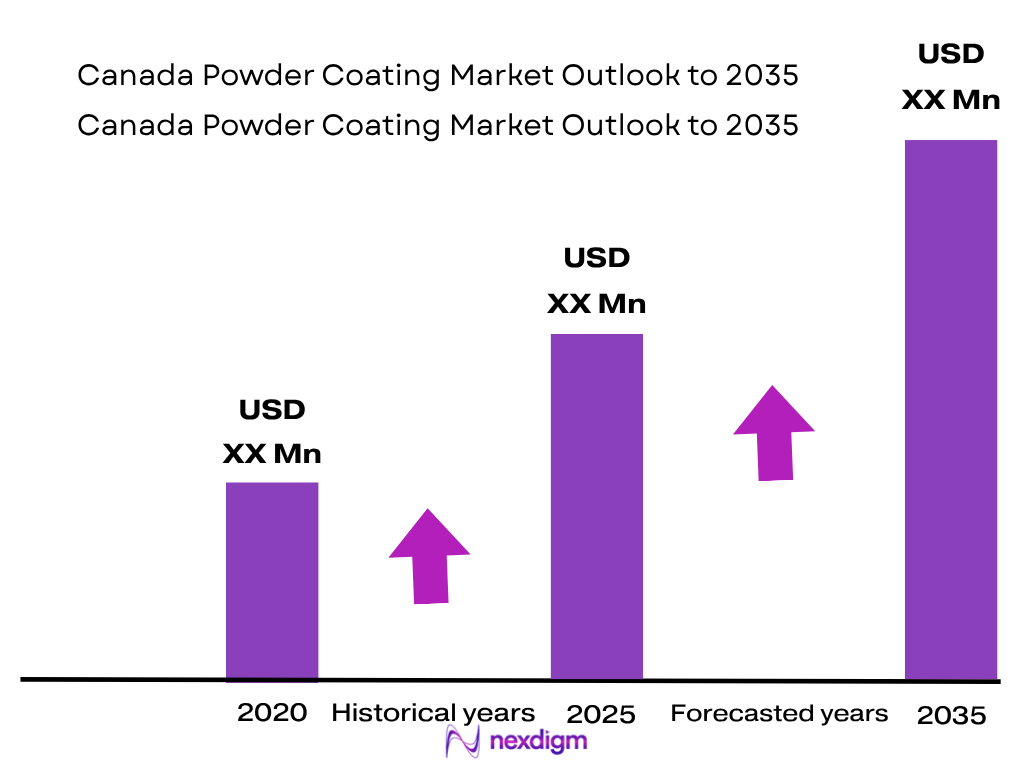
The Canada Powder Coating Market is valued at USD ~million, supported by the country’s automotive, appliance, architectural, fabricated-metal and industrial manufacturing base. Published Canada-specific industry data place the preceding market benchmark at USD 851.3 million, while Statistics Canada recorded total manufacturing sales of CAD 861.4 billion in the preceding annual cycle and CAD 847.2 billion in the latest annual cycle. Powder demand remains tied to durable metal finishing, corrosion protection and solvent-free industrial coating requirements.
Ontario and Québec dominate Canadian powder-coating consumption because they contain the country’s largest concentrations of automotive, fabricated-metal, aerospace, machinery, appliance and architectural manufacturing, while Alberta is strategically important for energy infrastructure and heavy equipment. Ontario recorded approximately CAD 5.55 billion of residential building investment in a late-period monthly observation, compared with Québec at CAD 3.27 billion. National industrial-building investment reached CAD 10.5 billion in the latest annual cycle, with Ontario contributing the largest increase, followed by Alberta.
Market Segmentation
By Resin Type
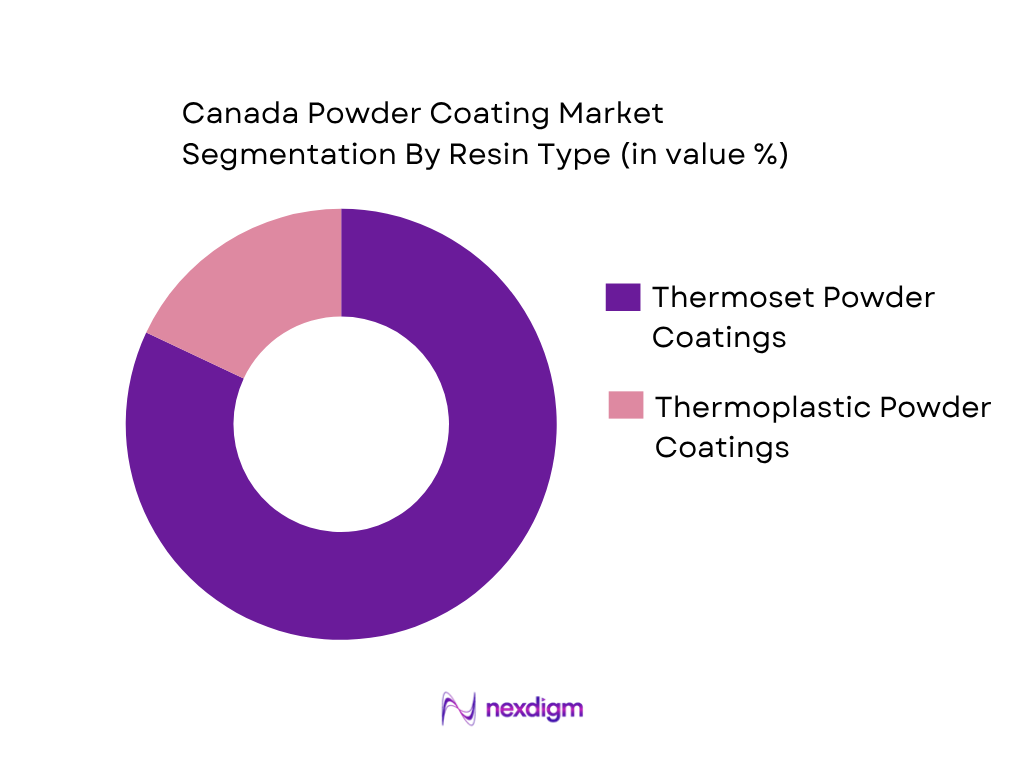
The Canada Powder Coating Market is segmented into thermoset and thermoplastic powder coatings. Thermoset powder coatings hold the dominant share because Canada’s principal powder-consuming industries—including appliances, automotive components, architectural aluminium, agricultural machinery, fabricated metals and general industrial equipment—require durable decorative and protective finishes that can be efficiently cross-linked during oven curing. Polyester, epoxy-polyester hybrid and epoxy systems offer broad performance flexibility across indoor and outdoor substrates. Canada-specific market research identifies thermoset powders as the leading resin category, while Axalta’s Canadian portfolio illustrates commercial demand for polyester, epoxy, low-energy, high-temperature, antimicrobial and non-TGIC thermoset technologies. Thermoplastics remain strategically relevant in thicker-film corrosion, abrasion and specialty protective applications, including infrastructure components, but represent a smaller addressable application base. Thermoset powders also benefit from automated electrostatic application, overspray reclaim capability and compatibility with high-volume industrial coating lines.
By End-Use Industry
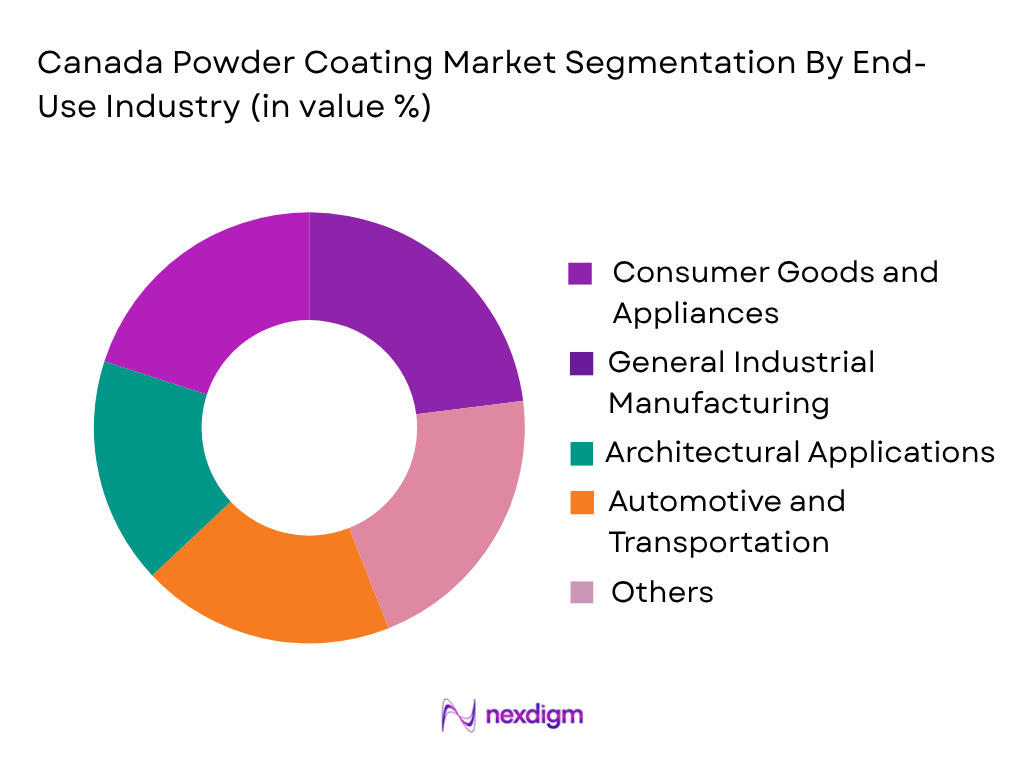
The Canada Powder Coating Market is segmented into appliances and consumer goods, general industrial manufacturing, architectural applications, automotive, furniture and other industrial applications. Appliances and consumer goods represent the dominant modeled segment because powder coating is extensively suited to shelving, refrigerators, HVAC assemblies, electrical housings, cabinets, racks and durable metal consumer products. Published Canada-specific research identifies consumer goods as the leading application, while more recent market coverage places appliances among the largest Canadian powder-coating end uses. General industrial demand is supported by fabricated metals and machinery, whereas architectural powders serve aluminium extrusions and building components requiring exterior durability. Automotive remains structurally important despite temporary production interruptions associated with EV retooling. Statistics Canada recorded CAD 55.1 billion in motor-vehicle manufacturing sales and CAD 33.7 billion in motor-vehicle parts sales in the latest annual cycle, demonstrating the size of the underlying coated-component ecosystem.
Competitive Landscape
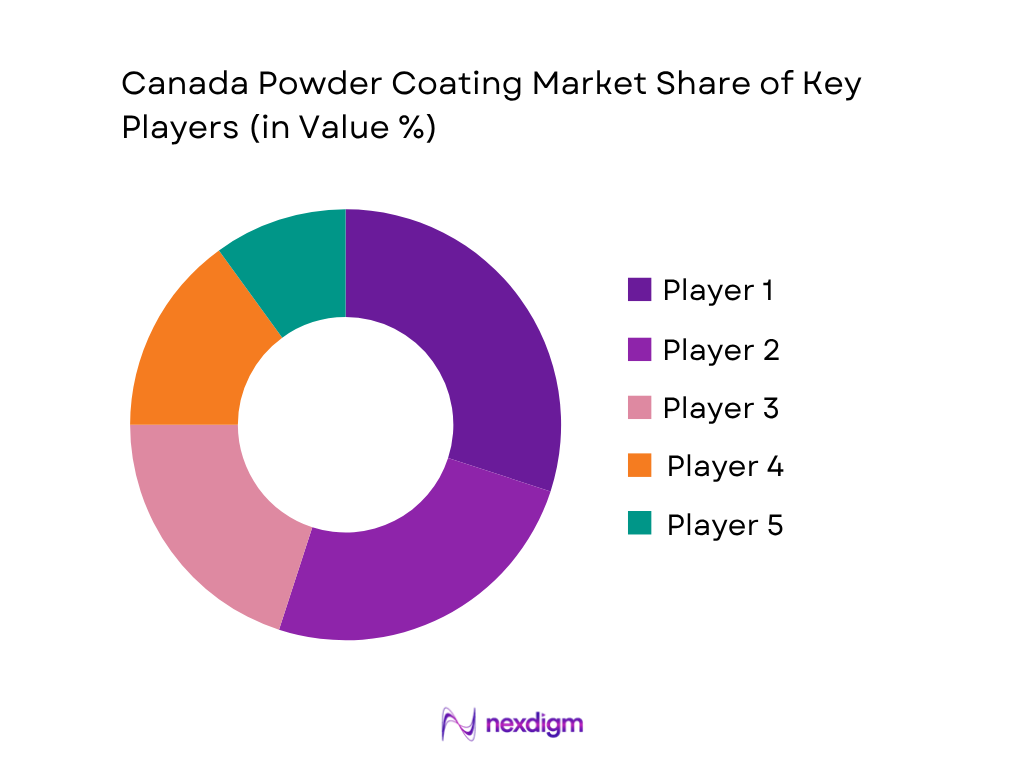
The Canada Powder Coating Market combines multinational coating groups with North American specialty powder suppliers. Competition is based less on commodity color availability alone and increasingly on resin breadth, OEM approval, low-temperature curing, corrosion performance, architectural durability, pipeline FBE technology, regional inventory and application-line technical support. Axalta maintains a dedicated Canadian powder-coating offering, AkzoNobel markets Interpon products in Canada, and PPG provides a broad Envirocron portfolio serving industrial, architectural and OEM applications.
| Company | Establishment Year | Headquarters | Core Powder Technologies | Canada / North America Supply Position | Key End Uses | Architectural Capability | Low-Cure / Efficiency Capability | Corrosion / Specialty Capability |
| AkzoNobel – Interpon | 1792 | Amsterdam, Netherlands | ~ | ~ | ~ | ~ | ~ | ~ |
| Axalta Coating Systems – Alesta | 1866 heritage | Philadelphia, USA | ~ | ~ | ~ | ~ | ~ | ~ |
| PPG Industries – Envirocron | 1883 | Pittsburgh, USA | ~ | ~ | ~ | ~ | ~ | ~ |
| The Sherwin-Williams Company | 1866 | Cleveland, USA | ~ | ~ | ~ | ~ | ~ | ~ |
| Protech Group / Oxyplast | 1976 | Montréal, Canada | ~ | ~ | ~ | ~ | ~ |
Canada Powder Coating Market Analysis
Growth Drivers
Automotive and Transportation Component Manufacturing Base
Canada’s automotive and transportation manufacturing ecosystem creates substantial recurring demand for powder coatings across wheels, suspension components, seat structures, springs, brackets, battery housings, chassis assemblies and fabricated vehicle components. Statistics Canada recorded CAD 55.1 billion in motor-vehicle manufacturing sales and CAD 33.7 billion in motor-vehicle-parts manufacturing sales during 2024. Canada also had 26.8 million registered road motor vehicles, including 24.6 million light-duty vehicles, providing a large installed transportation ecosystem supporting replacement parts and component manufacturing. Beyond conventional vehicles, automotive plants in Ontario underwent modernization and retooling for electric-vehicle production, widening future coating requirements toward battery enclosures, electrical housings and structurally coated components. Powder coatings are particularly suitable for these applications because electrostatic application enables consistent coverage of complex metal components while thermoset polyester, epoxy and hybrid formulations provide corrosion, impact and weathering resistance. Canada’s underlying macroeconomic scale further supports industrial demand: the IMF recorded 2024 nominal GDP of CAD 2,934 billion, equivalent to USD 2,173 billion, with a population of 41.1 million. Consequently, the scale of automotive production and component fabrication provides a direct industrial demand platform for Canadian powder-coating suppliers.
Expansion of Fabricated Metal, Machinery and Advanced Equipment Manufacturing
Canada’s diversified durable-goods manufacturing base supports powder-coating consumption well beyond automotive applications, particularly across fabricated metal products, industrial machinery, electrical equipment, aerospace components, cabinets, enclosures and structural assemblies. Statistics Canada recorded CAD 847.2 billion of total manufacturing sales during 2024, while aerospace product and parts manufacturing reached a record CAD 31.1 billion. Current production data demonstrate continued downstream activity: in March 2026, fabricated-metal-product manufacturing generated CAD 4.385 billion in monthly sales, machinery manufacturing generated CAD 4.516 billion, and electrical-equipment, appliance and component manufacturing generated CAD 1.358 billion. These industries require durable surface finishing on machinery frames, electrical cabinets, transformers, motors, racks, aerospace support equipment and fabricated assemblies, creating applications for polyester, epoxy-polyester hybrid, epoxy and specialty functional powder coatings. Powder technology also supports high-throughput manufacturers requiring repeatable film thickness and automated application. The broader economic foundation remains significant, with the World Bank reporting Canada’s 2024 GDP at USD 2.24 trillion and GDP per capita at USD 54,340.3. This combination of large-scale manufacturing and advanced-equipment production strengthens the addressable industrial substrate base for powder coatings.
Market Challenges
Dependence on Imported Epoxy and Polyester Resin Feedstocks
Canada’s powder-coating industry faces raw-material supply exposure because major resin families required for epoxy, hybrid and polyester formulations enter the country through international supply chains. World Bank WITS data show Canada imported exactly 29,537,400 kilograms of epoxide resins in primary forms during 2024. The United States supplied 20,500,300 kilograms, China supplied 4,037,340 kilograms, Other Asia supplied 1,531,470 kilograms, and South Korea supplied 1,372,630 kilograms. Canada also imported 35,612,000 kilograms of other primary-form polyesters, including 24,041,100 kilograms from the United States, 5,226,570 kilograms from China, and 2,131,370 kilograms from Germany. These resin groups are directly relevant to epoxy powders, epoxy-polyester hybrids, general industrial polyester powders and exterior-durable coating formulations. Heavy reliance on cross-border feedstocks increases exposure to shipping interruptions, customs changes, exchange-rate movements, supplier allocation decisions and qualification delays when specific resin grades become unavailable. This exposure is commercially important within an economy where the IMF recorded 2024 nominal GDP of CAD 2,934 billion, or USD 2,173 billion. Canadian powder formulators therefore require diversified resin sourcing, alternative approved formulations and resilient regional inventories to maintain reliable supply to OEMs and job coaters.
Automotive Retooling, Production Interruptions and Manufacturing Volatility
Canada’s concentration of powder-coating demand in transportation and export-oriented manufacturing creates operational risk when automotive plants undergo retooling, temporary shutdowns or supply disruptions. Statistics Canada recorded CAD 55.1 billion of motor-vehicle manufacturing sales and CAD 33.7 billion of motor-vehicle-parts sales in 2024, while noting that several Canadian assembly facilities underwent extended modernization for electric-vehicle production. Manufacturing volatility continued into 2025: total Canadian manufacturing sales were CAD 848.7 billion, and transportation-equipment sales amounted to CAD 33.0 billion in the fourth quarter. Statistics Canada also reported partial automotive assembly shutdowns during 2025 linked to trade uncertainty and changing production configurations. The operational challenge remained visible in 2026, when Canada sold 114,415 new motor vehicles in January, including only 8,826 new zero-emission vehicles. For powder suppliers, interruptions at assembly plants can propagate through Tier-1 and Tier-2 metal-component manufacturers, reducing coating-line throughput and delaying qualification programs. The macroeconomic context remains sizeable—the IMF recorded Canada’s 2024 nominal GDP at USD 2,173 billion—but powder producers still face end-market concentration risks. Diversification into architectural, machinery, aerospace, electrical and infrastructure applications is therefore increasingly important for stabilizing Canadian powder-coating demand.
Market Opportunities
EV Battery, Charging Infrastructure and Electrified Component Applications
Canada’s expanding electric-vehicle supply chain creates a significant future application pathway for powder coatings used on battery trays, battery enclosures, electrical housings, charging cabinets, motor components, structural brackets and supporting factory equipment. Federal government disclosures identify several large investments established across the Canadian EV ecosystem, including CAD 15 billion associated with Honda’s integrated Ontario EV supply-chain initiative, CAD 7 billion for Volkswagen PowerCo’s battery-cell facility in St. Thomas, and CAD 5 billion for the NextStar Energy battery manufacturing facility in Windsor. Government records also identify CAD 3.6 billion associated with Stellantis EV manufacturing in Windsor and Brampton and CAD 600 million for battery-material production in Québec. These investments create adjacent demand for metal fabrication, electrical equipment, automation systems and protective finishing rather than only direct automotive coating applications. Epoxy and functional powders are particularly relevant for dielectric protection, while durable polyester systems can address exterior charging and infrastructure enclosures. Canada’s macroeconomic capacity supports continued industrial localization: the IMF recorded 2024 nominal GDP at CAD 2,934 billion and population at 41.1 million. Existing EV manufacturing investment therefore provides a current industrial foundation from which specialty powder-coating applications can expand.
Architectural Aluminium and Industrial Building Applications
Canada’s construction and aluminium value chains provide a substantial future opportunity for super-durable polyester, fluoropolymer, corrosion-resistant and architectural powder coatings used on windows, doors, curtain walls, railings, façades, commercial HVAC equipment and exterior fabricated components. Statistics Canada recorded CAD 6,666.3 million of non-residential building investment in December 2024 alone, including CAD 1,465.0 million in industrial construction, CAD 3,268.4 million in commercial projects and CAD 1,932.8 million in institutional construction. The domestic aluminium ecosystem strengthens this opportunity. Natural Resources Canada recorded CAD 17.4 billion of Canadian aluminium-product exports during 2024, including CAD 2.5 billion in semi-finished aluminium products and CAD 1.7 billion in finished aluminium products. Canada also imported CAD 10.7 billion of aluminium products, indicating substantial metal-processing activity across the domestic value chain. These fabricated and semi-finished aluminium products create a natural substrate base for architectural and industrial finishing. Canada’s macroeconomic scale remains supportive, with the World Bank recording 2024 GDP of USD 2.24 trillion. As building-component manufacturers increasingly require long-lasting exterior finishes, suppliers offering weather-resistant polyester, super-durable and specification-compliant powders can expand penetration across Canadian architectural aluminium applications.
Future Outlook
The Canada Powder Coating Market is projected to expand at an indicative ~5.4% CAGR during 2026–2035, used as the requested forecast placeholder. Growth is expected to come from advanced manufacturing, architectural construction, EV-related component investment, electrical equipment, agricultural machinery, pipeline protection and conversion from solvent-based liquid coating processes. Industrial manufacturing will remain central to future demand. Statistics Canada recorded CAD 847.2 billion in manufacturing sales in the latest annual cycle, including CAD 55.1 billion in motor vehicles and CAD 33.7 billion in motor-vehicle parts. Aerospace product and parts output reached a record CAD 31.1 billion, providing another market for high-performance coated components.
Construction represents an additional demand platform for architectural-grade powders. Canadian investment in building construction reached CAD 253.8 billion, while industrial-building investment reached CAD 10.5 billion. Exterior aluminium profiles, railings, façade systems, doors, window systems, HVAC installations and fabricated building components can support continued demand for polyester, super-durable polyester and fluoropolymer powders. Technology adoption is also shifting toward productivity-focused systems. Axalta offers low-energy powders and recycled-content formulations, while PPG’s high-transfer-efficiency systems are designed to increase first-pass application and reduce powder consumption on complex metal components. These developments favor suppliers capable of combining material efficiency, low-temperature curing, rapid color matching and on-site technical support.
Major Players
- AkzoNobel – Interpon
- Axalta Coating Systems – Alesta
- PPG Industries – Envirocron
- The Sherwin-Williams Company
- Protech Group / Oxyplast
- TIGER Coatings / TIGER Drylac
- IFS Coatings
- TCI Powder Coatings
- Jotun Powder Coatings
- Prismatic Powders
- FAM Powder Coating
- IGP Pulvertechnik
- ST Powder Coatings
- Teknos Group – INFRALIT
- 3M – Scotchkote Fusion-Bonded Epoxy Coatings
Key Target Audience
- Powder Coating Manufacturers and Formulators
- Automotive OEMs and Automotive Component Manufacturers
- Architectural Aluminium Extruders and Building Product Manufacturers
- Agricultural, Construction and Heavy Equipment Manufacturers
- Industrial Job Coaters and Metal Fabricators
- Powder Resin, Pigment, Additive and Application Equipment Suppliers
- Investments and Venture Capitalist Firms
- Government and Regulatory Bodies (Environment and Climate Change Canada, Innovation, Science and Economic Development Canada, Natural Resources Canada, Canadian Centre for Occupational Health and Safety, Standards Council of Canada)
Research Methodology
Step 1: Identification of Key Variables
The initial phase involves constructing a comprehensive ecosystem map of the Canada Powder Coating Market covering resin suppliers, powder manufacturers, distributors, job coaters, OEM captive coating lines, aluminium extruders, automotive suppliers, machinery manufacturers and infrastructure contractors. Secondary and proprietary databases are used to identify critical variables including resin chemistry, powder consumption, film thickness, cure temperature, coated surface area, domestic manufacturing and imports.
Step 2: Market Analysis and Construction
Historical market development is assessed through both top-down and bottom-up methodologies. The top-down approach analyzes Canada’s industrial coatings environment and major powder-consuming industries, while bottom-up analysis estimates powder consumption from appliances, automobiles, fabricated metals, architectural aluminium, heavy machinery and infrastructure components. Domestic production, import flows, average powder consumption per application and end-user activity are reconciled to construct the market model.
Step 3: Hypothesis Validation and Expert Consultation
Market hypotheses are validated through computer-assisted telephone interviews with powder manufacturers, industrial distributors, job coaters, raw-material suppliers, coating-equipment providers and OEM procurement professionals. Interviews examine resin preferences, film-build requirements, powder recovery, cure conditions, color-change frequency, OEM specifications, architectural durability requirements, FBE usage and customer purchasing behavior. Primary inputs are used to verify and refine assumptions developed during secondary research.
Step 4: Research Synthesis and Final Output
The final stage triangulates findings across supply-side production, imported powder availability, downstream industrial activity and primary industry feedback. Top-down results are reconciled with bottom-up consumption calculations to minimize gaps or double counting. Final outputs include market segmentation, competitive positioning, technology benchmarking, customer procurement behavior and future demand scenarios for automotive, appliances, architectural aluminium, machinery, pipelines and general industrial powder-coating applications.

- Executive Summary
- Research Methodology (Market Definition and Scope, Canada Powder Coating Taxonomy, Thermoset and Thermoplastic Powder Classification, Resin Chemistry Mapping, Functional and Decorative Powder Classification, Substrate Mapping, Surface Pretreatment Assessment, Electrostatic Application Technology Assessment, Cure Technology Assessment, Film Thickness Assessment, Powder Recovery and Reclaim Assessment, Market Sizing Framework)

- Definition and Scope
- Canada Powder Coating Industry Evolution and Technology Development
- Powder Coating Manufacturing and Formulation Process
- Powder Coating Value Chain Analysis
- Canada Powder Coating Supply Chain Analysis
- Resin, Pigment, Additive and Filler Ecosystem Analysis
- Canada Powder Coating Import Dependency and Localization Assessment
- OEM Powder Coating Application Architecture and Job-Coater Solution Framework

- Growth Drivers (Expansion of Automotive and EV Component Manufacturing, Growth of Architectural Aluminum Applications, Rising Agricultural and Heavy Equipment Production, Expansion of Electrical Equipment Manufacturing, Increasing Industrial Metal Fabrication, Pipeline Corrosion-Protection Requirements, Liquid-to-Powder Conversion, Increasing Demand for Durable Solvent-Free Finishes)
- Market Challenges (Dependence on Imported Polyester and Epoxy Resins, Raw Material Supply Volatility, Automotive Production and Retooling Cycles, Energy-Intensive Cure Requirements, Pretreatment Quality Variation, OEM Qualification Barriers, Price Competition from Imported Powders, Skilled Applicator Constraints)
- Market Opportunities (Super-Durable Architectural Powders, Low-Bake and Fast-Cure Powders, EV Battery and Electrical Insulation Powders, Fusion-Bonded Epoxy Pipeline Powders, Agricultural Equipment Powder Coatings, Thermally Conductive Powder Coatings, Automated Powder Application Systems, Localized Specialty Powder Manufacturing)
- Market Trends (TGIC-Free Polyester Adoption, Low-Bake Fast-Cure Systems, Super-Durable Architectural Powders, Metallic and Textured Finishes, Functional Powder Coatings, Robotic Powder Application, Powder Recovery Systems, Sustainable Solvent-Free Finishing)
- Regulatory and Standards Landscape (Environment and Climate Change Canada Environmental Requirements, Canadian Environmental Protection Act Requirements, Workplace Hazardous Materials Information System Requirements, Provincial Occupational Health and Safety Standards, AAMA Architectural Coating Standards, AWWA Fusion-Bonded Epoxy Requirements, CSA Requirements, ASTM and ISO Powder Coating Test Standards)
- SWOT Analysis
- Porter’s Five Forces Analysis
- PESTLE Analysis
- Stakeholder Ecosystem
- Competition Ecosystem

- By Market Value (2020-2025)
- By Powder Coating Consumption Volume (2020-2025)
- By Coated Surface Area (2020-2025)
- By Domestic Production Volume (2020-2025)
- By Import Volume (2020-2025)
- By Export Volume (2020-2025)
- By Average Selling Price (2020-2025)
- By Thermoset Powder Consumption (2020-2025)
- By Thermoplastic Powder Consumption (2020-2025)

- By Resin Chemistry (In Value %)
Pure Polyester Powder Coatings
TGIC Polyester Powder Coatings
TGIC-Free Polyester Powder Coatings
Super-Durable Polyester Powder Coatings
Epoxy Powder Coatings
Epoxy-Polyester Hybrid Powder Coatings
Polyurethane Powder Coatings
Acrylic Powder Coatings
Fluoropolymer Powder Coatings
Silicone Polyester Powder Coatings
Nylon Powder Coatings
Polyethylene Powder Coatings
Other Specialty Thermoplastic Powders - By Coating Technology (In Value %)
Thermosetting Powder Coatings
Thermoplastic Powder Coatings
Low-Temperature Cure Powder Coatings
Low-Bake Fast-Cure Powder Coatings
Ultra-Low-Bake Powder Coatings
UV-Curable Powder Coatings
Thin-Film Powder Coatings
High-Temperature Resistant Powder Coatings - By Functional Performance (In Value %)
Decorative Powder Coatings
Corrosion-Resistant Powder Coatings
Super-Durable Architectural Powders
High-Temperature Powder Coatings
Electrical Insulation and Dielectric Powders
Antimicrobial Powder Coatings
Anti-Graffiti Powder Coatings
Scratch-Resistant Powder Coatings
Chemical-Resistant Powder Coatings
Marine Corrosion-Protection Powders
Fire-Retardant Powder Coatings
Fusion-Bonded Epoxy Powders
Rebar Powder Coatings
Zinc-Rich and Zinc-Free Powder Primers - By End-Use Industry (In Value %)
Automotive and Auto Components
Architectural Aluminum and Building Products
General Industrial Manufacturing
Agricultural Equipment
Construction and Earthmoving Equipment
Appliances and White Goods
Electrical and Electronics
Furniture and Metal Fabrication
HVAC and Refrigeration Equipment
Marine and Shipbuilding
Industrial Machinery and Equipment
Infrastructure and Construction
Oil and Gas Equipment
Pipeline Infrastructure
Renewable Energy Equipment
Telecommunication Equipment - By Distribution Channel (In Value %)
Direct Powder Manufacturer-to-OEM Sales
Direct Manufacturer-to-Job Coater Sales
Authorized Powder Coating Distributors
Industrial Paint and Coating Distributors
Regional Stocking Warehouses
Dealer and Reseller Networks
Equipment and Powder Bundled Distribution
Project-Specific Supply Contracts
Online B2B Industrial Platforms
Custom Color and Small-Batch Channels - By Region (In Value %)
Ontario
Québec
Alberta
British Columbia
Manitoba
Saskatchewan
New Brunswick
Nova Scotia
Newfoundland and Labrador
Prince Edward Island
Northern Territories

- Market Share of Major Players (By Revenue, Volume, Resin Chemistry, Powder Technology, End-Use Industry, Application Type, Market Type, Distribution Channel)
- Cross Comparison Parameters (Resin Chemistry and Powder Technology Breadth, Canada and North American Supply Footprint, Low-Temperature and Fast-Cure Technology Capability, Automotive and Heavy-Equipment OEM Qualification Coverage, Super-Durable Architectural Powder Portfolio Strength, Fusion-Bonded Epoxy and High-Corrosion Protection Capability, Custom Color Matching and Technical Application Support, Sustainable and TGIC-Free Low-Energy Powder Portfolio)
- SWOT Analysis of Major Players
- Pricing and Distribution Network Benchmarking
- Detailed Profiles of Major Companies
AkzoNobel – Interpon
Axalta Coating Systems – Alesta
PPG Industries – Envirocron
The Sherwin-Williams Company
Protech Group / Oxyplast
TIGER Coatings / TIGER Drylac
IFS Coatings
TCI Powder Coatings
Jotun Powder Coatings
Prismatic Powders
FAM Powder Coating
IGP Pulvertechnik
ST Powder Coatings
Teknos Group – INFRALIT
3M – Scotchkote Fusion-Bonded Epoxy Coatings

- Buyer Segmentation
- OEM Procurement Behaviour
- Supplier Selection Criteria
- Buyer Pain Points
- Technology Adoption Assessment
- Replacement and Repurchase Behaviour

- By Market Value (2026-2035)
- By Powder Coating Consumption Volume (2026-2035)
- By Coated Surface Area (2026-2035)
- By Domestic Production Volume (2026-2035)
- By Import Volume (2026-2035)
- By Export Volume (2026-2035)
- By Average Selling Price (2026-2035)
- By Thermoset Powder Consumption (2026-2035)
- By Thermoplastic Powder Consumption (2026-2035)


 Request a Sample
 Ask for Customization
 Get a Quote
 Enquire Now