

 Download PDF
Market Overview
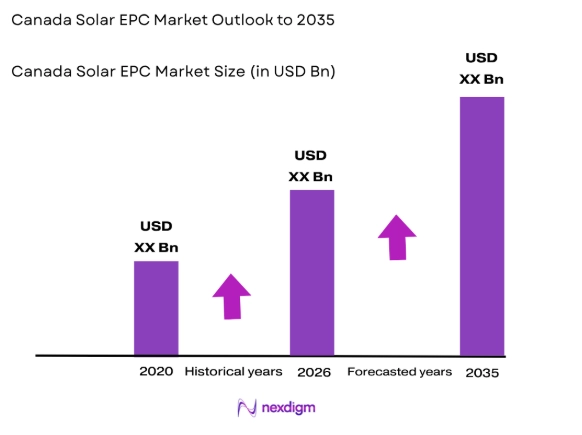
The Canada Solar EPC market is projected to reach USD ~ billion based on a recent historical assessment, driven by strong government incentives, declining costs of solar technology, and increasing demand for clean energy. Canada’s commitment to reducing carbon emissions and transitioning to renewable energy sources supports the market’s growth. The Solar EPC market benefits from both federal and provincial initiatives aimed at increasing renewable energy adoption, making it a key sector in Canada’s energy transition.
Ontario, Quebec, and British Columbia are the key regions driving the growth of the Canada Solar EPC market. Ontario, with its ambitious clean energy targets and strong renewable energy infrastructure, leads in solar power development. Quebec benefits from abundant hydroelectric resources and a growing solar industry, while British Columbia is focusing on enhancing its renewable energy capacity. These provinces play a central role in advancing solar energy projects, benefiting from favorable policy support and renewable energy integration efforts.
Market Segmentation
By Project Type
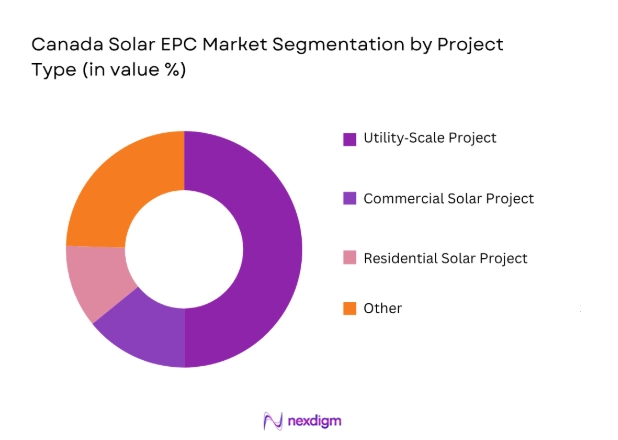
The Canada Solar EPC market is segmented by project type into Utility‑Scale (Ground‑Mounted) Solar Projects, Commercial Solar Projects, Residential Solar Projects, Other. Recently, utility-scale solar projects have dominated the market due to the increasing demand for large-scale renewable energy solutions to meet grid demand. The expansion of utility-scale solar installations is supported by federal and provincial policies that offer financial incentives and subsidies. With technological advancements and the decreasing cost of solar modules, utility-scale solar projects are expected to continue driving market growth.
By Technology Type
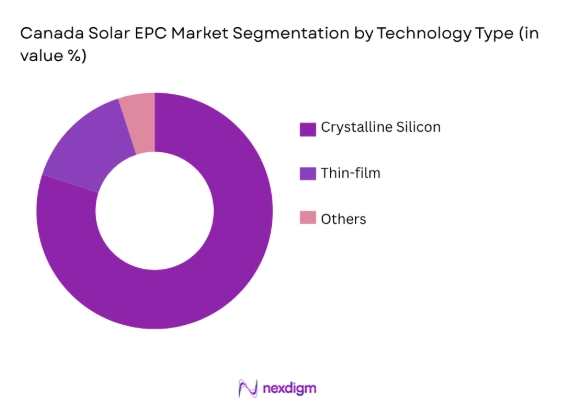
The Canada Solar EPC market is segmented by technology type into crystalline silicon, thin-film, and others. Recently, crystalline silicon technology has a dominant market share due to its efficiency and cost-effectiveness. Crystalline silicon panels, including monocrystalline and polycrystalline, are widely used in both residential and commercial applications. Their high energy conversion efficiency, coupled with continuous improvements in manufacturing techniques, makes them the preferred choice for large-scale installations, contributing to their dominance in the market.
Competitive Landscape
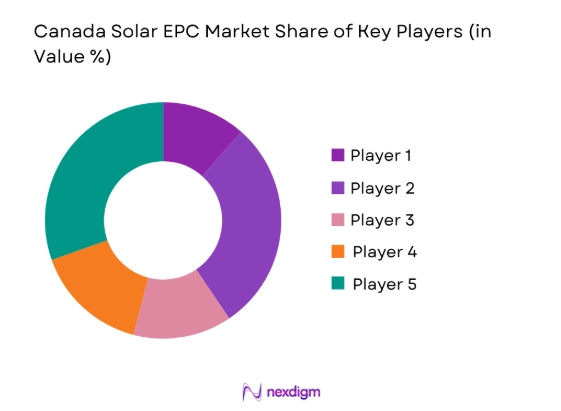
The competitive landscape of the Canada Solar EPC market is characterized by both large international players and growing local companies focusing on the development and installation of solar energy systems. The market is witnessing consolidation as larger firms acquire smaller regional players to expand their project portfolios. Key players are adopting technological advancements in solar panel efficiency, storage integration, and grid solutions to stay competitive. Collaboration with government entities and utilities further strengthens the market position of major players in the solar EPC sector.
| Company Name | Establishment Year | Headquarters | Technology Focus | Market Reach | Key Products | Revenue (USD Billion) | Market-Specific Parameter |
| Brookfield Renewable | 1999 | Toronto, Canada | ~ | ~ | ~ | ~ | ~ |
| TransAlta | 1909 | Calgary, Canada | ~ | ~ | ~ | ~ | ~ |
| Canadian Solar | 2001 | Guelph, Canada | ~ | ~ | ~ | ~ | ~ |
| Enbridge | 1949 | Calgary, Canada | ~ | ~ | ~ | ~ | ~ |
| SunPower | 1985 | San Jose, USA | ~ | ~ | ~ | ~ | ~ |
Canada Solar EPC Market Analysis
Growth Drivers
Government Policies and Financial Incentives
Government support through policies and incentives is a key driver of the Canada Solar EPC market. The Canadian government has set ambitious clean energy goals, aiming for significant reductions in greenhouse gas emissions and a transition to renewable energy sources. Policies such as the Clean Growth Program and the Canadian Renewable Energy Fund provide funding and tax incentives to support solar power projects. Additionally, several provinces, particularly Ontario, offer subsidies and tax credits for residential and commercial solar installations. This strong policy backing, combined with financial incentives, makes solar energy an attractive option for developers, businesses, and residential customers. With increasing demand for sustainable energy solutions, the supportive regulatory environment will continue to drive the growth of the solar EPC market in Canada.
Technological Advancements
Technological advancements in solar panels, energy storage, and grid integration systems are contributing to the growth of the Canada Solar EPC market. The efficiency of solar panels has increased significantly over the past decade, with innovations in crystalline silicon and thin-film technologies leading the way. These advancements have reduced the cost of solar panels, making them more accessible to a broader range of consumers and businesses. Additionally, the integration of energy storage solutions and improved grid management systems are enabling solar energy to be used more effectively, ensuring that it can be stored and delivered to the grid efficiently. As technology continues to improve and the cost of solar technology decreases, the adoption of solar energy will continue to grow, fueling further market expansion.
Market Challenges
High Initial Capital Costs
High upfront capital costs for solar projects remain a significant challenge in the Canada Solar EPC market. While solar energy is becoming more affordable over time, the initial costs associated with installing solar systems—especially large-scale utility projects—remain a major barrier. These costs include the purchase and installation of solar panels, inverters, battery storage systems, and other necessary infrastructure. Although government incentives and subsidies help mitigate these costs, they still represent a substantial financial burden for some developers and businesses. The high capital requirements can be a deterrent for smaller players in the market or those with limited access to financing options. Lowering these initial costs will be crucial for further accelerating the adoption of solar energy across Canada.
Energy Storage and Grid Integration
The integration of solar energy with energy storage systems and the grid is another significant challenge. Solar energy is intermittent, meaning its production varies throughout the day and across seasons. To ensure a steady and reliable power supply, solar projects must be paired with energy storage systems that can store excess energy during periods of high generation and release it when production is low. However, the cost of energy storage solutions, combined with the need for advanced grid infrastructure, adds complexity and cost to solar energy projects. Additionally, integrating solar power into the existing grid infrastructure requires upgrades and modifications to handle the increased capacity and variability of renewable energy sources. Overcoming these integration challenges will be critical for maximizing the potential of solar energy in Canada.
Opportunities
Growth of Solar Power in Residential and Commercial Sectors
The growth of solar power in the residential and commercial sectors presents a major opportunity for the Canada Solar EPC market. As solar technology becomes more affordable and accessible, there is increasing adoption of solar energy in both residential homes and commercial buildings. With the rising cost of traditional energy sources and the growing demand for sustainable energy solutions, consumers are turning to solar power as a cost-effective and environmentally friendly alternative. Additionally, government incentives, including rebates and tax credits, are encouraging homeowners and businesses to invest in solar energy. The expansion of the residential and commercial solar market offers significant opportunities for EPC contractors to deliver solar energy solutions tailored to these sectors, fueling further growth in the market.
Expansion of Utility-Scale Solar Projects
The expansion of utility-scale solar projects is another key opportunity for the Canada Solar EPC market. With Canada’s commitment to clean energy and carbon emissions reduction, the demand for utility-scale solar projects is expected to grow. These large-scale solar farms play a critical role in meeting the country’s energy needs and transitioning away from fossil fuels. The development of utility-scale solar projects is supported by government policies, favorable regulatory frameworks, and a growing interest from private investors. As solar panel efficiency improves and the cost of solar technology continues to fall, utility-scale projects will become more economically viable, presenting significant opportunities for solar EPC companies to undertake large-scale projects across the country.
Future Outlook
The future of the Canada Solar EPC market is promising, with continued growth anticipated across residential, commercial, and utility sectors. Technological advancements in solar panel efficiency and energy storage will enable more widespread adoption of solar energy, making it an increasingly attractive option for consumers and businesses. With the Canadian government’s ongoing commitment to reducing carbon emissions and transitioning to renewable energy sources, solar energy will play a central role in meeting the country’s clean energy goals. Over the next five years, the market is expected to experience significant expansion, driven by both government support and increasing consumer demand for sustainable energy solutions.
Major Players
- Brookfield Renewable Partners
- TransAlta
- Canadian Solar
- Enbridge
- SunPower
- Vestas
- Siemens Gamesa
- First Solar
- Innergex Renewable Energy
- Boralex
- Pattern Energy
- NextEra Energy
- EDF Renewables
- Nexterra
- Resolute Forest Products
Key Target Audience
- Investment and venture capitalist firms
- Government and regulatory bodies
- Energy developers and EPC contractors
- Solar panel manufacturers
- Solar project investors
- Commercial and residential solar consumers
- Utility companies
Research Methodology
Step 1: Identification of Key Variables
Identifying the key drivers, challenges, and regulatory frameworks affecting the Canada Solar EPC market, including government policies, technological advancements, and demand trends.
Step 2: Market Analysis and Construction
Analyzing the solar EPC market, including segmentation by technology type, project type, and end-user sector, to provide a comprehensive view of the market landscape.
Step 3: Hypothesis Validation and Expert Consultation
Consulting with industry experts, solar developers, and government bodies to validate hypotheses and ensure the accuracy of market assumptions and forecasts.
Step 4: Research Synthesis and Final Output
Synthesizing findings from primary and secondary research into a comprehensive market report, offering insights and recommendations for stakeholders in the Canadian Solar EPC market.

- Executive Summary
- Research Methodology (Definitions, Scope, Industry Assumptions, Market Sizing Approach, Primary & Secondary Research Framework, Data Collection & Verification Protocol, Analytic Models & Forecast Methodology, Limitations & Research Validity Checks)

- Market Definition and Scope
- Value Chain & Stakeholder Ecosystem
- Regulatory / Certification Landscape
- Sector Dynamics Affecting Demand

- Growth Drivers
Government Incentives for Solar Energy
Technological Advancements in Solar Panel Efficiency
Increasing Demand for Clean Energy - Market Challenges
High Initial Capital Investment
Intermittency of Solar Power
Regulatory Hurdles - Market Opportunities
Expansion in Residential Solar Installations
Integration with Energy Storage Solutions
Development of Floating Solar Projects - Trends
Rising Adoption of Solar in Commercial Sectors
Advancements in Solar Panel Efficiency - Government Regulations
- SWOT Analysis
- Porter’s Five Forces

- By Market Value, 2020-2025
- By Installed Units, 2020-2025
- By Average System Price, 2020-2025
- By System Complexity Tier, 2020-2025

- By System Type (In Value%)
Utility-scale Solar EPC
Commercial Solar EPC
Residential Solar EPC
Community Solar EPC
Floating Solar EPC - By Platform Type (In Value%)
Rooftop Platforms
Ground-mounted Platforms
Floating Platforms
Integrated Platforms - By Fitment Type (In Value%)
Fixed Solutions
Tracking Solutions
Hybrid Solutions
Modular Solutions - By End User Segment (In Value%)
Residential Sector
Commercial Sector
Industrial Sector

- Market structure and competitive positioning
- Market share snapshot of major players
- Cross Comparison Parameters (System Type, Platform Type, Procurement Channel, End User Segment, Fitment Type, Technological Integration, Installation Scale, Installation / Mounting Type, Technology, End‑User / Application, Project Size)
- SWOT Analysis of Key Competitors
- Pricing & Procurement Analysis
- Key Players
SMA Solar Technology
First Solar
Trina Solar
Canadian Solar
JinkoSolar
SunPower
Enphase Energy
LONGi Solar
Sungrow Power
Sunrun
Rivian
Brookfield Renewable Partners
Sungrow Power
NextEra Energy

- Growth in Residential Solar Adoption
- Commercial Sector’s Increased Investment
- Industrial Sector’s Growing Solar Demand
- Government’s Role in Solar Project Approvals

- Forecast Market Value, 2026-2035
- Forecast Installed Units, 2026-2035
- Price Forecast by System Tier, 2026-2035
- Future Demand by Platform, 2026-2035


 Request a Sample
 Ask for Customization
 Get a Quote
 Enquire Now