

 Download PDF
Market Overview
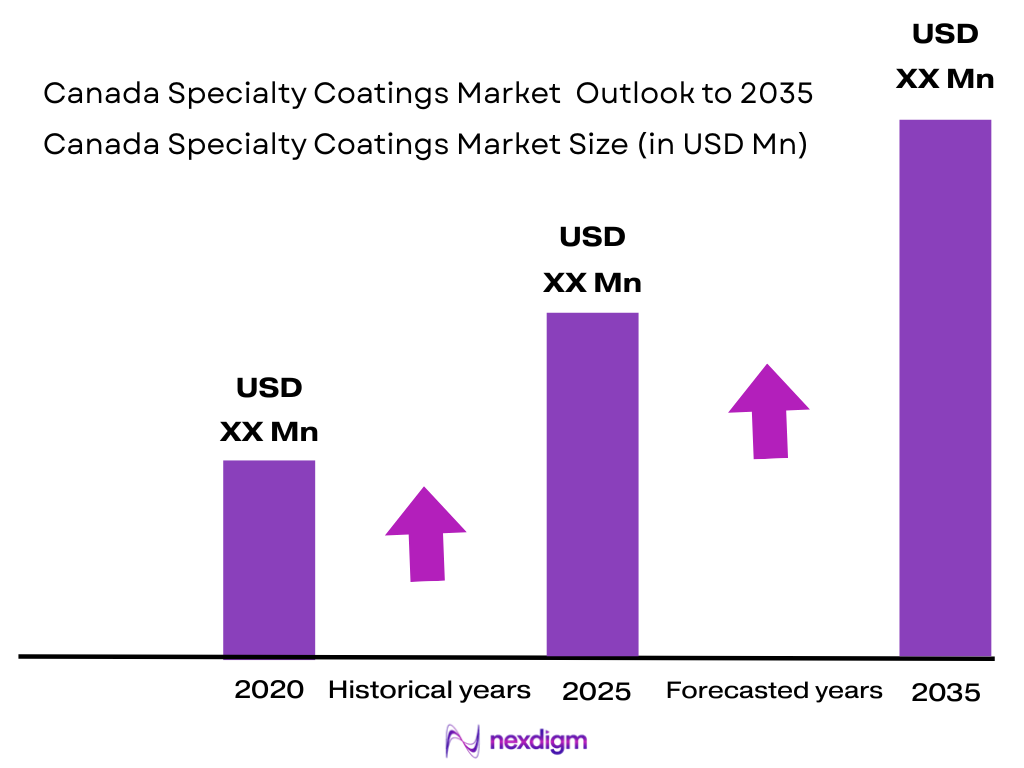
The Canada Specialty Coatings Market is valued at ~USD 3.2 billion in 2024 and is projected to expand at a CAGR of ~4.1% during 2026-2035. The market is supported by increasing demand for protective, functional and performance-based coatings across infrastructure, automotive, aerospace, energy, marine and industrial equipment applications. Canada’s industrial coatings ecosystem is strengthened by its manufacturing base, where specialty coatings are required for corrosion prevention, chemical resistance and durability. The Canadian industrial coatings segment is estimated at approximately USD 1.57 billion in 2024, reflecting the importance of industrial protective applications within the broader specialty coatings industry.
The market expansion is primarily driven by Canada’s requirement for coatings capable of operating under extreme climatic conditions, including freeze-thaw cycles, high humidity exposure and industrial chemical environments. Infrastructure rehabilitation, oil and gas asset maintenance, mining equipment protection and automotive manufacturing are major demand contributors. Canada has more than 200 coatings, adhesives and sealant manufacturing establishments, creating a domestic production and supply ecosystem for specialty coating solutions.
Market Segmentation
By Resin Type
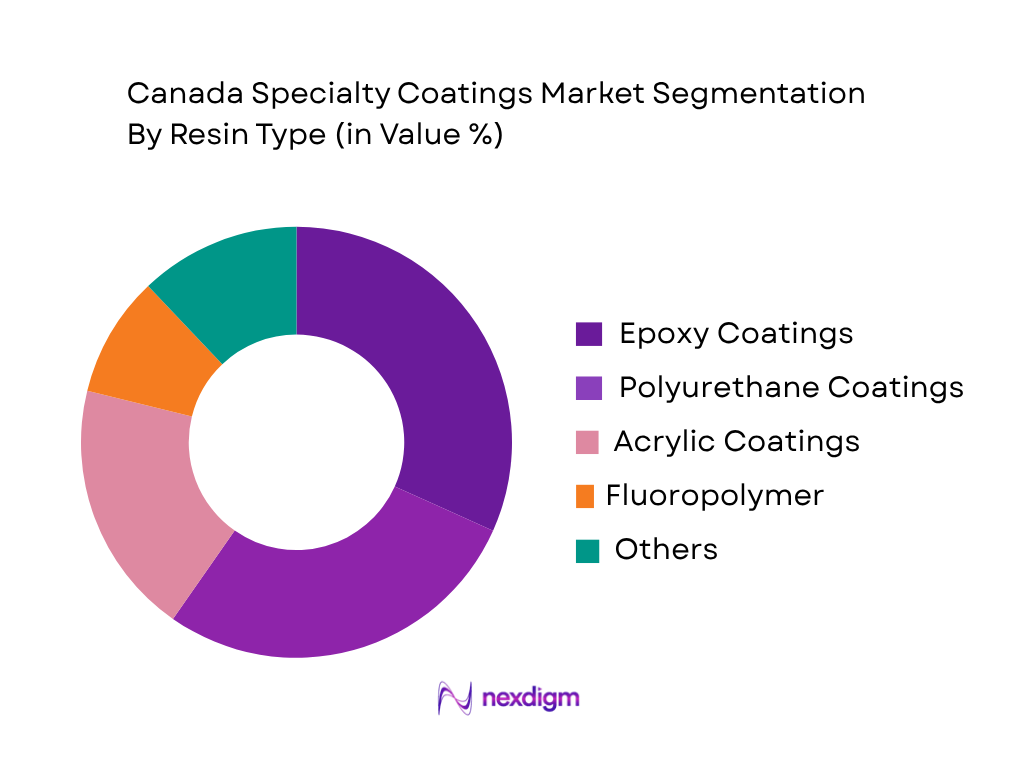
The Canada Specialty Coatings Market is segmented by resin type into epoxy, polyurethane, acrylic, fluoropolymer, alkyd and silicone coatings. Epoxy coatings account for the leading share with 31.5% in 2024 due to their extensive adoption in industrial infrastructure, oil and gas facilities, pipelines, bridges and heavy machinery applications. Epoxy systems provide strong adhesion, chemical resistance and protection against corrosion, making them suitable for Canada’s harsh operating environments. Polyurethane coatings represent the second-largest category with 27.8% share due to their superior weather resistance, abrasion protection and aesthetic durability. These coatings are widely used in transportation, automotive and commercial infrastructure applications. Acrylic coatings hold 18.6% share due to their fast drying characteristics and increasing adoption in environmentally compliant formulations. Fluoropolymer and silicone coatings are niche segments primarily used where extreme temperature resistance, chemical stability and long-term durability are required.
By Technology Type
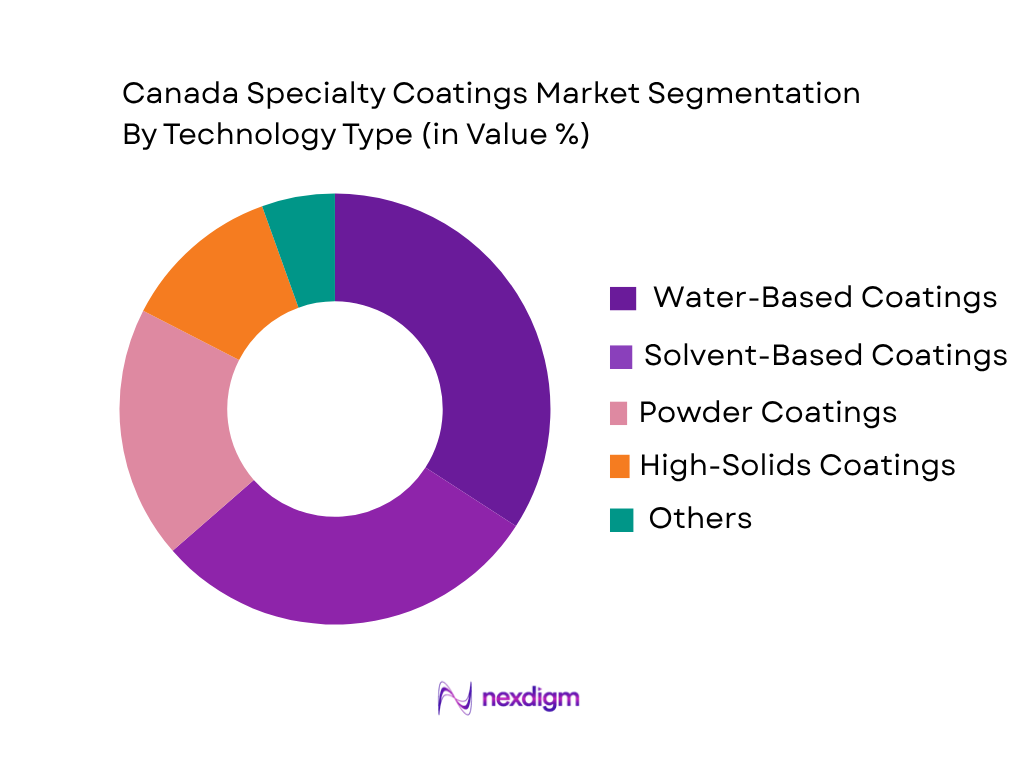
The Canada Specialty Coatings Market is segmented by technology into water-based, solvent-based, powder, high-solids, UV-curable and radiation-curable coatings. Water-based specialty coatings dominate with 34.2% share in 2024 due to increasing adoption driven by environmental compliance requirements and reduced VOC emissions. Canadian manufacturers and end users are increasingly shifting toward sustainable coating technologies that maintain performance while meeting environmental standards. Powder coatings represent 18.7% share and are widely used in metal finishing, automotive components, appliances and industrial equipment due to their durability and efficient application process. Solvent-based coatings maintain strong demand in heavy industrial applications where superior penetration, adhesion and corrosion resistance are required. High-solids coatings are gaining adoption in infrastructure and energy sectors because they provide improved protective performance with lower solvent usage. Advanced curing technologies remain specialized segments used in electronics, precision manufacturing and high-value industrial applications.
Competitive Landscape
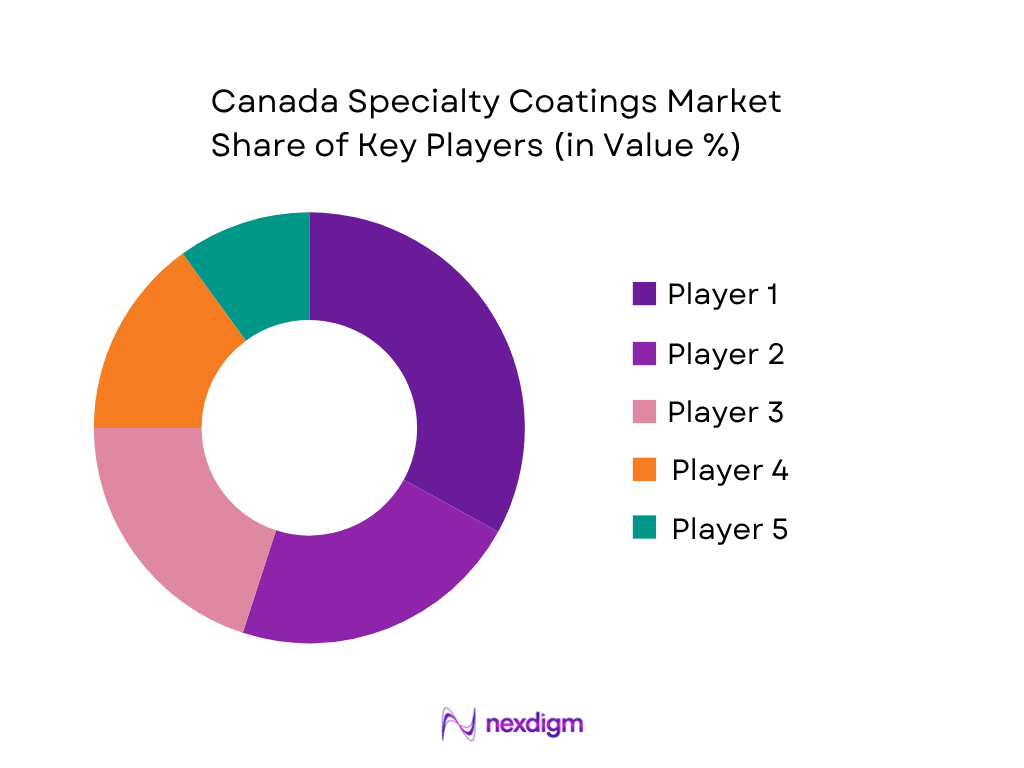
The Canada Specialty Coatings Market is highly competitive, with global coating manufacturers and specialized regional suppliers competing through advanced resin technologies, sustainable formulations, technical support capabilities and industry-specific solutions. The market is influenced by demand from automotive manufacturing, aerospace, oil and gas, infrastructure, marine, mining and industrial equipment sectors. Leading companies differentiate themselves through product innovation, low-VOC coating technologies, corrosion protection systems, customized formulations and extensive distribution networks. Major players operate across multiple coating categories including epoxy, polyurethane, acrylic, fluoropolymer and functional coatings.
| Company | Establishment Year | Headquarters | Major Product Categories | Key End-Use Industries | Resin Technology Portfolio | Sustainability Focus | Distribution Presence | R&D Capability |
| PPG Industries | 1883 | Pittsburgh, USA | ~ | ~ | ~ | ~ | ~ | ~ |
| Sherwin-Williams | 1866 | Cleveland, USA | ~ | ~ | ~ | ~ | ~ | ~ |
| AkzoNobel | 1792 | Amsterdam, Netherlands | ~ | ~ | ~ | ~ | ~ | ~ |
| Axalta Coating Systems | 1866 | Philadelphia, USA | ~ | ~ | ~ | ~ | ~ | ~ |
| BASF Coatings | 1865 | Ludwigshafen, Germany | ~ | ~ | ~ | ~ | ~ | ~ |
Canada Specialty Coatings Market Analysis
Market Growth Drivers
Industrial Infrastructure Modernization
Industrial infrastructure modernization is a major growth driver for the Canada Specialty Coatings Market as aging assets require advanced protective systems to improve operational life and reduce maintenance frequency. Canada’s infrastructure network includes more than 40,000 publicly owned bridges and structures, creating continuous demand for corrosion-resistant and durable coating solutions for transportation assets, industrial facilities and public infrastructure. The country’s economy generated approximately USD 2.2 trillion in GDP in 2024, supporting continued investment across construction, manufacturing, energy and industrial sectors. The Canadian construction sector contributed approximately CAD 151 billion to GDP in 2024, increasing requirements for protective coatings used in commercial buildings, industrial facilities and infrastructure projects. Specialty coatings including epoxy, polyurethane and high-solids formulations are increasingly used for bridges, pipelines, machinery and structural steel protection because of their resistance to moisture, chemicals and temperature fluctuations. Industrial modernization initiatives across provinces such as Ontario, Alberta and British Columbia are supporting demand for high-performance coating technologies that extend asset lifespan. Increasing replacement of conventional coatings with sustainable and low-VOC alternatives is further strengthening adoption among industrial users seeking compliance with environmental standards and improved lifecycle performance.
Oil Sands Asset Protection Requirements
Oil sands operations remain a significant demand contributor for specialty coatings in Canada because extraction, processing and transportation assets operate under highly corrosive conditions. Alberta contains one of the world’s largest oil sands reserves, with established production infrastructure requiring continuous protection of pipelines, storage tanks, processing equipment and heavy machinery. Canada produced approximately 5.0 million barrels of crude oil per day in 2024, maintaining strong demand for protective coating systems across upstream and downstream energy assets. Alberta’s economy generated approximately CAD 467 billion in nominal GDP in 2024, supported strongly by energy production and related industrial activities. Specialty coatings are required in oil sands facilities because equipment is exposed to chemicals, abrasion, moisture and extreme temperature variations. Epoxy, polyurethane and fluoropolymer coatings are widely applied in refineries, pipelines and processing plants to improve corrosion resistance and reduce operational downtime. The expansion and maintenance of energy infrastructure continue creating opportunities for advanced anti-corrosion and chemical-resistant coating solutions. Demand is also increasing for coatings capable of meeting stricter environmental requirements while maintaining performance in harsh operating environments.
Market Challenges
Dependence on Imported Specialty Raw Materials
Dependence on imported specialty raw materials remains a challenge for the Canada Specialty Coatings Market because advanced coatings require specialized resins, additives, pigments and performance chemicals that are not fully produced domestically. Canada imports a significant volume of chemical products to support manufacturing industries, with total chemical product imports exceeding CAD 70 billion in 2024. Specialty coating manufacturers rely on global supply chains for epoxy intermediates, fluoropolymers, functional additives and advanced polymer technologies. Currency fluctuations, transportation disruptions and international supply constraints can affect raw material availability and production planning. Canada’s manufacturing sector contributed approximately CAD 685 billion to GDP in 2024, creating consistent demand for specialty coatings but also increasing dependence on reliable chemical supply networks. The complexity of coating formulations makes substitution difficult because raw materials must meet strict performance requirements related to corrosion resistance, adhesion, thermal stability and chemical resistance. Manufacturers are increasingly exploring regional sourcing strategies and alternative materials to reduce supply chain exposure. However, limited domestic production capacity for certain specialty chemicals remains a structural challenge for coating producers operating in Canada.
Strict Environmental Regulations and VOC Compliance Requirements
Strict environmental regulations represent a major challenge for specialty coating manufacturers as Canada continues strengthening requirements related to volatile organic compounds (VOC), chemical management and sustainable manufacturing practices. The Canadian government regulates industrial chemicals through frameworks such as the Canadian Environmental Protection Act and the Chemicals Management Plan, influencing coating formulation and product approval processes. Canada’s industrial sector consumed approximately 8.3 exajoules of energy in 2024, creating significant attention toward reducing emissions from manufacturing and industrial operations. Specialty coating producers are increasingly required to develop low-VOC, water-based and high-solids formulations while maintaining performance characteristics demanded by industrial users. VOC restrictions can increase research requirements because replacing solvent-based technologies with environmentally compliant alternatives requires advanced formulation development. Industrial customers including automotive manufacturers, construction companies and energy operators are increasingly requesting coatings that meet sustainability objectives without reducing durability. The transition toward environmentally compliant coatings creates opportunities for innovation but increases development complexity, testing requirements and regulatory approval timelines for manufacturers operating in the Canadian market.
Market Opportunities
EV Battery Protection Coatings
The growth of electric vehicle manufacturing creates significant opportunities for specialty coatings used in battery protection, thermal management and component durability applications. Canada is expanding its electric vehicle ecosystem through investments in battery manufacturing and automotive supply chains. Canadian vehicle production reached approximately 1.3 million units in 2024, supporting demand for advanced automotive coating technologies. Ontario has become a major automotive investment hub, with multiple battery and electric vehicle manufacturing projects developing across the province. EV batteries require specialized coatings that provide electrical insulation, corrosion protection, thermal resistance and protection against moisture exposure. Specialty coatings are increasingly important for battery enclosures, electronic components and lightweight vehicle structures. Canada’s automotive manufacturing sector contributed approximately CAD 17 billion to GDP in 2024, creating a strong industrial base for advanced coating adoption. Future opportunities exist for manufacturers developing epoxy-based protective coatings, thermal barrier coatings and functional surface technologies designed specifically for electric mobility applications. The transition toward EV production is expected to encourage collaboration between coating manufacturers, automotive OEMs and battery technology suppliers.
Sustainable Water-Based and Bio-Based Coatings
Sustainable water-based and bio-based coatings represent a major opportunity for the Canada Specialty Coatings Market as industries increasingly adopt environmentally responsible alternatives. Demand is increasing for coating technologies that reduce VOC emissions while maintaining corrosion protection, durability and application performance. Canada’s environmental policies and industrial sustainability initiatives are encouraging manufacturers to develop coatings with reduced solvent dependency and renewable raw materials. The Canadian manufacturing sector accounted for approximately 10% of national GDP in 2024, creating a large industrial base seeking compliant coating solutions. Water-based coatings are gaining adoption in automotive, construction, industrial equipment and commercial applications because they provide lower emission profiles and improved workplace safety. Bio-based coatings using renewable feedstocks are emerging as alternatives for selected applications requiring sustainable material inputs. Industries including transportation, infrastructure and consumer manufacturing are increasingly incorporating sustainability criteria into procurement decisions. Specialty coating producers investing in advanced polymer chemistry, renewable materials and low-emission technologies are positioned to capture demand from companies seeking environmental compliance alongside high-performance protection.
Future Outlook
The Canada Specialty Coatings Market is expected to experience steady expansion through 2035, supported by rising demand for durable protective coatings across infrastructure, energy, transportation and industrial manufacturing sectors. Increasing investment in infrastructure rehabilitation, electric vehicle manufacturing, renewable energy projects and industrial modernization is expected to create new applications for advanced coating technologies. The transition toward sustainable coating systems, including water-based, bio-based and low-VOC formulations, will influence product development strategies. Demand for functional coatings with thermal management, antimicrobial properties and corrosion resistance is expected to increase as industries seek longer asset lifecycles and improved operational efficiency.
Major Players
- PPG Industries
- Sherwin-Williams
- AkzoNobel
- BASF Coatings
- Axalta Coating Systems
- RPM International
- Hempel
- Jotun
- Nippon Paint Holdings
- Kansai Paint
- Sika Canada
- Benjamin Moore
- Cloverdale Paint
- Tnemec Company
- General Paint
Key Target Audience
- Specialty Coatings Manufacturers
- Industrial Coating Producers
- Automotive OEM Manufacturers
- Aerospace and Defense Companies
- Oil and Gas Companies
- Construction and Infrastructure Developers
- Investments and Venture Capitalist Firms
- Government and Regulatory Bodies (Environment and Climate Change Canada, Innovation, Science and Economic Development Canada, Natural Resources Canada)
Research Methodology
Step 1: Identification of Key Variables
The initial phase involves developing a comprehensive ecosystem map of the Canada Specialty Coatings Market covering manufacturers, raw material suppliers, distributors, industrial users and regulatory stakeholders. Secondary research is conducted to identify major market variables including resin technologies, application industries, coating performance requirements and supply chain structures. The objective is to establish the fundamental market framework and define key demand and supply indicators.
Step 2: Market Analysis and Construction
Historical market information is analyzed through a combination of production data, industrial consumption trends, application-level demand assessment and supply-side evaluation. The analysis includes resin segmentation, technology adoption, end-use industry demand and distribution channel assessment. Market calculations are validated through industry benchmarks and consumption patterns across Canadian industrial sectors.
Step 3: Hypothesis Validation and Expert Consultation
Market assumptions are validated through discussions with coating manufacturers, industrial users, distributors and application specialists. Primary interactions provide insights into coating technology adoption, purchasing behavior, regulatory impact, product innovation and operational challenges. Expert inputs are integrated to improve accuracy and validate market dynamics.
Step 4: Research Synthesis and Final Output
The final stage combines secondary research, primary validation and analytical modeling to develop a comprehensive market assessment. Information related to competitive positioning, segmentation analysis, growth drivers, challenges and future opportunities is consolidated to provide strategic insights for business decision-making.

- Executive Summary
- Research Methodology (Market Definition and Scope, Specialty Coatings Classification Framework, Resin-Based Market Mapping, Application-Based Assessment, Market Sizing Methodology, Top-Down Analysis, Bottom-Up Analysis, Demand-Side Analysis, Supply-Side Analysis, Primary Interviews with Coating Manufacturers and End Users, Data Validation Framework, Forecasting Methodology, Assumptions and Limitations)

- Definition and Scope
- Specialty Coatings Industry Evolution and Development Timeline
- Canadian Specialty Coatings Value Chain Analysis
- Raw Material Ecosystem Analysis
- Manufacturing and Distribution Network Analysis
- Specialty Coatings Application Ecosystem

- Growth Drivers (Industrial Infrastructure Modernization, Oil Sands Asset Protection Requirements, Automotive Manufacturing Expansion, Aerospace Industry Development, Renewable Energy Infrastructure Growth, Mining Equipment Protection Demand, Manufacturing Automation Growth)
- Market Challenges (Dependence on Imported Specialty Raw Materials, Strict Environmental Regulations, VOC Compliance Requirements, Harsh Climate Performance Requirements, Skilled Application Workforce Shortage, High Product Qualification Cycles, Supply Chain Disruptions, Technology Development Costs)
- Market Opportunities (EV Battery Protection Coatings, Sustainable Water-Based Coatings, Bio-Based Coatings, Offshore and Marine Protective Coatings, Smart Functional Coatings, Infrastructure Anti-Corrosion Systems, Thermal Management Coatings, Aerospace Specialty Coatings, Antimicrobial Surface Technologies)
- Market Trends (Low-VOC Coating Adoption, Sustainable Coating Technologies, Powder Coating Expansion, High-Performance Industrial Coatings, Functional Surface Engineering, Digital Coating Application Monitoring, Lightweight Automotive Material Protection, Advanced Polymer Development)
- Government Regulations (Environment and Climate Change Canada Chemical Management Plan, VOC Emission Standards, Canadian Environmental Protection Act Requirements, Workplace Hazardous Materials Information System Compliance, Industrial Coating Disposal Regulations, Sustainable Product Regulations)
- SWOT Analysis
- Porter’s Five Forces Analysis
- PESTLE Analysis

- By Market Value (2020-2025)
- By Volume Consumption (2020-2025)
- By Average Selling Price (2020-2025)
- By Resin Technology (2020-2025)
- By End-Use Industry (2020-2025)

- By Resin Type (In Value %)
Epoxy Coatings
Polyurethane Coatings
Acrylic Coatings
Fluoropolymer Coatings
Alkyd Coatings
Silicone Coatings
Polyaspartic Coatings
Hybrid Resin Coatings - By Formulation Technology (In Value %)
Solvent-Based Specialty Coatings
Water-Based Specialty Coatings
Powder Coatings
High-Solids Coatings
UV-Curable Coatings
Radiation-Curable Coatings - By Application Industry (In Value %)
Construction and Infrastructure
Automotive and Transportation
Marine and Offshore
Oil and Gas
Industrial Equipment and Machinery
Electronics and Electrical
Aerospace and Defense
Mining and Energy - By Functional Property (In Value %)
Anti-Corrosion Coatings
Thermal Barrier Coatings
Chemical Resistant Coatings
Abrasion Resistant Coatings
Fire Protection Coatings
Antimicrobial Coatings
Self-Cleaning Coatings
Electrical Insulation Coatings - By Distribution Channel (In Value %)
Direct Industrial Sales
Specialty Chemical Distributors
Paint and Coating Retailers
OEM Supply Agreements
Online Industrial Platforms

- Market Positioning of Major Players (By Product Portfolio, Resin Technology, Application Industry, Distribution Network, Innovation Capability)
- Cross Comparison Parameters (Product Portfolio Breadth, Specialty Resin Manufacturing Capability, Anti-Corrosion Coating Expertise, Sustainable Coating Portfolio, Industrial Customer Base, R&D Capability, Application Technology Support, Distribution Network Coverage)
- SWOT Analysis of Major Players
- Detailed Profiles of Major Companies
Major Specialty Coatings Manufacturers
PPG Industries
Sherwin-Williams
AkzoNobel
BASF Coatings
Axalta Coating Systems
RPM International
Hempel
Jotun
Nippon Paint
Kansai Paint
Sika Canada
Benjamin Moore
General Paint
Cloverdale Paint
Tnemec Company

- Automotive Industry Coating Demand
- Aerospace Coating Requirements
- Oil and Gas Infrastructure Protection
- Mining Equipment Coating Applications
- Marine Asset Protection Requirements
- Construction Material Protection Demand
- Electronics Manufacturing Coating Needs
- Product Performance Preference Analysis

- By Market Value (2026-2035)
- By Volume Consumption (2026-2035)
- By Average Selling Price (2026-2035)
- By Resin Technology (2026-2035)
- By End-Use Industry (2026-2035)


 Request a Sample
 Ask for Customization
 Get a Quote
 Enquire Now