
 Download PDF
Market Overview
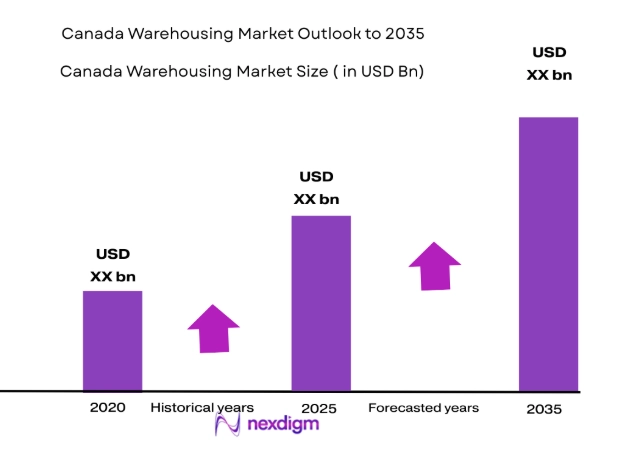
Based on a recent historical assessment, the Canada Warehousing Market is valued at approximately USD ~ billion, supported by strong demand across retail distribution, food logistics, and industrial supply chains. Expansion of e commerce fulfillment networks, national transportation corridors, and cross border trade activity continues to accelerate warehouse infrastructure development. Large logistics operators invest in automated storage facilities, robotics enabled fulfillment centers, and digital inventory systems that increase operational efficiency while supporting rising distribution volumes across Canada’s expanding consumer and manufacturing supply chains.
Major logistics activity is concentrated in Toronto, Vancouver, Montreal, Calgary, and Edmonton due to strong transportation connectivity, port access, and proximity to large consumer populations. Toronto and Montreal benefit from integrated rail and trucking corridors linking eastern Canadian manufacturing clusters with the United States trade network. Vancouver dominates Pacific trade logistics due to port connectivity supporting Asia bound freight flows. Calgary and Edmonton act as strategic distribution hubs serving western Canadian retail supply chains and resource driven industrial logistics networks.
Market Segmentation
By Product Type
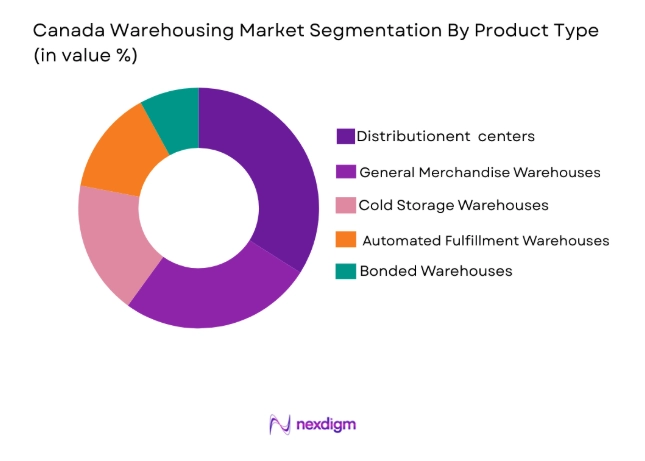
Canada Warehousing Market is segmented by product type into general merchandise warehouses, cold storage warehouses, bonded warehouses, automated fulfillment warehouses, and distribution centers. Recently, distribution centers have a dominant market share due to factors such as strong retail logistics demand, nationwide transportation connectivity, and increasing e commerce fulfillment activity across major Canadian metropolitan areas. Large retailers and logistics providers increasingly operate high capacity distribution hubs designed to manage large scale inventory flows across regional supply chains. These facilities integrate automated sorting systems, warehouse management software, and real time inventory tracking platforms that improve order processing efficiency. Growing cross border retail trade and omnichannel distribution strategies further strengthen demand for large distribution facilities located near major population centers and transportation corridors.
By Platform Type
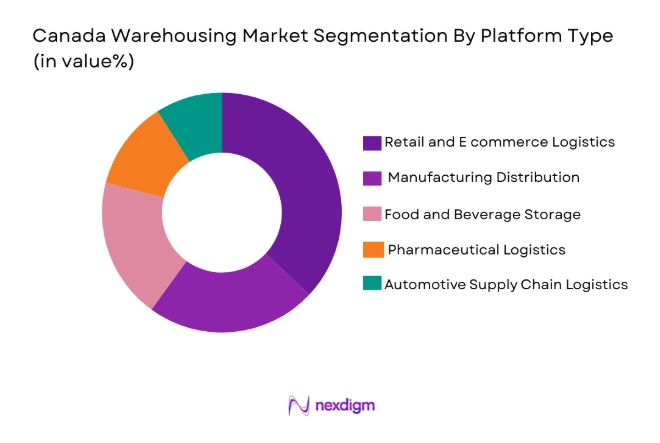
Canada Warehousing Market is segmented by platform type into retail and e commerce logistics, manufacturing distribution, food and beverage storage, pharmaceutical logistics, and automotive supply chain logistics. Recently, retail and e commerce logistics has a dominant market share due to factors such as rising online retail transactions, fast delivery expectations, and expanding fulfillment networks operated by major logistics providers. Online retailers increasingly rely on strategically located warehouses capable of managing rapid order processing and last mile distribution operations. Large fulfillment operators deploy robotics, digital inventory platforms, and predictive logistics software that improve storage density and distribution speed. Continued expansion of omnichannel retail supply chains and consumer demand for faster delivery services further strengthen the importance of dedicated retail logistics warehouse infrastructure.
Competitive Landscape
The Canada Warehousing Market is moderately consolidated with several international logistics operators, industrial real estate developers, and specialized cold storage providers controlling large infrastructure portfolios. Major players focus heavily on automated warehousing technology, large scale logistics parks, and strategically located fulfillment centers positioned near urban distribution hubs. Industrial real estate investment trusts and global logistics operators continue expanding warehouse networks across Canada through acquisitions, facility expansion projects, and advanced automation investments designed to increase distribution capacity and operational efficiency.
| Company Name | Establishment Year | Headquarters | Technology Focus | Market Reach | Key Products | Revenue | Warehouse Capacity Focus |
| Prologis | 1983 | United States | ~ | ~ | ~ | ~ | ~ |
| Lineage Logistics | 2008 | United States | ~ | ~ | ~ | ~ | ~ |
| Americold Realty Trust | 1903 | United States | ~ | ~ | ~ | ~ | ~ |
| Dream Industrial REIT | 2011 | Canada | ~ | ~ | ~ | ~ | ~ |
| Panattoni Development Company | 1986 | United States | ~ | ~ | ~ | ~ | ~ |
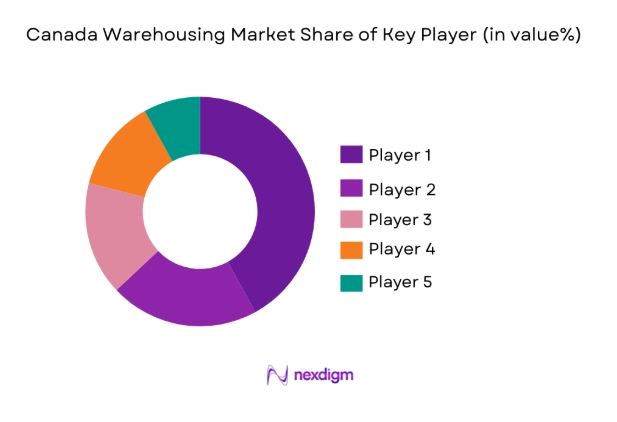
Canada Warehousing Market Analysis
Growth Drivers
Expansion of E Commerce Fulfillment and Omnichannel Retail Logistics Networks
Rapid expansion of digital commerce platforms significantly strengthens demand for large scale warehousing infrastructure capable of managing complex inventory distribution across national retail supply chains. Online retail marketplaces generate extremely high order volumes involving consumer goods, electronics, groceries, and household products requiring efficient storage and fulfillment systems. Logistics companies therefore expand automated warehouses equipped with robotics based sorting systems and digital inventory management platforms capable of processing thousands of orders per hour. Retail companies increasingly adopt omnichannel distribution models where warehouses support both store replenishment and direct consumer deliveries. Large fulfillment centers located near major urban regions reduce transportation times while supporting next day and same day delivery services. Investments in warehouse automation technologies including automated storage retrieval systems and artificial intelligence driven inventory forecasting further improve warehouse productivity. Expansion of cross border e commerce trade between Canada and the United States also strengthens the need for strategically located distribution facilities capable of managing international shipments efficiently. As digital retail participation continues expanding among Canadian consumers, warehousing infrastructure remains a critical component supporting modern retail logistics networks.
Growth of Integrated Supply Chain Logistics and Third Party Warehousing Services
Increasing complexity of national supply chains encourages manufacturers and retailers to outsource storage and distribution operations to specialized logistics providers operating large warehousing networks. Third party logistics companies offer integrated services including inventory storage, freight coordination, packaging operations, and distribution management that enable companies to focus on core business activities. Large logistics operators invest heavily in multi client warehouse facilities capable of supporting multiple industries including retail, pharmaceuticals, automotive manufacturing, and food processing. Warehouse operators deploy advanced warehouse management systems that allow real time tracking of inventory movements while improving operational efficiency across storage facilities. Expansion of international trade flows across Canadian ports and border crossings also increases demand for large logistics hubs capable of coordinating global supply chain distribution. Industrial manufacturers rely on regional distribution warehouses that support just in time inventory management strategies while minimizing transportation costs. Continuous development of transportation infrastructure connecting rail corridors, highways, and ports further strengthens the strategic role of warehouse facilities within national logistics networks. These operational efficiencies significantly encourage companies to expand outsourced warehousing services across Canada.
Market Challenges
Rising Industrial Land and Construction Costs in Major Logistics Hubs
Warehousing infrastructure development across Canada faces increasing challenges due to rapidly rising industrial land prices and construction costs in major logistics regions. Urban logistics hubs including Toronto, Vancouver, and Montreal experience strong demand for industrial real estate due to their proximity to consumer markets and transportation networks. Limited availability of developable land in these metropolitan regions significantly increases acquisition costs for warehouse developers seeking to expand distribution infrastructure. Construction costs also increase due to labor shortages, rising raw material prices, and higher regulatory compliance requirements associated with industrial development projects. Large warehouse facilities require extensive investments in structural construction, advanced automation technologies, and specialized storage infrastructure designed to support modern logistics operations. Logistics operators must therefore allocate substantial capital expenditures before facilities become operational. Smaller logistics companies often struggle to compete with larger operators that possess stronger financial capabilities and real estate portfolios. Increasing capital requirements for warehouse construction therefore create financial barriers that limit new market entrants while slowing infrastructure expansion in high demand logistics regions.
Labor Shortages Across Warehouse Operations and Logistics Facilities
Warehouse operators across Canada face persistent labor shortages affecting operational efficiency and workforce availability within distribution centers. Logistics facilities require large numbers of workers responsible for inventory handling, order picking, packaging operations, equipment operation, and facility management tasks. Rapid expansion of e commerce fulfillment networks significantly increases demand for warehouse employees across major logistics hubs creating intense competition for skilled labor. Demographic trends and aging workforce participation also reduce the availability of experienced logistics workers in several regions. Companies therefore experience operational challenges maintaining stable workforce capacity capable of managing high order processing volumes. Warehousing companies increasingly implement automation technologies including robotics and automated storage systems to compensate for workforce shortages while improving operational productivity. However automation adoption requires significant capital investment and technical expertise that smaller warehouse operators may struggle to implement. Training requirements associated with advanced warehouse technologies further increase operational complexity for logistics providers attempting to maintain efficient distribution operations.
Opportunities
Expansion of Automated Smart Warehousing and Robotics Based Fulfillment Systems
Continuous technological innovation across logistics automation technologies creates major opportunities for advanced warehouse infrastructure development across Canada. Automated storage retrieval systems, robotics enabled picking systems, and artificial intelligence driven warehouse management platforms significantly improve operational productivity and inventory management efficiency. Large logistics providers increasingly deploy automated warehouses capable of operating high speed distribution operations with reduced labor dependency. Robotics based systems improve order accuracy while reducing operational errors within high volume fulfillment facilities. Smart warehouses integrate sensor technologies and real time data analytics platforms capable of monitoring inventory movements and optimizing storage utilization across large facilities. Growing labor shortages across warehouse operations further encourage logistics operators to invest heavily in automation technologies capable of supporting high throughput distribution systems. Technology providers also develop flexible modular automation systems that allow warehouse operators to gradually upgrade existing facilities without large scale infrastructure replacement. These technological developments significantly expand opportunities for logistics operators seeking to modernize warehouse infrastructure across Canada.
Development of Regional Distribution Hubs Supporting Cross Border Trade Logistics
Canada’s strategic geographic location between global trade routes and the United States creates strong opportunities for warehouse expansion supporting international supply chain distribution. Major ports including Vancouver and Montreal handle large volumes of international cargo shipments entering North American markets. Logistics providers therefore establish regional distribution hubs located near ports, rail terminals, and highway networks capable of coordinating large freight movements across national and international supply chains. Cross border trade between Canada and the United States requires specialized warehouse facilities capable of managing customs documentation, freight consolidation, and inventory storage before final distribution. Industrial manufacturers and global retailers rely heavily on these logistics hubs to manage complex international shipment flows efficiently. Government investment in transportation infrastructure including rail corridors and port expansion projects further strengthens Canada’s logistics connectivity supporting warehouse development opportunities. Increasing trade volumes across North American supply chains therefore create long term growth potential for strategically located warehouse infrastructure across Canada.
Future Outlook
The Canada Warehousing Market is expected to expand steadily as logistics automation, e commerce fulfillment networks, and cross border trade activities continue strengthening supply chain infrastructure requirements. Investments in robotics based warehouse operations and digital inventory platforms are likely to transform operational productivity across logistics facilities. Growing demand for fast delivery services will encourage development of urban distribution hubs located near major consumer populations. Continued government investment in transportation corridors and port infrastructure will further support long term logistics expansion.
Major Players
- Prologis
- Lineage Logistics
- Americold Realty Trust
- Dream Industrial REIT
- WPT Industrial REIT
- Granite REIT
- Pure Industrial Real Estate Trust
- Panattoni Development Company
- Goodman Group
- Oxford Properties Group
- BentallGreenOak
- CBRE Group
- Colliers International
- Blackstone Industrial Logistics
- SEGRO
Key Target Audience
- Logistics and supply chain companies
- Industrial real estate developers
- Retail distribution companies
- Manufacturing companies
- Investments and venture capitalist firms
- Government and regulatory bodies
- Transportation infrastructure developers
Research Methodology
Step 1: Identification of Key Variables
Primary variables influencing the Canada Warehousing Market including logistics infrastructure capacity, warehouse automation technologies, and regional distribution demand are identified through secondary research. Key supply chain indicators, transportation networks, and industrial development patterns are examined to determine structural market drivers influencing warehouse expansion and operational investment decisions.
Step 2: Market Analysis and Construction
Market structure is constructed using industry reports, government data sources, logistics sector statistics, and corporate financial disclosures. Data modeling evaluates warehousing capacity, infrastructure expansion patterns, and operational investment across logistics networks to estimate overall market structure and competitive landscape.
Step 3: Hypothesis Validation and Expert Consultation
Industry specialists including logistics executives, warehouse operators, and supply chain analysts validate research assumptions and operational trends. Expert interviews provide qualitative insights into warehouse technology adoption, logistics outsourcing strategies, and infrastructure development across major Canadian distribution hubs.
Step 4: Research Synthesis and Final Output
Collected quantitative and qualitative information is synthesized into a comprehensive market structure outlining infrastructure capacity, competitive dynamics, and logistics technology adoption trends. Analytical models are applied to ensure data consistency while producing final insights regarding market performance and operational developments.

- Executive Summary
- Research Methodology (Definitions, Scope, Industry Assumptions, Market Sizing Approach, Primary & Secondary Research Framework, Data Collection & Verification Protocol, Analytic Models & Forecast Methodology, Limitations & Research Validity Checks)

- Market Definition and Scope
- Value Chain & Stakeholder Ecosystem
- Regulatory / Certification Landscape
- Sector Dynamics Affecting Demand
- Strategic Initiatives & Infrastructure Growth

- Growth Drivers
Expansion of E-commerce Fulfillment and Omnichannel Retail Distribution Networks
Increasing Demand for Temperature Controlled Food and Pharmaceutical Storage Facilities
Growth of Third Party Logistics Outsourcing Across National Supply Chains - Market Challenges
Rising Industrial Land and Construction Costs in Major Logistics Hubs
Labor Shortages Across Warehouse Operations and Distribution Facilities
Infrastructure Bottlenecks in Urban Freight Transportation Networks - Market Opportunities
Expansion of Automated Warehousing and Robotics Based Fulfillment Systems
Development of Smart Warehouses Integrated with AI Driven Inventory Platforms
Growth of Regional Distribution Centers Supporting Cross Border Trade - Trends
Adoption of Robotics and Automated Storage Retrieval Systems in Large Warehouses
Increasing Development of Urban Micro Fulfillment Centers Near Major Cities - Government Regulations
- SWOT Analysis
- Porter’s Five Forces

- By Market Value, 2020-2025
- By Installed Units, 2020-2025
- By Average System Price, 2020-2025
- By System Complexity Tier, 2020-2025

- By System Type (In Value%)
Automated Fulfillment Warehouses
Cold Storage Warehousing
Distribution Warehouses
Bonded Warehousing Facilities
Smart Logistics Warehouses - By Platform Type (In Value%)
Retail and E-commerce Fulfillment Platforms
Manufacturing Distribution Platforms
Food and Beverage Logistics Platforms
Pharmaceutical and Healthcare Storage Platforms
Automotive Spare Parts Distribution Platforms - By Fitment Type (In Value%)
Built-to-Suit Warehousing Facilities
Shared Multi-Client Warehouses
Dedicated Private Warehousing Facilities
Automated Robotics-Enabled Warehouses - By End User Segment (In Value%)
Retail and E-commerce Companies
Manufacturing and Industrial Companies
Third Party Logistics Providers

- Market Share Analysis
- Cross Comparison Parameters (Warehouse Automation Level, Storage Capacity, Temperature Control Capability, Distribution Network Coverage, Technology Integration, Client Industry Focus, Logistics Service Integration)
- SWOT Analysis of Key Competitors
- Pricing & Procurement Analysis
- Key Players
Prologis
SEGRO
Goodman Group
Dream Industrial REIT
WPT Industrial REIT
Granite REIT
Pure Industrial Real Estate Trust
Panattoni Development Company
BentallGreenOak
Oxford Properties Group
Blackstone Industrial Logistics
Colliers International
CBRE Group
Lineage Logistics
Americold Realty Trust

- Retail companies expanding omnichannel fulfillment infrastructure across national logistics networks
- Manufacturing companies increasing warehouse capacity to support just-in-time inventory management
- Third party logistics providers operating large multi-client distribution facilities across provinces
- Food and pharmaceutical distributors relying on specialized temperature controlled warehousing systems

- Forecast Market Value, 2026-2035
- Forecast Installed Units, 2026-2035
- Price Forecast by System Tier, 2026-2035
- Future Demand by Platform, 2026-2035


 Request a Sample
 Ask for Customization
 Get a Quote
 Enquire Now