
 Download PDF
Market Overview
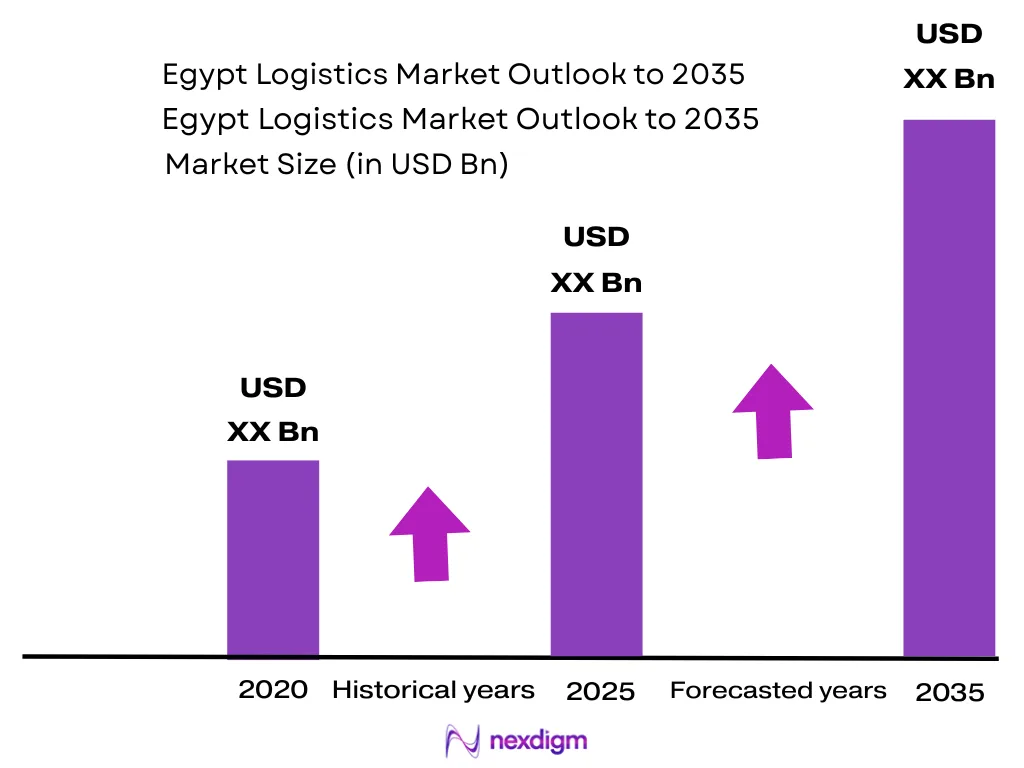
The Egypt logistics market is valued at USD ~ billion, based on a five-year historical analysis, and is supported by port modernization, road freight demand, Suez Canal-linked cargo flows, e-commerce fulfilment, warehousing and customs digitization. Egypt’s seaports handled 210 million tons of cargo and 9 million containers, including 5 million transit containers, while Suez Canal revenue moved from USD ~ billion to USD ~ billion because of Red Sea disruption, increasing the need for resilient multimodal logistics. The market is forecast to grow at a 6.40% CAGR during 2026–2035. Greater Cairo, Alexandria, Port Said, Suez, Ain Sokhna and Damietta dominate Egypt logistics because they combine consumer demand, port access, industrial zones, customs facilities and national freight corridors. Greater Cairo leads domestic distribution due to dense retail, FMCG and e-commerce demand; Alexandria and Damietta anchor Mediterranean trade; Port Said and Suez benefit from canal-linked container and transit movement; Ain Sokhna is strengthened by SCZONE’s industrial-port model, which spans six ports and four industrial zones near the Suez Canal.
Market Segmentation
By Mode of Transport
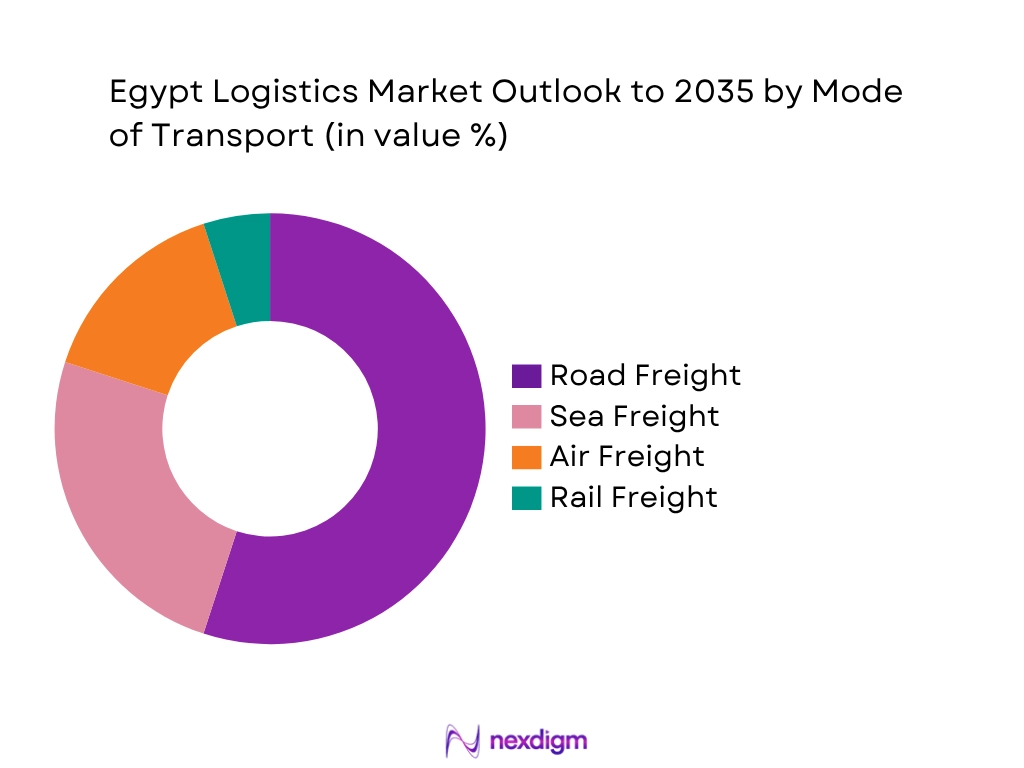
Egypt logistics market is segmented by mode of transport into road freight, sea freight, air freight and rail freight. Road freight has a dominant market share in Egypt under this segmentation because it provides nationwide flexibility across Greater Cairo, Alexandria, Delta governorates, Upper Egypt, Red Sea cities and industrial zones. It is the default mode for FMCG, retail, construction material, last-mile delivery and inland container movement from ports. BlueWeave’s Egypt freight and logistics coverage identifies road transportation as dominant because of flexibility, cost-effectiveness and extensive domestic coverage, while maritime transport accounts for about 25% and air freight for about 15%. Road freight also connects Egypt’s port system to warehouses, dry ports, industrial cities and consumer clusters, making it indispensable despite congestion, informal trucking and empty backhaul challenges.
By Logistics Function
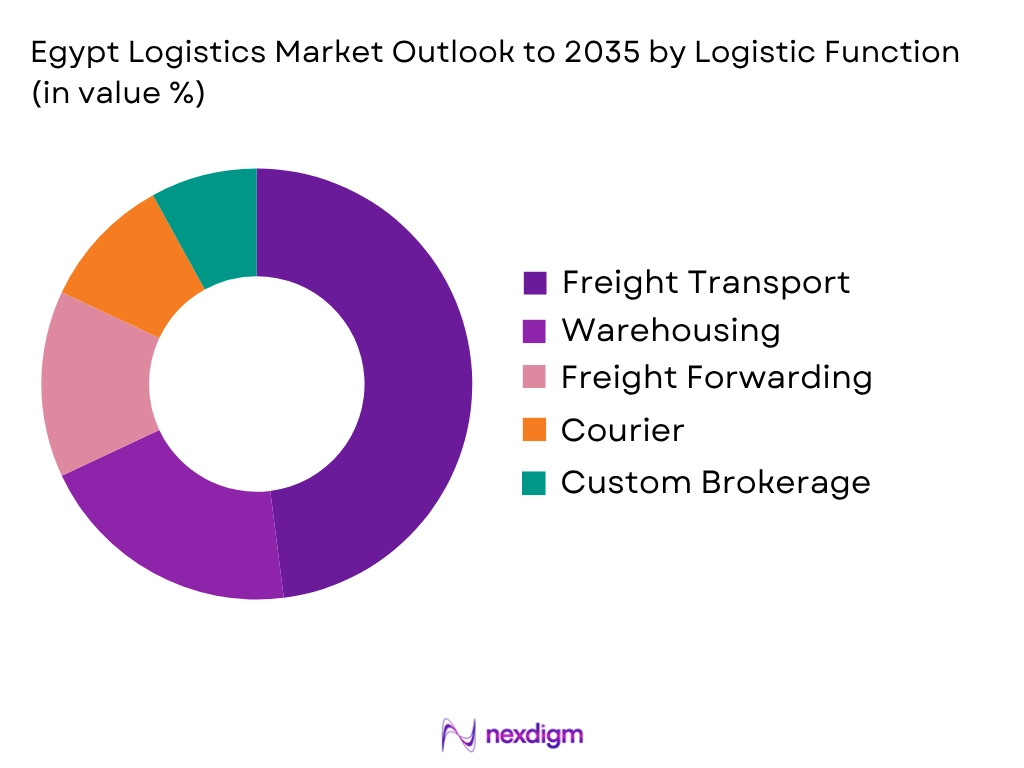
Egypt logistics market is segmented by logistics function into freight transport, warehousing and storage, freight forwarding, courier express parcel, customs brokerage and value-added logistics. Freight transport has a dominant market share because Egypt’s logistics demand is physically linked to container movement, bulk cargo, domestic distribution, industrial supply chains and port evacuation. Freight transport is supported by maritime cargo through Alexandria, Port Said, Damietta and Sokhna, and by inland movement through road corridors connecting ports to Cairo, industrial zones and Upper Egypt. Blue Weave identifies freight transport as the largest logistics function and links its dominance to strategic infrastructure investment, including nearly 80 transportation projects with an estimated investment of USD ~ billion. Warehousing and storage are rising because of retail, e-commerce, bonded storage, cold chain and SCZONE-linked fulfilment demand, but transport remains the core revenue-generating logistics activity.
Competitive Landscape
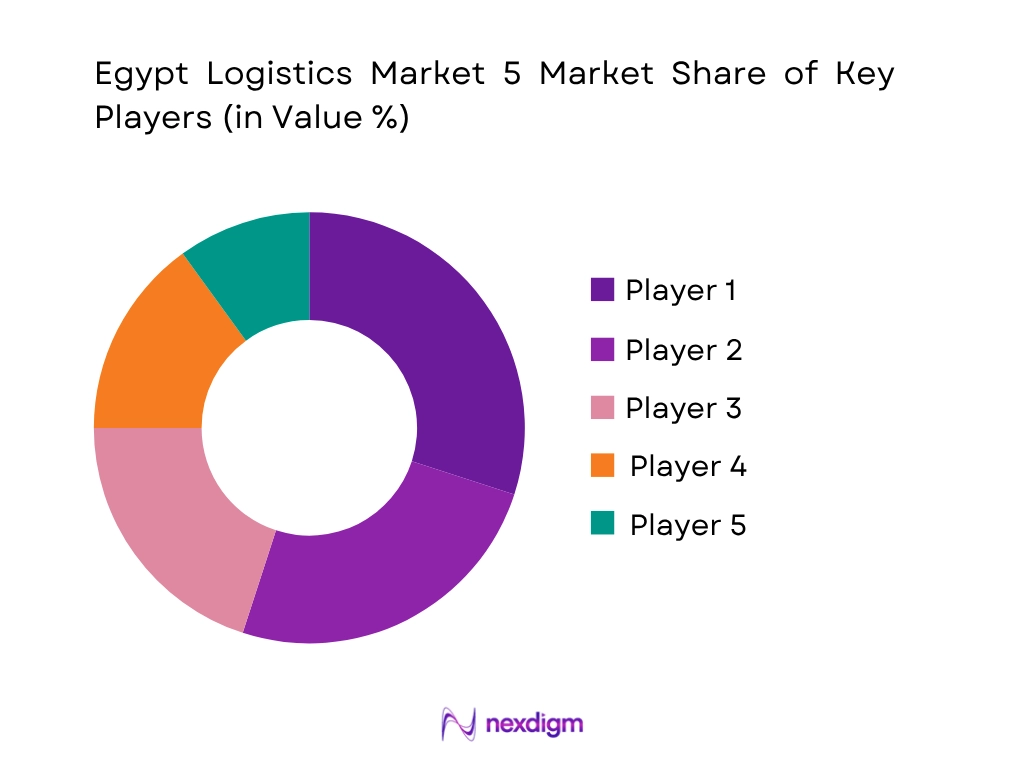
The Egypt logistics market is served by a mix of global integrators, regional express operators, shipping-linked logistics companies and domestic specialists. DHL, Aramex, DB Schenker, Kuehne + Nagel and Maersk hold strong positions because of international freight forwarding, contract logistics, express delivery, customs brokerage, port-linked services and multinational shipper relationships. Local players such as Egytrans, R2S Logistics and Mashaweer remain relevant in project cargo, domestic delivery and urban last-mile operations. The market is competitive but not fully consolidated because trucking, warehousing and last-mile delivery remain fragmented.
| Company | Establishment Year | Headquarters | Core Services in Egypt | Key Customer Verticals | Network Strength | Technology Capability | Specialized Logistics Capability | Egypt Market Position |
| DHL Group | 1969 | Bonn, Germany | ~ | ~ | ~ | ~ | ~ | ~ |
| Aramex | 1982 | Dubai, UAE | ~ | ~ | ~ | ~ | ~ | ~ |
| DB Schenker | 1872 | Essen, Germany | ~ | ~ | ~ | ~ | ~ | ~ |
| Kuehne+Nagel | 1890 | Schindellegi, Switzerland | ~ | ~ | ~ | ~ | ~ | ~ |
| Maersk | 1904 | Copenhagen, Denmark | ~ | ~ | ~ | ~ | ~ | ~ |
Egypt Logistics Market
Growth Drivers
Port-led cargo handling is strengthening Egypt’s logistics demand
Egypt’s logistics market is strongly supported by seaport cargo movement, container handling and nationwide port connectivity. The Maritime Transport and Logistics Sector reported 16,221 ship calls at Egyptian ports, 8,940,598 TEUs of container handling and 208,296 thousand tons of total goods movement across Egyptian ports. Alexandria handled 1,496,462 TEUs, El-Dekheila handled 715,389 TEUs, Damietta handled 1,416,385 TEUs, East Port Said handled 3,636,902 TEUs, and Sokhna handled 916,951 TEUs, showing that logistics demand is spread across Mediterranean and Red Sea gateways rather than being dependent on one port. The same data shows 96,390 thousand tons of imports, 69,796 thousand tons of exports and 42,110 thousand tons of transit cargo, creating demand for trucking, container drayage, customs brokerage, bonded warehousing and inland distribution. This logistics base is supported by Egypt’s macroeconomic scale, with the World Bank reporting USD 389.06 billion GDP and 116,538,258 population, both supporting freight movement, industrial activity and consumer distribution.
Industrial-zone and port-infrastructure expansion is increasing logistics outsourcing potential
Egypt’s logistics market is being driven by industrial-port integration, especially around SCZONE, Alexandria, Damietta, Sokhna and East Port Said. Reuters reported that the Suez Canal Economic Zone covers six ports and four industrial areas, with 164 new projects attracting more than USD 6.3 billion across recent investment cycles, while the zone invested USD 3 billion in infrastructure. This matters for logistics because industrial clustering increases demand for inbound raw-material transport, export container movement, bonded warehousing, contract logistics and freight forwarding. The Ministry of Transport also reported that Egypt owns 19 commercial ports, with 14 established ports and 5 new ports under development at Abu Qir, El Max, Gargoub, Bernees and Taba. Its maritime strategy includes planned berths and terminals of 70 km with navigational depths of 18–25 m, while Egyptian ports handled 1.6 billion tons of cargo and 72 million containers during the 2015–2024 period. IMF’s World Economic Outlook lists Egypt’s GDP at USD 429.65 billion in 2026, supporting logistics-linked industrial expansion. Sources: Reuters, Ministry of Transport, IMF.
Market Challenges
Red Sea disruption and Suez Canal volatility are affecting maritime logistics reliability
Egypt’s logistics market faces a market-specific challenge from Red Sea security disruption, which has affected Suez Canal-linked shipping flows and reduced predictability for maritime logistics, transit cargo, port services and inland container movement. Reuters reported that Egypt lost around USD 7 billion of Suez Canal revenue due to regional challenges, while another official-linked report stated that Suez Canal transit receipts dropped to USD 931.2 million in the first quarter of FY 2024/2025 from USD 2.4 billion in the comparable period, with net tonnage at 127.2 million tons. For logistics providers, this disruption matters beyond canal revenue because vessel diversions reduce transshipment flows, container availability, ship agency work, feeder activity and port-linked warehousing demand. Egypt responded by completing a trial run of a 10 km Suez Canal channel extension, raising the two-way section to 82 km and adding operational room for 6–8 ships daily, but route normalization remains tied to external security. Egypt’s World Bank-reported USD 389.06 billion GDP shows the macro stakes of protecting trade logistics.
Inland logistics capacity and multimodal connectivity remain uneven despite strong port activity
Egypt’s logistics market still faces inland bottlenecks because port throughput is high while dry-port, rail-linked and modern warehouse infrastructure remains under active development. The Maritime Transport and Logistics Sector recorded 8,940,598 TEUs and 208,296 thousand tons of port cargo movement, but inland evacuation remains dependent on road freight for container drayage, regional distribution and port-to-warehouse transfer. This creates pressure around Greater Cairo, Alexandria, Damietta, Sokhna and industrial-zone corridors. The government is addressing this through inland logistics nodes: the State Information Service reported that October Dry Port was established on 60 acres, with capacity for 720 containers per day, storage capacity of 260,000 containers, and 5 railway lines, but this also shows that multimodal systems are still being scaled rather than fully mature. The General Authority for Land and Dry Ports also reported approval for the 10th of Ramadan dry port and logistics center on 250 acres, reflecting continuing infrastructure gaps. Egypt’s 116,538,258 population adds pressure on urban distribution and last-mile logistics.
Market Opportunities
Dry ports and inland logistics hubs create scope for higher-efficiency freight movement
Egypt’s logistics market has an opportunity to expand through dry ports, inland container depots and rail-linked logistics hubs that reduce seaport congestion and shift part of container evacuation away from road-only movement. October Dry Port demonstrates the opportunity: the State Information Service reported a 60-acre inland trading area, 720 containers per day handling capacity, 260,000-container storage capacity and 5 railway lines, while EBRD identified the 6th of October Dry Port as Egypt’s first inland dry port west of Cairo, supported by a senior loan of up to USD 29.6 million. The opportunity is market-specific because Egypt’s ports already handle large cargo flows, including 96,390 thousand tons of imports, 69,796 thousand tons of exports and 42,110 thousand tons of transit cargo. More inland nodes can improve customs clearance, container repositioning, rail-road coordination and industrial-zone distribution. This is supported by Egypt’s macroeconomic base, with World Bank GDP of USD 389.06 billion and IMF 2026 GDP of USD 429.65 billion, indicating a large trade-linked economy requiring better inland logistics capacity.
E-commerce and digital trade adoption create opportunities for fulfilment and last-mile logistics
Egypt’s logistics market has an opportunity in fulfilment centers, parcel delivery, returns logistics, digital freight platforms and urban last-mile networks as digital adoption expands across a large consumer base. The U.S. International Trade Administration reported 96.3 million internet users in Egypt in early 2025, while its digital economy guide noted that the figure rose from a 2024 internet penetration level of 72.2 to 81.9 in early 2025, with peak internet usage averaging 14–16 hours per day. This creates stronger demand for warehouse management systems, parcel sorting, route optimization, payment reconciliation, cash-on-delivery handling and reverse logistics. The opportunity is reinforced by demographics: the World Bank reported Egypt’s population at 116,538,258 and GDP per capita at USD 3,338.5, showing a large consumer market that logistics companies can serve through scalable delivery networks. Unlike port logistics, this opportunity is less dependent on Red Sea shipping stability and is tied to domestic consumption, urban density and digital retail behavior across Greater Cairo, Alexandria, Delta cities and emerging secondary governorates.
Future Outlook
Over the next phase, the Egypt logistics market is expected to grow through integrated transport corridors, port-centric warehousing, e-commerce fulfilment, multimodal freight, cold chain and customs modernization. The country’s logistics advantage remains tied to geography: Egypt sits between the Mediterranean Sea, Red Sea, Africa, Europe and Asia, while the Suez Canal provides strategic relevance even during periods of maritime disruption.
Future growth will be shaped by inland connectivity rather than port expansion alone. Dry ports, logistics parks, rail-linked freight corridors and bonded warehousing are likely to reduce dependence on congested urban trucking and improve cargo evacuation from ports. The 6th of October dry port model, SCZONE logistics parks and inland container movement will become central to the future logistics network.
E-commerce and retail logistics will remain major demand generators. Egypt has one of the largest internet-user bases in MENA, and the U.S. International Trade Administration reported 96.3 million internet users and 81.9% internet penetration as of January 2025. However, only 8.3% of Egyptians make regular online purchases, showing that logistics providers still have room to expand parcel networks, COD reconciliation, returns handling and fulfilment infrastructure.
Cold chain logistics will also gain importance because of food exports, pharmaceuticals, supermarkets, dairy, frozen food and healthcare distribution. The opportunity is strongest for operators that can combine temperature-controlled storage, reefer trucking, compliance documentation and last-mile cold delivery. In parallel, global freight forwarders will continue expanding integrated logistics offerings as shippers seek fewer vendors, higher shipment visibility and more reliable customs coordination.
Risks remain material. Red Sea security disruption reduced Suez Canal traffic and revenue, showing that Egypt’s logistics ecosystem is exposed to geopolitical risk. The canal’s annual revenue fell from USD 10.25 billion to USD 3.99 billion, and ship traffic declined to 13,213 vessels from more than 26,000 vessels, according to AP’s reporting of Suez Canal Authority data. This reinforces the need for diversification into domestic warehousing, road freight, industrial-zone logistics, e-commerce, cold chain and value-added logistics.
Major Players
- DHL Egypt
- Aramex Egypt
- DB Schenker Egypt
- Kuehne+Nagel Egypt
- DSV Egypt
- CEVA Logistics Egypt
- Maersk Egypt
- CMA CGM Egypt
- FedEx Egypt
- UPS Egypt
- Agility Egypt
- Naqel Express Egypt
- R2S Logistics
- Egytrans
- Mashaweer
Key Target Audience
- Logistics service providers
- Freight forwarding companies
- Shipping lines and port operators
- Warehouse developers and industrial park operators
- E-commerce platforms and retail chains
- Manufacturing, FMCG and pharmaceutical companies
- Investments and venture capitalist firms
- Government and regulatory bodies, including Ministry of Transport, Egyptian Customs Authority, Suez Canal Authority, SCZONE, General Authority for Land and Dry Ports, Maritime Transport Sector
Research Methodology
Step 1: Identification of Key Variables
The initial phase involves constructing an ecosystem map for the Egypt logistics market, covering shippers, carriers, freight forwarders, 3PLs, 4PLs, port authorities, customs brokers, warehouse operators, e-commerce firms and government agencies. The key variables include freight flow, container movement, warehouse occupancy, customs clearance, fleet utilization and end-user logistics demand.
Step 2: Market Analysis and Construction
In this phase, historical market data is compiled across transportation, warehousing, freight forwarding, courier express parcel, customs brokerage and contract logistics. Public port statistics, logistics company disclosures, trade data and infrastructure announcements are analyzed to construct the market by service type, transport mode, region and end-user industry.
Step 3: Hypothesis Validation and Expert Consultation
Market hypotheses are validated through interviews with freight forwarders, port users, 3PL operators, warehouse developers, shipping agents, customs brokers and large shippers. These discussions help verify service-level gaps, pricing behavior, demand concentration, port evacuation bottlenecks, cold chain requirements and logistics outsourcing patterns.
Step 4: Research Synthesis and Final Output
The final phase involves triangulating secondary research, primary insights and bottom-up logistics activity indicators. Freight transport, warehousing, e-commerce fulfilment, cold chain and port-centric logistics are assessed together to deliver a validated view of market size, segmentation, competition, growth outlook and investment opportunities.

- Executive Summary
- Research Methodology (Market Definitions and Assumptions, Logistics Service Coverage, Freight Revenue Mapping, Shipment Flow Estimation, Top-to-Bottom Trade Flow Validation, Bottom-to-Top Fleet/Warehouse/Container Throughput Build-Up, Primary Interviews with 3PLs/Freight Forwarders/Warehouse Operators/Port Operators/Shippers, Secondary Research Validation, Customs and Port Data Triangulation, Limitations and Future Conclusions)

- Definition and Scope
- Market Genesis
- Evolution of Egypt as a Regional Logistics Hub
- Egypt Logistics Business Cycle
- Logistics Value Chain Analysis
- Supply Chain Ecosystem Analysis

- Growth Drivers (Suez Canal Connectivity, Port Modernization, Industrial Zone Expansion, E-Commerce Growth, Cold Chain Demand, Customs Digitization, Greater Cairo Consumption Base, Export-Oriented Manufacturing)
- Market Challenges (Road Congestion, Informal Trucking, Port Dwell Time, Warehouse Quality Gap, Refrigerated Fleet Shortage, Fuel Volatility, Border Clearance Complexity, Fragmented Provider Base)
- Market Opportunities (Multimodal Corridors, Dry Ports, Contract Logistics, Pharmaceutical Cold Chain, E-Commerce Fulfilment, Free Zone Warehousing, Digital Freight Matching, Green Logistics)
- Trends (Port-Centric Warehousing, Asset-Light 3PL Models, Warehouse Automation, Fleet Telematics, E-Commerce Returns, Cross-Border Connectivity, Sustainability Reporting)
- Government Regulation (Customs Law, Advance Cargo Information, National Single Window, Maritime Transport Regulations, Land Transport Licensing, Free Zone
- SWOT Analysis
- PESTLE Analysis
- Porter’s Five Forces Analysis
Stakeholder Ecosystem

- By Value (2020-2025)
- By Freight Volume (2020-2025)
- By Shipment Volume (2020-2025)

- By Mode of Transport (In Value %)
Road Freight
Sea Freight
Air Freight
Rail Freight
Multimodal Transport - By Service Type (In Value %)
Transportation Services
Warehousing Services
Freight Forwarding
Contract Logistics
Customs Brokerage - By End-User Industry (In Value %)
Retail and E-Commerce
FMCG
Food and Beverages
Pharmaceuticals and Healthcare
Automotive
Chemicals and Petrochemicals - By Region (In Value %)
Greater Cairo
Alexandria
Suez Canal Zone
Delta Region
Upper Egypt

- Market Share of Major Players on the Basis of Value and Shipment Volume
- Cross Comparison Parameters (Port Connectivity and Customs Brokerage Capability, Domestic Fleet and Line-Haul Network, Grade-A Warehousing and Fulfilment Footprint, Cold Chain and Reefer Asset Capability, E-Commerce Last-Mile and Returns Network, SCZONE/Free Zone/Bonded Logistics Presence, Technology Stack Including TMS/WMS/GPS/Control Tower, Key Industry Verticals Served Including FMCG/Pharma/Automotive/Retail)
- SWOT Analysis of Major Players
- Pricing Analysis of Major Players
- Competitive Positioning Matrix (Asset-Heavy vs Asset-Light, Domestic vs International Reach, Express vs Contract Logistics, General Cargo vs Specialized Cargo)
- Detailed Profiles of Major Companies
DHL Egypt
Aramex Egypt
DB Schenker Egypt
Kuehne+Nagel Egypt
DSV Egypt
CEVA Logistics Egypt
Maersk Egypt
CMA CGM Egypt
FedEx Egypt
UPS Egypt
Agility Egypt
Naqel Express Egypt
R2S Logistics
Egytrans
Mashaweer

- Market Demand and Utilization
- Purchasing Power and Logistics Budget Allocation
- Regulatory and Compliance Requirements
- Needs, Desires and Pain Point Analysis
- Decision-Making Process

- By Value (2026-2035)
- By Freight Volume (2026-2035)
- By Shipment Volume (2026-2035)


 Request a Sample
 Ask for Customization
 Get a Quote
 Enquire Now