

 Download PDF
Market Overview
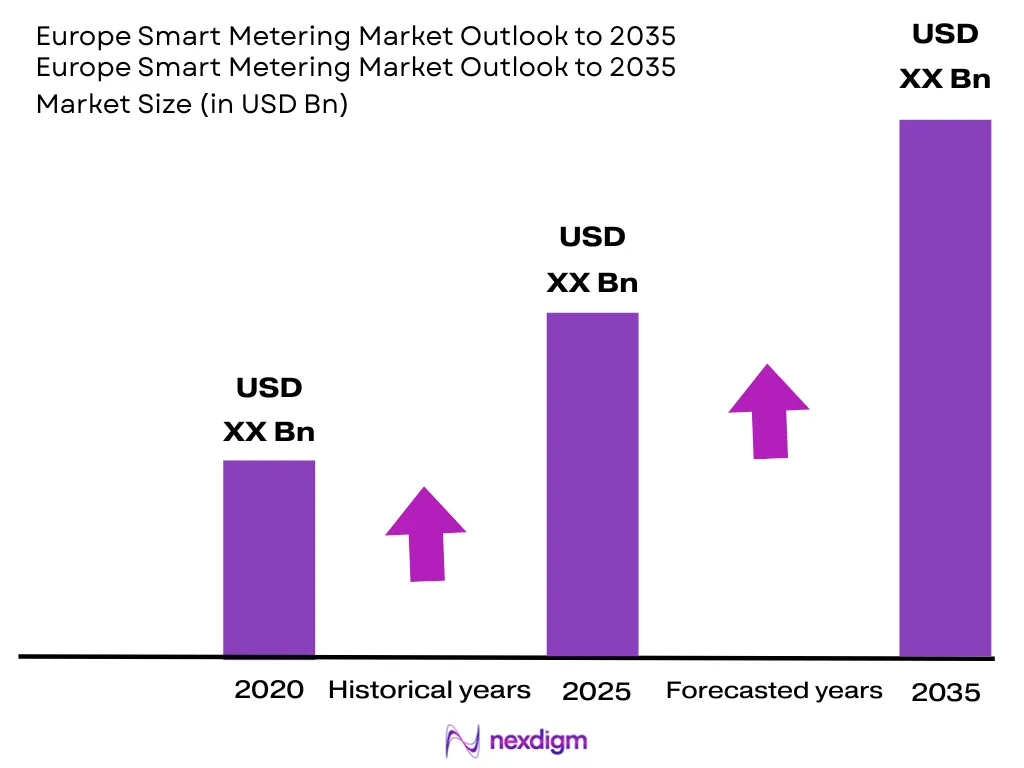
The Europe Smart Metering Market was valued at USD ~ Billion in 2024 and is anticipated to expand at a CAGR of ~% during 2026–2035. The market is primarily driven by binding EU regulatory mandates under the Electricity Market Directive 2019/944, which called for member states to target 80% smart meter coverage by 2024 where cost-effective, alongside a wave of national rollout programs now approaching completion in Western Europe and the Nordics while accelerating rapidly across Central, East, and Southeast Europe. The EU27+3 region had approximately 209 million smart electricity meters installed by the end of 2025, equivalent to roughly two-thirds of electricity customers, with a further 131 million units forecast for deployment between 2025 and 2031. The Europe smart gas meter market alone is projected to grow from USD 721.8 million in 2025 to USD 1,395.9 million by 2034, reflecting an 8.0% CAGR, as national programs in the UK, Italy, France, and Germany continue to drive gas metering digitalization alongside broader electricity metering rollouts.
Market Segmentation
By Generation
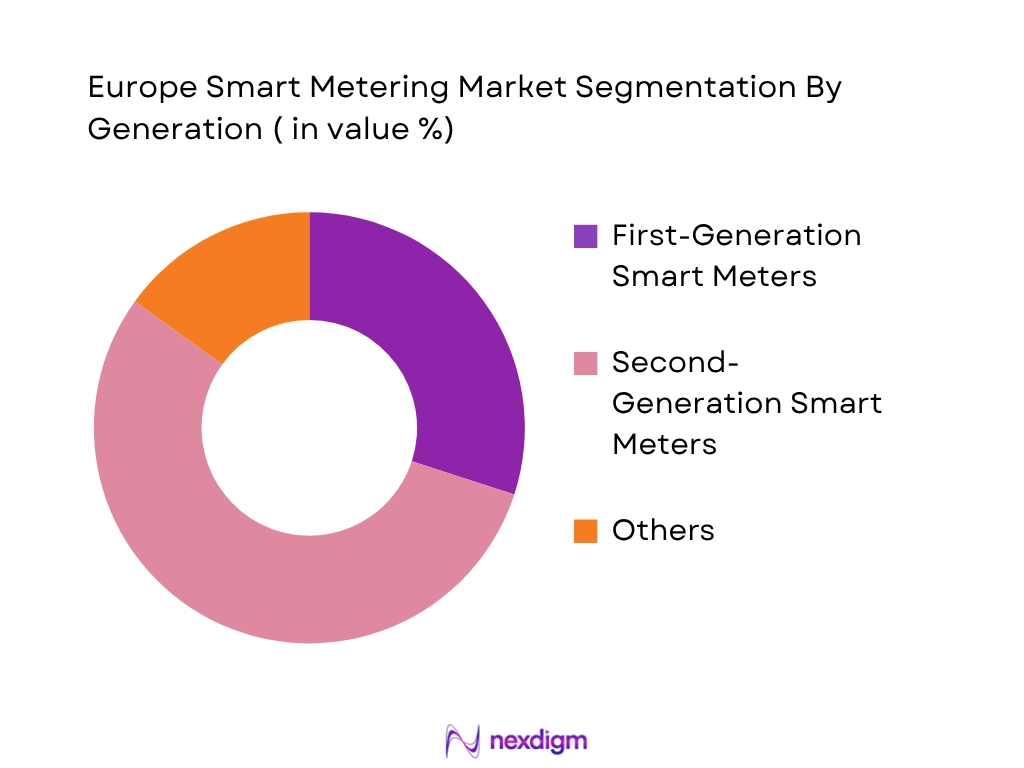
First-Generation Smart Meters continue to represent a substantial share of the Europe Smart Metering Market, particularly across Central, East, and Southeast Europe, where utilities in countries including Germany, Poland, and Greece are still working through their first large-scale rollout programs; Germany’s statutory framework mandates rollout from 2025 for consumers below 100,000 kWh annually, with 95% of applicable metering points required to be equipped by the end of 2030. Second-Generation Smart Meters (Replacement & Upgrade) represent the fastest-growing segment across Western Europe and the Nordics, where earlier rollout leaders such as Denmark, Sweden, Spain, France, and the Netherlands are now progressing to upgraded communications networks and next-generation devices; industry analysis indicates that replacements of first-generation smart meters are expected to account for 20% to 40% of total smart meter shipments across Europe over the next five years, equivalent to 3.5 to 7.0 million units annually. This divergence between first-generation and replacement-driven demand defines the most useful lens for understanding the market’s current and future shape.
By Communication Technology
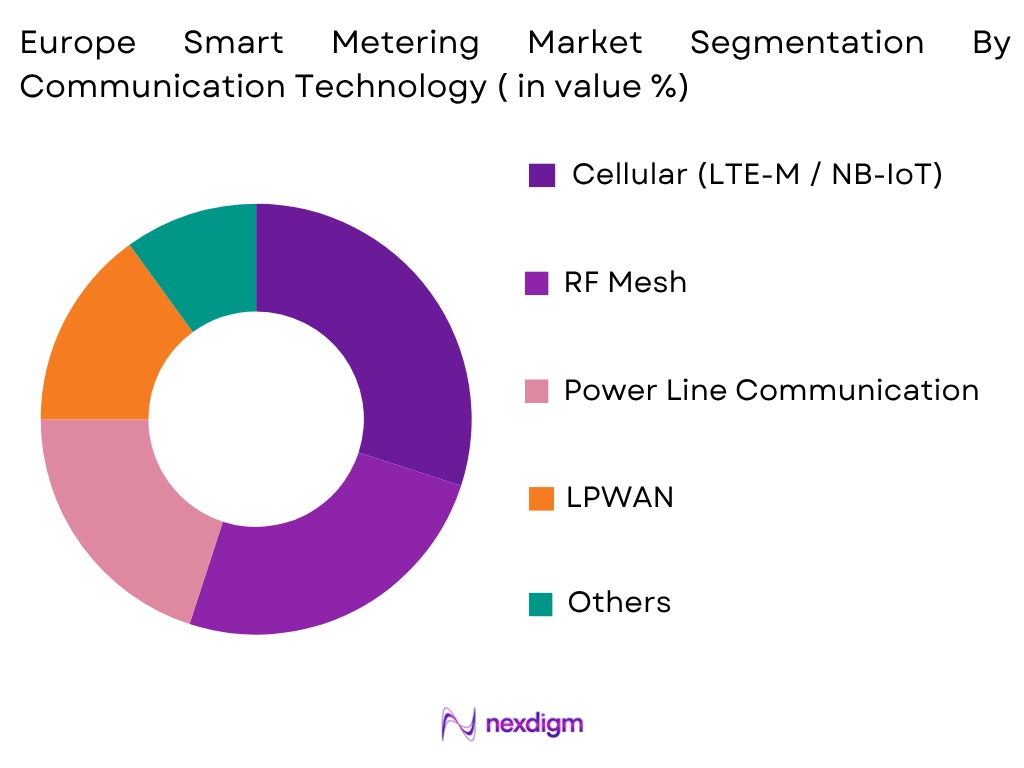
Cellular (LTE-M / NB-IoT) communication technology represents the primary growth driver of the Europe Smart Metering Market’s next phase, with 3GPP-based low-power wide-area (LPWA) technologies identified as the main catalyst for continued shipment growth as utilities modernize both first-generation and replacement meter fleets. RF Mesh and Power Line Communication (PLC) technologies remain foundational across established markets such as France, where the Linky rollout relied heavily on PLC infrastructure, and continue to underpin large-scale national programs given their proven reliability at scale. LPWAN technologies are gaining particular traction in markets pursuing second-generation upgrades, where utilities seek to balance communication range, battery efficiency, and data granularity to support increasingly sophisticated grid modernization and demand response applications alongside core metering functions.
Competitive Landscape
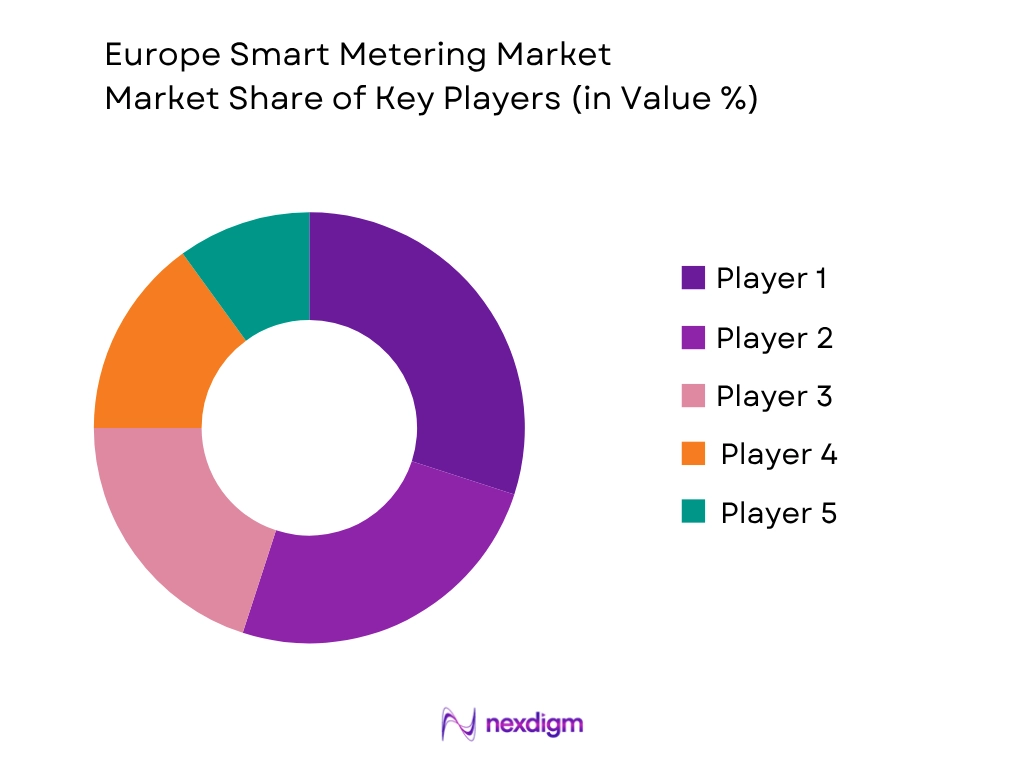
The Europe Smart Metering Market is led by a concentrated group of European-headquartered manufacturers with deep utility relationships built over decades of national rollout programs. Landis+Gyr, founded in 1896 and headquartered in Cham, Switzerland, stands as the global industry leader in smart metering technology, having deployed meters for major European utilities including British Gas, Iberdrola, Électricité Réseau Distribution France, E.ON, Vattenfall, and RWE across its more than 125-year history in energy management solutions. Kamstrup, founded in 1946 and based in Skanderborg, Denmark, reported a historically strong 2025 annual result with 15% revenue growth to DKK 3.5 billion, reflecting robust underlying demand for its metering solutions sold in more than 90 countries. Sagemcom Energy and Telecom, a French group known for advanced multi-utility smart metering platforms and open-architecture communication modules supporting large-scale AMI rollouts, competes alongside Iskraemeco, a longstanding Slovenian manufacturer founded in 1946, and Diehl Metering, headquartered in Nuremberg, Germany, which provides integrated metering systems focused on digital transformation for European utilities. These European manufacturers compete alongside global players including Itron, Sensus (part of Xylem), and Honeywell’s Elster business, with competitive dynamics increasingly shaped by second-generation replacement capability, LPWA communication technology integration, and meter data management software sophistication.
| Company | Established | Headquarters | Electricity Metering Portfolio | Gas/Water Metering Portfolio | Manufacturing Presence | Major End-Use Segments | Key Strategic Focus | Certifications & Compliance |
| Landis+Gyr Group AG | 1896 | ~
|
~ | ~ | ~ | ~ | ~ | ~ |
| Kamstrup A/S | 1946 | ~
|
~ | ~ | ~ | ~ | ~ | ~ |
| Sagemcom Energy and Telecom SAS | 2008 | ~
|
~ | ~ | ~ | ~ | ~ | ~ |
| Iskraemeco d.d. | 1946 | ~ | ~ | ~ | ~ | ~ | ~ | ~ |
| Diehl Metering GmbH | 1902 | ~
|
~ | ~ | ~ | ~ | ~ | ~ |
Europe Smart Metering Market Analysis
Growth Drivers
EU Regulatory Mandates and National Rollout Programs
Binding EU regulatory frameworks, including the Electricity Market Directive 2019/944 and earlier directives 2009/72/EC, 2009/73/EC, and the Energy Efficiency Directive 2012/27/EU, continue to anchor smart meter deployment across the region, targeting 80% coverage by 2024 where cost-effective. National rollout programs illustrate the scale of this regulatory-driven investment: France’s Linky rollout deployed 28 million meters at a total cost of €4.5 billion, saving households an average of €50 per year, while introducing fines from January 2023 for households refusing installation. Portugal’s EDP Distribuição has been installing 10,000 smart meters per week toward full national coverage by 2025 at a cost of approximately €230 million, and Belgium’s Fluvius network received up to €425 million in European Investment Bank financing to support rollout across Flanders, targeting 80% coverage by 2024. Germany’s newly clarified statutory framework, mandating rollout from 2025 for smaller consumers with 95% coverage required by 2030, signals that even historically slower-moving markets are now committing to binding national deadlines.
Second-Generation Replacement Cycle and LPWA Technology Transition
Europe’s smart metering market is no longer solely a first-time deployment story; in markets where rollouts are well advanced or largely completed, including much of Western Europe and the Nordics, the focus is increasingly shifting toward second-generation devices, upgraded communications networks, and operational lessons learned from earlier programmes. Industry analysts project that replacements of first-generation smart meters will account for 20% to 40% of total European smart meter shipments over the next five years, equivalent to 3.5 to 7.0 million units annually, with Spain identified as a particularly significant contributor to second-generation ramp-up activity. This replacement wave, combined with the adoption of 3GPP-based LPWA technologies such as LTE-M and NB-IoT as the primary driver of continued shipment growth, is reshaping manufacturer competition around communication technology sophistication rather than pure installation volume.
Market Challenges
Highly Uneven Rollout Progress Across Member States
The Europe Smart Metering Market remains characterized by stark disparities in national rollout maturity, creating a genuinely two-speed continent that manufacturers and utilities must navigate simultaneously. While Denmark and Sweden achieved 100% household smart meter penetration by 2021, and Estonia, Spain, Finland, Italy, Luxembourg, and Norway reached at least 98% coverage in the same period, Germany remained among Europe’s clear laggards, with only around 160,000 of more than 50 million metering locations equipped by 2021. The United Kingdom has similarly faced delays, with government coverage targets revised downward from an original 100% by 2025 goal to approximately 74.5% coverage of homes and small businesses due to slower-than-expected progress, illustrating how even well-resourced markets can fall meaningfully behind original rollout ambitions.
Consumer Resistance, Data Privacy Concerns and Cybersecurity Requirements
Smart meters collect detailed energy consumption data, raising data privacy and cybersecurity concerns that continue to generate consumer resistance across several European markets, compounded in some cases by misinformation about health risks or billing impacts. France’s decision to introduce fines from January 2023 for households refusing Linky meter installation illustrates the level of friction utilities and regulators have encountered in translating rollout mandates into full household compliance. Differences in regulatory frameworks and electricity market structures across EU member states further slow standardization efforts, with market complexity continuing to complicate cross-border technology deployment and manufacturer supply chain planning even as CEN-CENELEC’s Smart Meters Coordination Group works to harmonize technical standards across the region.
Market Opportunities
Central, East and Southeast Europe as the Next Growth Frontier
As rollouts in much of Western Europe and the Nordics reach maturity, the Central, East, and Southeast European region has emerged as the market’s clearest growth frontier, with the outlook improving significantly over recent years as multiple major rollouts move from planning into active deployment. Industry forecasts indicate that this region is expected to account for as much as 52% of annual EU27+3 smart meter shipments by 2029, up sharply from 28% in 2023, with 9 of the 10 fastest-growing markets for first-generation smart meter shipment volumes located within this region. Manufacturers and systems integrators with the regulatory expertise and local market relationships needed to navigate these newly accelerating national programs stand to capture a disproportionate share of Europe’s remaining first-generation deployment opportunity over the coming decade.
Second-Generation and Multi-Utility Meter Upgrade Cycle
The maturation of Europe’s earliest smart meter markets is creating a substantial and durable replacement opportunity, with first-generation devices installed in the Nordics, France, Spain, and the UK during the 2010s now approaching natural end-of-life or requiring communication technology upgrades to support modern grid applications. Manufacturers capable of offering multi-utility combined metering, integrated meter data management software, and LTE-M or NB-IoT-enabled communication modules are well positioned to capture this replacement wave, particularly as utilities increasingly view second-generation deployments as an opportunity to add demand response, grid edge intelligence, and advanced analytics capabilities that first-generation meters were not originally designed to support.
Future Outlook
The Europe Smart Metering Market is expected to witness sustained expansion over the forecast period, supported by continued national rollout completion across Central, East, and Southeast Europe, an accelerating second-generation replacement cycle across Western Europe and the Nordics, and continued EU regulatory support for grid modernization and decarbonization. Growing adoption of LTE-M and NB-IoT communication technology, alongside rising demand for integrated meter data management and demand response capability, will further shape competitive dynamics among the region’s leading manufacturers. The market is also likely to benefit from Europe’s broader energy transition agenda, as smart metering infrastructure increasingly serves as a foundational layer supporting renewable energy integration, grid flexibility, and consumer-level energy efficiency across the region’s diverse and increasingly digitalized national energy systems.
Major Players
- Landis+Gyr Group AG
- Kamstrup A/S
- Sagemcom Energy and Telecom SAS
- Iskraemeco d.d.
- Diehl Metering GmbH
- Itron, Inc.
- Sensus (Xylem)
- Honeywell International (Elster)
- Apator SA
- Zenner International GmbH & Co. KG
- Aclara Technologies LLC
- Aidon Oy
- ZIV Automation S.L.
- Holley Technology Ltd.
- Secure Meters Europe Ltd.
Key Target Audience
- Smart Meter Manufacturers and Component Suppliers
- Electricity, Gas and Water Utilities
- Distribution System Operators (DSOs)
- Meter Data Management and Software Providers
- Communication Module and Network Suppliers
- Investment and Venture Capitalist Firms
- Government and Regulatory Bodies (European Commission, National Energy Regulators, CEN-CENELEC)
- Grid Modernization and Systems Integration Firms
Research Methodology
Step 1: Identification of Key Variables
The research process begins with identifying the complete ecosystem of the Europe Smart Metering Market, including component and communication module suppliers, meter manufacturers, utilities and distribution system operators, meter data management software providers, and regulatory authorities. Extensive secondary research is conducted using company reports, government publications, trade associations, customs statistics, industry journals, and proprietary databases to determine the variables influencing market demand, pricing, deployment, adoption, and technological developments.
Step 2: Market Analysis and Construction
Historical market information is collected and analyzed to estimate market size, installed base figures, national rollout progress, and pricing trends. A combination of top-down and bottom-up approaches is used to estimate market revenues and validate segment-level performance. Deployment patterns across electricity, gas, water, and multi-utility metering are evaluated to establish an accurate representation of the industry.
Step 3: Hypothesis Validation and Expert Consultation
The preliminary findings are validated through Computer-Assisted Telephone Interviews (CATIs) and structured discussions with utility procurement managers, grid modernization specialists, regulatory experts, and senior executives operating within Europe’s smart metering and energy technology industry. These interviews help verify market assumptions, competitive developments, technology adoption trends, pricing dynamics, and future investment opportunities while refining the overall market estimates.
Step 4: Research Synthesis and Final Output
The final stage integrates insights obtained from primary interviews with quantitative information collected through secondary sources. Data triangulation techniques are applied to reconcile differences between supply-side and demand-side estimates, ensuring robust market forecasting. The report is then reviewed through multiple quality assurance checkpoints to deliver a comprehensive analysis covering market size, segmentation, competitive landscape, future outlook, and strategic recommendations for industry stakeholders.

- Executive Summary
- Research Methodology (Market Definitions and Assumptions, Abbreviations, Market Sizing Approach, Top-Down Analysis, Bottom-Up Analysis, Demand-Side Assessment, Supply-Side Assessment, Primary Industry Interviews, Secondary Research Validation, Data Triangulation, Forecasting Framework, Limitations and Future Conclusions)

- Definition and Scope
- Market Evolution and Industry Genesis
- Timeline of Major Industry Developments
- Smart Metering Industry Value Chain Analysis
- Supply Chain Analysis

- Growth Drivers (EU Regulatory Mandates and National Rollout Programs, Second-Generation Replacement Cycle, LPWA and Cellular Technology Transition, Grid Modernization and Renewable Integration Needs, Rising Demand for Real-Time Consumption Data, Decarbonization and Energy Efficiency Policy Support)
- Market Challenges (Highly Uneven Rollout Progress Across Member States, Consumer Resistance and Data Privacy Concerns, Cybersecurity and Grid Resilience Requirements, Fragmented National Regulatory Frameworks, High Upfront Capital Costs for Utilities, Communication Network Interoperability Issues)
- Market Opportunities (Central, East and Southeast Europe as the Next Growth Frontier, Second-Generation and Multi-Utility Meter Upgrade Cycle, LTE-M and NB-IoT Module Supply Growth, Smart Grid and Demand Response Integration, Meter Data Management and Analytics Services, Public-Private Grid Modernization Partnerships)
- Market Trends (Shift from Rollout Race to Technology Transition, Growth of 3GPP-Based LPWA Communication, Rise of Second-Generation Meter Replacement Demand, Multi-Utility Combined Metering Adoption, Integration with Demand Response and Smart Grid Platforms, Growing Focus on Cybersecurity-Hardened Meter Design)
- Government Regulations (EU Electricity Market Directive 2019/944, EU Directives 2009/72/EC and 2009/73/EC, EU Energy Efficiency Directive 2012/27/EU, National Smart Meter Rollout Mandates, CEN-CENELEC Smart Meter Standards, Data Privacy and Cybersecurity Requirements)
- Import and Export Analysis (Trade Volume, Major Manufacturing Hubs, Cross-Border Component Supply Chains, HS Code Analysis, Trade Balance)
- Raw Material Availability Analysis (Semiconductor and Communication Module Supply, Metering Component and Sensor Availability, Domestic European Manufacturing Capacity, Import Dependency for Advanced Chipsets, Regional Component Supply Chain Resilience)
- Technology Landscape (RF Mesh and PLC Communication Technology, LTE-M and NB-IoT Cellular Modules, Meter Data Management (MDM) Software Platforms, Demand Response Integration Technology, Cybersecurity and Encryption Technology)
- Sustainability Assessment (Energy Efficiency Enablement, Renewable Energy Grid Integration Support, Carbon Footprint Reduction Through Consumption Optimization, Circular Economy Alignment for Meter Components, End-of-Life Meter Recycling)
- PESTLE Analysis
- SWOT Analysis
- Porter’s Five Forces Analysis
- Stakeholder Ecosystem
- Competition Ecosystem

- By Market Value (2020-2025)
- By Installed Base (2020-2025)
- By Average Selling Price (2020-2025)

- By Meter Type (In Value %)
Smart Electricity Meters
Smart Gas Meters
Smart Water Meters
Multi-Utility & Combined Meters - By Communication Technology (In Value %)
RF Mesh
Power Line Communication (PLC)
Cellular (LTE-M / NB-IoT)
LPWAN
Fixed Broadband - By Component (In Value %)
Hardware
Software & Meter Data Management (MDM)
Communication Modules
Installation & Integration Services - By Generation (In Value %)
First-Generation Smart Meters
Second-Generation Smart Meters (Replacement & Upgrade) - By Region (In Value %)
Western Europe
Nordics
Southern Europe
Central & Eastern Europe
UK & Ireland

- Market Share of Major Players (By Value, Installed Base, Meter Type, Communication Technology, End User)
- Cross Comparison Parameters (Installed Base Scale, Communication Technology Portfolio, MDM Software Capability, Application Technical Support, Manufacturing Capacity, Regulatory Compliance & Certifications, Utility Customer Base, Innovation & New Product Launch Frequency)
- SWOT Analysis of Major Players
- Pricing Analysis by Meter Type and Communication Technology
- Production Capacity Analysis
- Manufacturing Footprint Analysis
- Distribution Network Analysis
- Innovation Benchmarking
- Detailed Profiles of Major Companies
Landis+Gyr Group AG
Kamstrup A/S
Sagemcom Energy and Telecom SAS
Iskraemeco d.d.
Diehl Metering GmbH
Itron, Inc.
Sensus (Xylem)
Honeywell International (Elster)
Apator SA
Zenner International GmbH & Co. KG
Aclara Technologies LLC
Aidon Oy
ZIV Automation S.L.
Holley Technology Ltd.
Secure Meters Europe Ltd.

- Consumption Pattern Analysis (Installed Base Penetration, Replacement Cycle Timing, End-User Segment Adoption, Seasonal Demand, National Rollout Program Impact)
- Purchasing Criteria (Regulatory Compliance, Communication Technology Compatibility, Cost Efficiency, Data Security, Interoperability, Installation Reliability)
- Procurement and Supplier Selection Analysis
- Second-Generation Upgrade Adoption Assessment
- First-Generation Rollout vs Replacement Market Demand
- Product Attribute Preference Analysis (Communication Reliability, Data Accuracy, Cybersecurity Features, Interoperability, Battery Life, Remote Connect/Disconnect Capability)
- Sustainability & ESG Influence on Procurement Decisions
- Pain Point Analysis
- Decision-Making Process

- By Market Value (2026-2035)
- By Installed Base (2026-2035)
- By Average Selling Price (2026-2035)


 Request a Sample
 Ask for Customization
 Get a Quote
 Enquire Now