

 Download PDF
 Download PDF
Market Overview
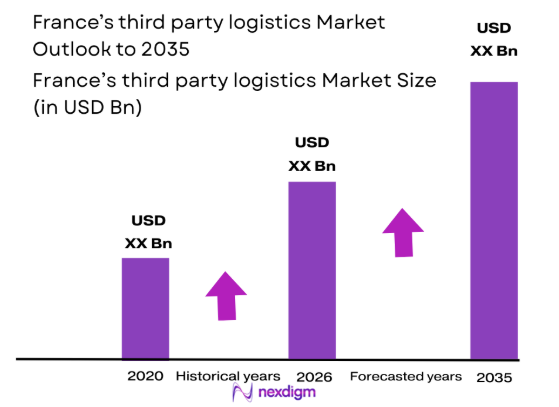
France’s third party logistics market is valued at approximately USD ~ billion based on a recent historical assessment, driven by the expansion of e commerce supply chains, increasing outsourcing of logistics operations by manufacturers, and rising demand for integrated transportation and warehousing services. Major logistics providers operate extensive distribution networks supported by automated warehouses, multimodal freight corridors, and digital supply chain platforms. According to data from the French Ministry of Ecological Transition and logistics industry associations, continuous growth in retail distribution and international trade significantly strengthens demand for professional 3PL services across the country.
Logistics operations in France are concentrated in major economic hubs including Paris, Lyon, Marseille, Lille, and Toulouse due to dense industrial clusters, international transport infrastructure, and proximity to European trade corridors. Paris functions as a central logistics command center supported by advanced distribution hubs and international freight facilities, while Marseille benefits from large maritime cargo volumes through its Mediterranean port complex. Lyon and Lille also play key roles in freight consolidation because of their strategic location connecting southern Europe, northern Europe, and cross border industrial supply chains.
Market Segmentation
By Service Type
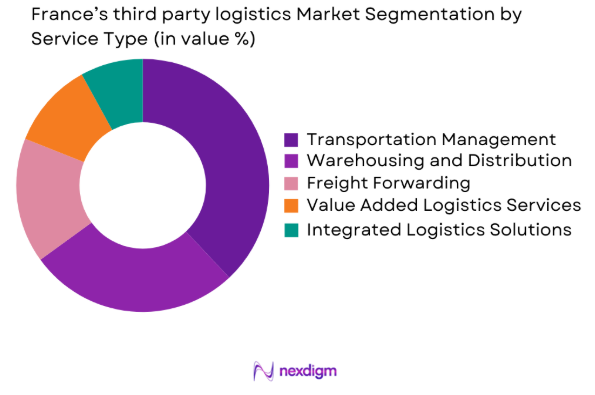
France 3PL market is segmented by service type into transportation management, warehousing and distribution, freight forwarding, value added logistics services, and integrated logistics solutions. Recently, transportation management has a dominant market share due to factors such as high demand for road freight coordination across national distribution networks, expansion of cross border trade within the European Union, and extensive reliance on trucking fleets to support retail supply chains. France possesses one of the largest road transportation infrastructures in Europe, allowing logistics companies to efficiently coordinate freight movement between manufacturing clusters, distribution centers, and consumer markets. Increasing parcel shipments from e commerce retailers further strengthen demand for transportation management services capable of handling high shipment volumes. Logistics providers also deploy advanced route optimization technologies and fleet management systems to reduce delivery times and improve operational efficiency, reinforcing the dominant role of transportation management services within the national third party logistics ecosystem.
By End User Industry
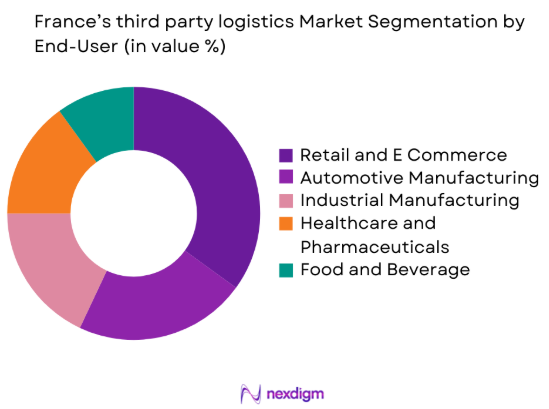
France 3PL market is segmented by end user industry into retail and e commerce, automotive manufacturing, industrial manufacturing, healthcare and pharmaceuticals, and food and beverage industries. Recently, retail and e commerce has a dominant market share due to factors such as the rapid growth of online retail platforms, high parcel shipment volumes, and increasing demand for omnichannel fulfillment networks across France. Retail companies rely heavily on specialized logistics providers to manage inventory storage, packaging operations, and last mile distribution services across large consumer markets. The presence of major e commerce retailers and multinational brands significantly increases logistics outsourcing demand. Automated fulfillment centers located near urban areas further strengthen logistics efficiency by enabling rapid delivery schedules and large scale order processing. The growing integration of digital commerce platforms with warehouse management systems also enhances operational productivity, reinforcing the dominant position of retail and e commerce as the largest end user segment in the national third party logistics market.
Competitive Landscape
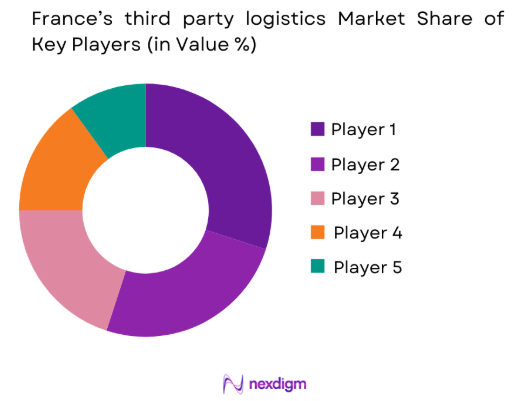
The France 3PL market demonstrates a moderately consolidated competitive structure where multinational logistics corporations and domestic logistics specialists compete through large distribution networks, advanced warehouse automation technologies, and integrated supply chain management platforms. Major companies expand their market presence through acquisitions, infrastructure investments, and strategic partnerships with retailers and manufacturers. International players operate extensive European logistics networks while French logistics companies maintain strong domestic distribution capabilities, allowing them to compete effectively across transportation management, warehousing, and freight forwarding services.
| Company Name | Establishment Year | Headquarters | Technology Focus | Market Reach | Key Products | Revenue | Logistics Network Size |
| DHL Supply Chain | 1969 | Bonn, Germany | ~ | ~ | ~ | ~ | ~ |
| Kuehne + Nagel | 1890 | Schindellegi, Switzerland | ~ | ~ | ~ | ~ | ~ |
| DB Schenker | 1872 | Essen, Germany | ~ | ~ | ~ | ~ | ~ |
| GEODIS | 1904 | Levallois-Perret, France | ~ | ~ | ~ | ~ | ~ |
| CEVA Logistics | 2007 | Marseille, France | ~ | ~ | ~ | ~ | ~ |
France’s third party logistics Market Analysis
Growth Drivers
Expansion of E Commerce Fulfillment and Omnichannel Retail Logistics Networks
France’s expanding digital commerce ecosystem significantly increases demand for third party logistics services capable of managing inventory storage, packaging, and nationwide parcel distribution. Online retail platforms generate high order volumes across product categories including electronics, clothing, groceries, pharmaceuticals, and household goods. Retailers increasingly outsource logistics operations to providers operating automated warehouses with robotics sorting systems and advanced warehouse management platforms. Omnichannel retail strategies also transform distribution networks as physical stores function as micro fulfillment centers serving nearby consumers. Logistics providers invest in artificial intelligence forecasting, automated inventory systems, and predictive analytics to improve efficiency. Regional fulfillment hubs near major cities reduce delivery distances and accelerate shipment processing.
Increasing Outsourcing of Supply Chain Operations by Manufacturing Industries
Manufacturing companies across France increasingly outsource supply chain operations to third party logistics providers to improve efficiency, reduce infrastructure investment, and focus on core production activities. Industries such as automotive, aerospace, consumer goods, and electronics rely on coordinated transportation networks linking suppliers, manufacturers, and distribution centers. Logistics providers manage transportation scheduling, inventory storage, customs documentation, and multimodal freight operations to ensure smooth movement of industrial components and finished products. Large warehouse networks near manufacturing clusters support flexible inventory management and reduce delivery delays. Digital supply chain technologies including visibility platforms and predictive inventory systems further optimize logistics performance while supporting cross border trade across European supply chains.
Market Challenges
Rising Transportation and Energy Costs Affecting Logistics Operations
The France 3PL market faces operational challenges due to rising transportation expenses including fuel prices, vehicle maintenance costs, and regulatory compliance requirements affecting freight networks nationwide. Logistics providers operating large trucking fleets experience financial pressure because fuel remains one of the largest cost components in transportation operations. Road freight dominates national logistics networks, making diesel price fluctuations a direct factor influencing service pricing. Environmental regulations also require investment in low emission vehicles and sustainable transport infrastructure. Compliance with driver work regulations and safety standards increases administrative costs. Higher energy consumption in automated warehouses and refrigerated storage facilities further raises operational expenditure for logistics providers.
Labor Shortages Across Transportation and Warehouse Logistics Workforce
The France 3PL market faces workforce challenges due to shortages of skilled logistics professionals including truck drivers, warehouse technicians, and supply chain specialists responsible for coordinating complex logistics operations. Modern logistics networks rely on trained personnel capable of operating warehouse automation systems, managing digital inventory platforms, and scheduling transportation across national freight corridors. Demographic shifts and changing career preferences reduce interest in physically demanding logistics roles such as long distance driving and manual warehouse work. Recruitment difficulties increase operational pressure on logistics companies expanding fleets or distribution centers. In response, many providers invest in automation technologies and robotics to reduce dependence on manual labor.
Opportunities
Expansion of Green Logistics and Sustainable Transportation Infrastructure
Growing environmental awareness and sustainability policies create opportunities for logistics companies in the France 3PL market to develop environmentally responsible transportation and supply chain solutions that reduce carbon emissions while maintaining efficient freight movement. European climate frameworks encourage adoption of alternative fuel transportation such as electric delivery vehicles, hydrogen powered trucks, and expanded rail freight corridors. Logistics providers increasingly invest in energy efficient warehouses, solar powered distribution facilities, and smart building systems to reduce operational energy consumption. Retailers and manufacturers also prefer logistics partners capable of supporting corporate sustainability goals through carbon conscious supply chains. Government investments in electric charging infrastructure and rail transport further accelerate adoption of green logistics solutions.
Integration of Digital Freight Platforms and Data Driven Supply Chain Technologies
Rapid digital transformation across logistics networks creates significant growth opportunities for third party logistics providers operating in France through adoption of digital freight platforms and data driven supply chain technologies that improve operational efficiency and shipment visibility. Digital freight marketplaces enable shippers to connect directly with logistics providers, matching freight demand with available transportation capacity. Artificial intelligence tools analyze shipment data and optimize transportation routes to reduce delivery times and costs. Internet of Things sensors and real time cargo monitoring platforms enhance shipment tracking across multimodal supply chains. Integration of warehouse automation and digital inventory systems further increases logistics productivity while enabling providers to manage large shipment volumes efficiently.
Future Outlook
The France 3PL market is expected to experience steady expansion driven by increasing e commerce shipments, growing industrial supply chains, and rising outsourcing of logistics operations by manufacturers and retailers. Technological innovations including warehouse automation, artificial intelligence based logistics optimization, and digital freight management platforms will significantly improve operational efficiency across national distribution networks. Government investments in sustainable transport infrastructure and environmental logistics initiatives will also encourage adoption of low emission transportation systems. Growing cross border trade within European markets will further strengthen demand for integrated third party logistics services.
Major Players
- DHL Supply Chain
- Kuehne + Nagel
- DB Schenker
- GEODIS
- CEVA Logistics
- XPO Logistics
- DSV
- Bolloré Logistics
- FM Logistic
- ID Logistics
- Rhenus Logistics
- DACHSER
- STEF Group
- Groupe Charles André
- Norbert Dentressangle Logistics
Key Target Audience
- Logistics service providers
- Retail and e commerce companies
- Automotive manufacturers
- Industrial manufacturing companies
- Pharmaceutical companies
- Food and beverage producers
- Investments and venture capitalist firms
- Government and regulatory bodies
Research Methodology
Step 1: Identification of Key Variables
Key variables influencing the France 3PL market including transportation infrastructure, logistics outsourcing trends, trade volumes, and e commerce shipment demand are identified through comprehensive industry analysis. These variables form the foundation for evaluating market structure and supply chain dynamics. Industry databases and government logistics statistics support this stage.
Step 2: Market Analysis and Construction
The market framework is constructed using a combination of supply chain mapping, logistics infrastructure assessment, and evaluation of industrial demand patterns across major economic sectors. Data from logistics associations, government trade statistics, and corporate financial disclosures are analyzed to construct the market model.
Step 3: Hypothesis Validation and Expert Consultation
Industry experts including logistics executives, supply chain analysts, and freight transportation specialists validate market assumptions through structured consultations. Their insights help verify supply chain trends, competitive dynamics, and operational challenges influencing logistics service demand.
Step 4: Research Synthesis and Final Output
Validated research insights are synthesized into a structured analytical framework describing market size, segmentation structure, competitive landscape, and growth dynamics. Quantitative data and qualitative insights are integrated to produce a comprehensive market report.

- Executive Summary
- Research Methodology (Definitions, Scope, Industry Assumptions, Market Sizing Approach, Primary & Secondary Research Framework, Data Collection & Verification Protocol, Analytic Models & Forecast Methodology, Limitations & Research Validity Checks)

- Market Definition and Scope
- Value Chain & Stakeholder Ecosystem
- Regulatory / Certification Landscape
- Sector Dynamics Affecting Demand
- Strategic Initiatives & Infrastructure Growth

- Growth Drivers
Expansion of E Commerce Fulfillment and Omnichannel Retail Logistics Networks
Growth of International Trade and Cross Border Supply Chains
Increasing Outsourcing of Supply Chain Operations by Manufacturers - Market Challenges
Rising Transportation and Fuel Costs Across Logistics Networks
Complex Regulatory Compliance in Cross Border Freight Movement
Shortage of Skilled Workforce in Logistics and Warehouse Operations - Market Opportunities
Adoption of Automation and Robotics in Warehouse Operations
Expansion of Green Logistics and Sustainable Transportation Solutions
Growth of Digital Freight Platforms and Data Driven Logistics Management - Trends
Integration of Artificial Intelligence in Supply Chain Planning
Expansion of Multimodal Transportation Networks
Increasing Adoption of Real Time Logistics Tracking Technologies - Government Regulations
- SWOT Analysis of Key Competitors
- Porter’s Five Forces

- By Market Value, 2020-2025
- By Installed Units, 2020-2025
- By Average System Price, 2020-2025
- By System Complexity Tier, 2020-2025

- By System Type (In Value%)
Transportation Management Services
Warehousing and Distribution Services
Freight Forwarding Services
Integrated Logistics Solutions
Value Added Logistics Services - By Platform Type (In Value%)
Road Logistics Platforms
Rail Freight Logistics Platforms
Air Cargo Logistics Platforms|
Maritime Logistics Platforms
Multimodal Logistics Platforms - By Fitment Type (In Value%)
Dedicated Contract Logistics
Shared Warehouse Logistics
On Demand Logistics Services
Integrated Supply Chain Solutions
Customized Industry Logistics - By End User Segment (In Value%)
Retail and E Commerce Companies
Automotive Manufacturers
Industrial Manufacturing Companies
Healthcare and Pharmaceutical Companies
Food and Beverage Companies - By Procurement Channel (In Value%)
Direct Corporate Contracts
Government Logistics Tenders
Third Party Logistics Brokers
Strategic Supply Chain Partnerships
Digital Freight Platforms

- Market Share Analysis
- Cross Comparison Parameters (Service Portfolio Breadth, Warehouse Network Coverage, Transportation Fleet Size, Technology Integration Capability, Industry Specialization)
- SWOT Analysis of Key Competitors
- Pricing & Procurement Analysis
- Key Players
DHL Supply Chain
Kuehne + Nagel
DB Schenker
GEODIS
CEVA Logistics
XPO Logistics
Bolloré Logistics
DSV A/S
FM Logistic
ID Logistics
Rhenus Logistics
DACHSER
Groupe Charles André
STEF Group
Norbert Dentressangle Logistics

- Retail Sector Demand for Omnichannel Fulfillment Infrastructure
- Automotive Manufacturing Dependence on Just In Time Logistics Systems
- Pharmaceutical Industry Requirement for Controlled Logistics Operations
- Food Industry Demand for Temperature Controlled Logistics Distribution

- Forecast Market Value, 2026-2035
- Forecast Installed Units, 2026-2035
- Price Forecast by System Tier, 2026-2035
- Future Demand by Platform, 2026-2035


 Request a Sample
 Ask for Customization
 Get a Quote
 Enquire Now