

 Download PDF
 Download PDF
Market Overview
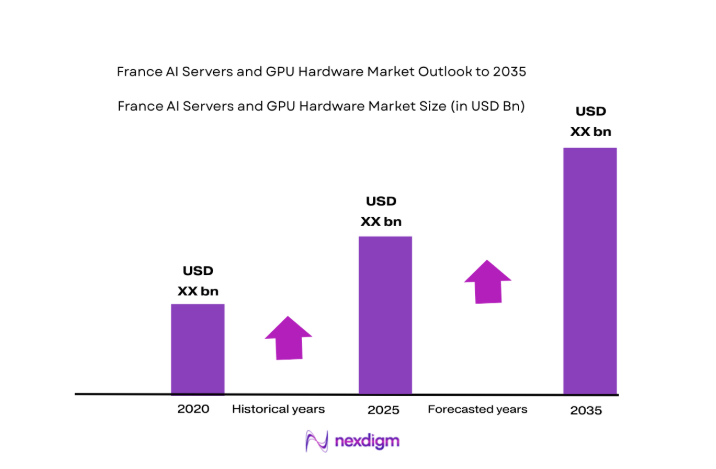
France AI Servers and GPU Hardware Market demonstrates strong expansion supported by enterprise AI adoption and sovereign infrastructure investment. Based on a recent historical assessment, the market value reached approximately USD ~ billion, driven by hyperscale data center deployments, national AI supercomputing programs, and industrial digitalization initiatives. Increasing demand for generative AI training clusters and high performance inference infrastructure across finance, manufacturing, and public administration continues to accelerate GPU server procurement across the national compute ecosystem.
Paris region, Grenoble, and Toulouse dominate the France AI Servers and GPU Hardware Market due to concentration of hyperscale data centers, semiconductor research clusters, and aerospace digital engineering hubs. Paris leads with dense colocation and cloud infrastructure, Grenoble benefits from microelectronics and HPC innovation ecosystems, while Toulouse drives demand through aerospace simulation and AI design workloads. Strong public investment programs and proximity to advanced networking infrastructure reinforce geographic dominance across these technology corridors.
Market Segmentation
By Product Type
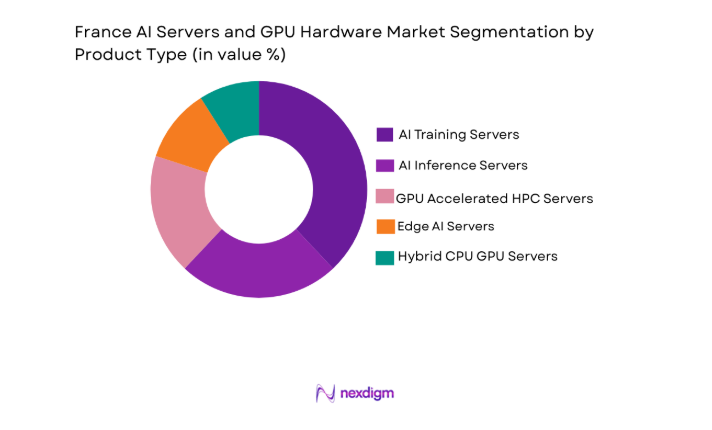
France AI Servers and GPU Hardware Market is segmented by product type into AI training servers, AI inference servers, GPU accelerated HPC servers, edge AI servers, and hybrid CPU GPU servers. Recently, AI training servers have a dominant market share due to factors such as demand patterns, brand presence, infrastructure availability, and enterprise preference. Large language model development, multimodal AI research, and sovereign foundation model initiatives require dense GPU clusters with high bandwidth memory and interconnect fabrics, driving procurement of training systems. Hyperscale cloud providers and national supercomputing programs prioritize training infrastructure to support domestic AI capability, while enterprises deploy centralized training clusters for proprietary model development. The technical complexity and capital intensity of training servers also elevate their share relative to inference and edge systems, reinforcing dominance within the product landscape.
By Platform Type
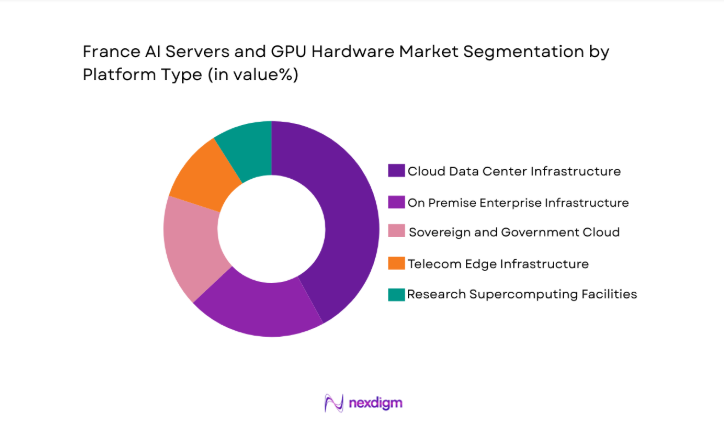
France AI Servers and GPU Hardware Market is segmented by platform type into cloud data center infrastructure, on premise enterprise infrastructure, sovereign and government cloud, telecom edge infrastructure, and research supercomputing facilities. Recently, cloud data center infrastructure has a dominant market share due to factors such as demand patterns, brand presence, infrastructure availability, and consumer preference. Hyperscale and colocation operators concentrate GPU clusters to deliver AI as a service and scalable training environments, enabling enterprises to access high performance compute without capital investment. National cloud initiatives and European sovereign cloud frameworks further strengthen centralized deployments. Advanced cooling, power density, and networking capabilities are also more mature in large data centers, making cloud platforms the preferred environment for GPU intensive AI workloads across sectors.
Competitive Landscape
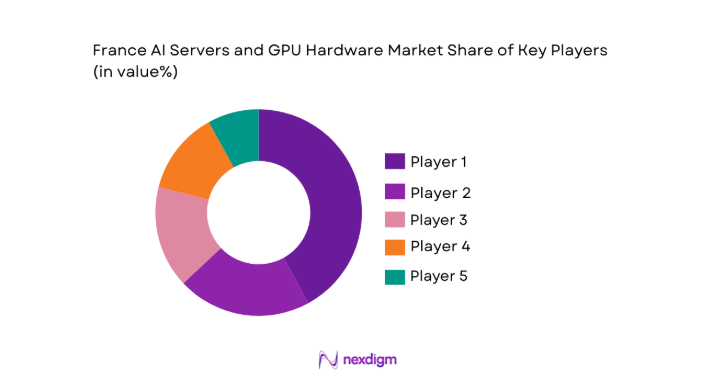
France AI Servers and GPU Hardware Market is moderately consolidated, with global semiconductor and server OEM leaders shaping technology standards while domestic integrators and sovereign cloud providers influence procurement in regulated sectors. Partnerships between accelerator vendors, system manufacturers, and cloud operators define competitive positioning, and national digital sovereignty programs elevate the role of European infrastructure firms. Scale advantages in GPU supply chains and advanced cooling architectures create barriers to entry, reinforcing leadership of established
| Company Name | Establishment Year | Headquarters | Technology Focus | Market Reach | Key Products | Revenue | GPU Integration Depth |
| NVIDIA | 1993 | USA | ~ | ~ | ~ | ~ | ~ |
| AMD | 1969 | USA | ~ | ~ | ~ | ~ | ~ |
| Intel | 1968 | USA | ~ | ~ | ~ | ~ | ~ |
| Hewlett Packard Enterprise | 2015 | USA | ~ | ~ | ~ | ~ | ~ |
| Atos Eviden | 1997 | France | ~ | ~ | ~ | ~ | ~ |
France AI Servers And Hardware Market Analysis
Growth Drivers
National Sovereign AI Infrastructure Investments
France has prioritized domestic artificial intelligence capability as a strategic technology pillar, leading to substantial public investment in national supercomputing centers, sovereign cloud platforms, and AI research infrastructure that directly expands demand for GPU servers and high performance AI hardware across the country. Government funded compute facilities and public private partnerships accelerate deployment of large scale training clusters used for national language models, defense analytics, and scientific simulation workloads requiring dense accelerator architectures. These programs also stimulate local supply chains, encouraging procurement from European system integrators and reinforcing domestic ecosystem growth. Industrial sectors including aerospace, automotive, and energy increasingly rely on sovereign compute resources to manage sensitive design data, creating sustained enterprise demand for secure AI servers. National policies promoting data sovereignty further incentivize localized AI infrastructure, strengthening domestic GPU hardware deployment rather than reliance on external cloud regions. Expansion of national research laboratories and digital innovation hubs equipped with AI supercomputers continues to multiply high performance server installations across academic and industrial collaborations. The strategic framing of AI compute as critical infrastructure ensures long term budget allocation stability, reducing cyclical volatility in procurement. As sovereign AI initiatives scale toward exascale and foundation model capability, demand for advanced GPU clusters and integrated AI server systems rises proportionally across France.
Enterprise Adoption of Generative AI and Advanced Analytics
Rapid integration of generative AI, predictive analytics, and autonomous decision systems into enterprise operations is transforming compute requirements, driving widespread procurement of GPU accelerated servers for training proprietary models, optimizing industrial processes, and enabling real time AI inference across business environments. Financial services institutions deploy GPU clusters for fraud detection, risk modeling, and algorithmic trading analytics, while manufacturing firms integrate AI simulation and quality prediction systems requiring intensive parallel processing capabilities. Healthcare providers and pharmaceutical companies use AI training infrastructure for drug discovery modeling and medical imaging analysis, expanding specialized server deployments. Enterprises increasingly prefer on premise or hybrid GPU infrastructure to maintain control over sensitive datasets, adding to domestic hardware demand. As generative AI applications scale from pilot to production across customer service, design automation, and supply chain optimization, compute intensity increases exponentially, reinforcing sustained procurement of AI servers. The competitive advantage associated with proprietary models motivates firms to invest in dedicated training clusters rather than relying solely on shared cloud compute. Enterprise digital transformation strategies therefore embed GPU hardware as foundational infrastructure, ensuring persistent growth in AI server adoption throughout France.
Market Challenges
High Energy Consumption and Thermal Constraints of GPU Infrastructure
AI training servers with dense GPU configurations consume substantial electrical power and generate significant thermal loads, creating infrastructure challenges for data center operators and enterprises attempting to scale deployments within existing facility constraints across France. Power availability limitations in urban data center regions restrict expansion of high density GPU clusters, requiring costly upgrades to electrical distribution and cooling systems before additional servers can be installed. Traditional air cooling architectures struggle to dissipate heat from modern accelerators, forcing adoption of liquid cooling solutions that increase capital expenditure and engineering complexity. Rising energy prices and sustainability regulations further elevate operational costs associated with GPU infrastructure, reducing economic efficiency of large scale AI compute deployments. Environmental compliance requirements related to energy efficiency and carbon reduction add additional design constraints for AI data centers. Smaller enterprises face barriers to entry because infrastructure retrofitting costs exceed hardware acquisition expenses. These factors collectively slow adoption pace and limit scalability of AI server installations outside hyperscale environments. Without parallel expansion of energy and cooling infrastructure, national AI compute growth may encounter physical and regulatory bottlenecks.
Supply Chain Dependence on Advanced Semiconductor and Accelerator Components
The France AI Servers and GPU Hardware Market relies heavily on imported advanced GPUs, high bandwidth memory modules, and specialized interconnect components manufactured in limited global locations, exposing domestic infrastructure deployment to supply disruptions and geopolitical technology restrictions. Concentration of leading edge semiconductor fabrication in a small number of countries creates vulnerability to export controls, production shortages, and logistics disruptions affecting GPU availability. Long procurement lead times for accelerators delay AI server deployment schedules and inflate system pricing for French buyers. Domestic alternatives remain limited in performance maturity, constraining substitution options during supply shortages. Integration complexity of heterogeneous AI hardware also requires close collaboration with international vendors, reinforcing dependence. National initiatives to develop European accelerators remain in early commercialization phases and cannot yet satisfy large scale demand. Enterprises and public institutions must therefore compete globally for scarce GPU capacity, creating procurement uncertainty. Persistent supply constraints could impede planned expansion of sovereign AI infrastructure and enterprise AI adoption across France.
Opportunities
Expansion of Sovereign Cloud and National AI Platforms
France’s strategic emphasis on digital sovereignty creates strong opportunity for domestic AI server and GPU hardware deployment within nationally controlled cloud platforms designed to host sensitive data and critical AI workloads across government, defense, healthcare, and industrial sectors. Sovereign cloud frameworks encourage public agencies and regulated industries to migrate AI processing from foreign hyperscale environments to certified domestic infrastructure, directly increasing GPU server demand. National AI model development programs require dedicated compute clusters hosted within sovereign facilities, accelerating procurement of high density training systems. European regulatory alignment further reinforces localization of AI workloads, benefiting domestic hardware providers and integrators. Telecom operators and regional data center firms can expand sovereign GPU hosting capacity to meet compliance driven demand. The resulting ecosystem stimulates partnerships among semiconductor designers, system manufacturers, and cloud operators within France. As sovereign digital infrastructure becomes foundational to national competitiveness, sustained investment flows toward AI hardware deployment. This structural shift presents long term growth potential for the domestic AI server market.
Adoption of Advanced Liquid Cooled and Energy Efficient AI Data Centers
Transition toward liquid cooled, high efficiency AI data center architectures across France opens substantial opportunity for deployment of next generation GPU servers optimized for high density and sustainable operation under stringent energy and environmental constraints. Liquid cooling enables significantly higher rack power densities, allowing operators to install more GPU servers within existing facilities and overcome space limitations. Energy efficiency improvements reduce operational costs and support compliance with national carbon reduction targets, encouraging enterprises and cloud providers to upgrade infrastructure. Integration of waste heat recovery and renewable energy systems further enhances sustainability credentials of AI compute facilities. Vendors offering liquid cooled GPU platforms and thermal optimized server designs gain competitive advantage in this evolving environment. Public incentives for green digital infrastructure accelerate adoption of advanced cooling technologies. Retrofitting of legacy data centers with liquid cooling creates additional hardware demand cycles. As AI workloads intensify, energy efficient GPU server solutions become essential, expanding market opportunities across France.
Future Outlook
France AI Servers and GPU Hardware Market is expected to expand steadily over the next five years as sovereign AI initiatives, enterprise generative AI adoption, and hyperscale data center expansion converge to accelerate GPU infrastructure deployment. Advances in liquid cooling, European accelerator development, and green data center policies will improve scalability and sustainability of AI compute environments. Strong regulatory support for digital sovereignty and secure cloud platforms will sustain localized hardware demand across public and industrial sectors.
Major Players
- NVIDIA
- AMD
- Intel
- Hewlett Packard Enterprise
- Dell Technologies
- Lenovo
- Supermicro
- Atos Eviden
- OVHcloud
- Fujitsu
- Graphcore
- SiPearl
- Cisco
- Schneider Electric
- Thales
Key Target Audience
- Hyperscale cloud providers
- Telecom network operators
- Government and regulatory bodies
- Defense and aerospace firms
- Semiconductor manufacturers
- Data center operators
- Industrial AI adopters
- Investments and venture capitalist firms
Research Methodology
Step 1: Identification of Key Variables
Key market variables including GPU shipments, AI server deployments, data center capacity, sovereign cloud investments, and enterprise AI adoption rates are identified through secondary research and industry databases. Technology roadmaps and regulatory frameworks are also mapped to define market boundaries and drivers.
Step 2: Market Analysis and Construction
Collected data is triangulated across supply chain participants including semiconductor vendors, server OEMs, integrators, and cloud providers to construct market size and segmentation structures. Historical deployment patterns and procurement trends are modeled to estimate national AI hardware demand.
Step 3: Hypothesis Validation and Expert Consultation
Findings are validated through consultation with AI infrastructure architects, data center engineers, and procurement specialists across France to confirm adoption drivers, constraints, and competitive dynamics. Expert insights refine segmentation shares and technology evolution assumptions.
Step 4: Research Synthesis and Final Output
Validated data and qualitative insights are synthesized into market models, segmentation tables, and strategic analysis frameworks to produce the final report. Consistency checks and cross verification ensure accuracy of market estimates and structural conclusions.

- Executive Summary
- Research Methodology (Definitions, Scope, Industry Assumptions, Market Sizing Approach, Primary & Secondary Research Framework, Data Collection & Verification Protocol, Analytic Models & Forecast Methodology, Limitations & Research Validity Checks)

- Market Definition and Scope
- Value Chain & Stakeholder Ecosystem
- Regulatory / Certification Landscape
- Sector Dynamics Affecting Demand
- Strategic Initiatives & Infrastructure Growth

- Growth Drivers
Expansion of sovereign AI and European digital autonomy programs
Rapid enterprise adoption of generative AI and large language models
Growth in hyperscale and colocation data center capacity in France
Government funding for national AI infrastructure and supercomputing
Acceleration of Industry 4.0 and industrial AI deployments - Market Challenges
High capital cost and energy consumption of GPU clusters
Supply constraints in advanced AI accelerators and memory
Data sovereignty and compliance complexity in AI workloads
Thermal management and cooling infrastructure limitations
Skills shortage in AI infrastructure engineering and integration - Market Opportunities
Deployment of sovereign AI cloud platforms in France
Adoption of liquid cooled AI supercomputing infrastructure
Expansion of edge AI compute across telecom networks - Trends
Shift toward GPU dense and heterogeneous AI server architectures
Integration of liquid and immersion cooling in AI data centers
Rise of European AI chip and accelerator ecosystem initiatives
Growth of AI as a service platforms hosted in sovereign clouds
Convergence of HPC and AI workloads in unified clusters - Government Regulations & Defense Policy
European data sovereignty and cloud certification frameworks
National AI strategy funding for compute infrastructure
Energy efficiency and green data center compliance mandates - SWOT Analysis
- Stakeholder and Ecosystem Analysis
- Porter’s Five Forces Analysis
- Competition Intensity and Ecosystem Mapping

- By Market Value, 2020-2025
- By Installed Units, 2020-2025
- By Average System Price, 2020-2025
- By System Complexity Tier, 2020-2025

- By System Type (In Value%)
AI Training Servers
AI Inference Servers
GPU Accelerated HPC Servers
Edge AI Servers
Hybrid CPU GPU Servers - By Platform Type (In Value%)
Cloud Data Center Infrastructure
On Premise Enterprise Infrastructure
Sovereign and Government Cloud
Telecom Edge Infrastructure
Research and Academic Supercomputing Facilities - By Fitment Type (In Value%)
Rack Mounted Systems
Blade Server Systems
Modular AI Pods
Integrated AI Appliances
Custom Built HPC Clusters - By EndUser Segment (In Value%)
Cloud Service Providers
Government and Defense Agencies
Large Enterprises and Industrial Firms
Research Institutions and Universities
Telecom and Digital Infrastructure Operators - By Procurement Channel (In Value%)
Direct OEM Procurement
System Integrators and VARs
Public Sector Tenders
Cloud Marketplace Procurement
Distributor and Channel Partners

- Market structure and competitive positioning
Market share snapshot of major players - Cross Comparison Parameters (GPU Density, Compute Performance, Energy Efficiency, Cooling Technology, Interconnect Bandwidth, Scalability, Sovereign Compliance, Deployment Flexibility, Total Cost of Ownership)
- SWOT Analysis of Key Competitors
- Pricing & Procurement Analysis
- Key Players
Atos
Eviden
OVHcloud
Schneider Electric
Thales
NVIDIA
AMD
Intel
Hewlett Packard Enterprise
Dell Technologies
Lenovo
Supermicro
Fujitsu
Graphcore
SiPearl

- Cloud providers expanding GPU clusters to support generative AI services
- Public sector investing in sovereign compute and secure AI infrastructure
- Enterprises adopting on premise AI servers for sensitive workloads
- Research institutions scaling supercomputing for AI and simulation

- Forecast Market Value, 2026-2035
- Forecast Installed Units, 2026-2035
- Price Forecast by System Tier, 2026-2035
- Future Demand by Platform, 2026-2035


 Request a Sample
 Ask for Customization
 Get a Quote
 Enquire Now