

 Download PDF
 Download PDF
Market Overview
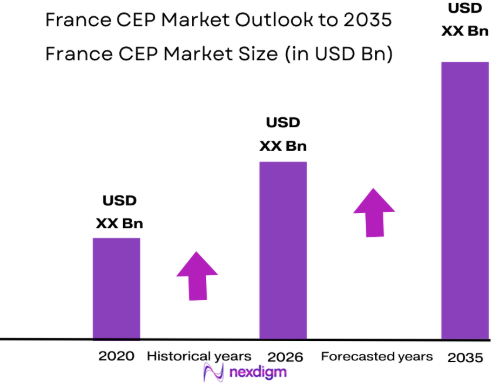
Based on a recent historical assessment, the France CEP market generated approximately USD ~ billion in parcel delivery and express logistics revenue across domestic and cross-border shipments, supported by rapid expansion of e-commerce transactions and omnichannel retail distribution. According to data referenced by the French Ministry of Ecological Transition and transport regulators, more than ~ billion parcels were processed nationwide through courier, express, and parcel networks. Increasing online retail purchases, cross-border trade within the European Union, and rapid delivery expectations continue to drive demand for CEP services across France’s integrated logistics ecosystem.
Paris remains the most dominant logistics hub due to its high consumer population density, extensive urban retail networks, and proximity to major transport corridors connecting Northern and Southern Europe. Lyon functions as a strategic inland distribution center supported by multimodal freight infrastructure linking road, rail, and air cargo networks. Marseille serves as a major maritime logistics gateway connecting Mediterranean shipping routes with European parcel distribution networks. Lille also plays a significant role due to its geographic position near Belgium and the Netherlands, enabling efficient cross-border parcel transportation across Western European markets.
Market Segmentation
By Product Type
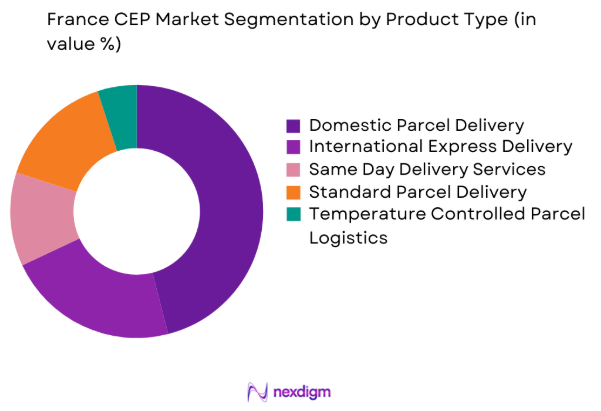
France CEP market is segmented by product type into domestic parcel delivery, international express delivery, same-day delivery services, standard parcel delivery, and temperature-controlled parcel logistics. Recently, domestic parcel delivery has a dominant market share due to strong demand generated by e-commerce platforms, online marketplaces, and omnichannel retail distribution systems. Major French retailers increasingly rely on domestic courier networks to fulfill millions of daily online orders. Infrastructure development such as automated parcel sorting facilities, regional distribution centers, and integrated last-mile delivery networks strengthens domestic shipping efficiency. In addition, growing adoption of parcel lockers and pickup points across French cities improves delivery flexibility and reduces failed delivery attempts. Consumer preference for faster delivery timelines further strengthens domestic parcel shipping volumes, while logistics companies expand electric vehicle fleets and route optimization systems to support high-frequency deliveries in dense urban areas.
By End User
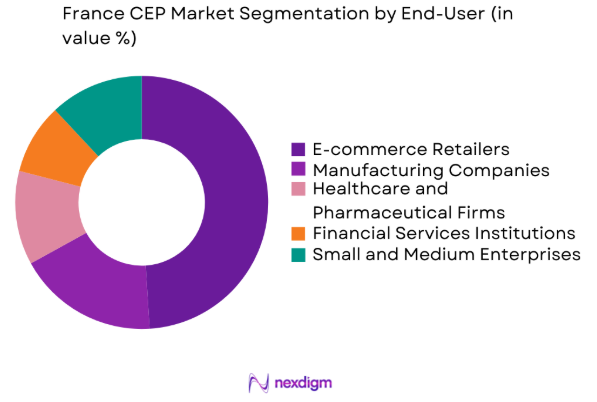
France CEP market is segmented by end user into e-commerce retailers, manufacturing companies, healthcare and pharmaceutical firms, financial services institutions, and small and medium enterprises. Recently, e-commerce retailers have a dominant market share due to the rapid expansion of online marketplaces and digital retail platforms across France. Large retailers such as online fashion, electronics, and grocery platforms generate massive daily parcel volumes requiring highly efficient courier networks. Fulfillment centers located near major population centers help companies accelerate order processing and delivery timelines. Retailers increasingly integrate CEP providers with warehouse management systems and digital order platforms to streamline parcel dispatching. Rising consumer expectations for fast delivery and real-time shipment tracking further increase reliance on courier networks, making e-commerce the largest contributor to CEP shipment volumes nationwide.
Competitive Landscape
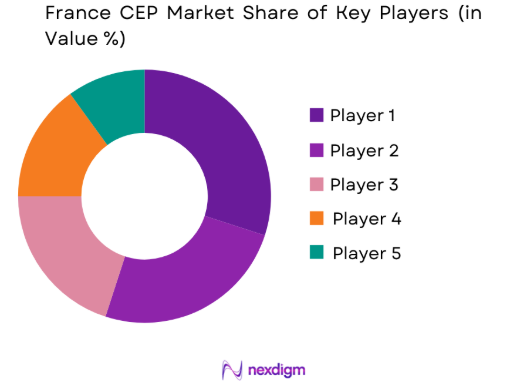
The France CEP market exhibits moderate consolidation, with several international logistics corporations competing alongside national parcel networks. Large operators benefit from extensive distribution infrastructure, automated parcel sorting systems, and advanced digital shipment tracking technologies. Major companies continuously invest in electric delivery fleets, AI-based route optimization systems, and parcel locker networks to strengthen last-mile delivery efficiency. Strategic partnerships with e-commerce platforms further strengthen competitive positioning, while cross-border logistics capabilities remain a critical factor shaping competitive differentiation across the national CEP ecosystem.
| Company Name | Establishment Year | Headquarters | Technology Focus | Market Reach | Key Products | Revenue | Parcel Network Scale |
| La Poste Group | 1576 | Paris | ~ | ~ | ~ | ~ | ~ |
| DHL Group | 1969 | Bonn | ~ | ~ | ~ | ~ | ~ |
| UPS | 1907 | Atlanta | ~ | ~ | ~ | ~ | ~ |
| FedEx | 1971 | Memphis | ~ | ~ | ~ | ~ | ~ |
| DPDgroup | 1976 | Issy-les-Moulineaux | ~ | ~ | ~ | ~ | ~ |
France CEP Market Analysis
Growth Drivers
Rapid Expansion of E-commerce Parcel Shipments Across France
The rapid expansion of digital commerce across France has significantly increased demand for courier express and parcel logistics services capable of managing high shipment volumes across urban and suburban regions. Online marketplaces selling fashion, electronics, groceries, household goods, and pharmaceuticals generate millions of orders daily, requiring reliable CEP infrastructure for fast and efficient delivery. Retailers increasingly depend on logistics companies that integrate last mile delivery with digital order management systems enabling automated parcel dispatch and shipment tracking. Logistics operators invest heavily in advanced sorting hubs, automated conveyor systems, and warehouse robotics to manage rising parcel throughput. Parcel locker networks and micro fulfillment hubs near major cities further improve delivery speed and operational efficiency.
Increasing Cross Border Trade and European Union Logistics Integration
France’s position within the European Union single market significantly strengthens cross border parcel flows connecting French exporters and retailers with consumers across neighboring European economies. Harmonized trade frameworks simplify customs procedures and allow faster cargo movement across member states, enabling courier companies to deliver international parcels efficiently through integrated transport networks. Industrial exporters shipping machinery, automotive components, pharmaceuticals, and consumer goods rely on CEP providers capable of coordinating parcel distribution across multiple countries. Logistics firms therefore expand regional parcel hubs and invest in multimodal infrastructure linking road, rail, and air transport networks. International e-commerce retailers also depend on CEP services to ship orders from French warehouses to customers across Western Europe.
Market Challenges
Urban Congestion and Last Mile Delivery Complexity in Major French Cities
Delivering parcels efficiently within densely populated urban centers such as Paris, Lyon, and Marseille creates major operational challenges for courier express and parcel logistics providers due to heavy traffic congestion, limited parking availability, and strict environmental regulations. Delivery vehicles frequently experience delays caused by restricted access zones, pedestrian streets, and traffic control measures designed to reduce urban pollution levels. Logistics companies therefore redesign delivery strategies by deploying smaller electric vans, cargo bicycles, and decentralized micro distribution hubs to maintain efficiency. Rising e-commerce parcel volumes further pressure urban logistics infrastructure that already operates near capacity. Additionally, stricter emission regulations require significant investment in electric fleets, charging infrastructure, and advanced fleet management systems.
Rising Operational Costs Across Transportation Fuel and Labor Markets
Courier express and parcel logistics companies operating in France face increasing operational cost pressures driven by higher fuel prices, rising labor expenses, vehicle maintenance requirements, and ongoing logistics infrastructure investments. Delivery fleets covering nationwide distribution routes consume large fuel volumes, significantly affecting operating expenditure during periods of volatile energy prices. Logistics providers also invest heavily in automated parcel sorting systems, warehouse robotics, and digital shipment tracking platforms to maintain competitive delivery speeds. Labor demand for drivers, warehouse staff, and logistics technicians further raises operational costs. Additionally, investments in electric fleets, renewable energy warehouses, and sustainable packaging increase short term expenditures while supporting long term environmental goals.
Opportunities
Expansion of Automated Parcel Locker and Pickup Point Networks
Parcel locker networks and neighborhood pickup points present a major growth opportunity for courier express and parcel logistics providers aiming to improve delivery efficiency and reduce failed home deliveries in urban and suburban areas. Automated locker systems allow customers to collect parcels at convenient locations including supermarkets, transit stations, and residential complexes instead of relying solely on home delivery. Logistics companies therefore lower operational costs linked to repeated delivery attempts while improving customer convenience and reliability. Retailers increasingly integrate locker options into e-commerce checkout platforms so customers can choose nearby pickup locations during purchases. As online shopping expands across France, demand for flexible parcel delivery solutions continues rising nationwide.
Adoption of Electric Delivery Fleets and Sustainable Logistics Infrastructure
Environmental sustainability initiatives across France and the European Union create strong opportunities for courier express and parcel logistics companies to modernize transportation fleets and significantly reduce carbon emissions throughout delivery networks. Government incentives supporting electric vehicle adoption encourage logistics providers to gradually replace diesel delivery vans with battery powered vehicles suited for dense urban parcel distribution. Electric fleets reduce fuel consumption, lower operating costs, and comply with strict environmental regulations limiting high emission vehicles in major city centers. Logistics operators are also investing in renewable energy powered warehouses, automated parcel sorting systems, and sustainable packaging solutions to improve environmental performance across the entire delivery chain. In addition, AI driven route optimization technologies help minimize transportation distances and improve delivery efficiency.
Future Outlook
The France CEP market is expected to experience sustained expansion as digital commerce adoption continues increasing across European consumer markets. Logistics companies will increasingly deploy automation technologies, electric delivery fleets, and AI-based logistics optimization platforms to improve operational efficiency. Government sustainability policies will accelerate the transition toward low-emission delivery networks across major urban centers. Rising cross-border e-commerce trade across the European Union will further strengthen parcel shipment volumes handled by courier express and parcel service providers.
Major Players
- La Poste Group
- DHL Group
- UPS
- FedEx
- DPDgroup
- GLS Group
- Chronopost
- Colissimo
- Geodis
- TNT Express
- Amazon Logistics
- Relais Colis
- Mondial Relay
- Hermes Europe
- XPO Logistics
Key Target Audience
- Investments and venture capitalist firms
- Government and regulatory bodies
- E-commerce companies
- Logistics and transportation providers
- Retail distribution companies
- Manufacturing exporters
- Supply chain technology providers
- Parcel locker infrastructure developers
Research Methodology
Step 1: Identification of Key Variables
Researchers identify key industry indicators including parcel shipment volumes logistics infrastructure capacity delivery network coverage and transportation costs influencing the France CEP market structure and operational performance.
Step 2: Market Analysis and Construction
Comprehensive analysis of national logistics statistics industry reports company financial disclosures and transportation infrastructure data is conducted to construct the France CEP market framework.
Step 3: Hypothesis Validation and Expert Consultation
Industry specialists logistics executives and transportation analysts review initial findings to validate demand drivers technology adoption trends and operational challenges shaping the national CEP ecosystem.
Step 4: Research Synthesis and Final Output
All verified data points are integrated into structured analytical models generating final insights regarding market size competitive dynamics technology adoption and long term logistics industry trends.

- Executive Summary
- Research Methodology (Definitions, Scope, Industry Assumptions, Market Sizing Approach, Primary & Secondary Research Framework, Data Collection & Verification Protocol, Analytic Models & Forecast Methodology, Limitations & Research Validity Checks)

- Market Definition and Scope
- Value Chain & Stakeholder Ecosystem
- Regulatory / Certification Landscape
- Sector Dynamics Affecting Demand
- Strategic Initiatives & Infrastructure Growth

- Growth Drivers
Rapid Expansion of E Commerce Parcel Shipments
Increasing Cross Border Trade within European Union
Growth of Same Day and Express Delivery Services - Market Challenges
Rising Fuel Costs and Transportation Expenses
Urban Congestion and Last Mile Delivery Constraints
Stringent Environmental and Emission Regulations - Market Opportunities
Expansion of Automated Parcel Locker Networks
Adoption of Electric Delivery Fleets
Growth in Cross Border E Commerce Fulfillment - Trends
Deployment of AI Enabled Logistics Optimization
Growth of Urban Micro Distribution Centers
Integration of Sustainable Delivery Technologies - Government Regulations
- SWOT Analysis of Key Competitors
- Porter’s Five Forces

- By Market Value, 2020-2025
- By Installed Units, 2020-2025
- By Average System Price, 2020-2025
- By System Complexity Tier, 2020-2025

- By System Type (In Value%)
Domestic Parcel Delivery Services
International Express Shipping Services
Same Day Delivery Solutions
Standard Parcel Delivery Services
Temperature Controlled Logistics Services - By Platform Type (In Value%)
Road Based Parcel Networks
Air Cargo Parcel Networks
Rail Integrated Parcel Transport
Urban Micro Fulfillment Networks
Multimodal Logistics Platforms - By Fitment Type (In Value%)
Business to Consumer Delivery Services
Business to Business Parcel Delivery
Cross Border Parcel Shipping
Subscription Based Delivery Services
Integrated Omnichannel Fulfillment Services - By End User Segment (In Value%)
E Commerce Retailers
Manufacturing and Industrial Companies
Healthcare and Pharmaceutical Firms
Financial and Legal Service Providers
Small and Medium Enterprises - By Procurement Channel (In Value%)
Direct Logistics Contracts
Third Party Logistics Partnerships
Online Shipping Platforms
Corporate Logistics Agreements
Freight and Parcel Brokers

- Market Share Analysis
- Cross Comparison Parameters (Delivery Network Coverage, Fleet Size, Parcel Handling Capacity, Technology Integration, Service Portfolio, Last Mile Delivery Capability, Cross Border Logistics Expertise, Warehouse and Fulfillment Infrastructure, Sustainability Initiatives, Delivery Speed and Reliability)
- SWOT Analysis of Key Competitors
- Pricing & Procurement Analysis
- Key Players
La Poste Group
DHL Group
UPS
FedEx
DPDgroup
GLS Group
Chronopost
Colissimo
Geodis
TNT Express
Amazon Logistics
Relais Colis
Mondial Relay
Hermes Europe
XPO Logistics

- Growing Demand from E Commerce Retailers for Rapid Delivery
- Manufacturing Sector Dependence on Reliable Parcel Logistics
- Healthcare Sector Demand for Temperature Controlled Deliveries
- SME Adoption of Digital Parcel Shipping Platforms

- Forecast Market Value, 2026-2035
- Forecast Installed Units, 2026-2035
- Price Forecast by System Tier, 2026-2035
- Future Demand by Platform, 2026-2035


 Request a Sample
 Ask for Customization
 Get a Quote
 Enquire Now