

 Download PDF
 Download PDF
Market Overview
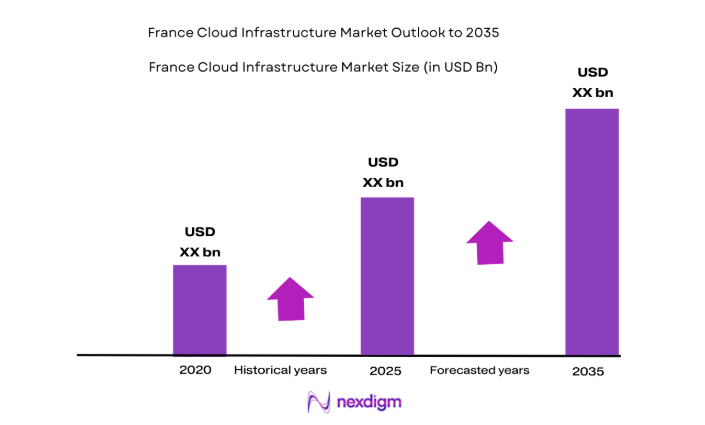
Based on a recent historical assessment, France cloud infrastructure market reached approximately USD ~ billion, driven by accelerating enterprise migration to hybrid architectures, sovereign cloud adoption mandates, and hyperscale data center expansion by global and domestic providers. Public sector digitalization programs and regulated industry modernization requirements continue to stimulate demand for compliant private and trusted cloud environments, while artificial intelligence workloads and high-density compute deployments increase infrastructure investments across compute, storage, and networking layers nationwide.
Paris and Île-de-France dominate France cloud infrastructure market due to dense enterprise concentration, financial sector presence, and proximity to major international connectivity hubs and subsea cable landings. Marseille has emerged as a strategic southern gateway supported by submarine cable interconnections linking Europe, Africa, and Asia, encouraging hyperscale and colocation development. Lyon and Toulouse show growing regional importance through aerospace, manufacturing, and technology ecosystems that require low-latency edge and hybrid cloud infrastructure deployment.
Market Segmentation
By Product Type
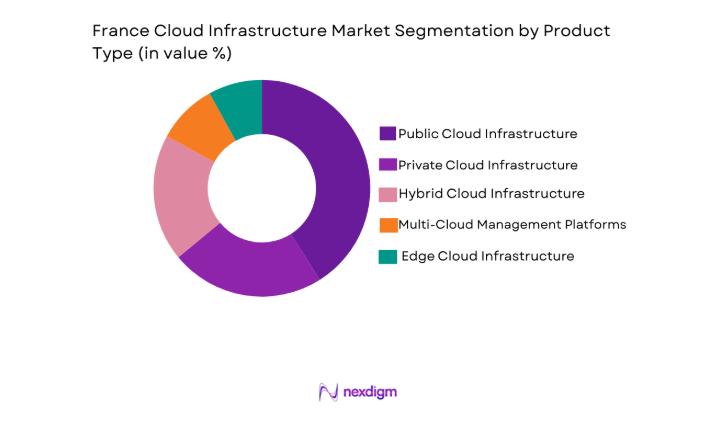
France cloud infrastructure market is segmented by product type into public cloud infrastructure, private cloud infrastructure, hybrid cloud infrastructure, multi-cloud management platforms, and edge cloud infrastructure. Recently, public cloud infrastructure has a dominant market share due to enterprise migration from on-premise systems, scalability requirements for AI and analytics workloads, and rapid hyperscale data center investments by major providers. Strong ecosystem support, mature service portfolios, and extensive geographic availability across France further reinforce public cloud leadership over private and hybrid alternatives.
By Platform Type
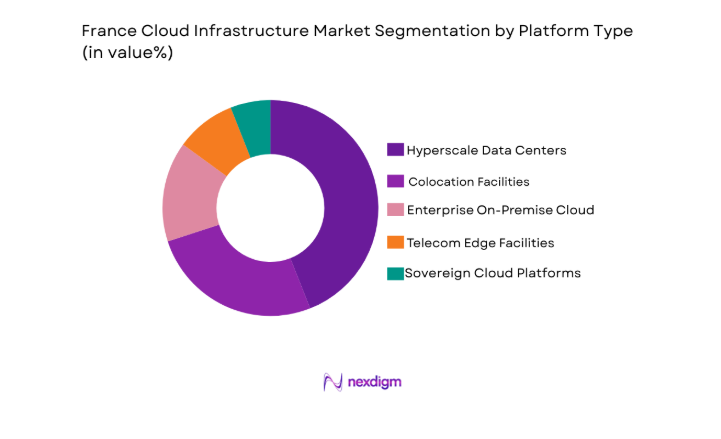
France cloud infrastructure market is segmented by platform type into hyperscale data centers, colocation facilities, enterprise on-premise cloud, telecom edge facilities, and sovereign cloud platforms. Recently, hyperscale data centers have a dominant market share due to large-scale capacity deployments, AI-ready infrastructure density, and sustained investments by global cloud providers in French regions with strong connectivity and energy availability. Economies of scale, automation, and integrated service delivery enable hyperscale facilities to outperform colocation and enterprise platforms in meeting enterprise and public sector demand.
Competitive Landscape
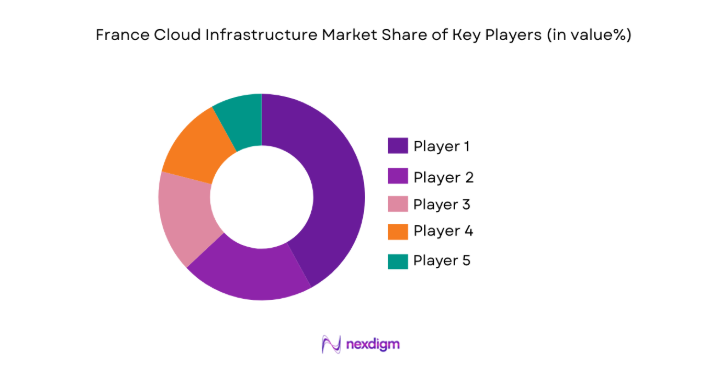
France cloud infrastructure market shows moderate consolidation, with global hyperscale providers and domestic sovereign cloud specialists shaping competitive intensity. International players leverage scale, advanced platforms, and AI infrastructure, while French firms emphasize compliance, sovereignty, and trusted cloud certification. Partnerships between telecom operators, system integrators, and public sector stakeholders influence procurement dynamics and regional deployment strategies across hyperscale and sovereign segments.
| Company Name | Establishment Year | Headquarters | Technology Focus | Market Reach | Key Products | Revenue | Sovereign Cloud Certification |
| OVHcloud | 1999 | France | ~ | ~ | ~
|
~ | ~ |
| Orange Business | 2006 | France | ~ | ~ | ~ | ~ | ~ |
| Capgemini | 1967 | France | ~ | ~ | ~ | ~ | ~ |
| Amazon Web Services | 2006 | USA | ~ | ~ | ~ | ~ | ~ |
| Microsoft Azure | 2010 | USA | ~ | ~ | ~ | ~ | ~ |
France Cloud Infrastructure Market Analysis
Growth Drivers
Sovereign and Trusted Cloud Adoption Driven by Data Localization and Regulatory Compliance
Sovereign and trusted cloud adoption driven by data localization and regulatory compliance: France cloud infrastructure market growth is strongly influenced by stringent European data protection frameworks and national cybersecurity certification requirements that compel enterprises and public institutions to deploy compliant cloud environments within national borders. Government-backed trusted cloud initiatives and certification schemes have accelerated domestic infrastructure investment, encouraging both local providers and global hyperscalers to establish sovereign regions and partnerships. Regulated industries such as finance, healthcare, and defense increasingly prioritize jurisdiction-controlled data processing and storage, expanding demand for compliant infrastructure layers. Public procurement policies further reinforce domestic cloud adoption by mandating security accreditation and operational transparency. These regulatory conditions stimulate capacity expansion in certified data centers and sovereign platforms. Enterprises also perceive sovereign cloud as a strategic risk mitigation approach against geopolitical and supply chain uncertainties. The combination of compliance obligations, institutional trust requirements, and national digital sovereignty strategy continues to expand infrastructure spending across compute, storage, and networking ecosystems.
Acceleration of Artificial Intelligence and High Performance Computing Workloads
Acceleration of artificial intelligence and high performance computing workloads: France cloud infrastructure market expansion is significantly propelled by rapid adoption of artificial intelligence, machine learning, and data-intensive analytics applications across industries including manufacturing, aerospace, finance, and public administration. AI model training and inference require high-density GPU clusters, advanced storage architectures, and ultra-low latency networking, driving hyperscale and specialized infrastructure deployments. Enterprises increasingly migrate compute-intensive workloads to scalable cloud platforms to access elastic GPU resources and advanced orchestration frameworks. National AI strategies and research investments also stimulate infrastructure demand across academic and industrial ecosystems. Hyperscale providers continue expanding AI-optimized data center capacity in French regions to support enterprise and research workloads. The convergence of AI adoption, digital transformation initiatives, and advanced analytics integration sustains long-term infrastructure spending. As AI becomes embedded in operational processes, demand for high-performance cloud infrastructure is expected to intensify across sectors.
Market Challenges
High Energy Consumption and Sustainability Constraints in Data Center Operations
High energy consumption and sustainability constraints in data center operations: France cloud infrastructure market faces substantial operational challenges due to the energy-intensive nature of hyperscale and high-density data centers required for modern cloud and AI workloads. Electricity availability, grid capacity, and rising energy costs directly influence site selection, expansion feasibility, and operational economics of cloud infrastructure providers. Environmental regulations and carbon reduction commitments impose additional compliance requirements on operators, necessitating investment in renewable energy sourcing, efficient cooling technologies, and waste heat recovery systems. Local community and municipal scrutiny over energy usage and land allocation can delay or restrict new facility development. Cooling demands increase with GPU-dense infrastructure, intensifying power and water consumption challenges. Providers must balance performance requirements with sustainability targets and regulatory expectations. These constraints elevate capital expenditure and operational complexity across the infrastructure lifecycle.
Complex Integration of Legacy Systems with Modern Cloud Architectures
Complex integration of legacy systems with modern cloud architectures: France cloud infrastructure market adoption is hindered by the technical and organizational complexity of integrating legacy enterprise IT environments with modern hybrid and multi-cloud platforms. Many large French enterprises and public institutions operate mission-critical applications on decades-old systems that require careful migration, refactoring, or coexistence strategies. Compatibility issues, data transfer constraints, and security compliance requirements complicate modernization programs and prolong deployment timelines. Skilled workforce shortages in cloud architecture and migration engineering further slow transformation initiatives. Integration costs can exceed infrastructure expenses, discouraging smaller organizations from rapid cloud adoption. Operational risk during migration of critical services also raises caution among regulated sectors. These technical barriers reduce the pace of infrastructure transition despite strong strategic intent toward cloud modernization.
Opportunities
Expansion of Sovereign Hyperscale Regions and National Cloud Ecosystems
Expansion of sovereign hyperscale regions and national cloud ecosystems: France cloud infrastructure market presents significant opportunity through the development of sovereign hyperscale regions that combine large-scale capacity with national compliance certification and trusted governance frameworks. Partnerships between domestic providers, telecom operators, and global hyperscalers enable creation of localized cloud regions that meet regulatory requirements while delivering advanced services. Public sector digital transformation programs increasingly prefer sovereign hyperscale environments to ensure jurisdictional control and operational transparency. National industrial strategies promoting digital sovereignty and European technology autonomy further stimulate infrastructure investments. Expansion of certified hyperscale campuses across multiple French regions enhances geographic resilience and latency performance. Enterprises in regulated sectors benefit from combining scale advantages with compliance assurance. This convergence of sovereignty and hyperscale economics creates a sustained infrastructure expansion pathway across France.
Growth of Edge Cloud Infrastructure for 5G and Industrial Digitalization
Growth of edge cloud infrastructure for 5G and industrial digitalization: France cloud infrastructure market opportunity is expanding through deployment of distributed edge nodes supporting 5G connectivity, industrial automation, and real-time analytics applications across manufacturing, transportation, energy, and smart city environments. Telecom operators and cloud providers increasingly collaborate to integrate compute resources within network edge facilities to enable ultra-low latency processing. Industrial enterprises require localized data processing for robotics control, predictive maintenance, and autonomous systems, driving demand for edge infrastructure clusters. Regional innovation ecosystems in aerospace, automotive, and advanced manufacturing stimulate edge deployment beyond major metropolitan hubs. Government smart infrastructure and Industry 4.0 programs further accelerate adoption. Edge computing complements centralized hyperscale capacity, creating a multi-tier infrastructure architecture. This distributed cloud model broadens infrastructure investment across metropolitan and regional France.
Future Outlook
France cloud infrastructure market is expected to expand steadily over the next five years, supported by sovereign cloud programs, hyperscale investments, and artificial intelligence workload growth. Regional data center expansion and edge deployments will strengthen geographic coverage and latency performance. Regulatory emphasis on data sovereignty and sustainability will shape infrastructure design and procurement. Enterprise digital transformation and public sector cloud adoption will continue to drive long-term demand.
Major Players
- OVHcloud
- Orange Business
- Capgemini
- Atos
- Thales
- 3DS OUTSCALE
- Scaleway
- Sopra Steria
- Bouygues Telecom
- SFR Business
- Iliad Group
- Amazon Web Services France
- Microsoft Azure France
- Google Cloud France
- IBM Cloud France
Key Target Audience
- Hyperscale cloud service providers
- Colocation and data center operators
- Telecom network operators
- Financial institutions and banks
- Government and regulatory bodies
- Industrial and manufacturing enterprises
- Technology investors and venture capital firms
- Energy and utilities companies
Research Methodology
Step 1: Identification of Key Variables
Key variables including cloud deployment models, infrastructure capacity, regulatory frameworks, regional data center distribution, and enterprise adoption patterns were defined. Market boundaries were established across public, private, hybrid, and edge infrastructure layers. Demand drivers and technology trends influencing infrastructure investments were mapped across sectors and regions.
Step 2: Market Analysis and Construction
Supply-side capacity data, enterprise adoption indicators, and infrastructure deployment trends were synthesized to construct market structure and segmentation. Regional ecosystem analysis assessed hyperscale, colocation, and sovereign deployments. Competitive positioning and platform distribution were evaluated across domestic and global providers operating in France.
Step 3: Hypothesis Validation and Expert Consultation
Infrastructure deployment assumptions and adoption trends were validated through consultation with cloud architects, data center operators, and enterprise IT decision makers. Regulatory and sovereignty dynamics were cross-checked with policy and compliance specialists. Technology evolution pathways in AI and edge infrastructure were verified with industry experts.
Step 4: Research Synthesis and Final Output
Validated inputs were integrated into a structured market framework covering segmentation, competitive landscape, and strategic outlook. Quantitative and qualitative findings were synthesized to ensure consistency across sections. Final analysis aligned infrastructure trends with regulatory and technological developments shaping France cloud infrastructure market evolution.

- Executive Summary
- Research Methodology (Definitions, Scope, Industry Assumptions, Market Sizing Approach, Primary & Secondary Research Framework, Data Collection & Verification Protocol, Analytic Models & Forecast Methodology, Limitations & Research Validity Checks)

- Market Definition and Scope
- Value Chain & Stakeholder Ecosystem
- Regulatory / Certification Landscape
- Sector Dynamics Affecting Demand
- Strategic Initiatives & Infrastructure Growth

- Growth Drivers
Expansion of sovereign cloud initiatives in France and EU
Rising enterprise migration to hybrid and multi-cloud architectures
Growth of AI and data-intensive workloads requiring hyperscale capacity
Public sector digital transformation and cloud-first mandates
Increasing demand for low-latency edge infrastructure - Market Challenges
Stringent data sovereignty and compliance requirements
High energy and cooling costs for data center operations
Skills shortages in advanced cloud engineering roles
Integration complexity across legacy and cloud environments
Capital intensity of hyperscale infrastructure expansion - Market Opportunities
Development of sovereign and trusted cloud platforms
Edge cloud deployment for 5G and industrial IoT use cases
AI-ready infrastructure and GPU cloud services - Trends
Shift toward sovereign and EU-controlled cloud environments
Adoption of liquid cooling and high-density racks
Growth of AI cloud and GPU-as-a-service offerings
Expansion of edge nodes by telecom operators
Automation through software-defined data center stacks - Government Regulations & Defense Policy
EU data protection and localization frameworks shaping cloud design
National cybersecurity certification for trusted cloud providers
Public funding for green and sovereign digital infrastructure

- By Market Value, 2020-2025
- By Installed Units, 2020-2025
- By Average System Price, 2020-2025
- By System Complexity Tier, 2020-2025

- By System Type (In Value%)
Public Cloud Infrastructure
Private Cloud Infrastructure
Hybrid Cloud Infrastructure
Multi-Cloud Management Systems
Edge Cloud Infrastructure - By Platform Type (In Value%)
Hyperscale Data Centers
Colocation Facilities
Enterprise On-Premise Cloud
Telecom Edge Facilities
Sovereign Cloud Platforms - By Fitment Type (In Value%)
Greenfield Cloud Deployments
Brownfield Data Center Modernization
Integrated Cloud Stacks
Modular Data Center Units
Software-Defined Infrastructure Layers - By End User Segment (In Value%)
Large Enterprises
Small and Medium Enterprises
Public Sector and Government
Telecom and Digital Service Providers
Financial and Regulated Industries - By Procurement Channel (In Value%)
Direct Vendor Contracts
Managed Service Providers
System Integrators
Public Procurement Frameworks
Cloud Marketplaces

- Market structure and competitive positioning
Market share snapshot of major players - Cross Comparison Parameters (Deployment Models, Data Sovereignty Compliance, Data Center Footprint, Service Portfolio Depth, Pricing Models)
- SWOT Analysis of Key Competitors
- Pricing & Procurement Analysis
- Key Players
OVHcloud
Orange Business
Capgemini
Atos
Thales
3DS OUTSCALE
Scaleway
Sopra Steria
Bouygues Telecom
SFR Business
Iliad Group
Amazon Web Services France
Microsoft Azure France
Google Cloud France
IBM Cloud France

- Large enterprises prioritizing hybrid and sovereign cloud adoption
- Public sector accelerating migration to certified trusted clouds
- Telecom operators investing in distributed edge infrastructure
- Financial and regulated industries driving compliant private cloud demand

- Forecast Market Value, 2026-2035
- Forecast Installed Units, 2026-2035
- Price Forecast by System Tier, 2026-2035
- Future Demand by Platform, 2026-2035


 Request a Sample
 Ask for Customization
 Get a Quote
 Enquire Now