

 Download PDF
 Download PDF
Market Overview
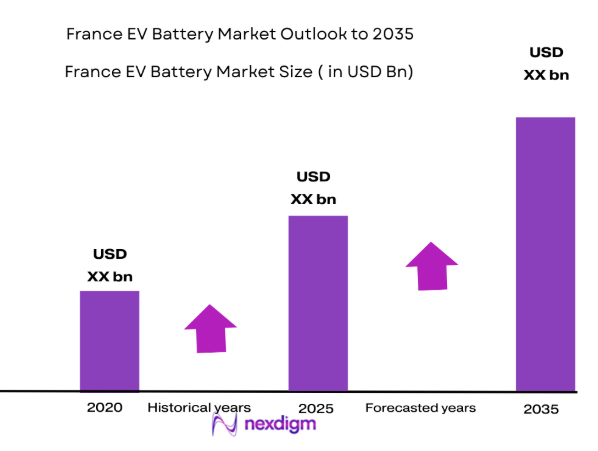
The France Electric Vehicle (EV) Battery market is growing rapidly, driven by an increasing shift towards sustainable transportation. The market size is projected to reach USD ~ billion by 2024, fueled by the growing demand for electric vehicles (EVs) in the country. Factors such as government incentives, stricter emission regulations, and advancements in battery technology contribute to the robust market expansion. Increased consumer preference for eco-friendly transportation solutions further accelerates the demand for high-performance EV batteries, positioning France as a key player in Europe’s EV battery market.
Dominant cities in the market include Paris, Lyon, and Marseille, which benefit from robust infrastructure and favorable policies for electric mobility. Paris, as the capital, leads the charge with numerous EV-friendly initiatives, including incentives for EV buyers and significant investments in charging infrastructure. Lyon follows closely with substantial government support for clean energy adoption, while Marseille capitalizes on its position as a major port for trade, making it a hub for commercial EVs and associated technologies. These cities offer the best opportunities for market growth due to favorable urban planning and sustainable transport policies.
Market Segmentation
By Product Type:
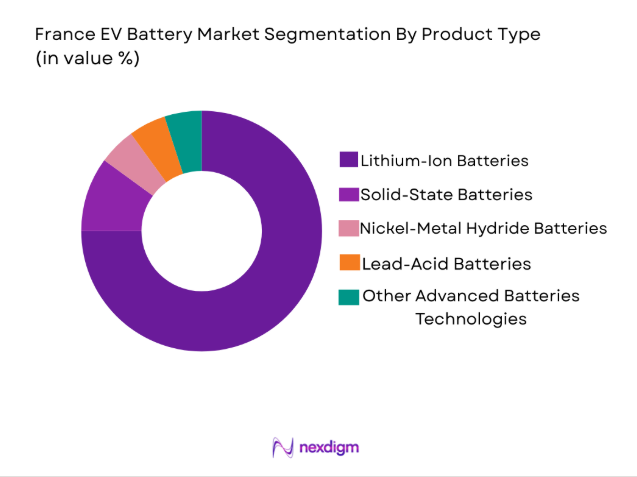
The France EV battery market is segmented by product type into Lithium-Ion Batteries, Solid-State Batteries, Nickel-Metal Hydride Batteries, Lead-Acid Batteries, and Other Advanced Battery Technologies. Lithium-Ion batteries currently dominate the market due to their superior energy density, longer lifespan, and growing demand from electric vehicle manufacturers. These batteries are widely used in electric vehicles due to their efficiency, charging capabilities, and extensive manufacturer support, positioning them as the most favorable option for future growth.
By Platform Type:
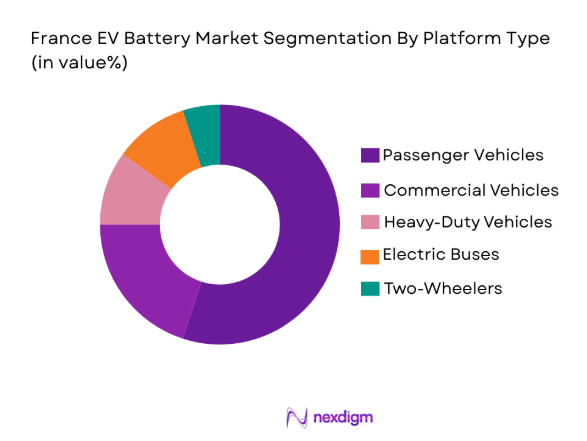
The France EV battery market is segmented by platform type into Passenger Vehicles, Commercial Vehicles, Heavy-Duty Vehicles, Electric Buses, and Two-Wheelers. Passenger vehicles have the largest share of the market due to rising consumer adoption of electric cars and the expanding availability of EV models. These vehicles benefit from increased investments in public charging infrastructure and incentives, making them a more accessible and preferred option for individual consumers.
Competitive Landscape
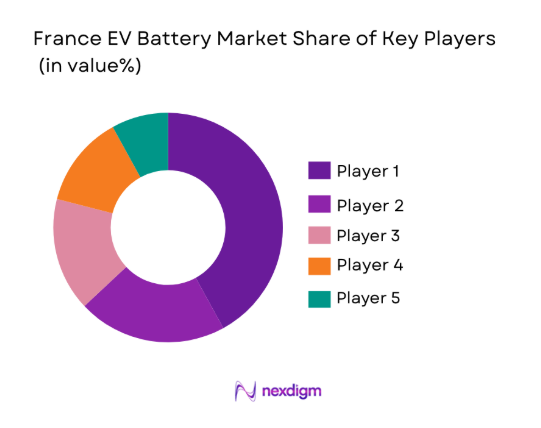
The France EV battery market is highly competitive, with many players focusing on technological innovations and strategic partnerships. Major players are working towards enhancing battery performance and reducing costs, while consolidation in the industry is ongoing, especially among battery manufacturers and automotive OEMs. These players are leveraging collaborations to improve charging infrastructure and provide integrated solutions that benefit consumers and the automotive industry.
| Company Name | Establishment Year | Headquarters | Technology Focus | Market Reach | Key Products | Revenue (USD) | Additional Parameter |
| Renault | 1899 | France | ~ | ~ | ~ | ~ | ~ |
| SAFT Batteries | 1918 | France | ~ | ~ | ~ | ~ | ~ |
| Peugeot | 1810 | France | ~ | ~ | ~ | ~ | ~ |
| LG Chem | 1947 | South Korea | ~ | ~ | ~ | ~ | ~ |
| Panasonic | 1918 | Japan | ~ | ~ | ~ | ~ | ~ |
France EV Battery Market Analysis
Growth Drivers
Government Incentives:
The rapid growth of the EV battery market in France can be attributed to strong government incentives for electric vehicles. These incentives, including tax rebates, subsidies for EV manufacturers, and infrastructure development support, have effectively reduced the financial burden for consumers. The French government’s commitment to reducing carbon emissions and promoting electric mobility is further driving demand for EV batteries. With growing environmental concerns and government-backed initiatives, more consumers and businesses are choosing electric vehicles. Furthermore, the country’s stringent regulations on carbon emissions, coupled with substantial investments in EV infrastructure, are creating an ideal environment for market growth. Additionally, government programs encouraging research and development in battery technology are expected to yield more affordable and efficient EV batteries in the future. These policies contribute to increased adoption rates of electric vehicles, driving further demand for high-performance batteries in the French market. With more charging stations being installed across the country, the convenience and accessibility of EVs are improving, thereby attracting more buyers. The combination of these factors is ensuring a steady growth trajectory for the EV battery market in France.
Technological Advancements:
Technological advancements in EV battery technologies are driving the market forward. Innovations in lithium-ion batteries, such as enhanced energy density, faster charging capabilities, and longer lifespans, are reducing the total cost of ownership for EV owners. Additionally, the development of solid-state batteries, which promise even greater efficiency and safety, is expected to revolutionize the market. These advancements are improving the performance of electric vehicles, making them more appealing to both consumers and businesses. Battery manufacturers are increasingly investing in R&D to improve charging speeds and battery life, ensuring that EVs become more competitive with traditional internal combustion engine vehicles. The widespread adoption of electric vehicles is heavily reliant on these improvements in battery technologies, and manufacturers are racing to develop next-generation batteries that are lighter, more efficient, and easier to produce. As these technologies continue to mature, battery costs are expected to decrease, which will further drive the adoption of EVs and battery-powered transportation. In addition, advancements in battery recycling and second-life battery use are helping to address environmental concerns associated with EV battery disposal. These technological breakthroughs will continue to shape the future of the EV battery market, making it an integral part of the automotive sector’s transition to sustainability.
Market Challenges
High Battery Production Costs:
One of the primary challenges in the France EV battery market is the high production cost of batteries, particularly for advanced technologies such as solid-state batteries. The raw materials required for battery manufacturing, such as lithium, cobalt, and nickel, are expensive, and the extraction processes can be environmentally damaging. These high production costs are passed on to consumers, making electric vehicles more expensive than their internal combustion engine counterparts. While government subsidies help mitigate this cost, the overall price of EVs remains a barrier to widespread adoption. Furthermore, the costs of developing and scaling up new battery technologies, such as solid-state batteries, are significant, which can delay their commercialization and hinder market growth. As demand for electric vehicles rises, manufacturers will need to find ways to reduce production costs to ensure that EVs remain affordable for consumers. This will likely require further advancements in battery technology and supply chain optimization to drive economies of scale and reduce costs over time.
Limited Charging Infrastructure:
The limited availability of EV charging stations in certain regions of France remains a major challenge for the widespread adoption of electric vehicles. While major urban centers like Paris have an extensive network of charging points, rural areas and smaller cities still lack sufficient infrastructure. This creates a range anxiety issue for EV owners, preventing them from fully embracing the electric vehicle lifestyle. Additionally, there is a lack of standardized charging infrastructure, which makes it difficult for consumers to find compatible charging stations across different locations. While the French government is investing in the expansion of the charging network, the pace of growth has been slower than expected. This delay in infrastructure development could slow the growth of the EV battery market, as consumers and businesses are hesitant to invest in EVs if they cannot rely on convenient charging options. To address this challenge, the French government and private companies must collaborate to accelerate the expansion of charging networks and ensure that consumers have access to fast, reliable, and widespread charging solutions.
Opportunities
Expansion of Charging Infrastructure:
The expansion of charging infrastructure presents a significant opportunity for growth in the France EV battery market. As the government and private sector continue to invest in the construction of EV charging stations across urban and rural areas, the convenience and accessibility of electric vehicles will improve. This increased access to charging points will help alleviate concerns about range anxiety and encourage more consumers to transition to EVs. Additionally, the growing use of fast-charging technology will reduce charging times, making EVs more convenient for everyday use. This, in turn, will drive the demand for EV batteries as more consumers opt for electric vehicles. The expansion of charging infrastructure also presents opportunities for the development of new battery technologies that are optimized for fast-charging and high-performance applications. With the growing demand for EVs, there is a clear need for further investment in charging infrastructure to ensure that France’s transition to electric mobility is successful. Government incentives and partnerships with private companies will continue to play a crucial role in accelerating the development of this infrastructure.
Integration of Renewable Energy:
The integration of renewable energy sources, such as solar and wind power, into the EV ecosystem represents another significant opportunity for the France EV battery market. As the country continues to invest in clean energy solutions, there is a growing opportunity to integrate renewable energy with EV charging infrastructure. Solar-powered charging stations, for example, could provide a sustainable solution for EV owners, allowing them to charge their vehicles using clean, renewable energy. This integration not only helps reduce the carbon footprint of electric vehicles but also supports France’s broader environmental goals. As renewable energy adoption increases, there will be a rising demand for energy storage solutions, creating opportunities for advanced battery technologies that can store excess energy for later use. By coupling EVs with renewable energy sources, France can create a more sustainable and resilient energy system while accelerating the adoption of electric vehicles. The integration of renewable energy will also reduce dependence on the grid and enhance the overall sustainability of the electric mobility ecosystem.
Future Outlook
The future of the France EV battery market is promising, with strong growth driven by technological advancements, government support, and rising consumer demand for electric vehicles. Over the next five years, the market is expected to experience a surge in investment, particularly in battery production and charging infrastructure. Advancements in battery technologies, such as solid-state batteries, will further enhance the efficiency and performance of EVs, driving greater adoption. Additionally, ongoing regulatory support for clean energy and sustainable transportation will ensure that the EV market continues to thrive. As the demand for electric vehicles increases, the EV battery market will continue to expand, with significant opportunities for innovation and market growth.
Major Players
- SAFT Batteries
- Peugeot
- LG Chem
- Panasonic
- Tesla
- BYD Co. Ltd.
- CATL
- Samsung SDI
- Nissan
- BMW Group
- Honda Motor Co.
- Hyundai Motor Company
- SK Innovation
- Toshiba Corporation
Key Target Audience
- Government and regulatory bodies
- Electric vehicle manufacturers
- Battery manufacturers
- Energy storage companies
- Automotive OEMs
- Fleet operators
- Charging infrastructure providers
Research Methodology
Step 1: Identification of Key Variables
In this step, key market variables such as product types, market dynamics, and consumer behavior patterns are identified to provide a clear foundation for the research.
Step 2: Market Analysis and Construction
Market sizing and segmentation analysis are performed to understand the overall market structure, growth potential, and key opportunities within the industry.
Step 3: Hypothesis Validation and Expert Consultation
Industry experts and stakeholders are consulted to validate the hypotheses developed in the market analysis and gain insights into emerging trends and challenges.
Step 4: Research Synthesis and Final Output
The final research findings are synthesized into a comprehensive report, including detailed market forecasts, trends, and recommendations for stakeholders.

- Executive Summary
- Research Methodology
(Definitions, Scope, Industry Assumptions, Market Sizing Approach, Primary & Secondary Research Framework, Data Collection & Verification Protocol, Analytic Models & Forecast Methodology, Limitations & Research Validity Checks)

- Market Definition and Scope
- Value Chain & Stakeholder Ecosystem
- Regulatory / Certification Landscape
- Sector Dynamics Affecting Demand
- Strategic Initiatives & Infrastructure Growth

- Growth Drivers
Government incentives for electric vehicles
Growing demand for sustainable mobility solutions
Technological advancements in battery efficiency
Increasing investments in EV infrastructure
Rising environmental regulations and carbon reduction goals - Market Challenges
High production costs of advanced battery technologies
Supply chain disruptions for critical raw materials
Limited charging infrastructure in certain regions
Battery disposal and recycling challenges
Technological barriers in achieving mass production of solid-state batteries - Market Opportunities
Partnerships with global automotive manufacturers for battery development
Expansion of EV charging stations to enhance battery usage
Advancements in second-life battery applications for energy storage - Trends
Development of high-density, long-life batteries
Integration of EV battery systems with renewable energy storage
Rise in battery leasing and swapping models
Increased focus on fast-charging technologies
Enhanced recycling methods for EV batteries - Government Regulations & Defense Policy
European Union’s Green Deal and carbon-neutral goals
Support for EV battery research and innovation
Government regulations on EV battery recycling and disposal - SWOT Analysis
Stakeholder and Ecosystem Analysis
Porter’s Five Forces Analysis
Competition Intensity and Ecosystem Mapping

- By Market Value, 2020-2025
- By Installed Units, 2020-2025
- By Average System Price, 2020-2025
- By System Complexity Tier, 2020-2025

- By System Type (In Value%)
Lithium-Ion Batteries
Solid-State Batteries
Nickel-Metal Hydride Batteries
Lead-Acid Batteries
Other Advanced Battery Technologies - By Platform Type (In Value%)
Passenger Vehicles
Commercial Vehicles
Heavy-Duty Vehicles
Electric Buses
Two-Wheelers - By Fitment Type (In Value%)
Original Equipment Manufacturer (OEM) Batteries
Aftermarket Batteries
Integrated Battery Systems
Modular Battery Solutions
Battery as a Service - By EndUser Segment (In Value%)
Automotive OEMs
Battery Manufacturers
Electric Vehicle (EV) Users
Government and Municipalities
Fleet Operators - By Procurement Channel (In Value%)
Direct Procurement from Manufacturers
Online Bidding Platforms
Third-party Distributors
Government Tenders
Private Sector Procurement - By Material / Technology (In Value%)
Lithium
Cobalt
Nickel
Graphite
Manganese

- Market structure and competitive positioning
Market share snapshot of major players
CrossComparison Parameters (System Type, Platform Type, EndUser Segment, Material/Technology, Procurement Channel)
SWOT Analysis of Key Competitors
Pricing & Procurement Analysis - Key Players
SNECMA
SAFT Batteries
VARTA AG
Blue Solutions
BYD Co. Ltd.
Panasonic Corporation
LG Chem Ltd.
Samsung SDI
CATL
BMW AG
Tesla Inc.
Volvo Cars
Renault SA
Peugeot SA
Ford Motor Company

- Automotive OEMs increasing EV battery production
- Government investments in electric vehicle infrastructure
- Adoption of EV batteries by fleet operators
- Electric vehicle users driving battery demand

- Forecast Market Value, 2026-2035
- Forecast Installed Units, 2026-2035
- Price Forecast by System Tier, 2026-2035
- Future Demand by Platform, 2026-2035


 Request a Sample
 Ask for Customization
 Get a Quote
 Enquire Now