
 Download PDF
 Download PDF
Market Overview
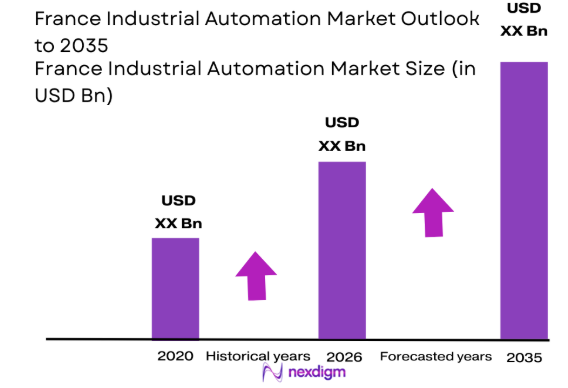
The France Industrial Automation Market is valued at approximately USD ~ billion in recent assessments, driven by increased adoption of automation across key industries such as automotive, manufacturing, and energy. This growth is further supported by technological advancements in robotics, AI, and IoT, which improve operational efficiency, productivity, and safety. Moreover, governmental policies promoting Industry 4.0 and smart factory initiatives provide substantial incentives for businesses to adopt automation solutions, thereby fostering market expansion.
The dominant cities in the market include Paris, Lyon, and Toulouse, where industrial hubs and technological innovation centers play a central role. These cities are home to large industrial manufacturers and tech firms, benefiting from strategic infrastructure, a skilled workforce, and a favorable regulatory environment. France’s commitment to advancing its manufacturing capabilities and ensuring sustainable development positions these regions as key drivers of the industrial automation market, enabling them to maintain significant influence in the sector.
Market Segmentation
By System Type
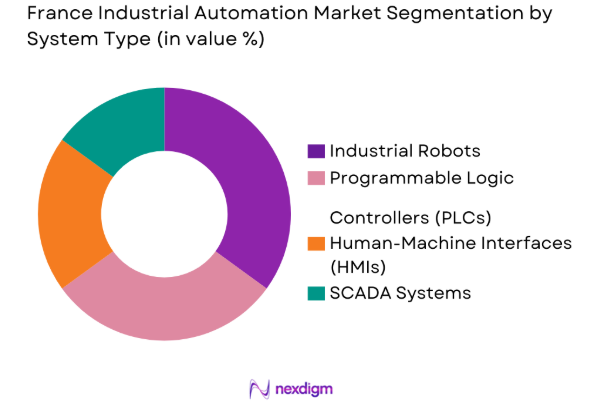
The France Industrial Automation market is segmented by system type into programmable logic controllers (PLCs), industrial robots, human-machine interfaces (HMIs), and supervisory control and data acquisition (SCADA) systems. Recently, industrial robots have captured a dominant market share, driven by their increasing adoption in industries like automotive, electronics, and logistics. This growth is attributed to advancements in robotics technology, which enhances productivity, reduces human error, and allows businesses to meet high-quality standards with greater efficiency.
By Platform Type
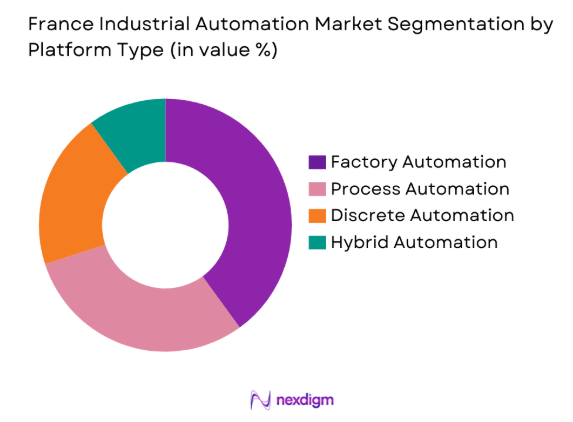
The France Industrial Automation Market is also segmented by platform type, which includes factory automation, process automation, and discrete automation. Factory automation has seen the most significant share due to the increased integration of robotics and AI into manufacturing processes. This is largely driven by the need for scalable, flexible, and high-precision automation solutions in industries such as automotive and consumer electronics, where high throughput and precision are critical.
Competitive Landscape
The competitive landscape of the France Industrial Automation market features a mix of global and local players, with major corporations investing heavily in research and development to introduce advanced automation technologies. The market has seen consolidation, particularly in areas like robotics and AI, where companies are focusing on partnerships and acquisitions to expand their technological capabilities and product offerings.
| Company Name | Establishment Year | Headquarters | Technology Focus | Market Reach | Key Products | Revenue (USD) | Additional Parameter |
| Siemens AG | 1847 | Munich, Germany | ~ | ~ | ~ | ~ | ~ |
| Rockwell Automation | 1903 | Milwaukee, USA | ~ | ~ | ~ | ~ | ~ |
| Schneider Electric | 1836 | Rueil-Malmaison, France | ~ | ~ | ~ | ~ | ~ |
| ABB Ltd. | 1988 | Zurich, Switzerland | ~ | ~ | ~ | ~ | ~ |
| Mitsubishi Electric | 1921 | Tokyo, Japan | ~ | ~ | ~ | ~ | ~ |
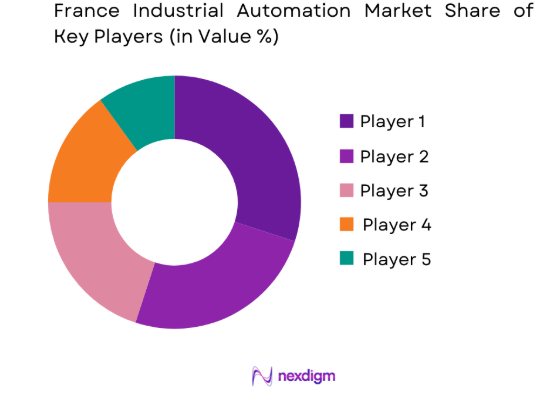
France Industrial Automation Market Analysis
Growth Drivers
Technological Advancements in Robotics
Robotics technology has advanced significantly over the past decade, with innovations in AI, machine learning, and IoT integration driving growth in the France Industrial Automation Market. These advancements have made robots smarter, faster, and more adaptable, improving productivity, precision, and reducing costs and human errors. Automation is increasingly adopted in sectors like automotive, electronics, and food production, where high efficiency and continuous operations are crucial. The reduction in costs for robotics and AI technologies has further accelerated this adoption, making automation solutions more accessible to smaller businesses. This technological progress not only boosts operational efficiency but also enables companies to remain competitive in an evolving industrial landscape.
Government Support for Industry 4.0
The French government’s support for digital transformation, particularly through its Industry 4.0 initiatives, has been a major growth driver for the industrial automation market. By promoting smart manufacturing, advanced robotics, and AI technologies, the government aims to strengthen France’s competitive position in the global manufacturing sector. Financial incentives, including grants, tax relief, and government-backed loans, encourage businesses to invest in automation systems. These initiatives not only make automation more accessible but also align with the country’s broader goal of fostering technological innovation and improving industrial competitiveness. As a result, these efforts help businesses modernize, enhance efficiency, and remain globally competitive, positioning France as a leader in industrial automation adoption.
Market Challenges
High Initial Investment Costs
A major challenge for the France Industrial Automation market is the high initial capital required for automation systems. Small and medium-sized enterprises (SMEs) often face significant barriers due to the high costs of advanced robotics, PLCs, and other automation technologies. This financial burden hinders the adoption of automation, particularly in industries with narrow profit margins or limited technological expertise. While the long-term operational savings from automation can offset these costs, the upfront investment remains a critical obstacle for many businesses. Overcoming this challenge requires finding cost-effective automation solutions, access to financing options, and government incentives to help SMEs integrate automation without jeopardizing their financial stability.
Integration with Legacy Systems
Integrating new automation technologies with existing legacy systems presents a significant challenge in the France Industrial Automation market. Many industries still rely on outdated infrastructure, which can be incompatible with modern automation solutions. Upgrading these legacy systems requires substantial financial investment and skilled personnel to manage the integration process. This transition can be time-consuming, and during the process, businesses may experience temporary disruptions in production. Such disruptions further complicate the shift to full automation, delaying the realization of benefits like improved efficiency and cost savings. Overcoming these barriers requires careful planning, resource allocation, and a step-by-step approach to ensure smooth integration without halting ongoing operations.
Opportunities
Emerging Demand for AI-Powered Automation
As AI continues to advance, there is an increasing opportunity for automation systems to become more intelligent and efficient. The demand for AI-powered automation is growing, particularly in industries such as manufacturing, logistics, and healthcare, where real-time analytics, predictive maintenance, and autonomous decision-making are critical for operational success. AI-enabled systems enhance productivity by analyzing historical data, identifying patterns, and adapting in real-time to changing conditions. This allows businesses to make informed decisions faster, optimize workflows, and prevent equipment failures before they occur. As a result, AI-driven automation not only boosts efficiency but also significantly reduces operational costs. The integration of AI into automation systems represents a major step toward a more autonomous, data-driven industrial future.
Partnerships for Smart Factory Solutions
Collaborations between automation vendors and technology providers are a key opportunity in the France Industrial Automation market. By partnering with IoT, AI, and cloud technology firms, industrial businesses can implement comprehensive smart factory solutions that integrate multiple automation components into a unified digital ecosystem. These collaborations enable businesses to enhance scalability, allowing them to apply automation solutions across various processes such as production, logistics, and supply chain management. The integration of these advanced technologies improves operational efficiency, provides better visibility and control, and optimizes decision-making. Ultimately, such partnerships drive industry-wide digital transformation, positioning companies to stay competitive in an increasingly automated and connected industrial landscape.
Future Outlook
Over the next five years, the France Industrial Automation market is expected to experience strong growth, driven by advancements in robotics, AI, and IoT technologies. The increasing push towards digitalization, government support for smart manufacturing, and the demand for energy-efficient solutions will fuel market expansion. Additionally, as industries look to optimize production lines and improve operational efficiency, automation technologies will continue to play a central role in transforming France’s industrial sector. The market is likely to see increased investments in AI-powered automation, predictive maintenance solutions, and integrated smart factory systems.
Major Players
- Siemens AG
- Rockwell Automation
- Schneider Electric
- ABB Ltd.
- Mitsubishi Electric
- Honeywell International
- Emerson Electric
- Yokogawa Electric Corporation
- Omron Corporation
- GE Automation
- KUKA AG
- Fanuc Corporation
- Bosch Rexroth AG
- Festo AG
- Hilscher Gesellschaft
Key Target Audience
- Investments and venture capitalist firms
- Government and regulatory bodies
- Large manufacturing corporations
- System integrators
- Automation solution providers
- Research and development organizations
- Technology startups in automation
- Industrial end-users
Research Methodology
Step 1: Identification of Key Variables
The first step involves identifying the key variables influencing the industrial automation market, including technological trends, regulatory frameworks, and market demands. These variables help define the scope of the research and set the parameters for the market sizing.
Step 2: Market Analysis and Construction
A detailed market analysis is conducted to understand the structure, segmentation, and competitive dynamics of the market. This step involves both primary and secondary research, including interviews with industry experts and data analysis from credible sources.
Step 3: Hypothesis Validation and Expert Consultation
The market findings are validated through expert consultations to ensure the data accuracy and relevance. This stage helps refine the hypotheses and ensures the market analysis aligns with industry trends.
Step 4: Research Synthesis and Final Output
The final output synthesizes all collected data, insights, and expert opinions into a cohesive report that outlines market size, growth drivers, challenges, opportunities, and a competitive landscape.

- Executive Summary
- Research Methodology (Definitions, Scope, Industry Assumptions, Market Sizing Approach, Primary & Secondary Research Framework, Data Collection & Verification Protocol, Analytic Models & Forecast Methodology, Limitations & Research Validity Checks)

- Market Definition and Scope
- Value Chain & Stakeholder Ecosystem
- Regulatory / Certification Landscape
- Sector Dynamics Affecting Demand
- Strategic Initiatives & Infrastructure Growth

- Growth Drivers
Increase in Demand for Automation in Manufacturing
Government Initiatives for Smart Manufacturing
Technological Advancements in Robotics - Market Challenges
High Initial Capital Investment
Lack of Skilled Workforce
Integration Issues with Legacy Systems - Market Opportunities
Growing Adoption of AI and Machine Learning in Automation
Emerging Markets and Infrastructure Development
Partnerships with Tech Providers for IoT Integration - Trends
Rise of Autonomous Robotics
Integration of IoT with Industrial Automation
Shift Towards Energy-efficient Automation Solutions - Government Regulations
- SWOT Analysis of Key Competitors
- Porter’s Five Forces

- By Market Value, 2020-2025
- By Installed Units, 2020-2025
- By Average System Price, 2020-2025
- By System Complexity Tier, 2020-2025

- By System Type (In Value%)
Programmable Logic Controllers
Industrial Robots
Supervisory Control and Data Acquisition (SCADA)
Human Machine Interface (HMI)
Drives & Motors - By Platform Type (In Value%)
Factory Automation
Process Automation
Discrete Automation
Hybrid Automation
Cloud-based Automation - By Fitment Type (In Value%)
On-premise Solutions
Cloud-based Solutions
Modular Systems
Integrated Systems
Edge Computing Solutions - By End User Segment (In Value%)
Automotive Industry
Manufacturing Industry
Oil & Gas
Energy & Utilities
Food & Beverages - By Procurement Channel (In Value%)
Direct Procurement
OEMs
Third-party Distributors
Online Bidding Platforms
Government Tenders

- Market Share Analysis
- Cross Comparison Parameters (System Type, Platform Type, End User Segment, Procurement Channel, Fitment Type, Geographic Region, Technology Integration, Industry Applications, Service Type, Customer Size)
- SWOT Analysis of Key Competitors
- Pricing & Procurement Analysis
- Key Players
Siemens AG
Rockwell Automation
Schneider Electric
ABB Ltd.
Mitsubishi Electric
Honeywell International Inc.
Emerson Electric Co.
Yokogawa Electric Corporation
Omron Corporation
GE Automation
KUKA AG
Fanuc Corporation
Hilscher Gesellschaft für System automation mbH
Bosch Rexroth AG
Festo AG & Co. KG

- Automotive Manufacturers Increasing Automation Adoption
- Oil & Gas Sector Embracing Predictive Maintenance
- Food & Beverage Industry’s Shift to Automation for Consistency
- Energy and Utilities Focusing on Smart Grid Solutions

- Forecast Market Value, 2026-2035
- Forecast Installed Units, 2026-2035
- Price Forecast by System Tier, 2026-2035
- Future Demand by Platform, 2026-2035


 Request a Sample
 Ask for Customization
 Get a Quote
 Enquire Now