
 Download PDF
 Download PDF
Market Overview
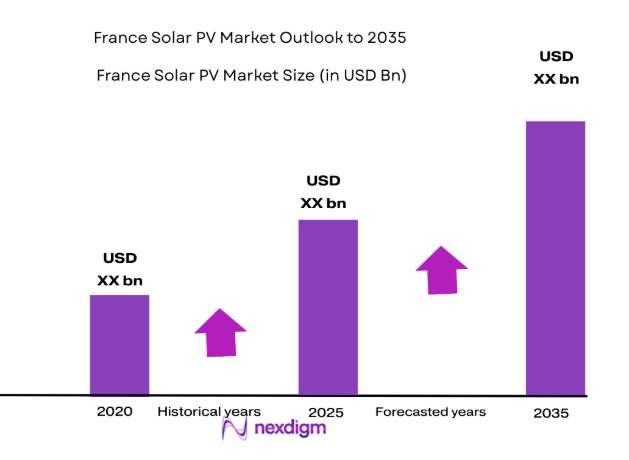
The France Solar PV market has seen substantial growth, driven by the country’s commitment to renewable energy and the increasing adoption of solar power systems across residential, commercial, and industrial sectors. Based on a recent historical assessment, the market size is valued at approximately USD ~ billion. Government incentives, technological advancements, and the push for clean energy are key drivers behind this growth, with France actively seeking to expand its solar capacity. These developments have attracted both domestic and international investors to capitalize on the market’s growth potential.
France continues to be a dominant player in the European solar energy landscape, supported by favorable government policies and robust infrastructure development. Cities like Paris, Lyon, and Marseille have emerged as key regions due to high urbanization, government backing, and a growing demand for sustainable energy solutions. The French government’s emphasis on achieving energy transition goals has fostered a favorable environment for solar energy adoption. As one of the leading solar energy adopters in Europe, France’s large-scale projects and investments in infrastructure further bolster its position in the global solar market.
Market Segmentation
By Product Type
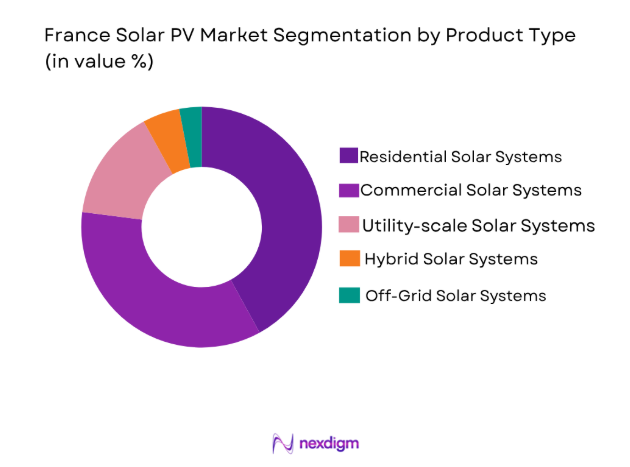
The France Solar PV market is segmented by product type into various categories, including residential solar systems, commercial solar systems, and utility-scale solar systems. The residential solar system sub-segment holds the dominant market share due to the growing demand for green energy solutions in private households and the increasing adoption of solar panels for home installations. Factors such as government incentives, rising electricity costs, and environmental concerns have made residential solar systems highly attractive to homeowners across the country.
By Platform Type
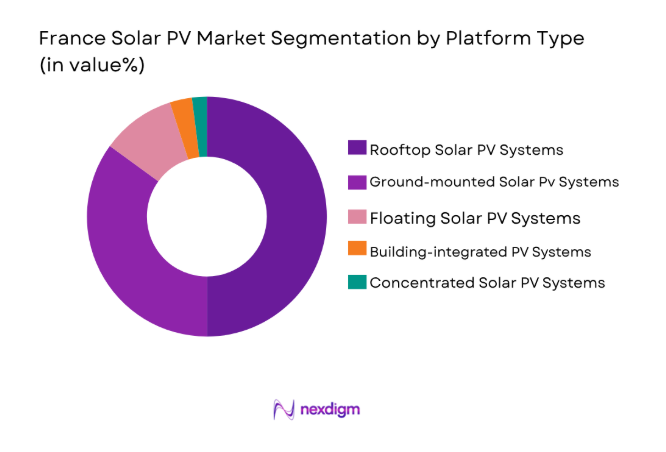
The market is segmented by platform type into rooftop solar PV systems, ground-mounted solar PV systems, and floating solar PV systems. The rooftop solar PV system sub-segment is the dominant player due to factors such as its suitability for both residential and commercial properties. This sub-segment benefits from government policies, incentives, and the ease of installation on existing structures, making it highly popular for energy-efficient solutions in urban and suburban setting.
Competitive Landscape
The France Solar PV market is characterized by a high level of competition with several major players consolidating their position in the market. Companies are focusing on enhancing their technological capabilities, increasing their manufacturing capacity, and expanding their presence in both the residential and commercial sectors. Additionally, French solar companies benefit from government subsidies and incentives, which have led to an increase in the number of domestic and international players entering the market.
| Company Name | Establishment Year | Headquarters | Technology Focus | Market Reach | Key Products | Revenue (USD) | Market-Specific Parameter |
| EDF Energies Nouvelles | 2005 | Paris, France | ~ | ~ | ~ | ~ | ~ |
| TotalEnergies | 1924 | Paris, France | ~ | ~ | ~ | ~ | ~ |
| ENGIE | 2008 | Paris, France | ~ | ~ | ~ | ~ | ~ |
| BayWa r.e. | 2009 | Munich, Germany | ~ | ~ | ~ | ~ | ~ |
| Voltalia | 2005 | Paris, France | ~ | ~ | ~ | ~ | ~ |
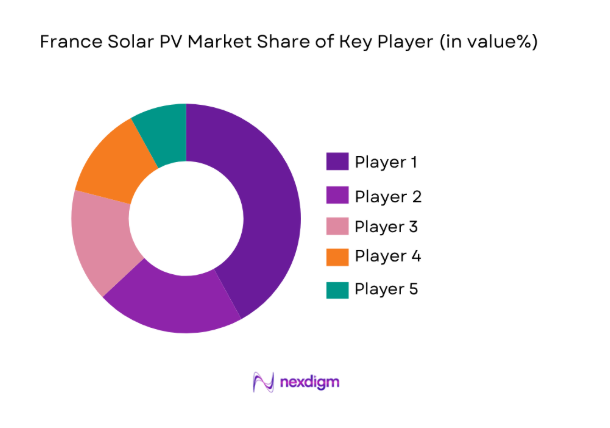
France Solar PV Market Analysis
Growth Drivers
Government Incentives for Renewable Energy
Government incentives play a significant role in driving the growth of the France Solar PV market. With substantial financial support in the form of subsidies, tax credits, and favorable policies, the government has made solar energy more accessible to both residential and commercial users. These incentives reduce the initial capital investment required for solar installations, encouraging more individuals and companies to opt for solar energy solutions. The long-term energy goals set by the French government further ensure that solar energy remains a priority, which boosts the market’s growth. As the government continues to push for decarbonization and sustainability, solar energy is set to gain an even larger market share in the coming years. These incentives are also in alignment with the European Union’s green energy objectives, ensuring that France remains a key player in the renewable energy sector.
Technological Advancements in Solar Energy
Technological advancements in solar energy solutions have also been a major growth driver for the France Solar PV market. New developments in solar panel efficiency, energy storage, and integration technologies have significantly reduced the overall costs associated with solar installations. The use of bifacial panels, which capture sunlight on both sides, has increased the energy yield of solar systems. Additionally, innovations in energy storage solutions such as lithium-ion batteries have made it easier to store excess solar energy for later use, ensuring a continuous power supply even when sunlight is not available. These technological improvements not only reduce the installation costs but also enhance the reliability and performance of solar systems, making them more attractive to end-users.
Market Challenges
High Initial Capital Investment
One of the major challenges facing the France Solar PV market is the high initial capital investment required for solar systems. Although solar energy offers long-term savings, the upfront costs for equipment, installation, and infrastructure remain significant barriers for both residential and commercial sectors. While government subsidies help alleviate some of these financial burdens, the cost of advanced solar panels, energy storage systems, and installation still represents a major obstacle for many potential customers. Despite technological advancements that have reduced overall system costs, the capital-intensive nature of solar power installations continues to limit widespread adoption, especially among small and medium-sized enterprises.
Grid Integration and Intermittency of Solar Power
Another significant challenge for the France Solar PV market is the issue of grid integration and the intermittency of solar power generation. Solar energy production is highly dependent on weather conditions and time of day, leading to fluctuations in power output. This intermittency makes it difficult to ensure a stable and reliable supply of solar power, particularly during periods of low sunlight or high demand. Additionally, integrating large amounts of solar power into the existing grid infrastructure requires significant upgrades to ensure that energy is transmitted efficiently and reliably. Overcoming these technical and logistical challenges is essential for the further growth and expansion of the solar energy market in France.
Opportunities
Expansion of Rooftop Solar Installations
One of the key opportunities for the France Solar PV market is the expansion of rooftop solar installations. As the demand for green energy solutions increases, more residential, commercial, and industrial buildings are turning to solar power as a viable energy source. Rooftop solar PV systems offer a flexible and scalable solution for energy generation, making them ideal for urban and suburban environments. The French government’s focus on renewable energy and its favorable policies towards solar adoption provide a strong foundation for the growth of rooftop solar installations. As more individuals and businesses seek to reduce their energy costs and carbon footprint, rooftop solar systems are poised to become a major segment within the market.
Integration with Electric Vehicles (EVs)
The growing demand for electric vehicles (EVs) presents a significant opportunity for the France Solar PV market. As the adoption of EVs continues to rise, the integration of solar power with EV charging infrastructure can provide a sustainable solution to meet the energy demands of electric vehicles. Solar-powered EV charging stations can reduce the reliance on traditional power grids, offering a cleaner and more cost-effective alternative. The French government’s push to reduce greenhouse gas emissions and promote sustainable transportation further supports the integration of solar power with EVs, creating new opportunities for solar energy providers to expand their product offerings and reach a broader customer base.
Future Outlook
The future outlook for the France Solar PV market is promising, with expected growth driven by technological advancements, favorable government policies, and increasing demand for clean energy. The market is poised to benefit from the continued development of more efficient and cost-effective solar technologies, including energy storage solutions. With the French government’s commitment to achieving energy transition goals and the EU’s green energy directives, the solar sector is expected to grow substantially over the next five years. As consumer awareness of renewable energy benefits rises, more residential and commercial installations are expected, contributing to France’s position as a leader in the global solar energy market.
Major Players
- EDF Energies Nouvelles
- TotalEnergies
- ENGIE
- BayWa r.e.
- Voltalia
- SolarWorld
- First Solar
- SMA Solar Technology
- Enel Green Power
- JinkoSolar
- REC Solar
- Trina Solar
- Canadian Solar
- LONGi Solar
- Hanwha Q CELLS
Key Target Audience
- Investments and venture capitalist firms
- Government and regulatory bodies
- Energy companies
- Environmental organizations
- Solar panel manufacturers
- Infrastructure developers
- Residential and commercial solar system installers
Research Methodology
Step 1: Identification of Key Variables
Key variables are identified to establish the foundation of market analysis. These variables are based on historical trends, current market conditions, and future projections.
Step 2: Market Analysis and Construction
In-depth analysis is performed to construct a comprehensive view of the market dynamics, trends, and opportunities. Data is gathered from primary and secondary sources to validate findings.
Step 3: Hypothesis Validation and Expert Consultation
Hypotheses are tested and validated through expert consultations and surveys from key industry players, ensuring accurate market forecasting and analysis.
Step 4: Research Synthesis and Final Output
The collected data is synthesized to create the final report, incorporating insights from market trends, challenges, opportunities, and competitive landscapes.

- Executive Summary
- Research Methodology (Definitions, Scope, Industry Assumptions, Market Sizing Approach, Primary & Secondary Research Framework, Data Collection & Verification Protocol, Analytic Models & Forecast Methodology, Limitations & Research Validity Checks)

- Market Definition and Scope
- Value Chain & Stakeholder Ecosystem
- Regulatory / Certification Landscape
- Sector Dynamics Affecting Demand
- Strategic Initiatives & Infrastructure Growth

- Growth Drivers
Government Incentives for Renewable Energy
Technological Advancements in Solar PV Efficiency
Increased Demand for Clean Energy - Market Challenges
High Initial Installation Costs
Intermittency of Solar Power
Grid Integration Challenges - Market Opportunities
Expansion of Rooftop Solar Installations
Development of Energy Storage Solutions
Integration with Electric Vehicles and Smart Grids - Trends
Rise in Adoption of Energy Storage Technologies
Shift Towards Community Solar Programs - Government Regulations
- SWOT Analysis
- Porter’s Five Forces

- By Market Value, 2020-2025
- By Installed Units, 2020-2025
- By Average System Price, 2020-2025
- By System Complexity Tier, 2020-2025

- By System Type (In Value%)
Residential Solar Systems
Commercial Solar Systems
Utility-Scale Solar Systems
Hybrid Solar Systems
Off-Grid Solar Systems - By Platform Type (In Value%)
Rooftop Solar PV Systems
Ground-Mounted Solar PV Systems
Floating Solar PV Systems
Building Integrated PV Systems
Concentrated Solar PV Systems - By Fitment Type (In Value%)
On-grid Solutions
Off-grid Solutions
Hybrid Solutions
Integrated Solutions - By End User Segment (In Value%)
Residential Sector
Commercial Sector
Industrial Sector

- Market Share Analysis
- Cross Comparison Parameters (System Type, Platform Type, Procurement Channel, End User Segment, Fitment Type, Government Policies, Technology Adoption)
- SWOT Analysis of Key Competitors
- Pricing & Procurement Analysis
- Key Players
EDF Energies Nouvelles
TotalEnergies
ENGIE
BayWa r.e.
Voltalia
SolarWorld
First Solar
SMA Solar Technology
Enel Green Power
JinkoSolar
REC Solar
Trina Solar
Canadian Solar
LONGi Solar
Hanwha Q CELLS

- Growing Residential Solar Installations
- Commercial Sector’s Move Towards Sustainability
- Industrial Demand for Cost-Effective Energy Solutions
- Government Policies Boosting End User Adoption

- Forecast Market Value, 2026-2035
- Forecast Installed Units, 2026-2035
- Price Forecast by System Tier, 2026-2035
- Future Demand by Platform, 2026-2035


 Request a Sample
 Ask for Customization
 Get a Quote
 Enquire Now