
 Download PDF
Market Overview
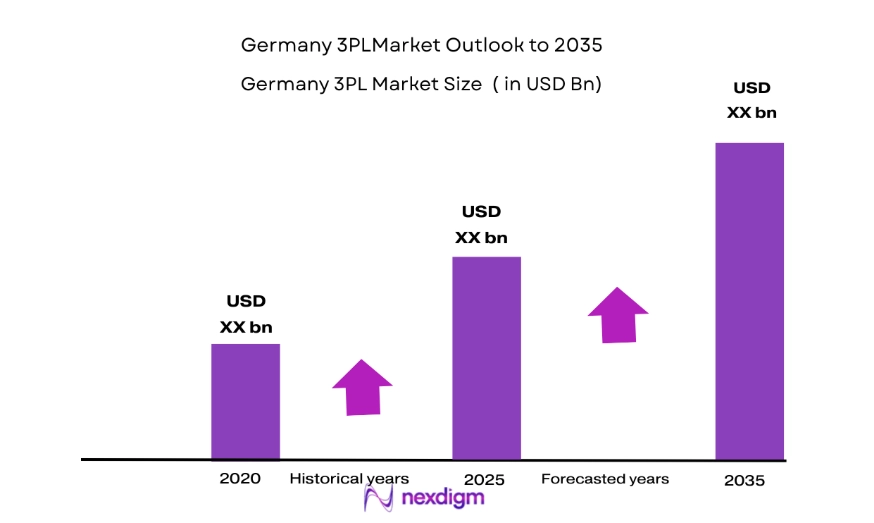
Germany’s third party logistics sector represents one of the most advanced logistics ecosystems in Europe, supported by highly integrated transportation networks, large industrial manufacturing bases, and extensive cross border trade corridors. Based on a recent historical assessment, the Germany 3PL market recorded a market value of approximately USD ~ billion according to logistics industry statistics from the German Federal Statistical Office and the Federal Ministry for Digital and Transport. Growth is driven by export oriented manufacturing supply chains, e commerce fulfillment expansion, multimodal transportation networks, and high demand for specialized contract logistics services across industrial sectors.
Logistics operations concentrate heavily in cities such as Hamburg, Bremen, Frankfurt, Munich, and Duisburg due to their proximity to international seaports, major cargo airports, rail freight terminals, and European highway networks. Hamburg serves as a major maritime logistics gateway connecting German exports to global trade routes, while Frankfurt functions as a key air cargo hub through Frankfurt Airport’s large freight handling infrastructure. Industrial clusters across Bavaria, Baden Württemberg, and North Rhine Westphalia further strengthen demand for integrated logistics services supporting automotive manufacturing, machinery production, chemical industries, and pharmaceutical distribution networks.
Market Segmentation
By Service Type
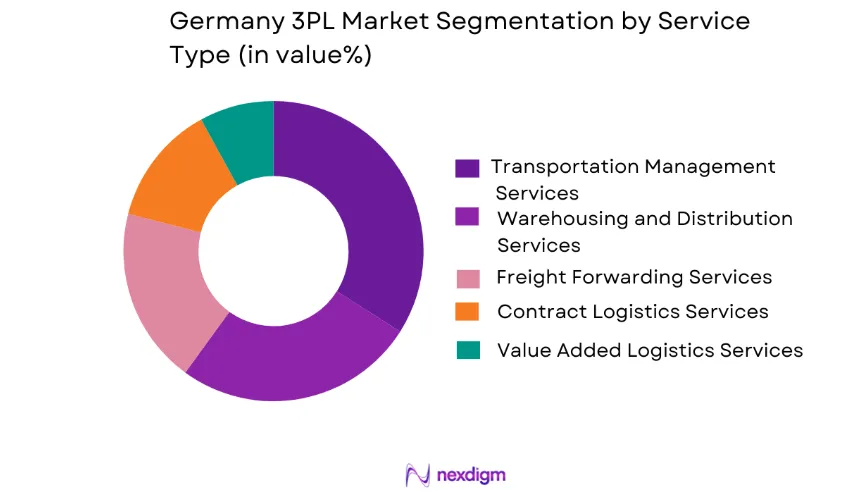
Germany 3PL market is segmented by service type into transportation management services, warehousing and distribution services, freight forwarding services, contract logistics services, and value added logistics services. Recently, transportation management services have a dominant market share due to factors such as high freight volumes generated by Germany’s export oriented manufacturing sector, dense European road transportation networks, and the need for efficient cross border freight coordination. Automotive supply chains, industrial component shipments, and retail distribution networks rely heavily on professional transportation management systems capable of coordinating road, rail, air, and maritime cargo movements across complex European trade corridors. The country’s strong integration with European Union trade routes requires logistics providers to manage multimodal cargo flows between production centers and international distribution hubs. Road freight transport dominates domestic cargo movement due to Germany’s extensive highway network connecting major industrial clusters and urban consumption centers. Logistics companies therefore invest heavily in advanced transportation planning software, digital freight platforms, and fleet management technologies that improve shipment tracking and route optimization. Demand from manufacturing industries including automotive, chemicals, and machinery manufacturing further strengthens the need for efficient freight coordination services capable of managing large scale cargo movements across European supply chains.
By End User Industry
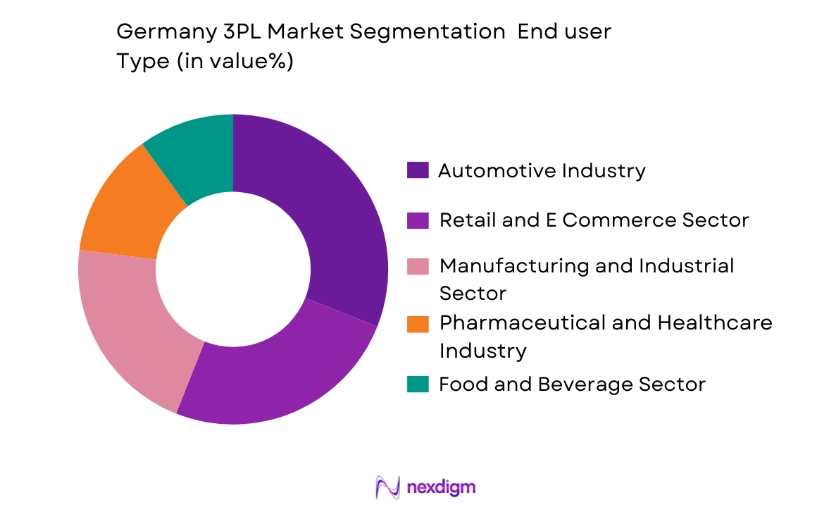
Germany 3PL market is segmented by end user type into automotive industry, retail and e commerce sector, manufacturing and industrial sector, pharmaceutical and healthcare industry, and food and beverage sector. Recently, the automotive industry has a dominant market share due to factors such as Germany’s global leadership in automotive manufacturing, extensive component supplier networks, and complex production logistics requirements. Major automotive manufacturers operate large scale production facilities across Bavaria, Baden Württemberg, and Lower Saxony that depend on highly synchronized supply chains capable of delivering thousands of components to assembly plants on strict schedules. Automotive supply chains require specialized logistics services including just in time inventory management, multimodal transportation coordination, and dedicated warehousing facilities located near production plants. Logistics providers manage inbound component shipments from European suppliers while also coordinating outbound export distribution for finished vehicles delivered to international markets. The complexity of automotive production logistics strengthens demand for integrated contract logistics services capable of coordinating cross border cargo transportation, customs documentation, and supply chain visibility systems. Strong automotive export activity and continuous vehicle production operations therefore maintain the automotive sector as the dominant logistics end user in Germany’s third party logistics market.
Competitive Landscape
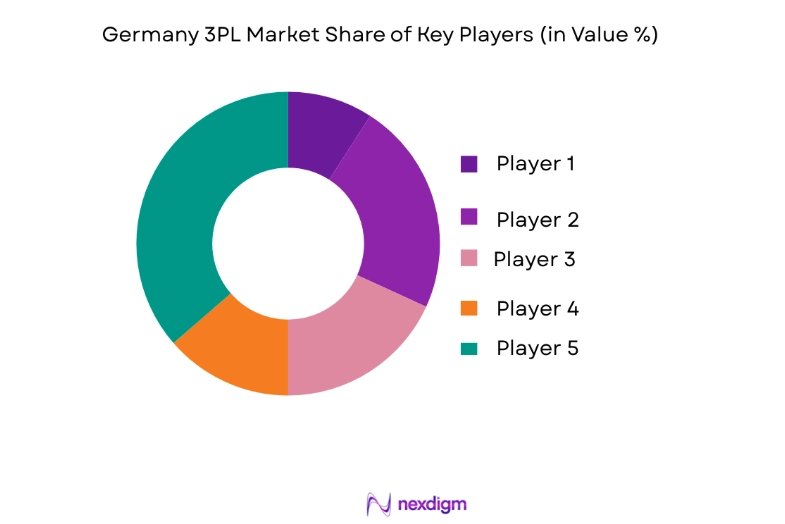
Germany’s 3PL market is characterized by the presence of large global logistics corporations combined with strong domestic logistics providers that operate extensive transportation and warehousing networks across Europe. The competitive environment remains moderately consolidated due to the dominance of multinational logistics firms capable of managing complex multimodal transportation services and international freight forwarding operations. Companies compete primarily through integrated logistics capabilities, digital freight technologies, large warehouse infrastructures, and cross border distribution networks that support European trade flows and industrial supply chains.
| Company Name | Establishment Year | Headquarters | Technology Focus | Market Reach | Key Products | Revenue | Warehouse Capacity |
| DHL Supply Chain | 1969 | Bonn, Germany | ~ | ~ | ~ | ~ | ~ |
| DB Schenker | 1872 | Essen, Germany | ~ | ~ | ~ | ~ | ~ |
| Kuehne + Nagel | 1890 | Schindellegi, Switzerland | ~ | ~ | ~ | ~ | ~ |
| DSV A/S | 1976 | Hedehusene, Denmark | ~ | ~ | ~ | ~ | ~ |
| DACHSER Group | 1930 | Kempten, Germany | ~ | ~ | ~ | ~ | ~ |
Germany 3PL Market Analysis
Growth Drivers
Expansion of E Commerce Fulfillment and Omnichannel Retail Logistics Networks
Rapid expansion of digital commerce platforms across Germany significantly strengthens demand for third party logistics services capable of managing high volume order fulfillment and nationwide distribution operations. Online retail marketplaces distribute consumer goods including electronics, apparel, household products, groceries, and pharmaceuticals that require efficient warehousing, packaging, and transportation services connecting fulfillment centers with residential delivery networks. Logistics providers increasingly operate automated warehouses equipped with robotics based sorting systems and digital inventory management platforms capable of processing thousands of orders per hour. Retail companies outsource logistics operations to specialized third party logistics providers in order to scale distribution networks without investing heavily in their own warehousing infrastructure. High consumer demand for same day and next day delivery services further increases reliance on advanced logistics networks located near major metropolitan regions. Germany’s strong internet penetration and widespread digital payment adoption enable millions of consumers to participate in online retail transactions which directly increases parcel shipment volumes across logistics networks.
Growth of Export Oriented Manufacturing and Automotive Supply Chains
Germany maintains one of the largest manufacturing economies in Europe with strong industrial sectors including automotive production, machinery manufacturing, chemicals, electronics, and precision engineering that depend heavily on advanced logistics infrastructure. Large industrial manufacturers operate complex supply chains requiring continuous transportation of raw materials, intermediate components, and finished products between production facilities and export distribution hubs. Automotive manufacturing clusters located across Bavaria, Baden Württemberg, and Lower Saxony generate extremely high freight volumes that require reliable logistics coordination services capable of supporting just in time production schedules.
Market Challenges
Rising Transportation Costs and Logistics Operational Expenses
Logistics providers across Germany face increasing operational costs driven by rising fuel prices, labor expenses, and infrastructure maintenance requirements that significantly impact profitability across transportation networks. Road freight transport remains the dominant logistics mode across the country which exposes logistics companies to fluctuating fuel prices that directly influence freight transportation costs. Logistics companies must also comply with environmental regulations that require investment in low emission vehicle fleets and energy efficient logistics infrastructure. Labor shortages within the trucking and logistics workforce further increase wage pressures as companies compete to recruit and retain qualified drivers and warehouse personnel.
Complex Regulatory Compliance Across European Logistics Networks
Germany’s logistics industry operates within a highly regulated transportation environment influenced by European Union trade policies, environmental regulations, and cross border freight transportation rules. Logistics companies must comply with customs documentation requirements, transportation safety regulations, and environmental emission standards that govern freight operations across European trade corridors. Road freight transportation regulations include strict rules regarding driver working hours, vehicle emission standards, and cargo safety requirements that logistics providers must monitor continuously. Compliance with carbon reduction targets and sustainability policies also requires logistics companies to invest in low emission transportation fleets and alternative fuel vehicles.
Opportunities
Adoption of Digital Logistics Technologies and Automation Platforms
Rapid technological innovation across logistics operations creates significant opportunities for third party logistics providers to improve operational efficiency through advanced digital solutions. Artificial intelligence driven logistics planning systems allow companies to optimize transportation routes, forecast shipment demand, and allocate warehouse resources more efficiently across distribution networks. Robotics based warehouse automation technologies improve order processing speeds while reducing labor requirements across large fulfillment centers. Digital freight platforms enable logistics providers to match cargo shipments with available transportation capacity more efficiently which reduces empty truck mileage and improves fleet utilization rates.
Expansion of Sustainable Green Logistics and Low Emission Transportation Solutions
Environmental sustainability initiatives create new opportunities for logistics providers to develop low emission transportation networks and energy efficient warehousing infrastructure across Germany’s logistics sector. Government policies promoting carbon emission reductions encourage logistics companies to adopt electric delivery vehicles, hydrogen powered trucks, and alternative fuel transportation technologies that reduce environmental impact. Investments in energy efficient warehouses equipped with solar power systems and automated energy management technologies further support sustainable logistics operations.
Future Outlook
Germany’s third party logistics sector is expected to experience sustained growth driven by expanding digital commerce activity, increasing industrial export volumes, and the adoption of advanced logistics technologies. Automation across warehouses and transportation networks will improve operational productivity while reducing delivery times across national supply chains. Government investments in transportation infrastructure and sustainable logistics solutions will further strengthen logistics efficiency. Demand for integrated multimodal transportation services and digital freight platforms will continue expanding across European trade corridors.
Major Players
- DHL Supply Chain
- DB Schenker
- Kuehne + Nagel
- DSV A/S
- CEVA Logistics
- GEODIS
- Rhenus Logistics
- Hellmann Worldwide Logistics
- DACHSER Group
- Fiege Logistics
- BLG Logistics Group
- Expeditors International
- UPS Supply Chain Solutions
- Kerry Logistics
- XPO Logistics
Key Target Audience
- Logistics service providers
- Automotive manufacturers
- E commerce retailers
- Industrial manufacturing companies
- Pharmaceutical distributors
- Food and beverage manufacturers
- Investments and venture capitalist firms
- Government and regulatory bodies
Research Methodology
Step 1: Identification of Key Variables
The research process begins with identifying critical variables influencing the Germany 3PL market including logistics infrastructure development, industrial production levels, transportation networks, and cross border trade volumes. Macroeconomic indicators and sector specific logistics demand drivers are examined to understand how supply chain dynamics influence logistics service demand.
Step 2: Market Analysis and Construction
The market is constructed through analysis of logistics service revenues, transportation volumes, warehousing capacities, and industry participation across multiple sectors including manufacturing, automotive production, retail distribution, and pharmaceutical logistics. Secondary data from government agencies and logistics associations supports the development of the market structure.
Step 3: Hypothesis Validation and Expert Consultation
Industry experts including logistics operators, freight forwarders, and supply chain specialists are consulted to validate assumptions regarding logistics demand drivers, technological adoption, and regulatory influences. These consultations ensure that research insights accurately reflect operational realities within Germany’s logistics industry.
Step 4: Research Synthesis and Final Output
All research insights are synthesized to develop a comprehensive analysis of the Germany 3PL market including segmentation, competitive landscape, growth drivers, challenges, and future opportunities. The final report integrates validated data sources with qualitative analysis to provide strategic insights for stakeholders operating within the logistics ecosystem.

- Executive Summary
- Research Methodology (Definitions, Scope, Industry Assumptions, Market Sizing Approach, Primary & Secondary Research Framework, Data Collection & Verification Protocol, Analytic Models & Forecast Methodology, Limitations & Research Validity Checks)

- Market Definition and Scope
- Value Chain & Stakeholder Ecosystem
- Regulatory / Certification Landscape
- Sector Dynamics Affecting Demand
- Strategic Initiatives & Infrastructure Growth

- Growth Drivers
Expansion of E Commerce Fulfillment and Omnichannel Retail Logistics Networks
Growth of Automotive Manufacturing Supply Chains and Export Logistics
Rising Demand for Integrated Multimodal Transportation and Warehousing Solutions
- Market Challenges
Rising Transportation Fuel Costs and Logistics Operational Expenses
Complex Regulatory Compliance Across European Union Trade Routes
Driver Shortages and Workforce Constraints in Transportation Operations - Market Opportunities
Adoption of Digital Freight Platforms and Logistics Automation Technologies
Expansion of Cross Border E Commerce Logistics Services Across Europe
Development of Sustainable Green Logistics and Low Emission Transportation - Trends
Integration of Artificial Intelligence in Logistics Planning and Route Optimization
Expansion of Automated Warehousing and Robotics Enabled Fulfillment Centers
Growth of Sustainable Logistics Solutions Including Electric Delivery Fleets - Government Regulations
- SWOT Analysis of Key Competitors

- By Market Value, 2020-2025
- By Installed Units, 2020-2025
- By Average System Price, 2020-2025
- By System Complexity Tier, 2020-2025

- By System Type (In Value%)
Transportation Management Services
Warehousing and Distribution Services
Freight Forwarding Services
Dedicated Contract Logistics
Integrated Supply Chain Solutions - By Platform Type (In Value%)
Road Transportation Platforms
Rail Freight Logistics Platforms
Air Cargo Logistics Platforms
Maritime Shipping Logistics Platforms
Multimodal Logistics Platforms - By Fitment Type (In Value%)
Asset Based Logistics Solutions
Non Asset Based Logistics Services
Hybrid Logistics Service Models
Contract Based Logistics Operations
Project Specific Logistics Deployment - By EndUser Segment (In Value%)
Automotive Manufacturing Industry
Retail and E Commerce Sector
Industrial Manufacturing Sector

- Market Share Analysis
- CrossComparison Parameters (Service Portfolio, Transportation Network Coverage, Warehouse Capacity, Technology Integration, Industry Specialization)
- SWOT Analysis of Key Competitors
- Pricing & Procurement Analysis
- Porter’s Five Forces
- Key Players
DHL Supply Chain
DB Schenker
Kuehne + Nagel
DSV A/S
CEVA Logistics
GEODIS
Rhenus Logistics
Hellmann Worldwide Logistics
DACHSER Group
BLG Logistics Group
Fiege Logistics
Kerry Logistics
Expeditors International
XPO Logistics
UPS Supply Chain Solutions

- Automotive manufacturers rely heavily on integrated logistics providers for component transportation and export coordination
- Retail and e commerce companies increasingly outsource fulfillment and distribution operations to specialized logistics providers
- Industrial manufacturing sectors depend on reliable multimodal freight coordination across European supply chains
- Pharmaceutical and healthcare companies require compliant temperature controlled logistics services for medical product distribution

- Forecast Market Value, 2026-2035
- Forecast Installed Units, 2026-2035
- Price Forecast by System Tier, 2026-2035
- Future Demand by Platform, 2026-2035


 Request a Sample
 Ask for Customization
 Get a Quote
 Enquire Now