

 Download PDF
Market Overview
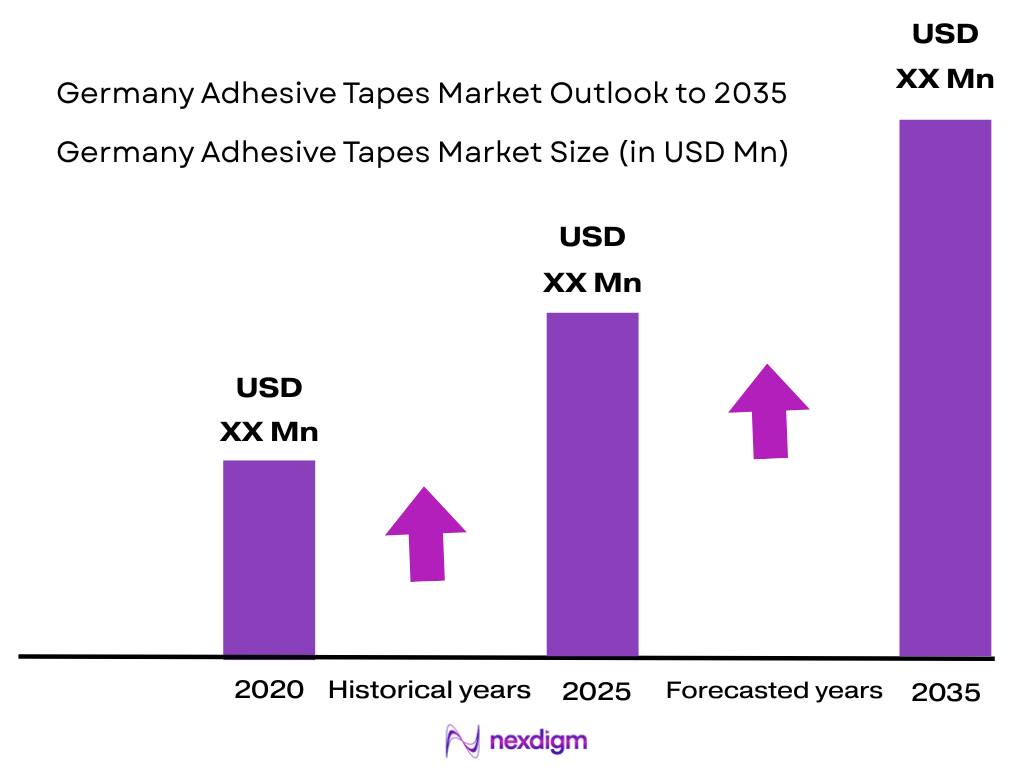
The Germany Adhesive Tapes Market is supported by a highly developed manufacturing base spanning automotive, machinery, electronics, packaging and construction applications. Germany’s manufacturing sector generated 19.9% of national gross value added in 2024, substantially above the EU average of 15.9%, creating a broad industrial customer base for bonding, mounting, masking, insulation and surface-protection tapes. Domestic automotive production reached 4,069,222 passenger vehicles in 2024, while the automotive industry’s turnover was €541.9 billion, reinforcing demand for specialized automotive assembly and component-bonding tapes.
Dominant Industrial Regions and Demand Centers: Germany’s adhesive-tape demand is concentrated around major industrial clusters including Bavaria, Baden-Württemberg, North Rhine-Westphalia, Lower Saxony and Hesse, where automotive, machinery, electronics, chemicals, packaging and industrial equipment production create recurring tape requirements. Germany had approximately 5.5 million employees in manufacturing establishments with 50 or more employees at the end of 2024. Automotive production also reached approximately 4.1 million passenger cars, while construction activity generated €103.5 billion of nominal orders in the main construction industry, sustaining demand across industrial assembly, mounting, sealing, insulation and construction applications.
Market Segmentation
By Adhesive Technology
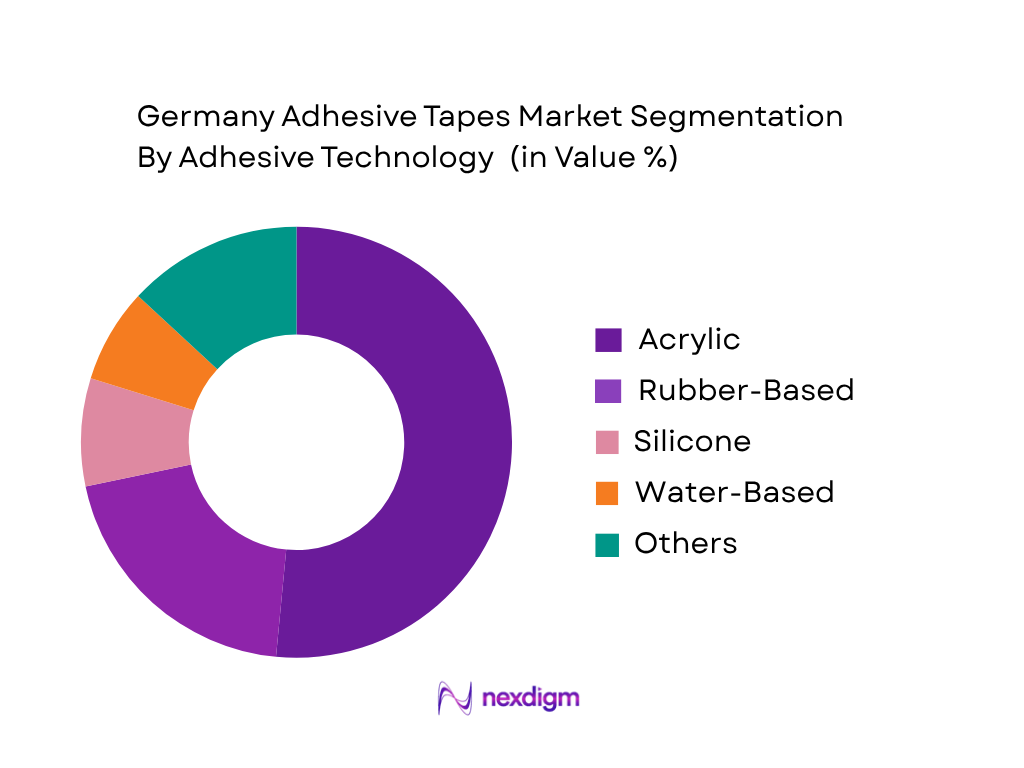
The Germany Adhesive Tapes Market is segmented by adhesive technology into acrylic, rubber-based, silicone, water-based, solvent-based and hot-melt adhesives. Acrylic adhesive tapes are expected to represent the dominant sub-segment because they provide a balanced combination of adhesion, aging resistance, temperature performance and compatibility with demanding industrial substrates. Their characteristics make them suitable for automotive trim, electronics assembly, signage, mounting, construction and industrial bonding. Germany’s manufacturing structure particularly supports higher-performance acrylic solutions because automotive and machinery manufacturers increasingly require lightweight bonding and clean assembly processes. The country’s automotive sector produced more than 4 million passenger cars in 2024, creating a substantial base for component mounting, interior assembly, wire management and surface-protection applications. At the same time, Germany’s manufacturing sector represented 19.9% of gross value added, supporting recurring industrial requirements for specialty tapes.
By End-Use Industry
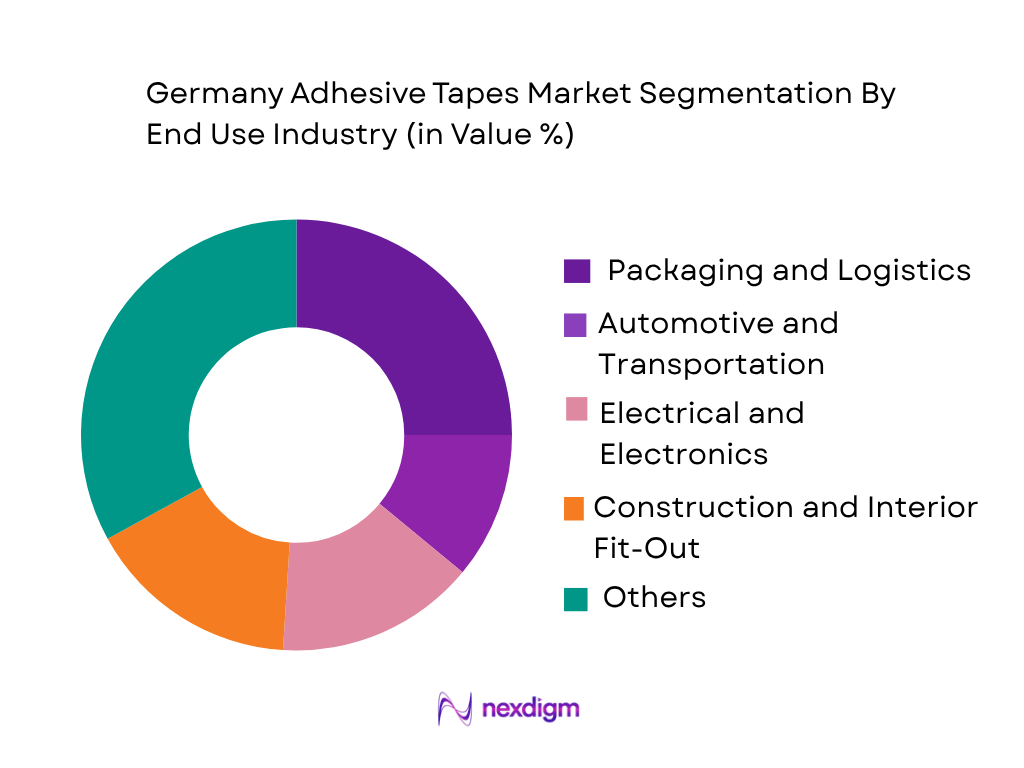
The Germany Adhesive Tapes Market is segmented by end-use industry into packaging and logistics, automotive and transportation, electrical and electronics, construction and interior fit-out, HVAC and MEP, healthcare and pharmaceuticals, industrial manufacturing, aerospace and defense, furniture and interiors, food and beverage, and marine and specialty applications. Automotive and transportation is positioned as the leading sub-segment because adhesive tapes are integrated into numerous vehicle manufacturing processes, including trim attachment, emblem mounting, wire harnessing, component fixation, insulation and lightweight assembly. Germany produced 4,069,222 passenger cars domestically in 2024, while automotive-industry turnover reached €541.9 billion. In addition, commercial and industrial manufacturing applications benefit from Germany’s substantial industrial base, with manufacturing accounting for 19.9% of national gross value added. These conditions support continuous requirements for high-performance bonding systems across OEMs, suppliers and component manufacturers. (VDA)
Competitive Landscape
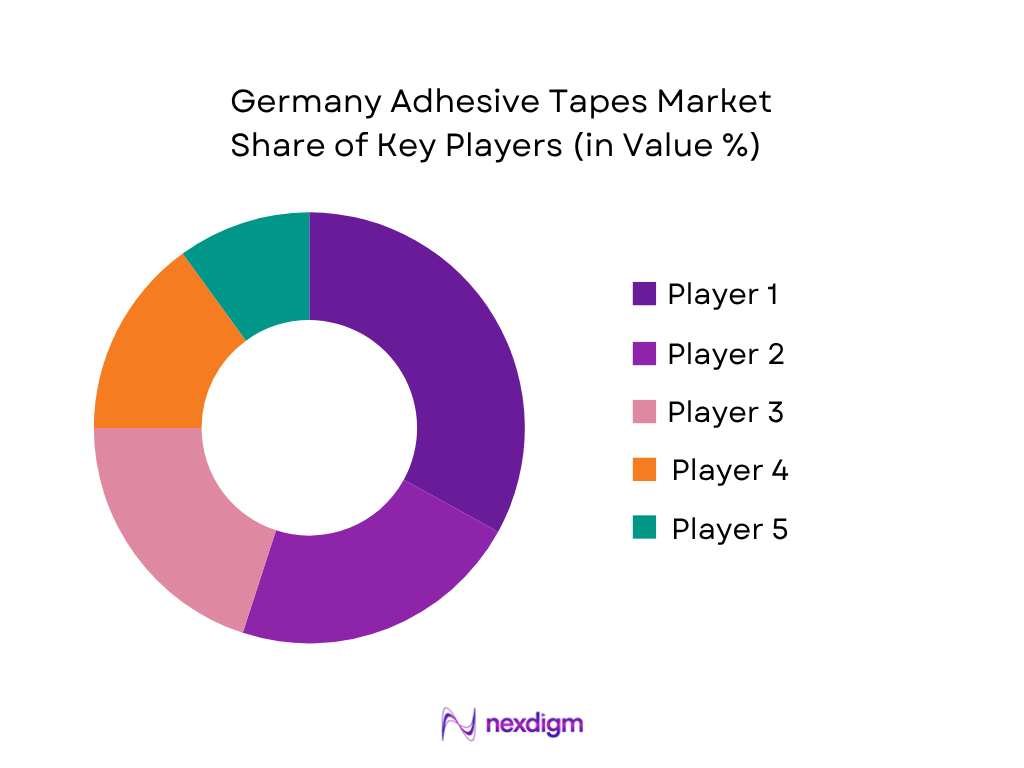
The Germany Adhesive Tapes Market is characterized by strong participation from German specialists and multinational adhesive-material manufacturers. Companies compete through adhesive chemistry, application engineering, product breadth, converting capabilities and OEM qualification rather than solely through commodity tape pricing. tesa, Lohmann, Coroplast, ORAFOL and 3M represent important competitive positions across industrial, automotive, electronics, packaging and specialty applications. The presence of Germany-based manufacturers alongside international suppliers creates a technically sophisticated market in which customized tape construction, precision converting and application-specific performance are important differentiators.
| Company | Establishment | Headquarters | Key Adhesive Technologies | Major Tape Applications | Automotive Capability | Electronics Capability |
| tesa SE | 1941 | Norderstedt, Germany | ~ | ~ | ~ | ~ |
| Lohmann GmbH & Co. KG | 1851 | Neuwied, Germany | ~ | ~ | ~ | ~ |
| Coroplast Fritz Müller GmbH & Co. KG | 1928 | Wuppertal, Germany | ~ | ~ | ~ | ~ |
| ORAFOL Europe GmbH | 1989 | Oranienburg, Germany | ~ | ~ | ~ | ~ |
| 3M Company | 1902 | St. Paul, Minnesota, USA | ~ | ~ | ~ | ~ |
Germany Adhesive Tapes Market Analysis
Growth Drivers
Automotive Manufacturing
Germany’s automotive manufacturing ecosystem remains one of the strongest demand foundations for adhesive tapes, particularly for mounting, trim attachment, wire management, insulation, surface protection, component fixation and lightweight assembly. Domestic passenger-car production reached 4,069,222 units in 2024, compared with 4,109,371 units in 2023, while domestic production increased to 4,148,836 units in 2025. Germany also exported 3,173,500 passenger cars in 2024, demonstrating the scale of the OEM production ecosystem. Electric-vehicle manufacturing is creating additional demand for electrically insulating, thermally resistant and flame-retardant tapes. Germany produced approximately 1.3 million electric passenger cars during the first 11 months of 2024, while November alone recorded 155,700 electric cars, including 120,500 battery-electric vehicles and 35,200 plug-in hybrids. These applications require specialized adhesive tapes for battery-cell and module assembly, cable routing, thermal-management components, sensor attachment, interior components and lightweight structures. The country’s manufacturing intensity further strengthens the addressable industrial base: manufacturing accounted for 19.9% of German gross value added in 2024, compared with an EU average of 15.9%. The combination of high-volume vehicle manufacturing and increasingly complex vehicle architectures therefore supports both conventional industrial tape consumption and premium engineered products. The automotive industry’s transition toward electrification is particularly relevant because adhesive tapes can replace mechanical fastening in selected applications while simultaneously providing electrical insulation, vibration damping and weight reduction. Consequently, Germany’s established OEM and Tier-1 supplier network provides adhesive-tape manufacturers with recurring qualification opportunities across vehicle platforms, powertrain components and electronics-intensive assemblies.
EV Production
Germany’s transition toward electric mobility is creating a distinct growth pathway for specialized adhesive tapes beyond conventional automotive applications. Domestic production of electric passenger cars reached approximately 1.3 million units during the first 11 months of 2024, already exceeding the country’s full-year 2023 electric-vehicle production. In November 2024, German factories produced a record 155,700 electric passenger cars, including 120,500 BEVs and 35,200 PHEVs. Across the full passenger-car market, Germany manufactured approximately 4.1 million vehicles in 2024, providing a large installed manufacturing platform for EV-specific adhesive solutions. Battery-electric architectures increase the number of components requiring controlled bonding, electrical insulation, thermal management and protection from vibration and environmental exposure. Adhesive tapes can therefore serve applications around battery packs, busbars, wiring harnesses, sensors, displays, charging components, interior systems and lightweight body structures. Germany’s wider industrial base reinforces this opportunity: manufacturing contributed 19.9% of national gross value added in 2024, while the electrical and digital industry generated €220.1 billion in turnover in 2024 and employed approximately 879,000 people domestically. This combination of automotive and electrical manufacturing supports demand for precision-engineered tape constructions rather than only commodity packaging products. The opportunity is particularly relevant for acrylic foam tapes, electrically insulating tapes, thermally conductive tapes, flame-retardant systems and die-cut adhesive components capable of automated assembly. As vehicle platforms incorporate greater electronic content, tape specifications increasingly need to satisfy dimensional precision, dielectric performance, temperature resistance and long-term adhesion requirements. This shifts the competitive basis from simple tape supply toward application engineering, qualification support and customized converting.
Market Challenges
Imported Raw-Material Exposure
Germany’s adhesive-tape industry remains exposed to movements in polymer, resin, specialty-chemical and other feedstock supply chains because adhesive formulations depend on materials whose production is distributed across international chemical markets. This exposure becomes more significant when manufacturers require acrylic polymers, silicone components, rubber systems, tackifiers, specialty resins and coating additives with tightly controlled specifications. Germany’s broader industrial environment illustrates the pressure: industrial production declined 4.5% in 2024, while production excluding energy and construction fell 4.9%. Capital-goods production declined 5.6%, indicating weaker industrial activity in several customer industries that purchase engineered tapes. At the same time, industrial producer prices fell 1.8% on an annual-average basis in 2024, but this was primarily influenced by lower energy prices; producer prices excluding energy increased 0.3%. Basic chemicals were 0.7% cheaper in December 2024 than a year earlier, while copper and semi-finished copper products were 6.4% more expensive, demonstrating that input conditions remained uneven across industrial materials. Energy also remains relevant to tape manufacturing because coating, drying, curing, slitting and converting operations require controlled industrial processes. Although industrial energy prices eased in 2024, the cost environment remains sensitive to international energy and feedstock conditions. For adhesive-tape manufacturers, sudden changes in polymer availability or chemical-input specifications can affect production scheduling, formulation economics and customer qualification. Substitution is not always straightforward because automotive, electronics and healthcare customers frequently require validated adhesive formulations. Consequently, manufacturers must manage supplier diversification, inventory resilience, formulation flexibility and regulatory documentation while maintaining consistent coating performance.
EU Chemical Compliance and Technical Qualification Requirements
Adhesive tapes supplied to Germany face significant technical and regulatory requirements when they are used in automotive, electronics, healthcare, construction and other controlled applications. Compliance with European chemical legislation can require detailed substance identification, documentation, restricted-substance management and communication throughout the supply chain. Technical qualification can add another layer because industrial customers may require testing for temperature resistance, shear strength, peel adhesion, aging, flame behavior, electrical insulation, chemical resistance and substrate compatibility before approving a tape. Germany’s large industrial base amplifies the importance of these requirements: manufacturing represented 19.9% of national gross value added in 2024, while the electrical and digital industry recorded €220.1 billion in turnover and approximately 879,000 domestic employees. Automotive production also reached 4,069,222 passenger cars in 2024, creating a large pool of applications in which material qualification and process reliability are critical. Construction provides another technically demanding market, with the main construction industry recording €103.5 billion of nominal order intake in 2024. For tape manufacturers, this means that market entry cannot always be achieved simply through competitive pricing. Products may need customer-specific validation, documentation and process integration before becoming qualified suppliers. The challenge is particularly pronounced for smaller tape converters and newer adhesive-chemistry suppliers that may lack extensive test facilities or established OEM relationships. Compliance requirements can also slow formulation changes because substitution of a resin, additive or backing material may require renewed validation. Consequently, regulatory readiness, technical documentation, application engineering and long-term supply consistency are becoming competitive necessities in Germany’s higher-value adhesive-tape applications.
Market Opportunities
EV Battery Assembly
EV battery manufacturing presents an opportunity for Germany’s adhesive-tape industry to move further toward engineered, high-performance products. German factories produced approximately 1.3 million electric passenger cars during the first 11 months of 2024, while November recorded 155,700 electric passenger cars, including 120,500 BEVs. Battery-intensive vehicle architectures require adhesive materials for electrical insulation, cell and module fixation, thermal-management interfaces, busbar protection, wire routing, sensor attachment and component sealing. The scale of Germany’s broader automotive industry reinforces this opportunity, with 4,069,222 passenger cars produced domestically in 2024 and 3,173,500 passenger cars exported. At the same time, Germany’s electrical and digital industry generated €220.1 billion in turnover in 2024, providing a complementary ecosystem for electronic components, automation equipment and electrical systems used throughout EV production. These conditions create opportunities for acrylic foam tapes, flame-retardant electrical tapes, thermally conductive adhesive systems, double-sided bonding tapes and precision die-cut components. Battery applications can also favor tapes that combine multiple functions, such as adhesion with electrical insulation or vibration damping. Suppliers capable of integrating adhesive chemistry with precision converting can therefore address more technically demanding portions of the value chain. The opportunity is not limited to vehicle manufacturers: battery-component suppliers, electronics manufacturers, charging-equipment producers and Tier-1 automotive suppliers represent additional customer groups. Germany’s established automotive qualification infrastructure can also create longer-term customer relationships once a specialized tape is approved for a platform or component. The resulting opportunity is therefore less dependent on commodity tape volumes and more closely connected with the migration toward higher-value application-specific bonding systems.
Semiconductor Manufacturing and Electronics Miniaturization
Germany’s electronics ecosystem creates opportunities for precision adhesive tapes used in semiconductor processing, electronic-component assembly, display systems, sensors, insulation, temporary fixation and protection applications. The German electrical and digital industry recorded €220.1 billion in turnover in 2024, employed approximately 879,000 people domestically, and reported €9.3 billion of investment in 2023. The industry also recorded 93,000 R&D employees in 2023, illustrating the technical depth of the sector. Germany’s manufacturing sector accounted for 19.9% of national gross value added in 2024, providing a broad industrial customer base for electronics-related tape solutions. Semiconductor and electronics applications increasingly require very thin adhesive constructions, controlled adhesion, low contamination, dimensional stability and compatibility with automated manufacturing processes. This creates potential for ultra-thin double-sided tapes, temporary bonding tapes, high-temperature masking tapes, electrically insulating tapes, clean-removal systems and precision die-cut adhesive components. Miniaturized electronics also increase the importance of converting accuracy because adhesive components may need to conform to small geometries or complex component surfaces. Suppliers able to combine advanced adhesive chemistry with precision coating, slitting, laminating and die-cutting can therefore target applications beyond standard industrial tape. The opportunity is strengthened by Germany’s role in industrial automation, automotive electronics and high-value machinery, where electronic components are increasingly integrated into conventional industrial equipment. Rather than competing primarily on tape length or basic adhesive strength, suppliers can differentiate through contamination control, dimensional tolerances, thermal performance, dielectric properties and automated application compatibility. These characteristics align closely with the technical requirements of semiconductor, sensor and advanced electronics manufacturing, making electronics miniaturization a strategically attractive pathway for specialty adhesive-tape suppliers operating in Germany.
Future Outlook
Over the forecast period, the Germany Adhesive Tapes Market is expected to increasingly shift toward high-performance and application-engineered tape systems rather than volume-led commodity products. Automotive electrification, electronics miniaturization, lightweight vehicle construction and industrial automation should support demand for specialty bonding solutions.
Packaging will remain an important volume application, while automotive, electronics, aerospace and precision industrial applications are expected to provide opportunities for higher-value products. Sustainability requirements should also accelerate development of low-VOC, water-based, recyclable and bio-based adhesive systems. The market’s future trajectory will remain closely connected to Germany’s industrial recovery, OEM production volumes and investment in advanced manufacturing infrastructure.
Major Players
- tesa SE
- Lohmann GmbH & Co. KG
- Coroplast Fritz Müller GmbH & Co. KG
- ORAFOL Europe GmbH
- 3M Company
- Nitto Denko Corporation
- Avery Dennison Corporation
- Saint-Gobain
- Sika AG
- Scapa Group plc
- Berry Global
- PPM Industries
- Monta Klebebandwerk GmbH
- KIP GmbH
- GERBAND
Key Target Audience
- Adhesive tape manufacturers and specialty tape converters
- Automotive OEMs and Tier-1/Tier-2 component manufacturers
- Electronics and semiconductor manufacturers
- Packaging producers and logistics companies
- Industrial machinery and equipment manufacturers
- Investments and venture capitalist firms (industrial materials, specialty chemicals and advanced manufacturing investors)
- Government and regulatory bodies (Federal Ministry for Economic Affairs and Energy, Federal Ministry for the Environment, Nature Conservation, Nuclear Safety and Consumer Protection, Federal Environment Agency)
- Procurement, sourcing and supply-chain decision-makers across major industrial end users
Research Methodology
Step 1: Identification of Key Variables
The initial stage establishes the Germany Adhesive Tapes Market ecosystem covering adhesive manufacturers, tape coaters, converters, distributors, OEMs and industrial end users. Key variables include adhesive chemistry, backing material, tape construction, application, end-use industry, domestic production, imports, exports and consumption.
Step 2: Market Analysis and Construction
Historical market information is compiled through industry databases, trade statistics, company disclosures and sector-level manufacturing indicators. The analysis reconciles production, import, export and consumption information to construct market value and volume estimates across adhesive technology, product format and end-use applications.
Step 3: Hypothesis Validation and Expert Consultation
Market hypotheses are validated through structured discussions with manufacturers, converters, distributors and industrial procurement professionals. Interviews focus on application demand, technology adoption, qualification requirements, product substitution, purchasing criteria and changes in OEM specifications.
Step 4: Research Synthesis and Final Output
The final stage integrates top-down macroeconomic indicators with bottom-up company, product and application analysis. Results are triangulated against automotive production, manufacturing activity, construction indicators and trade flows to produce a consistent market assessment and forecast framework.

- Executive Summary
- Research Methodology (Market Definition and Scope, Adhesive Tape Classification Framework, HS-Code Mapping, Historical Data Reconstruction, Top-Down Market Sizing, Bottom-Up Consumption Build-Up, Domestic Production Assessment, Import–Export Reconciliation, Demand-Side Analysis, Supply-Side Analysis, OEM Validation, Distributor Mapping, Primary Interviews, Data Triangulation, Forecasting Model, Scenario Analysis, Sensitivity Testing, Research Limitations)

- Definition and Scope
- Evolution of the German Adhesive Tapes Industry
- German Adhesive Tape Industry Structure
- Adhesive Tape Value Chain
- Raw Material-to-Tape Manufacturing Ecosystem
- Adhesive Formulation, Coating and Converting Landscape
- Germany Production and Import Supply Architecture
- Domestic Manufacturing Versus Imported Tape Supply

- Growth Drivers (Automotive Manufacturing, EV Production, Electronics Manufacturing, Packaging Demand, Industrial Automation, Machinery Production, Construction Activity, E-Commerce Fulfilment)
- Market Challenges (Imported Raw-Material Exposure, Polymer Feedstock Dependency, Adhesive Chemistry Volatility, Energy Intensity, EU Chemical Compliance, Technical Qualification Requirements, Commodity-Tape Competition)
- Market Opportunities (EV Battery Assembly, Semiconductor Manufacturing, Electronics Miniaturization, High-Performance Acrylic Foam, Sustainable Packaging, Low-VOC Adhesives, Precision Die-Cutting, Industrial Automation)
- Germany Adhesive Tapes Market Trends
Chemical Regulatory Framework (REACH, CLP, SVHC Management, Chemical Registration, Hazard Communication, Workplace Exposure) - SWOT Analysis
- Porter’s Five Forces Analysis
- PESTLE Analysis
- Stakeholder Ecosystem
- Competition Ecosystem

- By Market Value (2020-2025)
- By Tape Consumption Volume (2020-2025)
- By Average Selling Price (2020-2025)
- By Domestic Production Volume (2020-2025)
- By Import Volume (2020-2025)
- By Export Volume (2020-2025)
- By Domestic Consumption (2020-2025)
- By Premium Versus Commodity Tape Consumption (2020-2025)
- By Industrial Versus General-Purpose Tape Consumption (2020-2025)

- By Adhesive Technology (in value %)
Acrylic Adhesive Tapes
Rubber-Based Adhesive Tapes
Silicone Adhesive Tapes
Water-Based Adhesive Tapes
Solvent-Based Adhesive Tapes
Hot-Melt Adhesive Tapes
Reactive and Specialty Adhesive Systems - By Backing Material (in value %)
BOPP Tapes
PVC Tapes
PET Tapes
PE Tapes
Paper-Based Tapes
Nonwoven Tapes
Foam Tapes
Polyimide Tapes
Aluminum Foil Tapes
Fabric and Specialty Film Tapes - By Tape Construction (in value %)
Single-Sided Tapes
Double-Sided Tapes
Transfer Tapes
Foam Tapes
Filament-Reinforced Tapes
Masking Tapes
Protective Tapes
Electrical Insulation Tapes
Thermal Management Tapes
Functional Specialty Tapes - By Product Format (in value %)
Jumbo Rolls
Slit Rolls
Narrow-Width Industrial Rolls
Adhesive Sheets
Laminated Tape Structures
Die-Cut Adhesive Components
Customized Converted Tape Parts - By End-Use Industry (in value %)
Packaging and Logistics
Automotive and Transportation
Electrical and Electronics
Construction and Interior Fit-Out
HVAC and MEP
Healthcare and Pharmaceuticals
Industrial Manufacturing
Aerospace and Defense - By Application (in value %)
Carton Sealing and Case Closing
Permanent Mounting and Bonding
Splicing and Web Joining
Masking and Surface Protection
Electrical Insulation and Wire Management
Component Assembly
Lamination and Composite Bonding
Labelling and Graphic Applications
Packaging Reinforcement
HVAC Insulation and Sealing

- Market Share of Major Players (By Value, Volume, Adhesive Technology, Tape Construction, Backing Material, End-Use Industry, Application, Distribution Channel)
- Cross Comparison Parameters (Adhesive Technology Breadth, Tape Construction Portfolio, Automotive OEM Qualification Capability, Electronics-Grade Product Capability, Local Manufacturing Footprint, Precision Converting Capability, Distribution Network Strength, R&D and Innovation Intensity)
- Pricing and Product Positioning (Commodity Packaging Tapes, General Industrial Tapes, Premium Industrial Tapes, Automotive Tapes, Electronics Tapes, Specialty Functional Tapes)
- SWOT Analysis of Major Players
- Detailed Profiles of Major Companies
tesa SE
Lohmann GmbH & Co. KG|
Coroplast Fritz Müller GmbH & Co. KG
ORAFOL Europe GmbH
GERBAND
PPM Industries
Monta Klebebandwerk GmbH
KIP GmbH
Nitto Denko Corporation
3M Company
Avery Dennison Corporation
Saint-Gobain
Sika AG
Scapa Group
Berry Global

- Automotive and EV End-User Assessment
- Electrical, Electronics and Semiconductor End-User Assessment
- Packaging and Logistics End-User Assessment
- Construction and Interior Fit-Out End-User Assessment
- Industrial Manufacturing End-User Assessment
- Healthcare and Pharmaceutical End-User Assessment
- Aerospace and Defense End-User Assessment

- By Market Value (2026-2035)
- By Tape Consumption Volume (2026-2035)
- By Average Selling Price (2026-2035)
- By Domestic Production Volume (2026-2035)
- By Import Volume (2026-2035)
- By Export Volume (2026-2035)
- By Domestic Consumption (2026-2035)
- By Premium Versus Commodity Tape Consumption (2026-2035)
- By Industrial Versus General-Purpose Tape Consumption (2026-2035)


 Request a Sample
 Ask for Customization
 Get a Quote
 Enquire Now