
 Download PDF
Market Overview
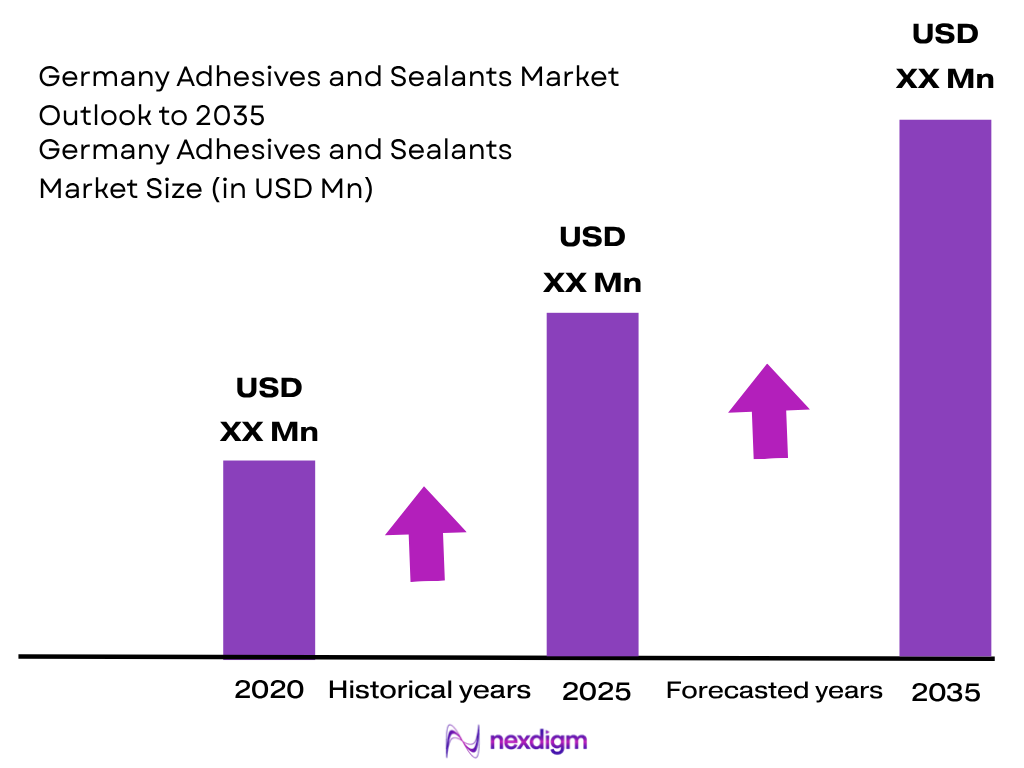
The Germany Adhesives and Sealants Market is valued at ~USD XXX million in 2024, supported by strong demand from automotive manufacturing, industrial production, packaging, construction, electronics and renewable energy sectors. The market growth is influenced by Germany’s position as Europe’s largest manufacturing economy, with high consumption of structural adhesives, reactive bonding systems, silicone sealants and polyurethane-based solutions. Germany’s manufacturing sector generated approximately EUR 2.1 trillion in revenue in 2024, while the automotive industry remained one of the largest industrial contributors with vehicle production exceeding 4.0 million passenger cars, supporting demand for lightweight bonding technologies and advanced assembly solutions.
The Germany Adhesives and Sealants Market is concentrated in major industrial regions including Bavaria, Baden-Württemberg, North Rhine-Westphalia and Saxony due to their strong automotive, chemical, engineering and manufacturing ecosystems. Bavaria and Baden-Württemberg dominate because of their extensive automotive OEM presence, premium vehicle manufacturing, aerospace activities and supplier networks. North Rhine-Westphalia contributes significantly through chemical production, industrial manufacturing and packaging industries, while Saxony has become an important centre for semiconductor, electronics and electric vehicle-related manufacturing. Germany’s position as Europe’s largest chemical producer and exporter further strengthens the availability and adoption of specialty adhesive technologies across multiple industries.
Market Segmentation
By Product Type
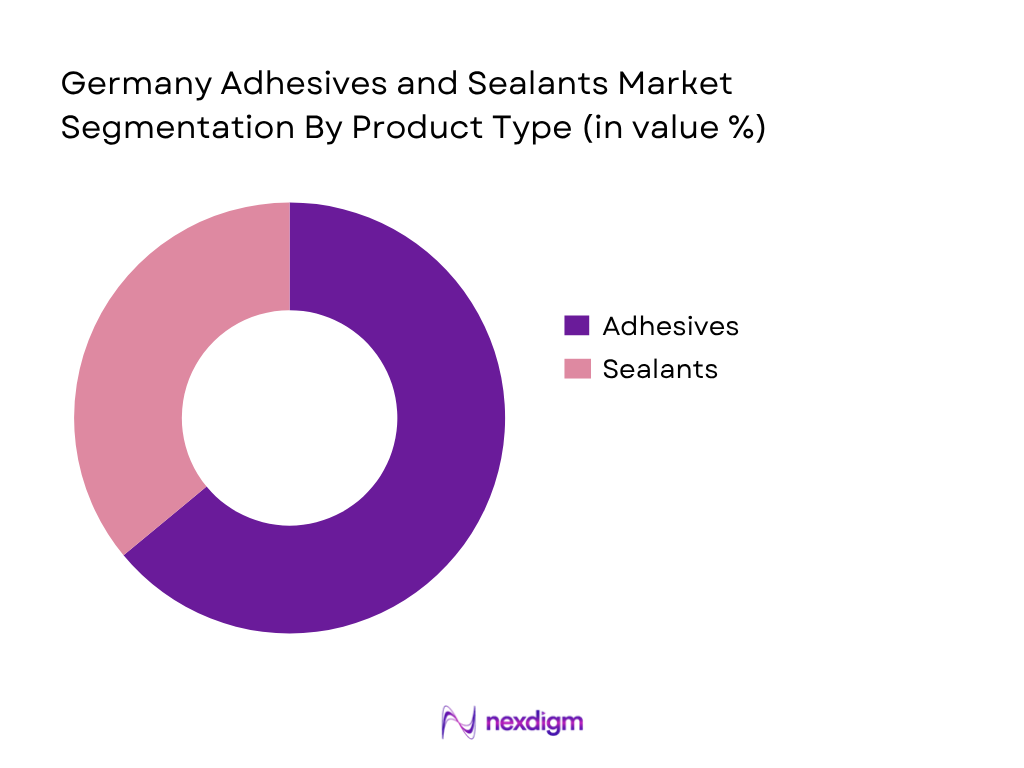
The Germany Adhesives and Sealants Market is segmented by product type into adhesives and sealants. Adhesives represent the dominant sub-segment due to their extensive utilization across automotive manufacturing, electric vehicle battery assembly, packaging, electronics, machinery production and industrial automation. Germany’s automotive industry increasingly relies on epoxy, polyurethane, acrylic and structural adhesives for lightweight vehicle manufacturing, composite bonding and replacement of traditional mechanical fastening methods. The growing production of electric vehicles has increased demand for thermal management adhesives, battery bonding materials and electrically insulating adhesive systems. Sealants maintain strong demand in construction, automotive glazing, industrial equipment and renewable energy applications due to their requirement for moisture resistance, durability and environmental protection. However, adhesives maintain a larger application base because they are integrated throughout manufacturing processes rather than being concentrated mainly around sealing applications.
By End-Use Industry
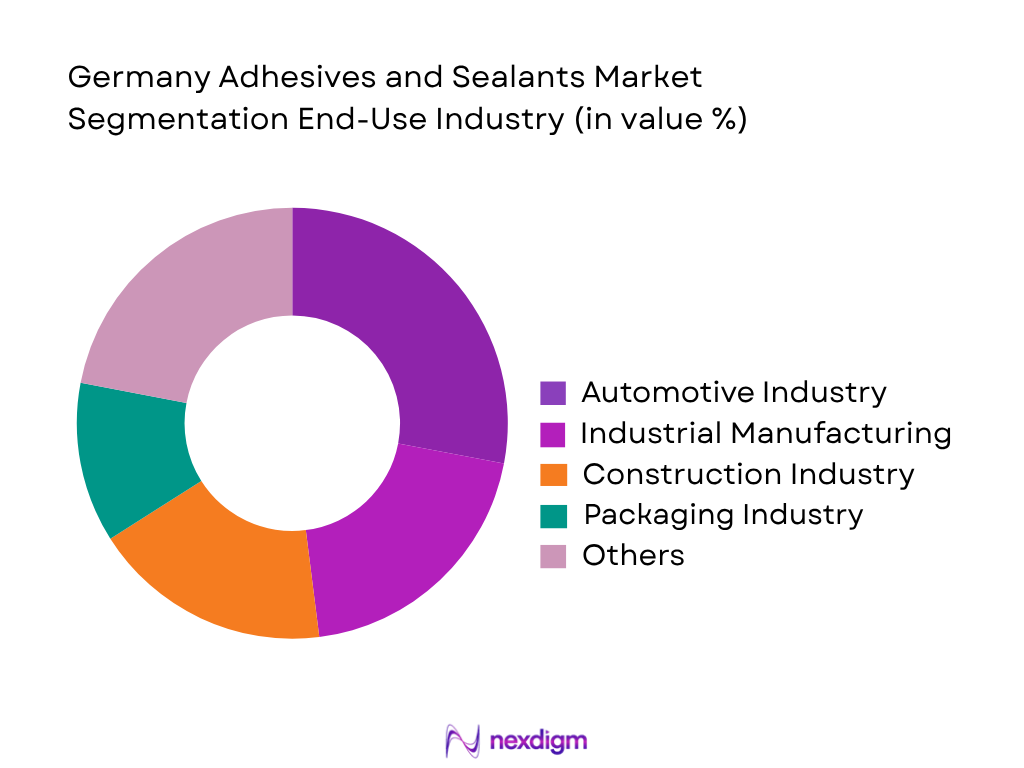
The Germany Adhesives and Sealants Market is segmented by end-use industry into automotive, construction, packaging, electronics, aerospace, renewable energy, healthcare, furniture and industrial manufacturing applications. Automotive represents the leading application segment due to Germany’s globally significant vehicle manufacturing ecosystem and increasing adoption of lightweight materials. Automotive manufacturers utilize adhesives for body structures, interiors, battery systems, electronic components and composite materials. Germany produced more than 4.0 million passenger vehicles in 2024, supporting continuous demand for automotive bonding technologies. Industrial manufacturing is another major consumer due to Germany’s strong machinery and engineering sector requiring adhesives for equipment assembly, maintenance and component integration. Construction applications remain important due to demand for façade sealants, insulation bonding, glazing systems and waterproofing materials. Electronics and renewable energy applications are gaining importance as Germany expands semiconductor manufacturing and clean-energy infrastructure.
Competitive Landscape
The Germany Adhesives and Sealants Market is highly competitive, consisting of global specialty chemical companies, industrial adhesive manufacturers and construction chemical suppliers. Major players compete through advanced resin technologies, automotive-grade bonding solutions, sustainable formulations, technical service capabilities and strong relationships with OEM customers. Companies such as Henkel, Sika, 3M, H.B. Fuller and Bostik maintain significant presence due to their broad product portfolios and ability to serve automotive, industrial, construction and packaging applications.
| Company | Established Year | Headquarters | Major Product Portfolio | Automotive Application Capability | Industrial Application Coverage | Technology Strength | Sustainability Focus | Distribution Network |
| Henkel AG & Co. KGaA | 1876 | Düsseldorf, Germany | ~ | ~ | ~ | ~ | ~ | ~ |
| Sika Deutschland GmbH | 1910 | Baar, Switzerland | ~ | ~ | ~ | ~ | ~ | ~ |
| H.B. Fuller | 1887 | Minnesota, USA | ~ | ~ | ~ | ~ | ~ | ~ |
| 3M Deutschland GmbH | 1902 | Minnesota, USA | ~ | ~ | ~ | ~ | ~ | ~ |
| Arkema / Bostik Germany | 1889 | Colombes, France | ~ | ~ | ~ | ~ | ~ | ~ |
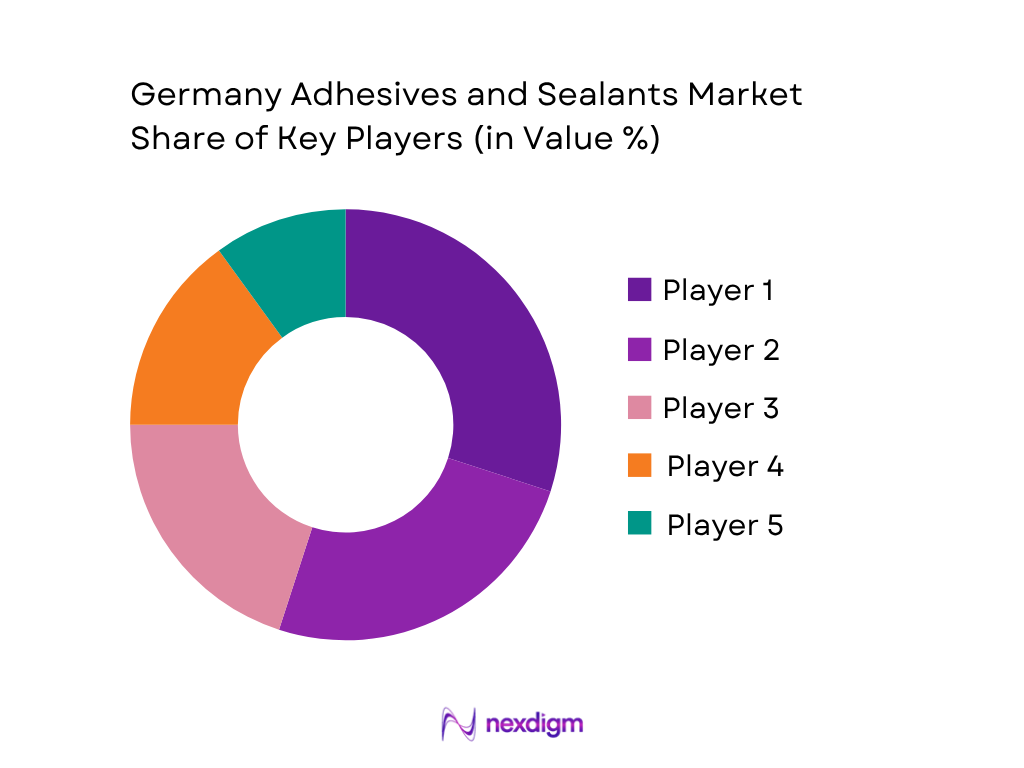
Germany Adhesives and Sealants Market Analysis
Growth Drivers
Expansion of Automotive Manufacturing and Electric Vehicle Bonding Applications
Germany’s automotive manufacturing ecosystem remains one of the strongest demand drivers for adhesives and sealants due to increasing adoption of lightweight materials, electric vehicle components and advanced assembly technologies. Adhesives are increasingly replacing mechanical fastening methods in vehicle structures, battery systems, interiors, electronic modules and composite components because they provide weight reduction, vibration resistance and improved design flexibility. Germany produced approximately 4.07 million passenger cars in 2024, maintaining its position as Europe’s largest passenger vehicle manufacturing base. The country also registered more than 46 million passenger vehicles on roads in 2024, creating a large installed automotive ecosystem requiring component manufacturing, repair and maintenance solutions. Germany’s manufacturing sector generated approximately EUR 2.1 trillion in turnover in 2024, with automotive remaining one of the key contributors to industrial output. The country’s GDP reached approximately US$4.66 trillion in 2024, while GDP per capita exceeded US$55,000, according to international economic indicators, reflecting a high-value industrial economy capable of supporting advanced material adoption. Electric vehicle production further increases demand for epoxy adhesives, polyurethane bonding systems, thermal interface materials and electrically insulating adhesives used in battery packs and electronic systems. The presence of major automotive OEMs, Tier-1 suppliers and engineering companies across Bavaria, Baden-Württemberg and Lower Saxony continues to support long-term demand for specialized adhesive technologies.
Growth of Industrial Manufacturing, Machinery Production and Advanced Engineering Applications
Germany’s industrial manufacturing base creates significant demand for adhesives and sealants across machinery production, automation equipment, electronics, renewable energy systems and industrial assembly applications. The country’s engineering sector relies heavily on bonding technologies for component integration, vibration control, sealing systems and precision manufacturing processes. Germany’s manufacturing industry generated approximately EUR 2.1 trillion in revenue in 2024, supported by strong performance across machinery, chemical, electrical and transportation equipment sectors. The mechanical engineering industry remained a major industrial contributor, with Germany operating more than 6,000 mechanical engineering companies, creating extensive requirements for industrial adhesives, sealants and assembly solutions. The electronics and electrical sector also supports demand for specialty adhesives used in insulation, component protection, thermal management and miniaturized devices. Germany’s renewable energy expansion further increases the application base for adhesives and sealants in wind turbines, solar equipment and electrical infrastructure. The country installed approximately 90 gigawatts of renewable energy capacity by 2024, increasing requirements for durable bonding and sealing materials. Germany’s strong industrial foundation is supported by a GDP of approximately US$4.66 trillion in 2024 and a population exceeding 84 million, creating a large domestic manufacturing ecosystem. These industrial applications favor high-performance adhesives with resistance to temperature variation, chemicals, vibration and mechanical stress, supporting demand for epoxy, polyurethane, silicone and hybrid polymer systems.
Market Challenges
Rising Energy Costs and Raw Material Volatility Affecting Adhesive Manufacturing
The Germany Adhesives and Sealants Market faces challenges from elevated energy costs, chemical feedstock volatility and dependence on energy-intensive manufacturing processes. Adhesive and sealant production requires polymers, resins, solvents, additives and specialty chemicals, many of which are derived from petrochemical feedstocks. Germany’s chemical industry, one of the largest globally, has been affected by higher energy requirements due to production dependence on natural gas and electricity. Germany consumed approximately 11.5 million terajoules of natural gas in 2024, making energy availability a critical factor for chemical manufacturing competitiveness. The chemical industry generated approximately EUR 230 billion in sales in 2024, demonstrating the scale of the sector where energy costs directly influence production economics. International supply-chain conditions also impact availability of epoxy resins, polyurethane components, acrylic monomers and specialty additives required for advanced adhesive formulations. Germany imported goods worth more than EUR 1.3 trillion in 2024, highlighting the country’s integration with global supply networks. The World Bank reported Germany’s GDP at approximately US$4.66 trillion in 2024, reflecting the importance of industrial competitiveness within the economy. Adhesive manufacturers must therefore manage inventory planning, supplier diversification and production efficiency while maintaining consistent product quality. These pressures are particularly significant for specialty adhesives used in automotive, aerospace and electronics applications where material substitution requires extensive validation and approval.
Stringent Environmental Regulations and Transition Toward Sustainable Formulations
Germany’s strict environmental framework creates challenges for adhesive and sealant manufacturers as companies must transition toward low-emission, sustainable and compliant formulations. European chemical regulations require manufacturers to manage substances carefully, reduce emissions and provide extensive documentation for industrial materials. Adhesive producers face increasing requirements related to volatile organic compounds, hazardous substance restrictions, recycling compatibility and environmental product declarations. Germany’s construction industry, automotive sector and packaging manufacturers are increasingly adopting materials that support sustainability objectives, requiring suppliers to reformulate traditional solvent-based products. Germany generated approximately 400 million tonnes of waste in 2024, increasing focus on circular economy practices and sustainable material solutions. The country’s construction sector, which employs more than 2.5 million people, increasingly incorporates environmentally responsible building materials, creating demand for low-VOC sealants and sustainable bonding systems. Automotive manufacturers are also increasing requirements for recyclable materials and lightweight components, affecting adhesive formulation strategies. Germany’s GDP of approximately US$4.66 trillion in 2024 and its role as Europe’s largest industrial economy make regulatory compliance particularly important because suppliers must meet demanding standards across multiple high-value industries. Manufacturers need continued investment in research, product certification and sustainable chemistry development to maintain competitiveness within the evolving German adhesives and sealants ecosystem.
Market Opportunities
Increasing Demand for Electric Vehicle, Battery and Lightweight Manufacturing Adhesives
The transition toward electric mobility creates significant opportunities for advanced adhesive technologies in Germany’s automotive ecosystem. Electric vehicle production requires specialized adhesives for battery pack assembly, cell fixation, thermal management, electronic protection and lightweight vehicle structures. Germany registered more than 46 million passenger vehicles in 2024, creating a large automotive manufacturing and service ecosystem requiring advanced bonding solutions. The country produced approximately 4.07 million passenger cars in 2024, supporting demand for structural adhesives, epoxy systems, polyurethane bonding materials and thermal interface solutions. German automotive manufacturers are increasingly adopting lightweight materials such as composites, aluminum and mixed-material structures, where adhesives provide improved joining performance compared with conventional mechanical fastening. Germany’s industrial base includes thousands of automotive suppliers producing components that require specialized adhesive systems for interiors, electronics, safety systems and battery modules. The country’s GDP reached approximately US$4.66 trillion in 2024, supporting continued investment in advanced manufacturing technologies. Growth in battery production facilities, semiconductor-related manufacturing and automotive electrification increases opportunities for suppliers offering electrically insulating adhesives, heat-resistant bonding systems and automated dispensing-compatible materials. Companies capable of providing customized solutions with technical validation support are positioned to address increasing requirements from automotive OEMs and Tier-1 suppliers.
Expansion of Sustainable Adhesives for Renewable Energy, Packaging and Green Construction
Sustainability-driven industrial transformation creates opportunities for low-VOC, bio-based and environmentally optimized adhesives and sealants across renewable energy, packaging and construction applications. Germany’s renewable energy sector continues expanding, with installed renewable capacity reaching approximately 90 gigawatts in 2024, increasing demand for durable bonding materials used in wind turbines, solar modules, electrical systems and infrastructure components. The packaging sector also represents an important opportunity as manufacturers seek recyclable packaging structures requiring compatible adhesive technologies. Germany’s packaging industry processes millions of tonnes of packaging materials annually, creating demand for water-based adhesives, hot melts and recyclable bonding systems. Construction sustainability initiatives further support adoption of environmentally compliant sealants for insulation, façades, glazing systems and energy-efficient buildings. Germany’s construction workforce exceeds 2.5 million employees, reflecting the scale of building activity requiring advanced construction chemical solutions. The country’s industrial economy, supported by GDP of approximately US$4.66 trillion in 2024, provides a strong base for adoption of premium sustainable materials. Adhesive suppliers developing solvent-free systems, recyclable packaging adhesives, bio-based formulations and low-emission sealants can benefit from increasing demand among manufacturers seeking compliance with environmental requirements while maintaining performance standards.
Future Outlook
Over the next decade, the Germany Adhesives and Sealants Market is expected to experience steady expansion driven by automotive electrification, industrial automation, renewable energy development and increasing adoption of lightweight manufacturing technologies. The transition toward electric vehicles will increase demand for battery adhesives, thermal management materials and structural bonding systems. Sustainability regulations across Europe will accelerate adoption of low-VOC, bio-based and recyclable adhesive technologies. Growth in semiconductor manufacturing, advanced engineering and green construction will further support demand for specialized adhesive and sealant solutions.
Germany’s strong industrial ecosystem, advanced manufacturing capabilities and focus on technological innovation will continue supporting high-value adhesive applications. Companies providing customized formulations, technical support and application-specific solutions are expected to gain stronger positioning across automotive, electronics and industrial sectors.
Major Players
- Henkel AG & Co. KGaA
- Sika Deutschland GmbH
- H.B. Fuller Deutschland GmbH
- 3M Deutschland GmbH
- Arkema / Bostik Germany
- Dow Deutschland GmbH & Co. KG
- Wacker Chemie AG
- BASF SE
- KLEBCHEMIE M.G. Becker GmbH & Co. KG
- DELO Industrial Adhesives
- Jowat SE
- Kisling AG
- Ruderer Klebetechnik GmbH
- KENT Deutschland GmbH
- MAPEI Deutschland GmbH
Key Target Audience
- Adhesive and Sealant Manufacturers
- Automotive OEMs and Electric Vehicle Battery Manufacturers
- Construction Chemical Manufacturers and Building Material Suppliers
- Packaging Manufacturers and Industrial Converters
- Electronics and Semiconductor Manufacturing Companies
- Aerospace Manufacturers and Maintenance, Repair and Overhaul Companies
- Investments and Venture Capitalist Firms
- Government and Regulatory Bodies (Federal Ministry for Economic Affairs and Climate Action, German Environment Agency, Federal Institute for Occupational Safety and Health, European Chemicals Agency)
Research Methodology
Step 1: Identification of Key Variables
The initial phase involves developing a comprehensive market ecosystem map covering raw material suppliers, adhesive manufacturers, sealant producers, distributors, OEM customers and end-use industries operating within Germany. Extensive secondary research is conducted to identify critical market variables including resin technologies, application categories, industrial demand patterns, production structures and regulatory requirements. This stage establishes the foundation for understanding market dynamics and competitive positioning.
Step 2: Market Analysis and Construction
This phase involves analyzing historical and current market conditions across automotive, construction, packaging, electronics and industrial manufacturing applications. Supply-side assessment includes production capabilities, technology portfolios, imports and distribution structures, while demand-side analysis evaluates consumption patterns across major industries. Market segmentation is developed through evaluation of product type, resin chemistry, technology adoption and application requirements.
Step 3: Hypothesis Validation and Expert Consultation
Market assumptions are validated through discussions with manufacturers, distributors, industrial users, automotive suppliers and application specialists. These consultations provide operational insights related to procurement patterns, technology preferences, competitive intensity and future demand requirements. Industry feedback is incorporated to refine market estimates and validate the accuracy of collected information.
Step 4: Research Synthesis and Final Output
The final stage integrates primary interviews, secondary research and analytical frameworks to develop a comprehensive Germany Adhesives and Sealants Market assessment. Data validation is performed through cross-checking supply-side and demand-side information. The final report provides detailed insights into market structure, segmentation, competitive landscape, opportunities and future growth strategies.

- Executive Summary
- Research Methodology (Market Definition and Scope, Germany Adhesives and Sealants Market Classification, Adhesive and Sealant Product Mapping, Resin-Level Assessment, Technology-Level Assessment, Application-Level Demand Analysis, End-Use Industry Assessment, Production Capacity Mapping, Domestic Manufacturing Assessment, Import and Export Trade Analysis, Raw Material Supply Assessment, Demand-Side Assessment, Supply-Side Assessment, Top-Down Market Sizing, Bottom-Up Market Sizing, Primary Industry Interviews, Data Triangulation, Forecasting Framework, Market Share Validation, Limitations and Future Conclusions)

- Definition and Scope
- Germany Adhesives and Sealants Industry Evolution and Development of Specialty Chemical Manufacturing, Industrial Bonding Technologies, Automotive Lightweighting Applications and Advanced Material Infrastructure
- Adhesives and Sealants Value Chain Analysis
- Adhesives and Sealants Supply Chain Analysis
- Resin Manufacturers, Chemical Feedstock Suppliers, Adhesive Formulators, Sealant Manufacturers, Industrial Distributors, Automotive OEMs, Construction Material Manufacturers, Packaging Converters, Electronics Manufacturers, Aerospace Companies, End-Use Industries
- Adhesive Integration Across Automotive, Electric Vehicles, Packaging, Building and Construction, Transportation, Electronics, Healthcare, Renewable Energy, Furniture and Industrial Manufacturing Applications

- Growth Drivers (Expansion of Electric Vehicle Manufacturing, Automotive Lightweighting Demand, Industrial Automation Growth, Advanced Manufacturing Expansion, Packaging Industry Development, Renewable Energy Equipment Production, Infrastructure Modernization, Increasing Adoption of Sustainable Adhesive Technologies, Rising Demand for High-Performance Bonding Systems)
- Market Challenges (Volatility in Chemical Raw Material Prices, High Energy Costs Affecting Chemical Manufacturing, Stringent Environmental Compliance Requirements, Dependence on Imported Specialty Chemicals, Automotive Industry Transition Challenges, High Product Qualification Requirements, Competition from Alternative Joining Technologies, Skilled Technical Workforce Requirements)
- Market Opportunities (Electric Vehicle Battery Bonding Applications, Low-VOC and Sustainable Adhesive Expansion, Bio-Based Adhesive Formulations, Semiconductor and Electronics Adhesive Applications, Lightweight Automotive Structures, Renewable Energy Bonding Solutions, Sustainable Packaging Adhesives, Green Building Sealant Adoption, Smart Manufacturing Adhesive Technologies)
- Market Trends (Shift Toward Structural Bonding Solutions, Electrification-Driven Adhesive Adoption, Low-Emission Adhesive Development, Silicone and Hybrid Sealant Expansion, Automated Adhesive Dispensing Systems, Digital Manufacturing Integration, Sustainable Packaging Solutions, Thermal Management Adhesives, Lightweight Material Bonding, Circular Economy Compatible Adhesive Systems)
- Government Regulations and Standards (European Union REACH Regulation, CLP Chemical Classification Requirements, VOC Emission Regulations, German Building Standards, DIN Adhesive and Sealant Standards, Automotive Quality Requirements, Packaging Sustainability Regulations, Environmental Product Declaration Requirements, Occupational Safety Regulations)
- SWOT Analysis
- Porter’s Five Forces Analysis
- PESTLE Analysis
- Stakeholder Ecosystem
- Competition Ecosystem

- By Market Value (2020-2025)
- By Market Volume (2020-2025)
- By Adhesives Consumption Volume (2020-2025)
- By Sealants Consumption Volume (2020-2025)
- By Domestic Production Volume (2020-2025)
- By Import Volume (2020-2025)
- By Export Volume (2020-2025)
- By Average Selling Price (2020-2025)

- By Adhesives Resin Type (In Value %)
Polyurethane Adhesives
Epoxy Adhesives
Acrylic Adhesives
Silicone Adhesives
Cyanoacrylate Adhesives
VAE / EVA Adhesives
Polyvinyl Acetate Adhesives
Reactive Adhesive Resins
Other Adhesive Resins - By Adhesives Technology (In Value %)
Water-Borne Adhesives
Solvent-Borne Adhesives
Reactive Adhesives
Hot-Melt Adhesives
UV-Cured Adhesives
Pressure-Sensitive Adhesives
Structural Adhesives
Thermally Conductive Adhesives
Electrically Conductive Adhesives - By Sealants Resin Type (In Value %)
Silicone Sealants
Polyurethane Sealants
Acrylic Sealants
Epoxy Sealants
Polysulfide Sealants
MS Polymer Sealants
Hybrid Polymer Sealants
Other Sealant Resins - By Application Type (In Value %)
Automotive and Transportation
Building and Construction
Packaging and Flexible Packaging
Electronics and Electrical
Aerospace and Defense
Renewable Energy
Healthcare and Medical Devices
Furniture and Woodworking
Industrial Assembly
Marine Applications - By End-Use Industry (In Value %)
Automotive Industry
Construction Industry
Packaging Industry
Chemical Industry
Electronics and Semiconductor Industry
Aerospace Industry
Renewable Energy Industry
Healthcare Industry
Industrial Manufacturing Industry
Furniture and Interior Industry - By Distribution Channel (In Value %)
Direct Industrial Sales
Authorized Distributors
Specialty Chemical Distributors
Construction Material Dealers
Industrial Supply Companies
OEM Procurement Channels
Online Industrial Platforms
Technical Applicator Networks - By Region (In Value %)
Bavaria
Baden-Württemberg
North Rhine-Westphalia
Hesse
Saxony
Lower Saxony
Other German Regions

- Market Share of Major Players (By Germany Revenue, Adhesives Sales Volume, Sealants Sales Volume, Resin Portfolio, Technology Portfolio, Automotive Application Exposure, Industrial Application Coverage, Production Capacity, Distribution Network Coverage, Regional Presence, OEM Customer Coverage, Product Certification Coverage, R&D and Application-Laboratory Capability)
- Cross Comparison Parameters (Adhesives and Sealants Revenue, Adhesive Resin Portfolio Breadth, Sealant Resin Portfolio Breadth, Automotive and EV Bonding Capability, Industrial Application Coverage, Sustainable Product Portfolio, R&D and Application Engineering Capability, Distribution Network Reach)
- SWOT Analysis of Major Players
- Competitive Positioning Matrix
- Adhesive Product Portfolio and Application Benchmarking
- Sealant Product Portfolio and Application Benchmarking
- Resin Formulation and Adhesive Technology Assessment
- Automotive Bonding Technology Assessment
- Sustainable Adhesive and Sealant Technology Assessment
- Detailed Profiles of Major Companies
Henkel AG & Co. KGaA
Sika Deutschland GmbH
H.B. Fuller Deutschland GmbH
3M Deutschland GmbH
Arkema / Bostik Germany
Dow Deutschland GmbH & Co. KG
Wacker Chemie AG
BASF SE
KLEBCHEMIE M.G. Becker GmbH & Co. KG
DELO Industrial Adhesives
Jowat SE
Kisling AG
Ruderer Klebetechnik GmbH
KENT Deutschland GmbH
MAPEI Deutschland GmbH

- Automotive OEM Adhesive Procurement Assessment
- Electric Vehicle Battery Manufacturer Bonding Requirement Analysis
- Automotive Component Manufacturer Adhesive Application Assessment
- Construction Contractor Sealant Procurement Analysis
- Building Material Manufacturer Adhesive Requirement Assessment
- Packaging Converter Adhesive Application Assessment
- Electronics Manufacturer Bonding Requirement Analysis
- Renewable Energy Equipment Adhesive Assessment
- Aerospace Manufacturer Adhesive Qualification Analysis
- Industrial Machinery Manufacturer Bonding Assessment

- By Market Value (2026-2035)
- By Market Volume (2026-2035)
- By Adhesives Consumption Volume (2026-2035)
- By Sealants Consumption Volume (2026-2035)
- By Adhesives Resin Type (2026-2035)
- By Adhesives Technology (2026-2035)
- By Sealants Resin Type (2026-2035)
- By Application Type (2026-2035)
- By End-Use Industry (2026-2035)
- By Region (2026-2035)


 Request a Sample
 Ask for Customization
 Get a Quote
 Enquire Now