
 Download PDF
Market Overview
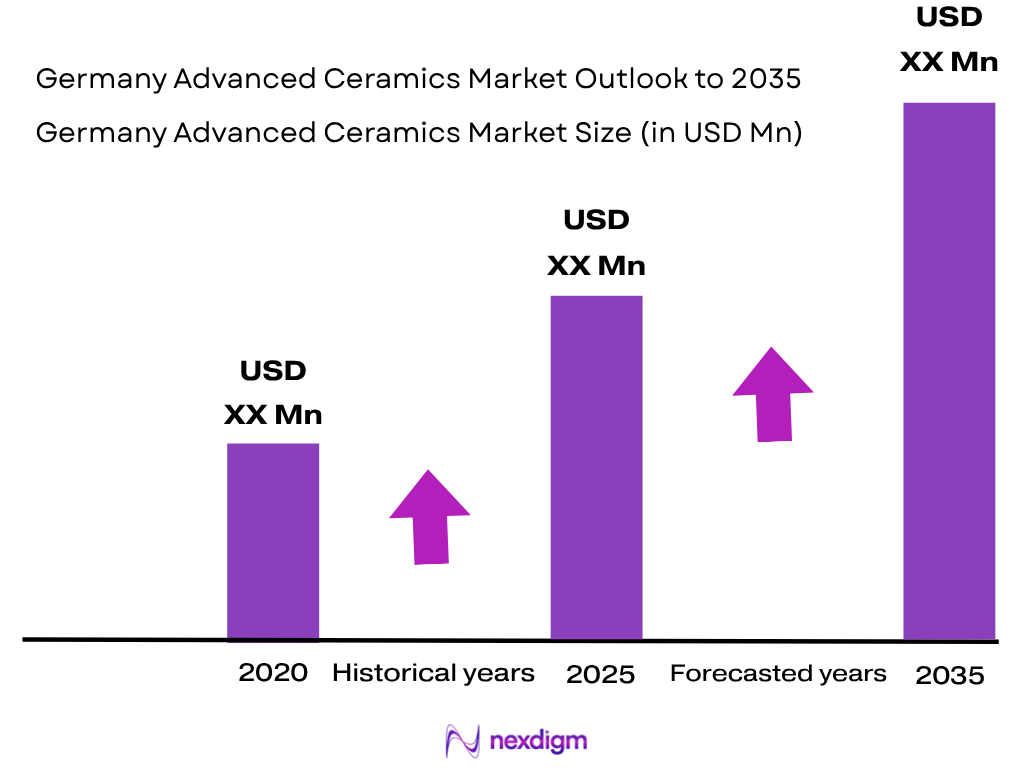
The Germany Advanced Ceramics Market was valued at approximately USD ~XX billion in 2024, compared with USD ~XX billion in 2023, reflecting increasing utilization of high-performance ceramic materials across automotive electronics, semiconductor equipment, industrial machinery, medical devices, electrical systems and energy technologies. Demand is supported by Germany’s large automotive manufacturing base, advanced industrial machinery ecosystem and strong electronics engineering capabilities. The increasing integration of sensors, power electronics, thermal-management systems and high-temperature components is expanding applications for alumina, zirconia, silicon carbide, silicon nitride and aluminum nitride ceramics.
Southern and western Germany represent major centers of advanced ceramics consumption because of their concentration of automotive manufacturing, electronics, precision engineering, healthcare technology and industrial equipment production. Bavaria benefits from automotive, semiconductor, aerospace and industrial technology activities, while Baden-Württemberg has a strong automotive and precision-engineering ecosystem. North Rhine-Westphalia contributes through industrial machinery, chemicals, energy and manufacturing applications. Major industrial locations including Munich, Stuttgart, Nuremberg, Augsburg, Dresden and Cologne support demand through OEM production, component manufacturing, semiconductor activities and specialized engineering supply chains.
Market Segmentation
By Material Type
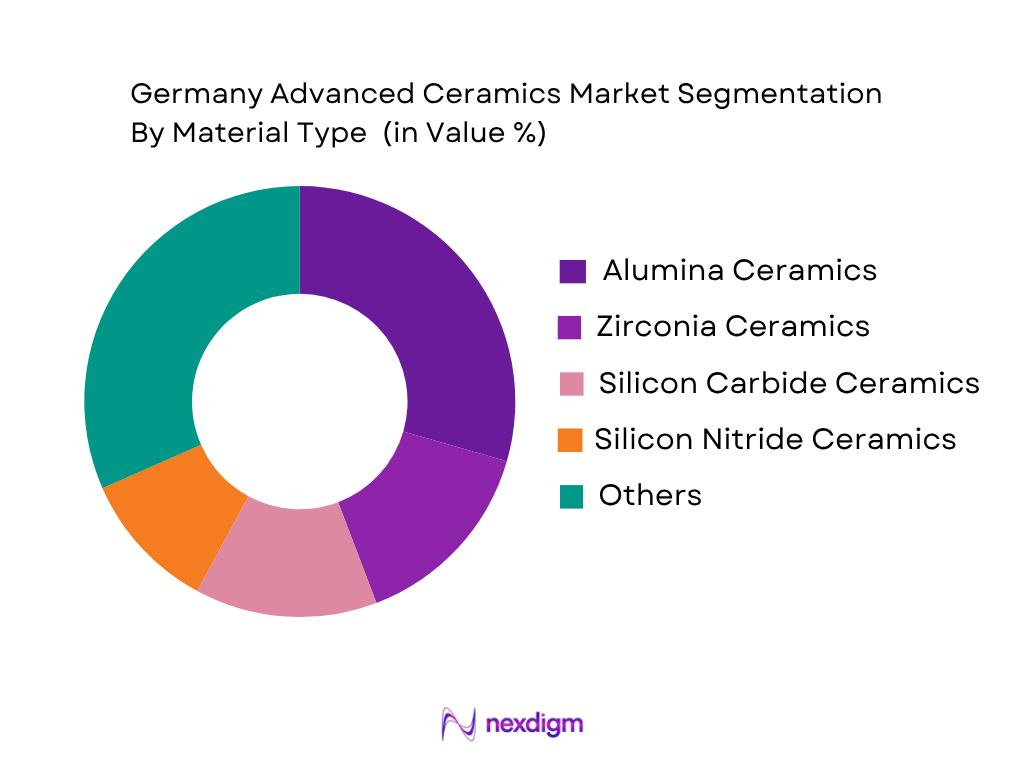
The Germany Advanced Ceramics Market is segmented by material type into alumina ceramics, zirconia ceramics, silicon carbide ceramics, silicon nitride ceramics, aluminum nitride ceramics, titanate ceramics, boron carbide ceramics, cordierite ceramics and ceramic matrix composites. Alumina ceramics are expected to represent the dominant sub-segment, with an estimated 2024 share of ~XX%, because of their broad use across electrical insulation, semiconductor equipment, industrial wear components, medical applications and electronic substrates. Alumina combines hardness, electrical insulation, chemical resistance and high-temperature performance, making it suitable for a wide range of German industrial applications. Its established processing infrastructure and availability across multiple grades also support adoption by component manufacturers. Silicon carbide and silicon nitride remain important in high-temperature, wear-resistant and power-electronics applications, while aluminum nitride benefits from thermal-management requirements. Zirconia maintains strong relevance in dental and medical applications because of its mechanical strength and biocompatibility. The broadest application base and mature manufacturing ecosystem therefore position alumina as the leading material category.
By End-Use Industry
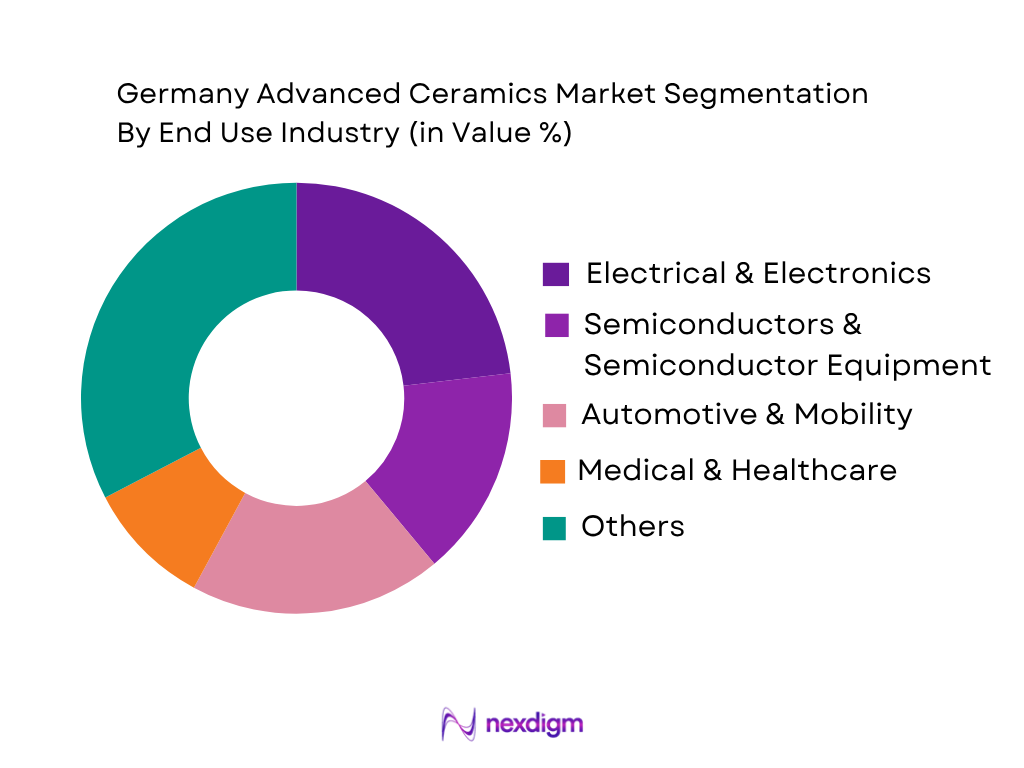
The Germany Advanced Ceramics Market is segmented by end-use industry into automotive and mobility, electrical and electronics, semiconductors and semiconductor equipment, medical and healthcare, industrial machinery, energy and power, aerospace and defense, telecommunications, chemical processing and environmental applications. Electrical and electronics is expected to remain the leading end-use segment, accounting for approximately ~XX% of the market in 2024, supported by demand for electrical insulation, ceramic substrates, electronic packages, thermal-management components and high-frequency components. Germany’s manufacturing base creates recurring requirements for materials capable of operating under high temperatures, electrical loads and demanding mechanical conditions. Semiconductor equipment represents another high-value application because ceramic components are used in wafer handling, plasma-facing equipment, heaters and precision assemblies. Automotive applications are also expanding as vehicle electronics, sensors and power-electronics content increases. Medical ceramics, particularly zirconia and alumina, benefit from Germany’s established medical-device and dental technology industries. Energy applications provide additional opportunities through power electronics, fuel-cell components and high-temperature systems.
Competitive Landscape
The Germany Advanced Ceramics Market is characterized by a combination of established German specialty-material manufacturers and international advanced ceramics companies supplying automotive, electronics, semiconductor, medical, industrial and energy applications. Competition is increasingly centered on material purity, component precision, thermal performance, customization, manufacturing capabilities and qualification for demanding OEM applications. Companies with local production, technical support and application-engineering capabilities are positioned to serve Germany’s sophisticated industrial customer base.
| Company | Establishment Year | Headquarters | Core Materials | Key Applications | Manufacturing Capabilities | Germany Presence | Primary Customer Base |
| CeramTec GmbH | ~19XX | Germany | ~ | ~ | ~ | ~ | ~ |
| Rauschert Group | ~18XX | Germany | ~ | ~ | ~ | ~ | ~ |
| Morgan Advanced Materials | ~18XX | UK | ~ | ~ | ~ | ~ | ~ |
| Kyocera Corporation | ~19XX | Japan | ~ | ~ | ~ | ~ | ~ |
| Saint-Gobain Performance Ceramics | ~16XX | France | ~ | ~ | ~ | ~ | ~ |
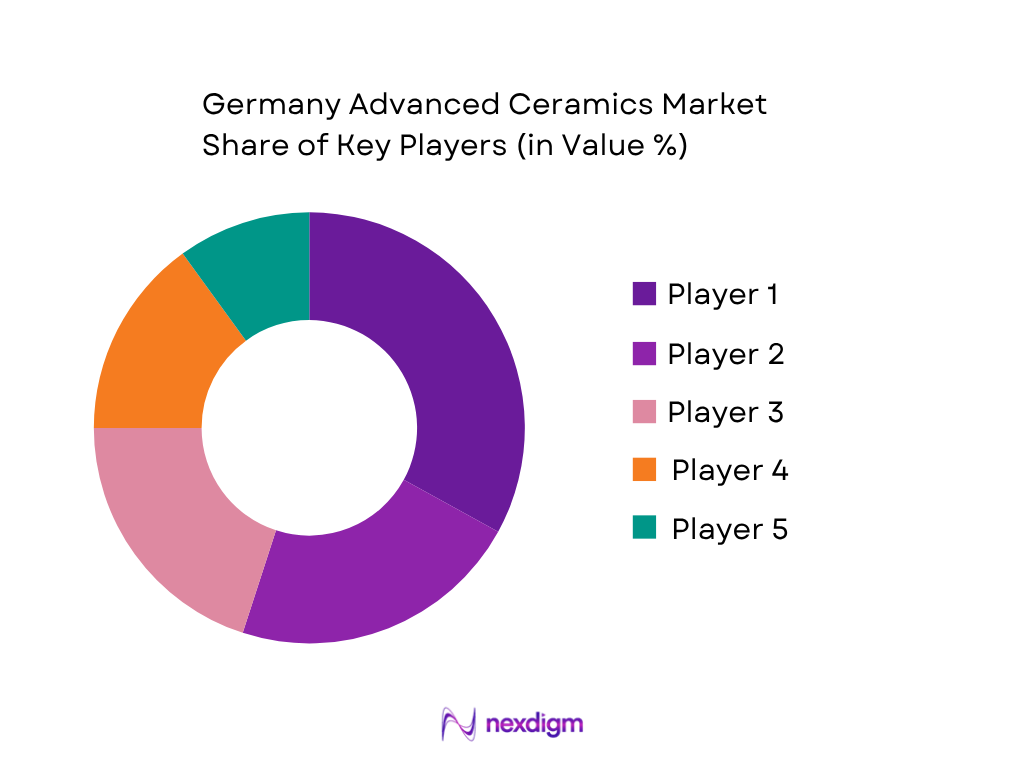
Germany Advanced Ceramics Market Analysis
Growth Drivers
Advanced Automotive Manufacturing
Germany’s automotive manufacturing base provides a substantial demand platform for advanced ceramics used in wear-resistant components, electrical insulation, sensors, substrates, bearings and high-temperature systems. The Federal Motor Transport Authority recorded approximately 2.8 million new passenger-car registrations in 2024, while the VDA reported 4,069,222 passenger cars produced domestically. Germany also produced 1,797,852 SUVs and off-road passenger vehicles, demonstrating the scale of vehicle manufacturing requiring increasingly sophisticated electronic and thermal systems. Electrification further increases the relevance of ceramic materials for power electronics, battery-related thermal management and high-voltage insulation. VDA data also show that 155,700 electric cars were manufactured in Germany during November 2024, representing a record monthly production level at that time. These production volumes support sustained requirements for alumina, zirconia, silicon nitride, aluminum nitride and silicon-carbide-based ceramic components. Germany’s automotive supplier ecosystem, precision-engineering capabilities and concentration of vehicle and component manufacturers reinforce domestic demand for technically qualified ceramic components. Advanced ceramics therefore benefit not simply from vehicle-unit production but from the increasing ceramic content associated with electrification, sensing, automation and thermal-management requirements across modern automotive platforms.
Semiconductor Equipment Demand
Germany’s advanced manufacturing ecosystem and semiconductor-equipment capabilities create an important application base for high-purity ceramics used in wafer handling, semiconductor processing equipment, insulation, thermal management, plasma-resistant components and precision tooling. Germany’s electronics and electrical industry remains a major industrial customer base; the Federal Ministry for Economic Affairs and Energy reports that the sector employed approximately 841,400 people and generated around €170.2 billion in turnover in the latest reported series. Destatis also recorded 319,000 employees in the manufacture of computer, electronic and optical products at the end of 2024, representing an increase of 64,000 employees compared with 2014. This industrial depth supports demand for materials capable of maintaining dimensional stability, electrical insulation and thermal performance under demanding semiconductor-processing conditions. Germany’s broader automation ecosystem further strengthens this driver: 26,982 industrial robots were installed in 2024, while the operational industrial-robot stock reached 278,881 units. Such highly automated production environments require precision ceramic components across equipment and tooling applications.
Market Challenges
High-Purity Raw Material Requirements
Advanced ceramics manufacturing in Germany faces stringent raw-material requirements because semiconductor, medical, electrical and aerospace applications can require tightly controlled purity, particle size, chemical composition and trace-element levels. This makes the production process more demanding than conventional ceramic manufacturing and increases dependence on specialized powder, precursor and processing inputs. The challenge is particularly relevant to alumina, aluminum nitride, silicon carbide and zirconia grades used in precision applications. Germany’s industrial environment also experienced significant manufacturing pressure: Destatis reported that overall industrial production declined 4.5% in 2024, while production excluding energy and construction decreased 4.9%. Production in the capital-goods sector declined 5.6%, and machinery and equipment manufacturing fell 8.1%. These conditions can constrain investment in specialized processing capacity, qualification equipment and new ceramic-material production lines. At the same time, Germany’s electrical-equipment production declined 14.6% in intermediate-goods manufacturing during the year, highlighting weakness across some downstream industrial markets. For advanced-ceramics producers, maintaining secure access to consistent high-purity powders while managing qualification requirements and manufacturing complexity is therefore a significant operational challenge.
Energy-Intensive Processing
Advanced ceramics require technically demanding processes such as powder preparation, forming, sintering, hot pressing, machining and surface finishing, several of which can involve substantial energy requirements and controlled processing environments. Germany’s energy-intensive industrial base has consequently faced a difficult operating environment. Destatis reported that total industrial production declined 4.5% in 2024, while energy-intensive industrial branches recorded production that was only 0.6% higher than the preceding year after substantial declines of 11.2% in 2023 and 5.7% in 2022. Germany’s electricity system also generated 431.7 TWh in 2024, according to the Federal Network Agency, with renewable sources contributing 254.9 TWh. While increasing renewable generation supports the long-term decarbonization of industrial processing, ceramic manufacturers still need reliable electricity for high-temperature furnaces and precision production equipment. Energy requirements are especially important where manufacturers operate continuous sintering or high-temperature treatment processes. Consequently, advanced-ceramics producers must balance process reliability, thermal-cycle control, equipment utilization and energy efficiency while meeting demanding material specifications. This creates a structural challenge for manufacturers seeking to expand high-purity and high-performance ceramic production in Germany.
Market Opportunities
Semiconductor Ceramic Components
Germany’s semiconductor and precision-electronics ecosystem creates an opportunity to expand domestic production of ceramic components designed for wafer processing, semiconductor equipment, thermal control, electrical insulation and high-temperature environments. Advanced ceramics can address requirements where conventional metals or polymers face limitations involving contamination, thermal stability, dielectric performance or wear resistance. The underlying industrial base provides measurable support for this opportunity. Destatis reported 319,000 employees in Germany’s manufacture of computer, electronic and optical products at the end of 2024, while the broader electrical and electronics industry employed approximately 841,400 people according to BMWK data. Germany also maintained a substantial automation infrastructure, with 26,982 industrial robots installed during 2024 and an operational stock of 278,881 robots. This combination of electronics manufacturing and highly automated industrial production creates opportunities for ceramic components integrated into precision equipment, handling systems, insulating structures and thermal-management assemblies. Germany’s semiconductor strategy and investment in domestic technology capabilities further strengthen the rationale for developing localized suppliers of high-purity ceramic components. For manufacturers, the opportunity extends beyond basic ceramic parts toward engineered components with tighter dimensional tolerances, controlled surface characteristics, improved thermal conductivity and application-specific material formulations.
EV Ceramic Components
The transition toward electric and electronically intensive vehicles creates opportunities for advanced ceramics in high-voltage insulation, power-electronics substrates, thermal-management components, sensors, electrical connectors and wear-resistant systems. Germany produced 4,069,222 passenger cars domestically in 2024, while VDA reported a record 155,700 electric vehicles produced in Germany in November 2024 alone. The automotive industry’s continuing investment in electrified drivetrains and increasingly automated manufacturing provides a broader platform for ceramic adoption. Germany’s industrial automation base reinforces this opportunity: the country installed 26,982 industrial robots in 2024, with automotive manufacturers remaining the leading customer group for industrial robots. Advanced ceramics are particularly relevant where EV architectures require materials capable of handling high temperatures, electrical isolation and demanding thermal cycles. Silicon carbide and aluminum nitride can support power-electronics and heat-management applications, while alumina and zirconia can serve electrical, structural and sensor-related functions. The opportunity therefore extends across both vehicle-level components and manufacturing equipment used to produce batteries, power electronics and electric drivetrains. As German automotive manufacturers and suppliers continue adapting production systems toward electrified vehicles, advanced ceramics can gain from the increasing technical requirements associated with compact, high-power and thermally demanding electronic architectures.
Future Outlook
The Germany Advanced Ceramics Market is expected to experience sustained expansion as German manufacturers increase their reliance on high-performance materials for electrification, automation, semiconductor technologies and advanced industrial systems. Growth will increasingly shift toward high-purity, thermally conductive and electrically insulating ceramic materials. Semiconductor equipment, EV power electronics, medical technology and energy systems are expected to generate attractive application opportunities. The market is also likely to benefit from greater localization of critical components, precision manufacturing capabilities and development of application-specific ceramic grades.
Major Players
- CeramTec GmbH
- Rauschert Group
- Morgan Advanced Materials plc
- Saint-Gobain Performance Ceramics & Refractories
- Kyocera Corporation
- CoorsTek Inc.
- 3M
- Tosoh Corporation
- Murata Manufacturing Co., Ltd.
- NGK Insulators, Ltd.
- Niterra Co., Ltd.
- CUMI International Limited
- SGL Carbon SE
- SCHOTT AG
- Röchling Industrial SE & Co. KG
Key Target Audience
- Advanced Ceramics Manufacturers and Component Producers
- Automotive and Electric Vehicle OEMs and Tier-1 Suppliers
- Semiconductor and Semiconductor Equipment Manufacturers
- Electrical, Electronics and Power Electronics Manufacturers
- Medical Device and Dental Technology Manufacturers
- Industrial Machinery and Precision Engineering Companies
- Investments and Venture Capitalist Firms
- Government and Regulatory Bodies (Federal Ministry for Economic Affairs and Climate Action, Federal Ministry of Education and Research, Federal Ministry for Digital and Transport, Federal Institute for Materials Research and Testing)
Research Methodology
Step 1: Identification of Key Variables
The initial phase involves mapping the Germany Advanced Ceramics ecosystem across raw-material suppliers, powder producers, ceramic manufacturers, precision-machining companies, distributors, OEMs and end-use industries. Market-specific variables include material grade, purity, thermal conductivity, dielectric performance, component form, manufacturing process and application intensity.
Step 2: Market Analysis and Construction
Historical market information is compiled through production statistics, trade data, company disclosures, industrial databases and sector-specific secondary research. The analysis evaluates consumption across alumina, zirconia, silicon carbide, silicon nitride and aluminum nitride, alongside application demand from electronics, automotive, semiconductor, medical and industrial customers.
Step 3: Hypothesis Validation and Expert Consultation
Market hypotheses are validated through discussions with advanced ceramic manufacturers, component suppliers, OEM procurement professionals, material specialists and application engineers. Expert inputs are used to assess material substitution, qualification cycles, manufacturing constraints, application penetration and technology adoption across Germany’s major end-use industries.
Step 4: Research Synthesis and Final Output
The final analysis integrates top-down and bottom-up market calculations with manufacturer-level assessments and end-user validation. Production, import and export information is reconciled with application-level demand to establish market estimates and segment shares. The resulting framework supports competitive benchmarking, opportunity assessment and long-term market forecasting.

- Executive Summary
- Research Methodology (Market Definition and Scope, Advanced Ceramics Taxonomy, Market Boundary Conditions, Market Sizing Framework, Top-Down Market Assessment, Bottom-Up Market Assessment, Demand-Side Validation, Supply-Side Validation, Import–Export Reconciliation, Manufacturer Mapping, End-User Validation, Primary Industry Interviews, Data Triangulation, Forecasting Framework, Scenario Analysis, Assumptions and Limitations)

- Definition and Scope
- Advanced Ceramics Industry Evolution and Technology Development
- Germany Advanced Ceramics Ecosystem Mapping
- Advanced Ceramics Value Chain Analysis
- Advanced Ceramics Supply Chain Analysis
- Domestic Production and Import Dependency Assessment

- Growth Drivers (Advanced Automotive Manufacturing, Semiconductor Equipment Demand, Industrial Automation, Power Electronics Expansion, Medical Device Manufacturing, Aerospace Engineering, Electronics Miniaturization, Energy Transition Technologies)
- Market Challenges (High-Purity Raw Material Requirements, Energy-Intensive Processing, Precision Manufacturing Complexity, High Qualification Requirements, Specialized Workforce Requirements, Advanced Equipment Requirements, Supply Chain Dependencies, High Technical Barriers to Entry)
- Market Opportunities (Semiconductor Ceramic Components, Ceramic Substrate Manufacturing, Thermal Management Ceramics, EV Ceramic Components, Medical Ceramics, Ceramic Matrix Composites, High-Purity Alumina Applications, Silicon Carbide Components, Hydrogen and Fuel Cell Ceramics)
- Market Trends (Electronics Miniaturization, High-Thermal-Conductivity Ceramics, Semiconductor Localization, EV Electrification, Advanced Ceramic Substrates, High-Purity Materials, Precision Ceramic Manufacturing, Advanced Sintering, Ceramic Matrix Composites)
- SWOT Analysis
- Porter’s Five Forces Analysis
- PESTLE Analysis

- By Market Value (2020-2025)
- By Volume Consumption (2020-2025)
- By Domestic Production (2020-2025)
- By Import Volume (2020-2025)
- By Export Volume (2020-2025)
- By Material Consumption (2020-2025)

- By Material Type (In Value %)
Alumina Ceramics
Zirconia Ceramics
Silicon Carbide Ceramics
Silicon Nitride Ceramics
Aluminum Nitride Ceramics
Titanate Ceramics
Boron Carbide Ceramics
Cordierite Ceramics
Ceramic Matrix Composites
Other Advanced Ceramics - By Product Form (In Value %)
Monolithic Ceramic Components
Ceramic Substrates
Ceramic Packages
Ceramic Coatings
Ceramic Powders
Ceramic Fibers
Ceramic Tubes and Rods
Ceramic Plates and Discs
Ceramic Seals and Bearings
Precision Ceramic Components - By Application (In Value %)
Electronic Components
Semiconductor Equipment Components
Ceramic Substrates
Ceramic Packages
Thermal Management Components
Electrical Insulation Components
Wear-Resistant Components
Medical Components - By Manufacturing Process (In Value %)
Dry Pressing
Injection Molding
Tape Casting
Extrusion
Slip Casting
Hot Pressing
Cold Isostatic Pressing
Hot Isostatic Pressing
Reaction Bonding
Pressureless Sintering
Spark Plasma Sintering - By End-Use Industry (In Value %)
Electrical and Electronics
Semiconductors and Semiconductor Equipment
Automotive and Mobility
Medical and Healthcare
Industrial Machinery
Energy and Power
Aerospace and Defense
Telecommunications
Chemical Processing

- Market Share of Major Players (By Value, Volume, Material Type, Product Form, Application, End-Use Industry)
- Cross Comparison Parameters (Advanced Ceramic Material Portfolio, Product and Component Portfolio Breadth, Manufacturing Process Capability, Precision Machining Capability, Material Purity Grades, Thermal and Electrical Performance Portfolio, Application-Specific Customization Capability, Germany Manufacturing and Technical Support Footprint)
- SWOT Analysis of Major Players
- Detailed Profiles of Major Companies
CeramTec GmbH
Rauschert Group
Morgan Advanced Materials plc
Saint-Gobain Performance Ceramics & Refractories
Kyocera Corporation
CoorsTek Inc.
3M
Tosoh Corporation
Murata Manufacturing Co., Ltd.
NGK Insulators, Ltd.
Niterra Co., Ltd.
CUMI International Limited
SGL Carbon SE
SCHOTT AG
Röchling Industrial SE & Co. KG

- Electronics Manufacturer Requirements
- Semiconductor Equipment Requirements
- Automotive and EV Manufacturer Requirements
- Medical Device Manufacturer Requirements
- Aerospace Manufacturer Requirements
- Industrial Equipment Requirements
- Purchasing Criteria Assessment
- Domestic Versus Imported Component Preference

- By Market Value (2026-2035)
- By Volume Consumption (2026-2035)
- By Domestic Production (2026-2035)
- By Import Volume (2026-2035)
- By Export Volume (2026-2035)
- By Material Consumption (2026-2035)


 Request a Sample
 Ask for Customization
 Get a Quote
 Enquire Now