
 Download PDF
 Download PDF
Market Overview
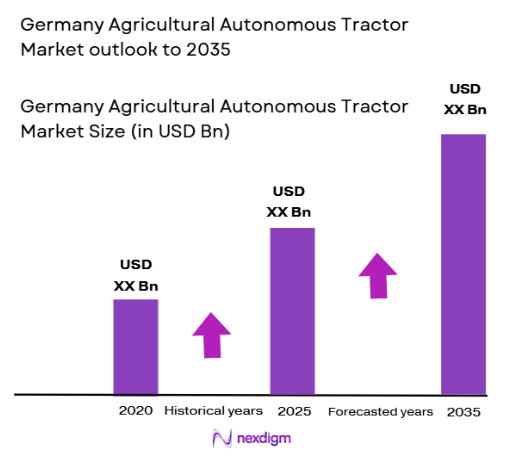
Germany Agricultural Autonomous Tractor market reached USD ~ billion based on a recent historical assessment, driven by strong mechanization intensity and high adoption of precision agriculture technologies across commercial farming systems. Demand expansion is supported by labor scarcity in agricultural operations and regulatory incentives for low-emission machinery. The market is further stimulated by integration of AI-enabled navigation, sensor fusion systems, and electrified drivetrains in autonomous tractors by leading European agricultural machinery manufacturers.
Bavaria and Lower Saxony dominate the Germany Agricultural Autonomous Tractor market due to large farm sizes, high cereal and livestock production value, and advanced farm mechanization ecosystems. Baden-Württemberg also demonstrates significant adoption supported by specialty crop cultivation requiring precision automation. Germany leads European deployment due to robust agricultural engineering industry clusters, strong digital farming infrastructure, and supportive automation standards. Neighboring France and Netherlands influence regional demand through cross-border equipment manufacturing and supply chain integration.
Market Segmentation
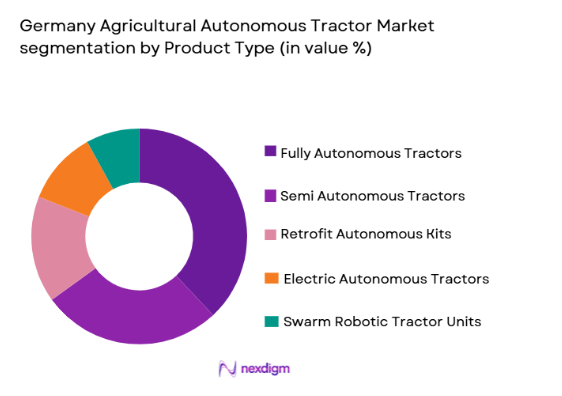
By Product Type:
Germany Agricultural Autonomous Tractor market is segmented by product type into fully autonomous tractors, semi-autonomous tractors, retrofit autonomous kits, electric autonomous tractors, and swarm robotic tractor units. Recently, fully autonomous tractors has a dominant market share due to factors such as demand patterns, brand presence, infrastructure availability, or consumer preference. Fully autonomous tractors lead adoption because large German farms prioritize complete labor replacement and continuous field operation capability across planting, spraying, and harvesting cycles. OEM manufacturers such as European tractor brands integrate autonomy directly into high-horsepower platforms, increasing reliability and safety certification readiness. Advanced GNSS-RTK coverage across Germany supports centimeter-level navigation accuracy required for full autonomy. Government incentives for precision agriculture and emissions reduction favor integrated autonomous tractors over retrofit solutions. Electrification compatibility and fleet management software integration further strengthen the segment’s leadership across commercial farms seeking operational efficiency.
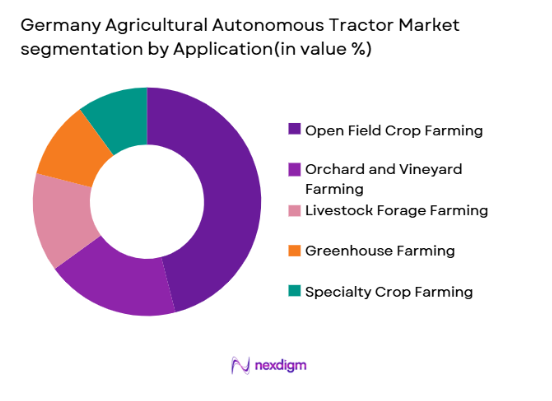
By Application:
Germany Agricultural Autonomous Tractor market is segmented by application into open-field crop farming, orchard and vineyard farming, livestock forage farming, greenhouse farming, and specialty crop farming. Recently, open-field crop farming has a dominant market share due to factors such as demand patterns, brand presence, infrastructure availability, or consumer preference. Open-field crop farming dominates because Germany’s agricultural land use is heavily concentrated in cereals, oilseeds, and industrial crops requiring large-scale mechanized operations. Autonomous tractors deliver maximum efficiency benefits in expansive fields where long straight passes enable optimized route planning and fuel savings. High-horsepower autonomous tractors are primarily designed for open-field tillage and seeding tasks, aligning with dominant crop patterns in Bavaria and Lower Saxony. Precision guidance infrastructure and digital field mapping are more mature in arable farming compared with horticulture. Farm contractors serving grain producers invest heavily in autonomous fleets, further consolidating application dominance.
Competitive Landscape
Germany Agricultural Autonomous Tractor market is moderately consolidated, with dominance of established European agricultural machinery manufacturers integrating autonomy into premium tractor platforms. Strategic collaborations between tractor OEMs and robotics technology firms are accelerating product innovation. Large multinational agricultural equipment companies maintain technological leadership through GNSS navigation, electrification, and AI-driven autonomy software. Domestic engineering suppliers and component specialists contribute sensors, drivetrains, and automation modules, reinforcing Germany’s integrated agricultural machinery ecosystem and sustaining competitive intensity.
| Company Name | Establishment Year | Headquarters | Technology Focus | Market Reach | Key Products | Revenue | Autonomy Integration Level |
| Fendt | 1930 | Germany | ~ | ~ | ~ | ~ | ~ |
| CLAAS | 1913 | Germany | ~ | ~ | ~ | ~ | ~ |
| John Deere | 1837 | USA | ~ | ~ | ~ | ~ | ~ |
| CNH Industrial | 2013 | UK | ~ | ~ | ~ | ~ | ~ |
| Kubota | 1890 | Japan | ~ | ~ | ~ | ~ | ~ |
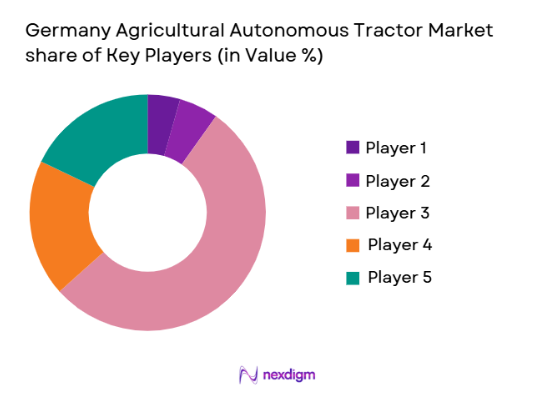
Germany Agricultural Autonomous Tractor Market Analysis
Growth Drivers
Labor Scarcity and Farm Workforce Aging in German Agriculture:
Labor shortages across German agriculture have intensified due to demographic aging and declining availability of seasonal farm workers, compelling farms to adopt automation technologies capable of replacing repetitive tractor operations. Autonomous tractors enable continuous operation during peak planting and harvesting windows, reducing dependency on skilled operators and mitigating labor cost inflation. German farms increasingly operate at larger scale and require extended operating hours, which autonomous tractors deliver through night-time and precision-guided field work without fatigue constraints. Government agricultural modernization programs encourage automation adoption to maintain productivity despite workforce contraction. Contractors servicing multiple farms deploy autonomous fleets to improve service capacity without expanding labor. Integration of remote monitoring and fleet management software further supports centralized supervision of multiple machines. Precision agriculture compatibility enhances input efficiency, aligning with sustainability targets. These structural labor pressures strongly reinforce long-term demand for autonomous tractor deployment across Germany’s commercial farming sector.
Demand for Precision and Low-Emission Agricultural Machinery:
Environmental sustainability regulations and precision agriculture incentives in Germany are accelerating demand for autonomous tractors equipped with emission-efficient powertrains and input-optimized operation capability. Autonomous tractors reduce fuel consumption through optimized route planning and consistent speed control, supporting compliance with agricultural emission targets and climate policies. Electrified autonomous tractor prototypes align with Germany’s broader electrification strategy and renewable energy integration in rural sectors. Precision application of fertilizers and crop protection enabled by autonomous guidance minimizes chemical usage and environmental impact. Government subsidy frameworks for digital and precision farming technologies encourage investment in autonomous equipment. German farmers prioritize machinery capable of meeting sustainability certification requirements demanded by European food supply chains. Autonomous tractors integrated with soil sensing and crop analytics enhance yield efficiency while reducing resource inputs. These environmental and precision efficiency drivers significantly expand adoption across technologically advanced German farms.
Market Challenges
High Capital Cost and Return on Investment Uncertainty for Farmers:
Autonomous tractors require substantial upfront investment compared with conventional tractors, creating adoption barriers for small and mid-sized German farms operating under tight profitability margins. Although long-term labor savings and efficiency gains are significant, the payback period remains uncertain due to variability in farm size, crop cycles, and utilization rates. Financing autonomous machinery is challenging because residual value and resale markets are still developing. German farmers traditionally maintain long machinery lifecycles, reducing willingness to adopt expensive emerging technologies. Maintenance and software support costs add to total ownership expenses. Integration with existing farm equipment fleets may require additional digital infrastructure investment. Government incentives partially offset costs but do not fully eliminate financial risk perception. Contractors and large farms adopt earlier, creating uneven market penetration. These cost and ROI uncertainties slow widespread adoption across the broader German agricultural sector.
Regulatory and Safety Certification Complexity for Autonomous Field Machinery:
Autonomous agricultural vehicles must comply with stringent European machinery safety regulations and operational standards, increasing development and deployment complexity for manufacturers and farmers. Certification processes for autonomous operation in open agricultural environments require validation of obstacle detection, fail-safe control systems, and remote supervision capabilities. Liability frameworks for accidents involving autonomous farm machinery remain evolving, creating legal uncertainty for operators. Germany’s strong safety culture demands extensive testing before commercial deployment. Integration of autonomous tractors on mixed-traffic rural roads adds regulatory constraints beyond field operation. Data security and connectivity standards for remote control systems impose additional compliance requirements. Farmers require assurance of safe coexistence with human workers and livestock. Certification delays slow product availability and increase development costs for OEMs. These regulatory complexities act as a structural barrier to rapid autonomous tractor adoption in Germany.
Opportunities
Expansion of Autonomous Fleet Services and Farm Contracting Models:
Agricultural contracting services in Germany present significant opportunity for autonomous tractor deployment because contractors operate machinery across multiple farms, maximizing utilization rates and economic viability. Autonomous fleets allow contractors to deliver extended operational hours and precision services without proportional labor expansion. Service-based autonomy reduces capital burden on individual farmers by shifting investment to contractors. Fleet management platforms enable centralized control of multiple autonomous tractors across dispersed fields. Contractors specializing in seeding, spraying, and tillage can standardize operations using autonomous systems, improving service consistency. Large grain producers increasingly outsource field operations to contractors adopting automation. This model accelerates diffusion of autonomous tractors across regions with fragmented farm ownership. Manufacturers collaborate with service providers to deploy pilot fleets, validating performance and business models. Contracting-driven adoption represents a scalable pathway for Germany’s autonomous tractor market expansion.
Integration with Digital Farming Platforms and Agricultural Data Ecosystems:
Germany’s advanced digital agriculture infrastructure creates strong opportunity for autonomous tractors integrated with farm management software, field mapping systems, and agronomic analytics platforms. Autonomous tractors generate high-resolution operational data enabling optimization of seeding depth, fertilizer placement, and soil management practices. Integration with precision agriculture platforms supports real-time decision-making and variable-rate application. Farms adopting digital twins and predictive agronomy models benefit from automated machinery executing optimized field plans. Agricultural cooperatives and technology providers offer integrated digital farming ecosystems incorporating autonomous equipment. Connectivity expansion through rural broadband and satellite positioning enhances autonomy reliability. Data-driven farm certification and traceability requirements favor autonomous systems capable of recording operations precisely. OEMs developing interoperable autonomy platforms can capture long-term service revenue streams. Digital ecosystem integration positions autonomous tractors as central nodes in Germany’s smart agriculture transformation.
Future Outlook
Germany Agricultural Autonomous Tractor market is expected to expand steadily over the next five years driven by continued labor shortages, precision agriculture adoption, and electrification of farm machinery. Autonomous functionality will increasingly integrate with digital farm management systems and AI-based agronomic analytics. Regulatory frameworks for agricultural autonomy are likely to mature, enabling broader commercial deployment. Expansion of contractor-operated autonomous fleets and electrified tractor platforms will further accelerate market penetration across German agriculture.
Major Players
- Fendt
- CLAAS
- John Deere
- CNH Industrial
- Kubota
- Bosch Rexroth
- ZF Friedrichshafen
- Horsch Maschinen
- Lemken
- Amazone
- Deutz Fahr
- Krone
- Trimble
- Raven Industries
- Continental
Key Target Audience
- Agricultural machinery manufacturers
- Autonomous vehicle technology developers
- Precision agriculture software providers
- Farm equipment distributors
- Agricultural cooperatives
- Investments and venture capitalist firms
- Government and regulatory bodies
- Farm contracting service providers
Research Methodology
Step 1: Identification of Key Variables
Market variables including tractor autonomy levels, farm size distribution, mechanization rates, labor trends, and regulatory frameworks were identified through agricultural statistics, machinery sales data, and technology adoption indicators across Germany.
Step 2: Market Analysis and Construction
Supply-side manufacturer revenues, autonomous tractor deployments, and technology integration trends were analyzed alongside farm mechanization demand patterns to construct market sizing and segmentation structure.
Step 3: Hypothesis Validation and Expert Consultation
Industry experts from agricultural engineering, precision farming, and machinery distribution validated assumptions regarding adoption drivers, pricing structures, and operational deployment models in Germany.
Step 4: Research Synthesis and Final Output
Validated quantitative and qualitative findings were synthesized into market estimates, competitive landscape mapping, and strategic outlook aligned with Germany’s agricultural automation trajectory.

- Executive Summary
- Research Methodology (Definitions, Scope, Industry Assumptions, Market Sizing Approach, Primary & Secondary Research Framework, Data Collection & Verification Protocol, Analytic Models & Forecast Methodology, Limitations & Research Validity Checks)

- Market Definition and Scope
- Value Chain & Stakeholder Ecosystem
- Regulatory / Certification Landscape
- Sector Dynamics Affecting Demand
- Strategic Initiatives & Infrastructure Growth

- Growth Drivers
Labor shortages in German agriculture accelerating automation adoption
Government support for precision and digital farming technologies
Demand for high efficiency and low emission farm machinery - Market Challenges
High upfront cost of autonomous tractor systems
Integration complexity with existing farm machinery fleets
Regulatory uncertainty for autonomous agricultural vehicles - Market Opportunities
Expansion of autonomous fleets in large scale cereal farms
Integration with digital farm management platforms
Adoption in specialty crops requiring precision operations - Trends
Shift toward electric autonomous tractor platforms
Adoption of swarm and multi unit autonomous field operations
Integration of AI driven crop and soil sensing in tractors
Partnerships between OEMs and robotics startups
Growth of retrofit autonomy solutions for legacy tractors - Government Regulations & Defense Policy
EU machinery safety and autonomy certification frameworks
German agricultural digitization and sustainability programs
Data governance and farm robotics operational standards - SWOT Analysis
- Stakeholder and Ecosystem Analysis
- Porter’s Five Forces Analysis
- Competition Intensity and Ecosystem Mapping

- By Market Value, 2020-2025
- By Installed Units, 2020-2025
- By Average System Price, 2020-2025
- By System Complexity Tier, 2020-2025

- By System Type (In Value%)
Fully Autonomous Field Tractors
Semi Autonomous Guidance Tractors
Swarm Robotics Tractor Units
Orchard and Vineyard Autonomous Tractors
Electric Autonomous Compact Tractors - By Platform Type (In Value%)
Open Field Crop Platforms
Orchard and Vineyard Platforms
Greenhouse and Controlled Farming Platforms
Mixed Terrain Utility Platforms
Specialty Crop Platforms - By Fitment Type (In Value%)
OEM Integrated Autonomous Tractors
Retrofit Autonomy Kits
Modular Autonomy Attachments
Fleet Automation Systems
Navigation and Control Addon Units - By EndUser Segment (In Value%)
Large Commercial Farms
Agricultural Cooperatives
Contract Farming Service Providers
Research and Experimental Farms
High Value Specialty Crop Growers - By Procurement Channel (In Value%)
Direct OEM Sales
Agricultural Machinery Dealers
Leasing and Farm Equipment Finance
Government Supported Programs
Autonomy Technology Integrators - By Material / Technology (in Value %)
LiDAR Based Navigation Systems
Vision and Camera Guidance Systems
GNSS RTK Positioning Systems
AI and Machine Learning Control Units
Electric and Hybrid Powertrains

- Market structure and competitive positioning
- Market share snapshot of major players
- CrossComparison Parameters (Autonomy Level, Powertrain Type, Navigation Technology, Farm Size Suitability, Crop Type Compatibility, Retrofit Capability, Connectivity Integration, Emission Profile, Fleet Management Software, Safety Certification)
- SWOT Analysis of Key Players
- Pricing & Procurement Analysis
- Key Players
Fendt
CLAAS
John Deere
CNH Industrial
Kubota
Bosch Rexroth
ZF Friedrichshafen
Horsch Maschinen
Lemken
Amazone
Deutz Fahr
Krone
Trimble
Raven Industries
Continental

- Large grain farms prioritizing autonomous fleet efficiency
- Contract farming services adopting autonomy for cost optimization
- Specialty crop growers seeking precision autonomous operations
- Research farms piloting next generation autonomous tractors

- Forecast Market Value, 2026-2035
- Forecast Installed Units, 2026-2035
- Price Forecast by System Tier, 2026-2035
- Future Demand by Platform, 2026-2035


 Request a Sample
 Ask for Customization
 Get a Quote
 Enquire Now