
 Download PDF
 Download PDF
Market Overview
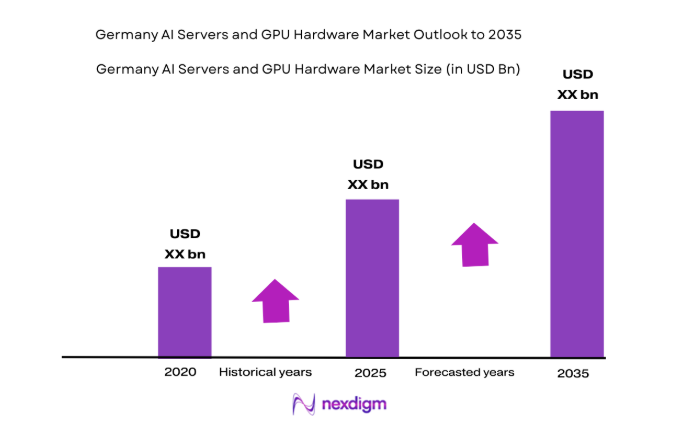
Germany AI servers and GPU hardware market reached approximately USD ~ billion based on a recent historical assessment, driven by accelerated enterprise AI adoption, expansion of hyperscale cloud regions, and national investments in sovereign compute infrastructure. Public funding programs such as the German Federal Ministry for Economic Affairs’ AI innovation initiatives and European HPC deployments have stimulated demand for GPU clusters and AI servers. Automotive AI development and industrial automation computing needs further strengthened hardware procurement across sectors.
Major demand concentration occurs in Berlin, Munich, Frankfurt, and Stuttgart due to dense data center infrastructure, automotive engineering clusters, hyperscale cloud availability, and research supercomputing facilities. Frankfurt leads through Europe’s largest internet exchange and colocation ecosystem, while Munich and Stuttgart dominate due to automotive AI and manufacturing technology ecosystems. Berlin contributes through startup AI innovation and federal research institutes. Regional technology parks and sovereign cloud projects reinforce these metropolitan leadership positions.
Market Segmentation
By Product Type
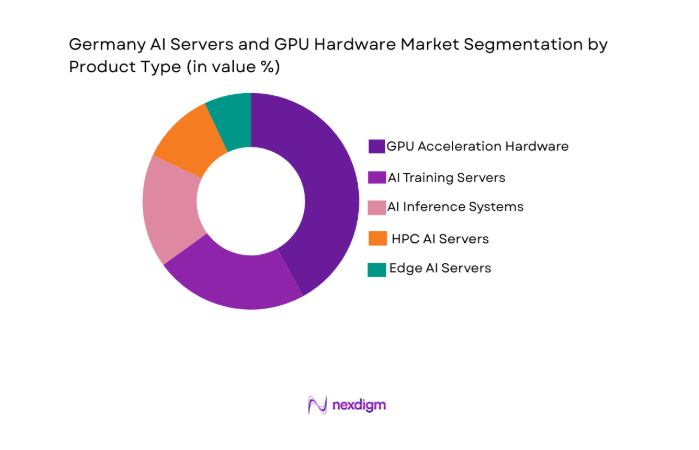
Germany AI Servers and GPU Hardware market is segmented by product type into GPU acceleration hardware, AI training servers, AI inference servers, edge AI servers, and HPC AI servers. Recently, GPU acceleration hardware has a dominant market share due to factors such as intensive deep learning workloads, automotive simulation requirements, hyperscale cloud GPU expansion, and strong vendor ecosystems. Germany’s autonomous driving R&D and industrial AI modeling require high-performance parallel processing, while enterprise generative AI deployments depend on scalable GPU clusters. Additionally, sovereign AI cloud initiatives and supercomputing investments prioritize GPU-dense systems, reinforcing sustained dominance of accelerator hardware across both data center and research infrastructure environments.
By Platform Type
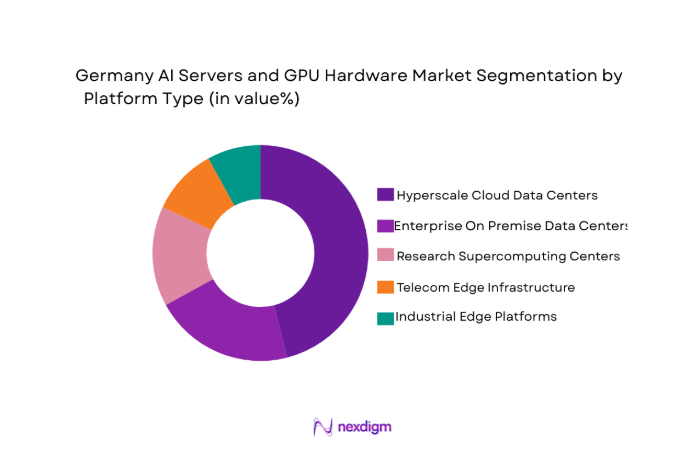
Germany AI Servers and GPU Hardware market is segmented by platform type into hyperscale cloud data centers, enterprise on-premise data centers, telecom edge infrastructure, research supercomputing centers, and industrial edge platforms. Recently, hyperscale cloud data centers have a dominant market share due to large-scale GPU deployments, sovereign cloud expansion, and enterprise AI migration toward cloud environments. Germany’s strict data sovereignty regulations encourage regional hyperscale investments, while Frankfurt’s connectivity ecosystem attracts cloud capacity expansion. Automotive and manufacturing firms increasingly access GPU resources via cloud platforms, accelerating hyperscale infrastructure procurement relative to enterprise or edge deployments.
Competitive Landscape
Germany AI servers and GPU hardware market shows moderate consolidation, with global OEMs and accelerator vendors dominating high-performance segments while European system integrators and sovereign infrastructure providers maintain regional influence. Hyperscale cloud providers drive procurement scale and technology standards, creating strong vendor lock-in around GPU ecosystems and AI software stacks. Domestic industrial technology firms participate through specialized edge and industrial AI compute solutions, but large multinational vendors retain leadership in data center and training cluster deployments.
| Company Name | Establishment Year | Headquarters | Technology Focus | Market Reach | Key Products | Revenue | Deployment Model |
| NVIDIA | 1993 | USA | ~ | ~ | ~ | ~ | ~ |
| Dell Technologies | 1984 | USA | ~ | ~ | ~ | ~ | ~ |
| Hewlett Packard Enterprise | 2015 | USA | ~ | ~ | ~ | ~ | ~ |
| Lenovo | 1984 | China | ~ | ~ | ~ | ~ | ~ |
| Atos / Eviden | 1997 | France | ~ | ~ | ~ | ~ | ~ |
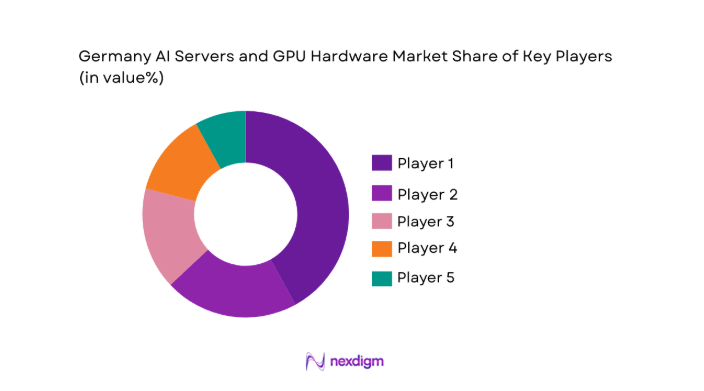
Germany AI Servers and GPU Hardware Market Analysis
Growth Drivers
Expansion of Automotive AI and Industrial AI Compute Demand
Germany’s leadership in automotive engineering and advanced manufacturing has created a structural need for large-scale AI training and simulation infrastructure, particularly for autonomous driving, robotics, and predictive maintenance applications. Automotive OEMs and Tier-1 suppliers are investing heavily in deep learning model development for perception systems, sensor fusion, and digital twin simulations, which require GPU-dense clusters capable of parallel computation at petaflop scale. Industrial automation firms similarly deploy AI for quality inspection, process optimization, and robotics vision systems, generating sustained demand for both training and inference hardware. National Industry 4.0 programs and smart factory initiatives accelerate enterprise AI adoption across manufacturing verticals, driving procurement of AI servers for edge and on-premise deployments. Germany’s strong mechanical engineering base increases computational modeling needs in materials science, aerodynamics, and industrial simulation, reinforcing HPC-AI convergence infrastructure investments. The integration of AI into industrial control systems and cyber-physical production environments requires localized compute nodes with accelerator support, expanding hardware demand beyond centralized data centers. Automotive autonomous driving testing environments rely on synthetic data generation and large-scale scenario modeling, which are compute-intensive GPU workloads that expand server cluster deployments. Additionally, collaborative research between automotive firms, research institutes, and AI startups fosters shared compute infrastructure, further scaling national AI hardware capacity. This sector-driven compute intensity structurally anchors Germany’s AI server and GPU hardware demand across both enterprise and research ecosystems.
Hyperscale and Sovereign Cloud Infrastructure Expansion
Germany’s regulatory emphasis on data sovereignty and digital independence has accelerated investments in regional hyperscale and sovereign cloud infrastructure, significantly increasing demand for AI servers and GPU clusters within national data center ecosystems. European initiatives promoting trusted cloud platforms and secure data processing environments encourage enterprises to migrate AI workloads to compliant domestic hyperscale providers rather than external regions, expanding local GPU deployment density. Frankfurt’s position as Europe’s primary internet exchange hub attracts global cloud operators to establish AI-capable data centers, while national cloud programs incentivize sovereign infrastructure procurement. Hyperscale providers are scaling GPU capacity to support enterprise generative AI, analytics, and machine learning services, leading to large-volume AI server procurement cycles. Government-funded AI supercomputing facilities and public research compute centers also adopt hyperscale architectures, integrating GPU accelerators into national HPC systems. Enterprises increasingly consume AI infrastructure as cloud services due to scalability, cost efficiency, and regulatory compliance advantages, reinforcing hyperscale dominance over on-premise deployments. Telecom operators deploying edge cloud platforms for 5G and industrial IoT services further extend GPU infrastructure into distributed networks. Sovereign AI cloud partnerships between governments and technology vendors create stable long-term procurement frameworks, sustaining hardware demand. This convergence of hyperscale expansion and sovereign cloud policy establishes cloud data centers as the central growth engine of Germany’s AI servers and GPU hardware market.
Market Challenges
Power Consumption Constraints and Data Center Energy Regulation
AI servers and GPU clusters consume significantly higher power density compared to conventional compute infrastructure, creating substantial operational and regulatory challenges within Germany’s energy-constrained data center environment. National energy efficiency regulations and sustainability mandates impose strict limits on data center power usage effectiveness and carbon emissions, complicating deployment of high-density GPU systems that require intensive cooling and electricity supply. Germany’s high industrial electricity costs increase operational expenses for hyperscale and enterprise AI infrastructure operators, reducing cost competitiveness relative to other regions. Grid capacity limitations in major data center hubs such as Frankfurt restrict expansion of large AI compute clusters due to insufficient available power allocation. Environmental permitting processes for new data center construction are lengthy and complex, delaying infrastructure scaling needed for AI workloads. Liquid cooling technologies mitigate thermal density but increase capital expenditure and operational complexity, further challenging adoption economics. Enterprises evaluating on-premise AI deployments often defer investment due to energy and facility constraints, shifting demand toward hyperscale providers. Sustainability reporting obligations and carbon neutrality targets pressure operators to optimize energy efficiency rather than expand capacity rapidly. These structural energy constraints collectively limit the pace and scale of AI server and GPU hardware deployment across Germany.
Semiconductor Supply Dependency and Hardware Cost Volatility
Germany’s AI servers and GPU hardware market remains highly dependent on imported advanced semiconductor components, particularly high-end GPUs and AI accelerators produced outside Europe, exposing infrastructure expansion to supply chain disruptions and pricing volatility. Global demand surges for AI accelerators have created allocation constraints and long lead times, delaying procurement cycles for hyperscale operators, enterprises, and research institutions within Germany. Limited domestic semiconductor manufacturing capacity for advanced nodes restricts regional supply resilience and increases reliance on external technology ecosystems. Fluctuating accelerator pricing significantly affects total cost of ownership for AI server deployments, complicating investment planning for organizations adopting large compute clusters. Export controls and geopolitical technology regulations influence availability of certain high-performance AI chips, introducing uncertainty into hardware sourcing strategies. European initiatives to develop semiconductor sovereignty remain in early stages and cannot yet supply high-performance AI accelerators at scale. Integrating heterogeneous accelerator architectures requires specialized engineering expertise and software optimization, increasing deployment complexity and costs. Smaller enterprises face barriers to entry due to high upfront hardware investment requirements and supply uncertainty. This dependency on global semiconductor supply chains structurally constrains Germany’s AI hardware market expansion and pricing stability.
Opportunities
Sovereign European AI Infrastructure and Public Compute Investments
Germany’s strategic commitment to digital sovereignty and European technological independence creates substantial opportunities for domestic AI servers and GPU hardware deployment through publicly funded sovereign infrastructure programs and national compute initiatives. Government-backed AI supercomputing centers and secure cloud platforms require large-scale accelerator clusters compliant with regional data protection and security standards, generating stable long-term procurement demand. Public sector adoption of AI in healthcare, climate modeling, defense analytics, and public administration expands national compute capacity requirements beyond commercial markets. Collaborative European HPC and AI projects integrate GPU-accelerated architectures across multiple research institutions, fostering sustained hardware investment cycles. Sovereign cloud partnerships between governments and technology providers stimulate local manufacturing, integration, and deployment ecosystems for AI infrastructure. Regulatory preference for regional data processing environments incentivizes enterprises to adopt domestically hosted AI platforms rather than external hyperscale regions. Germany’s leadership in European digital policy positions it as a primary location for sovereign AI infrastructure expansion. These publicly anchored compute investments provide predictable demand for AI servers and GPU hardware suppliers operating within the German and European technology landscape.
Industrial Edge AI and Distributed Compute Deployment Growth
Germany’s advanced manufacturing base and Industry 4.0 transformation trajectory create strong opportunities for distributed AI compute infrastructure deployed at industrial edges, production facilities, and telecom networks, expanding demand beyond centralized data centers. Smart factories increasingly rely on real-time AI inference for robotics vision, quality inspection, predictive maintenance, and process optimization, requiring localized GPU-enabled servers integrated into production environments. Automotive manufacturing plants deploy edge AI systems for autonomous robotics coordination and digital twin simulation, driving specialized industrial server adoption. Telecom operators deploying 5G standalone networks enable low-latency AI processing at edge nodes, supporting industrial IoT and autonomous systems applications across sectors. Industrial enterprises prioritize data sovereignty and latency control, favoring on-premise or edge AI hardware deployments within Germany. Advances in compact GPU accelerators and ruggedized AI servers enable integration into harsh industrial environments previously unsuitable for high-performance compute. Partnerships between industrial automation vendors and AI hardware suppliers create vertically integrated edge AI solutions tailored to manufacturing workflows. This distributed compute shift broadens Germany’s AI servers and GPU hardware market into industrial and telecom infrastructure domains.
Future Outlook
Germany AI servers and GPU hardware market is expected to expand steadily over the next five years, supported by hyperscale cloud expansion, sovereign AI infrastructure programs, and industrial AI adoption. Growth will be reinforced by automotive autonomous computing, research supercomputing investments, and distributed edge AI deployments. Energy-efficient architectures and liquid cooling will become standard in dense GPU clusters. Regulatory emphasis on digital sovereignty and sustainable data centers will shape procurement and deployment models across sectors.
Major Players
- NVIDIA
- Dell Technologies
- Hewlett Packard Enterprise
- Lenovo
- Atos Eviden
- IBM
- Fujitsu
- Supermicro
- NEC
- Siemens
- Bosch Rexroth
- Kontron
- T Systems
- Inspur
- Gigabyte
Key Target Audience
- Hyperscale cloud providers
- Automotive OEMs and Tier-1 suppliers
- Industrial automation companies
- Telecom operators
- Data center operators
- Government and regulatory bodies
- Investments and venture capitalist firms
- AI software platform providers
Research Methodology
Step 1: Identification of Key Variables
Key variables including AI server shipments, GPU deployments, data center capacity, hyperscale expansion, and industry AI adoption were identified. Demand drivers across automotive, cloud, manufacturing, and research sectors were mapped. Regulatory and infrastructure factors affecting compute deployment were also incorporated.
Step 2: Market Analysis and Construction
Market size was constructed through bottom-up analysis of AI server shipments and accelerator deployments across hyperscale, enterprise, and research environments. Vendor revenues, data center capacity additions, and public compute investments were synthesized to estimate national hardware demand.
Step 3: Hypothesis Validation and Expert Consultation
Findings were validated through secondary research from government AI infrastructure programs, HPC deployments, and enterprise AI adoption studies. Industry expert perspectives from data center operators and AI infrastructure vendors were incorporated to refine assumptions.
Step 4: Research Synthesis and Final Output
All datasets were triangulated across supply, demand, and infrastructure indicators to finalize market sizing and segmentation. Competitive positioning and deployment trends were synthesized into actionable insights. Final outputs were structured to reflect Germany’s AI infrastructure ecosystem dynamics.

- Executive Summary
- Research Methodology (Definitions, Scope, Industry Assumptions, Market Sizing Approach, Primary & Secondary Research Framework, Data Collection & Verification Protocol, Analytic Models & Forecast Methodology, Limitations & Research Validity Checks)

- Market Definition and Scope
- Value Chain & Stakeholder Ecosystem
- Regulatory / Certification Landscape
- Sector Dynamics Affecting Demand
- Strategic Initiatives & Infrastructure Growth

- Growth Drivers
Expansion of AI driven automotive and autonomous mobility development in Germany
Rising enterprise AI adoption across manufacturing and Industry 4.0 initiatives
Growth of hyperscale and sovereign cloud infrastructure investments - Market Challenges
High energy consumption and data center power constraints
Supply chain dependency on advanced semiconductor imports
Integration complexity of heterogeneous AI compute architectures - Market Opportunities
Domestic AI infrastructure sovereignty and European cloud initiatives
Edge AI deployment across industrial and telecom networks
AI supercomputing investments in research and climate modeling - Trends
Shift toward liquid cooled high density GPU clusters
Adoption of AI inference optimized servers in enterprises
Integration of AI accelerators in edge and telecom nodes
Growth of sovereign and regional AI cloud platforms
Convergence of HPC and AI workloads in unified clusters - Government Regulations & Defense Policy
EU data sovereignty and AI regulatory frameworks influencing infrastructure
German federal funding for AI supercomputing facilities
Energy efficiency and green data center compliance mandates - SWOT Analysis
- Stakeholder and Ecosystem Analysis
- Porter’s Five Forces Analysis
- Competition Intensity and Ecosystem Mapping

- By Market Value, 2020-2025
- By Installed Units, 2020-2025
- By Average System Price, 2020-2025
- By System Complexity Tier, 2020-2025

- By System Type (In Value%)
GPU Accelerated AI Servers
High Performance Computing AI Servers
Edge AI Servers
AI Training Servers
AI Inference Servers - By Platform Type (In Value%)
Data Center Infrastructure
Cloud Hyperscale Platforms
Enterprise On Premise Infrastructure
Telecom Edge Infrastructure
Research and Academic Clusters - By Fitment Type (In Value%)
Rack Mounted Systems
Blade Server Systems
Tower AI Servers
Integrated AI Appliances
Modular Scalable Systems - By End User Segment (In Value%)
Cloud Service Providers
Automotive and Autonomous Driving Firms
Manufacturing and Industrial Automation Firms
Healthcare and Life Sciences Organizations
Research Institutes and Universities - By Procurement Channel (In Value%)
Direct OEM Procurement
System Integrator Contracts
Government and Public Tenders
Cloud Marketplace Procurement
Distributor and VAR Channels - By Material / Technology (in Value %)
Advanced GPU Accelerators
AI Optimized CPUs
High Bandwidth Memory Modules
Liquid Cooling Technologies
High Speed Interconnect Fabric

- Market structure and competitive positioning
Market share snapshot of major players - Cross Comparison Parameters (Compute Performance, GPU Density, Energy Efficiency, Cooling Architecture, Interconnect Bandwidth, Scalability, AI Software Stack, Deployment Flexibility, Total Cost of Ownership)
- SWOT Analysis of Key Competitors
- Pricing & Procurement Analysis
- Key Players
Fujitsu Technology Solutions GmbH
Lenovo Germany GmbH
Hewlett Packard Enterprise Germany
Dell Technologies Germany
Atos SE
Bull SAS
Siemens AG
Bosch Rexroth AG
Kontron AG
Supermicro Europe
T Systems International GmbH
IBM Deutschland GmbH
NVIDIA DGX Systems Europe
NEC Deutschland GmbH
Eviden Germany GmbH

- Automotive sector demand for AI training clusters for autonomous systems
- Manufacturing firms deploying AI inference infrastructure for smart factories
- Cloud providers expanding GPU capacity for enterprise AI workloads
- Research institutions investing in national AI supercomputing platforms

- Forecast Market Value, 2026-2035
- Forecast Installed Units, 2026-2035
- Price Forecast by System Tier, 2026-2035
- Future Demand by Platform, 2026-2035


 Request a Sample
 Ask for Customization
 Get a Quote
 Enquire Now