

 Download PDF
 Download PDF
Market Overview
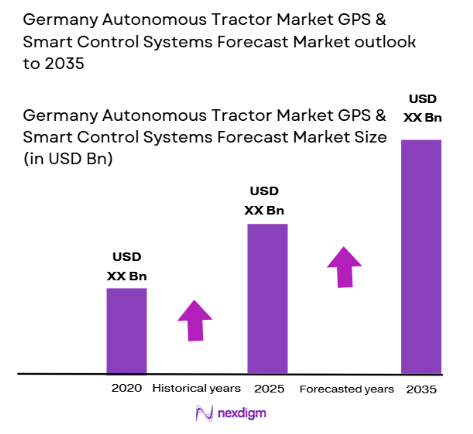
Germany autonomous tractor market GPS and smart control systems market reached USD ~ billion based on a recent historical assessment, supported by strong adoption of precision agriculture technologies and automation in mechanized farming. Expansion of large-scale commercial farming operations and the need to address agricultural labor shortages have accelerated demand for GPS-guided autonomous tractors and smart control systems. Government-backed digital agriculture programs and advanced farm mechanization levels have further strengthened system deployment across major agricultural regions.
Dominance within the Germany autonomous tractor market GPS and smart control systems market is concentrated in Bavaria, Lower Saxony, and North Rhine-Westphalia due to large arable land availability and intensive mechanized farming practices. These regions host leading agricultural equipment manufacturers and precision farming technology providers, enabling faster adoption of autonomous tractor platforms. Strong infrastructure, high farm incomes, and integration of advanced digital farming solutions across cereal and specialty crop production have reinforced regional leadership in smart tractor system deployment.
Market Segmentation
By Product Type:
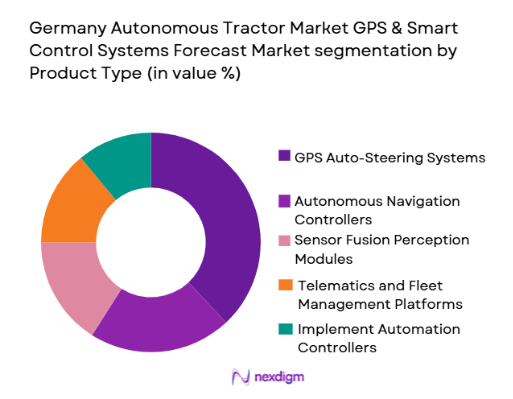
Germany Autonomous Tractor Market GPS and Smart Control Systems market is segmented by product type into GPS auto-steering systems, autonomous navigation controllers, sensor fusion perception modules, telematics and fleet management platforms, and implement automation controllers. Recently, GPS auto-steering systems has a dominant market share due to factors such as widespread retrofit compatibility across existing tractor fleets, strong dealer distribution networks, and farmer familiarity with precision guidance technologies. Adoption has been reinforced by demand for straight-line accuracy in large-scale cereal farming and ease of integration with ISOBUS implements. Compared with fully autonomous navigation systems, GPS auto-steering solutions require lower investment and minimal training, accelerating penetration among mid-sized farms. OEMs have standardized guidance-ready tractors, further embedding GPS auto-steering as the baseline automation layer in Germany’s mechanized agriculture landscape.
By Application:
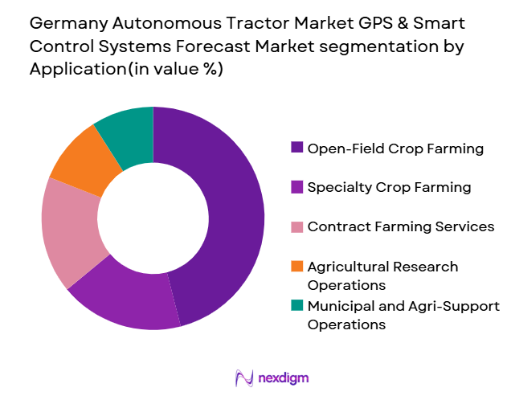
Germany Autonomous Tractor Market GPS and Smart Control Systems market is segmented by application into open-field crop farming, specialty crop farming, contract farming services, agricultural research operations, and municipal/agri-support operations. Recently, open-field crop farming has a dominant market share due to factors such as extensive cereal and oilseed cultivation requiring high-precision guidance and long operating hours suited to automation. Large farms in northern and eastern Germany operate high-horsepower tractors where GPS-based automation significantly reduces labor dependency and fuel wastage. Standardized field geometries and repetitive operations enable efficient deployment of autonomous control systems compared with fragmented specialty farming. Machinery manufacturers prioritize open-field solutions, increasing product availability and service support. As a result, smart control and GPS tractor technologies are most deeply embedded within open-field agricultural production systems.
Competitive Landscape
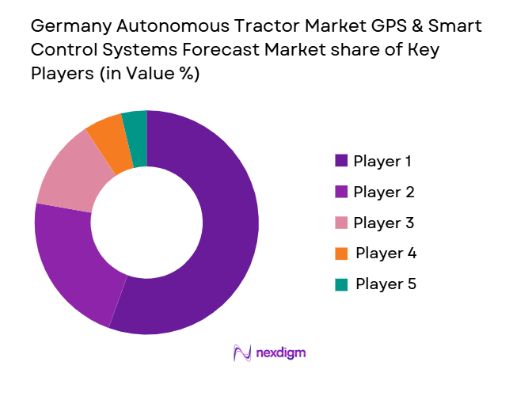
The Germany autonomous tractor market GPS and smart control systems market exhibits moderate consolidation led by global agricultural machinery OEMs and precision agriculture technology firms. Major tractor manufacturers integrate proprietary GPS and autonomy platforms directly into equipment, while specialized guidance and sensor companies supply retrofit and advanced perception systems. Strategic partnerships between machinery OEMs and digital agriculture technology providers are shaping competition, with innovation centered on autonomy levels, sensor integration, and fleet connectivity across large commercial farms.
| Company Name | Establishment Year | Headquarters | Technology Focus | Market Reach | Key Products | Revenue | Autonomy Integration Level |
| John Deere | 1837 | USA | ~ | ~ | ~ | ~ | ~ |
| CNH Industrial | 2013 | UK | ~ | ~ | ~ | ~ | ~ |
| AGCO (Fendt) | 1990 | USA/Germany | ~ | ~ | ~ | ~ | ~ |
| CLAAS | 1913 | Germany | ~ | ~ | ~ | ~ | ~ |
| Trimble Agriculture | 1978 | USA | ~ | ~ | ~ | ~ | ~ |
Germany Autonomous Tractor Market GPS & Smart Control Systems Forecast Market Analysis
Growth Drivers
Agricultural Labor Shortage and Farm Automation Demand:
Germany agriculture sector faces persistent labor shortages due to aging farmer demographics and declining seasonal workforce availability, creating structural pressure toward mechanization and automation adoption. Autonomous tractor GPS and smart control systems directly address this constraint by enabling extended operating hours without human drivers while maintaining precision field operations. Large farms particularly depend on automation to sustain productivity across planting and harvesting cycles where labor peaks are intense. Smart tractors also reduce operator fatigue and errors during repetitive operations such as tillage and seeding. Government digital farming programs support automation investments, further accelerating system deployment. Precision automation lowers dependency on skilled tractor operators, which are increasingly scarce in rural regions. As agricultural enterprises consolidate into larger units, the economic viability of autonomous tractor investment improves substantially. Consequently, labor scarcity acts as a foundational structural driver shaping long-term growth of GPS and smart control tractor technologies across Germany agriculture.
Precision Agriculture Efficiency and Input Optimization Requirements:
German agriculture increasingly prioritizes efficiency in fuel, fertilizer, and seed usage due to cost pressures and environmental regulations. GPS-guided autonomous tractors enable centimeter-level accuracy in field operations, minimizing overlaps and reducing input wastage across large arable farms. Smart control systems integrate with variable-rate technology, ensuring precise application aligned with soil and crop conditions. These capabilities directly support compliance with nutrient management and sustainability standards mandated across European agriculture. Farmers benefit from measurable reductions in operating costs and environmental footprint through optimized machine paths and automated section control. Integration with digital farm management platforms enables data-driven decision making, enhancing productivity per hectare. As sustainability and efficiency targets intensify, demand for precision-enabled autonomous tractors continues expanding. Thus, operational optimization requirements remain a central driver accelerating GPS and smart control system adoption across Germany’s mechanized farming sector.
Market Challenges
High Capital Cost and Return on Investment Uncertainty:
Autonomous tractor GPS and smart control systems require significant upfront investment in hardware, sensors, and software integration, creating financial barriers for small and mid-sized farms. While large enterprises can justify automation through scale efficiencies, smaller operators often face uncertain payback periods. Retrofit solutions reduce cost but still demand capital expenditure beyond conventional tractor upgrades. Financing options for advanced precision equipment remain limited compared with standard agricultural machinery loans. Farmers also consider technology obsolescence risk given rapid innovation cycles in autonomy and sensors. Uncertainty regarding long-term maintenance and software support further complicates investment decisions. Market adoption therefore concentrates among financially strong farms and contractors, slowing broader penetration. Cost sensitivity remains particularly acute in regions with mixed farm sizes and fragmented land structures. Consequently, high capital intensity continues constraining widespread deployment of autonomous GPS tractor systems across Germany agriculture.
Regulatory and Safety Constraints on Fully Autonomous Operation:
Agricultural autonomy in Germany operates within stringent machinery safety and liability regulations that still assume human supervision of heavy equipment. Fully driverless tractors face certification challenges related to operational safety, obstacle detection, and liability responsibility during accidents. Field conditions vary significantly across terrains and crop types, complicating standardization of autonomous safety protocols. Insurance frameworks for autonomous agricultural machinery remain underdeveloped, increasing risk exposure for farmers. Connectivity limitations in rural areas also hinder reliable remote monitoring of autonomous operations. Regulatory approval processes for advanced autonomy features progress slowly compared with technological development cycles. Farmers therefore adopt assisted autonomy systems more readily than fully driverless solutions. Compliance costs and certification timelines increase product development complexity for manufacturers. These regulatory and safety constraints continue moderating the pace of high-level autonomy deployment within Germany agricultural tractor systems market.
Opportunities
Retrofit Autonomy Integration Across Existing Tractor Fleets:
Germany maintains a large installed base of modern tractors already equipped with electronic control architectures compatible with GPS and smart control upgrades. Retrofit autonomy kits allow farmers to upgrade existing machinery without purchasing new autonomous tractors, significantly lowering adoption barriers. Dealers and precision agriculture integrators increasingly offer modular guidance and automation packages tailored to diverse tractor models. This expands addressable market beyond new equipment buyers to the broader tractor fleet. Retrofit solutions also enable phased automation adoption, starting with guidance and progressing toward full autonomy. Farmers can achieve precision benefits quickly while spreading investment costs over time. OEMs and technology firms view retrofit markets as high-growth segments due to scale potential. Integration of cloud connectivity and telematics further enhances retrofit value. Consequently, retrofit autonomy represents a major commercial expansion pathway for GPS and smart control systems in Germany agriculture.
Expansion of Autonomous Solutions in Specialty Crop and Vineyard Farming:
Germany specialty agriculture sectors such as vineyards, orchards, and horticulture require precise navigation within narrow rows and complex terrain, making them ideal for autonomous tractor innovation. Traditional large tractors are less suitable in these environments, creating demand for compact autonomous platforms with advanced GPS and sensor fusion. Labor intensity in specialty farming is particularly high, increasing automation value. Smart control tractors can operate safely among crops with minimal damage through precise path planning. Manufacturers are developing lightweight autonomous units tailored to vineyard and orchard operations. Adoption also aligns with premium crop production economics where automation cost can be justified. Government sustainability initiatives in specialty agriculture support precision mechanization. As these segments modernize, autonomous GPS tractor technologies gain new application domains beyond open-field farming. Specialty crop expansion therefore presents a strong opportunity frontier in Germany autonomous tractor market.
Future Outlook
Germany autonomous tractor market GPS and smart control systems market is expected to expand steadily over the next five years driven by continued precision agriculture adoption and mechanization efficiency goals. Advancements in sensor fusion, AI navigation, and connectivity will enable higher autonomy levels across farming operations. Regulatory clarity around autonomous machinery safety and liability is likely to improve deployment confidence. Increasing farm consolidation and sustainability requirements will sustain demand for GPS-guided smart tractors across German agriculture.
Major Players
- John Deere
- CNH Industrial
- AGCO
- Fendt
- CLAAS
- Trimble
- Topcon
- Hexagon Agriculture
- Bosch Rexroth
- Raven Industries
- Kubota
- Horsch
- Amazone
- Krone
- Kuhn Group
Key Target Audience
- Agricultural machinery manufacturers
- Precision agriculture technology providers
- Farm automation solution developers
- Agricultural equipment distributors
- Commercial farming enterprises
- Investments and venture capitalist firms
- Government and regulatory bodies
- Agricultural contractors
Research Methodology
Step 1: Identification of Key Variables
Key variables including tractor automation levels, GPS adoption rates, farm mechanization intensity, and precision agriculture penetration were identified through secondary data analysis and industry reports across Germany agriculture technology markets.
Step 2: Market Analysis and Construction
Market structure was constructed using equipment sales data, precision farming technology adoption metrics, and autonomous tractor deployment indicators across major German agricultural regions and farming segments.
Step 3: Hypothesis Validation and Expert Consultation
Findings were validated through consultation with agricultural machinery experts, precision agriculture specialists, and farm technology integrators to ensure realistic assessment of adoption drivers and constraints.
Step 4: Research Synthesis and Final Output
Validated insights were synthesized into market sizing, segmentation, and competitive analysis frameworks, ensuring consistency with Germany agricultural mechanization trends and autonomous tractor technology developments.

- Executive Summary
- Research Methodology (Definitions, Scope, Industry Assumptions, Market Sizing Approach, Primary & Secondary Research Framework, Data Collection & Verification Protocol, Analytic Models & Forecast Methodology, Limitations & Research Validity Checks)

- Market Definition and Scope
- Value Chain & Stakeholder Ecosystem
- Regulatory / Certification Landscape
- Sector Dynamics Affecting Demand
- Strategic Initiatives & Infrastructure Growth

- Growth Drivers
Labor Shortage in German Agriculture Driving Automation Adoption
Expansion of Precision Farming Practices Across Large Farms
Government Support for Smart Farming and Digitalization
Need for Fuel and Input Efficiency Optimization
Integration of Autonomous Implements in Mechanized Farming - Market Challenges
High Initial Cost of Autonomous Tractor Systems
Interoperability Issues Across Mixed Equipment Fleets
Regulatory Constraints on Fully Driverless Field Operations
Limited Connectivity in Rural Farming Regions
Farmer Skill Gap in Advanced Digital Systems - Market Opportunities
Growth in Retrofit Autonomy Solutions for Existing Tractors
Expansion of Vineyard and Specialty Crop Automation
Integration with Farm Management and Data Platforms - Trends
Shift Toward Fully Autonomous Field Operations
Adoption of AI Driven Precision Control Algorithms
Integration of Multi Sensor Perception in Tractors
Rise of Autonomy as a Service Models in Farming
Standardization of ISOBUS and Smart Implement Interfaces - Government Regulations & Defense Policy
EU Machinery Regulation Compliance for Autonomous Equipment
German Digital Farming Subsidy and Innovation Programs
Data Governance and Agricultural Telematics Standards - SWOT Analysis
- Stakeholder and Ecosystem Analysis
- Porter’s Five Forces Analysis
- Competition Intensity and Ecosystem Mapping

- By Market Value, 2020-2025
- By Installed Units, 2020-2025
- By Average System Price, 2020-2025
- By System Complexity Tier, 2020-2025

- By System Type (In Value%)
GNSS Guidance and Auto-Steering Systems
Autonomous Navigation Control Units
Machine Vision and Sensor Fusion Modules
Telematics and Remote Fleet Management Systems
Implement Automation and Section Control Systems - By Platform Type (In Value%)
Open Field Row Crop Tractors
Orchard and Vineyard Tractors
High Power Articulated Tractors
Compact Utility Tractors
Specialty Autonomous Field Robots - By Fitment Type (In Value%)
OEM Integrated Smart Control Systems
Dealer Installed Autonomy Kits
Aftermarket GPS Guidance Retrofits
Hybrid Assisted Steering Packages
Factory Ready Autonomy Prepared Platforms - By EndUser Segment (In Value%)
Large Commercial Farming Enterprises
Agricultural Contractors and Service Providers
Cooperative Farming Groups
Research and Agricultural Institutes
Specialty Crop Growers - By Procurement Channel (In Value%)
Direct OEM Procurement
Authorized Agricultural Equipment Dealers
Precision Agriculture Technology Integrators
Government Subsidy Programs
Leasing and Equipment Financing Providers - By Material / Technology (in Value %)
RTK GNSS Positioning Technology
LiDAR and Radar Perception Systems
AI Based Path Planning Software
ISOBUS Implement Communication Technology
Edge Computing Control Hardware

- Market structure and competitive positioning
- Market share snapshot of major players
- CrossComparison Parameters (Autonomy Level, GNSS Accuracy, Sensor Suite Integration, Implement Automation Capability, Software Platform Openness, Retrofit Compatibility, Connectivity Technology, Safety Redundancy Architecture, Fleet Management Integration, Price Tier Positioning)
- SWOT Analysis of Key Players
- Pricing & Procurement Analysis
- Key Players
Fendt
CLAAS
John Deere
CNH Industrial
Kubota
AGCO
Horsch
Amazone
Krone
Kuhn Group
Trimble Agriculture
Topcon Agriculture
Hexagon Agriculture
Raven Industries
Bosch Rexroth

- Large Farms Seeking Labor Independent Field Operations
- Contractors Investing in High Utilization Autonomous Fleets
- Specialty Crop Growers Demanding Precision Navigation
- Research Institutes Driving Autonomous Farming Trials

- Forecast Market Value, 2026-2035
- Forecast Installed Units, 2026-2035
- Price Forecast by System Tier, 2026-2035
- Future Demand by Platform, 2026-2035


 Request a Sample
 Ask for Customization
 Get a Quote
 Enquire Now