
 Download PDF
Market Overview
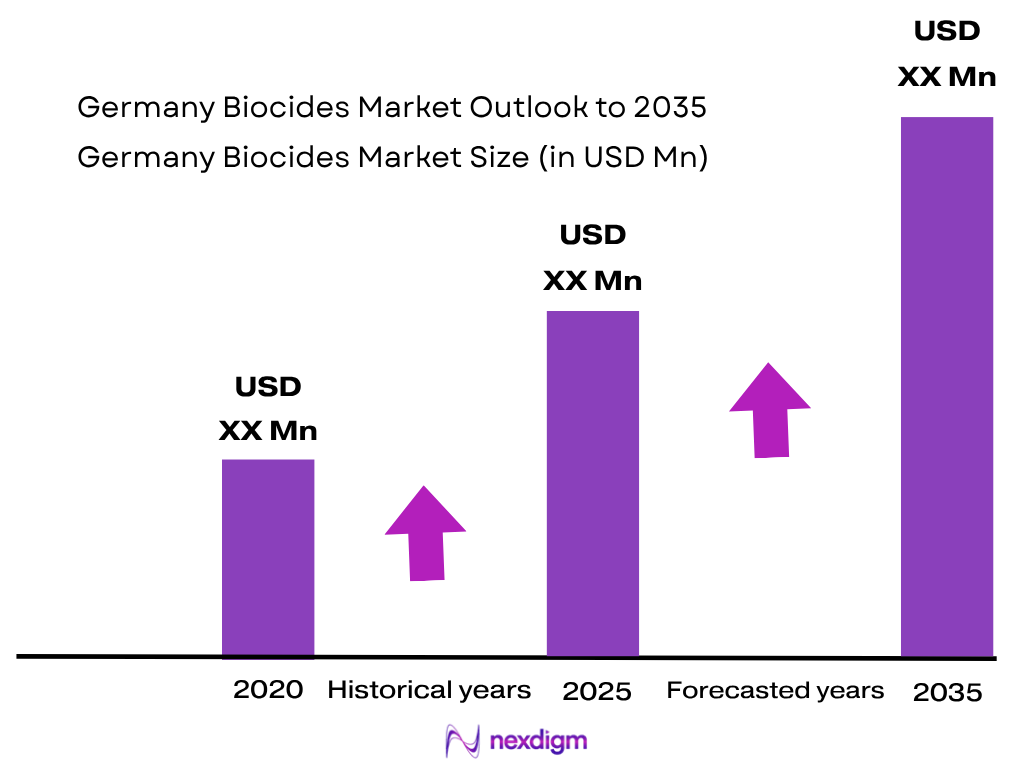
The Germany Biocides Market is valued at ~USD XX million in 2024, under the defined scope covering industrial and institutional biocides, preservatives, disinfectants, water-treatment biocides, antifouling products and related microbial-control formulations. Demand is supported by Germany’s large industrial and chemical manufacturing base, extensive food and pharmaceutical production, municipal and industrial water treatment, healthcare hygiene and coatings preservation. Germany generated EUR 4,328.97 billion of GDP in 2024, compared with EUR 4,219.31 billion in 2023, while real GDP contracted by 0.2% in 2024 following a 0.3% contraction in 2023. The scale of industrial activity remains important for biocide demand because microbial control is embedded in process-water treatment, cooling systems, product preservation, sanitation and material protection.
Germany’s chemical manufacturing ecosystem is particularly relevant. Destatis maintains dedicated production, turnover and new-order datasets for chemical and pharmaceutical manufacturing, reflecting the country’s extensive downstream industrial base. Germany also has 83,577,140 residents, compared with 83,456,045 in the preceding annual observation, creating a large municipal, healthcare, food-service and consumer-product ecosystem requiring hygiene and preservation solutions. The market therefore combines recurring industrial demand with regulatory-driven consumption, particularly where microbial contamination can affect product quality, worker safety, water systems or material durability.
Market Segmentation
By Product Type
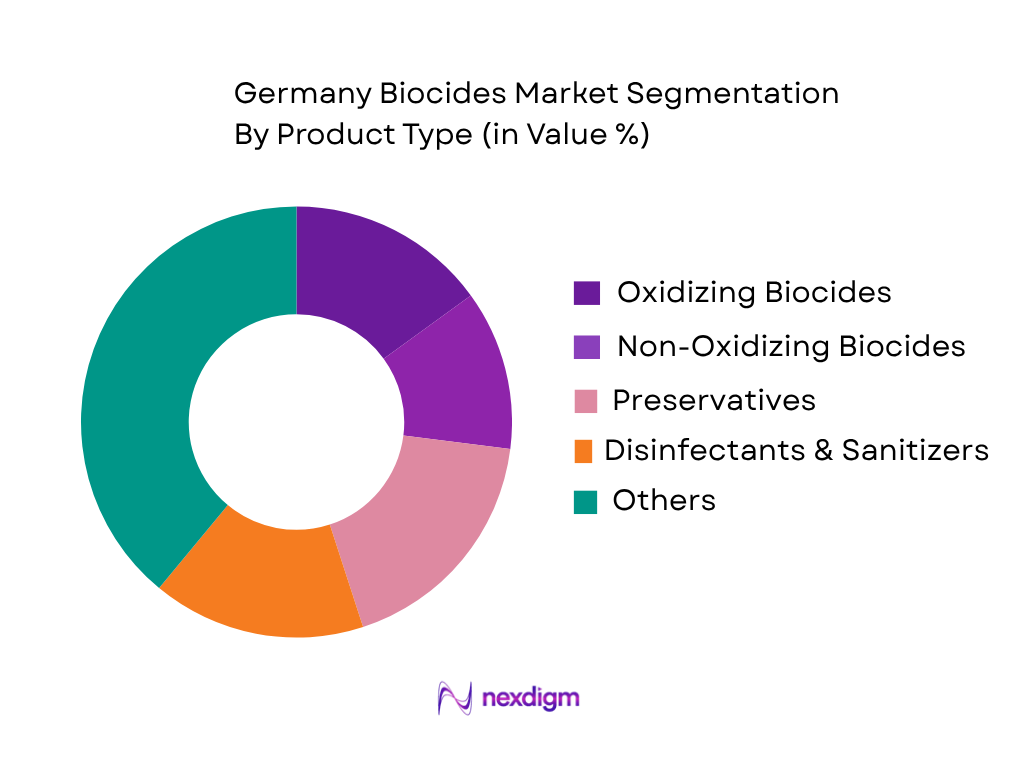
The Germany Biocides Market is segmented by product type into oxidizing biocides, non-oxidizing biocides, preservatives, disinfectants and sanitizers, antimicrobial additives, algaecides, fungicides, biofilm-control agents, insecticides and acaricides, rodenticides and antifouling biocides.
By Application
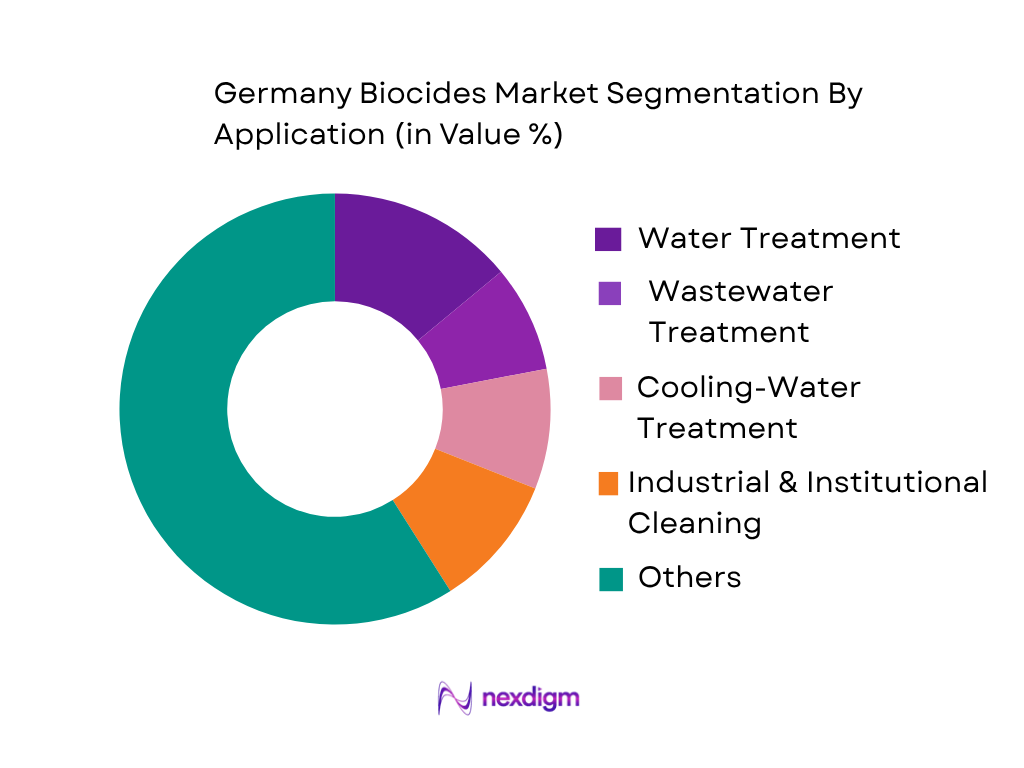
The Germany Biocides Market is segmented by application into water treatment, wastewater treatment, cooling-water treatment, industrial and institutional cleaning, food and beverage processing, paints and coatings, personal care and cosmetics, pulp and paper, textiles, oil and gas and petrochemicals, wood preservation, construction materials, marine and antifouling, agriculture and animal hygiene, and healthcare and institutional disinfection.
Competitive Landscape
The Germany Biocides Market is characterized by multinational specialty-chemical producers, dedicated antimicrobial suppliers, formulation specialists and companies with strong European regulatory capabilities. Competition is shaped by active-substance portfolios, product authorization, application-specific formulation expertise, technical service and the ability to comply with Germany’s stringent chemical and environmental requirements. Companies with manufacturing or R&D infrastructure in Germany have an additional advantage in serving customers requiring technical support, regulatory documentation and supply reliability.
| Company | Establishment | Headquarters | Biocide Portfolio | Key Applications | Germany Manufacturing/R&D | Regulatory Capability | Distribution Reach | Technical-Service Capability |
| LANXESS | 2004 | Cologne, Germany | ~ | ~ | ~ | ~ | ~ | ~ |
| BASF | 1865 | Ludwigshafen, Germany | ~ | ~ | ~ | ~ | ~ | ~ |
| Evonik Industries | 2007 | Essen, Germany | ~ | ~ | ~ | ~ | ~ | ~ |
| Schülke & Mayr | 1889 | Norderstedt, Germany | ~ | ~ | ~ | ~ | ~ | ~ |
| Arxada | 2021 | Basel, Switzerland | ~ | ~ | ~ | ~ | ~ | ~ |
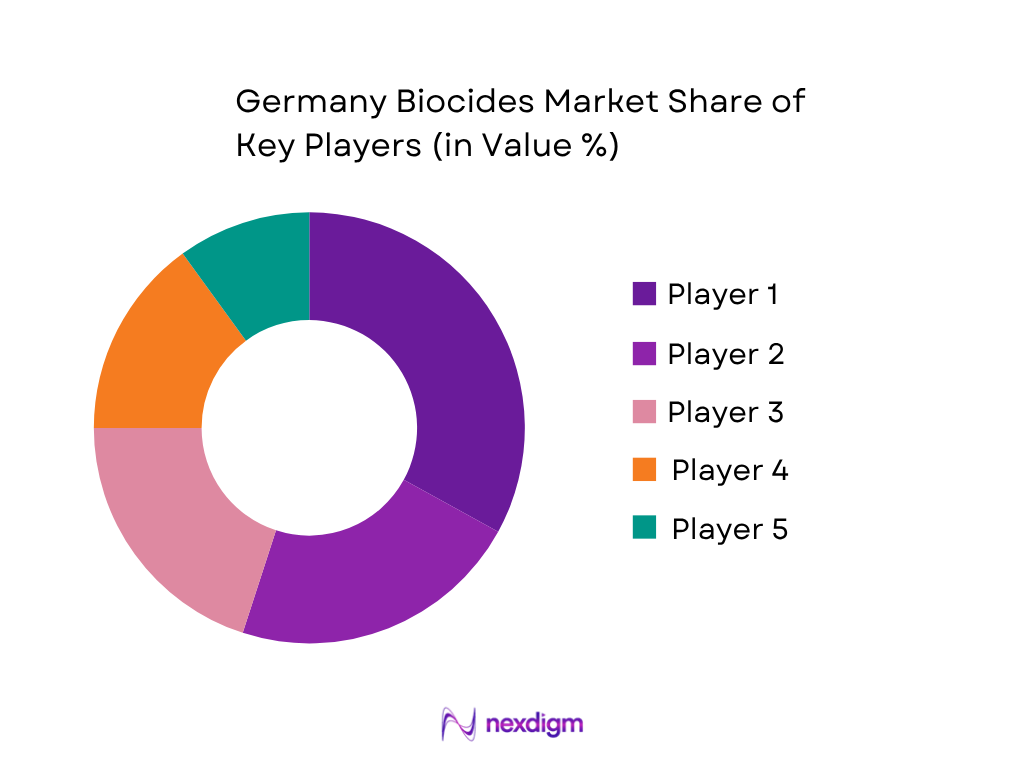
Germany Biocides Market Analysis
Growth Drivers
Industrial Water Treatment Demand
Germany’s industrial base provides a substantial recurring requirement for microbial control in process water, cooling circuits, wastewater systems and production environments. Industry represented 25.8% of German GDP in 2024, while the country’s current-price GDP reached USD 4.684 trillion, establishing a large industrial economic base for specialty chemical consumption. Manufacturing gross value added nevertheless declined 3.0% in 2024, making efficiency and reliable process-water management increasingly important for industrial operators. Germany’s public wastewater infrastructure comprised approximately 8,700 treatment plants and processed 8.33 billion m³ of wastewater, including 4.82 billion m³ of domestic and industrial wastewater. This treatment infrastructure creates recurring microbial-control requirements involving disinfection, biofilm management and process-water hygiene. The chemical-intensive industrial structure is particularly relevant because cooling systems, heat exchangers and process-water loops can experience bacterial growth, algae and biofilm formation that affect equipment performance and water quality. Biocides therefore support operational continuity across chemical production, metals, machinery, automotive and other manufacturing facilities. The combination of 25.8% industrial economic contribution, 8,659 public treatment plants and 8.33 billion m³ of treated wastewater demonstrates the breadth of water-management infrastructure supporting demand for microbial-control technologies.
Pharmaceutical and Healthcare Manufacturing
Germany’s pharmaceutical manufacturing ecosystem creates demand for highly controlled microbial-management solutions across production environments, purified-water systems, cleanrooms, equipment and formulated products. Destatis records 381 pharmaceutical-manufacturing establishments in Germany, employing 134,195 people, demonstrating the scale of the manufacturing base requiring controlled hygiene and preservation processes. Pharmaceutical production also provided positive momentum within an otherwise weak industrial environment: industrial production in December 2024 included an 11.6% increase in pharmaceutical production, contrasting with a 3.1% decline in overall industrial production during the same month. Germany’s wider economy generated USD 4.684 trillion of GDP and recorded USD 56,087 GDP per capita in 2024, supporting a sophisticated healthcare and pharmaceutical ecosystem. Biocides are relevant to pharmaceutical facilities through environmental sanitation, surface disinfection, water-system microbial control and preservation of selected formulated products, subject to applicable regulatory requirements. Healthcare facilities add further recurring hygiene demand because microbial contamination can affect infection-control procedures, equipment surfaces and high-contact environments. The combination of 381 pharmaceutical establishments, 134,195 pharmaceutical employees, 11.6% pharmaceutical production growth in December, and USD 56,087 GDP per capita indicates a technically demanding end-use environment where efficacy, regulatory status, material compatibility and environmental performance influence biocide selection.
Market Challenges
Stringent Biocidal Product Regulation
Regulatory requirements represent a significant challenge for Germany Biocides Market participants because products must satisfy European and German requirements governing active substances, product authorization, safe use, labeling, exposure and environmental protection. The regulatory burden is particularly relevant because biocides are intentionally designed to control living organisms, making environmental and human-exposure assessment central to product authorization. Germany’s industrial base generated USD 4.684 trillion of GDP in 2024, while industry accounted for 25.8% of GDP, meaning regulatory requirements affect a large and diverse base of industrial customers. Environmental controls are also significant: German authorities recorded approximately 6.5 million liters of water-hazardous substances released accidentally in 2024, of which around 2.0 million liters remained in the environment. Although these figures cover all water-hazardous substances rather than biocides specifically, they illustrate the country’s stringent environmental-management context. Germany’s wastewater infrastructure further demonstrates the scale of regulated water flows, with approximately 8,659 public wastewater treatment plants and 8.33 billion m³ of wastewater treated. Biocide suppliers consequently need detailed authorization dossiers, appropriate risk-mitigation measures, compliant labeling and controlled application instructions. Product developers may also face reformulation requirements when active substances are restricted or authorization conditions change, increasing development complexity and potentially slowing commercialization.
Active Substance Restrictions and Environmental Risk Controls
Restrictions on active substances and increasing scrutiny of environmental exposure create challenges for suppliers whose products depend on particular antimicrobial chemistries. Germany’s industrial sector represented 25.8% of GDP in 2024, creating extensive demand for effective microbial control while simultaneously generating large volumes of industrial water and wastewater requiring controlled chemical management. Approximately 8,659 public wastewater treatment plants treated 8.33 billion m³ of wastewater, including 4.82 billion m³ of domestic and industrial wastewater. This infrastructure creates pathways through which residual chemicals can reach treatment systems and ultimately receiving environments, making biodegradability, aquatic toxicity and residual management important considerations in product selection. Germany recorded approximately 6.5 million liters of water-hazardous substances released through accidents in 2024, with 2.0 million liters remaining in the environment. These figures are not biocide-specific, but they demonstrate the broader environmental sensitivity surrounding hazardous chemical management. At the same time, industrial production declined 4.5% on a calendar-adjusted basis in 2024, increasing pressure on manufacturers to justify chemical inputs through measurable operational benefits. Biocide suppliers therefore need to balance microbial efficacy with lower environmental exposure, controlled dosing, compatibility with wastewater systems and regulatory acceptability. Products facing active-substance restrictions may require substitution, reformulation or new authorization work, raising technical and compliance requirements for manufacturers.
Market Opportunities
Advanced Water-Treatment Biocides
Advanced water-treatment formulations represent an opportunity because Germany combines a large industrial water-management base with extensive wastewater infrastructure and increasingly sophisticated environmental requirements. Public wastewater treatment involved approximately 8,659 plants and 8.33 billion m³ of wastewater, while 4.82 billion m³ consisted of domestic and industrial wastewater. These volumes create a substantial operating environment for microbial-control technologies targeting bacterial growth, algae, biofilms and other biological fouling mechanisms. Industrial applications extend beyond municipal wastewater into cooling towers, process-water loops, heat exchangers and manufacturing systems. Germany’s industrial sector contributed 25.8% of GDP in 2024, reinforcing the importance of reliable process-water management across chemical, pharmaceutical, automotive, machinery and manufacturing facilities. Advanced formulations can differentiate through lower residual concentrations, improved compatibility with membranes and materials, targeted biofilm control and automated dosing rather than relying solely on conventional broad-spectrum treatment. The opportunity is also aligned with the country’s environmental-management requirements: approximately 2.0 million liters of water-hazardous substances remained in the environment following accidental releases in 2024, highlighting the importance of controlled chemical use. Suppliers capable of combining microbial efficacy with lower environmental exposure can therefore address both industrial performance requirements and stricter environmental expectations.
Sustainable Preservation and Low-Residual Chemistry
Sustainable preservation provides an opportunity across German paints, coatings, construction materials, formulated chemicals, pharmaceuticals and other water-based products where microbial contamination can shorten shelf life or compromise product quality. Germany’s manufacturing sector remains extensive despite a 3.0% decline in manufacturing gross value added in 2024, while industry still represented 25.8% of GDP. The scale of industrial production creates a broad installed base for preservatives and antimicrobial additives, but environmental expectations increasingly favor formulations that minimize residual release and reduce unnecessary chemical loading. Germany’s public wastewater network treated 8.33 billion m³ of wastewater through approximately 8,659 plants, creating a substantial downstream system in which chemical residues may ultimately be managed. Environmental risk is further demonstrated by the 6.5 million liters of water-hazardous substances released accidentally in 2024 and the 2.0 million liters that remained in the environment. These figures cover all hazardous substances, not biocides specifically, but they reinforce the importance of safer chemical management. Opportunity therefore exists for biodegradable or lower-toxicity active substances, optimized preservation systems, controlled-release technologies and formulations that maintain microbial protection with lower residual exposure. Suppliers combining regulatory readiness, environmental documentation and application-specific preservation performance can address German manufacturers seeking to maintain product protection while reducing environmental burden.
Future Outlook
The Germany Biocides Market is expected to develop through a combination of industrial microbial-control requirements, regulatory-driven product replacement and increasing demand for more targeted formulations. Water treatment, pharmaceutical manufacturing, food processing and coatings preservation are expected to remain important application areas. The regulatory environment is likely to increasingly influence product selection, favoring authorized active substances, lower environmental exposure, optimized dosing and application-specific formulations. Demand should also benefit from Germany’s established specialty-chemical manufacturing ecosystem and the continued development of sustainable microbial-control technologies. The market’s competitive structure is expected to shift toward suppliers capable of combining efficacy, regulatory support, environmental performance and technical service rather than relying solely on commodity biocide chemistry.
Major Players
- LANXESS
- BASF
- Evonik Industries
- Schülke & Mayr
- Arxada
- Ecolab
- Clariant
- Thor Group
- Vink Chemicals
- Buckman
- Solenis
- Kemira
- Dow
- Troy Corporation
- Italmatch Chemicals
Key Target Audience
- Biocides and Specialty-Chemical Manufacturers
- Industrial Water-Treatment Companies and Water Utilities
- Paints, Coatings and Construction-Chemical Manufacturers
- Pharmaceutical and Healthcare Manufacturing Companies
- Food and Beverage Processing Companies
- Investments and Venture Capitalist Firms (Industrial Chemicals, Water Technology, Specialty Materials)
- Government and Regulatory Bodies (German Federal Environment Agency – Umweltbundesamt; Federal Institute for Occupational Safety and Health – BAuA; Federal Office for Chemicals)
- Industrial Procurement and Chemical Distribution Companies
Research Methodology
Step 1: Identification of Key Variables
The initial phase involves constructing an ecosystem map covering German biocide manufacturers, active-substance suppliers, formulators, distributors and end users. Secondary research is used to identify product types, Product Types under the EU Biocidal Products Regulation, active substances, applications and end-use industries. Regulatory requirements and environmental constraints are mapped alongside industrial demand indicators.
Step 2: Market Analysis and Construction
Historical market information is compiled across product categories, active substances, applications and end-use industries. The assessment incorporates Germany’s industrial production base, chemical manufacturing activity, pharmaceutical and food-processing ecosystems, water-treatment requirements and import-export flows. Market values are then structured through a combination of demand-side consumption and supplier-side revenue assessment.
Step 3: Hypothesis Validation and Expert Consultation
Market hypotheses are validated through discussions with biocide manufacturers, formulators, water-treatment operators, chemical distributors and industrial procurement professionals. Expert inputs are used to test assumptions regarding product substitution, active-substance adoption, application intensity, regulatory effects and supply-chain conditions. Particular attention is given to differences between commodity disinfectants and specialty industrial biocides.
Step 4: Research Synthesis and Final Output
The final stage triangulates secondary research, supplier information, industrial indicators and expert inputs to establish the market structure. Company-level information is assessed against product portfolios, manufacturing footprint, regulatory positioning, application capabilities and distribution reach. The resulting analysis is structured to provide a Germany-specific view of market size, segmentation, competition, regulation and future demand.

- Executive Summary
- Research Methodology (Market Definition and Scope, Biocide Product Classification, Active Substance Mapping, Market Sizing Framework, Top-Down Analysis, Bottom-Up Analysis, Demand-Side Assessment, Supply-Side Assessment, Import-Export Assessment, Primary Industry Interviews, Regulatory Validation, Data Triangulation, Forecasting Framework, Scenario Analysis, Assumptions and Limitations)

- Definition and Scope
- Germany Biocides Industry Structure
- Biocidal Active Substance Ecosystem
- Biocide Formulation and Manufacturing Landscape
- Germany Biocides Value Chain Analysis

- Growth Drivers (Industrial Water Treatment Demand, Pharmaceutical and Healthcare Manufacturing, Food and Beverage Processing, Advanced Manufacturing, Chemical Industry Activity, Paints and Coatings Production, Hygiene Requirements, Wastewater Treatment and Water Reuse)
- Market Challenges (Stringent Biocidal Product Regulation, Active Substance Restrictions, Environmental Risk Controls, Aquatic Toxicity, Biocide Resistance, Hazardous Chemical Handling, Regulatory Compliance Costs, Imported Specialty Active Substance Dependency)
- Market Opportunities (Advanced Water-Treatment Biocides, Cooling-Tower Microbial Control, Wastewater-Reuse Biocides, Low-Residual Chemistry, Biofilm-Specific Technologies, Sustainable Preservation, Pharmaceutical Manufacturing Biocides, Food-Processing Hygiene, Local Formulation and Specialty Distribution)
- Market Trends (Low-Toxicity Formulations, Reduced Biocide Loading, Biofilm-Specific Treatment, Automated Chemical Dosing, Industrial Water Recycling, Sustainable Active Substances, Advanced Disinfection, Membrane Protection, Microbial Monitoring, Integrated Hygiene Management)
- Germany Biocidal Active Substance Regulatory Assessment (Union Approval Status, Existing Active Substances, New Active Substances, Active Substance Renewal, Product Authorisation, Union Authorisation, National Authorisation, Mutual Recognition, Transitional Arrangements)
- SWOT Analysis
- Porter’s Five Forces Analysis
- PESTLE Analysis

- By Market Value (2020-2025)
- By Biocidal Active Substance Consumption Volume (2020-2025)
- By Formulated Biocide Consumption Volume (2020-2025)
- By Product Type (2020-2025)
- By Application (2020-2025)
- By End-Use Industry (2020-2025)
- By Domestic Production and Imports (2020-2025)

- By Product Type (In Value %)
Oxidizing Biocides
Non-Oxidizing Biocides
Disinfectants and Sanitizers
Preservatives
Antimicrobial Additives
Algaecides
Fungicides
Biofilm-Control Agents
Insecticides and Acaricides
Rodenticides
Antifouling Biocides
Other Specialty Biocides - By Active Substance (In Value %)
Chlorine-Based Biocides
Bromine-Based Biocides
Chlorine Dioxide
Glutaraldehyde
Isothiazolinones
Quaternary Ammonium Compounds
DBNPA
Bronopol
Peracetic Acid
Hydrogen Peroxide
Phenolic Compounds
Copper-Based Biocides - By Application (In Value %)
Water Treatment
Wastewater Treatment
Cooling-Water Treatment
Industrial and Institutional Cleaning
Food and Beverage Processing
Paints and Coatings
Personal Care and Cosmetics
Pulp and Paper
Oil and Gas and Petrochemicals
Wood Preservation - By End-Use Industry (In Value %)
Municipal Water and Wastewater Utilities
Industrial Water Treatment
Food and Beverage Manufacturing
Pharmaceutical Manufacturing
Healthcare Facilities
Construction Materials
Pulp and Paper
Chemical Manufacturing
Automotive Manufacturing
Metalworking and Engineering
Personal Care and Household Products
Wood and Building Materials
Agriculture and Animal Production
Marine and Shipping - By Formulation Type (In Value %)
Liquid Biocides
Powder and Granular Biocides
Concentrated Formulations
Ready-to-Use Disinfectants
Water-Soluble Formulations
Emulsion and Dispersion Formulations
Controlled-Release Formulations - By Functional Requirement (In Value %)
Bacterial Control
Fungal Control
Algae Control
Biofilm Control
Slime Control
Preservation
Disinfection
Biofouling Prevention
Membrane Protection
Microbiologically Influenced Corrosion Control

- Market Share of Major Players (By Value, Volume, Product Type, Active Substance, Application, End-Use Industry, Distribution Channel)
- Cross Comparison Parameters (Active Substance Portfolio Breadth, Biocide Formulation Breadth, Industrial Water-Treatment Capability, Paints and Coatings Preservation Capability, Food and Pharmaceutical Hygiene Capability, Regulatory and Authorisation Expertise, German Technical-Service and Distribution Reach, Sustainable and Low-Residual Technology Capability)
- SWOT Analysis Of Major Players
- Detailed Profiles of Major Companies
LANXESS
BASF
Evonik Industries
Schülke & Mayr
Arxada
Ecolab
Clariant
Thor Group
Vink Chemicals
Buckman
Solenis
KEMIRA
DOW
Troy Corporation
Italmatch Chemicals

- Industrial Water-Treatment Demand Assessment
- Food and Beverage Customer Analysis
- Pharmaceutical Customer Analysis
- Healthcare Customer Analysis
- Paints and Coatings Customer Analysis
- Chemical Manufacturing Customer Analysis
- Automotive and Metalworking Customer Analysis

- By Market Value (2026-2035)
- By Biocidal Active Substance Consumption Volume (2026-2035)
- By Formulated Biocide Consumption Volume (2026-2035)
- By Product Type (2026-2035)
- By Application (2026-2035)
- By End-Use Industry (2026-2035)
- By Domestic Production and Imports (2026-2035)


 Request a Sample
 Ask for Customization
 Get a Quote
 Enquire Now