
 Download PDF
Market Overview
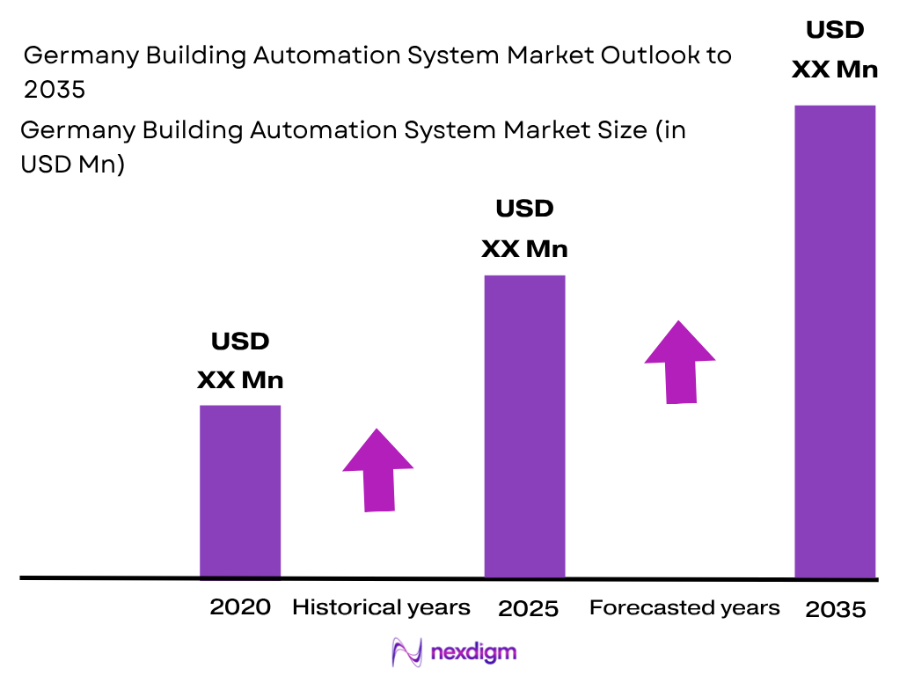
The Germany Building Automation System market is valued at ~USD X billion, with the market supported by energy-efficiency requirements, modernization of commercial buildings, HVAC optimization, and increasing adoption of connected building controls. Germany recorded EUR 450.66 billion in construction investment in the latest annual observation, compared with EUR 453.01 billion in the preceding year, while non-residential construction investment reached EUR 180.18 billion, compared with EUR 175.48 billion. These investment levels create a substantial addressable environment for automation, controls, sensors, energy monitoring and building-management systems.
Germany’s strongest building-automation demand is concentrated around major commercial, industrial and technology centers such as Berlin, Munich, Frankfurt, Hamburg, Stuttgart, Düsseldorf and Cologne, where large office portfolios, corporate campuses, airports, healthcare facilities, data centers and industrial properties require integrated HVAC, lighting, energy and security controls. The retrofit opportunity is particularly relevant because Germany had approximately 43.76 million dwellings across residential and non-residential buildings in the latest annual stock observation, while building-related final energy consumption stood at 792 TWh, demonstrating the scale of the building energy-management challenge.
Market Segmentation
By Component Type
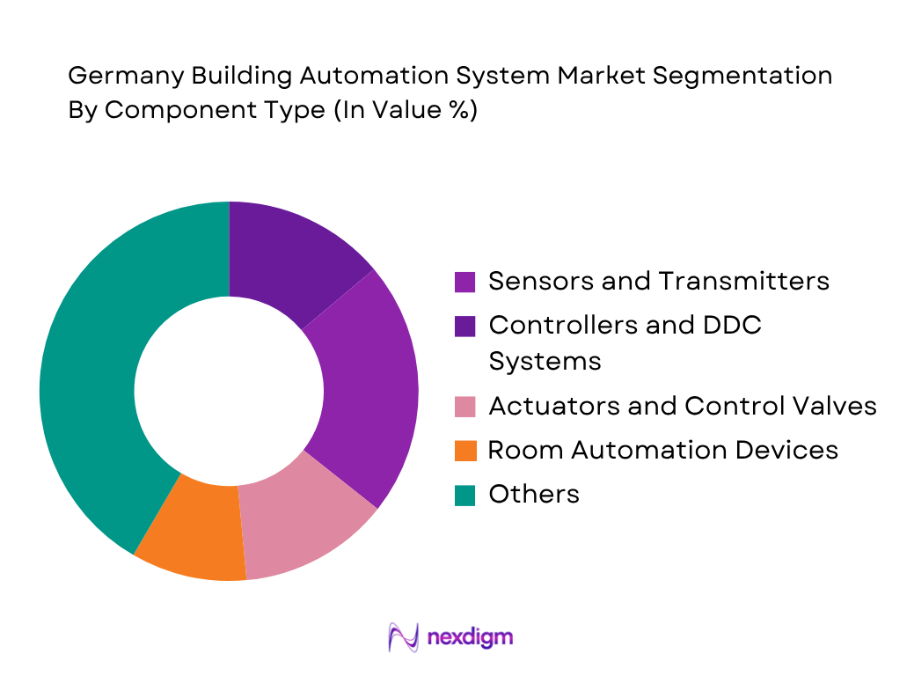
Germany Building Automation System market is segmented by component type into sensors and transmitters, controllers and DDC systems, actuators and control valves, room automation devices, communication gateways, building-management software, energy-management software, operator interfaces, smart meters and field devices. Controllers and DDC systems are expected to represent the dominant segment because they provide the central logic required to coordinate HVAC, room-level equipment, sensors, actuators and energy-management functions. Germany’s regulatory environment increasingly links building performance with monitoring and controllability. The federal building framework requires qualifying non-residential buildings to use building automation and control systems capable of continuously monitoring, recording and analysing energy consumption and building-technical systems. Such systems must also identify efficiency losses and provide information that supports improvements in building performance. Gesetze im Internet Siemens’ Desigo portfolio, for example, combines building-management software with PXC controllers, HVAC controls and room automation, illustrating the growing importance of controller-led architectures
By Building Type
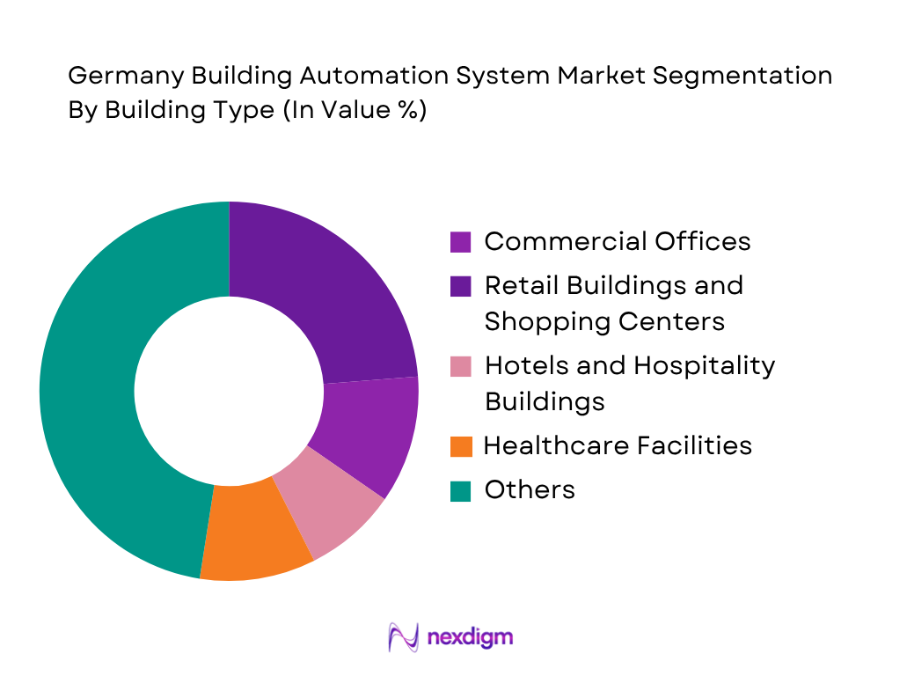
Germany Building Automation System market is segmented by building type into commercial offices, retail buildings, hotels and hospitality facilities, healthcare facilities, educational buildings, government and civic buildings, industrial facilities, data centers, airports and transportation facilities, residential buildings and corporate headquarters. Commercial office buildings are positioned as the dominant segment because they combine substantial HVAC, lighting, occupancy, access, energy-monitoring and indoor-environment requirements with comparatively high levels of digital infrastructure. Germany’s building-related energy consumption reached 792 TWh, with building-related heat consumption accounting for 32.5% of total final energy consumption, reinforcing the need for automated HVAC and energy controls. Umweltbundesamt The retrofit opportunity is also significant because construction activity is not limited to new buildings; Germany completed 161,682 buildings in the latest annual observation, while total construction investment remained above EUR 450 billion. This creates opportunities for both new automation installations and modernization of installed systems.
Competitive Landscape
The Germany Building Automation System market is characterized by global automation and building-technology companies alongside specialized German automation providers. Siemens, Schneider Electric, Johnson Controls, Honeywell and Bosch have particularly broad capabilities spanning building-management platforms, HVAC controls, sensors, energy management, security and digital building services. Siemens’ Desigo portfolio integrates building automation, management, HVAC, room automation and fire-safety capabilities, while Schneider Electric’s EcoStruxure Building provides an open platform for building-system integration and energy optimization. Siemens Johnson Controls’ Metasys platform integrates mechanical and electrical building systems and is deployed across more than 54,000 locations globally, while Honeywell Building Technologies provides building-management, security, fire/life-safety, electrical and sustainability solutions.
| Company | Establishment Year | Headquarters | Building Management System | HVAC Automation | Protocol / Integration Capability |
| Siemens | 1847 | Munich & Berlin, Germany | ~ | ~ | ~ |
| Schneider Electric | 1871 | Rueil-Malmaison, France | ~ | ~ | ~ |
| Johnson Controls | 1885 | Milwaukee, USA | ~ | ~ | ~ |
| Honeywell | 1906* | Charlotte, USA | ~ | ~ | ~ |
| Bosch | 1886 | Gerlingen, Germany | ~ | ~ | ~ |
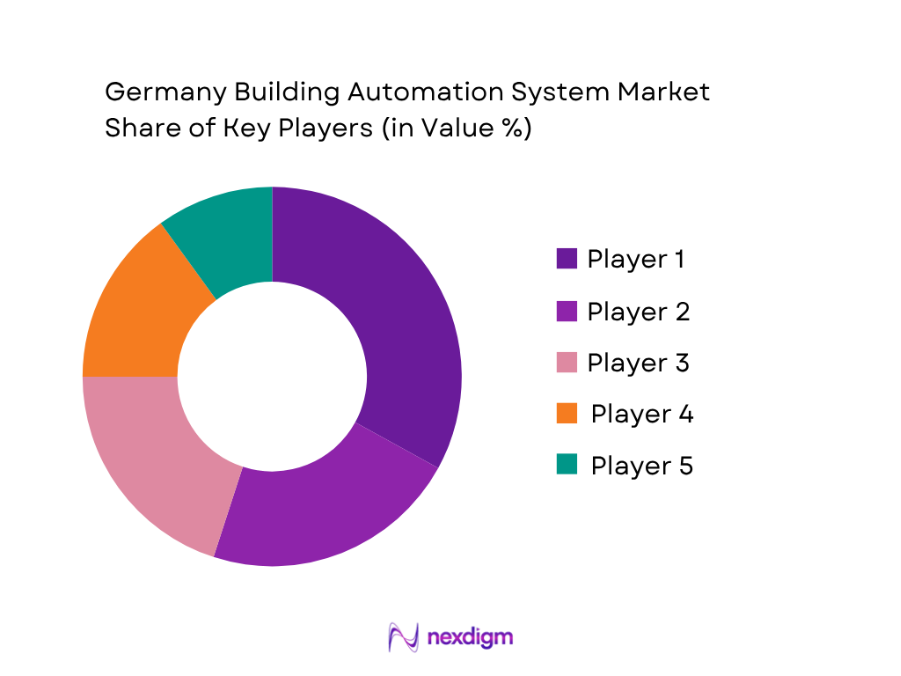
Germany Building Automation System Market Analysis
Growth Drivers
Energy Efficiency Requirements and Building Energy Management Demand
Germany Building Automation System market is being supported by the country’s large building-energy footprint and increasingly structured energy-efficiency requirements. The German Environment Agency reported building-related final energy consumption of 792 TWh, demonstrating the scale of energy that can be influenced through automated HVAC control, room regulation, metering, scheduling and energy-management platforms. The building stock also provides a substantial installed base for automation upgrades, with 43.76 million dwellings recorded in 2024 by the Federal Statistical Office. Germany’s construction investment reached EUR 450.66 billion in 2024, including EUR 180.18 billion in non-residential construction investment, creating a broad environment for automation equipment and controls. New heating-system deployment is also becoming increasingly connected to energy-management requirements: 69.4% of approximately 76,100 completed residential buildings used heat pumps as their primary heating source in 2024, while 73.9% used renewable energy as their primary heating source. These developments increase the technical need for coordinated monitoring of heating, cooling, ventilation, electricity and thermal systems. Building automation can connect these assets through controllers, sensors and software, enabling operators to monitor consumption, detect inefficiencies and coordinate equipment operation.
Commercial Building Modernization and HVAC Optimization Requirements
Commercial building modernization is another important driver because Germany combines a large existing building base with substantial requirements for controlling heating, ventilation, air conditioning and electrical systems. Construction investment totaled EUR 450.66 billion in 2024, while investment in non-residential construction reached EUR 180.18 billion, compared with EUR 175.48 billion in 2023. The building stock therefore represents a continuing demand environment for both new automation installations and retrofit projects. At the same time, Germany completed 251,900 dwellings in 2024, although completions declined by 42,500 units from the preceding year, highlighting the increasing importance of improving existing assets rather than relying exclusively on new construction. The Federal Statistical Office also reported that construction gross fixed capital formation fell by 3.5% in real terms during 2024, reinforcing the relevance of targeted modernization investments that can improve operational efficiency within existing properties. HVAC systems are particularly important because heating remains a major building-energy application. In new residential construction, heat pumps were the primary heating system in 69.4% of completed residential buildings and were planned for 81.0% of permitted residential buildings. This transition increases demand for controls capable of coordinating heat pumps, ventilation, room temperatures, meters and other building systems.
Market Challenges
High Initial System Integration Complexity and Legacy Building Automation Systems
Germany Building Automation System market faces significant technical complexity because modernization projects frequently require integration between existing HVAC equipment, electrical systems, meters, sensors, controllers and newer digital platforms. The challenge is particularly relevant across the existing building stock, which contained 43.76 million dwellings in 2024. Many properties therefore require automation upgrades without complete replacement of their underlying mechanical and electrical infrastructure. Germany’s construction environment also remained constrained, with construction gross fixed capital formation declining by 3.5% in real terms during 2024. Construction investment totaled EUR 450.66 billion, while non-residential construction investment amounted to EUR 180.18 billion, indicating a large but cost-sensitive investment environment. Building automation projects can require engineering surveys, protocol conversion, controller replacement, sensor installation, commissioning and integration with legacy equipment before operators receive the intended energy-management benefits. Interoperability becomes more complicated when buildings contain equipment installed during different modernization cycles. HVAC controllers, lighting systems, access systems and energy meters may operate through different communication architectures, requiring gateways or software integration. The problem is intensified in occupied commercial properties because installation work must often be coordinated around tenants and ongoing operations. Consequently, suppliers increasingly need solutions that can integrate legacy systems while minimizing disruption and commissioning requirements.
Cybersecurity Risks and Skilled Automation Engineer Shortages
Cybersecurity and specialist workforce requirements represent important challenges as German buildings become increasingly connected through IP networks, cloud platforms, remote monitoring and centralized building-management systems. Building automation now connects operational equipment such as HVAC controllers, ventilation systems, smart meters, access systems and energy-management platforms, increasing the number of digital interfaces that must be protected and maintained. The scale of the installed building base adds complexity: Germany had 43.76 million dwellings in 2024, while the country recorded 251,900 completed dwellings during the same year. This combination of existing and newly constructed properties creates a wide range of automation architectures requiring different cybersecurity and maintenance approaches. Technical complexity also coincides with a subdued construction environment. Real construction gross fixed capital formation declined by 3.5% in 2024, while total construction investment stood at EUR 450.66 billion. Building owners therefore have to balance cybersecurity upgrades, controls modernization and engineering requirements against constrained investment conditions. The workforce challenge is particularly relevant because advanced building automation projects require expertise across HVAC engineering, electrical controls, networking, software, cybersecurity and commissioning. Increasing deployment of heat pumps and integrated energy systems adds another technical layer, with 69.4% of residential buildings completed in 2024 using heat pumps as their primary heating source. This makes multidisciplinary automation expertise increasingly important for reliable system integration.
Market Opportunities
Building Automation Retrofit Programs and Energy Optimization of Existing Buildings
Germany Building Automation System market has a substantial opportunity in retrofitting existing commercial, institutional and residential buildings because the installed building base is considerably larger than annual new construction. Germany recorded 43.76 million dwellings in 2024, while only 251,900 dwellings were completed during the year, illustrating the much larger scale of the existing stock relative to annual additions. Construction investment reached EUR 450.66 billion, with EUR 180.18 billion directed toward non-residential construction. This creates opportunities for suppliers offering modular controls, sensors, HVAC automation, energy monitoring and building-management software that can be installed without full building reconstruction. Energy optimization provides a particularly relevant application because building-related final energy consumption stood at 792 TWh, according to the German Environment Agency. Retrofit solutions can therefore target operational areas such as heating schedules, ventilation control, temperature management, occupancy-based operation, lighting control and equipment fault detection. The transition toward electrified and renewable heating also creates an additional integration opportunity. Heat pumps represented the primary heating technology in 69.4% of residential buildings completed in 2024, while renewable energy served as the primary heating source in 73.9% of those buildings. Building automation platforms can coordinate these systems with meters, storage, ventilation and other electrical loads, creating opportunities for suppliers positioned around whole-building energy optimization rather than individual control components.
Cloud-Based Building Management, AI-Enabled Operations and Demand-Response Automation
Germany Building Automation System market has emerging opportunities in cloud-connected building management, AI-supported optimization, digital twins and automated demand-response functions because building owners increasingly require continuous visibility into equipment performance and energy consumption. Germany’s building-related final energy consumption of 792 TWh provides a substantial operational base where digital monitoring and automated optimization can create value without requiring complete replacement of building structures. The installed building base reached 43.76 million dwellings in 2024, creating opportunities for scalable platforms capable of connecting equipment across multiple properties. At the same time, Germany’s construction investment reached EUR 450.66 billion, including EUR 180.18 billion in non-residential construction, indicating a sizeable commercial and institutional property environment in which centralized facility-management platforms can be deployed. Electrification of heating further strengthens the opportunity for intelligent controls. Heat pumps were the primary heating technology in 69.4% of residential buildings completed in 2024, and 81.0% of permitted residential buildings were planned to use heat pumps as their primary heating system. These systems can be connected with smart meters, thermal storage, photovoltaic generation, ventilation and flexible electrical loads. Cloud platforms can provide portfolio-level visibility, while AI-enabled analytics can identify abnormal consumption, predict equipment faults and optimize operating schedules. Demand-response automation can further coordinate building loads with electricity-system conditions, strengthening the commercial case for connected building-management platforms.
Future Outlook
The Germany Building Automation System market is expected to benefit from the continuing transition toward energy-efficient, connected and data-driven buildings. Regulatory requirements are increasing the importance of measurable building performance, while owners are seeking automation solutions capable of reducing energy consumption, improving occupant conditions and extending equipment operating efficiency. Germany’s building-related final energy consumption remained 792 TWh, providing a substantial operational efficiency opportunity. Umweltbundesamt The next phase of the market is expected to emphasize retrofit automation, open communication protocols, cloud-connected building management, predictive maintenance, AI-supported optimization and integration of HVAC, lighting, shading and energy systems.
Major Players
- Siemens
- Schneider Electric
- Johnson Controls
- Honeywell
- Bosch Building Technologies
- Beckhoff Automation
- Kieback&Peter
- SAUTER Deutschland
- ABB
- WAGO
- Phoenix Contact
- Loxone
- Distech Controls
- Delta Controls
- Belimo
Key Target Audience
- Commercial Real Estate Owners and Operators
- Facility Management Companies
- Building Automation System Integrators
- HVAC and Mechanical-System Contractors
- Industrial Facility Operators
- Data Center Developers and Operators
- Investments and Venture Capitalist Firms
- Government and Regulatory Bodies (Federal Ministry for Economic Affairs and Climate Action, Federal Office for Economic Affairs and Export Control, Federal Ministry for Housing, Urban Development and Building)
Research Methodology
Step 1: Identification of Key Variables
The initial phase involves constructing a Germany Building Automation System ecosystem map covering building owners, automation manufacturers, HVAC suppliers, system integrators, facility managers and technology providers. The assessment identifies variables including installed automation systems, connected devices, HVAC controls, BMS deployments, retrofit activity, protocol adoption and energy-management requirements.
Step 2: Market Analysis and Construction
Historical and current information is compiled across building automation components, building types, applications and deployment models. Construction investment, building activity, energy consumption, retrofit requirements and regulatory developments are assessed alongside company product portfolios to establish the underlying demand structure of the Germany Building Automation System market. Official construction and energy statistics are used to validate market drivers. Destatis
Step 3: Hypothesis Validation and Expert Consultation
Market hypotheses are developed around automation penetration, retrofit potential, HVAC control adoption, open-protocol deployment, cloud-based building management and energy optimization. These hypotheses are validated through discussions with building automation specialists, system integrators, HVAC professionals, facility managers and technology suppliers to strengthen the interpretation of market dynamics.
Step 4: Research Synthesis and Final Output
The final stage integrates component-level, building-level and application-level findings into a consolidated Germany Building Automation System market assessment. Company capabilities, technology portfolios, regulatory requirements and building-energy indicators are triangulated to validate the competitive landscape, segmentation structure and future market outlook.

- Executive Summary
- Research Methodology (Market Definition and Scope, Germany Building Automation System Classification, Building Automation and Control System Mapping, Direct Digital Control Assessment, Distributed Control System Evaluation, Building Management System Assessment, Energy Management System Integration, HVAC Automation Assessment, Lighting Control Evaluation, Shading and Blind Control Assessment, Access and Security Integration, Fire and Life Safety Integration, Room Automation Assessment, Sensor and Actuator Mapping, Controller and DDC Architecture Assessment, Communication Protocol Analysis, BACnet and BACnet/IP Assessment, KNX Technology Evaluation, Modbus Integration Assessment, LonWorks and Other Protocol Assessment, Cloud-Based Building Automation Evaluation, Edge Computing Assessment, IoT Building Platform Assessment, Cybersecurity Assessment, Energy Monitoring and Optimization Assessment, Existing Building Retrofit Assessment, New-Build Automation Assessment, System Integrator Capability Assessment, Domestic Manufacturing and Engineering Capability Assessment, Import Dependency Assessment, Supply-Side Assessment, Demand-Side Assessment)

- Definition and Scope
- Germany Building Automation System Industry Evolution and Development of Building Management Systems, Direct Digital Controls, Distributed Building Automation, HVAC Controls, Room Automation, Smart Lighting Controls, Automated Shading Systems, Energy Management Systems, Occupancy-Based Controls, Indoor Air Quality Monitoring, IoT-Enabled Building Automation, Cloud Building Management Platforms, Edge-Based Automation, Digital Twins for Buildings, Predictive Building Operations, Integrated Security and Access Control, Fire and Life Safety Integration, Smart Metering and Energy Monitoring, Demand-Response Automation and AI-Enabled Building Optimization
- Building Automation System Value Chain Analysis
- Building Automation System Supply Chain Analysis
- Sensor Manufacturers, Temperature and Humidity Sensor Suppliers, Occupancy and Presence Sensor Suppliers, Air Quality Sensor Suppliers, Actuator Manufacturers, Valve and Damper Actuator Suppliers, DDC and Automation Controller Manufacturers, PLC and Industrial Control Suppliers, Room Automation Device Manufacturers, HVAC Control Equipment Suppliers, Lighting Control Manufacturers, Smart Metering Providers, Communication Gateway Manufacturers, Building Management Software Providers, Cloud Building Platforms, Cybersecurity Solution Providers, Building Automation System Integrators, Electrical Contractors, HVAC Contractors, Facility Management Companies, Energy Service Companies, Architects, MEP Consultants, General Contractors, Property Developers, Building Owners and Facility Operators

- Growth Drivers (Energy Efficiency Requirements, Building Energy Management Demand, Commercial Building Modernization, HVAC Optimization Requirements, Digitalization of Building Operations, Smart Building Adoption, Indoor Air Quality Management, Existing Building Retrofit Activity, Integration of Renewable Energy Systems, Demand-Response Capability, Facility Operating Cost Optimization, Building Decarbonization Requirements)
- Market Challenges (High Initial System Integration Complexity, Legacy Building Automation Systems, Fragmented Building Technology Infrastructure, Interoperability Requirements, Cybersecurity Risks, Skilled Automation Engineer Shortages, Proprietary Protocol Dependencies, Retrofit Installation Constraints, Long Building Upgrade Cycles, Integration of Multiple Building Systems, Data Governance Requirements, High Technical Commissioning Requirements)
- Market Opportunities (Building Automation Retrofit Programs, Energy Optimization of Existing Buildings, Cloud-Based Building Management Platforms, AI-Enabled Predictive Building Operations, Digital Twin Integration, Smart HVAC Optimization, Demand-Response Automation, Indoor Air Quality Monitoring, Automated Energy Metering, Cybersecurity-Enabled Building Controls, Data Center Automation, Multi-Site Facility Management Platforms, Smart Building-as-a-Service Models)
- Market Trends (Open Protocol Adoption, BACnet/IP Deployment, KNX Integration, Cloud-Based Building Management, Edge Computing, AI-Based Fault Detection, Predictive Maintenance, Occupancy-Based HVAC Control, Integrated Lighting and Shading Automation, Digital Energy Monitoring, Building Digital Twins, Cybersecurity-by-Design, Wireless Sensors, Smart Meter Integration, Interoperable Multi-Vendor Building Automation)
- Government Regulations and Standards (Gebäudeenergiegesetz Requirements, GEG Building Automation Requirements, DIN EN ISO 52120-1 Building Automation Energy Efficiency Framework, DIN V 18599 Building Energy Performance Assessment, DIN EN 15232 Legacy Building Automation Classification, VDI Building Automation Guidelines, BACnet Standards, KNX Standards, Energy Monitoring Requirements, Building Cybersecurity Requirements, Data Protection Requirements, Fire Safety Requirements, Electrical Safety Requirements)
- SWOT Analysis
- Porter’s Five Forces Analysis
- PESTLE Analysis
- Stakeholder Ecosystem
- Competition Ecosystem

- By Market Value (2020-2025)
- By Installed Building Automation Systems (2020-2025)
- By Connected Building Automation Devices (2020-2025)
- By Installed Sensors and Actuators (2020-2025)
- By Building Management System Deployments (2020-2025)
- By HVAC Automation System Deployments (2020-2025)

- By Component Type (In Value %)
Sensors and Transmitters
Controllers and DDC Systems
Actuators and Control Valves
Room Automation Devices
Communication Gateways and Interfaces
Building Management Software
Energy Management Software
Human-Machine Interfaces and Operator Panels
Smart Meters and Energy Monitoring Devices
Field Devices and Control Modules - By Building Automation Function (In Value %)
HVAC Control and Optimization
Lighting Control
Shading and Blind Control
Room Temperature Control
Indoor Air Quality Management
Energy Monitoring and Management
Occupancy and Presence Management
Access and Security Integration
Fire and Life Safety Integration
Water and Plumbing System Monitoring
Elevator and Vertical Transportation Integration
Electrical Power Monitoring - By Communication Protocol (In Value %)
BACnet and BACnet/IP
KNX
Modbus
LonWorks
M-Bus
OPC UA and OPC DA
DALI
EnOcean
Wireless Building Automation Protocols
Proprietary Building Automation Protocols - By Building Type (In Value %)
Commercial Office Buildings
Retail Buildings and Shopping Centers
Hotels and Hospitality Buildings
Healthcare Facilities
Educational Institutions
Government and Civic Buildings
Industrial and Manufacturing Facilities
Data Centers
Airports and Transportation Facilities
Residential and Multifamily Buildings
Corporate Headquarters
Sports and Entertainment Facilities - By Deployment Model (In Value %)
New Construction
Existing Building Retrofit
Building Modernization
System Replacement and Upgrade
Expansion of Existing Automation Systems
Multi-Site Building Automation Deployment
Cloud-Based Building Automation Deployment
On-Premise Building Automation Deployment
Hybrid Building Automation Deployment - By End-User (In Value %)
Building Owners
Property Developers
Facility Management Companies
Industrial Facility Operators
Commercial Real Estate Operators
Healthcare Facility Operators
Hospitality Operators
Government and Public-Sector Facility Operators
Data Center Operators
Energy Service Companies - By Region (In Value %)
North Rhine-Westphalia
Bavaria
Baden-Württemberg
Hesse
Berlin
Hamburg
Lower Saxony
Saxony
Rhineland-Palatinate
Rest of Germany

- Market Share of Major Players (By Germany Revenue, Building Automation Product Portfolio, Building Management System Capability, HVAC Automation Capability, Room Automation Portfolio, Sensor and Actuator Portfolio, Controller and DDC Capability, Communication Protocol Coverage, Cloud Building Platform Capability, Energy Management Capability, Cybersecurity Capability, System Integration Capability, Germany Service Network, Installed Building Base, Technical Support Capability)
- Cross Comparison Parameters (Building Automation System Portfolio Breadth, HVAC and Room Automation Capability, BACnet and KNX Interoperability, Controller and DDC Product Range, Sensor and Actuator Portfolio Depth, Cloud and Edge Building Management Capability, AI-Based Energy Optimization and Predictive Maintenance Capability, Germany System Integration and Technical Support Network)
- SWOT Analysis of Major Player
- Detailed Profiles of Major Companies
Siemens Smart Infrastructure
Schneider Electric
Johnson Controls
Honeywell Building Technologies
Bosch Building Technologies
Kieback&Peter GmbH
SAUTER Deutschland
Beckhoff Automation
WAGO
ABB
Loxone
Phoenix Contact
Distech Controls
Delta Controls
Belimo

- Building Owner Automation Requirement Assessment
- Facility Energy Optimization Requirement Analysis
- HVAC Automation Requirement Assessment
- Building Retrofit and Modernization Requirement Analysis
- Smart Building Integration Requirement Assessment
- Indoor Air Quality Monitoring Requirement Analysis
- Energy Management and Demand-Response Requirement Assessment

- By Market Value (2026-2035)
- By Installed Building Automation Systems (2026-2035)
- By Connected Building Automation Devices (2026-2035)
- By Installed Sensors and Actuators (2026-2035)
- By Building Management System Deployments (2026-2035)
- By HVAC Automation System Deployments (2026-2035)


 Request a Sample
 Ask for Customization
 Get a Quote
 Enquire Now
