

 Download PDF
Market Overview
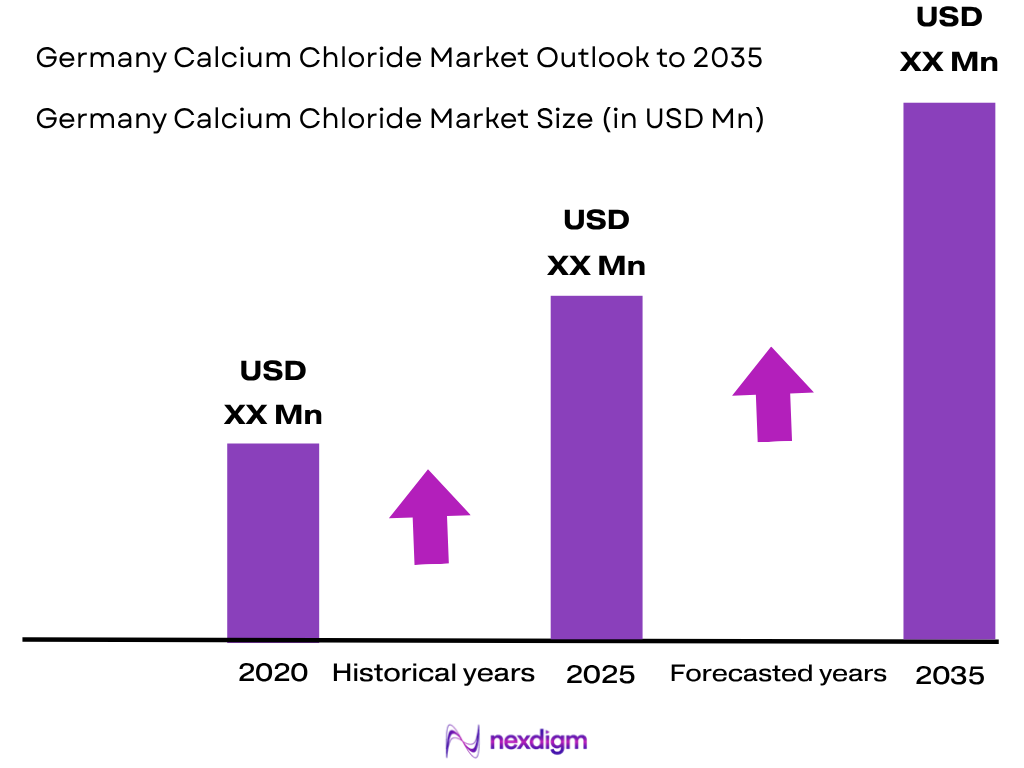
The Germany Calcium Chloride Market is estimated at ~USD XX million in 2024, with the value and forecast CAGR to be replaced by the final proprietary market model. Demand is supported by Germany’s large industrial and infrastructure base. Destatis recorded 209,815 manufacturing legal units, 7.47 million manufacturing employees, and EUR 2.56 trillion in manufacturing turnover in 2024, providing a broad downstream customer base for industrial chemicals. (Destatis) Calcium chloride demand is particularly linked to water treatment, food processing, construction materials, chemical processing, moisture control, and winter road maintenance.
Germany’s calcium chloride demand is concentrated around major industrial and logistics regions, particularly North Rhine-Westphalia, Bavaria, Baden-Württemberg, Hesse and Lower Saxony, where chemical manufacturing, food processing, construction, automotive supply chains and distribution infrastructure are strongly established. Germany recorded 7.41 million manufacturing employees in 2024, including approximately 326,000 in chemical manufacturing, while construction employed approximately 2.61 million people. (Destatis) This industrial concentration supports recurring calcium chloride requirements across water treatment, chemical processing, construction and industrial applications.
Market Segmentation
By Product Form
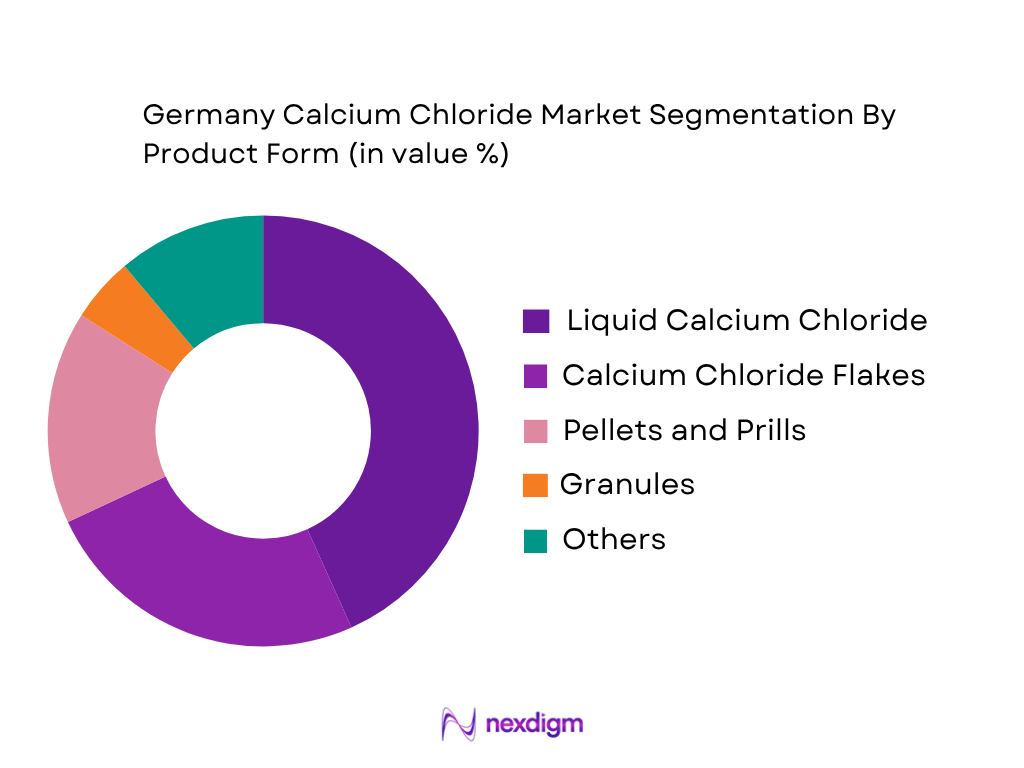
The Germany Calcium Chloride Market is segmented by product form into liquid calcium chloride, flakes, pellets and prills, powder, granules, hydrated calcium chloride and anhydrous calcium chloride. Liquid and concentrated solid forms are particularly relevant to industrial applications because they can be supplied according to application-specific concentration and handling requirements. For example, regional supplier Nedmag offers liquid calcium chloride at concentrations ranging from 16% to 38% and prills with a standard concentration of 96%, demonstrating the importance of concentration and physical form in industrial procurement. Liquid calcium chloride is expected to represent a major product-form category because it can be directly incorporated into water treatment, dust suppression, drilling fluids, industrial processing and other applications without requiring an additional dissolution step. Producers also offer different concentrations to match individual process requirements. Nobian, for example, produces calcium chloride at its Frankfurt site and supplies technical-grade material for de-icing, dust control, oil and gas, construction and water treatment applications. (Nobian) The availability of local production in Frankfurt is strategically relevant to German buyers because it provides a domestic supply point and supports shorter logistics routes. Solid forms remain important where customers require easier storage, transportation or controlled dosing. Prills and flakes can serve industrial, food and feed applications depending on grade and specification. Consequently, Germany’s product-form structure is determined by application requirements, concentration, handling characteristics, storage conditions and procurement preferences rather than by a single universal specification.
By Application
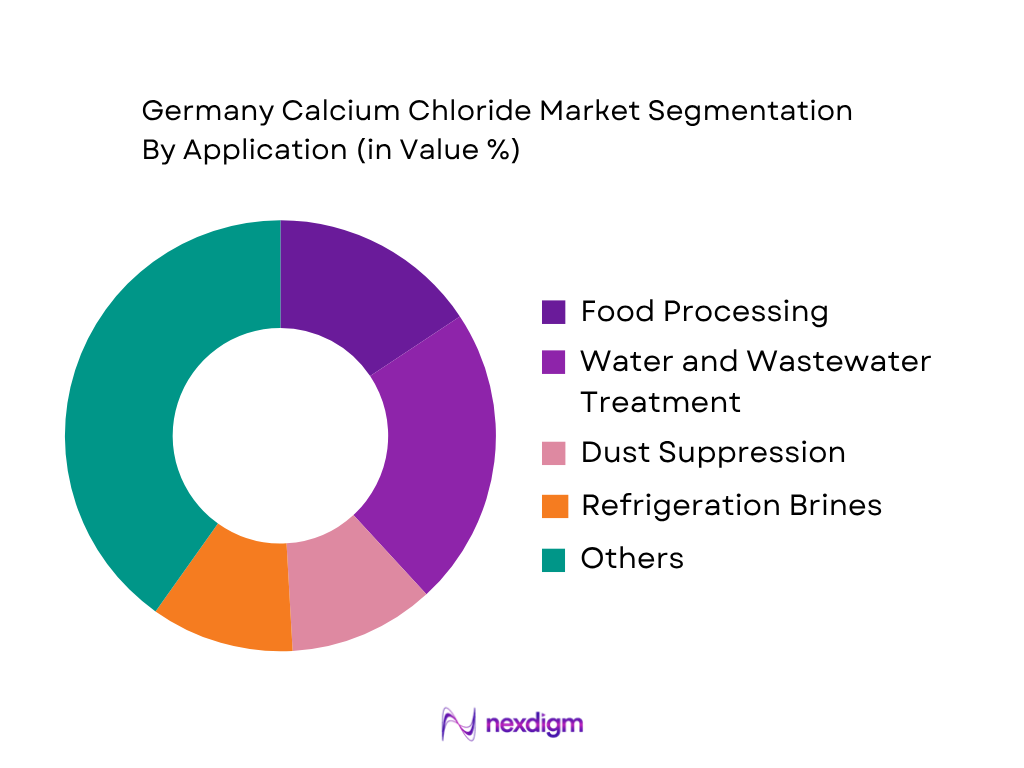
The Germany Calcium Chloride Market is segmented by application into water and wastewater treatment, food processing, construction and concrete acceleration, refrigeration brines, oil and gas, chemical processing, dust control and road maintenance, mining and mineral processing, paper and pulp processing and other industrial applications. The breadth of applications reduces dependence on any single downstream sector and creates demand from municipal, industrial, infrastructure and manufacturing customers. Water and wastewater treatment is positioned as a major application because calcium chloride can perform several functions within industrial and municipal water-treatment processes. Germany’s water, sewerage, waste-management and remediation sector comprised 11,366 legal units and 315,288 employees in 2024, according to Destatis. (Destatis) Calcium chloride also has established uses in industrial processing and environmental applications, while road maintenance provides an additional demand channel during winter conditions. Construction remains another relevant application despite the weaker German construction cycle. Destatis reported EUR 190.2 billion of construction-industry turnover in 2024 and approximately 1.003 million employees in businesses with 20 or more employees. (Destatis) Calcium chloride can be incorporated into concrete-related processes, dust suppression and other construction applications. Food processing provides a separate demand stream because food-grade calcium chloride is used for functions including texture control and food processing. The diversity of these applications makes application-specific grades, purity, concentration and regulatory compliance important competitive factors.
Competitive Landscape
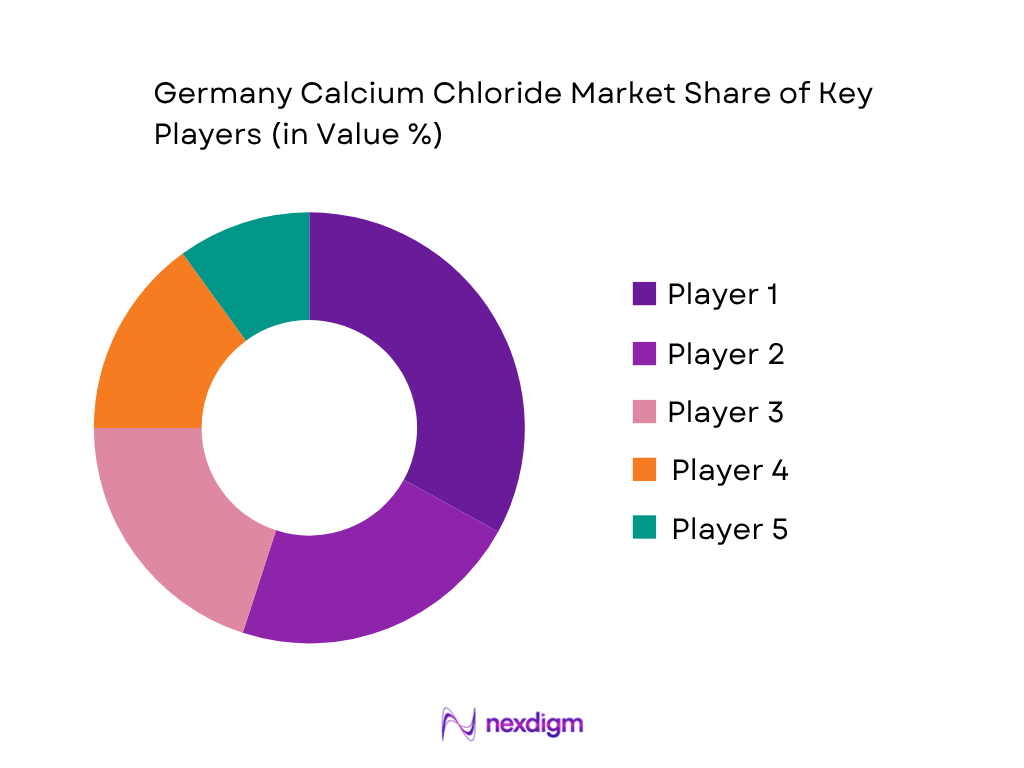
The Germany Calcium Chloride Market includes established chemical producers, European calcium chloride specialists and global chemical distributors. Competition is influenced by production location, physical-form availability, grade portfolio, application expertise, regulatory compliance and distribution reach. Nobian has a calcium chloride production site in Frankfurt, while Nedmag supplies technical, feed and food calcium chloride in liquid and prill forms. (Nobian) Chemical distributors additionally connect international producers with German industrial buyers.
| Company | Establishment Year | Headquarters | Germany Supply Presence | Product Forms | Grade Coverage | Key Applications | Distribution Capability |
| Nobian | 1918 | Amersfoort, Netherlands | ~ | ~ | ~ | ~ | ~ |
| Nedmag | 1958 | Veendam, Netherlands | ~ | ~ | ~ | ~ | ~ |
| Brenntag | 1874 | Essen, Germany | ~ | ~ | ~ | ~ | ~ |
| Solvay | 1863 | Brussels, Belgium | ~ | ~ | ~ | ~ | ~ |
| TETRA Technologies | 1981 | The Woodlands, Texas, USA | ~ | ~ | ~ | ~ | ~ |
Germany Calcium Chloride Market Analysis
Growth Drivers
Demand for De-Icing and Winter Road Maintenance
Germany’s requirement for calcium chloride in winter road maintenance is supported by its extensive road infrastructure and recurring cold-weather conditions across several federal states. Destatis reported approximately 2.83 million kilometres of roads in Germany in 2024 when combining federal, state, district and municipal road networks. Calcium chloride is used where rapid ice melting, brine preparation and lower-temperature de-icing performance are required. The German Federal Ministry for Digital and Transport continues to maintain extensive federal road infrastructure, while municipalities remain responsible for substantial local networks. Calcium chloride also supports dust suppression and surface stabilization in selected infrastructure applications. Its use can complement conventional sodium chloride where lower-temperature performance or liquid brine preparation is required. Germany’s transport and logistics sector provides an additional structural demand base, with Destatis recording 107,052 legal units and 2.56 million employees in transportation and storage activities in 2024. The combination of a large road network, winter-service responsibilities and an extensive logistics industry supports recurring requirements for de-icing chemicals. Demand is therefore linked not only to snowfall events but also to road-safety standards, municipal winter-service operations, freight movement and infrastructure maintenance requirements across Germany.
Expansion of Industrial Water Treatment
Industrial and municipal water-treatment activity provides a broad demand foundation for calcium chloride in Germany because the chemical can be used in selected wastewater-treatment, process-water and industrial treatment applications. Destatis recorded 11,366 legal units, 315,288 employees and EUR 76.0 billion in turnover across water supply, sewerage, waste management and remediation activities in 2024. Germany’s manufacturing ecosystem adds another significant demand base, with 209,815 manufacturing legal units, 7.47 million employees and EUR 2.56 trillion in turnover recorded in the same year. Calcium chloride can support treatment requirements associated with industrial effluent, process-water conditioning and selected wastewater applications. The need for reliable water management is particularly relevant to chemical manufacturing, food processing, metalworking and other industrial operations where wastewater streams require controlled treatment. Germany also maintains stringent environmental-management requirements, increasing the importance of dependable chemical inputs and consistent product specifications. In 2024, Germany’s industrial sector consumed 3,343 petajoules of energy, illustrating the scale of industrial operations that require supporting utility and environmental infrastructure. This combination of manufacturing intensity, water-management infrastructure and regulatory requirements creates a stable application environment for calcium chloride suppliers serving industrial and municipal treatment customers.
Market Challenges
Raw Material and Energy Dependence
Germany’s calcium chloride supply chain faces exposure to energy-intensive chemical production and broader industrial input conditions. Destatis reported that German industry consumed 3,343 petajoules of energy in 2024, while energy-intensive industries consumed approximately 2,738 petajoules. The chemical industry represented the largest energy-consuming industrial branch, with approximately 27.9% of total industrial energy consumption, equivalent to roughly 933 petajoules when calculated from the reported total. Natural gas accounted for 29.2% of industrial energy consumption, while electricity accounted for 21.1%, demonstrating the importance of energy availability to chemical manufacturing and processing. Calcium chloride production can be connected to chlor-alkali and related chemical processes, making upstream operating conditions important for supply reliability and producer economics. Germany’s manufacturing sector also recorded 7.47 million employees and EUR 2.56 trillion of turnover in 2024, meaning changes in industrial utilization can affect chemical demand across multiple customer sectors. The challenge is therefore not restricted to calcium chloride producers; distributors and end users can also experience exposure through transportation, warehousing, chemical processing and inventory requirements. Maintaining dependable supply while managing energy-intensive production conditions remains a significant consideration for German market participants.
Import and Supply Chain Exposure
Germany’s calcium chloride market remains connected to international and European supply networks, creating exposure to transportation availability, supplier concentration, border logistics and upstream production conditions. World Bank trade data recorded Germany’s 2024 calcium chloride imports at approximately 90.8 million kilograms, demonstrating the importance of international supply flows alongside domestic production. Germany imported approximately 65.2 million kilograms from the Netherlands, while additional volumes came from Sweden, Italy, Spain and the Czech Republic. This concentration within European supply routes can provide logistical advantages through relatively short distances, but disruptions affecting production, transportation or cross-border distribution can still influence availability. Germany’s overall goods-import system is exceptionally large, with imports of goods exceeding USD 1.37 trillion in 2024 according to international trade statistics. The chemical distribution sector also requires specialized storage because calcium chloride is hygroscopic and can absorb atmospheric moisture. Solid grades therefore require appropriate packaging, warehousing and handling systems, while liquid grades require suitable bulk tanks and transportation equipment. These requirements increase the operational complexity of maintaining inventories across German industrial customers. Consistent quality documentation, product specifications and regulatory compliance further increase supply-chain requirements for food, pharmaceutical, water-treatment and specialty industrial applications.
Market Opportunities
Food-Grade Calcium Chloride Applications
Germany’s large food-processing industry creates an opportunity for suppliers to expand food-grade calcium chloride applications through higher specification control, traceability and application-focused supply. Destatis reported approximately 498,000 employees in Germany’s food manufacturing industry at the end of 2024, demonstrating the scale of the downstream processing base. Calcium chloride is used in food applications including cheese production, fruit and vegetable processing and selected texture-control processes. Food manufacturers require ingredients that can meet defined purity, handling and documentation requirements, creating opportunities for suppliers with dedicated food-grade portfolios. Germany’s broader manufacturing sector employed approximately 5.5 million people in establishments with at least 50 employees at the end of 2024, while food manufacturing represented one of the major employment categories within this industrial base. The opportunity extends beyond domestic food consumption because German food manufacturers participate extensively in European supply chains and export markets. Suppliers can differentiate through consistent concentration, controlled impurity profiles, batch traceability, technical documentation and dependable delivery formats. Specialty food applications can also create opportunities for pellets, flakes and liquid solutions depending on production requirements. As German food processors continue to operate sophisticated production facilities, calcium chloride suppliers capable of meeting precise food-safety and quality specifications can strengthen relationships with industrial customers and expand higher-value application opportunities.
Shorter European Supply Chains
Shorter European supply chains provide an opportunity for calcium chloride suppliers to strengthen their position in Germany through regional production, local inventory, direct delivery and application-specific technical support. World Bank trade data shows that Germany imported approximately 90.8 million kilograms of calcium chloride in 2024, including approximately 65.2 million kilograms from the Netherlands. The significant role of nearby European suppliers demonstrates the commercial importance of regional logistics in the German market. Germany also recorded 107,052 legal units and approximately 2.56 million employees in transportation and storage activities in 2024, providing extensive logistics infrastructure for chemical distribution. Local or regional supply can reduce transportation distances, simplify replenishment and improve inventory responsiveness for industrial customers. This is particularly relevant for water treatment, construction, food processing, road maintenance and chemical manufacturing customers that require predictable availability. In 2026, Nobian announced direct calcium chloride deliveries from its Frankfurt site, illustrating how production located within Germany can support shorter supply routes and direct customer access. Regional suppliers can further strengthen their position through bulk delivery, local warehousing, emergency replenishment and technical support. These capabilities create opportunities to reduce dependence on distant supply sources while improving service reliability for German industrial users requiring continuous calcium chloride availability.
Future Outlook
Over the next decade, the Germany Calcium Chloride Market is expected to be shaped by industrial water treatment, specialty food applications, chemical processing, construction-related uses and winter maintenance requirements. Germany’s industrial base remains extensive, with manufacturing turnover of EUR 2.56 trillion and construction turnover of EUR 190.2 billion recorded in 2024. The market is also likely to place greater emphasis on supply reliability, application-specific grades and shorter European supply chains. Domestic and regional production assets, such as the Frankfurt calcium chloride operation operated by Nobian, can support this direction. (Nobian) Food-grade and high-purity applications can provide additional opportunities as manufacturers increasingly require documented quality, traceability and regulatory conformity.
Major Players
- Nobian
- Nedmag B.V.
- Brenntag SE
- Solvay SA
- TETRA Technologies, Inc.
- K+S AG
- BASF SE
- OQEMA AG
- Univar Solutions Inc.
- HELM AG
- Azelis Group
- IMCD Group
- Nordmann
- TER Chemicals
- Caldic B.V.
Key Target Audience
- Calcium chloride manufacturers and chemical producers
- Industrial water and wastewater treatment companies
- Food and beverage manufacturers
- Construction chemical and concrete manufacturers
- Chemical distributors and specialty chemical suppliers
- Investments and venture capitalist firms
- Government and regulatory bodies (Federal Ministry for Economic Affairs and Energy, Federal Ministry for the Environment, Nature Conservation, Nuclear Safety and Consumer Protection, German Environment Agency)
- Pharmaceutical, paper, mining and industrial-process manufacturers
Research Methodology
Step 1: Identification of Key Variables
The initial phase involves constructing a Germany Calcium Chloride Market ecosystem covering manufacturers, importers, distributors, industrial buyers and downstream users. Product forms, grades, production routes, applications and distribution channels are mapped to establish the market framework. Key demand variables include water treatment, food processing, construction, chemical manufacturing, road maintenance and industrial processing.
Step 2: Market Analysis and Construction
Historical market information is compiled through production, import, export, consumption and downstream-industry datasets. The analysis separates liquid and solid calcium chloride while evaluating technical, food, feed and specialty-grade requirements. Bottom-up calculations are then cross-checked against German industrial activity and application-specific demand indicators.
Step 3: Hypothesis Validation and Expert Consultation
Market hypotheses are validated through discussions with calcium chloride producers, chemical distributors, food manufacturers, water-treatment companies and industrial users. Interviews focus on procurement practices, product specifications, physical-form preferences, supply sources and application requirements. These inputs are used to refine demand assumptions and validate competitive positioning.
Step 4: Research Synthesis and Final Output
The final stage integrates primary findings with official German statistics, trade information and company-level operating information. Market estimates are triangulated across product form, grade, application and distribution channel. The resulting assessment provides a structured view of market dynamics, competitive intensity, supply-chain exposure and future strategic opportunities.

- Executive Summary
- Research Methodology (Market Definition and Scope, Germany Calcium Chloride Market Classification, Product Form Mapping, Grade Classification, Raw Material and Production Route Assessment, Import and Export Trade Analysis, Demand-Side Assessment, Supply-Side Assessment, End-Use Industry Mapping, Primary Industry Interviews, Top-Down Market Sizing, Bottom-Up Market Sizing, Data Triangulation, Forecasting Framework, Market Share Validation, Limitations and Research Conclusions)

- Definition and Scope
- Germany Calcium Chloride Industry Evolution
- Calcium Chloride Production Ecosystem
- Germany Calcium Chloride Value Chain Analysis
- Germany Calcium Chloride Supply Chain Analysis

- Growth Drivers (Demand for De-Icing and Winter Road Maintenance, Expansion of Industrial Water Treatment, Food Processing and Food Additive Applications, Chemical Manufacturing Activity, Construction and Building Material Demand, Oil and Gas Drilling Fluid Applications, Industrial Dehumidification Demand, Expansion of Specialty Chemical Applications)
- Market Challenges (Raw Material and Energy Dependence, Import and Supply Chain Exposure, Environmental and Chemical Compliance Requirements, Hygroscopic Storage and Handling Requirements, Quality Consistency Across Supply Sources, Transportation and Bulk Logistics Constraints, Competition from Sodium Chloride and Alternative De-Icing Materials, Restrictions on Calcium Chloride Use in Reinforced Concrete)
- Market Opportunities (Food-Grade Calcium Chloride Applications, Industrial Water Treatment Expansion, Specialty High-Purity Grades, Dehumidification and Moisture-Control Applications, Advanced Drilling Fluid Applications, Agricultural and Feed-Grade Applications, Sustainable By-Product-Based Production, Shorter European Supply Chains)
- Market Trends (Growth of Food-Grade Applications, Increasing Preference for Reliable European Supply, Specialty Prill Adoption, Sustainable Chemical Production, Digital Chemical Distribution, Application-Specific Calcium Chloride Grades, Supply Chain Localization, Industrial Water Treatment Demand)
- Government Regulations and Standards (EU REACH Requirements, CLP Classification and Labelling, EU Food Additive Requirements for E509, German Chemical Safety Requirements, German Drinking Water Regulations, Food Contact Requirements, Environmental Protection Requirements, Transport of Dangerous Goods Requirements, Waste and By-Product Regulations)
- SWOT Analysis
- Porter’s Five Forces Analysis
- PESTLE Analysis
- Stakeholder Ecosystem
- Competition Ecosystem

- By Market Value (2020-2025)
- By Consumption Volume (2020-2025)
- By Import Volume (2020-2025)
- By Export Volume (2020-2025)
- By Domestic Production Volume (2020-2025)
- By Average Realization (2020-2025)

- By Product Form (In Value %)
Liquid Calcium Chloride
Hydrated Solid Calcium Chloride
Anhydrous Solid Calcium Chloride
Calcium Chloride Flakes
Calcium Chloride Pellets and Prills
Calcium Chloride Powder - By Grade (In Value %)
Industrial Grade
Food Grade
Feed Grade
High-Purity Grade - By Raw Material / Production Route (In Value %)
Natural Brine
Solvay Process By-Product
Limestone and Hydrochloric Acid
Other Recovery-Based Production Routes - By Application (In Value %)
De-Icing and Winter Road Maintenance
Dust Control and Road Stabilization
Water and Wastewater Treatment
Food and Beverage Processing
Construction and Building Materials
Oil and Gas and Drilling Fluids
Agriculture and Fertilizer Applications
Mining and Mineral Processing
Pharmaceutical and Healthcare Applications
Paper and Pulp Processing
Industrial Drying and Dehumidification
Chemical Processing - By Distribution Channel (In Value %)
Direct Manufacturer Supply
Chemical Distributors
Industrial Chemical Wholesalers
Food Ingredient Distributors
Specialty Chemical Suppliers
Online Chemical Distribution Platforms - By Region (In Value %)
North Rhine-Westphalia
Bavaria
Baden-Württemberg
Hesse
Lower Saxony
Saxony
Rhineland-Palatinate
Hamburg and Bremen

- Market Share of Major Players (By Germany Revenue, Sales Volume, Import Volume, Product Form, Grade, Application Exposure, Manufacturing Capacity, Distribution Network, Food-Grade Capability, Industrial-Grade Capability, Customer Industry Coverage, Regional Supply Capability)
- Cross Comparison Parameters (Calcium Chloride Product Portfolio Breadth, Liquid Calcium Chloride Supply Capability, Solid Calcium Chloride Form Coverage, Food and Feed Grade Portfolio, Production and Processing Capacity, European Supply Chain Reach, Industrial Application Coverage, Regulatory and Certification Coverage)
- SWOT Analysis of Major Players
- Detailed Profiles of Major Companies
Nobian
Chemische Fabrik Kalk GmbH
Brenntag SE
Solvay SA
TETRA Technologies, Inc.
Nedmag B.V.
K+S AG
Tereos
Nouryon
SEQENS
BASF SE
Albemarle Corporation
OxyChem
Nirma Limited
Tata Chemicals Limited

- De-Icing and Winter Road Maintenance Procurement Assessment
- Municipal and Highway Maintenance Calcium Chloride Requirement Analysis
- Industrial Water and Wastewater Treatment Procurement Assessment
- Food and Beverage Manufacturer Calcium Chloride Requirement Analysis
- Dairy and Cheese Processing Application Assessment
- Construction Material and Building Product Application Assessment

- By Market Value (2026-2035)
- By Consumption Volume (2026-2035)
- By Import Volume (2026-2035)
- By Export Volume (2026-2035)
- By Domestic Production Volume (2026-2035)
- By Average Realization (2026-2035)


 Request a Sample
 Ask for Customization
 Get a Quote
 Enquire Now