

 Download PDF
 Download PDF
Market Overview
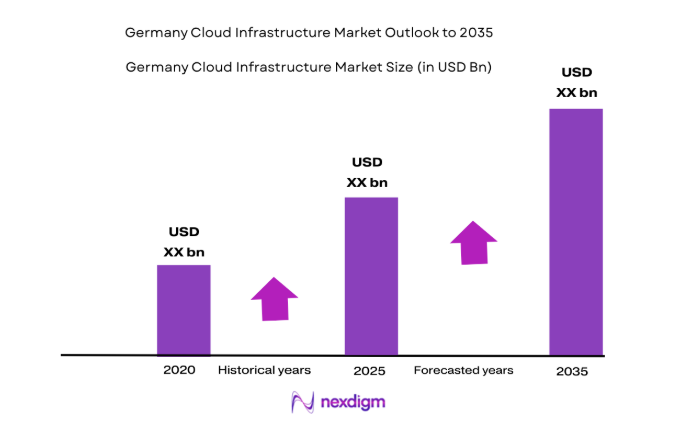
Germany’s cloud infrastructure market reached approximately USD ~ billion based on a recent historical assessment, driven by accelerated enterprise digitalization, hyperscale data center expansion, and sovereign cloud investments. Federal digital strategy programs and industrial cloud adoption across manufacturing and automotive sectors continue to expand infrastructure deployment. According to the German Federal Ministry for Economic Affairs and Climate Action and Eurostat ICT statistics, enterprise cloud usage and data center capacity investments have increased steadily, strengthening national infrastructure spending.
Berlin, Frankfurt, Munich, and Hamburg dominate Germany’s cloud infrastructure landscape due to dense fiber connectivity, financial and enterprise demand clusters, and proximity to major internet exchange hubs. Frankfurt hosts DE-CIX, one of the world’s largest internet exchange points, attracting hyperscale and colocation facilities. Southern regions including Bavaria benefit from industrial digitalization initiatives and automotive cloud demand, while northern port cities support logistics and telecom cloud nodes, reinforcing regional infrastructure concentration across Germany.
Market Segmentation
By Product Type
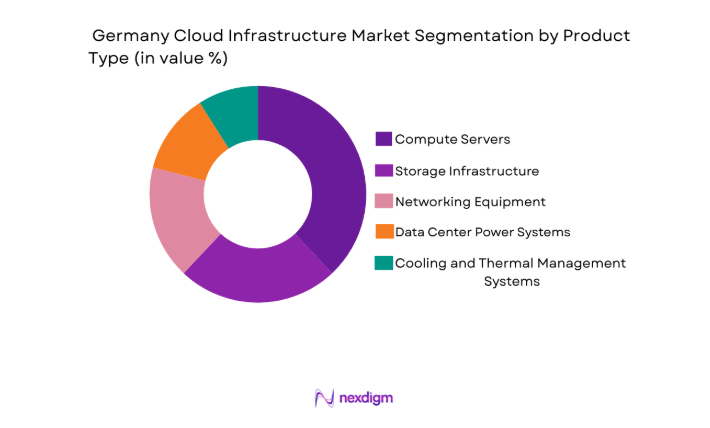
Germany Cloud Infrastructure market is segmented by product type into compute servers, storage infrastructure, networking equipment, data center power systems, and cooling and thermal management systems. Recently, compute servers has a dominant market share due to hyperscale deployments, AI workloads, and sovereign cloud platforms requiring high processing capacity. Enterprise migration to virtualized environments and industrial automation initiatives increase edge and private cloud compute demand. Strong OEM presence and GPU-based research workloads further reinforce compute server adoption across Germany.
By Platform Type
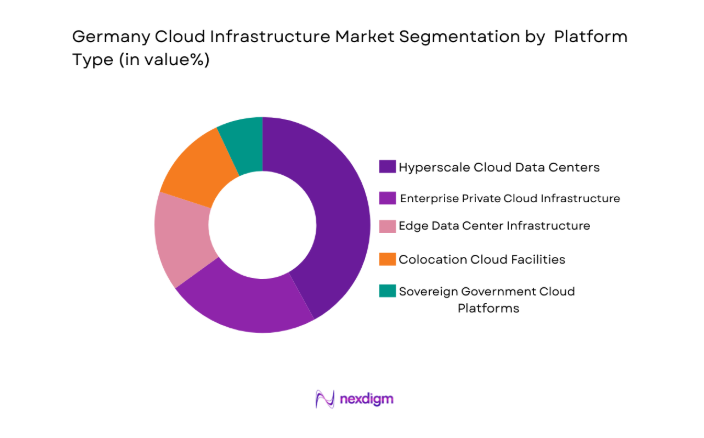
Germany Cloud Infrastructure market is segmented by platform type into hyperscale cloud data centers, enterprise private cloud infrastructure, edge data center infrastructure, colocation cloud facilities, and sovereign government cloud platforms. Recently, hyperscale cloud data centers has a dominant market share due to Germany’s role as a major enterprise and internet hub attracting global cloud investments. Frankfurt’s connectivity and data localization requirements support domestic hyperscale expansion. Industrial and financial sectors rely on hyperscale platforms for AI and analytics workloads, reinforcing their leading role.
Competitive Landscape
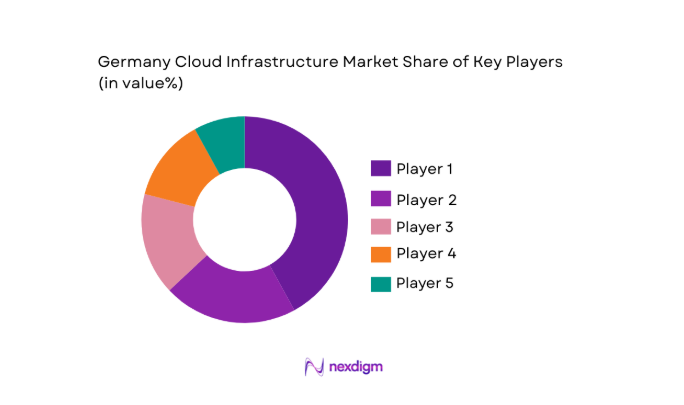
Germany’s cloud infrastructure market is moderately consolidated, led by hyperscale cloud providers, telecom operators, and data center specialists with strong domestic presence. Global cloud firms expand regions while German incumbents emphasize sovereign and compliant infrastructure. Partnerships between telecom operators, industrial technology firms, and hyperscale providers shape deployment ecosystems. Local colocation operators and engineering firms support infrastructure construction and operations, reinforcing a competitive but collaborative landscape driven by regulatory compliance and enterprise demand.
| Company Name | Establishment Year | Headquarters | Technology Focus | Market Reach | Key Products | Revenue | Data Center Capacity Germany |
| SAP | 1972 | Walldorf, Germany | ~ | ~ | ~ | ~ | ~ |
| Deutsche Telekom | 1995 | Bonn, Germany | ~ | ~ | ~ | ~ | ~ |
| Siemens | 1847 | Munich, Germany | ~ | ~ | ~ | ~ | ~ |
| Amazon Web Services Germany | 2006 | Seattle, USA | ~ | ~ | ~ | ~ | ~ |
| Microsoft Deutschland | 1983 | Munich, Germany | ~ | ~ | ~ | ~ | ~ |
Germany Cloud Infrastructure Market Analysis
Growth Drivers
Industrial Digitalization and Industry 4.0 Cloud Adoption
Germany’s strong industrial base is rapidly transitioning toward digitally connected manufacturing environments that depend on scalable cloud infrastructure for analytics, automation control, and real-time monitoring across production networks. Automotive manufacturers, machinery producers, and chemical companies increasingly deploy private and hybrid cloud environments to integrate operational technology systems with enterprise IT platforms, creating sustained demand for compute, storage, and edge infrastructure capacity nationwide. Federal digital transformation initiatives and Industry 4.0 funding programs encourage enterprises to modernize legacy systems and migrate workloads to cloud-based architectures, reinforcing infrastructure investments across regional industrial clusters and research ecosystems. Germany’s manufacturing sector generates large volumes of sensor, robotics, and production data that require high-performance processing and low-latency connectivity, leading to deployment of edge and on-premise cloud nodes integrated with central hyperscale facilities. Engineering simulation, digital twin modeling, and AI-driven quality optimization workloads also require GPU-accelerated compute environments, expanding infrastructure requirements beyond traditional enterprise IT hosting. Industrial firms prioritize data sovereignty and operational resilience, favoring domestic cloud regions and private cloud architectures compliant with German and EU regulatory frameworks, which further stimulates local infrastructure buildout. Technology partnerships between industrial conglomerates, telecom operators, and cloud providers support integrated industrial cloud platforms tailored to manufacturing applications, strengthening long-term infrastructure demand pipelines. Germany’s export-oriented industries increasingly require globally connected cloud platforms for supply chain coordination and collaborative engineering, driving hyperscale interconnection capacity growth within national data center hubs. Continuous modernization of factories and logistics networks toward autonomous operations ensures sustained long-term expansion of cloud infrastructure investments aligned with Germany’s industrial competitiveness strategy.
Expansion of Sovereign and Regulated Cloud Ecosystems
Germany’s regulatory environment and data protection framework emphasize national data sovereignty and secure digital infrastructure, driving substantial investment in sovereign cloud platforms and compliant data center ecosystems across the country. Public sector agencies, healthcare providers, financial institutions, and critical infrastructure operators increasingly require domestically hosted and jurisdiction-controlled cloud environments that meet stringent GDPR and national cybersecurity requirements, stimulating demand for specialized infrastructure deployments. National initiatives such as GAIA-X and sovereign cloud partnerships between telecom operators and global hyperscalers promote trusted data spaces and interoperable infrastructure standards, encouraging localized data center expansion aligned with European digital sovereignty objectives. Enterprises operating in regulated industries prioritize compliance-certified infrastructure with secure access controls, encryption frameworks, and audited operational governance, which increases capital spending on compliant hosting environments and sovereign cloud regions. German federal and state governments allocate digital modernization budgets toward secure government cloud platforms and interagency data exchange infrastructure, reinforcing domestic infrastructure growth. Telecom operators and IT service providers position sovereign cloud offerings as alternatives to foreign hyperscale dominance, investing in data centers, interconnection facilities, and secure networking capabilities across major metropolitan hubs. Cross-border European data sharing initiatives also require trusted infrastructure nodes within Germany to support regulated industrial and research collaboration, further expanding sovereign cloud capacity. Increasing geopolitical sensitivity around data control and digital autonomy strengthens long-term policy support for national cloud infrastructure investments, ensuring continued expansion of compliant, sovereign, and regulated cloud ecosystems throughout Germany’s digital economy.
Market Challenges
High Energy Costs and Power Availability Constraints for Data Centers
Germany’s energy market characteristics present structural challenges for large-scale cloud infrastructure deployment because data centers require continuous high-capacity electricity supply while operating within one of Europe’s highest industrial power price environments. Hyperscale facilities consume substantial electricity for compute operations and cooling systems, and rising energy costs directly increase operational expenditure, affecting investment decisions and long-term infrastructure economics. Regional grid capacity limitations and connection delays further constrain data center expansion, particularly in high-demand hubs such as Frankfurt where multiple hyperscale projects compete for available power allocation and transmission upgrades. Energy transition policies and renewable integration requirements add complexity to power procurement strategies for cloud operators, who must secure sustainable energy contracts while ensuring reliability and cost stability. Regulatory expectations for energy efficiency and carbon neutrality require additional capital investment in advanced cooling technologies, waste heat recovery, and renewable energy sourcing infrastructure, increasing deployment costs. Local permitting processes often evaluate environmental and power usage impacts, extending project timelines and introducing uncertainty into infrastructure development schedules. Operators must also balance energy sourcing commitments with redundancy requirements, maintaining backup generation and resilience capacity that further increases infrastructure expenditure. Competition for renewable energy supply among industrial users, electric mobility, and data centers intensifies procurement challenges and price volatility. These structural energy and power constraints create persistent barriers to rapid hyperscale expansion and raise long-term operational risks for Germany’s cloud infrastructure ecosystem.
Complex Regulatory, Zoning, and Environmental Compliance Landscape
Germany’s rigorous regulatory environment governing land use, environmental protection, construction standards, and data protection introduces significant complexity for cloud infrastructure development across federal states and municipalities. Data center projects must comply with multiple permitting layers, including environmental impact assessments, zoning approvals, building codes, and energy efficiency regulations, which extend planning timelines and increase administrative burden for operators. Local authorities often impose restrictions related to land utilization, noise, heat emissions, and visual impact, particularly in urban regions where infrastructure demand is highest, limiting available sites for hyperscale or colocation facilities. Germany’s federal structure results in regional variation in planning processes and approval requirements, creating fragmented regulatory conditions that complicate nationwide infrastructure rollout strategies. Environmental sustainability standards mandate efficient cooling, waste heat utilization, and resource management practices that require advanced engineering solutions and additional capital investment. Data sovereignty and cybersecurity regulations also impose operational compliance requirements related to data localization, access control, and infrastructure certification, affecting facility design and service architecture. Community and political scrutiny of large data center developments has increased due to energy consumption and land use concerns, leading to public consultation processes and potential opposition that delay projects. Operators must navigate overlapping EU and national regulatory frameworks while ensuring adherence to evolving sustainability targets and digital governance policies. These regulatory and compliance complexities create structural barriers to rapid infrastructure expansion and increase costs and uncertainty across Germany’s cloud infrastructure market.
Opportunities
Development of Energy-Efficient and Sustainable Green Data Centers
Germany’s strong environmental policy framework and corporate sustainability commitments create substantial opportunity for next-generation green data center infrastructure that minimizes energy consumption and carbon emissions while meeting growing cloud demand. Operators can deploy advanced cooling technologies such as liquid immersion systems, free-air cooling, and heat reuse integration with district heating networks to improve energy efficiency and reduce environmental impact, aligning with national climate targets. Renewable energy procurement through long-term power purchase agreements and on-site generation enables cloud infrastructure providers to achieve carbon-neutral operations, attracting sustainability-focused enterprises and regulated industries seeking compliant hosting environments. Germany’s engineering expertise and industrial innovation ecosystem support development of energy-optimized facility designs, modular construction, and intelligent power management systems that enhance operational efficiency. Federal incentives and green financing mechanisms for sustainable infrastructure investments further strengthen economic viability of environmentally optimized data centers. Urban heat reuse integration offers additional revenue streams and community benefits by supplying waste heat to residential or commercial heating networks. Enterprises increasingly prioritize sustainable digital infrastructure in procurement decisions, creating competitive differentiation for green cloud operators. Germany’s leadership in environmental technology and regulation positions the country as a hub for sustainable cloud infrastructure innovation. Expansion of green data center ecosystems therefore represents a significant long-term growth opportunity aligned with both environmental and digital transformation objectives.
Expansion of Edge and Industrial Cloud Infrastructure for Autonomous Systems
Germany’s transition toward autonomous manufacturing, connected mobility, and smart infrastructure creates substantial opportunity for distributed edge cloud deployments integrated with central hyperscale platforms across industrial and urban environments. Industrial automation systems, robotics, autonomous vehicles, and smart logistics networks require low-latency processing and localized data analytics capabilities that centralized cloud architectures cannot fully provide, driving demand for edge data center nodes near production and transportation hubs. Automotive manufacturers and mobility providers increasingly deploy edge infrastructure to support vehicle telemetry processing, predictive maintenance, and real-time navigation services within domestic networks. Smart city initiatives across German municipalities integrate IoT sensors, traffic systems, and public safety networks requiring localized cloud processing capacity. Telecom operators expanding 5G networks enable multi-access edge computing platforms integrated with regional data centers, creating new infrastructure deployment opportunities. Industrial enterprises favor private edge cloud environments for operational control and data sovereignty, stimulating on-premise and regional infrastructure installations. Research institutions and engineering firms require distributed computing environments for simulation, AI inference, and collaborative innovation across industrial clusters. Germany’s manufacturing density and urban infrastructure modernization programs therefore create strong structural demand for edge and industrial cloud architectures. Expansion of distributed cloud ecosystems linking hyperscale, regional, and edge nodes represents a major growth opportunity across Germany’s evolving digital infrastructure landscape.
Future Outlook
Germany’s cloud infrastructure market is expected to expand steadily over the next five years, supported by sovereign cloud initiatives, industrial digitalization, and hyperscale region investments. Growth will be driven by AI workloads, edge computing, and regulated sector cloud adoption across manufacturing, finance, and public services. Sustainability requirements will accelerate green data center innovation and renewable energy integration. Regulatory alignment with EU digital sovereignty programs will reinforce domestic infrastructure deployment and long-term demand.
Major Players
- SAP
- Deutsche Telekom
- Siemens
- OVHcloud
- T Systems
- Atos
- Nokia
- Fujitsu Technology Solutions
- IBM Deutschland
- Microsoft Deutschland
- Amazon Web Services Germany
- Google Cloud Germany
- Equinix
- NTT Global Data Centers EMEA
- Schneider Electric
Key Target Audience
- Cloud service providers
- Telecom operators
- Data center developers
- Industrial enterprises
- Financial institutions
- Government and regulatory bodies
- Investments and venture capitalist firms
- Hyperscale infrastructure investors
Research Methodology
Step 1: Identification of Key Variables
Key variables including infrastructure spending, data center capacity, enterprise cloud adoption, regulatory factors, and industrial digitalization indicators were identified from government ICT statistics, industry associations, and company disclosures to define market scope and segmentation.
Step 2: Market Analysis and Construction
Market structure was constructed by mapping infrastructure components, deployment platforms, and end-user demand across Germany’s digital economy using secondary data and validated supply-side benchmarks for cloud and data center investment patterns.
Step 3: Hypothesis Validation and Expert Consultation
Findings were validated through consultation with infrastructure engineers, telecom specialists, and enterprise IT architects to confirm technology trends, deployment drivers, and regulatory influences shaping Germany’s cloud infrastructure ecosystem.
Step 4: Research Synthesis and Final Output
Validated insights were synthesized into market sizing, segmentation, and strategic analysis frameworks aligned with Germany’s digitalization trajectory, producing structured outputs consistent with industry research standards.

- Executive Summary
- Research Methodology (Definitions, Scope, Industry Assumptions, Market Sizing Approach, Primary & Secondary Research Framework, Data Collection & Verification Protocol, Analytic Models & Forecast Methodology, Limitations & Research Validity Checks)

- Market Definition and Scope
- Value Chain & Stakeholder Ecosystem
- Regulatory / Certification Landscape
- Sector Dynamics Affecting Demand
- Strategic Initiatives & Infrastructure Growth

- Growth Drivers
Expansion of hyperscale cloud regions across Germany
Rising enterprise adoption of sovereign cloud solutions
Acceleration of AI and high performance computing workloads
National digitalization and Industry 4.0 initiatives
Growth in edge computing for low latency applications - Market Challenges
High energy costs impacting data center operations
Stringent environmental and zoning regulations
Grid capacity constraints for hyperscale facilities
Complex data sovereignty and compliance requirements
Skilled workforce shortages in cloud engineering - Market Opportunities
Development of green data center infrastructure
Expansion of sovereign and regulated cloud platforms
Edge cloud deployment for industrial automation - Trends
Shift toward liquid and immersion cooling technologies
Adoption of AI optimized server architectures
Integration of renewable energy in data centers
Growth of modular prefabricated data center builds
Emergence of sovereign cloud ecosystems in Europe - Government Regulations & Defense Policy
EU data sovereignty and GAIA X initiatives
German energy efficiency standards for data centers
National cybersecurity and critical infrastructure policies - SWOT Analysis
- Stakeholder and Ecosystem Analysis
- Porter’s Five Forces Analysis
- Competition Intensity and Ecosystem Mapping

- By Market Value, 2020-2025
- By Installed Units, 2020-2025
- By Average System Price, 2020-2025
- By System Complexity Tier, 2020-2025

- By System Type (In Value%)
Compute Servers
Storage Infrastructure
Networking Equipment
Data Center Power Systems
Cooling and Thermal Management Systems - By Platform Type (In Value%)
Hyperscale Cloud Data Centers
Enterprise Private Cloud Infrastructure
Edge Data Center Infrastructure
Colocation Cloud Facilities
Government Sovereign Cloud Platforms - By Fitment Type (In Value%)
Greenfield Data Center Deployments
Brownfield Infrastructure Upgrades
Modular Prefabricated Installations
Retrofit Efficiency Enhancements
Hybrid Cloud Integration Systems - By End User Segment (In Value%)
Cloud Service Providers
Telecom Operators
Financial Services Institutions
Manufacturing Enterprises
Public Sector and Research Institutions - By Procurement Channel (In Value%)
Direct OEM Procurement
System Integrator Contracts
EPC Data Center Contractors
Government Framework Agreements
Channel Partner Distribution

- Market structure and competitive positioning
Market share snapshot of major players - Cross Comparison Parameters (Compute Density, Energy Efficiency, Cooling Technology, Deployment Scale, Sovereignty Compliance, Edge Capability, AI Optimization, Cost Structure, Integration Services)
- SWOT Analysis of Key Competitors
- Pricing & Procurement Analysis
- Key Players
SAP
Deutsche Telekom
Siemens
OVHcloud
T Systems
Atos
Nokia
Fujitsu Technology Solutions
IBM Deutschland
Microsoft Deutschland
Amazon Web Services Germany
Google Cloud Germany
Equinix
NTT Global Data Centers EMEA
Schneider Electric

- Cloud providers expanding hyperscale regions domestically
- Manufacturers adopting private edge cloud for automation
- Financial institutions prioritizing sovereign infrastructure
- Public sector investing in secure national cloud platforms

- Forecast Market Value, 2026-2035
- Forecast Installed Units, 2026-2035
- Price Forecast by System Tier, 2026-2035
- Future Demand by Platform, 2026-2035


 Request a Sample
 Ask for Customization
 Get a Quote
 Enquire Now