
 Download PDF
Market Overview
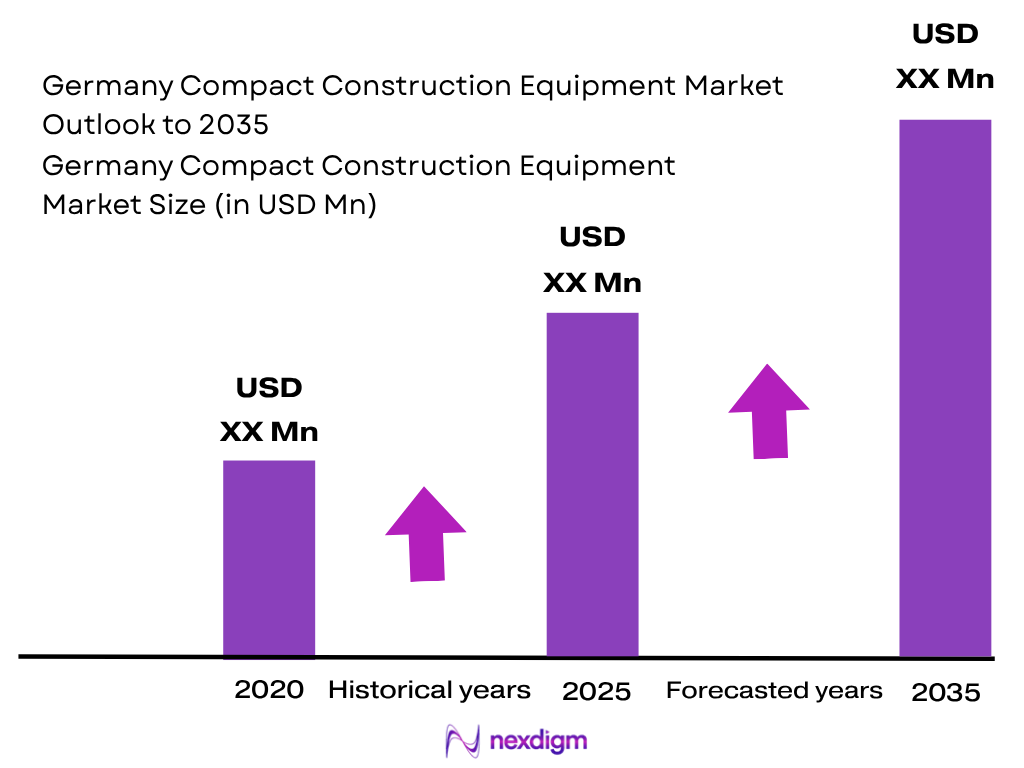
The Germany Compact Construction Equipment Market was valued at approximately USD ~XX billion in 2024, compared with USD ~XX billion in 2023, with the exact market value retained as a placeholder as requested. Demand is supported by Germany’s substantial construction and machinery investment base. Construction investment stood at EUR 453.01 billion in 2023 and EUR 450.66 billion in 2024, while machinery and equipment investment amounted to EUR 277.41 billion and EUR 267.10 billion, respectively.
North Rhine-Westphalia, Bavaria and Baden-Württemberg represent major demand centers for Germany’s compact construction equipment industry because of their dense urban areas, industrial facilities, transport infrastructure and extensive contractor networks. Berlin and Hamburg provide additional demand from urban redevelopment and utility projects where maneuverability is important. Germany recorded 163,906 building permits/building measures in 2023 and 145,010 in 2024, while estimated construction costs represented by these permits reached EUR 112.99 billion and EUR 104.06 billion, respectively.
Market Segmentation
By Equipment Type
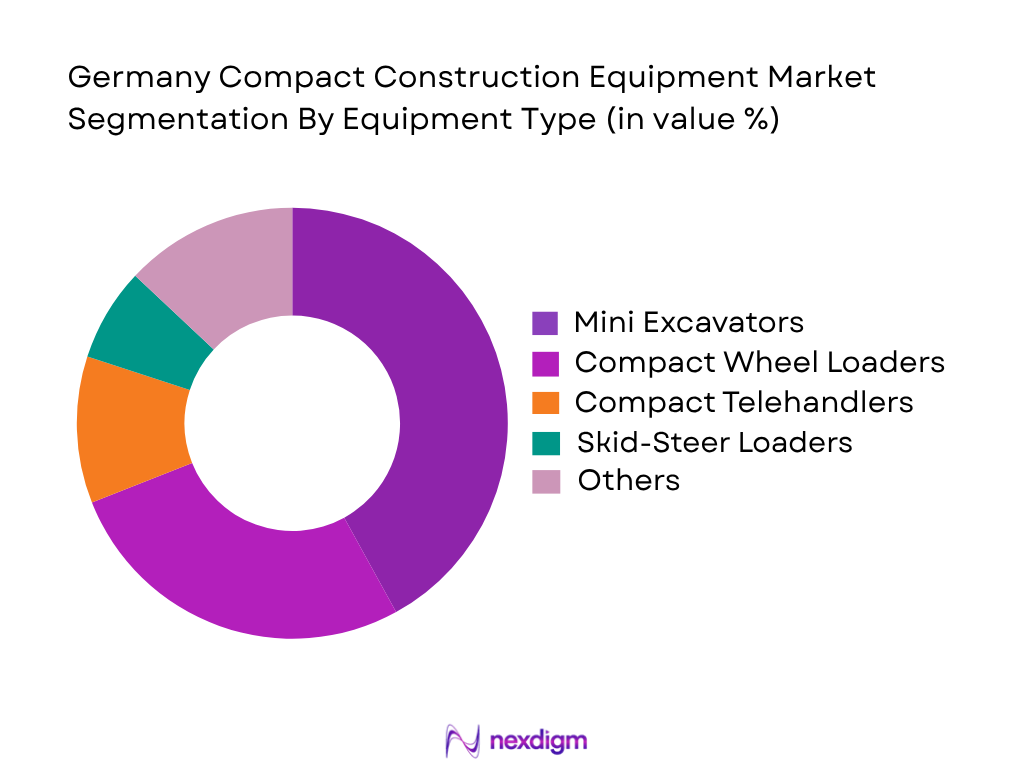
The Germany Compact Construction Equipment Market is segmented by equipment type into mini excavators, compact wheel loaders, skid-steer loaders, compact track loaders, compact telehandlers, mini dumpers, compact utility loaders and compact compaction equipment. Mini excavators represent the dominant segment, supported by their suitability for Germany’s dense urban construction environment, landscaping, utility installation, renovation and confined-site excavation. Their relatively small transport envelope and zero-tail-swing configurations allow contractors to work alongside buildings, roads and underground infrastructure. Wacker Neuson’s compact range illustrates this application breadth, with machines covering widths from approximately 700 mm and digging depths exceeding 2,700 mm in selected models. Wacker Neuson Mini excavators are also extensively represented in equipment-rental fleets, making them accessible to smaller contractors without outright ownership. Their ability to operate breakers, buckets, augers and other hydraulic attachments further increases machine utilization across construction phases. Electrification is reinforcing the category’s relevance for indoor and noise-sensitive urban construction, with battery-powered models increasingly offered alongside conventional diesel machines.
By Application
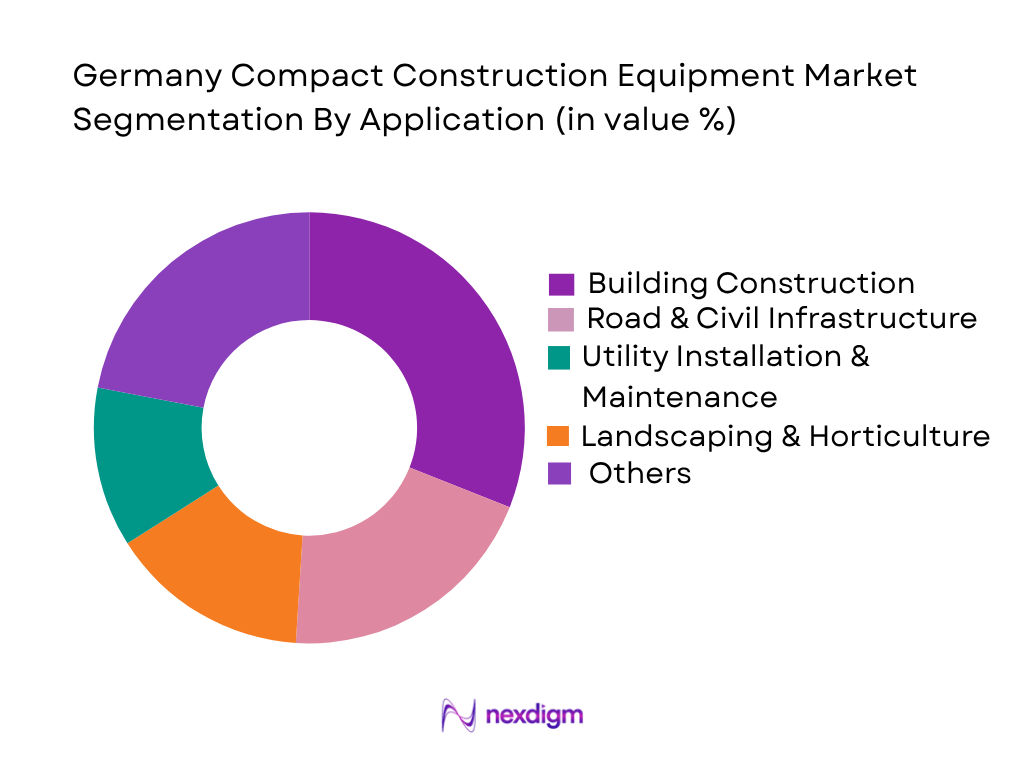
The Germany Compact Construction Equipment Market is segmented by application into building construction, road and civil infrastructure, utility installation, landscaping, demolition and renovation, municipal works, industrial construction and waste-handling applications. Building construction represents the leading application segment, reflecting Germany’s large existing building stock and continuing requirements for construction, redevelopment and renovation. Germany had approximately 43.76 million dwellings in 2024, compared with 43.52 million in 2023, creating a substantial installed building base requiring maintenance and modernization. Destatis Compact equipment is particularly useful for excavation around existing buildings, foundation modifications, landscaping, drainage and material handling. Nevertheless, new residential construction has weakened: permitted dwellings declined from 259,639 units in 2023 to 215,289 units in 2024. Destatis This increases the strategic importance of renovation, infrastructure and utility applications. Rental equipment also helps contractors shift machines between applications, allowing mini excavators and compact loaders to serve building sites, roadworks, landscaping and municipal projects without dedicated application-specific fleets.
Competitive Landscape
The Germany Compact Construction Equipment Market features German manufacturers alongside Japanese, American, British, Swedish and Chinese OEMs. Wacker Neuson has particular relevance through its German operations and broad compact-equipment portfolio, while Caterpillar, Kubota, Bobcat, Takeuchi, Komatsu, Volvo CE, JCB and Yanmar compete through mini excavators and compact loaders. Distribution reach, attachment ecosystems, rental relationships, electrification, telematics and aftermarket support are major competitive parameters. Germany’s mature equipment ecosystem also makes residual value and lifecycle support important purchasing considerations.
| Company | Established | Headquarters | Key Compact Equipment | Powertrain Capability | Attachment Capability | Electrification Focus | Dealer/Service Focus | Core Application Strength |
| Wacker Neuson | 1848 | Munich, Germany | ~ | ~ | ~ | ~ | ~ | ~ |
| Caterpillar | 1925 | Irving, USA | ~ | ~ | ~ | ~ | ~ | ~ |
| Kubota | 1890 | Osaka, Japan | ~ | ~ | ~ | ~ | ~ | ~ |
| Bobcat | 1958 | West Fargo, USA | ~ | ~ | ~ | ~ | ~ | ~ |
| Takeuchi | 1963 | Nagano, Japan | ~ | ~ | ~ | ~ | ~ | ~ |
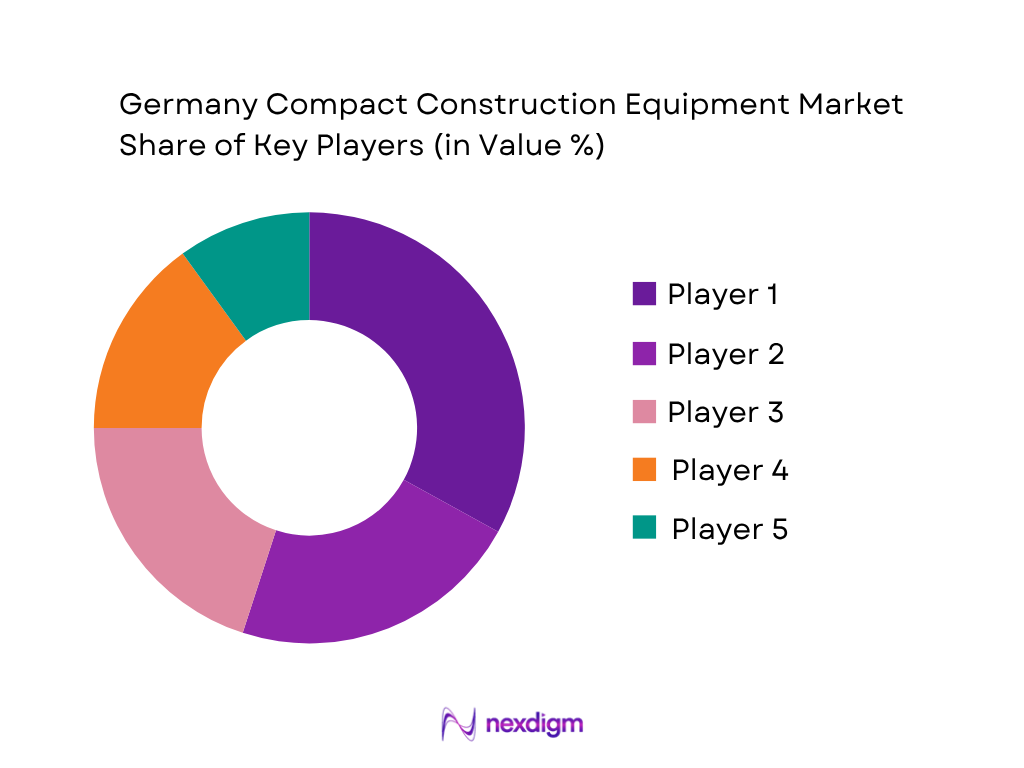
Germany Compact Construction Equipment Market Analysis
Growth Drivers
Large Construction Pipeline Supporting Compact Equipment Utilization
Germany’s substantial construction workload continues to support demand for mini excavators, compact wheel loaders, skid-steer loaders, compact track loaders and mini dumpers across excavation, material handling and utility applications. In 2024, Germany recorded 145,010 permitted buildings and construction measures, covering 20.08 million square metres of residential floor area, while the estimated construction cost represented by approved projects reached EUR 104.06 billion. Main-construction-sector orders reached a nominal EUR 103.5 billion, providing a sizeable project base requiring earthmoving and site-preparation machinery. Germany also completed 251,900 dwellings, while another 759,700 permitted dwellings remained unfinished at year-end, including 330,000 units already under construction. This backlog supports continuing equipment utilization even when new permitting weakens. Compact machines are particularly relevant because existing urban sites require maneuverability around buildings, underground utilities and restricted access points. Germany’s broader economic capacity also underpins equipment investment: nominal GDP reached EUR 4,328.97 billion, gross capital formation totaled EUR 930.70 billion, and government consumption reached EUR 951.78 billion in 2024. Together, this construction pipeline and capital base provide a durable operating environment for compact equipment fleets used by contractors, rental companies and infrastructure specialists.
Large Contractor Base and Infrastructure-Oriented Equipment Demand
Germany’s fragmented but extensive construction ecosystem creates recurring demand for compact machines that can serve multiple projects without requiring large operating areas. Official 2024 enterprise statistics recorded 377,905 construction enterprises employing approximately 2.606 million people, demonstrating the depth of the addressable contractor population. Within licensed construction trades alone, Germany had 67,437 main-construction businesses employing 798,129 people. The road-building trade accounted for 6,097 businesses and 153,511 workers, directly supporting demand for compact excavators, loaders, trenching equipment and small compaction machines used in road rehabilitation, drainage, curb construction and utility works. Masonry and concrete construction represented another 29,571 businesses with 372,461 workers, broadening demand across excavation and building-site material movement. Germany’s macroeconomic scale provides further support: GDP stood at EUR 4,328.97 billion and gross capital formation reached EUR 930.70 billion in 2024. The country also recorded EUR 1,793.67 billion of exports, indicating the size of the industrial and logistics infrastructure requiring continued construction and maintenance. This combination of thousands of specialized contractors and substantial capital formation supports high equipment utilization, particularly for versatile machines capable of operating with buckets, breakers, forks, augers and grapples.
Market Challenges
Residential Construction Weakness Reducing New-Site Equipment Requirements
The decline in Germany’s residential construction pipeline is a direct challenge for compact construction equipment demand because housing sites represent important applications for mini excavators, loaders, dumpers and landscaping machinery. Germany issued permits for 215,289 dwellings in 2024, compared with 259,639 in 2023, representing 44,350 fewer permitted dwellings without relying on percentage comparisons. Permits for dwellings in newly constructed buildings declined from 219,119 units to 175,950 units, a reduction of 43,169 units. The number of permitted new buildings decreased from 91,495 to 76,619, while associated planned construction expenditure declined from EUR 90.97 billion to EUR 82.48 billion. Residential floor area covered by overall permits also fell from 24.589 million square metres to 20.080 million square metres. This weaker project pipeline can delay purchases by contractors whose fleets are concentrated on residential excavation, foundations and landscaping. Germany’s wider economic environment compounds this challenge: 2024 GDP was approximately EUR 4,328.97 billion, but machinery and equipment investment faced pressure amid subdued industrial conditions. The challenge for compact-equipment suppliers is therefore to offset declining residential-site demand through roadworks, utilities, municipal construction, demolition, renovation and rental fleets where machine utilization can remain comparatively diversified.
Labor Availability and Rising Workforce Requirements
Germany’s construction industry depends on a large workforce, making labor availability and workforce productivity important constraints for compact-equipment utilization. Official enterprise statistics recorded approximately 2.606 million people employed across 377,905 construction enterprises in 2024. Licensed main-construction trades alone employed 798,129 people, including 372,461 workers in masonry and concrete construction, 153,511 in road construction, 105,182 in carpentry and 104,988 in roofing. Germany’s economy recorded approximately 46.081 million employed persons overall, while the number of unemployed people reached around 1.516 million. Average gross wages and salaries reached approximately EUR 3,838 per employee per month, increasing the importance of equipment that can raise output per operator. For compact-equipment manufacturers, labor constraints create a mixed operating environment: shortages can delay projects and reduce equipment deployment, but they also encourage contractors to adopt hydraulic attachments, telematics, machine controls and multifunction machines that reduce manual work. Germany’s nominal GDP reached EUR 4,328.97 billion, while employee compensation across the economy reached EUR 2,357.85 billion. Equipment suppliers must therefore address customers seeking higher productivity per operator while simultaneously facing constrained contractor staffing, technician availability and maintenance capacity.
Market Opportunities
Renovation, Utility and Existing-Building Work Creating Future Equipment Demand
Germany’s enormous existing building base creates an opportunity for compact construction equipment beyond conventional new residential development. The country completed 251,900 dwellings in 2024, while 759,700 already-approved dwellings remained unfinished at year-end, including approximately 330,000 dwellings already under construction. This pipeline requires continued excavation, landscaping, drainage, utility installation and material-handling activity. More importantly, construction-related installation activity generated EUR 84.26 billion of turnover in 2024. Gas, water, heating, ventilation and air-conditioning installation accounted for approximately EUR 39.90 billion, while electrical installation represented EUR 34.46 billion. These activities provide adjacent demand for compact excavators and loaders during trench excavation, underground connection work, site rehabilitation and building modernization. Germany’s economic capacity remains substantial, with GDP of EUR 4,328.97 billion, gross capital formation of EUR 930.70 billion and government consumption of EUR 951.78 billion in 2024. Future compact-equipment growth can therefore increasingly shift toward renovation, utility replacement and urban infrastructure rather than relying exclusively on greenfield construction. Small machine footprints, interchangeable attachments and low-emission configurations position compact equipment particularly well for projects undertaken around occupied buildings and established urban infrastructure.
Road, Municipal and Civil Infrastructure Applications Expanding Addressable Demand
Civil infrastructure offers a significant future growth pathway for Germany’s compact construction equipment industry because road rehabilitation, drainage, utility corridors and municipal projects require maneuverable machinery capable of working alongside active infrastructure. Germany recorded 6,097 licensed road-building businesses employing 153,511 people in 2024, while the sector generated approximately EUR 28.06 billion in turnover. Main-construction-sector orders reached EUR 103.5 billion, indicating a substantial pipeline across building and civil engineering activities. Compact excavators, wheel loaders, dumpers and compaction equipment can participate in trenching, pavement preparation, roadside works, pipe installation, landscaping and maintenance operations without requiring the operating envelope of full-size construction machines. The opportunity is reinforced by Germany’s large public-sector economic capacity: government expenditure reached approximately EUR 2,137.8 billion, while government revenue totaled approximately EUR 2,022.2 billion in 2024. Germany also recorded gross capital formation of EUR 930.70 billion within an economy generating EUR 4,328.97 billion of GDP. As contractors seek greater machine utilization across diverse projects, compact equipment offering hydraulic attachment compatibility, telematics, low-noise operation and electric powertrains can capture additional demand from municipal, road, utility and infrastructure contractors seeking versatile equipment for constrained urban worksites.
Future Outlook
The Germany Compact Construction Equipment Market is expected to record a forecast CAGR of approximately ~XX% during 2026-2035. Growth is expected to become increasingly linked to infrastructure modernization, utility replacement, building renovation, equipment rental and low-emission machinery rather than conventional residential construction alone. Battery-electric mini excavators and loaders should gain relevance for indoor projects, urban construction and environmentally sensitive locations. Digital fleet management, attachment versatility and operator-assistance technologies will also influence fleet replacement decisions.
Electrification represents an important technology transition. Compact equipment is particularly suitable for battery power because machines frequently operate on localized jobsites and applications where noise and exhaust restrictions can favor electric platforms. Wacker Neuson, for example, offers electric compact excavators with digging depths ranging from approximately 1,868 mm to 2,803 mm, illustrating how battery machinery is moving beyond experimental applications into commercially usable compact-equipment classes.
Major Players
- Wacker Neuson
- Liebherr
- Caterpillar
- Komatsu
- Volvo Construction Equipment
- JCB
- Kubota
- Bobcat
- Takeuchi
- Yanmar Compact Equipment
- Hitachi Construction Machinery
- SANY
- Kobelco Construction Machinery
- CASE Construction Equipment
- Manitou Group
Key Target Audience
- Compact Construction Equipment Manufacturers
- Construction Equipment Dealers and Distributors
- Construction Equipment Rental and Fleet Operators
- Building, Civil Engineering and Utility Contractors
- Landscaping, Municipal and Infrastructure Contractors
- Component, Attachment and Powertrain Manufacturers
- Investments and Venture Capitalist Firms
- Government and Regulatory Bodies (Federal Ministry for Housing, Urban Development and Building; Federal Ministry for Transport; Federal Institute for Occupational Safety and Health)
Research Methodology
Step 1: Identification of Key Variables
The initial stage establishes the Germany Compact Construction Equipment Market ecosystem, covering OEMs, dealers, rental companies, contractors, attachment manufacturers and component suppliers. Critical variables include equipment sales, operating weight, installed fleets, replacement cycles, rental penetration, electrification, construction activity and application demand.
Step 2: Market Analysis and Construction
Historical demand is assessed using equipment registrations and sales indicators, construction investment, building activity, infrastructure spending and machinery investment. A bottom-up framework evaluates mini excavators, compact loaders, telehandlers and other equipment categories, while the top-down approach examines Germany’s wider construction machinery ecosystem.
Step 3: Hypothesis Validation and Expert Consultation
Market hypotheses are validated through discussions with equipment manufacturers, distributors, rental operators, contractors and industry specialists. Interviews assess fleet utilization, equipment replacement, application mix, attachment demand, electric-equipment adoption, dealer performance and purchasing criteria to refine quantitative assumptions.
Step 4: Research Synthesis and Final Output
Demand-side and supply-side findings are triangulated to produce the final market structure. Equipment sales, rental activity, construction indicators, company portfolios and application requirements are reconciled to establish segmentation, competitive positioning and the outlook through 2035.

- Executive Summary
- Research Methodology (Market Definition and Scope, Compact Construction Equipment Classification, Equipment Operating Weight Classification, Mini Excavator Assessment, Compact Wheel Loader Assessment, Skid-Steer Loader Evaluation, Compact Track Loader Analysis, Compact Telehandler Assessment, Mini Dumper Evaluation, Compact Compaction Equipment Assessment, Diesel Powertrain Mapping, Battery-Electric Equipment Assessment, Hydraulic System Evaluation, Attachment Compatibility Assessment, Machine Productivity Analysis, Fleet Utilization Assessment, Rental Fleet Assessment, Dealer Network Mapping, Equipment Import and Domestic Production Assessment, Demand-Side Assessment, Supply-Side Assessment, Top-Down Market Sizing, Bottom-Up Market Sizing, Primary Industry Interviews, Data Triangulation, Forecasting Framework, Scenario Analysis)

- Definition and Scope
- Germany Compact Construction Equipment Industry Evolution and Development of Mini Excavators, Compact Wheel Loaders, Skid-Steer Loaders, Compact Track Loaders, Compact Telehandlers, Mini Dumpers, Electric Compact Equipment, Zero-Emission Construction Machinery, Hydraulic Attachments, Quick-Coupler Systems, Machine Control Systems, Telematics-Enabled Equipment, Urban Construction Machinery, Landscaping Equipment, Municipal Equipment, Utility Construction Machinery, Rental Fleet Equipment
- Compact Construction Equipment Value Chain Analysis
- Compact Construction Equipment Supply Chain Analysis
- Engine and Powertrain Suppliers, Hydraulic Component Manufacturers, Battery and Electric Drivetrain Suppliers, Steel and Structural Component Suppliers, Tire and Rubber Track Suppliers, Attachment Manufacturers, Compact Equipment OEMs, German Manufacturing Facilities, Equipment Importers, Authorized Dealers, Rental Companies, Parts and Service Providers, Construction Contractors, Landscaping Contractors, Municipal Authorities, Utility Contractors, Industrial End Users

- Growth Drivers (Urban Infrastructure Modernization, Building Renovation Activity, Utility Network Upgrades, Demand for Machines in Confined Construction Sites, Expansion of Equipment Rental, Landscaping and Municipal Equipment Demand, Replacement of Aging Construction Fleets, Increasing Mechanization of Small Construction Projects)
- Market Challenges (Weakness in Residential Construction, High Equipment Acquisition Costs, Skilled Equipment Operator Shortage, Construction Industry Labor Constraints, High Financing Costs, Competition from Used Construction Equipment, Battery Charging Infrastructure Constraints, Dealer Inventory Management Pressure)
- Market Opportunities (Battery-Electric Mini Excavators, Zero-Emission Urban Construction Equipment, Rental Fleet Electrification, Digital Fleet Management, Smart Attachments, Automated Machine Control, Utility Infrastructure Modernization, Compact Equipment for Building Renovation, Low-Noise Construction Machinery)
- Market Trends (Electrification of Compact Machinery, Zero-Tail-Swing Excavator Adoption, Telematics Integration, Quick-Coupler Penetration, Multi-Purpose Attachment Usage, Equipment Rental Expansion, Operator Assistance Systems, Digital Fleet Monitoring, Noise Reduction Technologies, Compact Machine Automation)
- Government Regulations and Standards (EU Stage V Emission Standards, Machinery Regulation Requirements, CE Conformity Requirements, German Occupational Safety Requirements, DGUV Construction Equipment Safety Requirements, Battery Safety Standards, Construction Site Noise Regulations, Equipment Inspection Requirements, EU Battery Regulation, Environmental and Recycling Requirements)
- SWOT Analysis
- Porter’s Five Forces Analysis
- PESTLE Analysis
- Stakeholder Ecosystem
- Competition Ecosystem

- By Market Value (2020-2025)
- By Equipment Sales Volume (2020-2025)
- By Installed Equipment Base (2020-2025)
- By Average Selling Price per Unit (2020-2025)
- By Mini Excavator Sales Volume (2020-2025)
- By Compact Wheel Loader Sales Volume (2020-2025)
- By Skid-Steer and Compact Track Loader Sales Volume (2020-2025)
- By Battery-Electric Compact Equipment Sales Volume (2020-2025)
- By Rental Fleet Equipment Volume (2020-2025)
- By Replacement Equipment Demand (2020-2025)

- By Equipment Type (In Value %)
Mini Excavators
Compact Wheel Loaders
Skid-Steer Loaders
Compact Track Loaders
Compact Telehandlers
Mini Dumpers
Compact Compaction Equipment
Compact Utility Loaders
Compact Backhoe Loaders
Other Compact Construction Equipment - By Operating Weight (In Value %)
Below 2 Tons
2-4 Tons
4-6 Tons
6-8 Tons
8-10 Tons
Above 10 Tons - By Propulsion Type (In Value %)
Diesel-Powered Equipment
Battery-Electric Equipment
Hybrid Equipment
Alternative-Fuel Equipment - By Application (In Value %)
Urban Building Construction
Road and Civil Infrastructure
Utility Installation and Maintenance
Landscaping and Gardening
Demolition and Renovation
Material Handling
Municipal Works
Industrial Construction
Agricultural and Rural Construction
Waste and Recycling Operations - By End-Use Industry (In Value %)
Building Construction
Civil Engineering and Infrastructure
Equipment Rental
Landscaping and Horticulture
Municipal and Public Works
Utilities and Energy Infrastructure
Industrial and Manufacturing Facilities
Agriculture
Waste Management and Recycling
Property and Facility Maintenance - By Sales Channel (In Value %)
OEM Direct Sales
Authorized Equipment Dealers
Independent Equipment Distributors
Equipment Rental Companies
Used Equipment Dealers
Digital Equipment Marketplaces - By Region (In Value %)
North Rhine-Westphalia
Bavaria
Baden-Württemberg
Lower Saxony
Hesse
Saxony
Berlin-Brandenburg
Hamburg and Northern Germany
Rhineland-Palatinate
Rest of Germany

- Market Share of Major Players (By Germany Revenue, Equipment Sales Volume, Mini Excavator Portfolio, Compact Loader Portfolio, Electric Equipment Portfolio, Dealer Coverage, Rental Presence, Installed Fleet, Application Coverage, After-Sales Network)
- Cross Comparison Parameters (Operating Weight Range, Mini Excavator Product Breadth, Battery-Electric Equipment Capability, Attachment Compatibility, Telematics and Fleet Management Capability, Dealer and Service Network Coverage, Equipment Rental Support Capability, Machine Control and Operator Assistance Technology)
- SWOT Analysis of Major Players
- Competitive Positioning Matrix
- Mini Excavator Portfolio Benchmarking
- Compact Wheel Loader Portfolio Benchmarking
- Battery-Electric Compact Equipment Benchmarking
- Attachment and Quick-Coupler Capability Assessment
- Dealer and After-Sales Network Benchmarking
- Rental Fleet Partnership Assessment
- Equipment Productivity and Operating Performance Benchmarking
- Residual Value and Replacement Cycle Assessment
- Detailed Profiles of Major Companies
Wacker Neuson
Liebherr
Caterpillar
Komatsu
Volvo Construction Equipment
JCB
Kubota
Bobcat
Takeuchi
Yanmar Compact Equipment
Hitachi Construction Machinery
SANY
Kobelco Construction Machinery
CASE Construction Equipment
Manitou Group

- Construction Contractor Equipment Requirement Assessment
- Rental Company Fleet Requirement Assessment
- Landscaping Contractor Requirement Assessment
- Municipal Equipment Requirement Assessment
- Utility Contractor Requirement Assessment
- Equipment Purchase Criteria Assessment
- Diesel versus Electric Equipment Preference Assessment
- Attachment Requirement Assessment
- Rental versus Ownership Decision Assessment
- After-Sales Requirement Assessment

- By Market Value (2026-2035)
- By Equipment Sales Volume (2026-2035)
- By Installed Equipment Base (2026-2035)
- By Average Selling Price per Unit (2026-2035)
- By Mini Excavator Sales Volume (2026-2035)
- By Compact Wheel Loader Sales Volume (2026-2035)
- By Skid-Steer and Compact Track Loader Sales Volume (2026-2035)
- By Battery-Electric Compact Equipment Sales Volume (2026-2035)
- By Rental Fleet Equipment Volume (2026-2035)
- By Replacement Equipment Demand (2026-2035)


 Request a Sample
 Ask for Customization
 Get a Quote
 Enquire Now