
 Download PDF
Market Overview
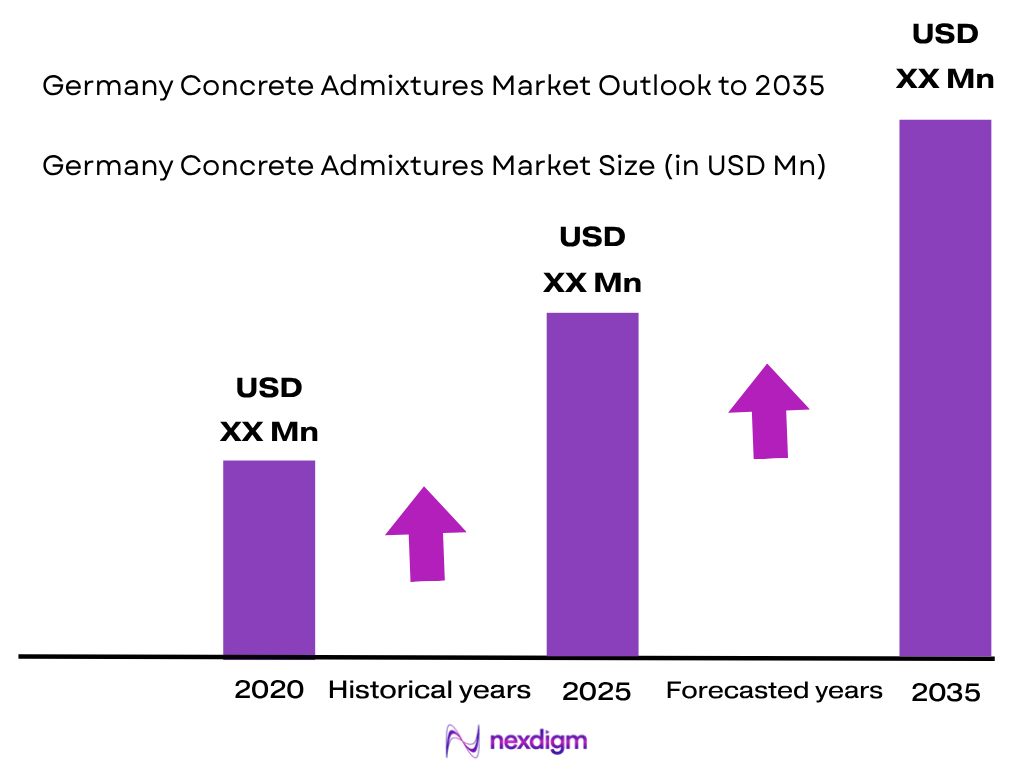
The Germany Concrete Admixtures Market is valued at approximately ~USD XX million, supported by ready-mix, precast, infrastructure and industrial concrete applications. Construction investment moved from EUR 453.01 billion to EUR 450.66 billion across the latest two annual observations, while non-residential construction investment increased from EUR 175.48 billion to EUR 180.18 billion. Germany also completed 294,399 and 251,937 dwellings, sustaining demand for PCE superplasticizers, accelerators, air entrainers and specialized concrete-performance systems.
North Rhine-Westphalia, Bavaria and Baden-Württemberg are major Germany Concrete Admixtures Market demand centers because of their extensive construction, industrial manufacturing, infrastructure and precast-concrete ecosystems. Germany’s total building completions moved from 183,665 to 161,682, while Baden-Württemberg alone completed 5,321 and 4,923 prefabricated buildings across the corresponding observations. Strong industrial clusters, highway networks, logistics construction and concrete-product manufacturing make these southern and western states particularly important for ready-mix, precast, paver and infrastructure admixture consumption.
Market Segmentation
By Admixture Type
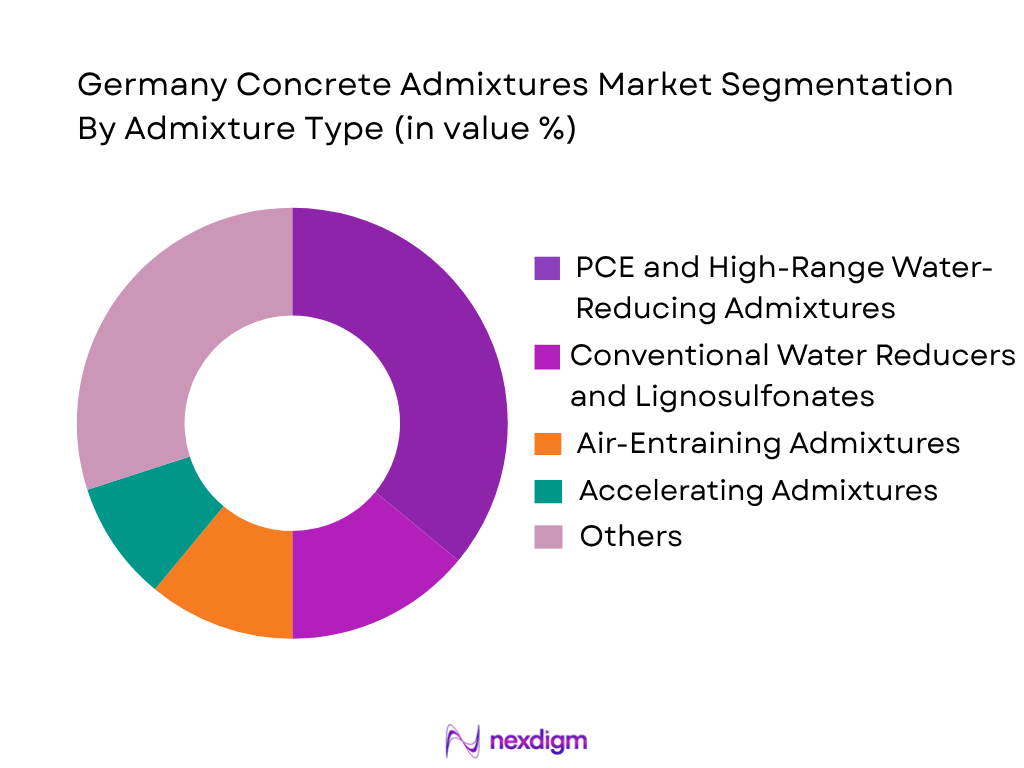
The Germany Concrete Admixtures Market is segmented into PCE and high-range water reducers, conventional plasticizers, air-entraining admixtures, accelerators, retarders, hydration stabilizers, viscosity modifiers, shrinkage reducers, water repellents and specialty low-carbon systems. PCE and high-range water-reducing admixtures hold the dominant modeled share because German ready-mix and precast producers increasingly require high water reduction, low viscosity, stable consistency and compatibility with clinker-reduced binders. PCE technology is particularly important in self-compacting concrete, high-performance concrete and precast manufacturing, where improved rheology permits dense reinforcement, efficient pumping and faster mold turnover. The shift toward lower-clinker cement further strengthens demand for advanced polymer architectures because changed binder composition can alter adsorption and workability. Master Builders Solutions markets MasterCO₂re technology specifically for reduced-clinker concrete, while MC-Bauchemie manufactures PCE polymers in Bottrop and develops formulations for challenging raw materials.
By Concrete Type
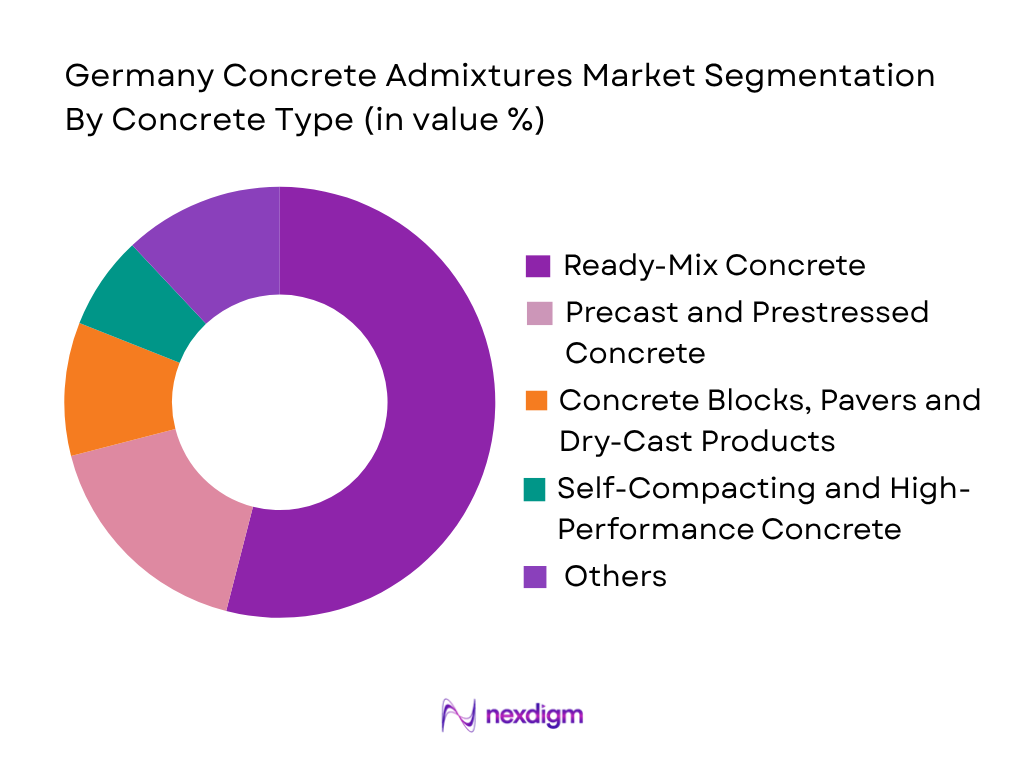
The Germany Concrete Admixtures Market is segmented into ready-mix concrete, precast and prestressed concrete, concrete blocks and pavers, self-compacting concrete, high-performance concrete, shotcrete, infrastructure concrete and specialty applications. Ready-mix concrete holds the dominant modeled share because it is used across residential, commercial, industrial, road, bridge and civil-engineering construction and requires repeatable control of consistency, setting and air content. German ready-mix producers increasingly use PCE systems to maintain workability while lowering water demand, while seasonal climate variation creates parallel requirements for accelerators, retarders and air entrainment. Ready-mix demand is also supported by substantial construction capital formation: building investment stood at EUR 450.66 billion, including EUR 180.18 billion in non-residential construction. Sika specifically identifies ready-mix concrete as a core German admixture application alongside precast, concrete goods and cement production, reflecting the segment’s central importance to admixture suppliers.
Competitive Landscape
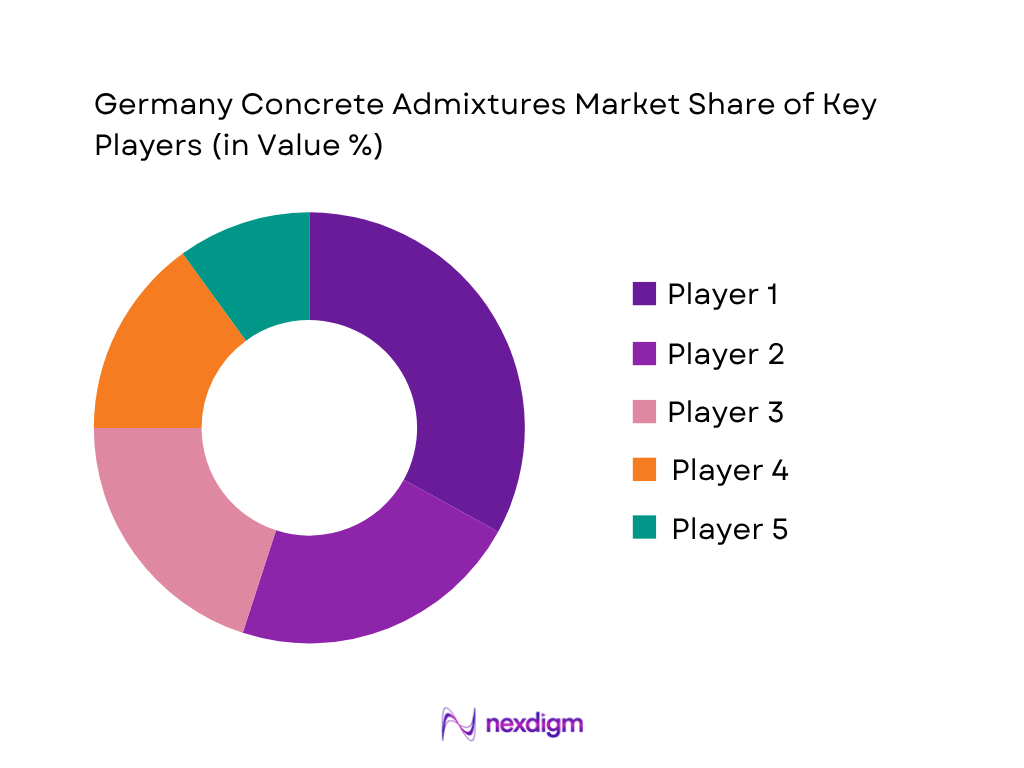
The Germany Concrete Admixtures Market has a technically intensive competitive structure led by established construction-chemical manufacturers with domestic production, polymer R&D, concrete laboratories and close links with ready-mix and precast producers. Master Builders Solutions, Sika, MC-Bauchemie, MAPEI and Ha-Be compete through PCE technology, low-carbon binder compatibility, air-entrainment systems, early-strength solutions and technical formulation support. Domestic laboratory capability is particularly important because admixture performance must be adapted to cement composition, SCMs, recycled aggregates and seasonal concrete conditions.
| Major Player | Establishment Year | Headquarters | PCE / HRWR Capability | Low-Carbon Concrete Capability | Ready-Mix Coverage | Precast Capability | Germany Manufacturing / R&D | Technical Support |
| Master Builders Solutions | 1909 | Mannheim, Germany | ~ | ~ | ~ | ~ | ~ | ~ |
| Sika | 1910 | Baar, Switzerland | ~ | ~ | ~ | ~ | ~ | ~ |
| MC-Bauchemie | 1961 | Bottrop, Germany | ~ | ~ | ~ | ~ | ~ | ~ |
| MAPEI | 1937 | Milan, Italy | ~ | ~ | ~ | ~ | ~ | ~ |
| Ha-Be Betonchemie | 1970 | Hameln, Germany | ~ | ~ | ~ | ~ | ~ | ~ |
Germany Concrete Admixtures Market Analysis
Growth Drivers
Infrastructure Modernization and Non-Residential Construction Sustain Admixture Demand
Germany’s infrastructure and non-residential construction base is supporting demand for PCE superplasticizers, air-entraining agents, accelerators, retarders and durability-focused concrete admixtures. Destatis recorded EUR 450.66 billion of construction investment in 2024, including EUR 180.18 billion in non-residential construction, followed by EUR 460.75 billion of construction investment and EUR 188.43 billion of non-residential construction in 2025. The German ready-mix concrete industry produced 36.81 million cubic metres in 2024, providing a large direct consumption base for chemical admixtures used in workability control, pumping, freeze-thaw protection and early-strength development. Public investment is also becoming more supportive: the federal government created a EUR 500 billion infrastructure and climate-neutrality special fund, and EUR 24 billion had already been disbursed during 2025. Rail infrastructure alone received around EUR 22 billion of investment funding in 2025. These construction and infrastructure volumes are significant relative to a 2024 German economy of USD 4,685.59 billion, with GDP per capita of USD 56,103.7, according to the World Bank, supporting continued specification of performance admixtures in transport, public-building and industrial concrete.
Ready-Mix Production and Low-Carbon Binder Transition Increase Need for Advanced PCE Systems
Germany’s large ready-mix sector and accelerating shift toward lower-clinker concrete are increasing the technical importance of high-performance PCE admixtures rather than simple conventional plasticizers. The Bundesverband Transportbeton reported 36.81 million cubic metres of ready-mixed concrete production in 2024, giving admixture suppliers a substantial industrialized batching base where dosage consistency, rheology and pumpability are critical. At the same time, Germany’s environmental policy is pushing concrete producers toward lower-carbon formulations. The Federal Environment Agency reported total German greenhouse-gas emissions of about 650 million tonnes of CO2-equivalent in 2024, while industrial emissions stood near 149 million tonnes; lower cement-clinker production was specifically identified as one factor reducing building-material emissions. Clinker production itself fell by almost 9 million tonnes-equivalent on the indexed production trajectory cited by the emissions-trading authority, intensifying interest in cements using slag, limestone, calcined clay and other substitutes. Such binders alter adsorption, water demand and early strength, increasing demand for tailored PCE systems, stabilizers and accelerators. Germany’s 2024 nominal GDP reached EUR 4,265.3 billion according to the IMF, while World Bank GDP was USD 4,685.59 billion, providing the economic scale for continued investment in advanced concrete formulation.
Market Challenges
Weak Residential Construction Creates Pressure on Conventional Admixture Volumes
Germany’s residential construction contraction is a direct market challenge for admixture suppliers exposed to standard ready-mix and building concrete. Destatis recorded 251,937 completed dwellings in 2024, falling to 206,586 in 2025. Total completed buildings and construction measures declined from 161,682 to 139,481, while newly completed buildings fell from 97,279 to 78,182. Building permits also remained weak: 215,289 dwellings were approved in 2024, compared with 238,063 in 2025, still below earlier construction levels. The backlog of approved but unfinished housing stood at 759,700 dwellings at the end of 2024, including approximately 330,000 already under construction, while 29,000 permits expired during that year. This weakening new-build environment reduces straightforward volume growth for water reducers, retarders and mainstream ready-mix admixtures and increases competitive pressure on suppliers to move toward infrastructure, precast and higher-value specialty applications. The macroeconomic environment also remained subdued: World Bank data put German 2024 GDP at USD 4,685.59 billion with GDP growth of -0.5, while the IMF recorded nominal GDP of EUR 4,265.3 billion, illustrating a large but slow-moving economy in which construction-volume recovery cannot be assumed.
Cement and SCM Transition Raises Compatibility and Formulation Complexity
The German Concrete Admixtures Market faces a technical challenge as cement chemistry changes while traditional supplementary cementitious material availability becomes less predictable. VDZ data show domestic cement shipments at 18,058,341 tonnes through November 2024, down materially from the preceding year’s level, reflecting weaker construction demand and a changing cement-production environment. The Federal Environment Agency also reported that cement-clinker production declined by almost 9 in indexed percentage-point terms during 2024, while the broader industrial sector still emitted around 149 million tonnes of CO2-equivalent. Producers are therefore under pressure to reduce clinker content while maintaining strength, workability and durability. This creates compatibility problems because PCE adsorption, sulfate balance, setting time and viscosity can change substantially when cement fineness, slag, limestone, fly ash or calcined-clay content varies. Ready-mix producers handling 36.81 million cubic metres of concrete in 2024 must manage these interactions at scale across different cement sources and seasonal conditions, making formulation stability difficult. Macroeconomic conditions add another constraint: Germany’s 2024 GDP was USD 4,685.59 billion and GDP per capita USD 56,103.7 according to the World Bank, while IMF nominal GDP reached EUR 4,265.3 billion, meaning technical adaptation is occurring in a very large but capital-disciplined construction economy.
Market Opportunities
Infrastructure Investment Creates a Large Opportunity for High-Durability Concrete Admixtures
Germany’s new infrastructure funding framework creates a significant future opportunity for admixture suppliers serving bridge, rail, road, tunnel and public-building concrete. The federal Special Fund for Infrastructure and Climate Neutrality provides EUR 500 billion of investment authorization over 12 years, of which EUR 300 billion is designated for federal infrastructure measures and EUR 100 billion is allocated to the Länder. During 2025, EUR 24 billion had already been disbursed, while federal investment expenditure increased by 17 billion-euro-equivalent on the reported expenditure trajectory. Rail infrastructure received approximately EUR 22 billion in 2025, with more than EUR 100 billion of federal rail funding embedded in the fiscal planning framework. These current commitments establish a much larger pipeline for bridge decks, tunnels, stations, foundations and civil structures requiring PCE superplasticizers, air-entraining agents, shrinkage-control systems, accelerators and low-permeability concrete. The opportunity is particularly relevant because infrastructure concrete demands longer design life and resistance to freeze-thaw cycles and de-icing salts. Germany’s 2024 GDP of USD 4,685.59 billion and GDP per capita of USD 56,103.7, according to the World Bank, indicate sufficient macroeconomic capacity to support this technically demanding public-investment cycle.
Low-Carbon Concrete and Recycled-Material Formulations Create a Technology-Led Growth Avenue
Germany’s decarbonization agenda creates a future growth avenue for admixtures capable of improving workability, early strength and rheology in clinker-reduced and recycled-material concrete. The Federal Environment Agency reported approximately 650 million tonnes of CO2-equivalent of total national greenhouse-gas emissions in 2024, with the industrial sector contributing roughly 149 million tonnes. Cement-clinker production fell by almost 9 in indexed terms, highlighting the industry’s move away from conventional high-clinker formulations. At the same time, Germany’s ready-mix industry still produced 36.81 million cubic metres of concrete in 2024, meaning even gradual adoption of reduced-clinker binders affects a large production base. Suppliers that can formulate PCE systems for CEM II, CEM III, slag-rich binders, calcined-clay systems and recycled aggregates can address water-demand variability, delayed strength development and unstable rheology that conventional admixtures may not manage effectively. The EUR 500 billion infrastructure and climate-neutrality investment fund also strengthens the future use case for lower-carbon construction materials in publicly financed assets. Germany’s macroeconomic base remains substantial, with 2024 GDP of USD 4,685.59 billion and GDP per capita of USD 56,103.7 from the World Bank, providing a strong platform for higher-value admixture technologies linked to low-carbon concrete.
Future Outlook
The Germany Concrete Admixtures Market is forecast to expand at approximately ~X.X% CAGR during 2026–2035. Growth will increasingly depend on value-added admixture technologies rather than simple expansion of conventional concrete volumes. Clinker-reduced cement, infrastructure rehabilitation, precast productivity, recycled aggregates and stricter durability requirements are expected to shift demand toward advanced PCE, rheology-control, air-entrainment and early-strength systems.
Germany’s construction base remains substantial despite weakness in residential building. Construction investment reached EUR 460.75 billion in 2025, including EUR 188.43 billion in non-residential construction, compared with EUR 450.66 billion overall one year earlier. This mix favors admixture suppliers exposed to industrial, logistics, infrastructure, commercial and public construction rather than only housing.
Major Players
- Master Builders Solutions Deutschland GmbH
- Sika Deutschland CH AG & Co KG
- MC-Bauchemie Müller GmbH & Co. KG
- MAPEI GmbH
- Ha-Be Betonchemie GmbH
- CHRYSO Deutschland GmbH / Saint-Gobain
- GCP Applied Technologies / Saint-Gobain
- CEMEX Admixtures GmbH
- Rhein-Chemotechnik GmbH
- SCHOMBURG GmbH & Co. KG
- PCT Performance Chemicals GmbH
- SNF Germany
- Wacker Chemie AG
- Evonik Industries AG
- Kao Chemicals Europe
Key Target Audience
- Concrete Admixture and Construction Chemical Manufacturers
- Ready-Mix Concrete Producers
- Precast and Prestressed Concrete Manufacturers
- Concrete Block and Paver Producers
- Cement and Supplementary Cementitious Material Producers
- Infrastructure and Civil Engineering Contractors
- Investments and Venture Capitalist Firms
- Government and Regulatory Bodies (Federal Ministry for Transport, Federal Highway Authority, German Institute for Building Technology, Federal Environment Agency, Federal Institute for Materials Research and Testing)
Research Methodology
Step 1: Identification of Key Variables
The initial phase involves developing an ecosystem map covering concrete admixture producers, chemical feedstock suppliers, cement manufacturers, ready-mix plants, precast factories and concrete-product manufacturers. Secondary research identifies the key variables influencing the Germany Concrete Admixtures Market, including concrete production, admixture dosage, binder chemistry, PCE penetration, clinker reduction, infrastructure activity and regional construction concentration.
Step 2: Market Analysis and Construction
Historical market demand is analyzed using top-down and bottom-up approaches. Top-down analysis assesses construction investment, building completions, cement demand and infrastructure activity, while bottom-up analysis estimates admixture consumption from ready-mix, precast and concrete-product output, typical dosage ranges, concrete type and admixture combinations used in each application.
Step 3: Hypothesis Validation and Expert Consultation
Market hypotheses are validated through computer-assisted telephone interviews with admixture manufacturers, ready-mix producers, precast companies, concrete technologists and cement specialists. These consultations assess PCE usage, air entrainment, early-strength requirements, clinker-reduced cement compatibility, product qualification, bulk dosing practices and competitive positioning across German concrete applications.
Step 4: Research Synthesis and Final Output
The final phase triangulates Destatis construction statistics, cement and concrete industry information, standards, company disclosures and primary interviews. Bottom-up admixture-consumption estimates are reconciled with top-down construction indicators. The resulting model assesses product mix, concrete applications, regional demand, competitive structure and future opportunities arising from low-carbon concrete, infrastructure rehabilitation and industrialized precast construction.

- Executive Summary
- Research Methodology (Market Definitions and Assumptions, Germany Concrete Admixtures Market Classification, Chemical Admixture Scope, Ready-Mix Concrete Assessment, Precast and Prestressed Concrete Assessment, Site-Batched Concrete Assessment, Water-Reducing Admixture Assessment, High-Range Water Reducer Assessment, PCE-Based Admixture Assessment, Lignosulfonate-Based Admixture Assessment, SNF-Based Admixture Assessment, Retarding Admixture Assessment, Accelerating Admixture Assessment, Air-Entraining Admixture Assessment, Hydration-Stabilizing Admixture Assessment, Shrinkage-Reducing Admixture Assessment, Viscosity-Modifying Admixture Assessment, High-Performance Concrete Assessment, Self-Compacting Concrete Assessment, Freeze-Thaw Resistant Concrete Assessment, Winter Concreting Assessment, Low-Carbon Concrete Assessment, Clinker-Reduced Cement Compatibility Assessment, Blast-Furnace Slag Compatibility Assessment, Fly Ash Compatibility Assessment, Calcined Clay Compatibility Assessment, Recycled-Aggregate Concrete Assessment)

- Definition and Scope
- Germany Concrete Admixtures Industry Evolution and Development of Conventional Water Reducers, Lignosulfonate-Based Plasticizers, Sulfonated Naphthalene Formaldehyde Superplasticizers, Polycarboxylate Ether Superplasticizers, Workability-Retention Admixtures, Retarding Admixtures, Accelerating Admixtures, Air-Entraining Admixtures, Hydration-Stabilizing Admixtures, Viscosity-Modifying Admixtures, Shrinkage-Reducing Admixtures, Corrosion-Inhibiting Admixtures, Self-Compacting Concrete Technologies, High-Performance Concrete Technologies, Freeze-Thaw Resistant Concrete, Precast High-Early-Strength Concrete, Low-Viscosity Concrete, Clinker-Reduced Concrete Admixtures, Calcined-Clay-Compatible Admixtures, Recycled-Aggregate Concrete Admixtures, Low-Carbon Concrete Technologies
- Concrete Admixtures Value Chain Analysis
- Concrete Admixtures Supply Chain Analysis
- PCE Macromonomer Suppliers, Acrylic Polymer Suppliers, Lignosulfonate Suppliers, Naphthalene-Based Chemical Suppliers, Surfactant Suppliers, Specialty Polymer Manufacturers, Concrete Admixture Manufacturers, Local Formulation and Blending Facilities, Ready-Mix Concrete Producers, Precast and Prestressed Concrete Manufacturers

- Growth Drivers (Infrastructure Rehabilitation, Bridge Replacement, Railway Modernization, Precast Concrete Industrialization, Low-Carbon Concrete Adoption, Clinker-Reduced Cement Use, PCE Superplasticizer Penetration, Self-Compacting Concrete, Energy Infrastructure Construction, Data Centre Development, Concrete Durability Requirements, Automated Concrete Production)
- Market Challenges (Weak New Residential Construction, Cement Chemistry Variability, Clinker-Reduced Cement Compatibility, Fly Ash Availability Constraints, Blast-Furnace Slag Availability, PCE Adsorption Variability, High Energy Costs, Specialty Raw Material Availability, Multi-Admixture Compatibility, Air-Void Stability, Regulatory Complexity, Ready-Mix Volume Pressure)
- Market Opportunities (CO2-Optimized PCE Systems, Calcined-Clay-Compatible Admixtures, Recycled-Aggregate Concrete, High-SCM Concrete, Bridge Rehabilitation, High-Durability Infrastructure Concrete, Precast Cycle-Time Reduction, Low-Viscosity Concrete, Digital Dosing, Returned Concrete Stabilization, Winter Concreting Systems, Wind-Energy Foundation Concrete)
- Market Trends (PCE-Based Superplasticizers, Low-Viscosity Concrete, Clinker-Reduced Concrete, Calcined Clay, Recycled Mineral Components, Low-CO2 Concrete, CO2 Performance Classes, Automated Admixture Dosing, Digital Concrete Production, Sustainable Concrete Mix Design, High-Early-Strength Precast Concrete, Performance-Based Specifications)
- Government Regulations and Standards (DIN EN 934-2 Concrete Admixture Requirements, DIN EN 206 Concrete Requirements, DIN 1045 Concrete Structures, DAfStb Concrete Guidelines, EN 13670 Execution of Concrete Structures, German Model Administrative Technical Building Regulations, REACH Chemical Compliance, CLP Classification and Labelling, Environmental Product Declaration Requirements, Infrastructure-Specific ZTV Specifications)
- SWOT Analysis
- Porter’s Five Forces Analysis
- PESTLE Analysis
- Stakeholder Ecosystem
- Concrete Admixtures Manufacturing and Concrete Construction Ecosystem

- By Market Value (2020-2025)
- By Admixture Consumption Volume (2020-2025)
- By High-Range Water-Reducing Admixture Consumption (2020-2025)
- By PCE-Based Superplasticizer Consumption (2020-2025)
- By Air-Entraining Admixture Consumption (2020-2025)
- By Accelerating Admixture Consumption (2020-2025)
- By Retarding Admixture Consumption (2020-2025)
- By Hydration-Stabilizing Admixture Consumption (2020-2025)
- By Viscosity-Modifying Admixture Consumption (2020-2025)
- By Ready-Mix Concrete Admixture Consumption (2020-2025)
- By Precast and Prestressed Concrete Admixture Consumption (2020-2025)
- By Concrete Block and Paver Admixture Consumption (2020-2025)
- By Infrastructure Concrete Admixture Consumption (2020-2025)
- By Low-Carbon Concrete Admixture Consumption (2020-2025)
- By Locally Manufactured Admixture Consumption (2020-2025)
- By Imported Admixture Consumption (2020-2025)

- By Admixture Type (In Value %)
Water-Reducing Admixtures
High-Range Water Reducers and Superplasticizers
PCE-Based Superplasticizers
Lignosulfonate-Based Plasticizers
SNF-Based Superplasticizers
Set-Retarding Admixtures
Set-Accelerating Admixtures
Air-Entraining Admixtures
Hydration-Stabilizing Admixtures
Viscosity-Modifying Admixtures
Shrinkage-Reducing Admixtures
Corrosion-Inhibiting Admixtures
Anti-Washout Admixtures
Efflorescence-Control Admixtures
Water-Repellent Admixtures
Specialty Low-Carbon Concrete Admixtures - By Chemical Technology (In Value %)
Polycarboxylate Ether-Based Admixtures
Lignosulfonate-Based Admixtures
Sulfonated Naphthalene Formaldehyde-Based Admixtures
Sulfonated Melamine Formaldehyde-Based Admixtures
Acrylic Polymer-Based Admixtures
Polymeric Viscosity Modifiers
Surfactant-Based Air-Entraining Agents
Non-Chloride Accelerator Chemistries
Calcium Nitrate-Based Systems
Glycol-Based Shrinkage-Reducing Systems
Hydration-Control Polymers
Hydrophobic and Water-Repellent Chemistries
Biobased and Renewable Chemistries
Hybrid Low-Carbon Admixture Systems - By Application (In Value %)
Ready-Mix Concrete
Precast Concrete
Prestressed Concrete
Self-Compacting Concrete
High-Performance Concrete
High-Strength Concrete
Ultra-High-Performance Concrete
Pumped Concrete
Shotcrete and Sprayed Concrete
Concrete Block and Paver Concrete
Road and Pavement Concrete
Bridge Concrete
Rail Infrastructure Concrete
Tunnel and Underground Concrete
Water and Wastewater Concrete
Wind-Energy Foundation Concrete - By Performance Requirement (In Value %)
High Water Reduction
Extended Workability
Low-Viscosity Concrete Performance
High Early Strength
Rapid Strength Development
Delayed Setting
Freeze-Thaw Resistance
De-Icing Salt Resistance
Improved Pumpability
Self-Compacting Performance
Air-Void Control
Reduced Permeability
Reduced Shrinkage
High-SCM Compatibility
Low-Clinker Concrete Optimization - By Region (In Value %)
North Rhine-Westphalia
Bavaria
Baden-Württemberg
Lower Saxony
Hesse
Saxony
Brandenburg
Berlin
Hamburg
Rhineland-Palatinate
Schleswig-Holstein
Saxony-Anhalt
Thuringia
Other Germany

- Market Share of Major Players (By Germany Revenue, Admixture Consumption Volume, PCE-Based Admixture Portfolio, Ready-Mix Concrete Exposure, Precast Concrete Exposure, Concrete Block and Paver Exposure, Infrastructure Project Exposure, Bridge and Rail Project Exposure, Low-Carbon Concrete Portfolio, Local Manufacturing Capacity, Polymer Formulation Capability, R&D Capability, Technical Laboratory Capability, Bulk Delivery Network, Regional Distribution Coverage)
- Cross Comparison Parameters (Concrete Admixture Portfolio Breadth, PCE Low-Viscosity and Workability-Retention Technology Capability, Ready-Mix Precast and Concrete-Products Customer Coverage, Germany Manufacturing and R&D Capability, Clinker-Reduced Cement and SCM Compatibility, Low-Carbon and CO2-Optimized Concrete Capability, DIN EN 934-2 DIN EN 206 and Infrastructure Specification Capability, Digital Dosing Technical Laboratory and Field-Service Support)
- SWOT Analysis of Major Players
- Competitive Positioning Matrix
- Major Companies
Master Builders Solutions Deutschland GmbH
Sika Deutschland CH AG & Co KG
MC-Bauchemie Müller GmbH & Co. KG
MAPEI GmbH
Ha-Be Betonchemie GmbH
CHRYSO Deutschland GmbH / Saint-Gobain
GCP Applied Technologies / Saint-Gobain
CEMEX Admixtures GmbH
Rhein-Chemotechnik GmbH
SCHOMBURG GmbH & Co. KG
PCT Performance Chemicals GmbH
SNF Germany
Wacker Chemie AG
Evonik Industries AG
Kao Chemicals Europe

- Ready-Mix Concrete Producer Requirement Assessment
- Precast Concrete Manufacturer Requirement Assessment
- Prestressed Concrete Manufacturer Requirement Assessment
- Concrete Block and Paver Producer Requirement Assessment
- Infrastructure Contractor Requirement Assessment
- Bridge and Highway Concrete Requirement Assessment
- Rail and Tunnel Concrete Requirement Assessment
- Cement Producer Compatibility Requirement Assessment
- Low-Carbon Concrete Requirement Assessment
- Freeze-Thaw and Air-Entrained Concrete Requirement Assessment
- PCE-Cement Compatibility Assessment
- Technical Laboratory and Field Service Requirement Assessment

- By Market Value (2026-2035)
- By Admixture Consumption Volume (2026-2035)
- By High-Range Water-Reducing Admixture Consumption (2026-2035)
- By PCE-Based Superplasticizer Consumption (2026-2035)
- By Air-Entraining Admixture Consumption (2026-2035)
- By Accelerating Admixture Consumption (2026-2035)
- By Retarding Admixture Consumption (2026-2035)
- By Hydration-Stabilizing Admixture Consumption (2026-2035)
- By Viscosity-Modifying Admixture Consumption (2026-2035)
- By Ready-Mix Concrete Admixture Consumption (2026-2035)
- By Precast and Prestressed Concrete Admixture Consumption (2026-2035)
- By Concrete Block and Paver Admixture Consumption (2026-2035)


 Request a Sample
 Ask for Customization
 Get a Quote
 Enquire Now
