
 Download PDF
Market Overview
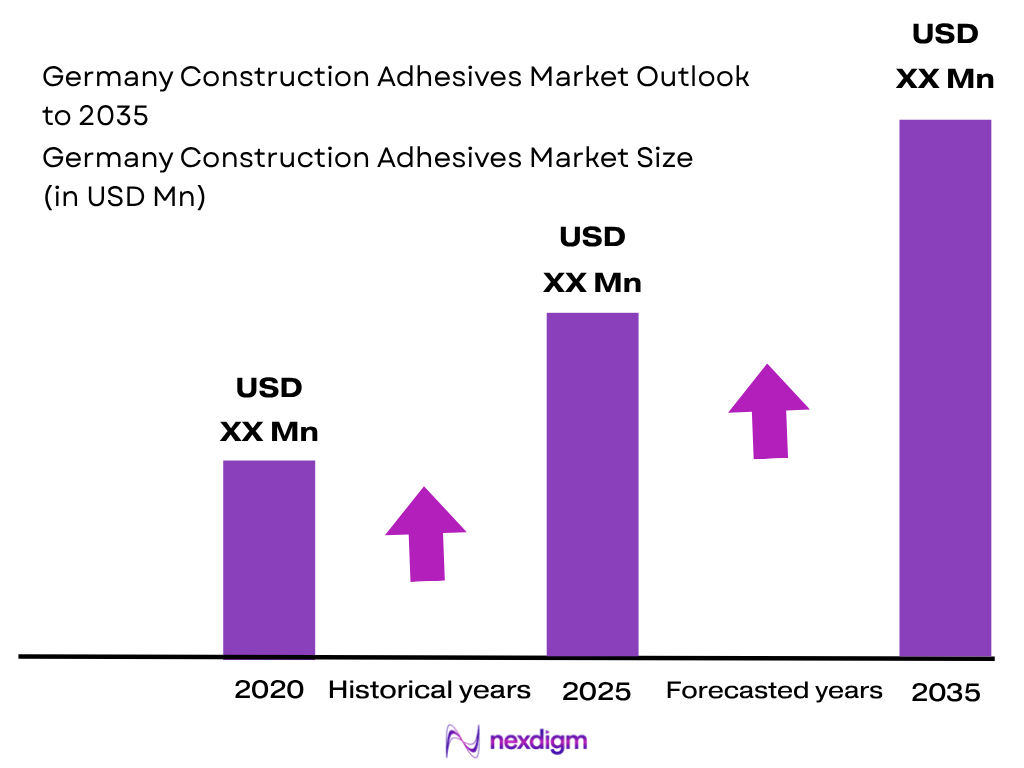
The Germany Construction Adhesives Market is valued at approximately ~USD XX million, supported increasingly by renovation, flooring replacement, tile installation and energy-efficient refurbishment. Building completions declined from 183,665 construction measures and 294,399 dwellings in the preceding reporting period to 161,682 construction measures and 251,937 dwellings in the latest period. Meanwhile, energy-efficiency and renewable-energy commitments increased from EUR7.5 billion to EUR9.5 billion, reinforcing renovation-oriented adhesive demand.
Rhine-Ruhr, Munich, Stuttgart, Frankfurt Rhine-Main, Berlin and Hamburg dominate Germany Construction Adhesives demand because these urban regions combine large residential stocks, commercial refurbishment, flooring replacement, façade modernization and institutional construction. National construction costs associated with completed works moved from approximately EUR100.4 billion in the preceding period to EUR95.9 billion in the latest period, while the unfinished housing pipeline still contained 759,700 permitted dwellings, sustaining renovation and completion-related adhesive consumption.
Market Segmentation
By Adhesive Chemistry
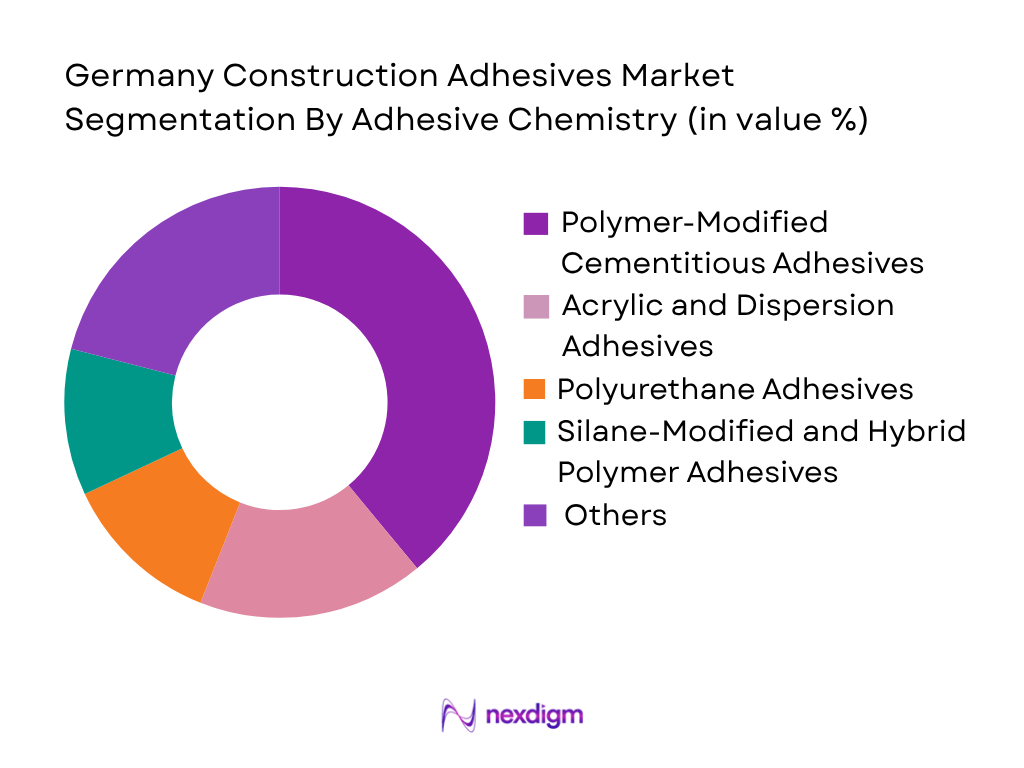
The Germany Construction Adhesives Market is segmented into polymer-modified cementitious adhesives, acrylic dispersion adhesives, epoxy adhesives, polyurethane adhesives, silane-modified polymer systems, hybrid polymer adhesives and other specialty chemistries. Polymer-modified cementitious adhesives hold the dominant position because ceramic tiles, porcelain stoneware and natural stone remain extensively used in bathrooms, kitchens, balconies, commercial spaces and renovation projects. Germany’s large existing building stock generates recurring replacement demand, while modern tile formats require stronger tensile adhesion, longer open time and greater deformability than conventional mortars. C2, S1 and S2 classified systems are therefore strategically important for large-format tiles and substrates exposed to movement or underfloor heating. Dispersion products remain important for selected interior applications, while epoxy and polyurethane chemistries serve structural, moisture-sensitive and heavy-duty installations. Silane-modified polymers are gaining relevance because they combine elastic bonding, broad substrate compatibility and low-emission characteristics suitable for interior refurbishment and prefabricated construction.
By Application
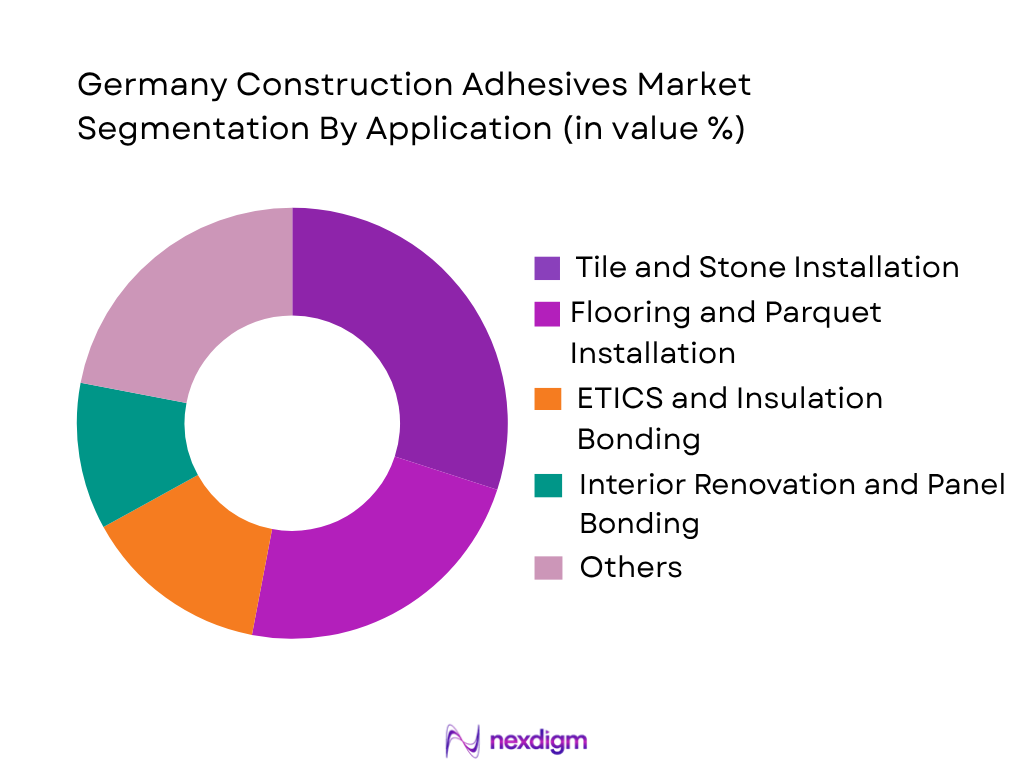
The Germany Construction Adhesives Market is segmented into tile and stone installation, flooring and parquet installation, ETICS and insulation bonding, structural bonding, prefabricated component bonding, façade applications and interior renovation. Tile and stone installation represents the dominant subsegment because residential modernization generates continuous demand for bathroom, kitchen and floor replacement, while commercial refurbishment supports porcelain, ceramic and natural-stone applications. Flooring and parquet adhesives are another major demand pool, supported by Germany’s large installed base of residential and commercial buildings. Low-emission products have become especially relevant for interior flooring because building occupants spend substantial time indoors and German specification practices strongly emphasize indoor-air quality. ARDEX notes that a large part of its portfolio carries EMICODE and/or Blue Angel certification, illustrating the importance of emission-controlled installation products. ETICS adhesives also benefit from energy-efficiency renovation, where insulation boards must be securely bonded to existing façades.
Competitive Landscape
The Germany Construction Adhesives Market is characterized by strong domestic construction-chemical manufacturers alongside multinational suppliers. Competition is based on DIN/EN product classification, flooring and parquet expertise, low-emission certification, renovation suitability, installer relationships and regional specialist distribution. German suppliers such as ARDEX, PCI, UZIN UTZ, Sopro, Kiesel and WAKOL have strong positions in professional installation channels, while multinational companies such as Sika, MAPEI, Bostik and Saint-Gobain compete through broader technology portfolios and system-based construction solutions. Low-emission credentials and installer support are important differentiators because Germany has stringent indoor-air-quality expectations and a mature specialist-trade structure.
| Major Player | Establishment Year | Headquarters | Tile Adhesives | Flooring / Parquet | Low-Emission Portfolio | ETICS / Façade | Hybrid / SMP Capability | Technical & Installer Support |
| ARDEX | 1949 | Witten, Germany | ~ | ~ | ~ | ~ | ~ | ~ |
| MAPEI | 1937 | Milan, Italy | ~ | ~ | ~ | ~ | ~ | ~ |
| Sika | 1910 | Baar, Switzerland | ~ | ~ | ~ | ~ | ~ | ~ |
| UZIN UTZ | 1911 | Ulm, Germany | ~ | ~ | ~ | ~ | ~ | ~ |
| PCI Augsburg | 1950 | Augsburg, Germany | ~ | ~ | ~ | ~ | ~ | ~ |
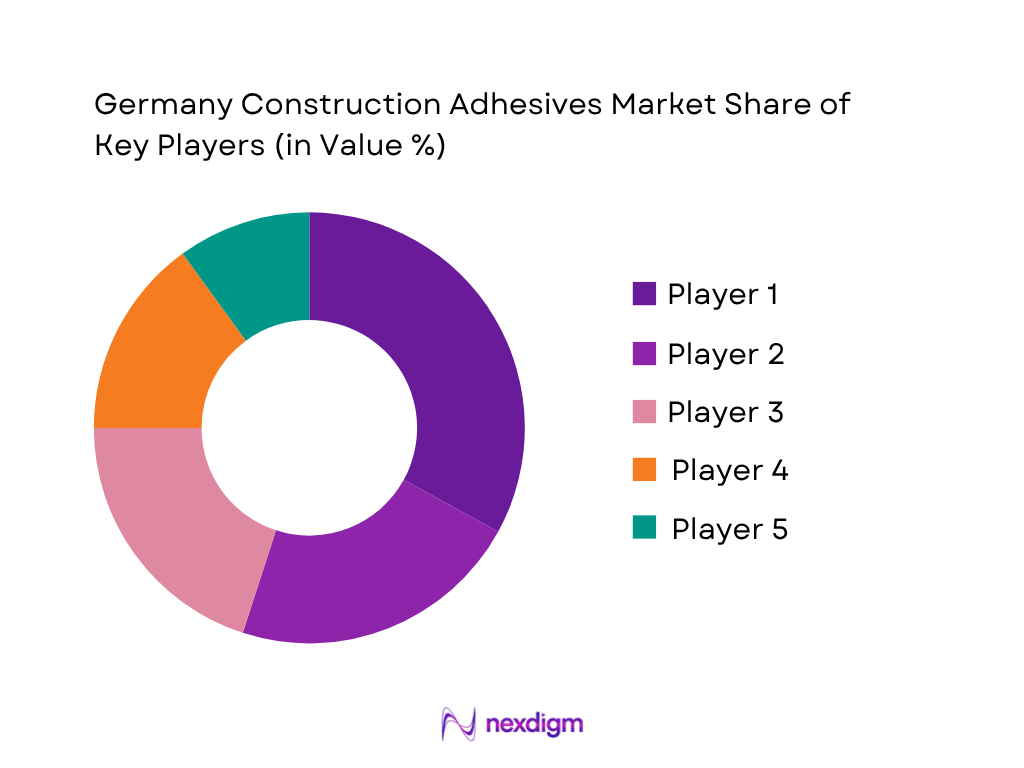
Germany Construction Adhesives Market Analysis
Growth Drivers
Large Existing Housing Stock Is Sustaining Renovation-Led Adhesive Demand
Germany’s construction adhesives demand is increasingly supported by renovation, flooring replacement, bathroom modernization and refurbishment of existing buildings rather than relying solely on new construction. Destatis recorded 43.7557 million dwellings in Germany at the end of 2024, compared with 43.5172 million dwellings a year earlier, creating an exceptionally large installed base requiring periodic tile replacement, parquet installation, resilient flooring, façade renovation and interior refurbishment. The country’s housing stock represented approximately 4.1 billion square metres of residential floor area, providing a substantial physical application base for cementitious tile adhesives, dispersion adhesives, polyurethane systems and silane-modified polymer products. Renovation activity is especially relevant for adhesive suppliers because existing substrates often require flexible, high-adhesion and fast-setting products capable of bonding to old tiles, screeds and mixed surfaces. Germany’s broader economic capacity remains significant despite construction weakness: World Bank data record nominal GDP of USD4,685.59 billion in 2024 and GDP per capita of USD56,103.7. This combination of a mature, high-value building stock and strong purchasing capacity supports recurring professional demand for specialized renovation adhesives, low-emission flooring systems and high-performance tile-installation products.
Energy-Efficiency Refurbishment Is Expanding ETICS and Interior Installation Demand
Germany’s energy-efficiency modernization activity is creating a direct demand channel for construction adhesives used in external thermal insulation composite systems, façade refurbishment, flooring replacement and interior renovation carried out alongside building upgrades. KfW recorded approximately 144,000 heating-system grant commitments by October 2024, demonstrating the scale of households actively undertaking energy-related building improvements. These projects frequently trigger complementary refurbishment work involving insulation boards, new floor coverings, wall finishes, bathrooms and interior surfaces, increasing consumption of ETICS adhesives, cementitious products, parquet adhesives and low-emission dispersion systems. The opportunity is amplified by Germany’s 43.7557 million dwellings and approximately 23.5 million apartments located in multifamily buildings, where coordinated renovation programs can generate repeated adhesive consumption across entire residential blocks. German building owners also operate within a high-income economy: World Bank data place nominal GDP at USD4,685.59 billion in 2024 and GDP per capita at USD56,103.7. The scale of the existing building base, combined with active energy modernization, favors suppliers offering complete adhesive systems for insulation, flooring, tiling and substrate preparation rather than standalone commodity products.
Market Challenges
Weak New Residential Construction Is Limiting Adhesive Demand from New-Build Projects
Germany’s construction adhesives market faces a significant challenge from reduced new residential activity, which directly affects demand for tile adhesives, flooring systems, parquet adhesives, structural bonding products and interior installation materials used during building completion. Destatis recorded 251,937 completed dwellings in 2024, while only 215,289 dwellings received building permits during the same period. New-building activity accounted for 220,666 completed dwellings, with just 97,279 newly completed buildings, indicating a considerably smaller flow of fresh projects requiring first-time adhesive installation. Permit activity was also weak, with only 76,619 new buildings authorized and 175,950 dwellings approved within new structures. This contraction reduces the number of bathrooms, kitchens, tiled common areas, floors and façades entering the installation stage, particularly affecting suppliers dependent on residential new-build channels. The broader economy also provided limited cyclical support: World Bank data show Germany’s nominal GDP at USD4,685.59 billion in 2024 and GDP per capita at USD56,103.7. As a result, adhesive manufacturers must increasingly redirect sales toward refurbishment, repair and specialist applications rather than depending on conventional residential expansion.
Large Construction Backlog Creates Uncertainty in Product Demand Timing
Germany’s substantial stock of permitted but unfinished housing creates a market-specific challenge for construction adhesive manufacturers because project authorization does not automatically translate into predictable near-term product consumption. Destatis recorded 759,700 permitted but unfinished dwellings at the end of 2024. Of these, approximately 330,000 dwellings were already under construction, while 179,200 dwellings had reached the enclosed-shell or roof-complete stage. At the same time, 29,000 residential building permits expired during the year, demonstrating that a significant portion of the development pipeline can be postponed or cancelled before reaching finishing stages. Construction adhesives are generally consumed relatively late in the building cycle, after structural work and substrate preparation, so delays between permitting, shell completion and interior fit-out can materially affect distributor inventory planning and manufacturer production schedules. Germany’s macroeconomic scale remains high, with World Bank data recording nominal GDP of USD4,685.59 billion in 2024 and GDP per capita of USD56,103.7, but this does not remove project-execution uncertainty. Suppliers therefore need diversified exposure across renovation, flooring, ETICS and repair markets to offset volatility in delayed new-build completions.
Market Opportunities
Energy-Retrofit Activity Creates Future Scope for ETICS and Low-Emission Adhesive Systems
Germany’s existing-building modernization pipeline creates substantial future opportunity for construction adhesive suppliers focused on insulation bonding, façade renovation, flooring replacement and low-emission interior systems. Current activity already provides a strong foundation: KfW had approved approximately 144,000 heating-system grant applications by October 2024, while Germany contained 43.7557 million dwellings and approximately 4.1 billion square metres of residential floor space. Energy upgrades frequently coincide with broader building modernization because owners replace floor finishes, refurbish bathrooms, improve wall assemblies and install insulation systems while properties are already under construction. This creates cross-selling opportunities for ETICS adhesives, flexible tile adhesives, parquet products, SMP systems and certified low-emission flooring adhesives. Multifamily housing is particularly relevant, with approximately 23.5 million dwellings located in 3.5 million multifamily buildings, allowing renovation measures to generate concentrated product demand across many units. World Bank data record German nominal GDP of USD4,685.59 billion in 2024 and GDP per capita of USD56,103.7, supporting continued capacity for high-specification renovation. Suppliers positioned around complete refurbishment systems can therefore capture future growth without relying primarily on a recovery in new residential construction.
Prefabricated and Industrialized Construction Opens Scope for Hybrid Bonding Technologies
Germany’s prefabricated building segment provides a future opportunity for construction adhesives used in factory assembly, timber components, panels, modular elements and mixed-material bonding, despite the broader construction slowdown. Destatis recorded approximately 24,106 prefabricated residential and non-residential buildings completed in 2024, incorporating around 28,825 dwellings and approximately 12.028 million square metres of usable space. Within residential prefabrication, around 16,900 residential buildings were completed, including approximately 14,300 single-family prefabricated houses, 1,700 two-family buildings and 720 residential buildings containing at least three dwellings. Factory-based construction favors adhesives because controlled production conditions support precise application of polyurethane, epoxy, silane-modified and hybrid polymer systems for timber, insulation, panels and composite assemblies. These technologies can reduce mechanical fastening requirements and enable bonding across dissimilar substrates. Germany’s industrial capacity provides a supportive backdrop, with World Bank data recording nominal GDP of USD4,685.59 billion in 2024 and GDP per capita of USD56,103.7. Current prefabrication volumes therefore provide an established platform for future adhesive innovation focused on modular, timber-hybrid and factory-assembled construction systems.
Future Outlook
The Germany Construction Adhesives Market is forecast to expand at approximately ~X.X% CAGR during 2026-2035, with future growth increasingly linked to renovation rather than purely to new construction. Existing-building modernization, energy-efficiency programs, flooring replacement and façade insulation are expected to shape product demand. The country entered this period with a substantial unfinished construction pipeline: 759,700 permitted but unfinished dwellings remained at the end of the latest reporting period, including approximately 330,000 already under construction. This pipeline provides a continuing base for tile, flooring and interior installation products.
Renovation-oriented chemistry is expected to gain strategic importance. Fast-setting tile adhesives, moisture-tolerant flooring products, SMP parquet adhesives and systems that can bond directly over existing substrates help reduce project downtime and labor intensity.
Major Players
- Sika Deutschland GmbH
- MAPEI GmbH
- ARDEX GmbH
- PCI Augsburg GmbH
- UZIN UTZ SE
- Bostik GmbH
- Saint-Gobain Weber GmbH
- Henkel AG & Co. KGaA / Ceresit / Thomsit
- Sopro Bauchemie GmbH
- Kiesel Bauchemie GmbH & Co. KG
- WAKOL GmbH
- MC-Bauchemie Müller GmbH & Co. KG
- Remmers GmbH
- tremco illbruck GmbH & Co. KG
- Murexin GmbH Germany
Key Target Audience
- Construction Adhesive and Building Chemical Manufacturers
- Tile, Flooring and Parquet Product Manufacturers and Distributors
- Specialist Installers and Renovation Contractors
- Housing Companies and Commercial Property Owners
- Prefabricated, Modular and Timber Construction Companies
- Investments and Venture Capitalist Firms
- Government and Regulatory Bodies (Federal Ministry for Housing, Urban Development and Building, Federal Environment Agency, German Institute for Building Technology, KfW)
- Construction Material Distributors and Builders’ Merchants
Research Methodology
Step 1: Identification of Key Variables
The initial phase involves constructing an ecosystem map covering adhesive manufacturers, polymer suppliers, dry-mix producers, specialist distributors, tile installers, flooring contractors, housing companies and renovation contractors. Secondary and proprietary research is used to identify chemistry, application, EN classification, emission certification and regional demand variables. The primary objective is to define the factors influencing consumption across new-build and renovation applications.
Step 2: Market Analysis and Construction
Historical market conditions are assessed using German construction completions, building permits, renovation activity and energy-efficiency funding. The top-down approach evaluates construction and refurbishment activity, while the bottom-up methodology examines manufacturer revenues, distributor throughput, installation volumes and application-specific consumption. Results are reconciled across tile, flooring, parquet, ETICS, structural and prefabrication adhesive categories.
Step 3: Hypothesis Validation and Expert Consultation
Market assumptions are validated through computer-assisted telephone interviews and structured discussions with manufacturers, installers, specialist distributors, flooring professionals and renovation contractors. These consultations evaluate adhesive consumption, product-class preferences, substrate conditions, low-emission requirements and installer purchasing behavior. Findings are used to distinguish professional specification-driven demand from retail and DIY consumption.
Step 4: Research Synthesis and Final Output
The final phase triangulates construction statistics, KfW refurbishment data, manufacturer disclosures, certification requirements and primary interviews. Demand is validated across adhesive chemistry, application, region and project type. Forecasting incorporates new-build recovery, existing-building renovation, ETICS upgrades, low-emission product adoption, prefabrication, timber construction and hybrid polymer technologies to establish the final Germany Construction Adhesives Market outlook.

- Executive Summary
- Research Methodology (Market Definitions and Assumptions, Germany Construction Adhesives Market Classification, Cementitious Adhesive Scope, Dispersion Adhesive Assessment, Epoxy Adhesive Assessment, Polyurethane Adhesive Assessment, Silane-Modified Polymer Assessment, Hybrid Polymer Adhesive Assessment, Tile Adhesive Assessment, Flooring Adhesive Assessment, Parquet Adhesive Assessment, Structural Bonding Assessment, ETICS Adhesive Assessment, Façade Adhesive Assessment, Insulation Adhesive Assessment, Prefabrication Adhesive Assessment, Renovation Adhesive Assessment, Large-Format Tile Assessment, Wet-Area Tiling Assessment, Balcony and Terrace Adhesive Assessment, DIN EN 12004 Classification Assessment, DIN EN 12002 Deformability Assessment, DIN EN 14293 Flooring Adhesive Assessment, EMICODE Assessment, Blue Angel Low-Emission Assessment)

- Definition and Scope
- Germany Construction Adhesives Industry Evolution and Development of Conventional Cementitious Mortars, Polymer-Modified Tile Adhesives, Dispersion Adhesives, Epoxy Structural Adhesives, Polyurethane Construction Adhesives, Silane-Modified Polymer Adhesives, Hybrid Polymer Adhesives, Flexible Tile Adhesives, Large-Format Tile Adhesives, Natural Stone Adhesives, Parquet Adhesives, Resilient Flooring Adhesives, ETICS Adhesives, Façade Bonding Systems, Structural Bonding Adhesives, Prefabrication Adhesives, Low-Emission Adhesives, Solvent-Free Systems and Sustainable Construction Adhesive Technologies
- Construction Adhesives Value Chain Analysis
- Construction Adhesives Supply Chain Analysis
- Polymer Resin Suppliers, Redispersible Polymer Powder Suppliers, Cement and Mineral Filler Suppliers, Epoxy Resin Suppliers, Polyurethane Raw Material Suppliers, Acrylic Dispersion Suppliers, Silane-Modified Polymer Suppliers, Specialty Additive Suppliers, Construction Adhesive Manufacturers, Dry-Mix Mortar Producers

- Growth Drivers (Existing Building Renovation, Energy-Efficiency Modernization, ETICS Installation, Bathroom and Interior Renovation, Flooring Replacement, Public Building Modernization, Multifamily Housing Refurbishment, Large-Format Tile Adoption, Underfloor Heating Integration, Prefabricated Construction, Low-Emission Product Demand, Timber Hybrid Construction)
- Market Challenges (Weak New Residential Construction, Building Permit Volatility, Skilled Installer Shortage, Raw Material Price Volatility, Polymer Feedstock Dependence, Multi-Substrate Compatibility, Residual Moisture Management, Stringent Emission Requirements, Application Error Risk, Renovation Substrate Variability, Contractor Price Pressure, Product Certification Complexity)
- Market Opportunities (Energy-Retrofit Adhesives, ETICS Bonding Systems, Low-Emission Flooring Adhesives, Large-Format Tile Adhesives, S1 and S2 Flexible Adhesives, SMP and Hybrid Polymer Systems, Parquet Adhesives, Prefabrication Adhesives, Timber Hybrid Construction Adhesives, Public Building Renovation, Fast-Track Renovation Products, Sustainable Dry-Mix Formulations)
- Market Trends (C2 Tile Adhesives, S1 and S2 Deformable Adhesives, EC1 PLUS Low-Emission Systems, Silane-Modified Polymer Adhesives, Solvent-Free Flooring Products, Large-Format Tile Systems, Rapid-Setting Renovation Products, System-Based ETICS Solutions, Ready-to-Use Dispersion Adhesives, Sustainable Packaging, Digital Product Documentation, Prefabrication-Compatible Adhesives)
- Government Regulations and Standards (DIN EN 12004 Tile Adhesive Classification, DIN EN 12002 Deformability Testing, DIN EN 14293 Wood Flooring Adhesive Requirements, EMICODE Emission Classification, Blue Angel Requirements, German Building Product Requirements, EU Construction Products Regulation, REACH Requirements, CLP Chemical Classification, VOC and Indoor Air Quality Requirements, GEV Emission Requirements)
- SWOT Analysis
- Porter’s Five Forces Analysis
- PESTLE Analysis
- Stakeholder Ecosystem
- Construction Adhesives Manufacturing and Renovation Project Ecosystem

- By Market Value (2020-2025)
- By Consumption Volume (2020-2025)
- By Cementitious Adhesive Consumption (2020-2025)
- By Tile Adhesive Consumption (2020-2025)
- By Dispersion Adhesive Consumption (2020-2025)
- By Epoxy Adhesive Consumption (2020-2025)
- By Polyurethane and Hybrid Adhesive Consumption (2020-2025)
- By Flooring Adhesive Consumption (2020-2025)
- By Parquet Adhesive Consumption (2020-2025)
- By ETICS and Insulation Adhesive Consumption (2020-2025)
- By Structural Bonding Adhesive Consumption (2020-2025)
- By Residential Construction Adhesive Consumption (2020-2025)
- By Commercial and Institutional Adhesive Consumption (2020-2025)
- By Renovation and Modernization Adhesive Consumption (2020-2025)
- By New-Build Adhesive Consumption (2020-2025)

- By Adhesive Chemistry (In Value %)
Polymer-Modified Cementitious Adhesives
Acrylic Dispersion Adhesives
Epoxy Adhesives
Polyurethane Adhesives
Silane-Modified Polymer Adhesives
MS Polymer and Hybrid Adhesives
SBR-Based Adhesives
PVA-Based Adhesives
Reactive Resin Adhesives
Other Specialty Construction Adhesives - By Product Type (In Value %)
Standard Tile Adhesives
Improved Cementitious Tile Adhesives
Flexible Tile Adhesives
Large-Format Tile Adhesives
Rapid-Setting Tile Adhesives
Natural Stone Adhesives
Ready-Mixed Dispersion Adhesives
Flooring Adhesives
Parquet Adhesives
Structural Epoxy Adhesives
Concrete Bonding Adhesives
ETICS Adhesives
Façade Adhesives
Insulation Adhesives
Prefabrication and Panel Bonding Adhesives - By Application (In Value %)
Floor Tiling
Wall Tiling
Large-Format Tile Installation
Porcelain Stoneware Installation
Natural Stone Installation
Bathroom and Wet-Area Tiling
Tile-on-Tile Installation
Balcony and Terrace Tiling
Vinyl and Resilient Flooring
Textile Flooring
Parquet and Wood Flooring
Structural Concrete Bonding
ETICS Insulation Board Bonding
Façade Panel Bonding
Prefabricated Component Bonding
Interior Fit-Out and Decorative Bonding - By Performance Requirement (In Value %)
High Tensile Adhesion Strength
Extended Open Time
Slip Resistance
S1 Deformability
S2 High Deformability
Rapid Setting
Moisture Resistance
Freeze-Thaw Resistance
High Initial Grab
Structural Load Transfer
Underfloor Heating Compatibility
Low-Emission Performance
Solvent-Free Performance
High Residual Moisture Tolerance - By Region (In Value %)
North Rhine-Westphalia
Bavaria
Baden-Württemberg
Hesse
Lower Saxony
Berlin
Hamburg
Saxony
Rhineland-Palatinate
Schleswig-Holstein
Frankfurt Rhine-Main
Munich Metropolitan Region
Rhine-Ruhr
Stuttgart Region
Rest of Germany

- Market Share of Major Players (By Germany Revenue, Adhesive Consumption Volume, Tile Adhesive Portfolio, Flooring Adhesive Portfolio, Parquet Adhesive Portfolio, ETICS Adhesive Exposure, Structural Adhesive Portfolio, Residential Renovation Exposure, Commercial Renovation Exposure, Manufacturing Footprint, Distributor Network, Installer Coverage, EMICODE Portfolio, Technical Support, Specification Presence)
- Cross Comparison Parameters (Construction Adhesive Chemistry Portfolio Breadth, EN 12004 C2 S1 and S2 Tile Adhesive Capability, Flooring and Parquet Adhesive Technology Capability, EMICODE Blue Angel and Low-Emission Product Portfolio, Germany Manufacturing Warehousing and Specialist Distribution Network, Renovation ETICS and Existing-Building Project Exposure, Installer Training Specification and Technical Support Capability, Sustainable Hybrid Polymer and Circular Construction Solution Capability)
- SWOT Analysis of Major Players
- Competitive Positioning Matrix
- Major Companies
Sika Deutschland GmbH
MAPEI GmbH
ARDEX GmbH
PCI Augsburg GmbH
UZIN UTZ SE
Bostik GmbH
Saint-Gobain Weber GmbH
Henkel AG & Co. KGaA / Ceresit / Thomsit
Sopro Bauchemie GmbH
Kiesel Bauchemie GmbH & Co. KG
WAKOL GmbH
MC-Bauchemie Müller GmbH & Co. KG
Remmers GmbH
tremco illbruck GmbH & Co. KG
Murexin GmbH Germany

- Tile Installer Requirement Assessment
- Flooring Installer Requirement Assessment
- Parquet Installer Requirement Assessment
- ETICS Contractor Requirement Assessment
- General Contractor Procurement Assessment
- Renovation Contractor Requirement Assessment
- Housing Company Adhesive Specification Assessment
- Commercial Property Owner Requirement Assessment
- Architect Specification Assessment
- Flooring Planner Requirement Assessment
- Prefabricated Construction Manufacturer Requirement Assessment
- Timber Construction Requirement Assessment
- Low-Emission Adhesive Requirement Assessment
- Technical Service and Installer Training Requirement Assessment

- By Market Value (2026-2035)
- By Consumption Volume (2026-2035)
- By Cementitious Adhesive Consumption (2026-2035)
- By Tile Adhesive Consumption (2026-2035)
- By Dispersion Adhesive Consumption (2026-2035)
- By Epoxy Adhesive Consumption (2026-2035)
- By Polyurethane and Hybrid Adhesive Consumption (2026-2035)
- By Flooring Adhesive Consumption (2026-2035)
- By Parquet Adhesive Consumption (2026-2035)
- By ETICS and Insulation Adhesive Consumption (2026-2035)
- By Structural Bonding Adhesive Consumption (2026-2035)


 Request a Sample
 Ask for Customization
 Get a Quote
 Enquire Now