

 Download PDF
Market Overview
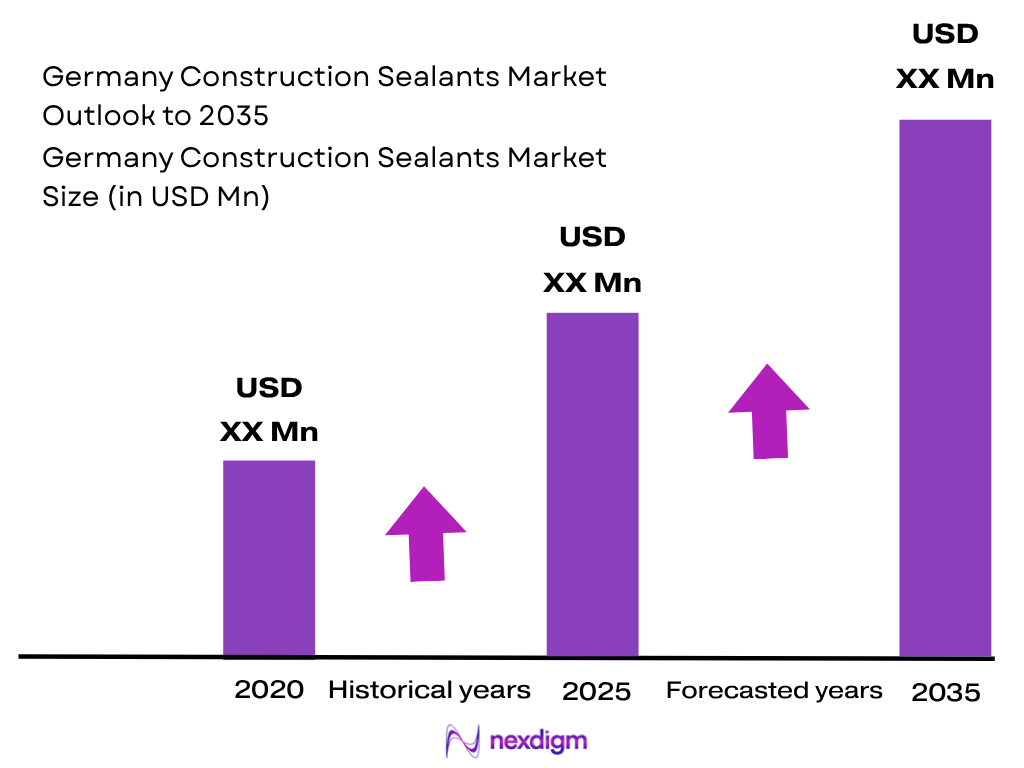
The Germany Construction Sealants Market is valued at approximately USD ~XX million, supported by both new construction and a large refurbishment base. Approved building projects declined from 163,906 in the preceding annual observation to 145,010 in the latest period, while estimated construction costs moved from EUR112.99 billion to EUR104.06 billion. Germany nevertheless maintained 43.76 million dwellings, sustaining recurring demand for window, façade, sanitary, roofing and renovation sealants.
North Rhine-Westphalia, Bavaria, Baden-Württemberg, Berlin, Hamburg and major metropolitan corridors dominate Germany’s sealant consumption because they combine large building stocks, industrial construction, renovation activity and dense professional contractor networks. National dwelling stock increased from 43.52 million units to 43.76 million units, while North Rhine-Westphalia contained 2,482 square kilometres of residential land, Bavaria 2,267 square kilometres and Baden-Württemberg 1,612 square kilometres, supporting extensive installed-building maintenance demand.
Market Segmentation
By Sealant Chemistry
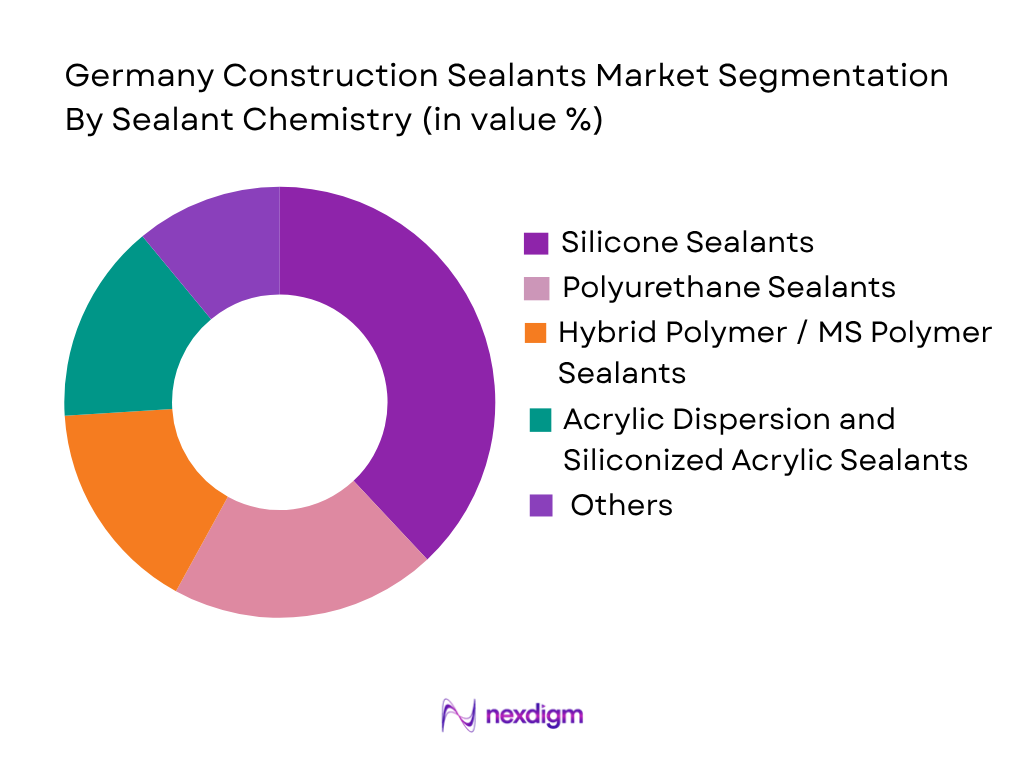
The Germany Construction Sealants Market is segmented into silicone sealants, polyurethane sealants, hybrid polymer and silyl-modified polymer sealants, acrylic dispersion sealants, butyl sealants, polysulfide sealants and other specialty chemistries. Silicone sealants hold the dominant market share because Germany has extensive demand from sanitary installation, window construction, façade weathersealing, natural stone applications, glazing and renovation. Neutral-cure silicones are particularly important where long-term UV resistance, permanent elasticity and compatibility with glass, aluminum and mineral substrates are required. Germany also has an established domestic professional sealant manufacturing ecosystem, including specialist producers with portfolios covering sanitary, natural stone, façade and glazing applications. Hybrid polymers are increasingly relevant because they combine paintability, low-emission characteristics and broad substrate adhesion, while acrylics remain important for interior connection joints and paintable applications. Polyurethane products maintain a strong position in concrete, flooring and movement joints where mechanical resistance is important.
By Application
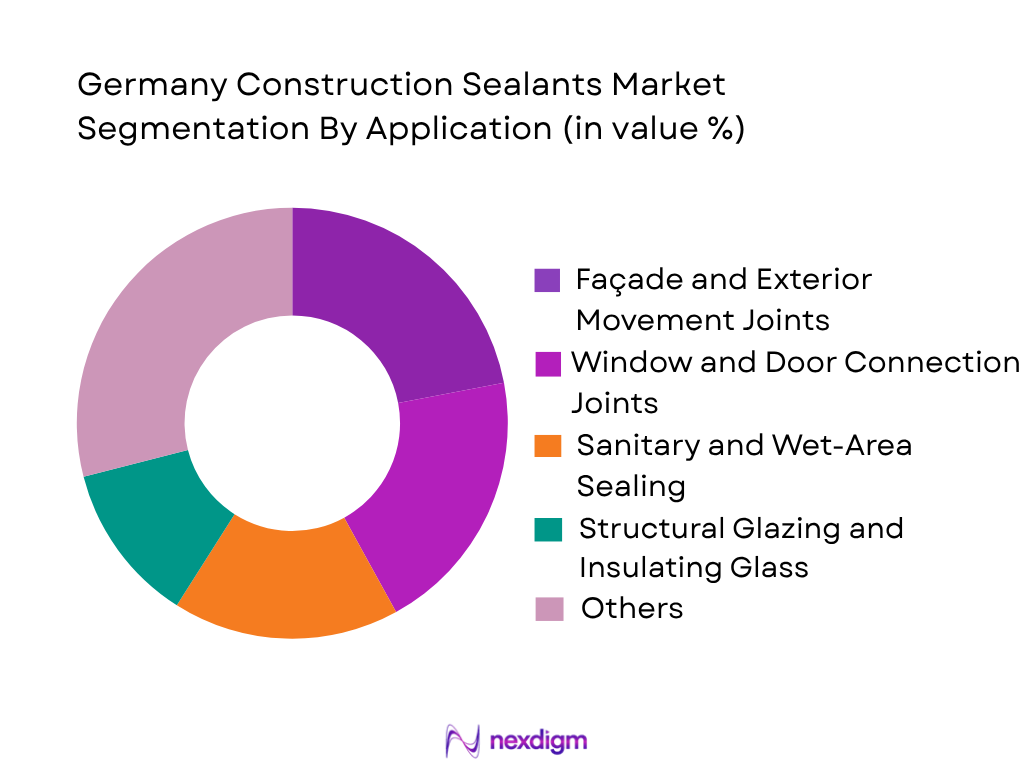
The Germany Construction Sealants Market is segmented into façade and exterior joints, window and door connections, sanitary and wet-area sealing, structural glazing and insulating glass, natural stone applications, floor and concrete joints, roofing, fire-rated and acoustic applications and other uses. Window, façade and exterior connection sealing collectively represent the dominant demand pool because Germany’s large existing building stock requires continuous maintenance, energy-efficiency upgrades and joint replacement. KfW identifies old windows as a major thermal weak point, with older units potentially accounting for substantial room-heat losses, making window replacement a key refurbishment measure. Modern double- and triple-glazed windows require reliable perimeter sealing to maintain airtightness, driving-rain resistance and moisture control. Sanitary silicone is also widely consumed because bathrooms, kitchens, healthcare facilities and commercial wet areas require elastic and mold-resistant joints. Structural glazing and insulating-glass sealants represent smaller but highly technical application segments.
Competitive Landscape
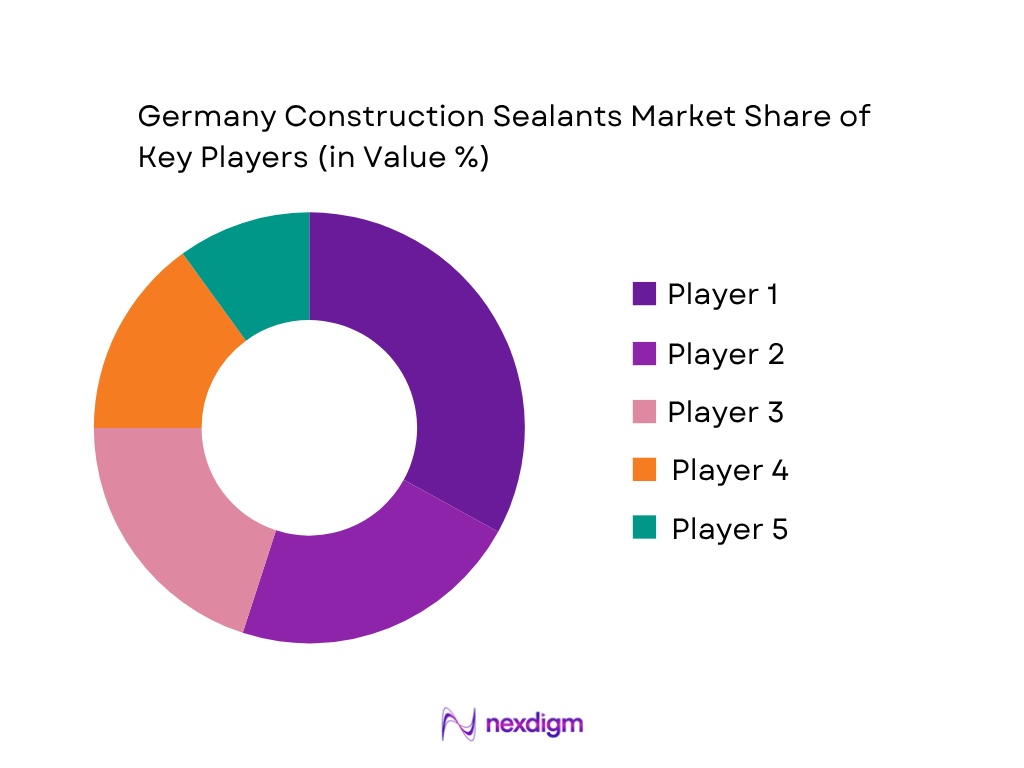
The Germany Construction Sealants Market combines domestic specialist producers with multinational construction-chemical companies. Hermann Otto / OTTO-CHEMIE has a long-established German position in professional silicone and hybrid sealants, while Sika competes across façade, glazing, concrete and construction-joint applications. Tremco CPG / illbruck is strongly positioned in window installation and building-envelope systems, Soudal participates across silicone, hybrid and professional construction products, and Dow is particularly important in structural glazing and silicone technology. Competitive differentiation centres on DIN/EN compliance, application specialization, domestic manufacturing, professional trade distribution, technical training and compatibility testing.
| Major Player | Establishment Year | Headquarters | Façade & Silicone Capability | Hybrid / PU Capability | Window & Connection Joint Capability | Structural Glazing Capability | Sanitary / Natural Stone Capability | Technical & Professional Trade Support |
| Hermann Otto GmbH / OTTO-CHEMIE | 1881 | Fridolfing, Germany | ~ | ~ | ~ | ~ | ~ | ~ |
| Sika | 1910 | Baar, Switzerland | ~ | ~ | ~ | ~ | ~ | ~ |
| Tremco CPG / illbruck | 2019 current CPG structure | Cologne-area German operations / European network | ~ | ~ | ~ | ~ | ~ | ~ |
| Soudal | 1966 | Turnhout, Belgium | ~ | ~ | ~ | ~ | ~ | ~ |
| Dow | 1897 | Midland, Michigan, US | ~ | ~ | ~ | ~ | ~ | ~ |
Germany Construction Sealants Market Analysis
Growth Drivers
Large Existing Building Stock Sustaining Recurring Sealant Replacement Demand
Germany’s extensive installed building base is a major growth driver for construction sealants because façades, windows, bathrooms, roofs and movement joints require periodic maintenance and replacement throughout a building’s operating life. Destatis recorded 43,755,726 dwellings at the end of 2024, representing approximately 4.112 billion square metres of residential floor space and 185,021,030 rooms. During the same period, 216,133 dwellings were added through new construction and another 153,548 dwellings were added through construction measures on existing buildings, involving approximately 14.326 million square metres of floor area in existing-building projects. These volumes create recurring requirements for silicone sanitary sealants, acrylic connection products, hybrid window sealants, façade weatherseals and polyurethane movement-joint systems. Existing-building work is particularly relevant because replacement windows, bathroom modernization and façade refurbishment typically require complete removal and renewal of adjoining sealant joints. Germany’s broader macroeconomic capacity supports this large maintenance market: World Bank data record 2024 GDP of US$4.6856 trillion and GDP per capita of US$56,103.7. The combination of a very large dwelling stock and extensive modification activity sustains demand beyond purely new-build construction.
Continued Construction Pipeline Supporting Façade, Window and Interior Joint Applications
Despite softer construction conditions, Germany maintained a sizeable flow of completed buildings and dwellings that continues to generate demand for construction sealants. Destatis recorded 161,682 completed buildings or construction works in 2024, including 251,937 completed dwellings with 24.768 million square metres of living floor space. New-building activity alone accounted for 97,279 buildings, 220,666 dwellings and 21.237 million square metres of residential floor space, while estimated building and structural costs associated with completed work reached EUR95.399 billion. Each completed residential or non-residential building creates multiple sealant-intensive interfaces including window-to-wall joints, façade transitions, sanitary joints, precast connections, floor joints and roofing penetrations. The scale of completed work therefore supports demand for silicone, hybrid polymer, acrylic and polyurethane products across both structural and finishing stages. Germany’s economic base also remains substantial despite weak output momentum, with the World Bank reporting 2024 GDP of US$4.6856 trillion and GDP per capita of US$56,103.7. This combination of significant physical construction volumes and a high-income building market supports continued specification of higher-performance professional sealant systems.
Market Challenges
Declining Residential Completions Reducing Incremental New-Build Sealant Demand
Germany’s construction sealants market faces pressure from the contraction in residential completions, which reduces incremental demand for window perimeter sealants, sanitary silicones, façade joints and interior connection products associated with newly delivered homes. Destatis recorded 251,937 completed dwellings in 2024, compared with 294,399 dwellings in 2023, while completed residential floor area fell from 29.554 million square metres to 24.768 million square metres. The slowdown continued into 2025, when only 206,586 dwellings were completed and residential floor area fell further to 20.056 million square metres. New-building completions declined from 220,666 dwellings in 2024 to 175,867 dwellings in 2025, reducing the number of new windows, bathrooms, balconies, façades and structural joints entering the installation phase. Sealant manufacturers therefore need greater exposure to renovation and replacement channels to compensate for weaker greenfield activity. The challenge sits within an economy where World Bank data show 2024 GDP of US$4.6856 trillion and GDP per capita of US$56,103.7. Germany’s large economy supports demand, but shrinking residential completion volumes constrain the pace at which entirely new sealant applications are created.
Large Construction Backlog and Longer Completion Cycles Complicating Demand Conversion
Germany’s construction sealants market also faces delayed demand conversion because a large number of approved dwellings remain unfinished for extended periods. Destatis reported a construction backlog of 759,700 approved but unfinished dwellings at the end of 2024, including 330,000 units already under construction and 179,200 units that had reached shell-completion stage. The average period between approval and completion of a new residential building increased to 26 months in 2024, compared with 24 months in 2023. In addition, 29,000 residential building permits expired in 2024, indicating that a sizeable portion of approved activity did not proceed to completion within the permitted period. This matters for sealant suppliers because products for windows, façades, bathrooms and finishing joints are often required relatively late in the construction sequence; delayed projects therefore postpone material procurement even after permits are issued. The macroeconomic backdrop remains sizeable, with World Bank data placing Germany’s 2024 GDP at US$4.6856 trillion and GDP per capita at US$56,103.7. Long project durations and cancellations consequently make demand forecasting, distributor inventory planning and production scheduling more difficult.
Market Opportunities
Energy-Efficient Refurbishment Creating Expansion Potential for Window and Façade Sealants
Germany’s large energy-refurbishment agenda provides a significant future opportunity for sealant manufacturers because window replacement, façade upgrading and building-envelope improvement require durable airtight and weather-resistant joints. KfW announced that more than EUR10 billion was earmarked in the 2024 federal budget for construction and housing support, approximately EUR5 billion more than the preceding budgetary level. At the building-stock level, Destatis recorded 153,548 dwelling additions through construction measures on existing buildings in 2024, representing approximately 14.326 million square metres of floor area. These projects create direct demand for interior acrylic or hybrid airtight joints, exterior weatherproof sealants, glazing silicones and products compatible with insulation and façade systems. Germany’s total stock of 43,755,726 dwellings further provides a very large installed base from which future refurbishment projects can emerge, especially as windows, façades and wet-area joints reach replacement cycles. Macroeconomic capacity supports investment in these upgrades: World Bank data show 2024 GDP of US$4.6856 trillion and GDP per capita of US$56,103.7. Suppliers positioned around low-emission, paintable, hybrid and high-weatherability technologies can address this refurbishment-driven demand.
Recovery in Building Permits Creating a Forward Pipeline for Sealant Installation
The recovery in German residential building permits creates a future opportunity for construction sealant suppliers because approved projects form the pipeline from which window, façade, sanitary and movement-joint installations subsequently arise. Destatis recorded 238,500 residential units approved in 2025, representing an increase of 23,200 units from the preceding annual level. Of these, 198,100 units were approved in new buildings and 40,400 units were associated with conversions of existing buildings. New multifamily buildings accounted for 128,100 approved dwellings, while single-family houses contributed 44,500 units and residential homes another 9,100 units. Multifamily construction is particularly relevant for sealants because each building contains repeated window-perimeter joints, bathrooms, façade connections, balconies and fire-rated interfaces, creating greater sealant intensity per project than a typical detached house. The broader pipeline is also visible in approved building costs, which increased from EUR104.060 billion in 2024 to EUR113.815 billion in 2025. Germany’s macroeconomic scale remains substantial, with World Bank data showing 2024 GDP of US$4.6856 trillion and GDP per capita of US$56,103.7. This permit recovery provides a stronger forward installation base for professional construction sealants.
Future Outlook
The Germany Construction Sealants Market is expected to expand at approximately ~XX% CAGR during 2026-2035, with growth increasingly linked to renovation rather than purely to greenfield residential construction. Energy refurbishment, window replacement, façade re-sealing and bathroom modernization will provide a broad recurring demand base. Hybrid polymer sealants should gain relevance where professional installers require paintability, low emissions and multi-substrate adhesion. Silicone will remain critical for sanitary, façade, natural-stone and glazing applications because of its long-term elasticity and weather resistance.
Germany’s large installed building stock will make replacement cycles strategically important. The country had approximately 43.76 million dwellings, which creates sustained requirements for joint maintenance even when new housing approvals soften. Low-emission formulations, foil-sausage packaging, professional application systems and compliance with DIN EN 15651, DIN 18540 and related technical standards are expected to become increasingly important competitive differentiators.
Major Players
- Hermann Otto GmbH / OTTO-CHEMIE
- Sika Deutschland CH AG & Co KG
- Tremco CPG Germany GmbH / illbruck
- Soudal Deutschland
- Dow Silicones Deutschland GmbH
- Momentive Performance Materials
- MAPEI GmbH
- Bostik GmbH
- Henkel AG & Co. KGaA
- KÖMMERLING Chemische Fabrik GmbH
- MC-Bauchemie Müller GmbH & Co. KG
- Remmers GmbH
- ARDEX GmbH
- fischerwerke GmbH & Co. KG
- Würth Group
Key Target Audience
- Construction Sealant and Construction Chemical Manufacturers
- Window, Door and Façade System Manufacturers
- Glazing, Façade and Building Envelope Contractors
- Renovation and Energy-Efficiency Contractors
- Building Material and Professional Trade Distributors
- Silicone, Polyurethane and Hybrid Polymer Suppliers
- Investments and Venture Capitalist Firms
- Government and Regulatory Bodies (German Institute for Building Technology, Federal Ministry for Housing, Urban Development and Building, German Institute for Standardization, Federal Environment Agency)
Research Methodology
Step 1: Identification of Key Variables
The initial phase involves developing an ecosystem map covering sealant manufacturers, polymer suppliers, distributors, Fachhandel networks, Fensterbauer, façade contractors, glazing contractors, sanitary installers and renovation specialists. Critical variables include building stock, renovation intensity, window replacement, sealant chemistry, DIN/EN classifications, joint movement requirements, packaging formats and regional construction activity.
Step 2: Market Analysis and Construction
Historical data for the Germany Construction Sealants Market is compiled using building permits, housing completions, dwelling stock, renovation activity and professional construction demand. Bottom-up calculations assess application-specific joint length, sealant yield and chemistry use, while top-down calculations evaluate construction and refurbishment activity. The two approaches are reconciled to establish historical market and segmentation estimates.
Step 3: Hypothesis Validation and Expert Consultation
Market hypotheses are validated through computer-assisted telephone interviews with sealant manufacturers, professional distributors, window installers, façade contractors, glazing specialists and sanitary trades. Discussions examine silicone and hybrid adoption, product classification, natural-stone compatibility, low-emission requirements, foil-sausage usage, technical training, joint preparation practices and professional purchasing behaviour.
Step 4: Research Synthesis and Final Output
Primary findings are triangulated with Destatis construction statistics, German building standards, KfW renovation frameworks, manufacturer technical documentation and professional distribution evidence. The final analysis reconciles top-down and bottom-up estimates while incorporating housing-stock ageing, energy refurbishment, window replacement, façade renovation, sanitary modernization and product-technology migration into the forecasting framework.

- Executive Summary
- Research Methodology (Market Definitions and Assumptions, Germany Construction Sealants Market Classification, Silicone Sealant Scope, Polyurethane Sealant Assessment, Hybrid Polymer Sealant Assessment, Acrylic Sealant Assessment, Butyl Sealant Assessment, Polysulfide Sealant Assessment, Structural Glazing Sealant Assessment, Insulating Glass Sealant Assessment, Façade Joint Sealant Assessment, Window and Door Sealant Assessment, Natural Stone Sealant Assessment, Sanitary Sealant Assessment, Concrete Joint Sealant Assessment, Fire-Rated Sealant Assessment, Acoustic Sealant Assessment, Roofing Sealant Assessment, DIN EN 15651 Assessment, DIN 18540 Exterior Joint Assessment, DIN 18545 Glazing Assessment, DIN 52452 Compatibility Assessment, DIBt Structural Glazing Approval Assessment, CE and Declaration of Performance Assessment, VOC and Emissions Assessment, Joint Movement Assessment, Substrate Compatibility Assessment, Renovation and Refurbishment Assessment, Energy-Efficiency Retrofit Assessment)

- Definition and Scope
- Germany Construction Sealants Industry Evolution and Development of Glazing Putties, Acrylic Joint Sealants, Acetoxy Silicone Sealants, Neutral-Cure Silicone Sealants, One-Component Polyurethane Sealants, Two-Component Polyurethane Sealants, Natural Stone Silicones, Sanitary Silicones, Structural Glazing Silicones, Insulating Glass Secondary Sealants, Hybrid Polymer Sealants, Silyl-Modified Polymer Sealants, Fire-Rated Joint Sealants, Acoustic Sealants, Floor Joint Sealants, Roofing Sealants, Façade Weatherseal Systems, Window Connection Sealants, Low-Emission Sealants and High-Movement Professional Joint Systems
- Construction Sealants Value Chain Analysis
- Construction Sealants Supply Chain Analysis
- Silicone Polymer Suppliers, Polyurethane Prepolymer Suppliers, SMP Polymer Suppliers, Acrylic Dispersion Suppliers, Plasticizer Suppliers, Mineral Filler Suppliers, Fungicide and Biocide Suppliers, Pigment Suppliers, Catalyst Suppliers, Cartridge and Foil-Sausage Packaging Suppliers, Sealant Manufacturers, Private-Label Producers, Construction Chemical Distributors, Baustoff-Fachhandel, Window and Façade Distributors, Glazing Contractors, Fensterbauer, Façade Contractors, Tilers, Sanitary Installers, Flooring Contractors, General Contractors

- Growth Drivers (Large Existing Building Stock, Energy-Efficient Building Renovation, Window and Door Replacement, Façade Refurbishment, Bathroom Modernization, Structural Glazing Demand, Insulating Glass Production, Building Envelope Airtightness Requirements, Commercial Renovation, Natural Stone Installation, Professional Trade Distribution, Building Maintenance and Re-Sealing Demand)
- Market Challenges (Weak New Residential Construction, Construction Project Delays, Skilled Trades Shortage, Silicone and Polymer Feedstock Volatility, Sealant-Substrate Compatibility, Natural Stone Staining Risk, Joint Design Errors, Mold Exposure in Sanitary Applications, Cold-Weather Installation Constraints, Emission Requirements, Product Classification Complexity, Competitive Professional Trade Market)
- Market Opportunities (Energy-Efficiency Renovation Sealants, Window Connection Systems, Hybrid SMP Sealants, Low-Emission Products, Structural Glazing Silicones, Insulating Glass Sealants, Façade Re-Sealing, Natural Stone Silicones, Fire-Rated Sealants, Prefabricated Joint Systems, Mold-Resistant Sanitary Sealants, Low-Plasticizer-Migration Technologies, Foil-Sausage Packaging, Reduced-Carbon Formulations)
- Market Trends (Neutral-Cure Silicone Adoption, Hybrid Polymer Growth, DIN EN 15651 Performance Classification, Low-Emission Indoor Products, High-Movement Façade Sealants, Non-Staining Stone Silicones, Mold-Resistant Sanitary Systems, Structural Glazing Silicone Technology, Low-Monomer PU Products, Paintable Hybrid Sealants, Sausage Packaging, Installer-Oriented Application Tools, Digital Joint Calculators, Color-Matched Sealant Systems)
- Government Regulations and Standards (DIN EN 15651 Façade Sealants, DIN EN 15651 Glazing Sealants, DIN EN 15651 Sanitary Sealants, DIN EN 15651 Floor Joint Sealants, DIN 18540 Exterior Wall Joint Sealing, DIN 18545 Glazing with Sealants, DIN 52452 Sealant Compatibility Testing, DIN 52460 Sealing and Glazing Terminology, DIN EN 15434 Bonding Sealants, DIBt Structural Sealant Glazing Approvals, CE Marking and Declaration of Performance Requirements, REACH Requirements, CLP Chemical Classification, VOC and Indoor Emission Requirements, German Building Energy Requirements)
- SWOT Analysis
- Porter’s Five Forces Analysis
- PESTLE Analysis
- Stakeholder Ecosystem
- Construction Sealants Manufacturing and Professional Trade Ecosystem

- By Market Value (2020-2025)
- By Sealant Consumption Volume (2020-2025)
- By Silicone Sealant Consumption (2020-2025)
- By Polyurethane Sealant Consumption (2020-2025)
- By Hybrid Polymer Sealant Consumption (2020-2025)
- By Acrylic Sealant Consumption (2020-2025)
- By Façade Joint Sealant Consumption (2020-2025)
- By Window and Door Sealant Consumption (2020-2025)
- By Structural Glazing Sealant Consumption (2020-2025)
- By Insulating Glass Sealant Consumption (2020-2025)
- By Sanitary Sealant Consumption (2020-2025)
- By Natural Stone Sealant Consumption (2020-2025)
- By Concrete and Flooring Joint Sealant Consumption (2020-2025)
- By Fire-Rated and Acoustic Sealant Consumption (2020-2025)

- By Sealant Chemistry (In Value %)
Silicone Sealants
Polyurethane Sealants
Hybrid Polymer and Silyl-Modified Polymer Sealants
Acrylic Dispersion Sealants
Siliconized Acrylic Sealants
Butyl Sealants
Polysulfide Sealants
Polyether Sealants
Other Specialty Construction Sealants - By Product Type (In Value %)
One-Component Silicone Sealants
Two-Component Silicone Sealants
One-Component Polyurethane Sealants
Hybrid SMP Sealants
Acrylic Joint Sealants
Structural Glazing Sealants
Insulating Glass Sealants
Natural Stone Sealants
Sanitary and Mold-Resistant Sealants
Façade Joint Sealants
Window Connection Sealants
Floor Joint Sealants
Fire-Rated Sealants
Acoustic Sealants
Roofing and Sheet-Metal Sealants - By Application (In Value %)
Exterior Façade Joints
Window and Door Connection Joints
Curtain Wall Weathersealing
Structural Silicone Glazing
Insulating Glass Edge Sealing
Precast Concrete Joints
Masonry and Render Joints
Natural Stone Joints
Sanitary and Wet-Area Sealing
Floor and Movement Joints
Roof and Sheet-Metal Sealing
Balcony and Terrace Joints
Fire-Rated Construction Joints
Acoustic Perimeter Sealing
Infrastructure and Concrete Joints - By Performance Requirement (In Value %)
High-Movement Façade Sealants
Medium-Movement Joint Sealants
Low-Movement Interior Sealants
Low-Modulus Sealants
Structural Glazing Performance
Non-Staining Natural Stone Performance
Mold and Fungal Resistance
Low-Emission Performance
Paintable Sealants
Primerless Adhesion
UV and Weather Resistance
Low-Temperature Flexibility
Fire Resistance
Acoustic Performance
Chemical and Cleaning-Agent Resistance - By Region (In Value %)
North Rhine-Westphalia
Bavaria
Baden-Württemberg
Lower Saxony
Hesse
Berlin
Hamburg
Saxony
Rhineland-Palatinate
Schleswig-Holstein
Brandenburg
Saxony-Anhalt
Thuringia
Mecklenburg-Vorpommern
Saarland
Bremen

- Market Share of Major Players (By Germany Revenue, Sealant Consumption Volume, Silicone Sealant Portfolio, Polyurethane Sealant Portfolio, Hybrid Polymer Portfolio, Acrylic Portfolio, Façade Exposure, Window Installation Exposure, Structural Glazing Exposure, Sanitary Sealant Exposure, Natural Stone Portfolio, Domestic Manufacturing Capacity, Fachhandel Coverage, Technical Laboratory Capability, Specification Support)
- Cross Comparison Parameters (Professional Silicone and Façade Sealant Portfolio Breadth, DIN EN 15651 and DIN 18540 Performance Capability, Structural Glazing and Insulating Glass Sealant Capability, Hybrid Polymer and Low-Emission Technology Breadth, Natural Stone and Sanitary Specialty Sealant Capability, Germany Manufacturing and Professional Trade Distribution Reach, Renovation and Window-Connection System Exposure, Technical Laboratory Application Training and Specification Support)
- SWOT Analysis of Major Players
- Competitive Positioning Matrix
- Major Companies
Hermann Otto GmbH / OTTO-CHEMIE
Sika Deutschland CH AG & Co KG
Tremco CPG Germany GmbH / illbruck
Soudal Deutschland
Dow Silicones Deutschland GmbH
Momentive Performance Materials
MAPEI GmbH
Bostik GmbH
Henkel AG & Co. KGaA
KÖMMERLING Chemische Fabrik GmbH
MC-Bauchemie Müller GmbH & Co. KG
Remmers GmbH
ARDEX GmbH
fischerwerke GmbH & Co. KG
Würth Group

- Façade Contractor Requirement Assessment
- Glazing Contractor Requirement Assessment
- Fensterbauer Requirement Assessment
- Sanitary Installer Requirement Assessment
- Tile Installer Requirement Assessment
- Flooring Contractor Requirement Assessment
- Roofing Contractor Requirement Assessment
- General Contractor Procurement Assessment
- Architect and Façade Planner Specification Assessment
- Building Owner and Facility Manager Requirement Assessment
- Renovation Contractor Requirement Assessment
- Technical Service and Application Training Requirement Assessment

- By Market Value (2026-2035)
- By Sealant Consumption Volume (2026-2035)
- By Silicone Sealant Consumption (2026-2035)
- By Polyurethane Sealant Consumption (2026-2035)
- By Hybrid Polymer Sealant Consumption (2026-2035)
- By Acrylic Sealant Consumption (2026-2035)
- By Façade Joint Sealant Consumption (2026-2035)
- By Window and Door Sealant Consumption (2026-2035)
- By Structural Glazing Sealant Consumption (2026-2035)
- By Insulating Glass Sealant Consumption (2026-2035)
- By Sanitary Sealant Consumption (2026-2035)
- By Natural Stone Sealant Consumption (2026-2035)
- By Concrete and Flooring Joint Sealant Consumption (2026-2035)
- By Fire-Rated and Acoustic Sealant Consumption (2026-2035)


 Request a Sample
 Ask for Customization
 Get a Quote
 Enquire Now
