
 Download PDF
Market Overview
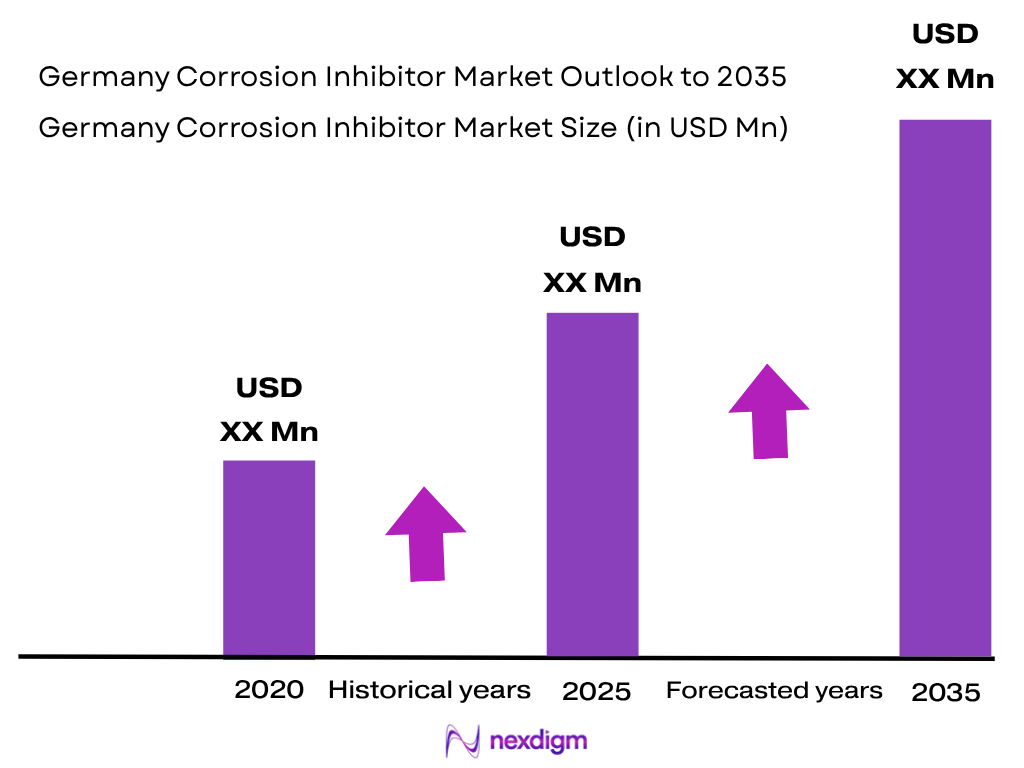
The Germany Corrosion Inhibitor Market is valued at approximately USD ~XX million, based on historical demand from chemicals, automotive, steel, metalworking, industrial water treatment, power generation and refining. Germany’s chemical-pharmaceutical industry generated EUR 221 billion in sales compared with approximately EUR 225 billion in the preceding period, while domestic passenger-car production moved from 4,109,371 units to 4,069,222 units. These industrial bases sustain recurring corrosion-protection requirements in manufacturing equipment, fluids, cooling systems and metallic components.
North Rhine-Westphalia, Baden-Württemberg, Bavaria, Lower Saxony and the Rhine-Main/Ludwigshafen corridor are the principal demand centers because they concentrate chemicals, automotive manufacturing, steelmaking, refineries, metal processing and industrial utilities. German automotive turnover moved from approximately EUR 565 billion to EUR 542 billion, while domestic passenger-car production remained above 4 million units in both periods. Chemical facilities operated at an average 75-point capacity-utilization level in the latest period, supporting continuous process-water, equipment and metal-protection requirements.
Market Segmentation
By Chemistry Type
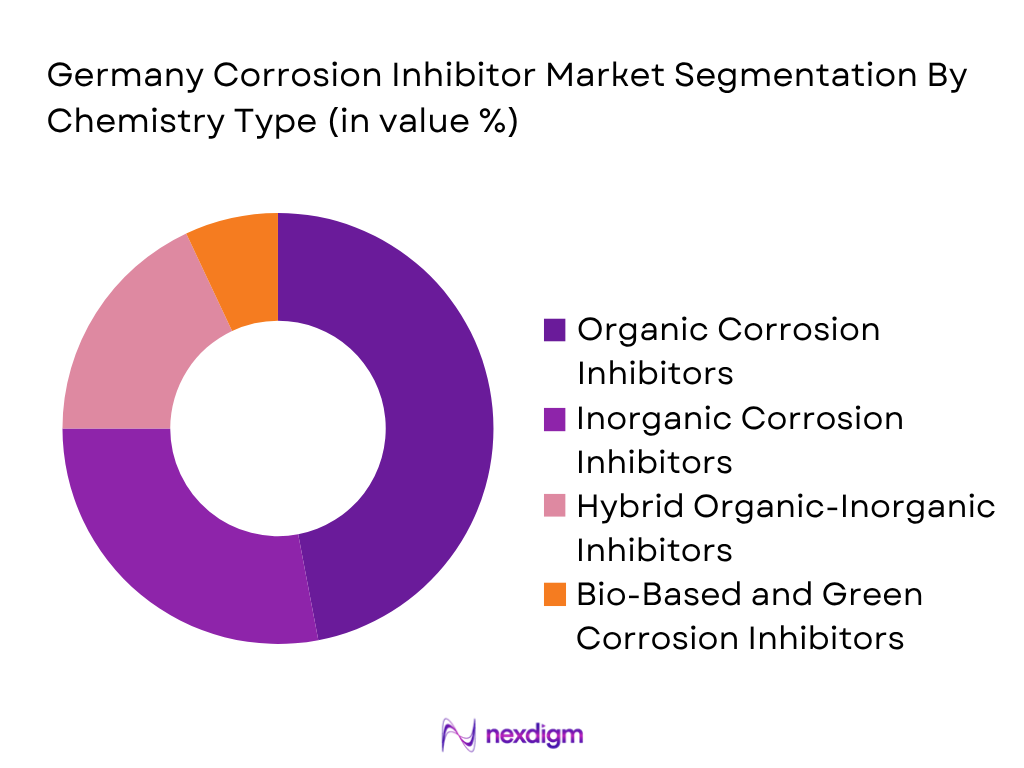
The Germany Corrosion Inhibitor Market is segmented into organic corrosion inhibitors, inorganic corrosion inhibitors, hybrid organic-inorganic inhibitors, and bio-based and low-environmental-impact inhibitors. Organic corrosion inhibitors hold the dominant market position because Germany’s industrial structure creates substantial requirements for amines, carboxylates, azoles and other adsorption-based formulations used in metalworking fluids, lubricants, industrial cleaners, cooling systems and automotive manufacturing. Germany manufactured 4,069,222 passenger cars, while automotive-industry turnover reached EUR 541.9 billion, demonstrating the enormous installed base of machining, forming, cleaning, component storage and fluid-management operations requiring metal protection. BASF’s IRGACOR portfolio, for example, addresses hydraulic fluids, turbine lubricants, compressor oils, metalworking fluids, driveline lubricants and e-mobility fluids, while Henkel provides aqueous corrosion-protection and passivation chemistries for steel, cast iron and aluminium. Inorganic phosphates, silicates, molybdates and related inhibitors retain significant roles in industrial-water and closed-loop applications. Hybrid chemistries are increasingly relevant where German operators require simultaneous corrosion, scale and mixed-metal protection.
By End-Use Industry
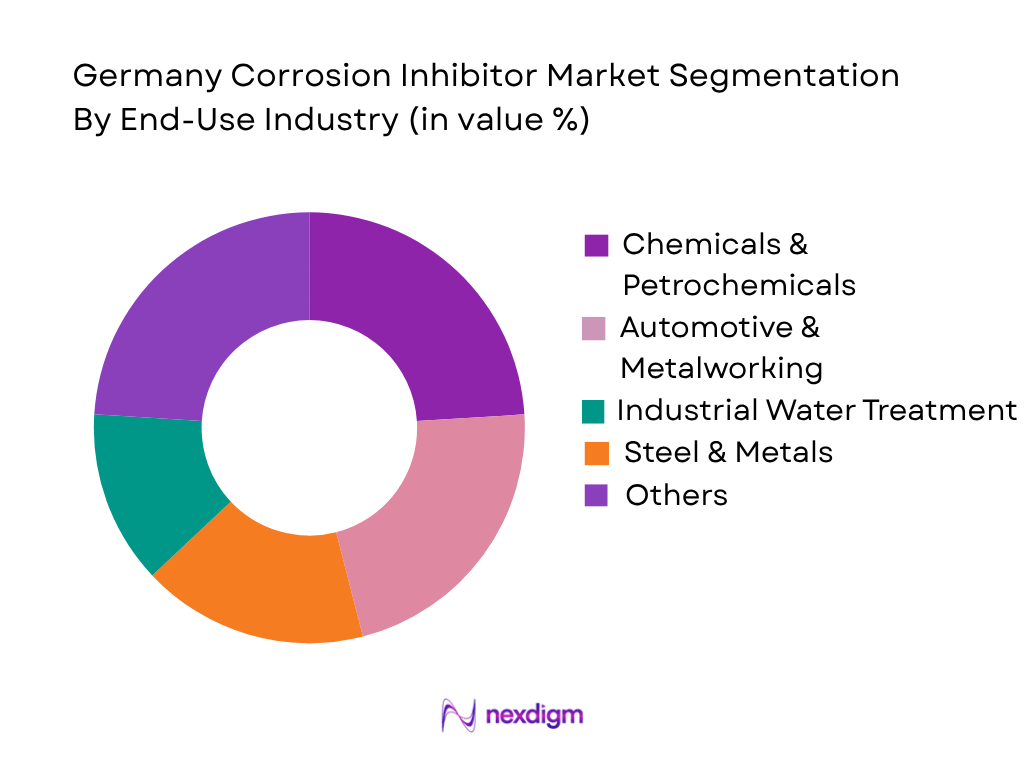
The Germany Corrosion Inhibitor Market is segmented into chemicals and petrochemicals, automotive and metalworking, industrial water treatment, steel and metals, power and utilities, refining and fuels, and other industrial applications. Chemicals, petrochemicals and industrial process manufacturing collectively represent the dominant demand environment because Germany operates one of Europe’s largest chemical production systems, incorporating reactors, pipelines, heat exchangers, cooling circuits, boilers, storage equipment and process-water systems. Chemical and pharmaceutical sales reached EUR 221 billion, while German industry consumed 3,343 petajoules of energy. The chemical industry was the country’s largest industrial energy-consuming branch, indicating the scale of continuously operated process assets requiring corrosion management. Steelmaking creates another substantial application base, with German crude-steel production reaching 37.2 million tonnes. Automotive and metalworking demand is reinforced by more than 4 million domestically manufactured passenger cars, requiring corrosion protection throughout machining, cleaning, forming, component storage and fluid-management operations. Consequently, inhibitor demand spans both process-plant treatment and manufactured-metal protection.
Competitive Landscape
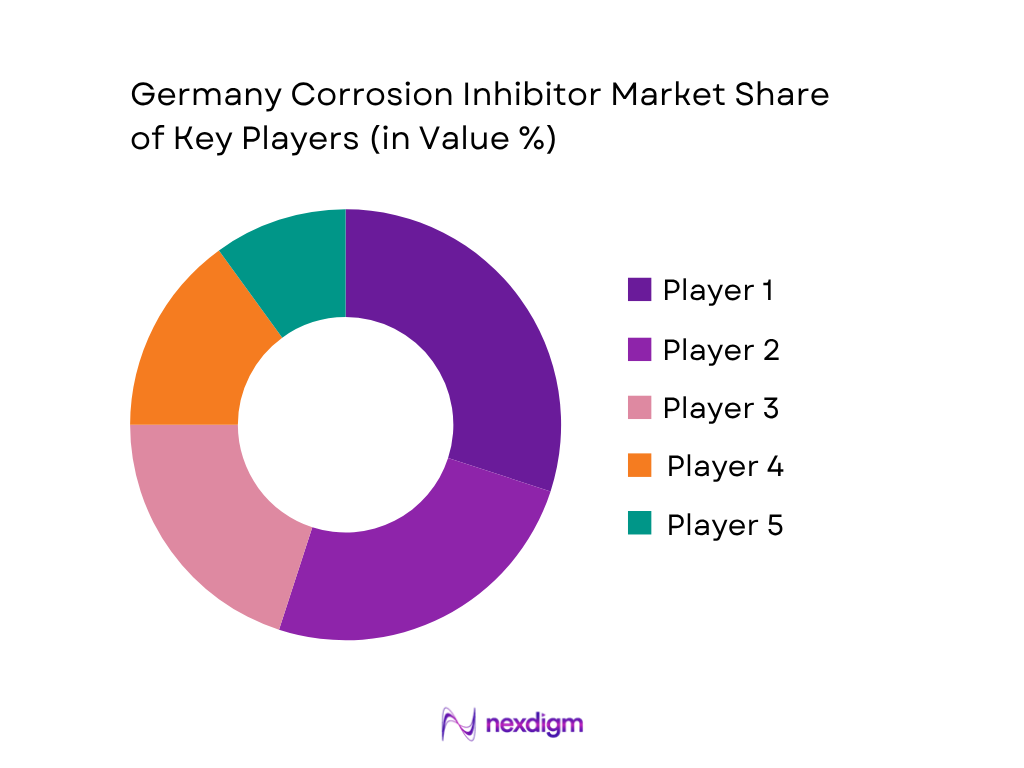
The Germany Corrosion Inhibitor Market is characterized by a strong domestic specialty-chemical base combined with international industrial-water and process-treatment specialists. BASF, LANXESS and Henkel possess strong Germany-based chemistry and industrial application capabilities, while Kurita and Ecolab/Nalco Water compete through engineered water-treatment programs. Competitive differentiation centers on multi-metal protection, REACH-compliant formulations, low-phosphorus chemistry, automotive compatibility, corrosion-and-scale integration, laboratory testing, chemical dosing and technical service.
| Major Player | Establishment Year | Headquarters | Core Corrosion Chemistry | Major Germany Applications | Water-Treatment Capability | Automotive/Metalworking Capability | Sustainability Position | Application Engineering |
| BASF | 1865 | Ludwigshafen, Germany | ~ | ~ | ~ | ~ | ~ | ~ |
| LANXESS | 2004 | Cologne, Germany | ~ | ~ | ~ | ~ | ~ | ~ |
| Henkel | 1876 | Düsseldorf, Germany | ~ | ~ | ~ | ~ | ~ | ~ |
| Kurita Water Industries | 1949 | Tokyo, Japan | ~ | ~ | ~ | ~ | ~ | ~ |
| Ecolab / Nalco Water | 1923 | St. Paul, USA | ~ | ~ | ~ | ~ | ~ | ~ |
Germany Corrosion Inhibitor Market Analysis
Growth Drivers
Large Automotive and Advanced Manufacturing Base Sustains Industrial Corrosion-Control Demand
Germany’s extensive automotive, machinery, metalworking and manufacturing infrastructure creates recurring demand for corrosion inhibitors used in metalworking fluids, cooling circuits, closed-loop systems, component storage, surface treatment and temporary metal protection. German automotive plants manufactured 4,069,222 passenger cars in 2024, while production increased to 4,148,836 vehicles in 2025. The automotive industry recorded EUR 541.938 billion in sales and employed 772,949 people in 2024, illustrating the scale of metal-processing assets requiring corrosion management. Germany also had 209,815 manufacturing legal units employing 7,471,915 people in 2024, demonstrating the breadth of industrial equipment exposed to water, coolants, process fluids and atmospheric corrosion. Domestic crude-steel production reached 37.2 million tonnes in 2024, providing another substantial metal-processing application base. At the macroeconomic level, World Bank data place Germany’s GDP at USD 4.69 trillion in 2024 and GDP per capita at USD 56,103.7. This combination of vehicle manufacturing, steel production and sophisticated industrial processing supports continuing consumption of organic inhibitors, azoles, carboxylates, phosphonates, passivating agents and vapor-phase corrosion protection across German industrial operations.
Large Chemical, Power and Process-Industry Infrastructure Drives Specialized Corrosion Protection
Germany’s chemical and energy infrastructure creates substantial requirements for corrosion inhibitors in cooling towers, boilers, heat exchangers, steam-condensate systems, chemical-processing equipment and industrial water circuits. The German chemical-pharmaceutical industry generated EUR 221 billion in sales during 2024, including EUR 82 billion from domestic business and EUR 139 billion from foreign business. Germany’s manufacturing sector contained 209,815 legal units with turnover of EUR 2.557 trillion in 2024, while electricity, gas, steam and air-conditioning supply comprised 74,485 legal units employing 313,858 people. The electricity system generated 431.7 TWh in 2024, including 254.9 TWh from renewable sources, while installed renewable capacity reached nearly 190 GW. These large-scale chemical and utility assets require controlled water chemistry to protect carbon steel, copper alloys, stainless steel and mixed-metallurgy systems. World Bank data report German GDP at USD 4.69 trillion in 2024, reinforcing the industrial depth supporting treatment demand. Consequently, Germany represents a technically sophisticated application environment for phosphonates, molybdates, silicates, azoles, filming amines and multifunctional corrosion-and-scale inhibitor programs.
Market Challenges
Weakness Across Chemicals and Steel Restrains Corrosion-Inhibitor Volume Expansion
Germany’s corrosion-inhibitor suppliers face demand pressure from subdued activity across several corrosion-intensive industries, particularly chemicals, steel and manufacturing. German crude-steel production stood at 37.2 million tonnes in 2024, while domestic steel market supply was only around 27 million tonnes, reflecting a historically weak industrial environment. The chemical-pharmaceutical industry generated EUR 221 billion in sales during 2024, but chemical plants operated at an average capacity utilization of only 75 units per 100 units of capacity. Conditions remained difficult in 2025, when chemical-plant capacity utilization averaged 72.5 units per 100, and combined chemical-pharmaceutical sales reached EUR 220 billion. Destatis additionally recorded approximately 5.5 million employees in manufacturing establishments with at least 50 employees at the end of 2024, representing 68,000 fewer workers than one year earlier. Germany nevertheless retained a massive USD 4.69 trillion GDP in 2024, according to the World Bank. For corrosion-inhibitor producers, the challenge is therefore not absence of an industrial installed base, but weaker plant utilization, production activity and maintenance-related chemical consumption across important customer industries.
Stringent Environmental Requirements Increase the Complexity of Corrosion-Inhibitor Formulation
Germany’s corrosion-control market increasingly requires suppliers to balance high inhibition efficiency with demanding environmental, wastewater and chemical-safety expectations. This is particularly relevant for fluorinated substances, persistent chemicals and treatment formulations discharged through industrial-water systems. Germany’s environmental authorities identify trifluoroacetate as an extremely persistent substance that can enter rivers through industrial wastewater, highlighting the regulatory sensitivity surrounding persistent chemical chemistry. The scale of affected industrial activity is substantial: Germany had 11,366 legal units in water supply, sewerage, waste management and remediation employing 315,288 people in 2024, while the broader manufacturing sector included 209,815 legal units and 7,471,915 employees. Chemical-industry employment alone reached approximately 326,000 people at the end of 2024. German seaports simultaneously handled 274.0 million tonnes of cargo, including 97.0 million tonnes at Hamburg, 42.5 million tonnes at Bremerhaven and 34.5 million tonnes at Wilhelmshaven, creating additional marine and industrial corrosion exposure. With World Bank GDP recorded at USD 4.69 trillion in 2024, suppliers must serve an enormous industrial base while developing lower-persistence, wastewater-compatible and technically effective corrosion-control formulations.
Market Opportunities
Electrification and Renewable Infrastructure Create New Corrosion-Control Applications
Germany’s energy transition creates opportunities for corrosion-inhibitor suppliers across district heating, renewable-energy auxiliaries, thermal storage, cooling circuits, electrolyzer balance-of-plant systems and other water-containing energy infrastructure. Installed renewable electricity capacity reached nearly 190 GW in 2024 after almost 20 GW of additional capacity entered service. Solar capacity reached 99.3 GW, offshore wind capacity reached 9.2 GW, and biomass capacity stood at approximately 9 GW. Renewable generators supplied 254.9 TWh of electricity, while total German generation reached 431.7 TWh. The Bundesnetzagentur also recorded approximately 435,000 newly registered plug-in balcony solar installations and commissioning of a 174 MW large-scale battery facility in Hamm. These current infrastructure indicators demonstrate the scale at which Germany is redesigning its energy system. World Bank data simultaneously place GDP at USD 4.69 trillion in 2024 and GDP per capita at USD 56,103.7. This expanding energy ecosystem provides future growth avenues for corrosion inhibitors formulated for closed-loop cooling, thermal systems, mixed metallurgy and long-life equipment, particularly products compatible with increasingly stringent environmental requirements and digitally controlled treatment systems.
Automotive Electrification and High-Value Metal Manufacturing Support Advanced Corrosion Protection
Germany’s transition toward electrified mobility creates a future opportunity for corrosion-inhibitor suppliers serving precision components, battery thermal-management systems, metalworking fluids, temporary protection, export packaging and mixed-metal cooling circuits. German factories produced 4,069,222 passenger cars in 2024 and increased output to 4,148,836 units in 2025. The automotive industry generated EUR 541.938 billion in sales in 2024, while manufacturers invested EUR 43.733 billion in tangible assets and spent EUR 59.408 billion on research and development. Germany also maintained 49,339,166 passenger cars and 4,496,626 commercial vehicles in use during the 2024 reporting period, providing a large downstream maintenance and component ecosystem. At the same time, manufacturing encompassed 209,815 legal units with EUR 2.557 trillion of turnover, supporting broad demand for corrosion protection beyond automotive assembly. World Bank data record German GDP at USD 4.69 trillion in 2024. These current indicators support future opportunities for low-residue metalworking inhibitors, aluminum and copper protection, vapor-phase inhibitors, water-glycol corrosion packages and environmentally optimized formulations designed for electric-vehicle and precision-manufacturing applications.
Future Outlook
The Germany Corrosion Inhibitor Market is forecast to expand at approximately ~XX% CAGR during 2026-2035, with demand shifting toward higher-performance, lower-environmental-impact and multifunctional treatment chemistry. Growth opportunities will increasingly emerge from electric-vehicle production, advanced metalworking, low-carbon industrial processes, renewable-power infrastructure and optimized industrial-water management. Regulatory pressure should further accelerate substitution away from environmentally burdensome inhibitor chemistries toward biodegradable, phosphate-reduced, heavy-metal-free and digitally optimized treatment programs.
Automotive manufacturing will remain an important technology-intensive application. German factories produced 4,148,836 passenger cars in 2025, compared with 4,069,222 units in 2024. The sector also invested EUR 43.733 billion in tangible assets and spent EUR 59.408 billion on research and development in 2024. Corrosion-control suppliers can therefore address emerging requirements in e-mobility fluids, battery-component manufacturing, aluminium processing, mixed-metal systems, machining fluids and temporary component protection.
Major Players
- BASF
- LANXESS
- Henkel
- Kurita Water Industries
- Nalco Water / Ecolab
- Clariant
- Evonik Industries
- Solenis
- Italmatch Chemicals
- Cortec Corporation
- Sika Deutschland
- Master Builders Solutions Deutschland
- Chemische Werke Kluthe
- Zeller+Gmelin
- FUCHS
Key Target Audience
- Corrosion Inhibitor and Specialty Chemical Manufacturers
- Automotive, Machinery and Metalworking Companies
- Chemical, Petrochemical and Refining Operators
- Steel, Metals and Industrial Manufacturing Companies
- Industrial Water Treatment and Utility Operators
- Investments and Venture Capitalist Firms
- Government and Regulatory Bodies (Federal Ministry for Economic Affairs and Energy, Federal Environment Agency, Federal Institute for Occupational Safety and Health, German Environment Agency REACH/CLP Competent Authorities)
- EPC Contractors, Industrial Asset Owners and Strategic Chemical Investors
Research Methodology
Step 1: Identification of Key Variables
The initial phase constructs an ecosystem map covering corrosion-inhibitor manufacturers, specialty chemical producers, industrial-water companies, automotive suppliers, metalworking-fluid formulators, steel companies, chemical complexes, utilities and distributors. Critical variables include chemical production, automotive output, steelmaking, industrial-water consumption, refinery operations, metallurgy mix, environmental regulations and inhibitor chemistry. These variables define the addressable Germany Corrosion Inhibitor Market.
Step 2: Market Analysis and Construction
Historical market construction applies parallel top-down and bottom-up approaches. Top-down analysis assesses chemical production, automotive manufacturing, steel output, industrial energy use, power generation and process-industry activity. Bottom-up analysis evaluates supplier revenues, inhibitor product volumes, dosage requirements, replenishment frequencies and customer installations. Results are reconciled across chemistry type, application medium, end-use industry and industrial region.
Step 3: Hypothesis Validation and Expert Consultation
Market hypotheses are validated through computer-assisted telephone interviews with corrosion engineers, water-treatment specialists, chemical formulators, automotive process engineers, metalworking-fluid suppliers, industrial distributors and plant-maintenance professionals. Interviews assess chemistry selection, dosage practices, mixed-metal compatibility, environmental requirements, customer qualification, domestic production and technical-service requirements. Primary findings refine preliminary market estimates and competitive positioning.
Step 4: Research Synthesis and Final Output
Primary findings are triangulated with German industrial statistics, trade information, automotive production data, chemical-industry indicators, steel production and company disclosures. Bottom-up inhibitor-consumption calculations are reconciled with application-level installed assets to prevent duplication across metalworking, cooling-water, boiler and process applications. The consolidated model establishes market sizing, segmentation, competitive structure and the long-term Germany Corrosion Inhibitor Market forecast.

- Executive Summary
- Research Methodology (Market Definition and Scope, Germany Corrosion Inhibitor Market Classification, Industrial Corrosion Inhibitor Demand Assessment, Cooling Water and Boiler Treatment Consumption Mapping, Metalworking and Process Fluid Corrosion Inhibitor Demand Assessment, Domestic Formulation and Manufacturing Capacity Assessment, Import Dependency Analysis, Amine Imidazoline Phosphonate Azole Molybdate Silicate and Organic Acid Raw Material Assessment, Chemical Blending Dosing and Corrosion Monitoring Technology Mapping, Installed Industrial Equipment Base Assessment)

- Definition and Scope
- Germany Corrosion Inhibitor Industry Evolution and Development of Industrial Water Treatment Inhibitors, Process Corrosion Inhibitors, Metalworking Fluid Additives, Volatile Corrosion Inhibitors and Reinforced Concrete Corrosion Protection Ecosystem
- Organic Corrosion Inhibitor, Inorganic Corrosion Inhibitor, Film-Forming Inhibitor, Passivating Inhibitor, Volatile Corrosion Inhibitor, Migrating Corrosion Inhibitor and Multifunctional Corrosion-and-Scale Control Industry Structure
- Germany Corrosion Inhibitor Value Chain Analysis
- Germany Corrosion Inhibitor Supply Chain Analysis
- Specialty Chemical Feedstock Supplier, Corrosion Inhibitor Manufacturer, Industrial Water Treatment Chemical Formulator, Metalworking Additive Manufacturer, Chemical Distributor, Chemical Dosing Provider, Corrosion Monitoring Company, MRO Contractor, EPC Contractor

- Growth Drivers (Large Chemical and Pharmaceutical Manufacturing Base, Extensive Industrial Cooling Water and Boiler Installed Base, Automotive Metalworking and Functional Fluid Demand, Steel and Metal Processing Corrosion Protection Requirements, Machinery Manufacturing Asset Protection, Industrial Water Reuse and Efficiency Requirements, Aging Industrial Equipment Maintenance Demand, High-Value Process Equipment Reliability Requirements)
- Market Challenges (Weakness in Energy-Intensive Industrial Production, High Energy Costs for Chemical Manufacturing, Strict Environmental Restrictions on Phosphorus and Hazardous Chemistry, Replacement of Conventional Heavy-Metal-Based Inhibitors, Complex REACH Chemical Compliance, Diverse Metallurgy Compatibility Requirements)
- Market Opportunities (Low-Phosphorus Industrial Cooling Water Programs, Biodegradable Corrosion Inhibitors, PFAS-Free Metal Protection Chemistry, Green and Bio-Based Corrosion Inhibitors, Closed-Loop Water Treatment, Hydrogen Infrastructure Corrosion Management, Battery and EV Thermal Management Fluids, High-Purity Electronics Corrosion Control, Industrial Water Reuse Treatment, Digital Corrosion Monitoring, Automated Chemical Dosing)
- Market Trends (Low-Phosphorus Corrosion Inhibition, Biodegradable Organic Inhibitors, Phosphate-Free and Heavy-Metal-Free Formulations, Multifunctional Corrosion-and-Scale Control, Film-Forming Amine Programs, Azole Optimization for Copper Alloys, Volatile Corrosion Inhibitor Packaging, Smart Chemical Dosing, Online Corrosion Monitoring, Predictive Water Treatment)
- Regulatory and Standards Landscape (EU REACH Regulation, CLP Regulation, German Drinking Water Ordinance, Federal Water Act, Wastewater Ordinance, Industrial Emissions Directive Requirements, Water Hazard Class Requirements, DIN EN Water Treatment Chemical Standards, VDI Cooling Water Guidelines, German Occupational Chemical Safety Requirements, Biocidal Products Regulation Interaction, Environmental Discharge Requirements)
- SWOT Analysis
- Porter’s Five Forces Analysis
- PESTLE Analysis
- Stakeholder Ecosystem
- Competition Ecosystem

- By Market Value (2020-2025)
- By Corrosion Inhibitor Consumption Volume (2020-2025)
- By Industrial Water Treatment Corrosion Inhibitor Consumption Volume (2020-2025)
- By Metalworking and Metal Protection Corrosion Inhibitor Consumption Volume (2020-2025)
- By Chemical and Petrochemical Corrosion Inhibitor Consumption Volume (2020-2025)
- By Domestic Corrosion Inhibitor Production Value (2020-2025)
- By Domestic Corrosion Inhibitor Production Volume (2020-2025)
- By Corrosion Inhibitor Import Value (2020-2025)
- By Average Selling Price (2020-2025)

- By Chemistry Type (In Value %)
Amine-Based Corrosion Inhibitors
Imidazoline-Based Corrosion Inhibitors
Carboxylate-Based Corrosion Inhibitors
Azole-Based Corrosion Inhibitors
Phosphonate-Based Corrosion Inhibitors
Phosphate-Based Corrosion Inhibitors
Nitrite-Based Corrosion Inhibitors
Molybdate-Based Corrosion Inhibitors
Silicate-Based Corrosion Inhibitors
Zinc-Based Corrosion Inhibitors
Organic Acid and Carboxylate Inhibitors
Hybrid Organic-Inorganic Corrosion Inhibitors
Bio-Based and Biodegradable Corrosion Inhibitors - By Inhibitor Mechanism (In Value %)
Anodic Corrosion Inhibitors
Cathodic Corrosion Inhibitors
Mixed Corrosion Inhibitors
Film-Forming Corrosion Inhibitors
Adsorption-Type Corrosion Inhibitors
Passivating Corrosion Inhibitors
Volatile Corrosion Inhibitors
Migrating Corrosion Inhibitors
Neutralizing Corrosion Inhibitors
Oxygen Scavenger-Assisted Corrosion Control Systems - By Application Medium (In Value %)
Open Recirculating Cooling Water Systems
Closed Cooling Water Systems
Boiler Feedwater and Steam Systems
Condensate Return Systems
Industrial Process Water
Chemical Process Streams
Refinery Process Streams
Metalworking Fluids
Metal Cleaning and Pickling Solutions
Automotive Coolants and Functional Fluids
District Heating and Building Water Systems
Drinking Water Distribution Systems
Temporary Metal Preservation Systems
Reinforced Concrete Systems - By Product Form (In Value %)
Water-Soluble Liquid Corrosion Inhibitors
Oil-Soluble Corrosion Inhibitors
Water-Dispersible Corrosion Inhibitors
Concentrated Liquid Treatment Packages
Powder and Solid Corrosion Inhibitors
Corrosion-and-Scale Inhibitor Packages
Volatile Corrosion Inhibitor Products
Migrating Corrosion Inhibitor Products
Corrosion-Inhibiting Admixtures
Metalworking Fluid Additive Packages - By End-Use Industry (In Value %)
Chemical and Petrochemical Manufacturing
Automotive and Mobility
Steel and Metal Processing
Machinery and Industrial Equipment Manufacturing
Power Generation
Industrial Water Treatment
Petroleum Refining
Pulp and Paper
Food and Beverage Processing
Pharmaceutical Manufacturing
Electronics and Precision Manufacturing
Building Services and District Heating
Infrastructure and Reinforced Concrete
Marine and Transportation Equipment
General Manufacturing

- Market Share of Major Players (By Germany Revenue, Corrosion Inhibitor Sales Volume, Industrial Water Treatment Sales Volume, Chemistry Type, Product Form, End-Use Industry, Germany Manufacturing and Distribution Footprint, Technical Service and Corrosion Monitoring Coverage)
- Cross Comparison Parameters (Germany Corrosion Inhibitor Revenue, Industrial Water-Metalworking-Process Corrosion Chemistry Portfolio Breadth, Low-Phosphorus-Biodegradable and Heavy-Metal-Free Formulation Capability, REACH-DIN-Drinking Water and Industrial Compliance Capability, Germany Manufacturing-Formulation and Laboratory Capability, Chemical-Automotive-Steel-Machinery Customer Exposure, Germany Distribution-Dosing and Digital Monitoring Footprint, Corrosion Testing-Water Analysis and Application Engineering Capability)
- SWOT Analysis of Major Players
- Competitive Positioning Matrix
- Corrosion Inhibitor Chemistry and Product Portfolio Benchmarking
- Pricing and Corrosion Inhibitor Product Category Benchmarking
- Manufacturing, Formulation and Corrosion Monitoring Technology Assessment
- End-Use Industry and Critical Corrosion Application Exposure Assessment
- Domestic Manufacturing Versus Imported Corrosion Inhibitor Supply Positioning
- Detailed Profiles of Major Companies
Kurita Europe
Nalco Water / Ecolab Germany
Solenis Germany
BASF
LANXESS
Henkel Germany
FUCHS SE
SurTec International
Sika Deutschland
Master Builders Solutions Deutschland
Cortec Corporation
Clariant
ICL / BK Giulini
Zeller+Gmelin
Veolia Water Technologies Germany

- Chemical and Petrochemical Plant Corrosion Inhibitor Procurement Assessment
- Automotive Manufacturing and Metalworking Corrosion Protection Requirement Analysis
- Steel and Metal Processing Corrosion Inhibitor Requirement Assessment
- Industrial Cooling Water Corrosion-and-Scale Treatment Procurement Analysis
- Boiler and Steam System Corrosion Inhibitor Requirement Assessment
- Power Generation Water Chemistry and Corrosion Control Assessment
- Machinery and Industrial Equipment Metal Protection Requirement Analysis
- Pulp and Paper Process Corrosion Inhibitor Procurement Assessment
- Municipal and Industrial Water System Corrosion Control Requirement Assessment
- Infrastructure and Reinforced Concrete Corrosion Protection Assessment

- By Market Value (2026-2035)
- By Corrosion Inhibitor Consumption Volume (2026-2035)
- By Industrial Water Treatment Corrosion Inhibitor Consumption Volume (2026-2035)
- By Metalworking and Metal Protection Corrosion Inhibitor Consumption Volume (2026-2035)
- By Chemical and Petrochemical Corrosion Inhibitor Consumption Volume (2026-2035)
- By Domestic Corrosion Inhibitor Production Value (2026-2035)
- By Domestic Corrosion Inhibitor Production Volume (2026-2035)
- By Corrosion Inhibitor Import Value (2026-2035)
- By Average Selling Price (2026-2035)


 Request a Sample
 Ask for Customization
 Get a Quote
 Enquire Now