

 Download PDF
 Download PDF
Market Overview
Germany’s edge computing market was valued at approximately USD ~ billion based on a recent historical assessment, reflecting strong adoption across industrial automation, telecom infrastructure, and connected mobility ecosystems. Growth is driven by widespread Industry 4.0 deployments, expansion of localized data processing architectures, and telecom edge investments supporting ultra-low latency applications. Federal digitalization programs and sovereign cloud initiatives have accelerated enterprise edge adoption, particularly in manufacturing analytics, predictive maintenance, and autonomous systems requiring real-time processing close to data sources.
Within Germany, major edge computing deployments concentrate in industrialized regions such as Bavaria, Baden-Württemberg, and North Rhine-Westphalia, supported by dense manufacturing clusters and automotive engineering ecosystems. Cities including Munich, Stuttgart, and Düsseldorf lead due to advanced Industry 4.0 adoption, automotive R&D hubs, and telecom infrastructure density. Frankfurt remains central for edge-adjacent micro data centers due to Europe’s largest internet exchange and hyperscale connectivity, enabling low-latency financial, cloud, and enterprise edge workloads across domestic and cross-border digital corridors.

Market Segmentation
By Product Type
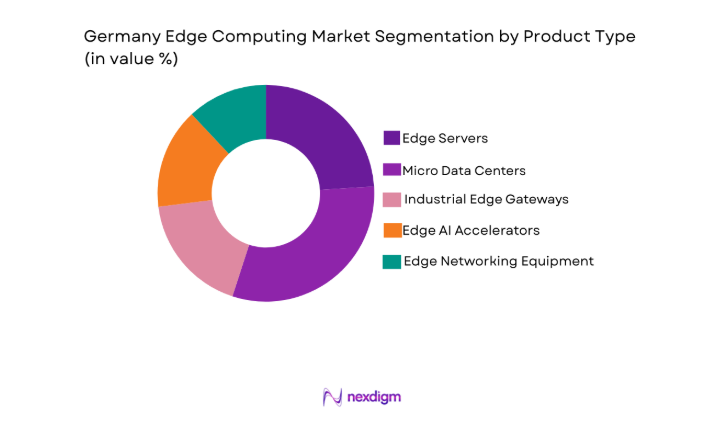
Germany Edge Computing market is segmented by product type into edge servers, micro data centers, industrial edge gateways, edge AI accelerators, and edge networking equipment. Recently, micro data centers have a dominant market share due to factors such as industrial deployment scalability, modular infrastructure availability, localized processing requirements in manufacturing sites, and strong vendor ecosystems providing turnkey ruggedized edge facilities for distributed Industry 4.0 operations across Germany’s factory-dense regions.
By Platform Type
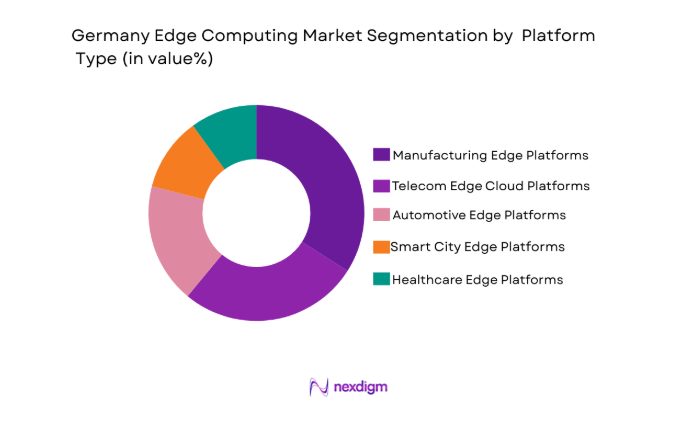
Germany Edge Computing market is segmented by platform type into manufacturing edge platforms, telecom edge cloud platforms, automotive edge platforms, smart city edge platforms, and healthcare edge platforms. Recently, manufacturing edge platforms have a dominant market share due to factors such as Germany’s industrial digitalization intensity, large installed base of connected machinery, need for real-time production analytics, and integration with private 5G and industrial IoT architectures supporting predictive maintenance and automated quality control across advanced production environments.
Competitive Landscape
Germany’s edge computing market shows moderate consolidation with strong participation from domestic industrial technology firms, telecom operators, and global IT infrastructure providers. Integrated industrial automation vendors and telecom incumbents exert significant influence through end-to-end edge solutions combining hardware, connectivity, and orchestration platforms. Strategic partnerships between cloud providers and German engineering firms are expanding sovereign edge architectures, while system integrators play a key role in deploying distributed industrial edge infrastructures across manufacturing and mobility ecosystems.
| Company
Name |
Establishment Year | Headquarters | Technology Focus | Market Reach | Key Products | Revenue | Industrial Edge Integration Capability |
| Siemens AG | 1847 | Munich, Germany | ~ | ~ | ~ | ~ | ~ |
| Deutsche Telekom AG | 1995 | Bonn, Germany | ~ | ~ | ~ | ~ | ~ |
| Robert Bosch GmbH | 1886 | Stuttgart, Germany | ~ | ~ | ~ | ~ | ~ |
| SAP SE | 1972 | Walldorf, Germany | ~ | ~ | ~ | ~ | ~ |
| Hewlett Packard Enterprise | 2015 | Houston, USA | ~ | ~ | ~ | ~ | ~ |

Germany Edge Computing Market Analysis
Growth Drivers
Industrial Digitalization and Industry 4.0 Edge Integration
Germany’s leadership in advanced manufacturing and Industry 4.0 transformation is driving substantial investment in edge computing infrastructure deployed directly within production environments to enable real-time analytics, machine control, and predictive maintenance across highly automated factories. German industrial enterprises are integrating edge processing with robotics, sensor networks, and digital twins to reduce latency, increase operational visibility, and support autonomous decision-making in complex production systems. Edge architectures allow localized data processing to meet strict data sovereignty requirements while enabling secure connectivity to cloud platforms for higher-level analytics and orchestration. The widespread modernization of brownfield manufacturing facilities across automotive, machinery, and electronics sectors requires distributed compute nodes capable of operating in harsh industrial conditions. Government-supported industrial digitalization programs and standards initiatives are accelerating vendor ecosystems delivering interoperable edge solutions tailored to German production environments. Industrial firms are prioritizing resilience and operational continuity, and localized edge infrastructure reduces dependency on centralized data centers and network availability. Integration of edge computing with private 5G networks in factories enables ultra-reliable low-latency communications essential for collaborative robotics and automated guided vehicles. German engineering culture emphasizing precision and automation strongly aligns with deterministic edge processing architectures that ensure consistent real-time control. As production systems become increasingly data-intensive and autonomous, edge computing becomes foundational infrastructure embedded within next-generation smart factories.
Telecom 5G Edge Infrastructure Expansion
Germany’s nationwide deployment of standalone 5G networks is enabling telecom operators to roll out multi-access edge computing nodes integrated within radio and core network architectures to support latency-critical enterprise and consumer applications. Telecom edge sites positioned near population and industrial centers allow application providers to host workloads closer to end users, reducing latency for immersive media, connected mobility, and industrial automation services. German telecom operators are forming partnerships with cloud hyperscalers and enterprise solution providers to create distributed edge cloud platforms combining connectivity, compute, and orchestration capabilities. Regulatory frameworks supporting private and campus 5G spectrum allocation have enabled enterprises to deploy localized networks integrated with edge computing nodes for secure and deterministic performance. Telecom operators are monetizing edge infrastructure through platform-as-a-service models targeting manufacturing, automotive, logistics, and public sector digitalization use cases. The densification of 5G base stations and fiber backhaul networks across Germany supports scalable edge node deployment across metropolitan and industrial corridors. Edge computing enhances telecom network efficiency by offloading processing from centralized cores and enabling localized content delivery and analytics. Enterprises adopting real-time applications such as autonomous vehicles, remote operations, and augmented reality rely on telecom-integrated edge environments for guaranteed performance. Germany’s advanced telecom ecosystem and industrial demand convergence position telecom edge infrastructure as a critical enabler of national digital transformation.
Market Challenges
High Capital Intensity of Distributed Edge Infrastructure
Deploying edge computing across geographically distributed industrial sites and telecom networks in Germany requires significant capital investment in ruggedized hardware, micro data centers, connectivity upgrades, and orchestration platforms capable of managing thousands of decentralized nodes. Unlike centralized cloud deployments, edge infrastructure must be replicated across numerous locations, increasing hardware procurement, installation, and lifecycle management costs. Industrial environments require specialized edge equipment capable of operating under vibration, dust, temperature, and electromagnetic conditions common in manufacturing facilities. German enterprises emphasize reliability and certification compliance, increasing engineering and deployment expenses for edge solutions. Integration with legacy operational technology systems often requires customized interfaces and retrofitting, adding engineering complexity and cost. Telecom operators face similar capital burdens when extending edge compute capacity across dense 5G networks and local exchanges. Energy efficiency and cooling requirements in constrained edge sites further raise operational expenditures compared with centralized data centers. Smaller enterprises may struggle to justify return on investment without clear productivity gains or new revenue streams enabled by edge applications. Financing distributed edge rollouts across multiple plants or regional sites remains challenging despite strong digitalization incentives. The capital-intensive nature of edge infrastructure deployment continues to slow adoption among cost-sensitive industrial segments.
Data Sovereignty and Interoperability Constraints
Germany’s strict data protection culture and European digital sovereignty frameworks impose stringent requirements on data localization, processing control, and cross-border data flows, complicating edge computing architectures that integrate cloud and distributed processing layers. Enterprises must ensure sensitive industrial and personal data processed at the edge remains compliant with regulatory frameworks, requiring secure orchestration and governance across decentralized environments. Interoperability challenges arise from diverse industrial protocols, proprietary automation systems, and heterogeneous edge hardware platforms deployed across manufacturing and infrastructure sectors. German industrial ecosystems include long equipment lifecycles and vendor-specific technologies that complicate standardized edge integration. Ensuring secure communication between edge nodes, cloud platforms, and operational systems requires robust identity, encryption, and lifecycle management frameworks. Multi-vendor edge environments create complexity in orchestration, monitoring, and software updates across distributed sites. Regulatory expectations around cybersecurity and critical infrastructure resilience impose additional certification and compliance requirements on edge deployments. Cross-border industrial operations within European supply chains must address varying national data governance interpretations. Organizations must balance localized processing advantages with centralized analytics requirements while maintaining compliance and interoperability. These regulatory and technical constraints increase deployment complexity and slow standardized edge adoption across Germany’s industrial landscape.
Opportunities
Private Industrial 5G and Edge Convergence in Smart Manufacturing
Germany’s regulatory support for enterprise spectrum allocation and campus 5G networks creates a significant opportunity for tightly integrated private connectivity and edge computing infrastructures embedded within factories and logistics facilities to enable autonomous production and real-time control. Manufacturers deploying private 5G networks require localized compute platforms to process machine vision, robotics coordination, and digital twin simulations with deterministic latency and high reliability. Edge computing allows sensitive production data to remain on premises while enabling selective synchronization with enterprise and cloud analytics systems. German machine builders and automation vendors are integrating edge-ready architectures into next-generation equipment, expanding embedded edge markets. Industrial operators seek scalable platforms capable of supporting modular factory expansions and flexible manufacturing lines driven by edge intelligence. Integration of edge computing with industrial AI models enables predictive maintenance, quality inspection, and adaptive process optimization. Private industrial networks combined with edge processing support collaborative robotics and autonomous logistics systems operating safely alongside human workers. Germany’s strong manufacturing base and engineering ecosystem accelerate adoption of integrated connectivity-compute architectures. Vendors offering interoperable private 5G and edge platforms aligned with German industrial standards can capture substantial growth. The convergence of private connectivity and edge computing represents a transformative infrastructure opportunity in the country’s smart manufacturing evolution.
Sovereign Edge Cloud for Regulated and Critical Sectors
Germany’s emphasis on digital sovereignty and secure data governance creates opportunities for localized edge cloud architectures designed to meet regulatory requirements in sectors such as public administration, healthcare, energy, and finance where data residency and control are critical. Sovereign edge clouds enable processing and storage within national or regional boundaries while supporting distributed applications requiring low latency and high availability. German government digitalization programs and critical infrastructure modernization initiatives are encouraging secure domestic computing capabilities integrated with edge nodes near operational sites. Healthcare providers adopting real-time diagnostics and connected medical devices require compliant localized processing environments. Energy utilities deploying smart grids and distributed renewable management systems benefit from edge processing near substations and field assets. Financial institutions processing sensitive transactional data leverage sovereign edge nodes within national boundaries to reduce latency and ensure compliance. Domestic telecom and technology firms are partnering to build sovereign edge infrastructures aligned with European data frameworks. Enterprises seek assurance that data processed at the edge remains under jurisdictional control while benefiting from cloud-like scalability. Sovereign edge architectures support secure collaboration across regulated industries without exposing sensitive data to external jurisdictions. This alignment of regulatory priorities and technological capabilities positions sovereign edge computing as a major strategic opportunity in Germany.
Future Outlook
Germany’s edge computing market is expected to expand steadily as Industry 4.0 automation deepens, private 5G deployments scale, and sovereign digital infrastructure initiatives accelerate localized computing adoption. Advancements in industrial AI, modular micro data centers, and telecom edge platforms will support broader enterprise deployment across manufacturing, mobility, energy, and public sectors. Regulatory emphasis on data sovereignty and secure infrastructure will further encourage domestic edge ecosystems, while demand for real-time analytics and autonomous operations sustains long-term growth momentum.
Major Players
- Siemens AG
- Deutsche Telekom AG
- SAP SE
- Robert Bosch GmbH
- T-Systems International GmbH
- Adva Network Security GmbH
- Kontron AG
- Bechtle AG
- Cancom SE
- Atos Information Technology GmbH
- NTT Data Deutschland SE
- IBM Deutschland GmbH
- Hewlett Packard Enterprise Germany
- Dell Technologies Germany
- Nokia Solutions and Networks Germany
Key Target Audience
- Industrial manufacturing enterprises
- Telecom network operators
- Automotive OEMs and mobility technology firms
- Energy and utilities operators
- Public sector digital infrastructure agencies
- Healthcare system operators
- Investments and venture capitalist firms
- Government and regulatory bodies
Research Methodology
Step 1: Identification of Key Variables
Demand drivers, deployment models, industry adoption patterns, pricing structures, and regulatory frameworks were identified across Germany’s industrial, telecom, and enterprise edge computing ecosystem through secondary literature and infrastructure data mapping.
Step 2: Market Analysis and Construction
Market sizing combined infrastructure deployment data, enterprise digitalization investments, telecom edge rollout metrics, and vendor revenues to construct Germany’s distributed edge computing market structure and segmentation framework.
Step 3: Hypothesis Validation and Expert Consultation
Industry experts across industrial automation, telecom infrastructure, and enterprise IT validated adoption assumptions, deployment costs, and technology trends to refine market segmentation and competitive positioning.
Step 4: Research Synthesis and Final Output
Validated datasets and qualitative insights were synthesized into a structured market model, ensuring alignment with Germany’s regulatory environment, industrial adoption dynamics, and technological evolution of edge computing.

- Executive Summary
- Research Methodology (Definitions, Scope, Industry Assumptions, Market Sizing Approach, Primary & Secondary Research Framework, Data Collection & Verification Protocol, Analytic Models & Forecast Methodology, Limitations & Research Validity Checks)

- Market Definition and Scope
- Value Chain & Stakeholder Ecosystem
- Regulatory / Certification Landscape
- Sector Dynamics Affecting Demand
- Strategic Initiatives & Infrastructure Growth

- Growth Drivers
Industry 4.0 digitalization across German manufacturing
Expansion of 5G standalone networks enabling edge workloads
Rising autonomous and connected vehicle data processing needs
Demand for low-latency analytics in industrial automation
Growth of smart infrastructure and urban digital services - Market Challenges
High capital expenditure for distributed edge infrastructure
Complex integration with legacy industrial systems
Data sovereignty and compliance constraints
Limited edge orchestration standardization
Power and cooling constraints in micro edge sites - Market Opportunities
Private 5G-enabled industrial edge deployments
Edge AI adoption in predictive maintenance
Sovereign cloud and localized data processing initiatives - Trends
Convergence of edge computing with industrial IoT platforms
Shift toward containerized edge orchestration environments
Adoption of micro modular data centers
Integration of AI inference at the edge layer
Telecom operator edge cloud expansion strategies - Government Regulations & Defense Policy
EU data localization and digital sovereignty frameworks
German Industry 4.0 and GAIA-X initiatives
Critical infrastructure cybersecurity compliance mandates - SWOT Analysis
- Stakeholder and Ecosystem Analysis
- Porter’s Five Forces Analysis
- Competition Intensity and Ecosystem Mapping

- By Market Value, 2020-2025
- By Installed Units, 2020-2025
- By Average System Price, 2020-2025
- By System Complexity Tier, 2020-2025

- By System Type (In Value%)
On-premise Edge Servers
Micro Data Center Systems
Industrial Edge Gateways
AI Edge Accelerators
Edge Networking Infrastructure - By Platform Type (In Value%)
Manufacturing Edge Platforms
Telecom Edge Cloud Platforms
Smart City Edge Platforms
Automotive Edge Platforms
Healthcare Edge Platforms - By Fitment Type (In Value%)
Standalone Edge Deployments
Integrated Data Center Edge
Embedded Industrial Edge
Vehicle-mounted Edge Systems
Ruggedized Outdoor Edge Units - By End User Segment (In Value%)
Manufacturing Enterprises
Telecom Operators
Automotive OEMs
Healthcare Providers
Public Sector and Municipalities

- Market structure and competitive positioning
Market share snapshot of major players - Cross Comparison Parameters (Edge Hardware Portfolio, Edge Software Stack, 5G Integration Capability, Industrial Partnerships, Deployment Scale)
- SWOT Analysis of Key Competitors
- Pricing & Procurement Analysis
- Key Players
Siemens AG
Deutsche Telekom AG
SAP SE
Robert Bosch GmbH
T-Systems International GmbH
Adva Network Security GmbH
Kontron AG
Bechtle AG
Cancom SE
Atos Information Technology GmbH
NTT Data Deutschland SE
IBM Deutschland GmbH
Hewlett Packard Enterprise Germany
Dell Technologies Germany
Nokia Solutions and Networks Germany

- Manufacturers prioritize real-time analytics for production efficiency
- Telecom operators deploy edge nodes for ultra-low latency services
- Automotive firms adopt edge for autonomous mobility data processing
- Public sector integrates edge in smart mobility and utilities

- Forecast Market Value, 2026-2035
- Forecast Installed Units, 2026-2035
- Price Forecast by System Tier, 2026-2035
- Future Demand by Platform, 2026-2035


 Request a Sample
 Ask for Customization
 Get a Quote
 Enquire Now