
 Download PDF
 Download PDF
Market Overview
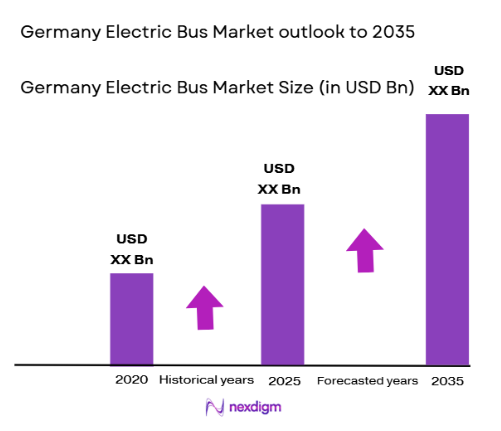
The Germany Electric Bus Market is valued at USD ~ billion, driven by the increasing demand for eco-friendly public transportation solutions. Strong governmental initiatives, including funding for electric bus infrastructure and purchase incentives, have encouraged transit authorities and private operators to transition to electric buses. Moreover, advancements in battery technology, particularly lithium-ion and solid-state batteries, have enhanced the appeal of electric buses by reducing operational costs and increasing range and efficiency. As the demand for sustainable transport solutions grows, the market is expected to maintain a robust growth trajectory.
The market is primarily driven by urban centers such as Berlin, Munich, and Frankfurt. These cities are leading the transition due to their strong environmental policies, large population bases, and robust infrastructure for electric vehicles, including charging stations. The German government’s commitment to reducing carbon emissions has spurred investments in electric bus fleets, with incentives and subsidies aimed at both public and private sectors. Additionally, cities with extensive public transport networks have been quick to embrace electric buses, contributing to the market’s overall growth.
Market Segmentation
By Product Type:
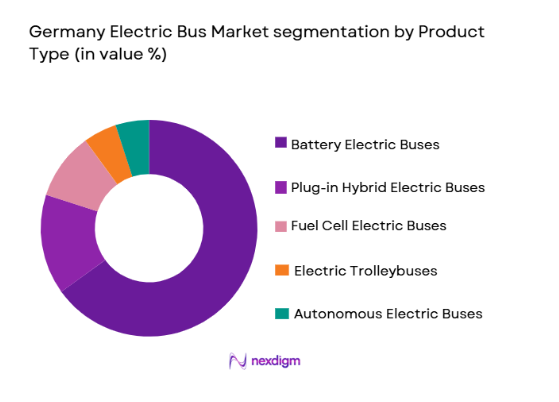
Germany Electric Bus market is segmented by product type into battery electric buses, plug-in hybrid electric buses, fuel cell electric buses, electric trolleybuses, and autonomous electric buses. Recently, battery electric buses have dominated the market due to their advanced battery technology, lower operating costs, and growing demand for emission-free urban transport solutions. The shift towards electric mobility, supported by government incentives and favorable regulations, has led to increased deployment of battery electric buses, making them the dominant choice among city transport authorities and private operators.
By Platform Type:
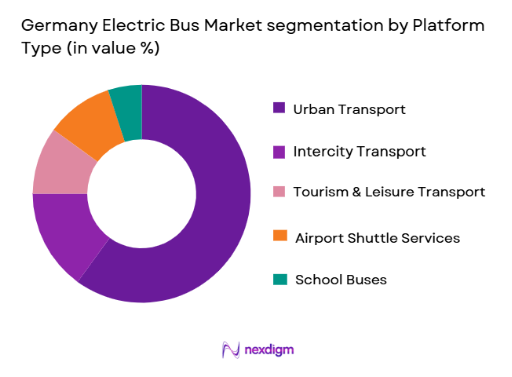
Germany Electric Bus market is segmented by platform type into urban transport, intercity transport, tourism & leisure transport, airport shuttle services, and school buses. Urban transport has a dominant market share due to the high demand for environmentally friendly public transport solutions in densely populated areas. German cities are rapidly integrating electric buses into their public transport systems, driven by stringent emission norms and growing consumer preference for sustainable travel. Urban transport platforms are favored by local governments aiming to reduce pollution, improve air quality, and meet sustainability goals.
Competitive Landscape
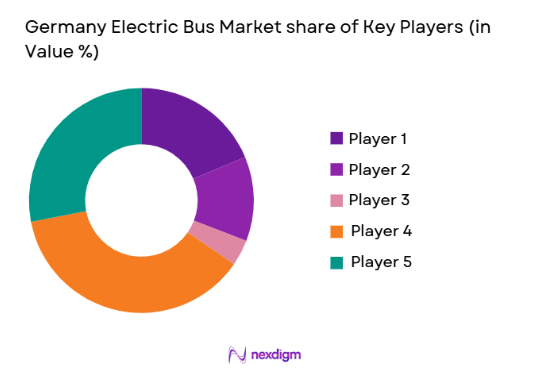
The competitive landscape of the Germany Electric Bus market is dynamic, with numerous players vying for market leadership through technological innovations, partnerships, and government collaborations. Major players in the market are focusing on the development of more efficient and cost-effective electric bus models to cater to the rising demand for eco-friendly public transport solutions. Market consolidation is also evident, as companies look to collaborate with government authorities and transport operators to offer end-to-end solutions. The increasing competition is leading to significant investments in R&D to advance battery technology and enhance operational efficiency.
| Company Name | Establishment Year | Headquarters | Technology Focus | Market Reach | Key Products | Revenue (USD Billion) | Market-specific Parameter |
| Siemens Mobility | 1847 | Berlin, Germany | ~ | ~ | ~ | ~ | ~ |
| MAN Truck & Bus | 1758 | Munich, Germany | ~ | ~ | ~ | ~ | ~ |
| VDL Bus & Coach | 1998 | Eindhoven, NL | ~ | ~ | ~ | ~ | ~ |
| Mercedes-Benz | 1926 | Stuttgart, Germany | ~ | ~ | ~ | ~ | ~ |
| BYD | 1995 | Shenzhen, China | ~ | ~ | ~ | ~ | ~ |
Germany Electric Bus Market Analysis
Growth Drivers
Government Incentives for Electric Bus Adoption:
Government-backed initiatives and policies have been a key driver in the adoption of electric buses across Germany. Significant subsidies, tax exemptions, and grants for purchasing electric buses, as well as funding for related infrastructure such as charging stations, have reduced the financial burden on municipalities and transport operators. These incentives have accelerated the transition to electric vehicles in public transport fleets, fostering growth in the electric bus market. Moreover, Germany’s commitment to reducing its carbon footprint and achieving its sustainability goals has prompted investments in green technologies, such as electric buses, that help mitigate pollution and reduce dependency on fossil fuels. Government agencies are also focusing on expanding electric bus infrastructure, improving charging networks, and incentivizing research into more efficient and affordable battery technologies. With increased regulatory pressure on diesel emissions and growing environmental awareness, government incentives continue to propel the electric bus market in Germany forward. These efforts have created a conducive environment for the growth of electric buses, ensuring long-term demand in the public transport sector.
Technological Advancements in Electric Bus Batteries:
Advances in electric vehicle (EV) battery technology have also significantly contributed to the growth of the Germany Electric Bus market. Innovations in lithium-ion batteries, solid-state batteries, and fast-charging technologies have improved the energy efficiency, range, and performance of electric buses. These technological advancements have addressed many of the early challenges faced by electric buses, such as limited range and long charging times, making them more suitable for integration into public transport fleets. Battery manufacturers and electric bus producers are investing heavily in research to further enhance battery performance, reduce costs, and improve overall efficiency. The development of ultra-fast charging stations and the ability to charge vehicles during operation have also increased the appeal of electric buses for public transport authorities. As battery technologies continue to evolve, they are expected to reduce the total cost of ownership for electric buses, making them even more attractive to operators and accelerating the transition to electric fleets.
Market Challenges
High Initial Cost of Electric Buses:
The high upfront cost of electric buses remains one of the significant challenges facing the market. While electric buses offer long-term operational savings through lower fuel and maintenance costs, their initial purchase price is still significantly higher than that of traditional diesel buses. This price difference is primarily due to the high cost of the batteries, which make up a substantial portion of the overall vehicle cost. While government incentives and subsidies help offset these costs, the initial financial burden remains a barrier for some municipalities and transport operators, especially smaller or less economically prosperous areas. As a result, many transport authorities continue to rely on conventional diesel buses, which are more affordable upfront, despite the growing demand for electric alternatives. This challenge is expected to diminish over time as battery prices decrease, but in the short term, the high purchase cost continues to hinder the rapid adoption of electric buses in certain regions.
Limited Charging Infrastructure:
The availability of charging infrastructure is another key challenge that has slowed the widespread adoption of electric buses in Germany. Although urban areas have seen significant investments in charging stations, rural areas and smaller cities still face challenges in establishing a comprehensive and reliable charging network for electric buses. The lack of adequate charging infrastructure can result in operational delays, increased downtime, and limited range, which negatively impacts the efficiency and feasibility of electric bus deployment. Furthermore, existing public charging stations may not be equipped to handle the higher power requirements of large electric buses, exacerbating the issue. To overcome this challenge, Germany needs to continue its efforts in expanding and upgrading the charging infrastructure, particularly in less densely populated areas. This will require further investment in both public and private sectors to build a comprehensive network of charging stations that can support the growing fleet of electric buses.
Opportunities
Public Transport Fleet Electrification:
The electrification of public transport fleets presents a major opportunity for growth in the Germany Electric Bus market. With the increasing focus on reducing carbon emissions and improving urban air quality, municipalities are more inclined to transition their fleets to electric buses. The German government’s goal to reduce greenhouse gas emissions and promote green public transport is creating favorable conditions for fleet electrification. Many public transport operators are already working toward this goal by integrating electric buses into their fleets. As the government continues to offer incentives and subsidies, and as battery costs decrease, it is expected that more transport operators will make the shift to electric buses in the coming years. This trend presents a significant opportunity for electric bus manufacturers, charging infrastructure providers, and related technology developers, as they stand to benefit from the increasing demand for sustainable transportation solutions.
Expansion of Charging Infrastructure:
The ongoing expansion of charging infrastructure is another opportunity for growth in the Germany Electric Bus market. As the number of electric buses on the road increases, the demand for reliable and fast-charging stations will rise. To meet this demand, Germany is investing in the development of both public and private charging networks. The growth of fast-charging technologies, such as ultra-fast chargers that reduce downtime for buses, is further fueling this opportunity. Additionally, innovations in wireless charging technologies and the development of charging stations that can charge multiple buses simultaneously are expected to make charging infrastructure even more efficient. As the infrastructure continues to expand and improve, it will make the adoption of electric buses more viable for transport operators, driving market growth and contributing to the wider transition to electric mobility.
Future Outlook
The future outlook for the Germany Electric Bus Market is positive, with steady growth expected in the coming years. Advances in battery technology, coupled with the expansion of charging infrastructure, are set to drive further market adoption. The German government’s continued commitment to sustainability and emission reduction will play a crucial role in supporting the transition to electric buses. Additionally, consumer demand for cleaner public transport options will continue to rise, making electric buses a key part of Germany’s long-term transportation strategy.
Major Players
- Siemens Mobility
- MAN Truck & Bus
- VDL Bus & Coach
- Mercedes-Benz
- BYD
- Alexander Dennis
- Scania
- Ebusco
- New Flyer
- Solar Bus & Coach
- Proterra
- DAF Trucks
- Iveco
- Arriva
- Nikola
Key Target Audience
- Investments and venture capitalist firms
- Government and regulatory bodies
- Public transportation authorities
- Electric vehicle manufacturers
- Charging infrastructure developers
- Urban planning agencies
- Sustainable mobility advocacy groups
- Environmental organizations
Research Methodology
Step 1: Identification of Key Variables
Key market variables were identified, including government policies, technological trends, and demand patterns in public transport sectors.
Step 2: Market Analysis and Construction
Data was gathered through primary and secondary sources to construct a market model, analyzing the market size, segmentation, and forecast trends.
Step 3: Hypothesis Validation and Expert Consultation
The hypothesis about growth drivers and market challenges were validated through expert consultations, including discussions with industry leaders and market analysts.
Step 4: Research Synthesis and Final Output
The final output was synthesized based on research findings, including detailed segmentation, competitive landscape analysis, and market forecasts.

- Executive Summary
- Research Methodology (Definitions, Scope, Industry Assumptions, Market Sizing Approach, Primary & Secondary Research Framework, Data Collection & Verification Protocol, Analytic Models & Forecast Methodology, Limitations & Research Validity Checks)

- Market Definition and Scope
- Value Chain & Stakeholder Ecosystem
- Regulatory / Certification Landscape
- Sector Dynamics Affecting Demand
- Strategic Initiatives & Infrastructure Growth

- Growth Drivers
Government Subsidies for Electric Buses
Rising Urbanization and Public Transport Demand
Technological Advancements in Electric Vehicle Batteries
Environmental Concerns Driving Green Initiatives
Infrastructure Development Supporting EV Adoption - Market Challenges
High Initial Investment Costs
Limited Charging Infrastructure
Technological and Performance Uncertainty
Integration with Existing Transport Systems
Regulatory Hurdles and Compliance Issues - Market Opportunities
Partnerships with Private Sector for Infrastructure Growth
Government-backed Initiatives for Fleet Electrification
Development of Autonomous Electric Bus Technologies - Trends
Growth of Smart Transportation Solutions
Advancements in Fast-charging Technologies
Emerging Demand for Autonomous Electric Buses
Integration of Renewable Energy with Charging Infrastructure
Increase in Demand for Environmentally Friendly Public Transport Solutions - Government Regulations & Defense Policy
Government Incentives for EV Adoption
Regulatory Standards for Emissions and Environmental Impact
EU Funding Programs for Electric Transport Development - SWOT Analysis
- Stakeholder and Ecosystem Analysis
- Porter’s Five Forces Analysis
- Competition Intensity and Ecosystem Mapping

- By Market Value, 2020-2025
- By Installed Units, 2020-2025
- By Average System Price, 2020-2025
- By System Complexity Tier, 2020-2025

- By System Type (In Value%)
Battery Electric Buses
Plug-in Hybrid Electric Buses
Fuel Cell Electric Buses
Electric Trolleybuses
Autonomous Electric Buses - By Platform Type (In Value%)
Urban Transport
Intercity Transport
Tourism & Leisure Transport
Airport Shuttle Services
School Buses - By Fitment Type (In Value%)
On-premise Solutions
Cloud-based Solutions
Hybrid Solutions
Modular Solutions
Integrated Solutions - By EndUser Segment (In Value%)
Municipal Transport Authorities
Private Transport Operators
Tourism Companies
Educational Institutions
Airport Operators - By Procurement Channel (In Value%)
Direct Procurement
Government Tenders
Private Sector Procurement
Online Bidding Platforms
Third-party Distributors - By Material / Technology (in Value%)
Lithium-ion Batteries
Fuel Cells
Electric Drive Systems
Charging Infrastructure
Telematics & Fleet Management Systems - Germany Electric Bus Market Analysis
Growth Drivers
Government Subsidies for Electric Buses
Rising Urbanization and Public Transport Demand
Technological Advancements in Electric Vehicle Batteries
Environmental Concerns Driving Green Initiatives
Infrastructure Development Supporting EV Adoption - Market Challenges
High Initial Investment Costs
Limited Charging Infrastructure
Technological and Performance Uncertainty
Integration with Existing Transport Systems
Regulatory Hurdles and Compliance Issues - Market Opportunities
Partnerships with Private Sector for Infrastructure Growth
Government-backed Initiatives for Fleet Electrification
Development of Autonomous Electric Bus Technologies - Trends
Growth of Smart Transportation Solutions
Advancements in Fast-charging Technologies
Emerging Demand for Autonomous Electric Buses
Integration of Renewable Energy with Charging Infrastructure
Increase in Demand for Environmentally Friendly Public Transport Solutions - Government Regulations & Defense Policy
Government Incentives for EV Adoption
Regulatory Standards for Emissions and Environmental Impact
EU Funding Programs for Electric Transport Development - SWOT Analysis
- Stakeholder and Ecosystem Analysis
- Porter’s Five Forces Analysis
- Competition Intensity and Ecosystem Mapping

- Market structure and competitive positioning
- Market share snapshot of major players
- CrossComparison Parameters (System Type, Platform Type, Procurement Channel, EndUser Segment, Fitment Type, Material/Technology, Price Tier, Installation Time, Battery Type, Charging Infrastructure)
- SWOT Analysis of Key Players
- Pricing & Procurement Analysis
- Key Players
Siemens Mobility
MAN Truck & Bus
VDL Bus & Coach
Mercedes-Benz
Volvo Buses
BYD
Alexander Dennis
Scania
Ebusco
New Flyer
Solaris Bus & Coach
Proterra
DAF Trucks
Iveco
Arriva

- Growing Investments in Public Transport Electrification
- Increased Government Focus on Clean Transportation Solutions
- Public Awareness of the Environmental Impact of Diesel Buses
- Demand for Reliable and Cost-effective Public Transport Systems

- Forecast Market Value, 2026-2035
- Forecast Installed Units, 2026-2035
- Price Forecast by System Tier, 2026-2035
- Future Demand by Platform, 2026-2035


 Request a Sample
 Ask for Customization
 Get a Quote
 Enquire Now