
 Download PDF
 Download PDF
Market Overview
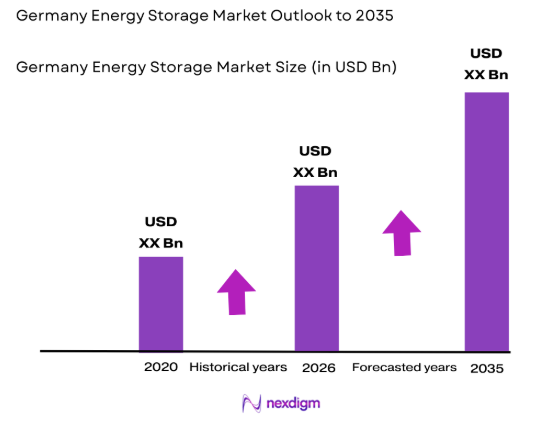
The Germany Energy Storage market is expected to reach approximately USD ~ billion based on a recent historical assessment. The growth of this market is driven by the increasing demand for renewable energy sources and the need for solutions to stabilize power grids. Government incentives, technological advancements in battery storage, and the integration of renewable energy into the national grid further contribute to this expansion. Energy storage systems are seen as crucial in ensuring the reliability and efficiency of energy production and consumption, especially with the rise of intermittent renewable sources like wind and solar.
Germany’s key regions leading in energy storage development include Bavaria and North Rhine-Westphalia. These areas benefit from strong infrastructure, substantial government support, and proximity to major renewable energy producers. With continued investment in grid integration and storage technologies, Germany remains a leader in the energy storage sector. The country’s commitment to renewable energy and its strategic initiatives, including the Energiewende policy, ensure that these regions will remain critical in driving market growth.
Market Segmentation
By Storage Type
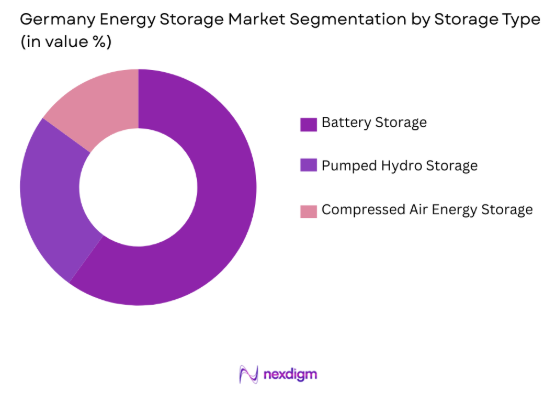
The Germany Energy Storage market is segmented by storage type into battery storage, pumped hydro storage, and compressed air energy storage. Recently, battery storage has become the dominant sub-segment due to factors such as declining battery costs, advances in lithium-ion technology, and the increasing demand for flexibility in energy supply. With the rise of electric vehicles and large-scale renewable energy integration, the demand for reliable and efficient battery storage solutions continues to grow. This sub-segment’s dominance is supported by favorable regulations and an increasing number of installations across both residential and industrial applications.
By End-User
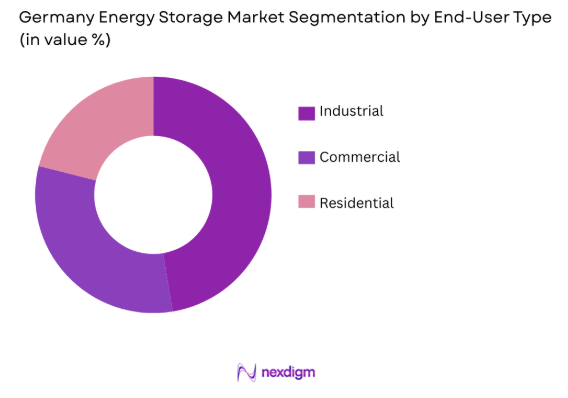
The Germany Energy Storage market is segmented by end-user into residential, commercial, and industrial applications. Recently, the industrial segment has been dominating the market share due to the increasing need for large-scale energy storage solutions for manufacturing plants, utility services, and grid stabilization. Industries are increasingly adopting energy storage systems to enhance energy efficiency, lower operational costs, and ensure a reliable energy supply, particularly with the growing adoption of renewable energy sources. Moreover, government incentives targeted at industrial users have contributed to this sub-segment’s dominance in the market.
Competitive Landscape
The competitive landscape of the Germany Energy Storage market is characterized by significant consolidation and the growing influence of large players across the entire supply chain. The market is witnessing the entrance of established energy companies, technology providers, and energy storage specialists, all of which are vying for market share. Major players are investing in research and development to bring new energy storage technologies to market, and many are also entering partnerships or acquisitions to enhance their product offerings and reach.
| Company Name | Establishment Year | Headquarters | Technology Focus | Market Reach | Key Products | Revenue (USD Billion) | Market-Specific Parameter |
| Siemens Energy | 2020 | Munich, Germany | ~ | ~ | ~ | ~ | ~ |
| Tesla | 2003 | Palo Alto, USA | ~ | ~ | ~ | ~ | ~ |
| VARTA | 1887 | Ellwangen, Germany | ~ | ~ | ~ | ~ | ~ |
| Engie | 2008 | Paris, France | ~ | ~ | ~ | ~ | ~ |
| ABB | 1988 | Zurich, Switzerland | ~ | ~ | ~ | ~ | ~ |
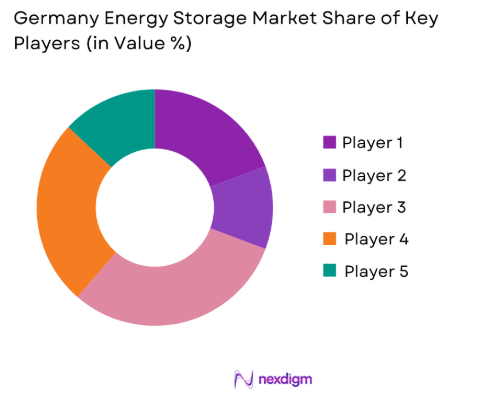
Germany Energy Storage Market Analysis
Growth Drivers
Government Support for Energy Storage Solutions
The German government’s strong support for energy storage is a key growth driver in the market. The German government’s Energiewende policy emphasizes the transition to renewable energy sources and highlights energy storage as a crucial component in stabilizing the power grid. Government incentives, such as grants and subsidies for the installation of energy storage systems, help reduce initial costs for developers and end-users. Additionally, regulations mandating renewable energy integration with energy storage systems encourage investments in advanced storage technologies. The focus on renewable energy and grid stability ensures that energy storage will continue to play a critical role in Germany’s energy infrastructure, supporting the growth of the market.
Technological Advancements in Energy Storage
Advances in battery technology, especially lithium-ion batteries, are driving the growth of the energy storage market in Germany. The continuous development of more efficient and cost-effective energy storage solutions has made energy storage systems more accessible to both residential and industrial consumers. Innovations in battery chemistry, coupled with declining production costs, have made energy storage systems economically viable at large scales. Energy storage technologies are evolving to provide longer-lasting, higher-capacity systems that can efficiently store excess renewable energy. As the need for grid stabilization and renewable energy integration increases, technological advancements will continue to drive the adoption of energy storage systems in Germany.
Market Challenges
Regulatory and Permitting Issues
One of the key challenges in the Germany Energy Storage market is regulatory barriers and permitting processes. The regulatory framework for energy storage in Germany is complex, and the permitting process for energy storage installations can be time-consuming and cumbersome. Regulations related to energy storage system integration with the national grid, environmental impact assessments, and safety standards can delay project timelines and increase costs. The need for updates to grid infrastructure to accommodate energy storage solutions also presents a challenge, particularly as demand for renewable energy increases. Resolving these regulatory issues and simplifying permitting processes will be essential for maintaining market momentum.
High Initial Capital Costs
Another challenge facing the Germany Energy Storage market is the high upfront cost of energy storage systems. Despite advancements in battery technology, the initial capital investment for energy storage systems remains a significant barrier, particularly for small-scale residential applications. While costs have decreased over the past decade, large-scale installations still require substantial investment, which can deter potential customers. Additionally, energy storage systems often require ongoing maintenance and operational expenses, further contributing to the total cost of ownership. As the market continues to mature, cost reductions and financing options will be critical in overcoming this challenge and ensuring widespread adoption.
Opportunities
Integration of Energy Storage with Renewable Energy
The integration of energy storage with renewable energy sources presents a significant opportunity for growth in the Germany Energy Storage market. As Germany continues to expand its renewable energy capacity, particularly wind and solar, the demand for energy storage systems to store excess energy during periods of low demand increases. Energy storage systems, such as batteries, can store this energy for later use, ensuring a reliable supply even when renewable energy generation is low. The development of hybrid energy systems that combine energy storage with renewable generation sources will further enhance energy security and grid stability. As a result, energy storage solutions will become even more critical in enabling the full integration of renewable energy into Germany’s power grid.
Expansion of Electric Vehicle (EV) Energy Storage
The growing adoption of electric vehicles (EVs) presents an opportunity for energy storage market growth in Germany. As EV adoption increases, there is a potential to integrate EV batteries into the broader energy storage market, particularly through vehicle-to-grid (V2G) technologies. This integration allows EVs to serve as mobile storage units, providing additional storage capacity for renewable energy when the vehicles are not in use. The development of V2G systems presents a significant opportunity to expand energy storage capacity and enhance grid stability. Furthermore, the increasing demand for EVs in Germany, supported by government incentives and growing environmental concerns, will drive the adoption of energy storage solutions across both residential and commercial sectors.
Future Outlook
The future of the Germany Energy Storage market is optimistic, with significant growth expected in both residential and industrial sectors. Technological advancements in battery storage, along with favorable government policies supporting the energy transition, are likely to drive continued market expansion. The integration of energy storage with renewable energy sources will enhance grid stability and support Germany’s goals for carbon neutrality. Furthermore, the growing adoption of electric vehicles and the development of vehicle-to-grid technologies will provide new avenues for energy storage, ensuring a stable and sustainable energy future for Germany.
Major Players
- Siemens Energy
- Tesla
- VARTA
- Engie
- ABB
- LG Chem
- AES Corporation
- Fluence Energy
- E.ON
- Schneider Electric
- NextEra Energy
- Mitsubishi Power
- Samsung SDI
- BYD
- Panasonic
Key Target Audience
- Investments and venture capitalist firms
- Government and regulatory bodies
- Energy producers and developers
- Large-scale energy consumers
- Independent power producers
- Renewable energy equipment manufacturers
- Energy storage solution providers
Research Methodology
Step 1: Identification of Key Variables
Identification of market drivers, challenges, opportunities, and regulatory frameworks specific to the Germany Energy Storage market. This includes technological advancements, government policies, and economic indicators.
Step 2: Market Analysis and Construction
Detailed market segmentation and quantitative analysis are conducted to build a comprehensive understanding of the energy storage landscape in Germany. This includes historical trends, current market conditions, and future forecasts.
Step 3: Hypothesis Validation and Expert Consultation
Consultation with industry experts and stakeholders to validate hypotheses and ensure the accuracy of market assumptions. Primary and secondary research are conducted to gather real-world insights and data.
Step 4: Research Synthesis and Final Output
The data gathered through research is synthesized to create a cohesive market report that provides insights into market trends, future growth, and strategic opportunities for stakeholders.

- Executive Summary
- Research Methodology (Definitions, Scope, Industry Assumptions, Market Sizing Approach, Primary & Secondary Research Framework, Data Collection & Verification Protocol, Analytic Models & Forecast Methodology, Limitations & Research Validity Checks)

- Market Definition and Scope
- Value Chain & Stakeholder Ecosystem
- Regulatory / Certification Landscape
- Sector Dynamics Affecting Demand

- Growth Drivers
Increasing Demand for Renewable Energy Integration
Government Incentives and Subsidies for Energy Storage
Advancements in Battery Technologies - Market Challenges
High Initial Capital Investment for Energy Storage Systems
Regulatory Hurdles and Delays in Approvals
Challenges in Energy Storage Efficiency and Duration - Market Opportunities
Expanding Role of Energy Storage in Electric Vehicle Charging Infrastructure
Integration of Energy Storage in Smart Grids
Development of Large-Scale Energy Storage Projects - Trends
Shift Towards Decentralized Energy Systems
Integration of AI and IoT with Energy Storage Solutions - Government Regulations
- SWOT Analysis
- Porter’s Five Forces

- By Market Value, 2020-2025
- By Installed Units, 2020-2025
- By Average System Price, 2020-2025
- By System Complexity Tier, 2020-2025

- By System Type (In Value%)
Lithium-ion Batteries
Flow Batteries
Lead-Acid Batteries
Sodium-based Batteries
Compressed Air Energy Storage - By Platform Type (In Value%)
Residential Platforms
Commercial Platforms
Industrial Platforms
Utility-scale Platforms - By Fitment Type (In Value%)
On-grid Solutions
Off-grid Solutions
Hybrid Solutions
Modular Solutions - By End User Segment (In Value%)
Utilities
Commercial Sector
Residential Sector

- Market Share Analysis
- Cross Comparison Parameters (System Type, Platform Type, Procurement Channel, End User Segment, Fitment Type, Energy Density, Installation Scale)
- SWOT Analysis of Key Competitors
- Pricing & Procurement Analysis
- Key Players
Siemens Energy
ABB
Vestas
Tesla
LG Chem
Sonnen
Fluence
BYD
General Electric
Schneider Electric
Samsung SDI
Hitachi
E.ON
Enel X
Saft

- Growing Demand from the Residential Sector
- Expanding Adoption in the Commercial Sector
- Utility Companies Increasing Investment
- Energy Storage Role in Grid Stabilization

- Forecast Market Value, 2026-2035
- Forecast Installed Units, 2026-2035
- Price Forecast by System Tier, 2026-2035
- Future Demand by Platform, 2026-2035


 Request a Sample
 Ask for Customization
 Get a Quote
 Enquire Now