
 Download PDF
Market Overview
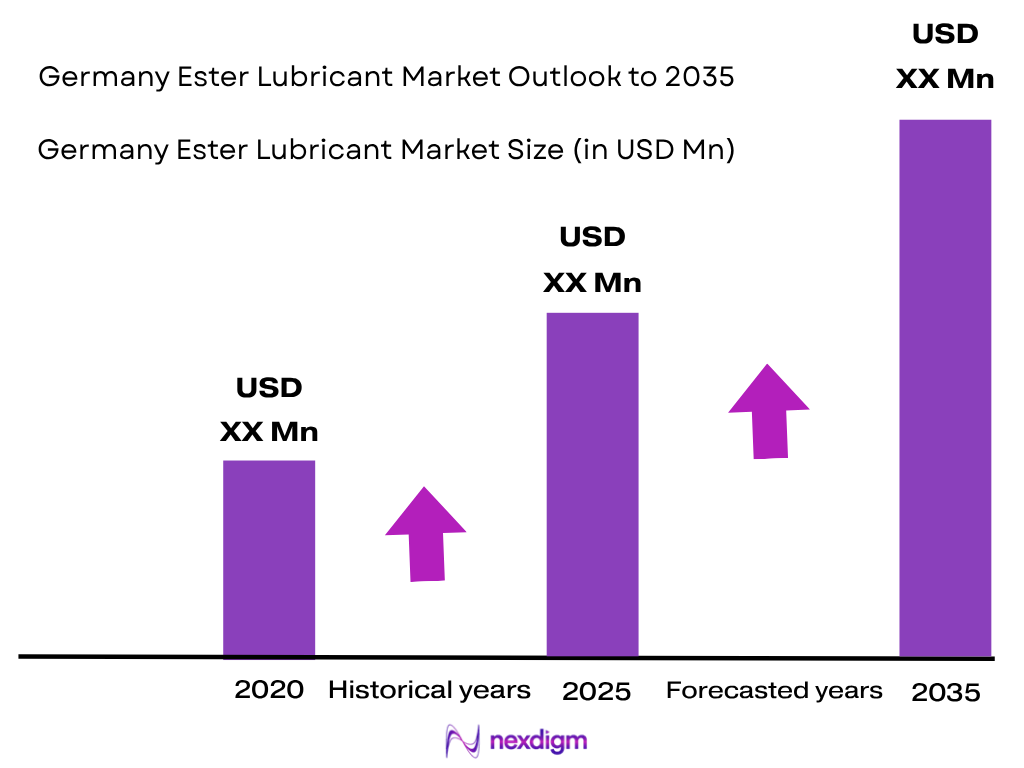
The Germany Ester Lubricant market is valued at approximately USD ~ billion in 2024, based on historical industry analysis of synthetic ester, bio-based ester, and specialty ester lubricant consumption across automotive, industrial, aerospace, and energy applications. The market growth is driven by increasing demand for high-performance lubricants with superior thermal stability, biodegradability, low volatility, and extended equipment life. The expansion of electric vehicle manufacturing, industrial automation, renewable energy installations, and environmentally acceptable lubricant adoption has further supported ester lubricant demand across Germany’s advanced manufacturing ecosystem.
Germany represents one of the most developed ester lubricant markets in Europe, supported by its strong automotive manufacturing base, industrial machinery production, and specialty chemical industry. Major industrial hubs including Bavaria, Baden-Württemberg, North Rhine-Westphalia, and Lower Saxony dominate ester lubricant consumption due to the presence of automotive OEMs, machinery manufacturers, chemical producers, and industrial equipment users. The country’s focus on engineering excellence, energy efficiency, sustainability regulations, and advanced lubrication technologies has encouraged adoption of synthetic esters and bio-based ester lubricants across multiple end-use industries.
Market Segmentation
By Ester Type
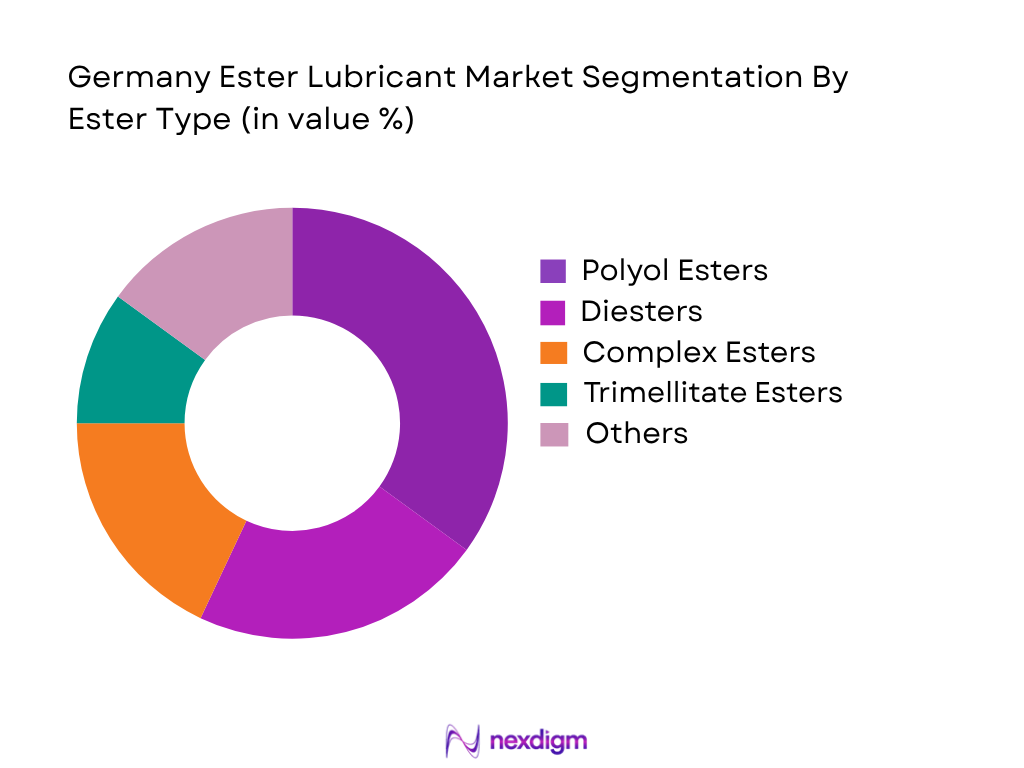
Germany Ester Lubricant market is segmented by ester type into monoesters, diesters, polyol esters, complex esters, trimellitate esters, phosphate esters, neopolyol esters, and other specialty esters. Among these, polyol esters hold a dominant market position due to their superior oxidation stability, high-temperature performance, low volatility, and compatibility with demanding applications such as aerospace lubricants, automotive fluids, refrigeration compressors, and industrial machinery. Polyol esters are widely preferred for applications requiring extended service intervals and extreme operating conditions. The presence of advanced automotive manufacturers and industrial equipment producers in Germany has increased demand for premium ester formulations. Additionally, growing sustainability requirements have supported the adoption of high-performance ester lubricants that provide improved efficiency while reducing environmental impact.
By Application
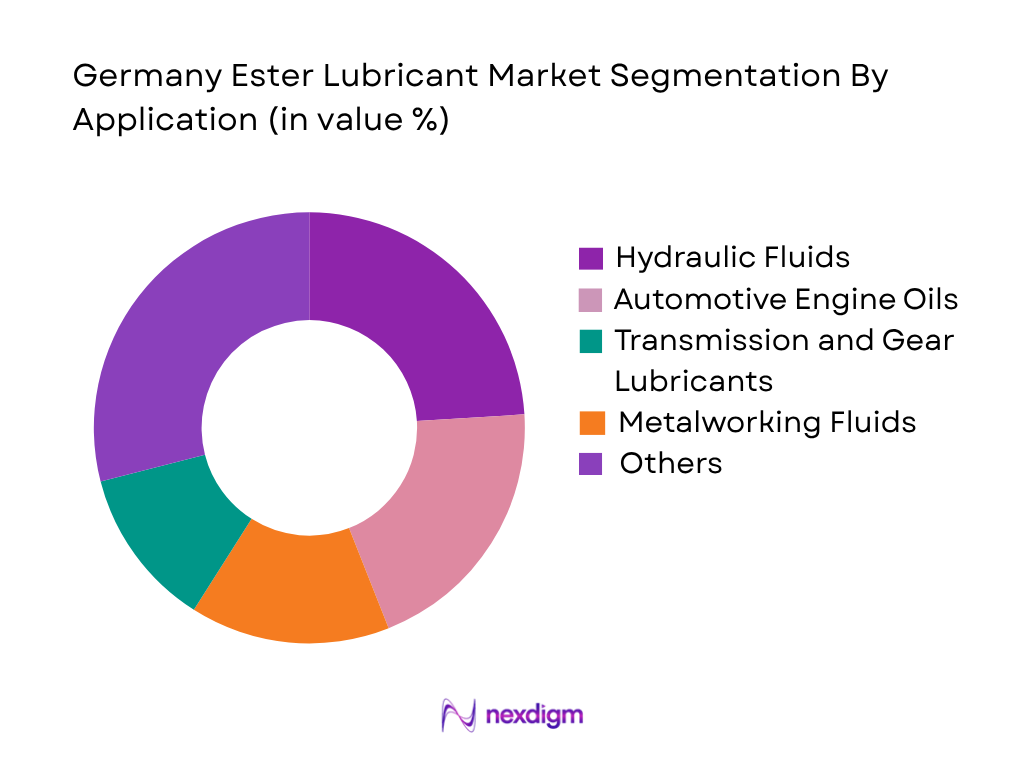
Germany Ester Lubricant market is segmented by application into automotive engine oils, transmission and gear lubricants, hydraulic fluids, compressor lubricants, turbine lubricants, metalworking fluids, greases, aerospace lubricants, marine lubricants, and refrigeration lubricants. The industrial hydraulic fluids and automotive lubrication segment dominates the market due to Germany’s strong manufacturing base, automotive production capabilities, and demand for efficient machinery operation. Ester-based hydraulic fluids are increasingly utilized in applications requiring biodegradability, fire resistance, and high performance under extreme conditions. Automotive manufacturers and component suppliers are also adopting ester-based formulations for advanced engines, transmissions, and electric vehicle thermal management systems. The increasing focus on energy efficiency and reduced maintenance requirements has strengthened the demand for ester lubricants across industrial applications.
Competitive Landscape
The Germany Ester Lubricant market is characterized by the presence of global lubricant manufacturers, specialty chemical companies, and regional lubricant suppliers. Major players including FUCHS SE, BASF SE, ExxonMobil, Shell, TotalEnergies, and Klüber Lubrication compete through advanced ester formulations, application-specific solutions, OEM approvals, and extensive industrial distribution networks. The competitive environment is influenced by product innovation, sustainability initiatives, technical support capabilities, and development of bio-based lubricant technologies.
| Company | Establishment Year | Headquarters | Ester Lubricant Portfolio | Major Application Areas | Bio-Based Ester Capability | Distribution Network | R&D Capability |
| FUCHS SE | 1931 | Mannheim, Germany | ~ | ~ | ~ | ~ | ~ |
| BASF SE | 1865 | Ludwigshafen, Germany | ~ | ~ | ~ | ~ | ~ |
| ExxonMobil Corporation | 1999 | Spring, USA | ~ | ~ | ~ | ~ | ~ |
| Shell Deutschland GmbH | 1902 | Hamburg, Germany | ~ | ~ | ~ | ~ | ~ |
| Klüber Lubrication | 1929 | Munich, Germany | ~ | ~ | ~ | ~ | ~ |
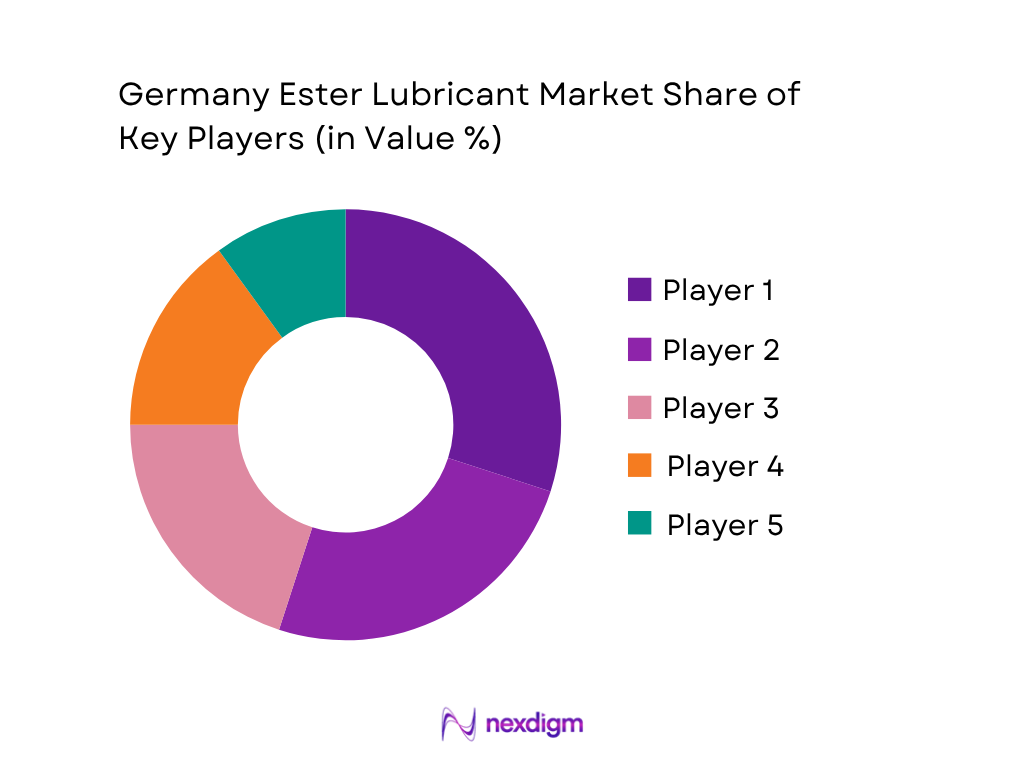
Germany Ester Lubricant Market Analysis
Growth Drivers
Increasing Automotive Manufacturing and Electrification Activities
Germany’s strong automotive manufacturing ecosystem is a major growth driver for ester lubricants, as advanced lubrication solutions are increasingly required for vehicle components, electric vehicle systems, transmissions, and high-performance automotive applications. According to the German Association of the Automotive Industry (VDA), Germany produced approximately 4.07 million passenger cars in 2024, reflecting the continued scale of domestic vehicle manufacturing and supporting demand for specialty lubricants used in production machinery, testing equipment, and automotive components. The International Energy Agency (IEA) reported that global electric car sales exceeded 17 million units in 2024, increasing the requirement for specialized thermal management fluids and high-performance lubricants compatible with electric mobility systems. Germany also registered approximately 1.4 million new electric vehicle registrations in 2024, according to the Federal Motor Transport Authority (KBA), highlighting the transition toward electrified transportation. Ester lubricants provide advantages including thermal stability, oxidation resistance, low volatility, and compatibility with advanced vehicle systems, making them increasingly relevant for automotive manufacturers and component suppliers. The presence of major automotive production clusters in Bavaria, Baden-Württemberg, and Lower Saxony further strengthens demand for ester-based lubricant technologies across manufacturing and mobility applications.
Expansion of Industrial Automation and Renewable Energy Equipment
The increasing adoption of industrial automation, precision machinery, and renewable energy infrastructure in Germany is supporting demand for high-performance ester lubricants used in hydraulic systems, gearboxes, compressors, turbines, and industrial equipment. According to the German Federal Statistical Office (Destatis), Germany’s manufacturing sector generated approximately EUR 2.1 trillion in industrial revenue in 2024, demonstrating the continued importance of machinery-intensive industries that require efficient lubrication solutions. The International Renewable Energy Agency (IRENA) reported that Germany had approximately 70 GW of installed wind power capacity in 2024, creating demand for long-life lubricants used in wind turbine gear systems and maintenance applications. Additionally, the International Energy Agency (IEA) reported that renewable energy capacity additions continued expanding globally, increasing the requirement for reliable lubrication technologies supporting energy infrastructure. Ester lubricants are increasingly selected for applications requiring biodegradability, high temperature resistance, extended service intervals, and improved equipment efficiency. Germany’s strong presence in industrial machinery manufacturing, automation technology, and renewable energy equipment production creates a favorable environment for ester lubricant adoption across multiple industrial applications.
Market Challenges
High Dependence on Specialty Raw Materials and Feedstock Availability
The Germany Ester Lubricant market faces challenges due to dependence on specialized chemical feedstocks, including fatty acids, polyols, synthetic alcohols, and other esterification components required for producing high-performance lubricant formulations. According to the European Chemicals Agency (ECHA), more than 23,000 chemical substances were registered under the REACH framework by 2024, reflecting the complexity of chemical supply chains and regulatory compliance requirements within Europe. The German Chemical Industry Association (VCI) reported that the German chemical industry generated approximately EUR 225 billion in sales in 2024, highlighting the scale and importance of chemical inputs required for specialty lubricant production. Variations in availability of renewable feedstocks, specialty intermediates, and imported chemical materials can influence formulation flexibility and production planning. Ester lubricant manufacturers must also comply with strict European chemical regulations, documentation requirements, and environmental standards, increasing operational complexity. These factors create challenges for manufacturers seeking consistent raw material availability while maintaining sustainable and technically advanced ester lubricant formulations for automotive, industrial, and aerospace applications.
Competition from Alternative Synthetic Lubricant Technologies
The Germany Ester Lubricant market experiences competitive pressure from alternative synthetic lubricant technologies, including polyalphaolefin (PAO)-based lubricants and advanced mineral lubricant formulations. According to the European Automobile Manufacturers’ Association (ACEA), Europe produced approximately 18 million motor vehicles in 2024, creating significant demand for diverse lubricant technologies across automotive applications. While ester lubricants provide advantages such as biodegradability, polarity, and high-performance characteristics, competing lubricant technologies continue to be adopted due to established supply chains, broader application familiarity, and existing equipment compatibility. The German Engineering Federation (VDMA) reported that Germany’s mechanical engineering sector employed approximately 1.1 million workers in 2024, representing a large industrial customer base where lubricant selection depends on equipment specifications, operating conditions, and maintenance requirements. Ester lubricants often require application-specific formulation expertise and technical validation before adoption, particularly in industrial machinery and automotive systems. The need for compatibility testing, OEM approvals, and customer qualification processes can slow adoption compared with conventional synthetic lubricant alternatives.
Market Opportunities
Increasing Adoption of Bio-Based and Environmentally Acceptable Lubricants
Growing environmental regulations and sustainability objectives are creating opportunities for bio-based ester lubricants and environmentally acceptable lubrication solutions across Germany’s industrial sectors. According to the European Environment Agency (EEA), Germany generated approximately 280 million tonnes of greenhouse gas emissions in 2024, reinforcing the need for emission reduction initiatives across industrial activities. The German Federal Environment Agency (UBA) continues to promote environmentally responsible industrial practices, including the adoption of products that reduce ecological impact. Bio-based ester lubricants offer advantages such as renewable feedstock utilization, biodegradability, reduced environmental persistence, and improved sustainability profiles compared with conventional lubricant alternatives. Germany’s extensive use of hydraulic equipment, forestry machinery, agricultural systems, and industrial equipment creates opportunities for environmentally acceptable lubricants. The expansion of sustainability-focused procurement practices among industrial users and increasing emphasis on circular economy principles are encouraging manufacturers to develop renewable ester formulations. Existing demand from industries operating near environmentally sensitive areas provides additional opportunities for ester lubricant suppliers to expand specialized product offerings.
Growth Opportunities from Electric Vehicles and Advanced Thermal Management Systems
The transition toward electric mobility is creating new opportunities for ester lubricant technologies, particularly in electric vehicle thermal management fluids, specialized greases, and high-performance lubrication systems. According to the Federal Motor Transport Authority (KBA), Germany recorded approximately 1.4 million newly registered electric vehicles in 2024, demonstrating continued adoption of electrified transportation technologies. The International Energy Agency (IEA) reported that electric vehicle deployment increased significantly worldwide, with global electric vehicle stock exceeding 40 million units in 2024. Electric vehicles require specialized fluids capable of managing heat transfer, electrical compatibility, and long-term operational reliability. Ester-based formulations offer properties including dielectric performance, thermal stability, and oxidation resistance, supporting their application in emerging electric mobility systems. Germany’s position as a major automotive technology hub, combined with ongoing investments in battery manufacturing and electric vehicle production facilities, provides opportunities for lubricant manufacturers to develop specialized ester-based solutions for next-generation transportation technologies.
Future Outlook
Over the next decade, the Germany Ester Lubricant market is expected to demonstrate significant growth driven by increasing adoption of sustainable lubrication solutions, expansion of electric vehicle manufacturing, rising industrial automation, and demand for high-performance synthetic lubricants. The transition toward environmentally acceptable lubricants and renewable feedstock-based ester formulations is expected to create new opportunities across automotive, industrial, and renewable energy applications.
Major Players
- FUCHS SE
- BASF SE
- ExxonMobil Corporation
- Shell Deutschland GmbH
- TotalEnergies Marketing Deutschland GmbH
- BP Europa SE
- Klüber Lubrication München SE & Co. KG
- Evonik Industries AG
- LANXESS Deutschland GmbH
- Croda Europe Limited
- The Lubrizol Corporation
- Afton Chemical GmbH
- Zschimmer & Schwarz GmbH & Co KG
- Panolin International Inc.
- Quaker Houghton GmbH
Key Target Audience
- Automotive OEMs and Component Manufacturers
- Industrial Machinery Manufacturers and Equipment Producers
- Lubricant Manufacturers and Ester Base Stock Suppliers
- Chemical and Specialty Chemical Companies
- Investments and Venture Capitalist Firms (Energy Transition Funds, Industrial Technology Investment Firms, Sustainable Chemistry Investment Funds)
- Government and Regulatory Bodies (European Chemicals Agency (ECHA), German Federal Environment Agency (UBA), Federal Ministry for Economic Affairs and Climate Action (BMWK))
- Renewable Energy Equipment Manufacturers
- Aerospace and Aviation Lubricant Procurement Organizations
Research Methodology
Step 1: Identification of Key Variables
The initial phase involves developing a comprehensive ecosystem map covering major stakeholders operating within the Germany Ester Lubricant market. This includes ester manufacturers, lubricant formulators, additive suppliers, automotive OEMs, industrial users, and regulatory institutions. Extensive secondary research is conducted to identify market variables including ester chemistry, application demand, production capacity, raw material availability, and industry-specific consumption patterns.
Step 2: Market Analysis and Construction
In this phase, historical market information related to ester lubricant production, consumption, pricing trends, and application adoption is analyzed. The study evaluates demand from automotive manufacturing, industrial machinery, aerospace, renewable energy, and specialty lubrication sectors. Supply chain analysis, production assessment, and trade flow evaluation are conducted to establish market structure and revenue estimation.
Step 3: Hypothesis Validation and Expert Consultation
Market assumptions are developed and validated through computer-assisted telephone interviews (CATIs) and discussions with industry experts representing lubricant manufacturers, chemical suppliers, OEMs, and industrial consumers. These interactions provide operational insights regarding product demand, technology adoption, formulation requirements, and competitive developments.
Step 4: Research Synthesis and Final Output
The final phase involves consolidating findings from primary and secondary research to generate a validated market assessment. Direct discussions with industry participants are used to verify product segmentation, application trends, competitive positioning, and future growth opportunities. The collected insights support accurate market analysis and strategic recommendations.

- Executive Summary
- Research Methodology (Market Definition and Scope, Germany Ester Lubricant Market Classification, Ester Base Stock Mapping, Ester Chemistry Assessment, Ester Molecular Structure Assessment, Monoester and Diester Evaluation, Polyol Ester Assessment, Complex Ester Assessment, Trimellitate Ester Assessment, Synthetic and Bio-Based Ester Assessment, Viscosity Grade Mapping, Performance Property Assessment, Application-Level Demand Analysis, End-Use Industry Assessment, Lubricant Formulation Mapping, Base Oil Supply Assessment, Domestic Production Assessment, Import and Export Trade Analysis, Raw Material Supply Assessment, Demand-Side Assessment, Supply-Side Assessment, Top-Down Market Sizing, Bottom-Up Market Sizing, Primary Industry Interviews, Data Triangulation, Forecasting Framework, Market Share Validation, Limitations and Future Conclusions)

- Definition and Scope
- Germany Ester Lubricant Industry Evolution and Development of Synthetic Base Oil Technology, High-Performance Lubricant Formulation, Automotive Lubrication, Industrial Fluid Applications, Aerospace Lubrication, Renewable Lubricant Technologies and Sustainable Ester-Based Lubricant Solutions
- Ester Lubricant Value Chain Analysis
- Ester Lubricant Supply Chain Analysis
- Fatty Acid and Alcohol Feedstock Suppliers, Oleochemical Feedstock Producers, Petrochemical Feedstock Suppliers, Ester Base Stock Manufacturers, Specialty Ester Producers, Lubricant Additive Manufacturers, Lubricant Blenders, Industrial Lubricant Manufacturers, Automotive Lubricant Suppliers, Aerospace Lubricant Suppliers, Distributors, Industrial OEMs and End-Use Industries
- Ester Lubricant Integration Across Automotive Engine Oils, Transmission Fluids, Gear Lubricants, Hydraulic Fluids, Compressor Oils, Turbine Lubricants, Metalworking Fluids, Greases, Aerospace Lubricants, Marine Lubricants, Refrigeration Lubricants and Environmentally Acceptable Lubricants

- Growth Drivers (Demand for High-Performance Synthetic Lubricants, Increasing Automotive Manufacturing Activities, Electric Vehicle Production Expansion, Industrial Automation Growth, High-Temperature Lubrication Requirements, Demand for Environmentally Acceptable Lubricants, Increasing Equipment Efficiency Requirements, Growth of Renewable Energy Equipment, Advanced Metalworking Applications, Demand for Extended Drain Interval Lubricants)
- Market Challenges (High Specialty Ester Production Costs, Raw Material Price Volatility, Limited Ester Lubricant Awareness, Formulation Compatibility Constraints, Competition from PAO and Other Synthetic Base Stocks, Hydrolytic Stability Challenges, Complex Qualification Requirements, Specialty Feedstock Availability Issues, Supply Chain Dependency on Imported Raw Materials)
- Market Opportunities (Bio-Based Ester Lubricant Expansion, Electric Vehicle Thermal Management Applications, Aerospace Lubricant Demand, Wind Turbine Lubrication Applications, Environmentally Acceptable Hydraulic Fluids, Advanced Industrial Lubricants, Food-Grade Lubricants, Sustainable Metalworking Fluids, Renewable Feedstock-Based Ester Development)
- Market Trends (Shift Toward Synthetic Base Stocks, Sustainable Lubricant Adoption, Bio-Based Ester Development, Low-Volatility Ester Formulations, Electrification-Driven Lubricant Development, Environmentally Friendly Lubricants, Advanced Industrial Fluid Technologies, Premium Automotive Lubricant Demand, Longer Drain Interval Lubricants, Ester-PAO Blended Lubricant Development)
- Government Regulations and Standards (European Union REACH Regulation, European Chemicals Agency Requirements, German Federal Environmental Regulations, EU Ecolabel Requirements, DIN Lubricant Standards, ASTM Testing Standards, OEM Lubricant Specifications, VDA Automotive Standards, Food-Grade Lubricant Requirements, Environmentally Acceptable Lubricant Standards)
- SWOT Analysis
- Porter’s Five Forces Analysis
- PESTLE Analysis
- Stakeholder Ecosystem
- Competition Ecosystem

- By Market Value (2020-2025)
- By Market Volume (2020-2025)
- By Ester Base Stock Consumption Volume (2020-2025)
- By Synthetic Ester Consumption Volume (2020-2025)
- By Bio-Based Ester Consumption Volume (2020-2025)
- By Monoester Consumption Volume (2020-2025)
- By Diester Consumption Volume (2020-2025)
- By Polyol Ester Consumption Volume (2020-2025)

- By Ester Type (In Value %)
Monoesters
Diesters
Polyol Esters
Complex Esters
Trimellitate Esters
Phosphate Esters
Neopolyol Esters
Other Specialty Esters - By Base Stock Origin (In Value %)
Petrochemical-Based Esters
Oleochemical-Based Esters
Bio-Based Esters
Renewable Feedstock-Based Esters
Blended Ester Base Stocks - By Lubricant Application (In Value %)
Automotive Engine Oils
Transmission and Gear Lubricants
Hydraulic Fluids
Compressor Lubricants
Turbine Lubricants
Metalworking Fluids
Greases
Aerospace Lubricants
Marine Lubricants
Refrigeration Lubricants - By End-Use Industry (In Value %)
Automotive Manufacturing
Aerospace and Aviation
Industrial Manufacturing
Metal Processing
Power Generation
Renewable Energy Equipment
Chemical Processing
Food and Beverage Processing
Mining and Construction Equipment
Pharmaceutical Manufacturing - By Region (In Value %)
Western Germany
Southern Germany
Northern Germany
Eastern Germany

- Market Share of Major Players (By Germany Revenue, Ester Base Stock Sales Volume, Ester Chemistry Portfolio, Production Capacity, Synthetic Ester Portfolio, Bio-Based Ester Portfolio, Automotive Application Exposure, Aerospace Application Coverage, Industrial Application Coverage, Distribution Network Coverage, Regional Presence, OEM Customer Coverage, Technical Service Capability)
- Cross Comparison Parameters (Ester Lubricant Revenue, Ester Chemistry Portfolio Breadth, Polyol Ester Technology Coverage, Diester and Monoester Capability, Automotive Lubricant Application Coverage, Bio-Based Ester Portfolio Breadth, Industrial Lubricant Formulation Capability, Germany Distribution Network Reach)
- SWOT Analysis of Major Players
- Competitive Positioning Matrix
- Ester Base Stock Product Portfolio and Application Benchmarking
- Synthetic Ester Formulation and Performance Assessment
- Automotive and Transportation Ester Lubricant Technology Assessment
- Aerospace and Aviation Ester Lubricant Technology Assessment
- Industrial Ester Lubricant and Metalworking Fluid Assessment
- Bio-Based and Environmentally Acceptable Ester Technology Assessment
- Detailed Profiles of Major Companies
FUCHS SE
BASF SE
ExxonMobil Corporation
Shell Deutschland GmbH
TotalEnergies Marketing Deutschland GmbH
BP Europa SE
Klüber Lubrication München SE & Co. KG
Evonik Industries AG
LANXESS Deutschland GmbH
Croda Europe Limited
The Lubrizol Corporation
Afton Chemical GmbH
Zschimmer & Schwarz GmbH & Co KG
Panolin International Inc.
Quaker Houghton GmbH

- Automotive OEM Ester Lubricant Requirement Assessment
- Electric Vehicle Lubricant Application Assessment
- Industrial Machinery Lubricant Requirement Analysis
- Metalworking Fluid Formulation Assessment
- Renewable Energy Equipment Lubricant Procurement Analysis
- Aerospace and Aviation Lubricant Requirement Analysis
- Chemical Processing Lubricant Requirement Assessment
- Food Processing Lubricant Procurement Assessment
- Mining and Construction Equipment Lubricant Analysis
- Compressor and Turbine Lubricant Requirement Assessment
- Lubricant Blender Ester Base Stock Procurement Analysis
- Industrial OEM Ester Lubricant Qualification Assessment

- By Market Value (2026-2035)
- By Market Volume (2026-2035)
- By Ester Base Stock Consumption Volume (2026-2035)
- By Synthetic Ester Consumption Volume (2026-2035)
- By Bio-Based Ester Consumption Volume (2026-2035)
- By Monoester Consumption Volume (2026-2035)
- By Diester Consumption Volume (2026-2035)
- By Polyol Ester Consumption Volume (2026-2035)


 Request a Sample
 Ask for Customization
 Get a Quote
 Enquire Now