
 Download PDF
 Download PDF
Market Overview
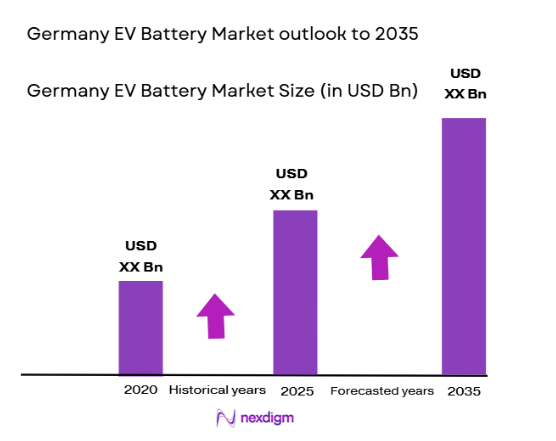
The Germany EV battery market is expected to reach a market size of approximately USD ~ billion by the end of the year, driven by factors such as increasing government incentives, growing adoption of electric vehicles (EVs), and the rapid expansion of charging infrastructure. The German government’s support for EV adoption through subsidies, grants, and tax incentives has played a critical role in accelerating market growth. Technological advancements, particularly in lithium-ion batteries, and an expanding EV infrastructure further propel demand. Additionally, the rising focus on sustainable energy sources and the automotive industry’s commitment to reducing carbon emissions are contributing factors.
Germany’s EV battery market is dominated by major cities such as Berlin, Munich, and Stuttgart, where infrastructure development and a high density of automotive manufacturers are present. These cities benefit from strong governmental support and private-sector investment in EV-related technologies. The country’s automobile industry, which includes global players like Volkswagen, BMW, and Mercedes-Benz, plays a crucial role in market growth. Germany’s commitment to carbon-neutral policies and sustainable manufacturing also reinforces its position as a leader in EV battery adoption.
Market Segmentation
By Product Type:
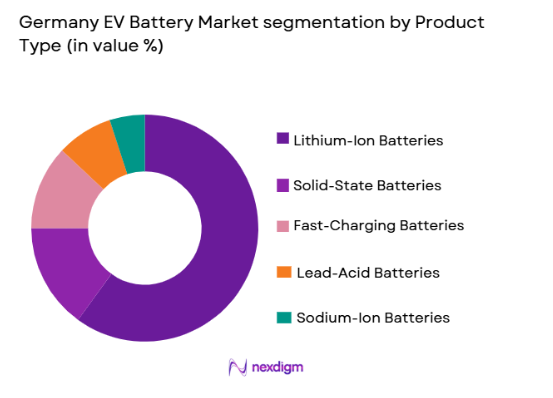
Germany EV battery market is segmented by product type into lithium-ion batteries, solid-state batteries, fast-charging batteries, lead-acid batteries, and sodium-ion batteries. Recently, lithium-ion batteries have a dominant market share due to advancements in energy density, improved cost-effectiveness, and widespread adoption across electric vehicles. Their ability to deliver higher performance and longer ranges compared to other battery types has made them the preferred choice for both consumers and manufacturers. Furthermore, the strong infrastructure for lithium-ion batteries, combined with ongoing technological innovations, ensures continued growth in their adoption across the country.
By Platform Type:
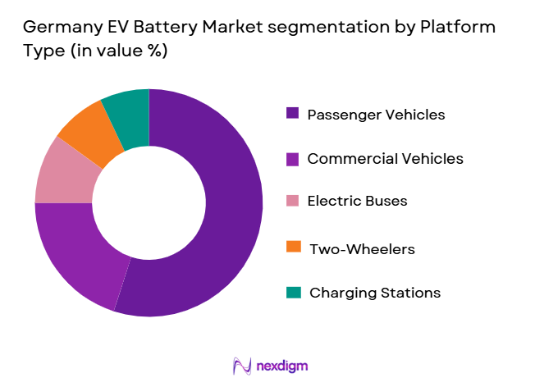
Germany EV battery market is segmented by platform type into passenger vehicles, commercial vehicles, electric buses, two-wheelers, and charging stations. The passenger vehicle segment dominates the market share, driven by strong consumer demand for electric cars supported by incentives and technological advancements in battery life and vehicle range. These vehicles cater to the growing eco-conscious consumer base in Germany, particularly in urban areas, where air quality concerns are high and charging infrastructure is robust. Additionally, government regulations and a large number of automobile manufacturers pushing for electric vehicle production ensure this segment’s continued dominance.
Competitive Landscape
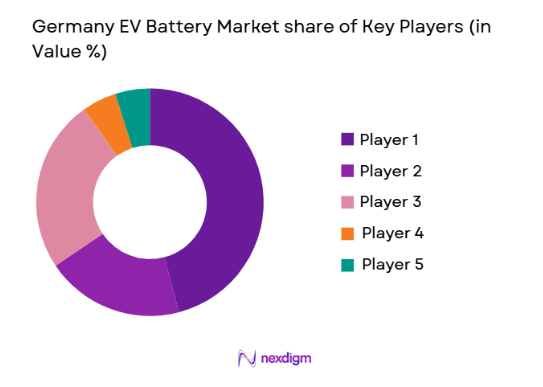
The competitive landscape of Germany’s EV battery market is characterized by the presence of both established automotive giants and innovative battery manufacturers. The market has seen increasing consolidation due to the growing demand for advanced EV battery technologies, with companies seeking strategic partnerships and acquisitions to strengthen their market position. Major players are focusing on enhancing battery efficiency, cost reductions, and infrastructure development to meet the rapidly increasing demand for electric vehicles. The competition is expected to intensify with the ongoing shift toward sustainable and green technologies.
| Company Name | Establishment Year | Headquarters | Technology Focus | Market Reach | Key Products | Revenue (USD Billion) | Additional Market Parameter |
| Volkswagen Group | 1937 | Wolfsburg, DE | ~ | ~ | ~ | ~ | ~ |
| BMW AG | 1916 | Munich, DE | ~ | ~ | ~ | ~ | ~ |
| Daimler AG | 1926 | Stuttgart, DE | ~ | ~ | ~ | ~ | ~ |
| Northvolt AB | 2016 | Stockholm, SE | ~ | ~ | ~ | ~ | ~ |
| CATL | 2011 | Ningde, CN | ~ | ~ | ~ | ~ | ~ |
Germany EV Battery Market Analysis
Growth Drivers
Government Incentives for Electric Vehicle Adoption:
Government incentives for electric vehicle adoption have been a significant driver of Germany’s EV battery market growth. Various subsidies, grants, and tax benefits offered by the government encourage both consumers and businesses to make the switch to electric vehicles. These incentives help offset the higher upfront costs associated with EVs, making them more accessible to the general public. Furthermore, the German government’s strategic push to achieve carbon neutrality by 2050 has created a favorable environment for the development and adoption of EV technologies. The country’s long-term commitment to reducing greenhouse gas emissions aligns with global efforts to transition to cleaner and more sustainable transportation, thereby further propelling the demand for electric vehicles and, consequently, EV batteries. Moreover, these initiatives are not only limited to private consumers but also target commercial fleets, ensuring broad-based demand across various sectors. This regulatory and financial support is expected to continue boosting market growth for years to come.
Technological Advancements in Battery Technology:
Technological advancements in battery technology, particularly lithium-ion batteries, have significantly contributed to the growth of the Germany EV battery market. These advancements have led to improvements in energy density, charging speed, and battery lifespan, making electric vehicles more attractive to consumers. Additionally, ongoing research and development in areas such as solid-state batteries and fast-charging solutions hold the potential to revolutionize the industry. German manufacturers, including both traditional automakers and specialized battery producers, are heavily investing in R&D to stay ahead of the curve and meet the growing demand for higher-performing batteries. These innovations help address key challenges such as long charging times and limited driving range, which have been major barriers to EV adoption. As these technological improvements continue, the overall cost of EVs is expected to decrease, making them more affordable and accessible to a wider audience.
Market Challenges
High Production Costs of EV Batteries:
The high production costs of EV batteries remain a significant challenge for Germany’s EV battery market. The materials required for battery production, such as lithium, cobalt, and nickel, are costly and subject to volatile price fluctuations, which adds to the overall cost of manufacturing electric vehicles. As a result, despite the growing demand for EVs, the cost of EV batteries still constitutes a major barrier to wider adoption, particularly for consumers seeking affordable options. Manufacturers are under pressure to find ways to reduce production costs without compromising battery performance. Furthermore, the reliance on a limited number of suppliers for raw materials creates supply chain vulnerabilities that could further increase costs. To address this, companies are exploring new battery chemistries, including alternatives to traditional lithium-ion batteries, and focusing on recycling strategies to reduce dependence on raw material extraction. However, the high costs remain a key challenge to achieving widespread EV adoption.
Lack of Charging Infrastructure:
One of the significant challenges hindering the growth of Germany’s EV battery market is the insufficient charging infrastructure. While the country has made progress in expanding its network of public and private charging stations, the overall availability and accessibility of these stations remain limited in certain regions. This is especially true in rural areas where the number of charging points is relatively low compared to urban centers. The lack of widespread charging infrastructure deters potential EV buyers, as range anxiety—concern about running out of battery before finding a charging station—is still a prominent issue. Even in major cities, the demand for charging points often exceeds supply, leading to longer wait times and lower convenience for users. Without significant investment in charging infrastructure, the adoption of electric vehicles, and thus the demand for EV batteries, will face considerable barriers.
Opportunities
Expansion of EV Battery Recycling:
One significant opportunity in Germany’s EV battery market is the expansion of battery recycling initiatives. Recycling helps reduce the dependence on raw materials and lowers the environmental impact of battery production. As the number of electric vehicles on the road increases, the need for efficient and large-scale battery recycling becomes even more critical. Germany’s well-established recycling infrastructure and strong environmental regulations make it an ideal location for the growth of battery recycling programs. Manufacturers and recycling companies are investing in technologies to increase the efficiency of battery collection, dismantling, and repurposing, which will play a key role in securing a sustainable supply of materials for future EV battery production. By capitalizing on this opportunity, Germany can reduce costs associated with raw material extraction, lower the carbon footprint of battery production, and promote circular economy principles. Furthermore, expanding battery recycling can lead to the creation of new jobs and industries focused on sustainable waste management solutions.
Growth in Autonomous Electric Vehicles:
Another opportunity for Germany’s EV battery market lies in the growth of autonomous electric vehicles (AEVs). These vehicles, which combine electric propulsion with autonomous driving technology, are gaining traction worldwide, particularly in Germany, a global hub for automotive innovation. AEVs are expected to be more energy-efficient than traditional vehicles, further increasing the demand for advanced EV batteries. Germany’s leadership in autonomous driving research and development, supported by major automakers and technology firms, positions the country to be at the forefront of this emerging market. The integration of AI, machine learning, and improved battery technologies will be critical to the development of AEVs, driving demand for higher-capacity and more efficient batteries. This growth trajectory offers an exciting opportunity for battery manufacturers to innovate and supply the next generation of electric vehicles, thus contributing to the country’s transition to sustainable mobility solutions.
Future Outlook
The future outlook for Germany’s EV battery market over the next five years is positive, with expected growth driven by technological advancements, government policies, and rising consumer demand for electric vehicles. The ongoing development of solid-state batteries and improvements in lithium-ion battery technologies are expected to enhance performance and reduce costs, making EVs more affordable. Additionally, the expansion of charging infrastructure and recycling initiatives will further support market growth. Stringent environmental regulations and incentives for EV adoption will continue to drive demand across multiple sectors, positioning Germany as a leader in the transition to sustainable mobility.
Major Players
- Volkswagen Group
- BMW AG
- Daimler AG
- Northvolt AB
- CATL
- Tesla, Inc.
- LG Energy Solution
- Panasonic Corporation
- Hyundai Motor Group
- SK Innovation
- BYD Company Ltd
- Ford Motor Company
- General Motors
- Stellantis
- Rivian Automotive
Key Target Audience
- Automobile Manufacturers
- Battery Manufacturers
- Electric Vehicle Fleet Operators
- Renewable Energy Providers
- Government and Regulatory Bodies
- Transportation and Logistics Companies
- Investors and Venture Capitalists
- Supply Chain and Raw Material Providers
Research Methodology
Step 1: Identification of Key Variables
This step involves identifying the key drivers, challenges, and trends in the Germany EV battery market, followed by a detailed review of market reports, statistics, and expert insights.
Step 2: Market Analysis and Construction
Data collected from various secondary sources and industry publications are analyzed to understand the market’s size, segmentation, and competitive structure.
Step 3: Hypothesis Validation and Expert Consultation
Experts in the automotive and energy sectors are consulted to validate assumptions, ensuring accurate market forecasting and trend identification.
Step 4: Research Synthesis and Final Output
The gathered data, validated hypotheses, and expert insights are synthesized to produce a comprehensive report on the Germany EV battery market, including actionable recommendations for stakeholders.

- Executive Summary
- Research Methodology (Definitions, Scope, Industry Assumptions, Market Sizing Approach, Primary & Secondary Research Framework, Data Collection & Verification Protocol, Analytic Models & Forecast Methodology, Limitations & Research Validity Checks)

- Market Definition and Scope
- Value Chain & Stakeholder Ecosystem
- Regulatory / Certification Landscape
- Sector Dynamics Affecting Demand
- Strategic Initiatives & Infrastructure Growth

- Growth Drivers
Government Incentives for EV Adoption
Technological Advancements in Battery Efficiency
Increase in Electric Vehicle Adoption
Growing Demand for Sustainable Energy Solutions
Advancements in Battery Recycling Technologies - Market Challenges
High Initial Cost of EV Batteries
Lack of Charging Infrastructure
Battery Lifecycle and Efficiency Concerns
Regulatory Barriers and Standards
Supply Chain Disruptions for Raw Materials - Market Opportunities
Development of Solid-State Batteries
Expansion of EV Battery Recycling Programs
Collaboration with Renewable Energy Providers - Trends
Increase in Battery Energy Density
Integration of Fast-Charging Technology
Growth in Battery Leasing Models
Government Policies Supporting EV Battery Production
Focus on Sustainable and Eco-Friendly Batteries - Government Regulations & Defense Policy
Battery Recycling Regulations
Government Funding for EV Battery Research
EV Battery Certification Standards - SWOT Analysis
- Stakeholder and Ecosystem Analysis
- Porter’s Five Forces Analysis
- Competition Intensity and Ecosystem Mapping

- By Market Value, 2020-2025
- By Installed Units, 2020-2025
- By Average System Price, 2020-2025
- By System Complexity Tier, 2020-2025

- By System Type (In Value%)
Battery Electric Vehicle (BEV) Batteries
Plug-in Hybrid Electric Vehicle (PHEV) Batteries
Fast-Charging Batteries
Lithium-Ion Batteries
Solid-State Batteries - By Platform Type (In Value%)
Passenger Electric Vehicles
Commercial Electric Vehicles
Heavy-Duty Electric Vehicles
Electric Two-Wheelers
Electric Buses - By Fitment Type (In Value%)
On-Premise Charging Solutions
Public Charging Stations
Fast Charging Solutions
Home Charging Solutions
Portable Charging Systems - By EndUser Segment (In Value%)
Automobile Manufacturers
Battery Manufacturers
End Consumers
Government and Public Sector
Fleet Operators - By Procurement Channel (In Value%)
Direct Procurement
Private Sector Procurement
Government Tenders
Online Bidding Platforms
Third-party Distributors - By Material / Technology (In Value%)
Lithium-Ion Technology
Graphene Batteries
Solid-State Battery Technology
Cobalt-Free Batteries
Battery Recycling Technologies

- Market structure and competitive positioning
- Market share snapshot of major players
- CrossComparison Parameters (System Type, Platform Type, Procurement Channel, EndUser Segment, Fitment Type, Material/Technology, Market Share, Competitive Positioning, Innovation Index, Price Sensitivity)
- SWOT Analysis of Key Players
- Pricing & Procurement Analysis
- Key Players
Volkswagen Group
BMW AG
Mercedes-Benz AG
Audi AG
Tesla, Inc.
Northvolt AB
CATL
LG Energy Solution
SK Innovation
Panasonic Corporation
Samsung SDI
BASF SE
Exide Technologies
Envision AESC
SAFT Groupe

- Automobile Manufacturers Increasing EV Production
- Government Initiatives Promoting EV Adoption
- Battery Manufacturers Focused on Technology Advancements
- Fleet Operators Transitioning to Electric Fleets

- Forecast Market Value, 2026-2035
- Forecast Installed Units, 2026-2035
- Price Forecast by System Tier, 2026-2035
- Future Demand by Platform, 2026-2035


 Request a Sample
 Ask for Customization
 Get a Quote
 Enquire Now