
 Download PDF
Market Overview
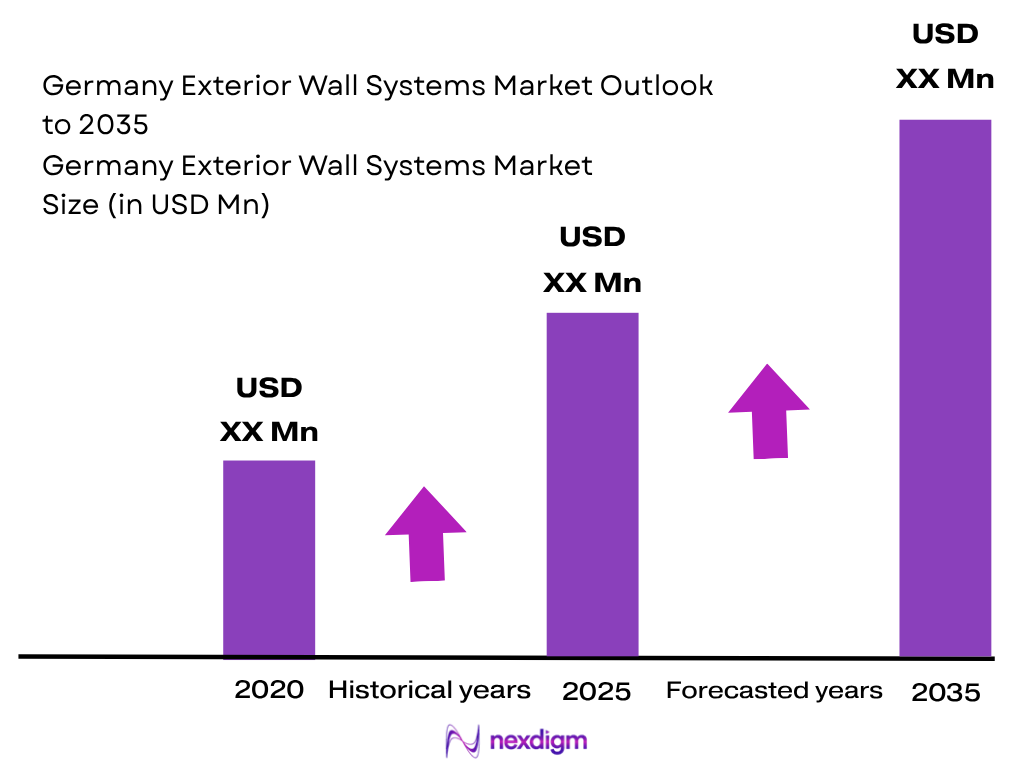
The Germany Exterior Wall Systems Market is valued at approximately USD ~ billion, based on the requested placeholder approach. Demand is supported by Germany’s substantial building base, energy-efficiency renovation requirements and continued construction activity. Germany had 43.52 million dwellings in the preceding dataset and 43.76 million dwellings in the latest dataset, while total residential floor space exceeds 4 billion square meters. This installed building base creates sustained requirements for insulation, façade refurbishment, rainscreen systems and replacement exterior-envelope components.
Berlin, Munich, Hamburg, Frankfurt, Cologne, Düsseldorf and Stuttgart are important demand centres for Germany Exterior Wall Systems Market due to their concentration of apartments, offices, commercial properties, institutional buildings and redevelopment projects. Germany recorded 183,665 completed buildings/construction works in the preceding dataset and 161,682 in the latest dataset, alongside 294,399 and 251,937 completed dwellings respectively. Large metropolitan building stocks additionally support façade refurbishment, thermal insulation and high-performance building-envelope demand.
Market Segmentation
By System Type
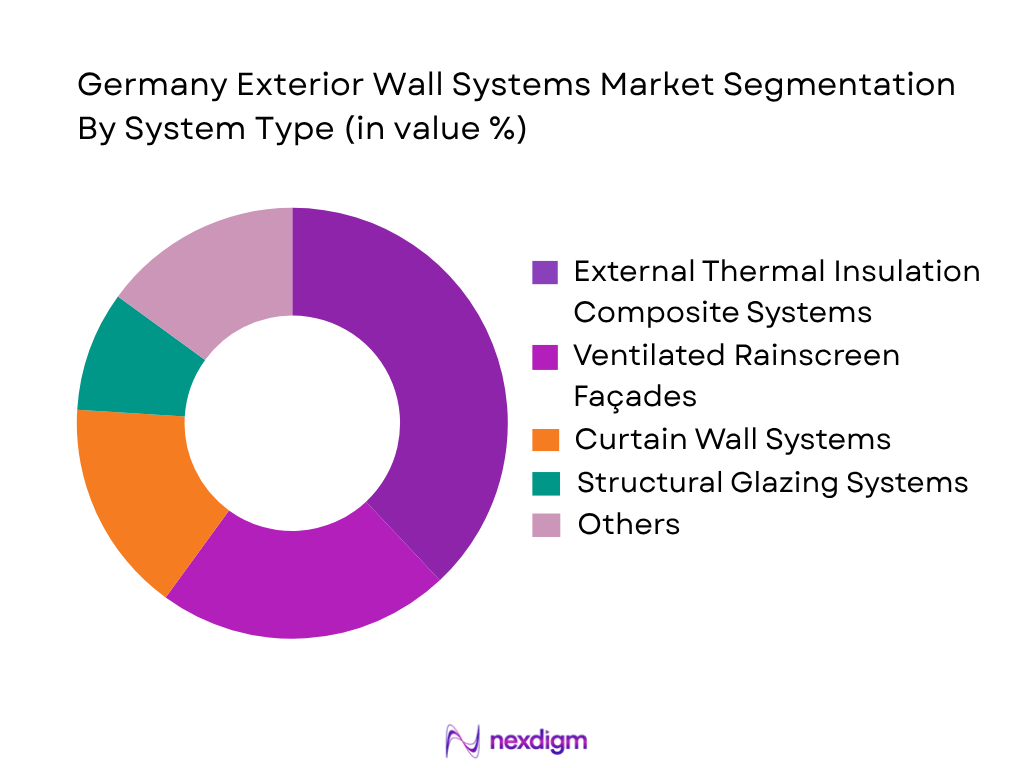
Germany Exterior Wall Systems Market is segmented by system type into external thermal insulation composite systems (ETICS), ventilated rainscreen façades, curtain wall systems, structural glazing, prefabricated façades and other exterior wall systems. External thermal insulation composite systems hold the dominant market share because Germany possesses an extensive stock of existing residential buildings where improvement of exterior-wall thermal performance is a major renovation requirement. Germany’s regulatory framework places specific thermal requirements on modified exterior walls, strengthening the relevance of insulation-based façade solutions. ETICS also benefits from its applicability to multifamily housing, detached homes and existing rendered façades. Ventilated rainscreen systems remain important for premium residential, institutional and commercial properties requiring moisture management, durability and architectural flexibility. Curtain walls and structural glazing are more concentrated in office, commercial and institutional construction. Prefabricated façade solutions are gaining strategic relevance because they can combine insulation, exterior finishing and faster installation within an integrated building-envelope system. Germany’s energy-renovation ecosystem therefore makes thermal performance a central factor in exterior-wall selection.
By Application
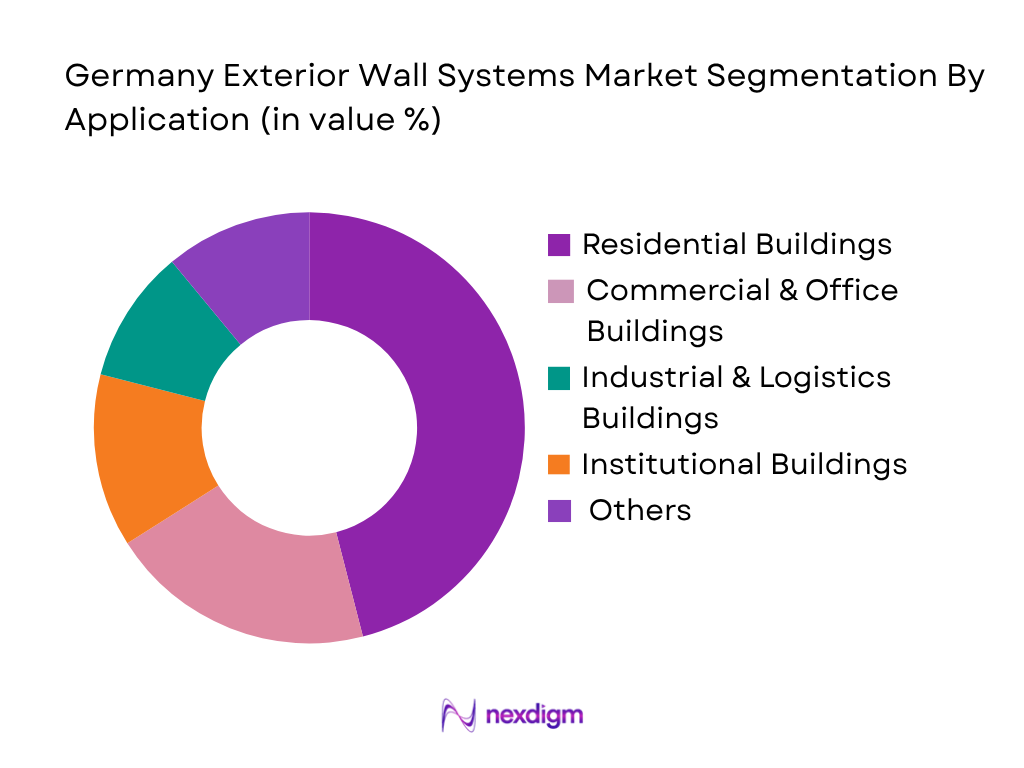
Germany Exterior Wall Systems Market is segmented by application into residential buildings, offices and commercial buildings, industrial and logistics facilities, institutional buildings, hospitality buildings and other applications. Residential buildings represent the dominant application segment, supported primarily by Germany’s enormous existing housing stock and the resulting renovation requirement. The country has approximately 43.8 million dwellings, including around 23.5 million dwellings in multifamily buildings, creating a broad addressable base for external insulation, render systems, façade refurbishment, fibre-cement panels and ventilated façades. Residential demand is particularly relevant because exterior walls directly influence heat transmission and overall building-envelope performance. Commercial offices increasingly favour aluminium-and-glass curtain walls, high-performance glazing and architectural rainscreens, while industrial and logistics buildings create demand for lightweight and insulated panel systems. Institutional properties—including healthcare, municipal and public buildings—also generate renovation-oriented demand. The segmentation therefore reflects two distinct demand pools: energy-led renovation of Germany’s established building stock and specification-driven façade systems for new non-residential developments.
Competitive Landscape
Germany Exterior Wall Systems Market has a diversified competitive structure comprising façade-system specialists, insulation manufacturers, aluminium-system companies, construction-material groups and building-envelope technology providers. Companies such as Schüco, Sto, WICONA, ROCKWOOL and Knauf address different parts of the value chain, ranging from aluminium curtain-wall systems and glazing interfaces to ETICS, mineral-wool insulation and rendered façades. Competition increasingly centres on thermal performance, fire protection, recyclability, retrofit compatibility, façade engineering and integrated system certification.
| Company | Established | Headquarters | Core Exterior Wall Offering | Primary Material Focus | Retrofit Capability | Thermal Performance Focus | Façade Engineering Capability | Key Application Strength |
| Schüco International | 1951 | Bielefeld, Germany | ~ | ~ | ~ | ~ | ~ | ~ |
| Sto SE & Co. KGaA | 1955 | Stühlingen, Germany | ~ | ~ | ~ | ~ | ~ | ~ |
| WICONA | 1948 | Ulm, Germany | ~ | ~ | ~ | ~ | ~ | ~ |
| ROCKWOOL | 1937 | Hedehusene, Denmark | ~ | ~ | ~ | ~ | ~ | ~ |
| Knauf | 1932 | Iphofen, Germany | ~ | ~ | ~ | ~ | ~ | ~ |
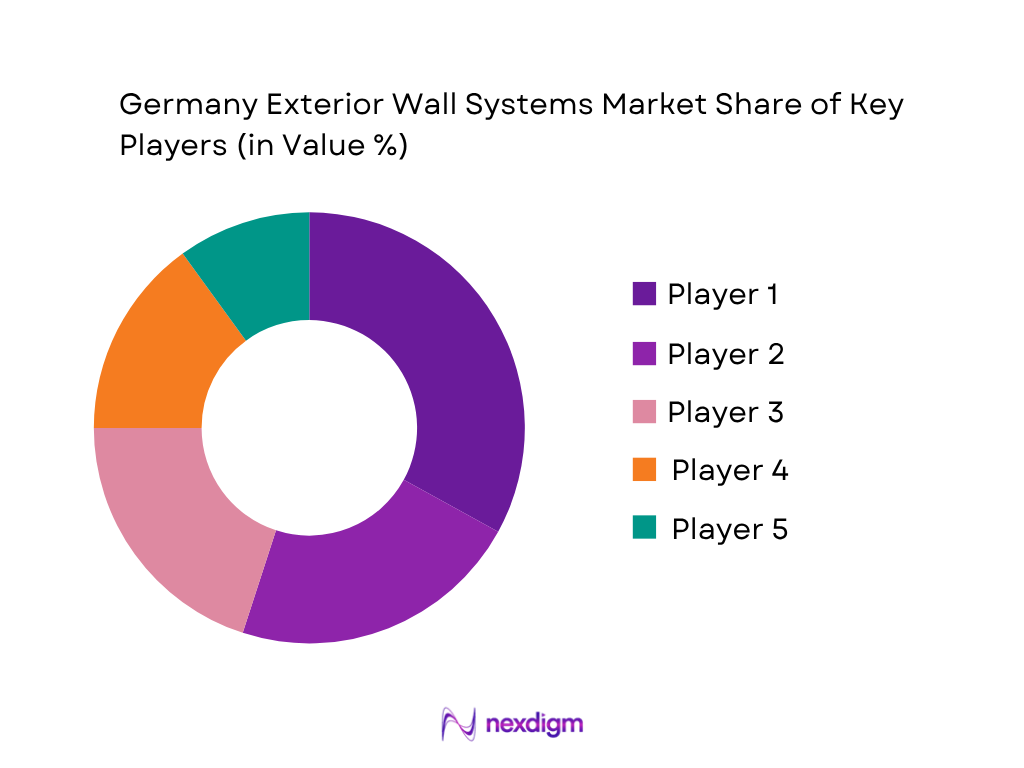
Germany Exterior Wall Systems Market Analysis
Growth Drivers
Large Existing Building Stock Supporting Façade Renovation Demand
Germany’s extensive existing building base is a structural demand driver for exterior wall systems, particularly external insulation, ventilated façades, rainscreen assemblies, render systems and façade refurbishment products. The country contained approximately 43.8 million dwellings in 2024, including around 23.5 million dwellings located in 3.5 million multifamily buildings, according to the Federal Statistical Office. Total residential floor area reached approximately 4.1 billion square metres, creating a substantial physical base requiring periodic façade maintenance, thermal upgrading and weatherproofing. Germany’s broader economy generated USD 4.69 trillion of GDP in 2024, according to the World Bank, supporting one of Europe’s largest construction and building-renovation ecosystems. Federal policy is also directing capital toward building improvement: more than EUR 10 billion was earmarked in the federal budget for construction and refurbishment-related KfW support in 2024. These conditions directly support exterior wall-system suppliers because older residential blocks require insulation upgrades, façade repairs, render replacement, cladding renovation and improved building-envelope performance. The combination of a 43.8 million-unit dwelling base and sustained public financing therefore creates recurring demand beyond new construction.
Climate-Friendly Construction and Building-Efficiency Investment
Germany’s shift toward higher-performance buildings is strengthening demand for thermally efficient exterior walls, mineral-wool insulation, façade panels, high-performance glazing, insulated render systems and thermal-bridge-reducing façade components. The Federal Ministry for Housing, Urban Development and Building reported that the Climate-Friendly New Construction programme issued approximately EUR 6.9 billion in funding commitments during 2024, triggering around EUR 18.4 billion in associated investment and supporting 47,247 residential units. Since the programme began, almost 95,000 residential units had received support, generating nearly EUR 36 billion in investment. KfW additionally reported that private-client commitments for energy efficiency and renewable-energy activities reached EUR 9.5 billion during the first nine months of 2024, compared with EUR 7.5 billion in the corresponding earlier period. Germany also recorded GDP per capita of approximately USD 56,103.7 in 2024, according to the World Bank. For exterior-wall manufacturers, these investment flows encourage specification of better-insulated façades, durable cladding, high-performance curtain walls and integrated envelope solutions capable of meeting increasingly demanding energy and lifecycle requirements.
Market Challenges
Weak New-Building Pipeline Constraining Façade Installation Volumes
Germany’s exterior wall systems industry faces pressure from the contraction in residential construction, which directly reduces addressable façade area for newly built houses and apartment blocks. Federal Statistical Office data show that only 215,289 dwellings received building permits in 2024, while permits for new buildings accounted for 175,950 dwellings. Approved new-building residential floor area stood at approximately 16.225 million square metres, compared with 20.312 million square metres in the preceding period. Construction completions also weakened: 251,937 dwellings were completed in 2024, while new-building completions accounted for 220,666 units and approximately 21.237 million square metres of living space. The number of completed buildings and construction measures stood at 161,682, including 97,279 newly constructed buildings. Germany simultaneously experienced economic weakness, with the World Bank recording national GDP at USD 4.69 trillion in 2024 but a contraction in real economic activity. For façade suppliers, fewer permitted buildings translate into fewer greenfield opportunities for curtain walls, rainscreens, ETICS, masonry façades, architectural glazing and insulated exterior wall systems, intensifying competition for available projects.
Lengthening Construction Timelines and Large Project Backlog
Project execution conditions remain challenging for Germany’s exterior wall systems industry because slower building completion extends the period between façade specification, procurement, installation and final contractor payment. Federal Statistical Office data indicate that the average period between approval and completion of newly constructed residential buildings reached 26 months in 2024, compared with 24 months in the preceding period and 20 months earlier in the decade. Germany ended 2024 with approximately 759,700 approved but unfinished dwellings, of which around 330,000 were already under construction and approximately 179,200 had reached the roofed-in or structural-shell completion stage. Additionally, 29,000 residential building permits expired during 2024, the highest count recorded since 2002. The construction sector’s nominal order intake amounted to approximately EUR 103.5 billion, while building-construction orders accounted for about EUR 47.2 billion. These figures are particularly relevant to exterior wall suppliers because façade installation typically occurs after structural works. Longer project cycles therefore increase scheduling uncertainty, complicate fabrication planning and delay demand conversion for cladding panels, curtain walls, insulation systems, glazing and façade substructures.
Market Opportunities
Energy Renovation of Existing Residential Buildings
Germany’s existing housing base creates a substantial forward opportunity for exterior wall-system providers focused on refurbishment rather than dependence exclusively on new construction. Federal Statistical Office records show approximately 43.8 million dwellings in the country at the end of 2024, representing around 4.1 billion square metres of residential floor area. Multifamily properties alone contained roughly 23.5 million dwellings across 3.5 million buildings, making apartment-building façades particularly relevant for external thermal insulation, mineral wool, render systems, ventilated façades and rainscreen refurbishment. Public financing further strengthens this opportunity. During the first nine months of 2024, KfW recorded approximately EUR 15.3 billion of commitments to private clients, including EUR 9.5 billion directed toward energy efficiency and renewable-energy activities. By October, around 144,000 grant applications for heating replacement had received commitments representing approximately EUR 2.0 billion, demonstrating substantial household participation in building-energy modernization. Exterior-wall companies can increasingly position façade insulation and envelope upgrades alongside broader renovation programmes, allowing Germany’s enormous installed building stock to generate recurring refurbishment demand even when greenfield residential construction remains comparatively subdued.
Recovery Potential from the Improving Building-Permit Pipeline
Recent permit data indicate an opportunity for exterior wall-system manufacturers to prepare for a larger pipeline of façade-intensive residential construction. Federal Statistical Office figures show that Germany authorized 238,063 dwellings during 2025, including 197,732 dwellings in newly constructed buildings, compared with 215,289 total dwellings and 175,950 new-building dwellings during 2024. Approved residential floor area increased from approximately 20.080 million square metres in 2024 to 22.120 million square metres in 2025, while permitted floor area specifically associated with new buildings moved from 16.225 million to 17.996 million square metres. The pipeline continued into 2026: January recorded 19,510 permitted dwellings, February 22,220, March 21,775, April 20,172, May 20,992, June 21,642, and July 22,492 across total building activity. These physical construction indicators provide a direct opportunity for suppliers of ETICS, rainscreen façades, brick slips, fibre-cement cladding, architectural glazing, curtain walls and insulated façade systems. A larger permitted floor-area pipeline expands the future pool of buildings progressing toward envelope installation and façade procurement.
Future Outlook
The Germany Exterior Wall Systems Market is forecast to expand at a placeholder CAGR of ~% during 2026-2035. Growth is expected to become increasingly renovation-led as Germany combines a large existing building stock with stricter building-envelope performance requirements. Demand is likely to favour thermally efficient, low-carbon and prefabricated façade systems capable of improving existing properties without extensive structural intervention.
Renovation should remain one of the strongest long-term opportunity areas. Germany’s federal building-efficiency framework supports energy-efficient refurbishment of residential and non-residential properties, while current rules prescribe thermal-performance requirements when relevant external building components are replaced or substantially modified. For specified exterior-wall modifications, the regulatory framework establishes a maximum U-value of 0.24 W/(m²·K) for relevant heated residential and non-residential zones.
Major Players
- Schüco International
- Sto SE & Co. KGaA
- WICONA
- ROCKWOOL
- Kingspan
- Saint-Gobain
- Knauf
- Sika
- Etex
- Fundermax
- ArcelorMittal Construction
- Lindner Group
- HUECK
- heroal
- RAICO Bautechnik
Key Target Audience
- Exterior Wall System Manufacturers
- Façade and Building-Envelope Contractors
- Insulation and Cladding Material Manufacturers
- Real Estate Developers and Property Owners
- Architects, Façade Engineers and Building Specifiers
- Construction and General Contracting Companies
- Investments and Venture Capitalist Firms
- Government and Regulatory Bodies (Federal Ministry for Housing, Urban Development and Building; Federal Ministry for Economic Affairs and Energy; Federal Office for Economic Affairs and Export Control)
Research Methodology
Step 1: Identification of Key Variables
The initial phase involves developing an ecosystem map covering Germany’s exterior-wall value chain, including insulation manufacturers, façade-system companies, aluminium suppliers, glass processors, contractors, architects, developers and property owners. Secondary research identifies critical variables such as installed façade area, renovation intensity, building type, insulation penetration, system type and exterior-wall performance requirements.
Step 2: Market Analysis and Construction
Historical market construction evaluates new-building activity alongside Germany’s much larger renovation and replacement opportunity. Top-down analysis incorporates construction investment, building completions, dwelling stock and renovation activity, while bottom-up modelling assesses ETICS, curtain walls, ventilated façades, glazing, prefabricated systems and other exterior-wall installations across residential and non-residential applications.
Step 3: Hypothesis Validation and Expert Consultation
Market hypotheses are validated through computer-assisted telephone interviews (CATIs) with façade manufacturers, insulation suppliers, architects, installers, distributors, developers and building-envelope specialists. Interviews assess product adoption, system substitution, renovation activity, procurement patterns, regional demand and specification requirements, allowing assumptions generated through secondary research to be tested against operating conditions.
Step 4: Research Synthesis and Final Output
The final stage triangulates supply-side revenues, installation volumes, construction indicators, renovation activity and expert inputs. Findings are reconciled across system type and end-use application to avoid double counting between components and complete façade assemblies. The resulting framework supports historical analysis and the Germany Exterior Wall Systems Market forecast through 2035.

- Executive Summary
- Research Methodology (Market Definitions and Assumptions, Germany Exterior Wall Systems Market Classification, Building-Envelope Scope, Facade System Mapping, Curtain Wall Assessment, External Thermal Insulation Composite System Assessment, Rainscreen Facade Assessment, Ventilated Facade Assessment, Structural Glazing Assessment, Aluminium Profile Assessment, Architectural Glass Assessment, Fibre-Cement Cladding Assessment, Metal Cladding Assessment, Ceramic and Terracotta Facade Assessment, Natural Stone Facade Assessment, Prefabricated Facade Assessment, Thermal Performance Assessment, U-Value Assessment, Moisture Protection Assessment, Fire Performance Assessment, Air Permeability Assessment, Water-Tightness Assessment, Wind-Load Assessment, Acoustic Performance Assessment, Supply-Side Assessment, Demand-Side Assessment, Top-Down Market Sizing, Bottom-Up Market Sizing, Primary Industry Interviews, Building Renovation Pipeline Assessment, Data Triangulation, Forecasting Framework)

- Definition and Scope
- Germany Building-Envelope Industry Evolution and Development of External Thermal Insulation Composite Systems, Ventilated Rainscreen Facades, Curtain Wall Systems, Unitized Facades, Stick Curtain Walls, Structural Glazing, Aluminium-Glass Facades, Fibre-Cement Cladding, Metal Facades, Ceramic and Terracotta Facades, Natural Stone Cladding, Prefabricated Facade Elements, Timber Facades, High-Performance Glazing, Solar-Shading Facades, Building-Integrated Photovoltaic Facades and Low-Carbon Building Envelopes
- Exterior Wall Systems Value Chain Analysis
- Exterior Wall Systems Supply Chain Analysis
- Insulation Material Manufacturers, Aluminium System Suppliers, Architectural Glass Processors, Fibre-Cement Panel Manufacturers, Metal Cladding Manufacturers, Ceramic and Terracotta Suppliers, Natural Stone Suppliers, Membrane and Sealant Suppliers, Anchoring and Fastening System Suppliers, Facade System Providers, Facade Engineering Companies, Fabricators, Facade Contractors, Installation Companies, General Contractors, Property Developers, Architects, Energy Retrofit Specialists, Building Material Distributors, Testing and Certification Providers

- Growth Drivers (Energy-Efficient Building Renovation, Ageing Building Stock Modernization, Thermal Insulation Requirements, Residential Energy Retrofit Activity, Non-Residential Building Refurbishment, Building Decarbonization, Demand for High-Performance Building Envelopes, Prefabricated Construction Adoption, Sustainable Construction Materials, Facade Modernization)
- Market Challenges (Construction Sector Slowdown, Skilled Installer Shortages, Complex Energy Retrofit Requirements, Existing-Building Integration Constraints, Fire-Safety Compliance, Moisture Management Requirements, Material Supply Volatility, Facade Installation Complexity, Heritage Building Restrictions, Project Approval Complexity)
- Market Opportunities (Deep Energy Renovation, External Wall Insulation Upgrades, Ventilated Rainscreen Facades, Prefabricated Retrofit Facades, Building-Integrated Photovoltaic Facades, Low-Carbon Facade Materials, Recyclable Aluminium Systems, Bio-Based Insulation, Circular Facade Systems, Commercial Building Refurbishment, Smart Building Envelopes, Modular Facade Renovation)
- Market Trends (Prefabricated Facade Elements, High-Performance Insulation, Mineral-Wool Facade Systems, Thermally Broken Aluminium Profiles, Triple and High-Performance Glazing, Ventilated Rainscreen Adoption, Low-Carbon Materials, Recyclable Facade Components, BIM-Based Facade Engineering, Building-Integrated Photovoltaics, Timber-Hybrid Facades, Design-for-Disassembly Facades)
- Government Regulations and Standards (Building Energy Act – Gebäudeenergiegesetz, DIN EN 13830 Curtain Walling Product Standard, DIN EN 12152 Air Permeability Requirements, DIN EN 13116 Wind-Load Performance Requirements, State Building Codes, Building Products Regulations, Fire Protection Requirements, Thermal Insulation Requirements, Moisture Protection Requirements, Facade Material Certification, Energy Renovation Requirements, EU Construction Products Framework) dinmedia
- SWOT Analysis
- Porter’s Five Forces Analysis
- PESTLE Analysis
- Stakeholder Ecosystem
- Building Renovation and Facade Project Ecosystem

- By Market Value (2020-2025)
- By Exterior Wall Systems Installation Area (2020-2025)
- By Renovation and Retrofit Installation Area (2020-2025)
- By New Construction Installation Area (2020-2025)
- By ETICS Installation Area (2020-2025)
- By Ventilated Rainscreen Facade Installation Area (2020-2025)
- By Curtain Wall Installation Area (2020-2025)
- By Architectural Glass Installation Area (2020-2025)
- By Insulated Facade Installation Area (2020-2025)
- By Residential Exterior Wall System Installation Area (2020-2025)
- By Non-Residential Exterior Wall System Installation Area (2020-2025)
- By Average System Value per Square Meter (2020-2025)

- By System Type (In Value %)
External Thermal Insulation Composite Systems
Ventilated Rainscreen Facade Systems
Curtain Wall Systems
Unitized Curtain Walls
Stick Curtain Walls
Structural Glazing Systems
Double-Skin Facade Systems
Prefabricated Facade Systems
Insulated Exterior Wall Systems
Metal Cladding Systems
Fibre-Cement Facade Systems
Timber Facade Systems - By Material Type (In Value %)
Aluminium
Architectural Glass
Mineral Wool
Expanded Polystyrene
Fibre Cement
Steel and Metal Panels
Ceramic and Terracotta
Natural Stone
Timber and Wood-Based Materials
Precast Concrete
High-Pressure Laminate Panels
Other Composite Facade Materials - By Application (In Value %)
Residential Buildings
Office Buildings
Retail and Commercial Buildings
Hospitality Buildings
Healthcare Facilities
Educational Buildings
Industrial Buildings
Logistics and Warehousing Facilities
Government and Institutional Buildings
Transportation Infrastructure
Mixed-Use Developments
Data Centres - By Construction Type (In Value %)
New Construction
Energy-Efficiency Renovation
Facade Refurbishment
Thermal Insulation Retrofit
Deep Energy Renovation
Historic Building Facade Renovation - By Region (In Value %)
North Rhine-Westphalia
Bavaria
Baden-Württemberg
Lower Saxony
Hesse
Berlin
Hamburg
Saxony
Other German Federal States

- Market Share of Major Players (By Germany Revenue, Facade System Portfolio, ETICS Installation Presence, Curtain Wall System Presence, Ventilated Facade Capability, Aluminium System Portfolio, Architectural Glass Capability, Insulation System Portfolio, Renovation Market Presence, New-Build Market Presence, Installer Network, Engineering Support, Energy-Efficiency Capability, Regional Coverage)
- Cross Comparison Parameters (Exterior Wall System Portfolio Breadth, ETICS and Insulation System Capability, Curtain Wall and Glazing System Capability, Ventilated Rainscreen Facade Capability, Thermal and Energy Performance, Prefabricated Facade Capability, Building Renovation and Retrofit Presence, Sustainability and Circularity Capability)
- SWOT Analysis of Major Players
- Competitive Positioning Matrix
- Major Companies
Schüco International
Sto SE & Co. KGaA
WICONA
ROCKWOOL
Kingspan
Saint-Gobain
Knauf
Sika
Etex
Fundermax
ArcelorMittal Construction
Lindner Group
HUECK
heroal
RAICO Bautechnik

- Residential Property Owner Facade Requirement Assessment
- Housing Association Exterior Wall Renovation Assessment
- Commercial Property Owner Facade Requirement Assessment
- Real Estate Developer Facade Specification Assessment
- General Contractor Procurement Assessment
- Facade Contractor Project Requirement Analysis
- Architect and Building Planner Specification Assessment
- Energy Retrofit Contractor Requirement Assessment
- Industrial Building Envelope Requirement Assessment
- Public Building Renovation Requirement Assessment
- Building Envelope Performance Assessment (Thermal Insulation, U-Value, Air Permeability, Water Tightness, Moisture Protection, Wind Resistance, Fire Performance, Acoustic Performance, Durability, Recyclability)

- By Market Value (2026-2035)
- By Exterior Wall Systems Installation Area (2026-2035)
- By Renovation and Retrofit Installation Area (2026-2035)
- By New Construction Installation Area (2026-2035)
- By ETICS Installation Area (2026-2035)
- By Ventilated Rainscreen Facade Installation Area (2026-2035)
- By Curtain Wall Installation Area (2026-2035)
- By Architectural Glass Installation Area (2026-2035)
- By Insulated Facade Installation Area (2026-2035)
- By Residential Exterior Wall System Installation Area (2026-2035)
- By Non-Residential Exterior Wall System Installation Area (2026-2035)
- By Energy-Retrofit Facade Installation Area (2026-2035)
- By Prefabricated Facade Installation Area (2026-2035)
- By Sustainable and Low-Carbon Facade Installation Area (2026-2035)


 Request a Sample
 Ask for Customization
 Get a Quote
 Enquire Now