

 Download PDF
Market Overview
The Germany Fire Clay Market is supported by refractory demand from steelmaking, glass production, ceramics, foundries, industrial furnaces and residential heating applications. German crude-steel output reached 37.2 million tonnes, compared with 35.4 million tonnes in the preceding year, while glass production reached 6.661 million tonnes. These high-temperature industries require refractory materials capable of resisting thermal shock, abrasion, chemical attack and sustained operating temperatures. Fireclay and chamotte remain relevant where aluminosilicate refractories provide suitable thermal and mechanical performance. Steel Industry Germany
Demand is concentrated around Germany’s established industrial clusters, particularly North Rhine-Westphalia, Bavaria, Hesse, Saxony and other regions containing steel plants, foundries, glass facilities, ceramic manufacturers and refractory production sites. North Rhine-Westphalia is particularly important because the Ruhr industrial region combines steelmaking, metal processing, foundries and industrial furnace applications. Germany’s refractory ecosystem also includes established producers and suppliers in locations such as Großalmerode, Mülheim-Kärlich, Borken and Neunkirchen near Nuremberg. Vesuvius, for example, operates three German production locations and serves steel, foundry and other high-temperature industries.
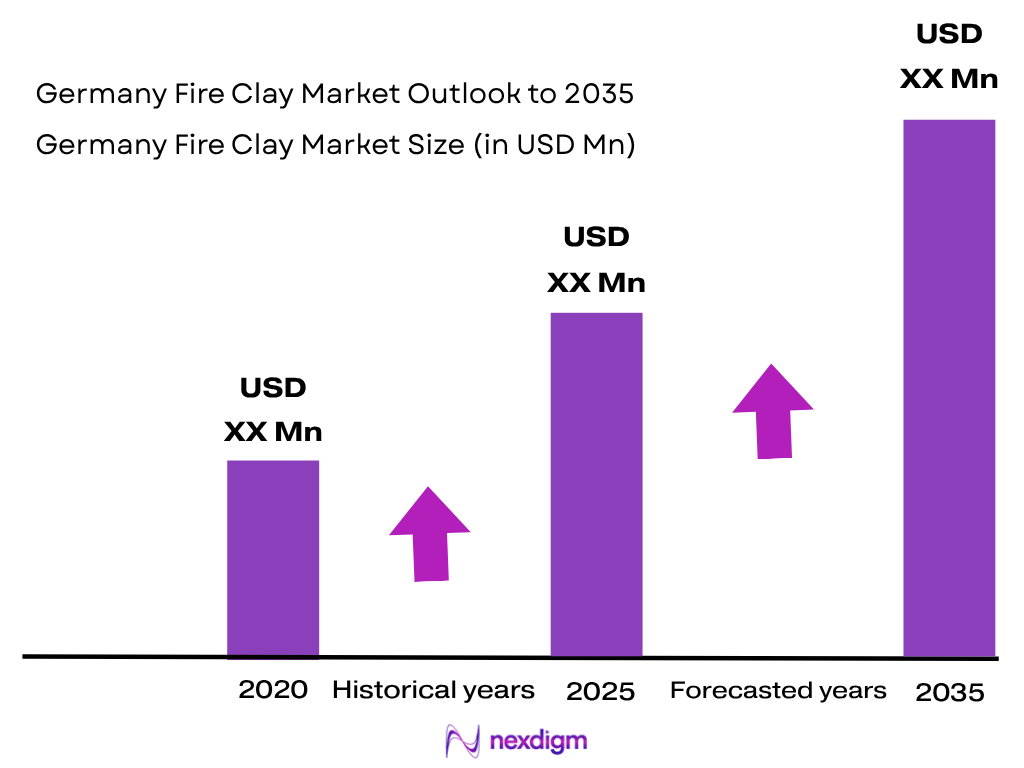
Market Segmentation
By Product Form
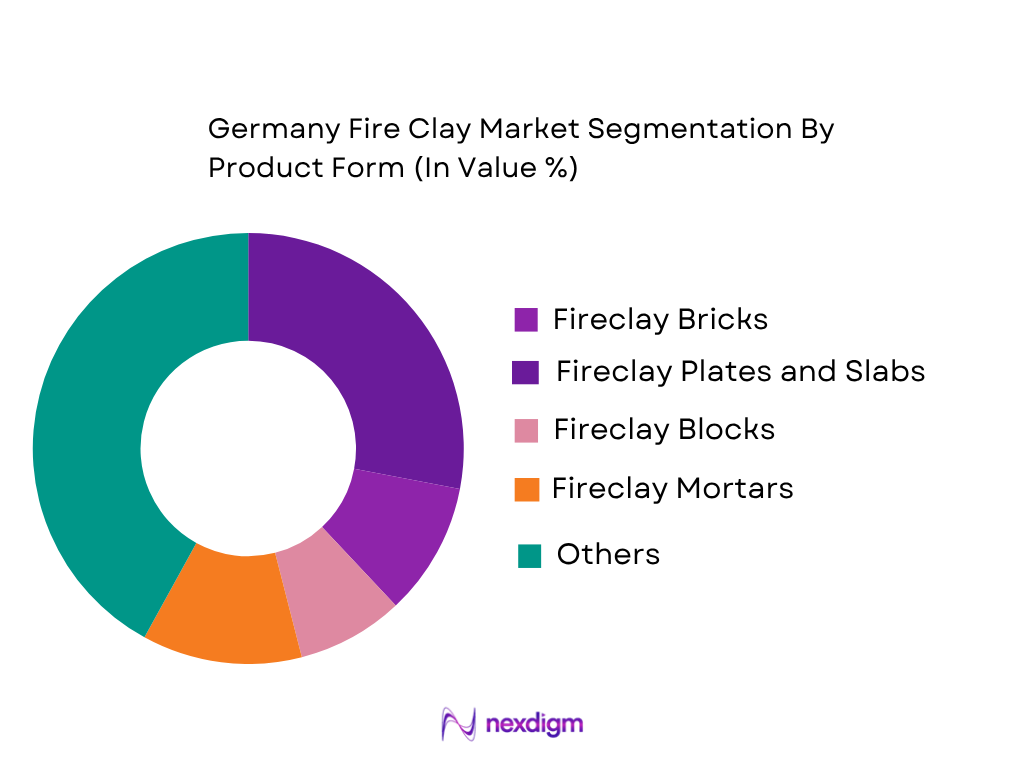
The Germany Fire Clay Market is segmented by product form into fireclay bricks, fireclay plates and slabs, fireclay blocks, fireclay mortars, fireclay castables, monolithic fireclay products, granular fireclay, powdered fireclay, refractory chamotte and custom-shaped fireclay components. Fireclay bricks and shaped products are expected to constitute the leading product category because they are directly applicable to furnace linings, stove construction, fireplaces, kiln walls and other high-temperature structures. German manufacturers maintain specialized capabilities for shaped fireclay products, while suppliers such as Wolfshöher Tonwerke produce fireclay bricks and plates for stove construction and heating applications. The company states that its fireclay production remains based in Germany and uses locally sourced raw materials, including material from its own clay pit. Fireclay mortars and monolithic products complement shaped products by providing joints, repairs, protective layers and customized furnace solutions. Demand across product forms is determined by thermal resistance, density, porosity, mechanical strength, dimensional requirements and the operating temperature of the end-use equipment.
By End-Use Industry
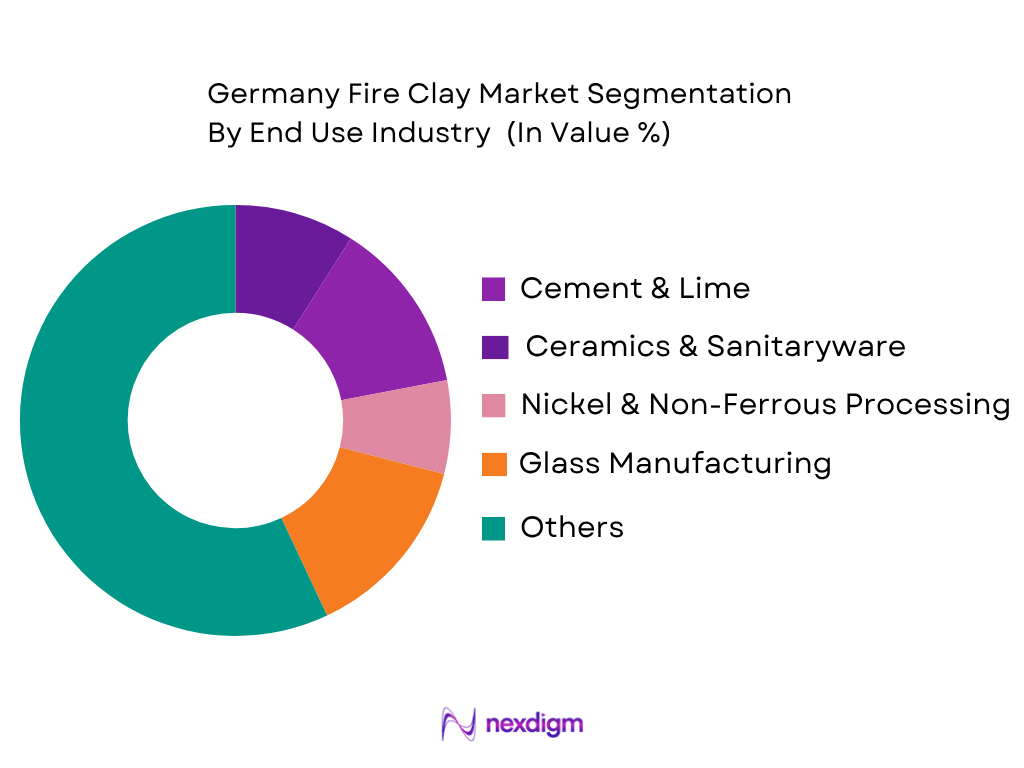
The Germany Fire Clay Market is segmented by end-use industry into iron and steel, cement and lime, glass manufacturing, ceramics, foundry and metal casting, non-ferrous metals, energy and waste treatment, residential heating and stove construction, and chemical and process industries. Iron and steel represents the leading application category because refractory materials are essential throughout steelmaking, casting, heat treatment and associated high-temperature processes. Germany produced 37.2 million tonnes of crude steel, providing a substantial refractory-consumption base. Glass is another significant application, with German producers manufacturing 6.661 million tonnes of glass. Fireclay products are used where thermal insulation, resistance to heat and chemical exposure, and dimensional stability are required. Ceramic kilns, foundries, industrial furnaces and stove construction create additional demand for shaped bricks, plates, mortars and specialty chamotte. Application requirements vary according to furnace temperature, atmosphere, abrasion exposure, molten-material contact and thermal cycling. Consequently, German buyers typically select fireclay grades based on alumina content, silica composition, porosity, bulk density, refractoriness and thermal-shock characteristics.
Competitive Landscape
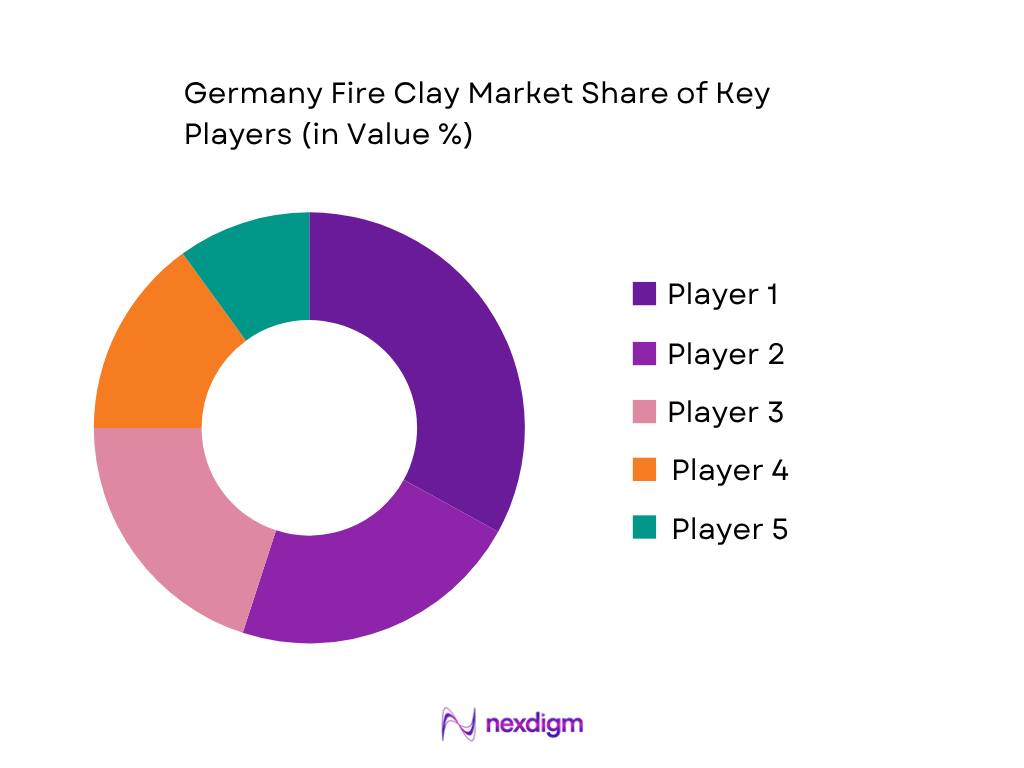
The Germany Fire Clay Market contains both specialized German fireclay manufacturers and diversified international refractory companies. Competition is differentiated by product breadth, raw-material access, shaped-refractory capability, technical formulation, industrial furnace coverage and distribution reach. Specialist producers such as Wolfshöher Tonwerke and Chamottewerke Mering focus strongly on fireclay and chamotte products, while larger refractory groups serve steel, foundry, glass, non-ferrous metals and industrial furnace applications. The German refractory association lists companies including RHI Magnesita Deutschland, Saint-Gobain IndustrieKeramik Rödental, Vesuvius, Steuler-KCH Materials and VGT-DYKO among industry participants.
| Company | Establishment | Headquarters | Fire Clay / Chamotte Portfolio | Shaped Refractories | Industrial Furnace Coverage | Steel Application | Glass & Ceramic Coverage |
| RHI Magnesita Deutschland AG | 1834* | Wiesbaden, Germany | ~ | ~ | ~ | ~ | ~ |
| Vesuvius GmbH | 1916* | Borken, Germany | ~ | ~ | ~ | ~ | ~ |
| Saint-Gobain IndustrieKeramik Rödental GmbH | 1665* | Rödental, Germany | ~ | ~ | ~ | ~ | ~ |
| Wolfshöher Tonwerke GmbH & Co. KG | 1856 | Neunkirchen am Sand, Germany | ~ | ~ | ~ | ~ | ~ |
| Chamottewerke Mering Max Zettler GmbH | 1890s* | Mering, Germany | ~ | ~ | ~ | ~ | ~ |
Germany Fire Clay Market Analysis
Growth Drivers
Industrial Furnace Modernization
Industrial furnace modernization is supporting demand for fire clay and chamotte products because German high-temperature industries require refractory linings that can withstand repeated heating, cooling, abrasion and chemical exposure. Germany produced 37.2 million tonnes of crude steel in 2024, compared with 35.4 million tonnes in 2023, according to Wirtschaftsvereinigung Stahl. Steelmaking, reheating, casting and heat-treatment operations require refractory materials across multiple furnace zones. Germany also produced 6.661 million tonnes of glass in 2024, according to the German Environment Agency, including 3.788 million tonnes of container glass and 1.794 million tonnes of flat glass. These applications require furnace linings capable of maintaining dimensional stability under sustained high temperatures. The modernization requirement is reinforced by Germany’s broader industrial transition toward more energy-efficient equipment. Destatis reported industrial production declined 4.5% in 2024, creating pressure on manufacturers to improve equipment utilization and operating efficiency. Modern furnace designs increasingly emphasize thermal management, longer refractory service intervals and reduced heat losses. Fire clay products, particularly shaped bricks, plates, mortars and chamotte-based materials, can support these requirements in suitable operating environments. The combination of steel, glass and industrial furnace activity therefore creates recurring replacement and modernization demand for specialized fire clay products.
Steel and Foundry Refractory Demand
Germany’s steel and metal-processing ecosystem remains an important demand foundation for fire clay products because refractory materials are required to protect furnaces and other high-temperature equipment from thermal, mechanical and chemical stresses. Wirtschaftsvereinigung Stahl recorded 37.2 million tonnes of German crude-steel production in 2024, up from 35.4 million tonnes in 2023. Electric-arc-furnace production alone reached approximately 10.8 million tonnes, demonstrating continued activity across high-temperature steelmaking routes. Destatis additionally reported that metal production and processing accounted for 23.7% of industrial energy consumption in 2024, equivalent to a substantial industrial operating base requiring heat-intensive processes. Fire clay and chamotte can be used in selected furnace linings, ladle-related components, burner zones, heat-treatment equipment and supporting refractory structures, depending on temperature and chemical conditions. Foundries similarly require refractory materials for melting, holding and casting operations. Germany’s industrial production environment creates recurring requirements because refractory components are consumable materials subject to thermal cycling, erosion and mechanical wear. Demand is therefore connected not only to new furnace installations but also to maintenance, relining and replacement cycles across steelmaking and foundry facilities.
Market Challenges
Energy-Intensive Calcination
Energy consumption during clay calcination, chamotte production, firing and subsequent refractory processing represents a structural challenge for Germany’s fire clay industry. Destatis reported that German industry consumed 3,343 petajoules of energy in 2024, with natural gas accounting for 29.2%, electricity for 21.1%, mineral oils and petroleum products for 16.5%, and coal for 14.5%. Energy-intensive industrial sectors consumed approximately 2,738 petajoules, with metal production and processing alone accounting for 23.7% of total industrial energy consumption. Fire clay processing requires controlled thermal treatment to produce the required mineralogical structure, dimensional stability and refractory performance. Manufacturers must therefore manage furnace loading, firing schedules, thermal-cycle efficiency and equipment utilization while maintaining consistent product quality. Germany’s industrial energy environment adds pressure because refractory producers compete with other energy-intensive manufacturing operations for reliable energy supply. Electricity generation data from Destatis shows Germany fed 431.5 billion kWh into the grid in 2024, while electricity imports reached 81.7 billion kWh, illustrating the broader restructuring of the power system. For fire clay manufacturers, this environment increases the importance of efficient calcination, optimized kiln operation, heat recovery and process control. Energy-intensive production can therefore constrain margins and influence investment decisions regarding additional domestic processing capacity.
Raw Material Quality Variability
Raw-material consistency is a significant challenge for Germany’s fire clay market because refractory performance depends on controlled chemical composition, mineralogy, particle-size distribution and firing behavior. Fire clay used for industrial refractories must meet application-specific requirements concerning alumina content, silica balance, refractoriness, porosity, thermal expansion and resistance to thermal shock. Variability in naturally occurring clay deposits can affect these characteristics and require additional beneficiation, blending or quality-control procedures. The challenge occurs within a German industrial environment where production volumes remain substantial but overall industrial output declined 4.5% in 2024, according to Destatis. Manufacturers therefore face pressure to maintain consistent specifications while controlling process complexity. Germany’s glass industry produced 6.661 million tonnes of glass in 2024, including 292,500 tonnes of specialty glass, demonstrating the presence of demanding high-temperature applications requiring controlled refractory performance. Steel production also reached 37.2 million tonnes, reinforcing the importance of reliable refractory inputs. Fire clay suppliers must consequently maintain stable feedstock characteristics and carefully control calcination and particle sizing. Variability becomes particularly important for customized bricks, plates and furnace components, where deviations in density, porosity or thermal expansion can influence service performance and replacement intervals.
Market Opportunities
Advanced Chamotte Grades
Advanced chamotte grades present an opportunity for German fire clay producers because chamotte enables manufacturers to engineer refractory products around specific thermal, mechanical and dimensional requirements. Germany’s industrial base provides several suitable application environments: crude-steel production reached 37.2 million tonnes in 2024, while glass production reached 6.661 million tonnes, according to Wirtschaftsvereinigung Stahl and the German Environment Agency respectively. These industries operate furnaces and kilns exposed to high temperatures, thermal cycling and mechanical stresses, creating requirements for refractory materials with controlled porosity, thermal expansion and resistance to thermal shock. Advanced chamotte can be formulated with controlled grain sizes and carefully selected calcined clay characteristics to support specialized brick, plate, mortar and castable production. The opportunity also extends to ceramic kilns, foundry furnaces and industrial heat-treatment equipment. Germany’s industrial transition creates additional relevance because Destatis recorded 3,343 petajoules of industrial energy consumption in 2024, making thermal efficiency and refractory service life important operational considerations. Producers can therefore develop application-specific chamotte grades that support longer refractory campaigns, optimized heat retention and more consistent furnace operation. Higher-performance products can also allow suppliers to differentiate from basic fire clay products by targeting technically demanding industrial applications where material specifications are closely controlled.
Sustainable Refractory Materials
Sustainable refractory materials represent an opportunity for Germany’s fire clay market because industrial customers are increasingly focused on material efficiency, resource conservation and reducing the environmental burden associated with furnace operations. Germany generated 503.2 billion kWh of gross electricity in 2024, while 59.4% of electricity fed into the grid originated from renewable sources, according to Destatis. At the same time, industrial energy consumption reached 3,343 petajoules, demonstrating the scale of energy use that manufacturers are seeking to optimize. Refractory recycling can contribute to this objective by recovering usable mineral material from spent bricks, monolithics and other refractory products, reducing the requirement for virgin raw materials in suitable applications. The German Environment Agency notes that recycled glass can reduce energy and raw-material requirements, illustrating the broader industrial relevance of material circularity. For fire clay manufacturers, opportunities include recycled chamotte feedstocks, reclaimed refractory aggregates, longer-life products and formulations designed for easier recovery after service. The steel industry provides a particularly relevant downstream environment, with 37.2 million tonnes of crude steel produced in 2024. Developing recyclable fire clay products and closed-loop refractory supply arrangements can therefore support resource efficiency while creating additional value from materials that would otherwise enter waste streams.
Future Outlook
The Germany Fire Clay Market is expected to remain supported by replacement demand from furnaces, kilns, foundries, glass facilities, steel plants and stove construction. Product development is likely to focus on longer service life, improved thermal-shock resistance, optimized porosity and more application-specific fireclay formulations. Refractory recycling and lower-emission production processes should become increasingly relevant as German industrial users pursue resource efficiency. The market will also benefit from demand for customized shaped components and advanced chamotte grades where conventional refractory materials do not provide the required combination of thermal and mechanical properties.
Major Players
- RHI Magnesita Deutschland AG
- Vesuvius GmbH
- Saint-Gobain IndustrieKeramik Rödental GmbH
- Wolfshöher Tonwerke GmbH & Co. KG
- Chamottewerke Mering Max Zettler GmbH
- Steuler-KCH Materials GmbH
- VGT-DYKO GmbH
- Sievering GmbH & Co. KG
- P-D Refractories GmbH
- Dr. C. Otto Feuerfest GmbH
- Adolf Gottfried Tonwerke GmbH
- Kärlicher Ton- und Schamotte-Werke Mannheim & Co. KG
- Rath GmbH
- Conrad Liphard & Söhne GmbH
- PYRO Worms GmbH
Key Target Audience
- Fireclay and Chamotte Manufacturers
- Refractory Brick and Monolithic Refractory Producers
- Steel Producers and Metallurgical Furnace Operators
- Glass Manufacturers and Glass Furnace Operators
- Ceramic and Kiln Manufacturers
- Foundries and Industrial Furnace Operators
- Investments and Venture Capitalist Firms (Industrial Materials and Advanced Manufacturing Investors)
- Government and Regulatory Bodies (Federal Ministry for Economic Affairs and Energy, Federal Ministry for the Environment, Nature Conservation, Nuclear Safety and Consumer Protection, Federal Environment Agency)
Research Methodology
Step 1: Identification of Key Variables
The initial phase involves constructing a Germany Fire Clay Market ecosystem covering clay extraction, beneficiation, calcination, chamotte production, refractory manufacturing and end-use industries. Key variables include product form, alumina content, thermal resistance, porosity, density, application temperature, consumption volume and customer type.
Step 2: Market Analysis and Construction
Historical market information is compiled using industrial-production statistics, trade data, refractory classifications and end-use indicators. The analysis evaluates fireclay consumption across steel, glass, ceramics, foundries, industrial furnaces and stove construction while separating shaped and unshaped refractory products.
Step 3: Hypothesis Validation and Expert Consultation
Market hypotheses are validated through discussions with refractory manufacturers, furnace operators, distributors and industrial users. Interviews focus on product specifications, procurement practices, replacement cycles, material preferences, application requirements and competitive positioning across German end-use industries.
Step 4: Research Synthesis and Final Output
The final stage triangulates supply-side production information with demand-side application indicators, trade flows and company-level product capabilities. Bottom-up consumption estimates are reconciled with top-down industry indicators to construct the Germany Fire Clay Market database and forecast framework.

- Executive Summary
- Research Methodology (Market Definitions and Assumptions, Fire Clay Classification, Refractory-Grade Material Mapping, Raw Material Assessment, Chamotte Manufacturing Process Mapping, Fire Clay Quality Parameters, Alumina Content Assessment, Refractoriness Evaluation, Apparent Porosity Assessment, Bulk Density Assessment, Thermal Shock Resistance Assessment, Thermal Expansion Assessment, Grain-Size Distribution Analysis, Firing and Calcination Process Assessment, Supply-Side Mapping, Demand-Side Assessment, End-Use Industry Assessment, Import and Export Flow Analysis, Primary Industry Interviews, Data Triangulation, Forecasting Framework, Limitations and Future Conclusions)

- Definition and Scope
- Fire Clay Industry Evolution
- Fire Clay Industry Value Chain Analysis
- Fire Clay Supply Chain Analysis
- Refractory Clay Mining and Extraction

- Growth Drivers (Industrial Furnace Modernization, Steel and Foundry Refractory Demand, Ceramic and Glass Production Requirements, Expansion of High-Temperature Processing, Demand for Thermal-Shock-Resistant Materials, Stove and Fireplace Construction, Industrial Kiln Replacement, Energy-Efficient Furnace Design, Customized Refractory Components, Growing Demand for High-Purity Chamotte)
- Market Challenges (Energy-Intensive Calcination, Natural Gas and Electricity Exposure, Raw Material Quality Variability, Limited Domestic Clay Deposits, Mining and Environmental Restrictions, High-Temperature Processing Requirements, Strict Refractory Quality Standards, Competition from High-Alumina Refractories, Competition from Monolithic Refractories, Industrial Production Volatility)
- Market Opportunities (Advanced Chamotte Grades, High-Purity Fire Clay Products, Customized Shaped Refractories, Energy-Efficient Furnace Linings, Low-Emission Fire Clay Manufacturing, Industrial Kiln Modernization, Glass Furnace Applications, Foundry Furnace Applications, Sustainable Refractory Materials, Recycled Refractory Raw Materials)
- Market Trends (Increasing Refractory Material Efficiency, Customized Fire Clay Components, Higher Thermal-Shock Resistance, Low-Porosity Chamotte Development, Digital Quality Monitoring, Energy-Efficient Firing Processes, Refractory Recycling, Lightweight Fire Clay Products, Extended Service Life, Application-Specific Fire Clay Formulations)
- Government Regulations and Standards (EU Construction Products Regulation, EU Industrial Emissions Directive, German Federal Immission Control Act, German Mining and Raw Materials Regulations, REACH Requirements, CLP Requirements, DIN Refractory Standards, EN Refractory Product Standards, Occupational Safety Requirements, Waste and Refractory Recycling Regulations)
- SWOT Analysis
- Porter’s Five Forces Analysis
- PESTLE Analysis

- By Market Value (2020-2025)
- By Volume Consumption (2020-2025)
- By Average Selling Price (2020-2025)
- By Fire Clay Consumption Volume (2020-2025)
- By Refractory Chamotte Consumption Volume (2020-2025)

- By Product Form (In Value %)
Fire Clay Bricks
Fire Clay Plates and Slabs
Fire Clay Blocks
Fire Clay Mortars
Fire Clay Castables
Fire Clay Monolithics
Granular Fire Clay
Powdered Fire Clay
Refractory Chamotte
Custom-Shaped Fire Clay Components - By Alumina Content (In Value %)
Low-Alumina Fire Clay
Medium-Alumina Fire Clay
High-Alumina Fire Clay - Specialty High-Purity Fire Clay
Chamotte-Based Fire Clay - By Application (In Value %)
Industrial Furnaces
Kilns and Heat-Treatment Equipment
Stoves and Fireplaces
Chimney and Flue Systems
Foundry Furnaces
Glass Furnaces
Ceramic Kilns
Incineration and Waste-Treatment Equipment
Non-Ferrous Metal Furnaces - By End-Use Industry (In Value %)
Iron and Steel
Cement and Lime
Glass Manufacturing
Ceramics
Foundry and Metal Casting
Non-Ferrous Metals
Energy and Waste Treatment
Residential Heating and Stove Construction
Chemical and Process Industries
Construction and Building Materials - By Distribution Channel (In Value %)
Direct Industrial Sales
Refractory Manufacturers
Industrial Distributors
Specialty Refractory Suppliers
Building Material Distributors
Stove and Fireplace Suppliers
Online Industrial Suppliers
Contract Manufacturing and Custom Formulation

- Market Share of Major Players (By Germany Revenue, Fire Clay Product Portfolio, Chamotte Production Capability, Shaped Refractory Capacity, Monolithic Refractory Coverage, Industrial Furnace Application Coverage, Steel Industry Coverage, Glass and Ceramic Industry Coverage, Distribution Network, Manufacturing Footprint, Technical Service Coverage, Custom Formulation Capability, Raw Material Integration, Aftermarket and Replacement Services)
- Cross Comparison Parameters (Fire Clay Product Portfolio Breadth, Chamotte Grade Range, Alumina Grade Coverage, Fire Clay Brick Manufacturing Capability, Custom-Shaped Product Capability, Industrial Furnace Application Coverage, Refractory Technical Service Reach, Germany Distribution and Customer Coverage)
- SWOT Analysis of Major Players
- Detailed Profiles of Major Companies
RHI Magnesita Deutschland AG
Refratechnik Holding GmbH
Saint-Gobain IndustrieKeramik Rödental GmbH
Vesuvius GmbH
Wolfshöher Tonwerke GmbH & Co. KG
Witgert GmbH & Co. KG
Dr. C. Otto Feuerfest GmbH
Steuler-KCH Materials GmbH
Sievering GmbH & Co. KG
Feuerfest Vertriebsgesellschaft mbH
HYM Refractories GmbH
Gottfried Feldspat GmbH
VGT-DYKO GmbH
Conrad Liphard & Söhne GmbH
CE PROTEC GmbH

- Iron and Steel Refractory Requirement Assessment
- Foundry Furnace Fire Clay Demand Analysis
- Glass Furnace Refractory Requirement Assessment
- Cement and Lime Kiln Application Analysis
- Ceramic Kiln Fire Clay Requirement Assessment
- Stove and Fireplace Construction Demand Analysis
- Industrial Furnace Operator Procurement Analysis

- By Market Value (2026-2035)
- By Volume Consumption (2026-2035)
- By Average Selling Price (2026-2035)
- By Fire Clay Consumption Volume (2026-2035)
- By Refractory Chamotte Consumption Volume (2026-2035)


 Request a Sample
 Ask for Customization
 Get a Quote
 Enquire Now