
 Download PDF
Market Overview
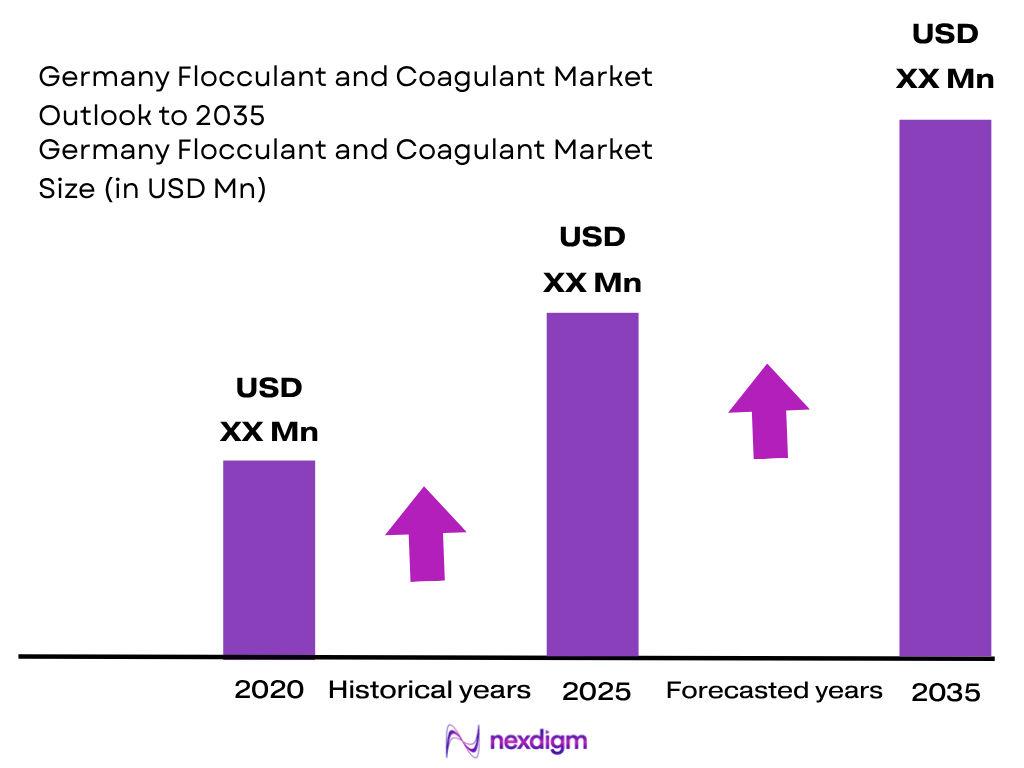
The Germany Flocculant and Coagulant Market is estimated at ~USD XX.X billion in 2024, with the report forecast to cover a ~XX.X% CAGR during 2026-2035. The market is supported by Germany’s extensive wastewater-treatment infrastructure and industrial base. Destatis reported that around 8,700 public wastewater-treatment plants treated more than 8.33 billion cubic meters of wastewater, while Germany’s GDP was approximately USD 4.69 trillion in 2024. Manufacturing represented 19.9% of gross value added, sustaining demand for coagulation, flocculation and sludge-treatment chemicals across industrial applications.
Germany’s demand for flocculants and coagulants is concentrated around major industrial and population centers, particularly North Rhine-Westphalia, Bavaria, Baden-Württemberg, Lower Saxony and Hesse. North Rhine-Westphalia combines extensive municipal infrastructure with chemical, metal, manufacturing and industrial wastewater activity. Destatis recorded 1.97 billion cubic meters of wastewater treated in North Rhine-Westphalia in the referenced national wastewater statistics, while Bavaria recorded approximately 1.56 billion cubic meters. Germany’s industrial structure further supports recurring chemical-treatment requirements across manufacturing and process industries.
Market Segmentation
By Product Type
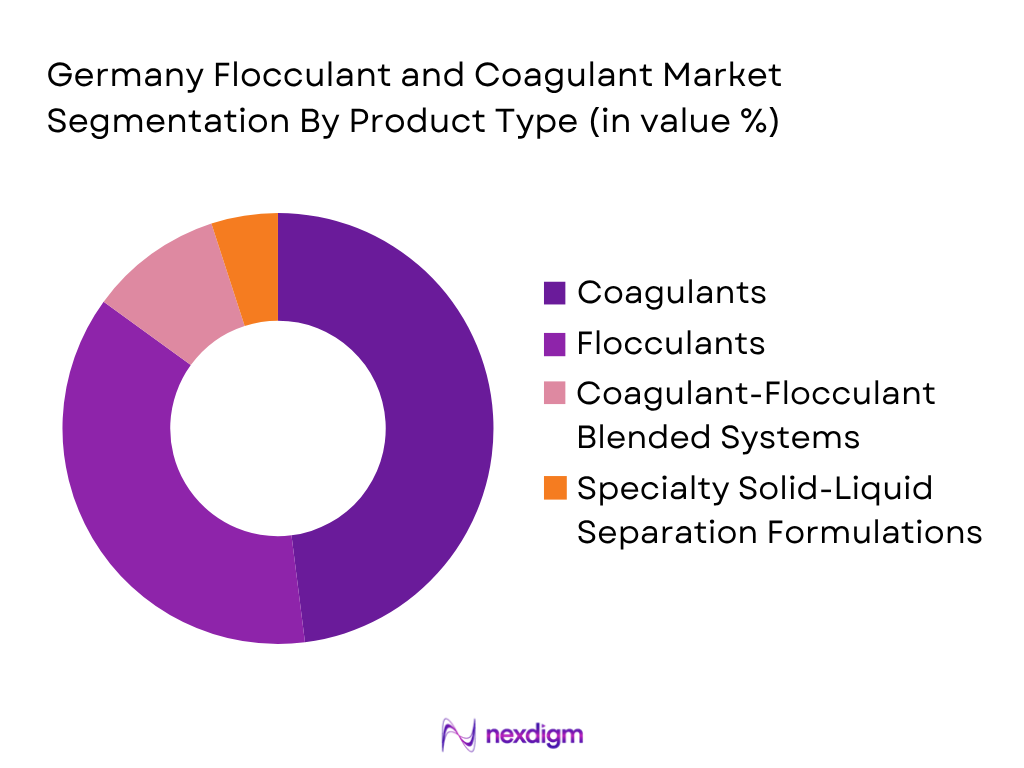
The Germany Flocculant and Coagulant Market is segmented by product type into coagulants, flocculants, coagulant-flocculant blended systems and specialty solid-liquid separation formulations. Coagulants are expected to account for the dominant sub-segment because they are fundamental to the initial destabilization of suspended and colloidal particles in drinking-water and wastewater treatment. Aluminum- and iron-based chemistries are widely applicable across clarification, pretreatment and industrial effluent treatment. Flocculants subsequently facilitate particle aggregation, sedimentation and sludge separation, making them important in municipal and industrial sludge-treatment processes. The breadth of Germany’s treatment infrastructure supports recurring chemical demand, while its large manufacturing ecosystem creates additional requirements for process-water and wastewater clarification. Destatis reported that German manufacturing accounted for 19.9% of national gross value added in 2024, while public wastewater treatment involved approximately 8,700 plants and more than 8.33 billion cubic meters of treated wastewater in the latest detailed national dataset.
By End-Use Industry
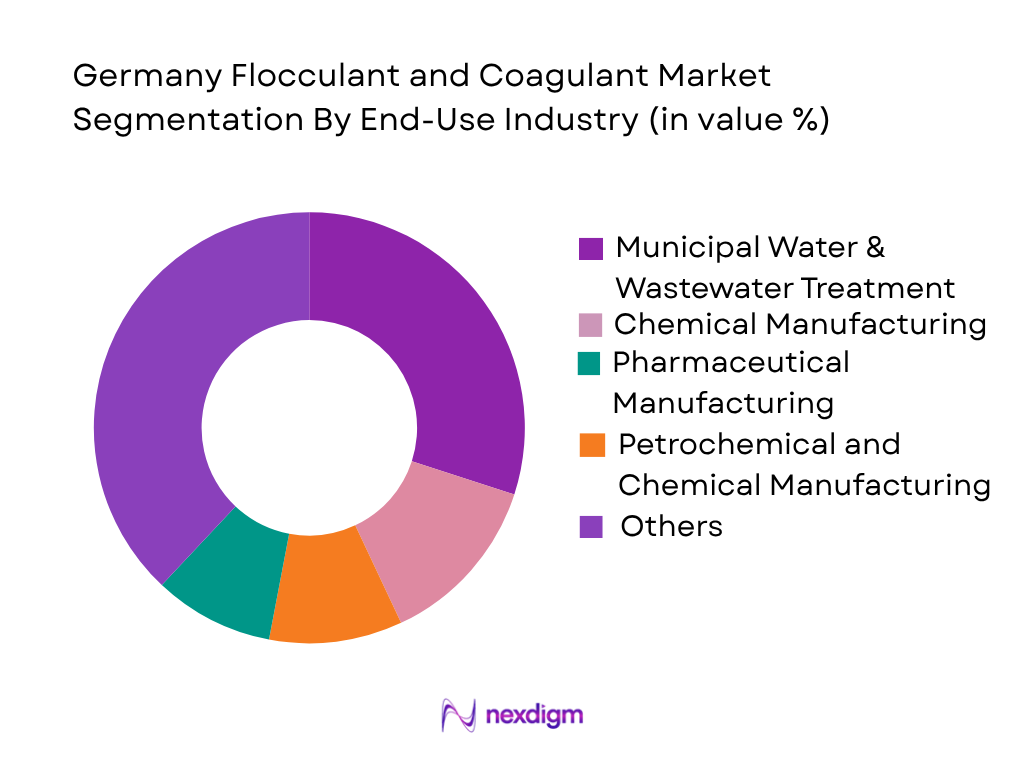
The Germany Flocculant and Coagulant Market is segmented by end-use industry into municipal water and wastewater treatment, chemical manufacturing, pharmaceutical manufacturing, food and beverage processing, pulp and paper, mining and mineral processing, power generation, metal processing, automotive manufacturing and other industrial applications. Municipal water and wastewater treatment represents the dominant demand center because coagulation and flocculation are established treatment stages for clarification, suspended-solids removal and sludge management. Industrial applications provide an additional recurring requirement, particularly where process streams contain suspended solids, colloids or difficult-to-separate contaminants. Germany’s manufacturing sector accounted for 19.9% of gross value added in 2024, while chemical manufacturing remained a significant industrial employer, with approximately 326,000 employees at the end of 2024. Public wastewater treatment also generated approximately 1.67 million tonnes of dry sewage sludge requiring disposal in 2024, reinforcing the importance of sludge thickening and dewatering chemistry.
Competitive Landscape
The Germany Flocculant and Coagulant Market includes global water-treatment chemical companies and specialty chemical manufacturers with established European distribution, technical-service and formulation capabilities. Companies such as Kemira, SNF, Solenis, Ecolab and BASF participate across municipal and industrial water-treatment applications, with portfolios spanning polymer flocculants, inorganic and organic coagulants, process chemicals, monitoring and treatment services. Kemira identifies municipal and industrial water treatment as core customer markets, while BASF has historically maintained flocculant and coagulant offerings for water-management applications.
| Company | Establishment Year | Headquarters | Germany Water-Treatment Presence | Product Chemistry Coverage | Municipal Applications | Industrial Applications | Technical Service Capability |
| Kemira Oyj | 1920 | Helsinki, Finland | ~ | ~ | ~ | ~ | ~ |
| SNF Group | 1978 | Andrézieux-Bouthéon, France | ~ | ~ | ~ | ~ | ~ |
| Solenis LLC | 1907* | Wilmington, Delaware, USA | ~ | ~ | ~ | ~ | ~ |
| Ecolab Inc. | 1923 | St. Paul, Minnesota, USA | ~ | ~ | ~ | ~ | ~ |
| BASF SE | 1865 | Ludwigshafen, Germany | ~ | ~ | ~ | ~ | ~ |
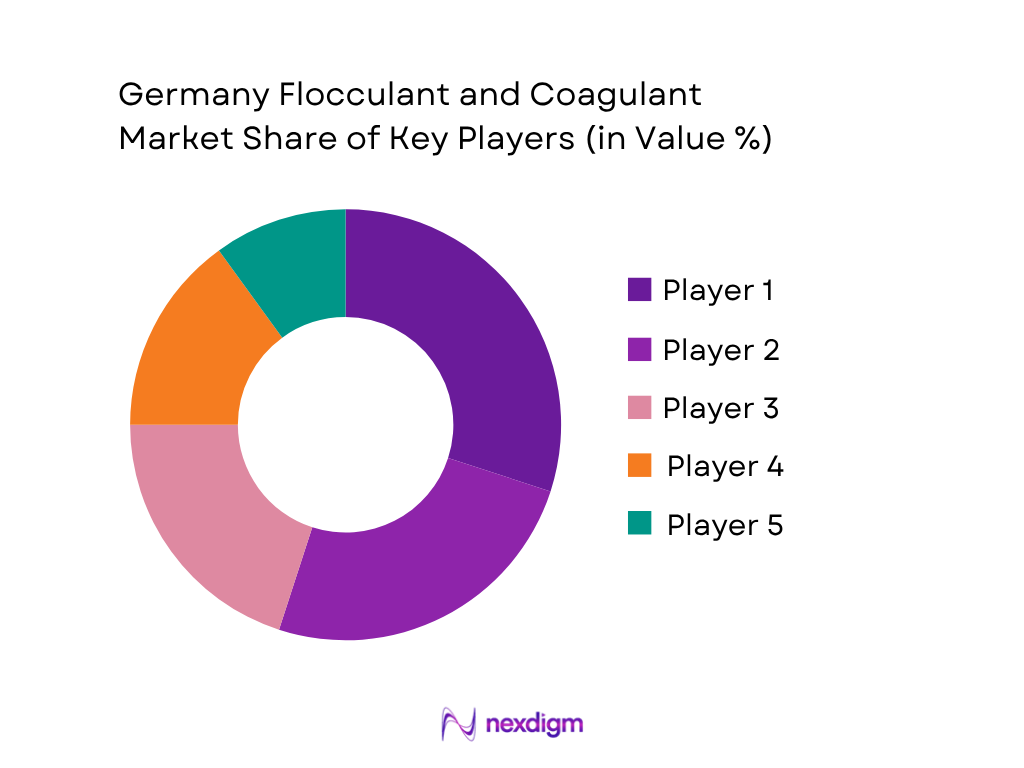
Germany Flocculant and Coagulant Market Analysis
Growth Drivers
Expansion of Municipal and Industrial Wastewater Treatment
Germany’s extensive water-treatment infrastructure creates a recurring requirement for coagulation, flocculation and sludge-conditioning chemicals across municipal and industrial facilities. The country operates 8,659 public wastewater treatment plants, while around 98.3% of the population is connected to public sewerage infrastructure. Germany’s public wastewater system also processes billions of cubic metres of wastewater annually, creating a substantial operating base for chemical treatment processes. In addition, sewage-sludge management remains an important treatment requirement, with 1,666,268 tonnes of dry sewage sludge disposed of in 2024. These conditions support continuous demand for chemicals used for suspended-solids removal, clarification, sludge thickening and dewatering. Industrial applications add another demand layer because Germany maintains a large manufacturing ecosystem covering chemicals, metals, food processing, pharmaceuticals, machinery and automotive production. The industrial sector consumed 3,343 petajoules of energy in 2024, indicating the scale of industrial activity requiring process-water and wastewater-management systems. The chemical industry alone accounted for 27.9% of industrial energy consumption, while approximately 46,000 industrial and mining establishments were included in the relevant energy-use survey. This industrial concentration supports ongoing requirements for specialized coagulation and flocculation formulations across process and wastewater-treatment operations.
Strong Industrial Base and Chemical Manufacturing Activity
Germany’s large industrial and chemical-manufacturing ecosystem supports demand for flocculants and coagulants because numerous production processes generate wastewater containing suspended solids, colloids, emulsified materials and other contaminants requiring solid-liquid separation. Manufacturing remains a major component of Germany’s economy, with industry including construction contributing 25.6% of GDP in 2024 according to international economic data. The country’s manufacturing base includes chemicals, metals, machinery, automotive, food processing, pharmaceuticals and electronics, creating multiple end-use channels for water-treatment chemicals. Chemical manufacturing is particularly relevant because the chemical industry consumed 27.9% of Germany’s industrial energy consumption in 2024 and employed approximately 326,000 people at the end of 2024. Metal production and processing represented another 23.7% of industrial energy consumption, creating wastewater-treatment requirements associated with metal finishing, processing and production operations. Germany’s overall industrial production declined during 2024, but the installed manufacturing base remained extensive, with industrial facilities continuing to operate wastewater-treatment systems regardless of short-term production cycles. Flocculants and coagulants are therefore required not only for expansion projects but also for routine clarification, sludge separation, process-water recycling and compliance-oriented wastewater treatment. The diversity of German industrial operations provides a broad customer base for both commodity treatment chemicals and specialized formulations designed for demanding industrial wastewater streams.
Market Challenges
Industrial Downturn and Volatility in Manufacturing Activity
Germany’s industrial slowdown creates uncertainty for demand from manufacturing-intensive applications of flocculants and coagulants. Real industrial production declined during 2024, while production excluding energy and construction also recorded a significant contraction. Manufacturing gross value added fell by 3.0%, with machinery, automotive and other industrial sectors experiencing weaker production. Industrial production for the year was approximately 4.5% lower than the preceding year, while production excluding energy and construction declined by 4.9%. This environment can affect chemical consumption in industrial wastewater-treatment systems because lower production volumes may reduce process-water throughput and wastewater generation at individual facilities. Energy-intensive industries were particularly exposed to operating-cost pressures, with chemical and metal-processing operations affected by high energy requirements. Germany’s industrial sector nevertheless consumed 3,343 petajoules of energy during 2024, demonstrating that the underlying industrial treatment base remains substantial. The challenge for suppliers is therefore not the absence of industrial demand but fluctuations in operating rates, plant utilization and investment decisions. Producers supplying industrial customers may need to manage variable ordering patterns and increasingly demonstrate measurable treatment efficiency. Municipal demand provides greater stability, but industrial customers can remain sensitive to production cycles, plant closures, restructuring and changes in manufacturing capacity.
Regulatory, Environmental and Sludge-Management Requirements
Germany’s stringent environmental framework creates additional technical and compliance requirements for suppliers of flocculants and coagulants. Treatment chemicals must operate effectively while supporting increasingly demanding wastewater-quality, sludge-management and resource-recovery objectives. Public wastewater treatment generated 1,666,268 tonnes of dry sewage sludge requiring disposal during 2024, illustrating the scale of residual-material management associated with wastewater treatment. Of this quantity, more than 1.24 million tonnes were disposed of within the originating federal state, while approximately 415,069 tonnes were transferred to another German state. The treatment and disposal of sludge can increase operational complexity because wastewater operators must balance clarification performance, dewatering efficiency, residual chemical content and downstream disposal or recovery requirements. Germany also processed 362.719 million tonnes of total waste in 2024, reinforcing the broader importance of resource recovery and controlled waste handling. These conditions encourage water-treatment operators to optimize chemical dosing and reduce unnecessary sludge generation while maintaining treatment performance. For suppliers, this increases the importance of application engineering, laboratory testing and customized formulation. Products that perform adequately under one wastewater composition may require adjustment for another facility, making technical support an increasingly important component of commercial competition within the German flocculant and coagulant market.
Market Opportunities
Water Reuse, Sludge Dewatering and Resource-Recovery Applications
Germany’s established wastewater infrastructure provides opportunities for advanced flocculant and coagulant solutions focused on water reuse, sludge dewatering and resource recovery. The country operates 8,659 public wastewater treatment plants, creating a large installed treatment base where chemical optimization can improve clarification and solids separation. Sewage-sludge management is particularly relevant, with 1,666,268 tonnes of dry matter requiring disposal in 2024. This creates opportunities for high-performance polymer flocculants that improve sludge thickening and dewatering, potentially reducing the volume of material requiring downstream handling. The broader German waste system processed 362.719 million tonnes of waste in 2024, strengthening the policy and industrial emphasis on recovery and efficient resource utilization. Water-reuse applications can also become increasingly relevant for industrial facilities seeking to reduce freshwater withdrawals and improve process-water efficiency. Germany’s public water infrastructure already serves more than 99% of the population, while approximately 5,599 public water-supply companies provide drinking-water services. The combination of extensive infrastructure, industrial water requirements and resource-efficiency objectives creates opportunities for suppliers offering specialized chemistry rather than only conventional commodity products. Advanced formulations can target difficult industrial streams, improve solids capture, support automated dosing and integrate with modern wastewater-treatment processes.
Specialty Formulations for Chemical, Metal and Process Industries
The concentration of chemical, metal, pharmaceutical, food and machinery manufacturing creates opportunities for application-specific flocculant and coagulant formulations designed around individual wastewater characteristics. Germany’s chemical industry employed approximately 326,000 people at the end of 2024, while metal production and processing accounted for 23.7% of industrial energy consumption. These industries can generate complex wastewater streams containing suspended solids, emulsions, metal residues, organic materials and other contaminants that may require specialized treatment sequences rather than standard chemical programs. The food industry also represented a substantial manufacturing employment base, with approximately 498,000 employees reported across the relevant food-manufacturing category at the end of 2024. Such diversity provides opportunities for suppliers to develop sector-specific formulations for food-processing wastewater, chemical effluent, metal-processing streams and pharmaceutical manufacturing. Germany’s industrial energy consumption reached 3,343 petajoules in 2024, highlighting the scale of the industrial ecosystem that requires process-water management and wastewater treatment. Digital dosing systems, laboratory optimization and application-specific polymer selection can further strengthen these opportunities by improving chemical utilization and treatment consistency. Suppliers capable of combining formulation expertise with technical service can address increasingly complex wastewater streams while supporting industrial customers seeking reliable solid-liquid separation and water-treatment performance.
Future Outlook
Over the next decade, the Germany Flocculant and Coagulant Market is expected to develop around wastewater-treatment modernization, industrial water efficiency, sludge management and increasingly specialized treatment chemistry. Demand should remain connected to municipal wastewater infrastructure while industrial users increasingly focus on process optimization, water reuse and reduced chemical consumption per unit of treated water. The country’s manufacturing intensity creates a broad industrial customer base, although industrial production declined during 2024, making application efficiency and cost optimization increasingly relevant.
The market is also positioned around higher-performance polymer formulations, lower-residual coagulants, automated dosing and digital monitoring. Germany’s regulatory environment places strong emphasis on water quality, chemical management and environmental performance, encouraging suppliers to develop formulations that provide effective separation while supporting compliance and resource efficiency. Sludge management will remain an important application area because Germany recorded approximately 1.67 million tonnes of dry sewage sludge disposed of in 2024.
Major Players
- Kemira Oyj
- SNF Group
- Solenis LLC
- Ecolab Inc.
- BASF SE
- Kurita Europe GmbH
- Feralco Group
- Kronos Worldwide, Inc.
- LANXESS AG
- Donau Chemie AG
- Kuraray Co., Ltd.
- Buckman Laboratories International, Inc.
- GEO Specialty Chemicals, Inc.
- USALCO LLC
- Aries Chemical, Inc.
Key Target Audience
- Municipal Water and Wastewater Utilities
- Industrial Water Treatment Operators
- Chemical and Specialty Chemical Manufacturers
- Pulp and Paper Manufacturers
- Food and Beverage Processing Companies
- Investments and Venture Capitalist Firms
- Government and Regulatory Bodies (Federal Ministry for the Environment, Nature Conservation, Nuclear Safety and Consumer Protection; Federal Environment Agency)
- Water Treatment Equipment, Engineering and EPC Companies
Research Methodology
Step 1: Identification of Key Variables
The initial phase involves constructing a Germany-specific ecosystem map covering municipal utilities, industrial wastewater operators, chemical suppliers, polymer manufacturers, distributors and treatment technology providers. Product variables include coagulant chemistry, flocculant polymer type, charge density, molecular weight, formulation and application. Demand variables are mapped across municipal, industrial, sludge-treatment and process-water applications.
Step 2: Market Analysis and Construction
Historical market information is compiled through top-down and bottom-up approaches, covering product consumption, domestic production, imports, exports, application demand and end-use industries. Municipal wastewater infrastructure, industrial production, sludge generation and treatment requirements are evaluated to establish demand relationships. Regional assessment covers major industrial states and wastewater-treatment clusters.
Step 3: Hypothesis Validation and Expert Consultation
Market hypotheses are validated through discussions with water-treatment chemical suppliers, municipal procurement specialists, industrial wastewater operators, engineering companies and application specialists. Technical consultations focus on product selection, dosage requirements, treatment performance, chemistry substitution and procurement practices. Findings are used to validate product and end-use segmentation assumptions.
Step 4: Research Synthesis and Final Output
The final stage integrates secondary research, industry-level evidence and primary insights into a consolidated Germany market model. Market estimates are cross-checked through supply-side capacity, demand-side consumption and trade-flow analysis. Competitive benchmarking evaluates chemistry portfolios, technical capabilities, distribution coverage, industrial exposure and application-specific positioning before finalizing the market outlook.

- Executive Summary
- Research Methodology (Market Definition and Scope, Germany Flocculant and Coagulant Market Classification, Flocculant and Coagulant Product Mapping, Chemistry-Level Assessment, Polymer-Level Assessment, Charge-Type Assessment, Form-Level Assessment, Application-Level Demand Analysis, End-Use Industry Assessment, Water Treatment Process Mapping, Production Capacity Mapping, Domestic Manufacturing Assessment, Import and Export Trade Analysis, Raw Material Supply Assessment, Municipal Demand Assessment, Industrial Demand Assessment, Demand-Side Assessment, Supply-Side Assessment, Top-Down Market Sizing, Bottom-Up Market Sizing, Primary Industry Interviews, Data Triangulation, Forecasting Framework, Market Share Validation, Limitations and Future Conclusions)

- Definition and Scope
- Germany Flocculant and Coagulant Industry Evolution and Development of Municipal Water Treatment, Industrial Wastewater Treatment, Advanced Solid-Liquid Separation Technologies and Specialty Water Treatment Chemical Manufacturing
- Flocculant and Coagulant Value Chain Analysis
- Flocculant and Coagulant Supply Chain Analysis
- Chemical Feedstock Suppliers, Polymer Manufacturers, Coagulant Manufacturers, Flocculant Formulators, Water Treatment Chemical Suppliers, Distributors, Municipal Water Utilities, Wastewater Treatment Operators, Engineering and EPC Companies, Industrial End Users, Chemical Manufacturers, Metal Processing Companies, Food and Beverage Manufacturers, Pharmaceutical Manufacturers
- Flocculant Integration Across Drinking Water Treatment, Municipal Wastewater Treatment, Industrial Effluent Treatment, Chemical Processing, Metal Processing, Food and Beverage, Pharmaceutical Manufacturing, Pulp and Paper, Power Generation and Industrial Sludge Treatment

- Growth Drivers (Aging Water and Wastewater Infrastructure, Industrial Wastewater Treatment Requirements, Chemical Manufacturing Activity, Metal Processing Demand, Sewage Sludge Treatment Requirements, Water Reuse and Recycling, Stringent Wastewater Quality Requirements, Process Water Optimization, Demand for High-Efficiency Solid-Liquid Separation)
- Market Challenges (Raw Material Price Volatility, Energy-Intensive Chemical Manufacturing, Stringent Environmental Regulations, Sewage Sludge Disposal Constraints, Industrial Production Volatility, Product Qualification Requirements, Environmental Concerns Associated with Synthetic Polymers, Municipal Budget Constraints, Skilled Water Treatment Operator Requirements)
- Market Opportunities (Advanced Polyacrylamide Formulations, Water Reuse and Recycling Systems, Low-Residual Coagulant Technologies, Bio-Based and Biodegradable Flocculants, Industrial Wastewater Treatment Expansion, High-Efficiency Sludge Dewatering Systems, Specialty Industrial Formulations, Automated Chemical Dosing, Digital Water Treatment Monitoring)
- Market Trends (High-Performance Polymer Flocculants, Water Reuse Technologies, Advanced Sludge Dewatering, Low-Residual Coagulants, Automated Chemical Dosing, Digital Water Treatment Monitoring, Specialty Industrial Wastewater Formulations, Sustainable Flocculant Development, Online Process Monitoring)
- Government Regulations and Standards (European Union REACH Regulation, CLP Chemical Classification Requirements, German Wastewater Ordinance Requirements, German Drinking Water Ordinance Requirements, Sewage Sludge Ordinance Requirements, Federal Water Act Requirements, Industrial Emissions Requirements, DIN Water Treatment Standards, Chemical Product Safety Requirements)
- SWOT Analysis
- Porter’s Five Forces Analysis
- PESTLE Analysis
- Stakeholder Ecosystem
- Competition Ecosystem

- By Market Value (2020-2025)
- By Market Volume (2020-2025)
- By Flocculant Consumption Volume (2020-2025)
- By Coagulant Consumption Volume (2020-2025)
- By Organic Flocculant Consumption Volume (2020-2025)
- By Inorganic Coagulant Consumption Volume (2020-2025)
- By Domestic Production Volume (2020-2025)
- By Import Volume (2020-2025)
- By Export Volume (2020-2025)
- By Average Selling Price (2020-2025)

- By Product Type (In Value %)
Flocculants
Coagulants
Coagulant-Flocculant Blended Systems
Specialty Solid-Liquid Separation Formulations - By Charge Type (In Value %)
Cationic
Anionic
Nonionic
Amphoteric - By Application Type (In Value %)
Coagulation
Flocculation
Clarification
Sedimentation
Sludge Thickening
Sludge Dewatering
Dissolved Air Flotation
Solid-Liquid Separation
Process Water Treatment
Water Recycling and Reuse - By End-Use Industry (In Value %)
Municipal Water and Wastewater Treatment
Chemical Manufacturing
Metal Processing
Power Generation
Food and Beverage
Pulp and Paper
Pharmaceutical Manufacturing
Automotive Manufacturing
Mining and Mineral Processing
Other Industrial Applications - By Water Treatment Application (In Value %)
Drinking Water Treatment
Municipal Wastewater Treatment
Industrial Wastewater Treatment
Process Water Treatment
Cooling Water Treatment
Boiler Water Treatment
Water Reuse and Recycling
Sewage Sludge Treatment
Industrial Sludge Treatment - By Distribution Channel (In Value %)
Direct Industrial Sales
Direct Municipal Utility Sales
Authorized Water Treatment Distributors
Specialty Chemical Distributors
Water Treatment Service Companies
Engineering and EPC Procurement
Industrial Supply Networks
Online Industrial Platforms - By Region (In Value %)
North Rhine-Westphalia
Bavaria
Baden-Württemberg
Lower Saxony
Hesse
Rhineland-Palatinate
Saxony
Other German Regions

- Market Share of Major Players (By Germany Revenue, Flocculant Sales Volume, Coagulant Sales Volume, Product Chemistry Portfolio, Polymer Production Capacity, End-Use Industry Exposure, Municipal Customer Coverage, Industrial Customer Coverage, Distribution Network Coverage, Regional Presence, Water Treatment Application Coverage, Technical Service Capability, R&D and Application-Laboratory Capability)
- Cross Comparison Parameters (Flocculant and Coagulant Revenue, Organic and Inorganic Product Portfolio Breadth, Polyacrylamide Technology Coverage, Municipal Water Treatment Capability, Industrial Wastewater Treatment Coverage, Sludge Dewatering Technology Capability, Chemical and Metal Industry Application Coverage, Germany Distribution Network Reach)
- SWOT Analysis of Major Players
- Competitive Positioning Matrix
- Flocculant Product Portfolio and Application Benchmarking
- Detailed Profiles of Major Companies
SNF Group
Kemira Oyj
Ecolab Deutschland GmbH
Solenis Germany GmbH
BASF SE
Kurita Europe GmbH
Feralco Group
LANXESS AG
Nouryon Chemicals GmbH
Dow Deutschland GmbH
Buckman Laboratories GmbH
Veolia Water Technologies Germany GmbH
SUEZ Deutschland GmbH
BWT Wassertechnik GmbH
Brenntag SE

- Municipal Drinking Water Utility Procurement Assessment
- Municipal Wastewater Treatment Plant Chemical Requirement Analysis
- Industrial Wastewater Treatment Operator Assessment
- Chemical Manufacturing Effluent Treatment Analysis
- Metal Processing Wastewater Treatment Assessment
- Power Generation Water Treatment Chemical Procurement Analysis
- Food and Beverage Wastewater Treatment Assessment
- Pharmaceutical Manufacturing Wastewater Treatment Analysis
- Pulp and Paper Mill Flocculant Requirement Assessment
- Automotive Manufacturing Wastewater Treatment Assessment
- Sludge Dewatering Chemical Procurement Assessment
- Water Treatment Engineering and EPC Procurement Analysis

- By Market Value (2026-2035)
- By Market Volume (2026-2035)
- By Flocculant Consumption Volume (2026-2035)
- By Coagulant Consumption Volume (2026-2035)
- By Organic Flocculant Consumption Volume (2026-2035)
- By Inorganic Coagulant Consumption Volume (2026-2035)
- By Domestic Production Volume (2026-2035)
- By Import Volume (2026-2035)
- By Export Volume (2026-2035)
- By Average Selling Price (2026-2035)


 Request a Sample
 Ask for Customization
 Get a Quote
 Enquire Now