
 Download PDF
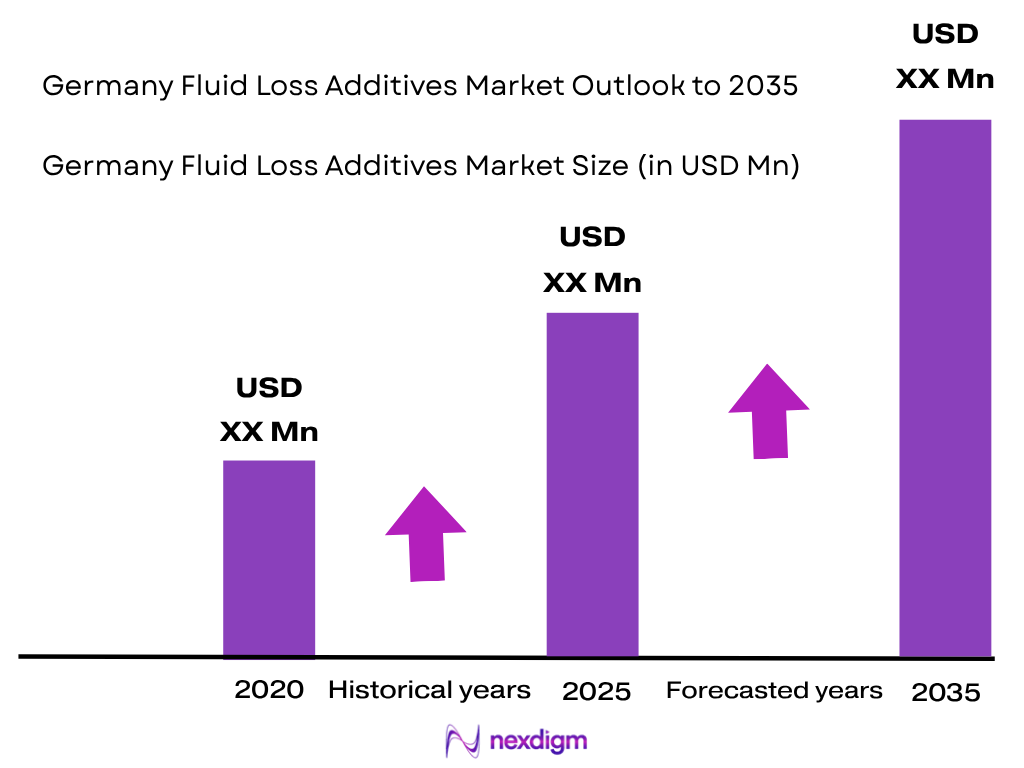
Market Overview
The Germany Fluid Loss Additives Market is valued at approximately ~USD XX million, supported by deep drilling, geothermal wells, domestic hydrocarbon operations and underground-storage activity. German upstream drilling footage moved from 29,380 metres to 27,917 metres across the two latest annual observations, while production-well drilling accounted for 18,950 metres and 14,282 metres, respectively. Expanding geothermal development increasingly complements conventional oil and gas demand for filtration-control polymers, cement additives and high-temperature drilling-fluid chemistry.
Lower Saxony, Bavaria, the Northern German Basin and Upper Rhine Graben form major demand areas because they combine hydrocarbon wells, underground storage and deep-geothermal resources. Deep-geothermal exploration permits expanded from 82 to 155 across the two latest observations, while operating projects remain especially concentrated in southern Bavaria. Germany also maintains 40 underground gas-storage locations with working-gas capacity reaching 280 TWh, supporting periodic drilling, workover and well-integrity activities requiring fluid-loss-control and cementing chemicals.
Market Segmentation
By Application
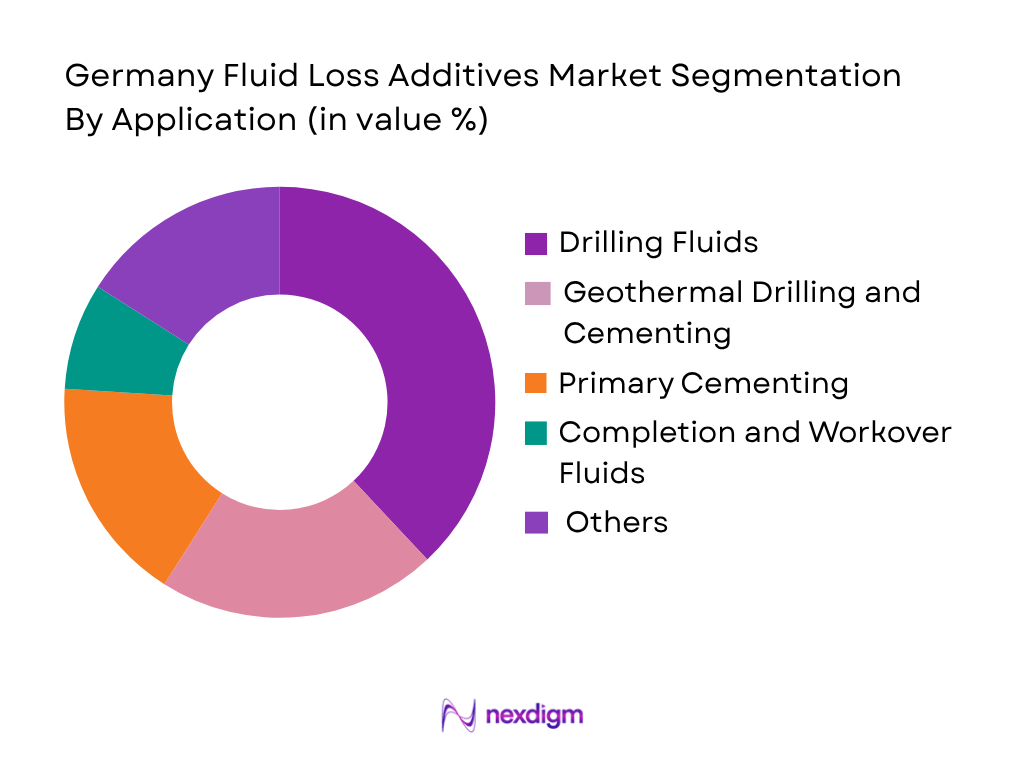
The Germany Fluid Loss Additives Market is segmented into drilling fluids, primary cementing, remedial cementing, geothermal drilling fluids, geothermal cementing, completion and workover fluids, reservoir drill-in fluids, underground-storage wells and emerging CCS-related applications. Drilling fluids hold the dominant modeled market share, reflecting recurring consumption throughout well construction. Fluid-loss additives reduce filtrate invasion and control filter-cake formation while drilling through permeable sandstone, carbonate, fractured geothermal and salt-bearing formations. Germany recorded 27,917 metres of hydrocarbon drilling footage in the latest annual dataset, including 14,282 metres of production-well drilling and 5,120 metres of field-appraisal drilling. Deep geothermal activity further expands addressable demand because wells may extend several kilometres and require temperature-stable water-based systems. BASF specifically markets Polydrill fluid-loss chemistry for difficult environments involving elevated temperature, seawater, calcium-based muds and saturated salt systems, illustrating the performance specifications relevant to German geothermal, hydrocarbon and subsurface-storage applications.
By Chemical Type
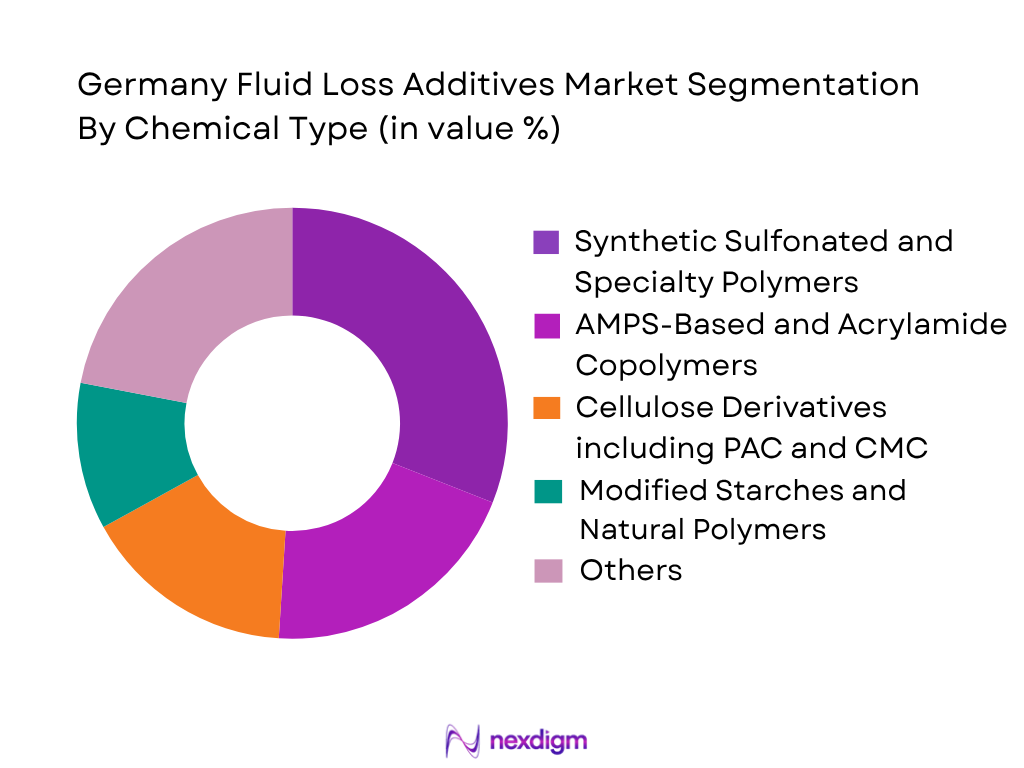
The Germany Fluid Loss Additives Market is segmented into synthetic sulfonated polymers, AMPS-based polymers, polyacrylamide systems, acrylate copolymers, cellulose derivatives, PAC, CMC, modified starch, latex-based cement additives, crosslinked polymers and biodegradable formulations. Synthetic polymers represent the dominant modeled segment because Germany’s geothermal and deep-well applications increasingly require performance under elevated temperatures, saline formation water and prolonged circulation. Synthetic sulfonated polymers can offer better thermal stability and contamination tolerance than conventional natural polymers in demanding environments. BASF’s current oilfield portfolio includes synthetic sulfonated Polytrol fluid-loss additives for cementing and Polydrill chemistry for drilling systems, with the latter designed for fluid-loss control above 450°F and compatibility with saturated salt brines. Germany’s domestic specialty-chemical manufacturing base also supports formulation expertise, polymer R&D and application testing. These capabilities favor high-performance synthetic systems in geothermal wells, storage wells and technically demanding oil and gas applications where fluid stability and predictable filtration behavior outweigh reliance on lower-specification commodity chemistry.
Competitive Landscape
The Germany Fluid Loss Additives Market combines German specialty-chemical manufacturers with global oilfield-service and polymer suppliers. BASF has a particularly relevant position because it maintains dedicated drilling and cementing fluid-loss portfolios, while Evonik contributes specialty-chemical and formulation expertise. Clariant and SNF compete through specialty polymers and process chemistry, whereas Halliburton brings integrated drilling and cementing capability. Competition centers on temperature stability, brine tolerance, REACH compliance, application laboratories, formulation customization and technical support for geothermal and deep-well projects.
| Major Player | Establishment Year | Headquarters | Fluid Loss / Polymer Capability | High-Temperature & Brine Capability | Drilling / Cementing Coverage | Germany / EU Technical Presence | Environmental & Regulatory Capability | Application Support |
| BASF | 1865 | Ludwigshafen, Germany | ~ | ~ | ~ | ~ | ~ | ~ |
| Evonik Industries | 2007 | Essen, Germany | ~ | ~ | ~ | ~ | ~ | ~ |
| Clariant | 1995 | Muttenz, Switzerland | ~ | ~ | ~ | ~ | ~ | ~ |
| SNF | 1978 | Andrézieux-Bouthéon, France | ~ | ~ | ~ | ~ | ~ | ~ |
| Halliburton | 1919 | Houston, USA | ~ | ~ | ~ | ~ | ~ | ~ |
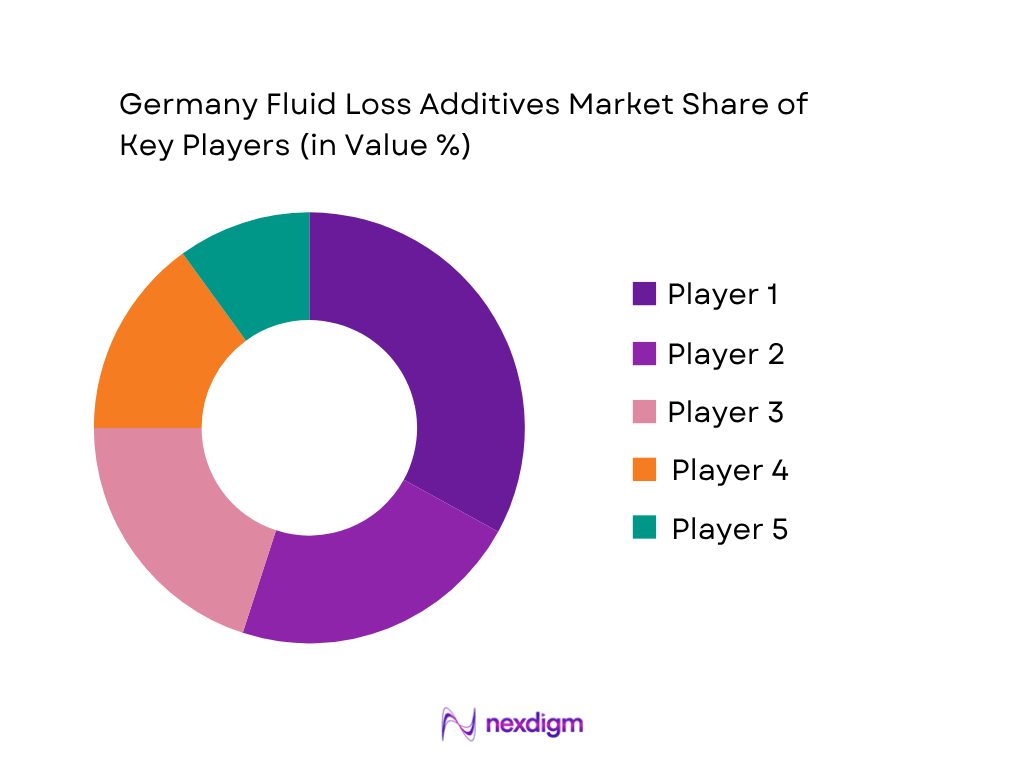
Germany Fluid Loss Additives Market Analysis
Growth Drivers
Deep Geothermal Expansion Increasing Demand for High-Temperature Fluid Loss Control
Germany’s accelerating deep-geothermal development is becoming a direct demand driver for fluid loss additives used in drilling fluids, cement slurries and well-completion systems. Bundesverband Geothermie reported 155 exploration permits for deep-geothermal projects, compared with 82 previously, while 18 plants were under construction and 178 projects were in planning in 2026. Deep-geothermal wells in Germany extend from more than 400 metres to approximately 5,000 metres, with subsurface temperatures exceeding 150°C at depths of roughly 4,000–5,000 metres in some areas. These conditions require filtration-control polymers that retain performance during extended circulation, high thermal exposure and interaction with mineralized formation water. Fluid loss additives are therefore required to control filtrate invasion, maintain thin filter cakes and stabilize cement slurries during well construction. Germany’s macroeconomic capacity supports continued technically intensive energy infrastructure, with World Bank data recording GDP of USD 4,685.6 billion and GDP per capita of USD 56,103.7 in 2024. IMF data recorded nominal GDP at EUR 4,265.3 billion, providing a substantial industrial base for geothermal drilling, specialty polymer development and municipal heat-decarbonization investments.
Continued Deep Drilling and Underground Storage Activity Supporting Baseline Consumption
Germany’s domestic drilling and underground-storage infrastructure provides a continuing baseline for fluid loss additive consumption alongside emerging geothermal demand. BVEG recorded 27,917 metres of oil and gas drilling activity in 2024, including 14,282 metres of production drilling, 5,120 metres of partial-field exploration drilling, 3,475 metres of exploration drilling and 2,991 metres of auxiliary drilling. Active producing fields included 629 oil wells and 273 gas wells, demonstrating an installed well base that generates recurring requirements for drilling, remedial cementing and intervention fluids. Underground storage adds another technically relevant application: Germany maintains 40 gas-storage locations operated by 24 companies, with maximum working-gas capacity of approximately 280 TWh, including 137 TWh in cavern storage and 120 TWh in porous formations. These assets require periodic integrity work, workovers and cement remediation where filtration control is important. World Bank data place German GDP at USD 4,685.6 billion and GDP per capita at USD 56,103.7 in 2024, while IMF data record nominal GDP of EUR 4,265.3 billion, supporting continued expenditure on energy security, storage integrity and technically specialized well services.
Market Challenges
Declining Conventional Hydrocarbon Drilling Limits Traditional Oilfield Demand
Germany’s conventional oil and gas drilling base remains comparatively limited and declined in 2024, constraining the traditional demand pool for fluid loss additives. BVEG recorded total drilling footage of 27,917 metres, down from 29,380 metres in the preceding year. Production-well drilling fell more sharply from 18,950 metres to 14,282 metres, while the Weser-Ems region recorded only 134 metres compared with 1,685 metres previously. Although exploration activity included 3,475 metres of new exploration drilling and 5,120 metres of partial-field exploration drilling, the overall hydrocarbon drilling scale remains materially smaller than in major international upstream markets. Fluid loss additive suppliers therefore cannot depend solely on conventional oilfield applications and must increasingly address geothermal, storage and emerging subsurface-energy wells. The challenge is especially relevant for suppliers whose portfolios are concentrated in oil-based muds or traditional cementing applications rather than high-temperature water-based systems. Germany’s wider economy remained large despite weak activity, with World Bank data recording GDP of USD 4,685.6 billion and GDP per capita of USD 56,103.7 in 2024; IMF data recorded nominal GDP of EUR 4,265.3 billion, emphasizing that market constraints stem from upstream structure rather than limited national economic capacity.
Extreme Geothermal Depth and Temperature Increase Formulation Complexity
Germany’s shift toward deep geothermal wells creates demanding technical conditions that can reduce the effectiveness of conventional cellulose, starch and lower-temperature polymer fluid loss additives. BVEG defines deep geothermal applications as wells extending from 400 metres to approximately 5,000 metres, while subsurface temperatures can exceed 150°C at depths of around 4,000–5,000 metres. German geothermal reservoirs are predominantly low-enthalpy systems below approximately 170°C, meaning projects frequently require deep drilling to access commercially useful heat. Extended exposure to these temperatures can cause polymer degradation, viscosity loss and deterioration of filter-cake quality, while saline formation fluids can further affect polymer hydration and cement-slurry compatibility. Suppliers must therefore develop thermally stable synthetic polymers and test compatibility with brines, retarders, dispersants and cement systems before field deployment. The issue grows as geothermal project activity expands: 155 exploration permits were reported in 2024, while 18 facilities were under construction and 178 were planned in 2026. World Bank data show Germany generated USD 4,685.6 billion of GDP in 2024, and IMF data place nominal GDP at EUR 4,265.3 billion, supporting project investment but also raising expectations for technically reliable well-construction chemistry.
Market Opportunities
Deep Geothermal Project Pipeline Creating Future Demand for Specialized Polymers
Germany’s deep-geothermal project pipeline creates one of the strongest future opportunities for high-temperature synthetic fluid loss additives, geothermal cementing polymers and brine-compatible filtration-control chemistry. Bundesverband Geothermie reported 155 exploration permits in 2024, compared with 82 previously, while the 2026 project map showed 45 operating facilities, 18 facilities under construction and 178 planned projects. Of the operating facilities, 43 supplied heat and 12 fed electricity into the grid, with some facilities serving both functions. These current development indicators imply a growing number of wells requiring drilling-fluid conditioning, high-temperature filtration control and durable cement placement as projects move from exploration into construction. The opportunity is strengthened by Germany’s federal objective of enabling approximately 10 TWh of deep-geothermal heat for heating networks. Deep wells reaching up to 5,000 metres require polymers capable of maintaining filter-cake integrity during prolonged high-temperature circulation. The World Bank recorded German GDP at USD 4,685.6 billion and GDP per capita at USD 56,103.7 in 2024, while IMF data recorded nominal GDP of EUR 4,265.3 billion, supporting municipal, utility and industrial capacity to finance technically demanding geothermal developments.
Underground Storage and Emerging Subsurface Energy Wells Expanding Application Scope
Germany’s large underground-storage infrastructure creates a future opportunity for fluid loss additives beyond conventional oil and gas drilling, particularly in cavern workovers, storage-well integrity programs and emerging hydrogen or carbon-storage applications. The Federal Ministry for Economic Affairs and Energy reports maximum underground natural-gas working capacity of approximately 280 TWh, comprising 137 TWh of cavern storage, 120 TWh of porous-storage capacity and 22 TWh in other storage facilities. Germany has 40 storage sites operated by 24 companies, establishing a substantial base of subsurface wells requiring periodic intervention, cement repair and integrity management. Salt-cavern applications are especially relevant for filtration-control suppliers because high-salinity fluids can destabilize conventional polymers and increase demand for salt-tolerant synthetic chemistry. The country’s broader subsurface expertise is also relevant as Germany develops new geothermal and storage frameworks; the Geothermal Acceleration Act entered the legislative process in 2025 and became part of the government’s accelerated heat-infrastructure framework in 2026. World Bank data record German GDP of USD 4,685.6 billion and GDP per capita of USD 56,103.7 in 2024, while IMF nominal GDP stood at EUR 4,265.3 billion, supporting continued investment in energy-security and subsurface infrastructure.
Future Outlook
The Germany Fluid Loss Additives Market is expected to expand at approximately ~X.X% CAGR during 2026–2035, with the market gradually shifting from dependence on conventional hydrocarbon drilling toward geothermal, underground-storage, high-temperature cementing and emerging subsurface energy applications. Advanced synthetic polymers, environmentally optimized chemistry and application-specific formulations are expected to gain importance as well conditions become technically more demanding.
Deep geothermal energy represents the clearest structural growth platform. Germany’s federal objective is to enable deep geothermal heat supply of around 10 TWh for heating networks, and the project pipeline is already expanding. The number of deep-geothermal exploration permits increased from 82 to 155, while current industry reporting identifies 18 facilities under construction and 178 planned facilities. This implies a growing requirement for drilling fluids, cement slurries, filtration-control polymers and high-temperature additives used during deep-well construction.
Major Players
- BASF
- Evonik Industries
- Clariant
- SNF
- Halliburton
- SLB
- Baker Hughes
- Weatherford
- Newpark Resources
- Syensqo
- Ashland
- Dow
- Nouryon
- LANXESS
- Wacker Chemie
Key Target Audience
- Fluid Loss Additive and Specialty Polymer Manufacturers
- Drilling Fluid and Cementing Chemical Suppliers
- Geothermal Project Developers and Operators
- Oil, Gas and Underground Storage Operators
- Deep Drilling and Well Construction Contractors
- Specialty Chemical Distributors and Formulators
- Investments and Venture Capitalist Firms
Government and Regulatory Bodies (Federal Ministry for Economic Affairs and Energy, Federal Institute for Geosciences and Natural Resources, Federal Environment Agency, State Mining Authorities, European Chemicals Agency)
Research Methodology
Step 1: Identification of Key Variables
The initial phase involves constructing an ecosystem map of the Germany Fluid Loss Additives Market covering specialty polymer manufacturers, drilling-fluid suppliers, cementing companies, geothermal developers, drilling contractors, storage operators and chemical distributors. Desk research identifies variables including drilling footage, well depth, application type, temperature, salinity, polymer chemistry, fluid system, project geography, environmental compliance and technical-support requirements.
Step 2: Market Analysis and Construction
Historical market demand is analyzed through top-down and bottom-up techniques. Top-down analysis evaluates German hydrocarbon drilling, geothermal project activity, underground-storage infrastructure and specialty-chemical supply, while bottom-up analysis models fluid-loss additive consumption according to well depth, drilling-fluid volume, cement slurry volume, additive concentration, temperature class, brine exposure and individual well applications.
Step 3: Hypothesis Validation and Expert Consultation
Market hypotheses are validated through computer-assisted telephone interviews and discussions with drilling-fluid suppliers, polymer manufacturers, geothermal drilling contractors, cementing specialists, storage operators and laboratory professionals. These consultations validate polymer-selection criteria, geothermal temperature requirements, salt tolerance, REACH-related product preferences, application dosages, technical qualification requirements and the distinction between conventional oilfield and geothermal applications.
Step 4: Research Synthesis and Final Output
The final phase triangulates drilling statistics, geothermal project information, storage infrastructure data, company disclosures and primary research. Bottom-up chemical-consumption estimates are reconciled against top-down well activity and specialty-chemical supply indicators. The resulting model determines application mix, chemical-type segmentation, competitive positioning, domestic manufacturing exposure and the longer-term opportunity presented by geothermal, storage and subsurface-energy applications.

- Executive Summary
- Research Methodology (Market Definitions and Assumptions, Fluid Loss Additive Market Boundary, Drilling Fluid Additive Classification, Cementing Fluid Loss Additive Classification, Geothermal Well Fluid Assessment, Oil and Gas Well Fluid Assessment, Water-Based Mud Assessment, Brine-Based Fluid Assessment, Cement Slurry Assessment, Polymer Chemistry Mapping, Synthetic Polymer Assessment, Cellulose Derivative Assessment, Starch-Based Additive Assessment, High-Temperature Fluid Loss Additive Assessment, Deep Geothermal Well Assessment, Conventional Oil and Gas Well Assessment, Salt-Formation Drilling Assessment, Underground Storage Well Assessment, CCS Well Assessment, API Fluid Loss Mapping, HTHP Filtration Performance Assessment, Temperature Stability Assessment, Salt and Divalent-Ion Tolerance Assessment, Formation Damage Assessment, REACH Compliance Assessment, Supply-Side Assessment, Demand-Side Assessment, Top-Down Market Sizing, Bottom-Up Market Sizing, Primary Industry Interviews, Deep Drilling Project Mapping, Data Triangulation, Forecasting Framework)

- Definition and Scope
- Evolution of Fluid Loss Control Chemistry in Germany, Development of Domestic Oil and Gas Drilling, Deep Geothermal Well Construction, Hydrothermal Geothermal Projects, Petrothermal Exploration, Underground Gas Storage Wells, Salt-Cavern Drilling, CCS and Subsurface Storage, High-Temperature Drilling Fluids, Deep-Well Cementing, Environmentally Optimized Well Construction Chemistry, Fluid Loss Additives Industry Value Chain, Fluid Loss Additives Supply Chain
- Specialty Monomer Suppliers, Water-Soluble Polymer Manufacturers, Cellulose Derivative Suppliers, Starch and Natural Polymer Suppliers, Specialty Chemical Manufacturers, Oilfield Chemical Formulators, Drilling Fluid Service Companies, Cementing Service Companies, Geothermal Drilling Contractors, Local Chemical Producers, Chemical Distributors, Laboratory Testing Providers, Deep Drilling Contractors, Geothermal Project Developers, Oil and Gas Operators, Storage Operators, Research and Technical Testing Laboratories

- Growth Drivers (Deep Geothermal Expansion, Municipal Heat Decarbonization, Hydrothermal Well Development, Domestic Oil and Gas Drilling, Underground Storage Activity, High-Temperature Well Construction, Cementing Activity, Reservoir Protection Requirements, Thermal Stability Requirements, German Specialty Polymer Manufacturing)
- Market Challenges (Limited Domestic Hydrocarbon Drilling Scale, High-Temperature Polymer Degradation, High-Salinity and Divalent-Ion Contamination, Complex Geothermal Formations, REACH Compliance Requirements, Environmental Restrictions, Long Product Qualification Cycles, Formation Damage Risk)
- Market Opportunities (Deep Geothermal Projects, High-Temperature Synthetic Polymers, Geothermal Cementing Additives, Biodegradable Fluid Loss Additives, Low-Toxicity Drilling Chemistry, Underground Storage Wells, CCS Injection Wells, Salt-Tolerant Polymer Systems, German-Manufactured Specialty Polymers, Customized Geothermal Fluid Formulations)
- Market Trends (AMPS-Based Polymer Adoption, Temperature-Stable Synthetic Chemistry, Low-Solids Water-Based Systems, Environmentally Optimized Additives, Reservoir-Friendly Fluid Systems, Geothermal-Specific Cementing Chemistry, High-Salinity Polymer Systems)
- Government Regulations and Standards (EU REACH Regulation, CLP Regulation, German Federal Mining Act, Federal Water Act, Environmental Impact Assessment Requirements, Groundwater Protection Requirements, Chemical Storage Requirements, Waste Management Regulations, Mining Authority Approval Requirements, Geothermal Project Permitting Requirements)
- SWOT Analysis
- Porter’s Five Forces Analysis
- PESTLE Analysis
- Stakeholder Ecosystem
- Deep Drilling, Geothermal and Oilfield Chemical Ecosystem

- By Market Value (2020-2025)
- By Fluid Loss Additive Consumption Volume (2020-2025)
- By Drilling Fluid Loss Additive Consumption (2020-2025)
- By Cementing Fluid Loss Additive Consumption (2020-2025)
- By Geothermal Well Fluid Loss Additive Consumption (2020-2025)
- By Oil and Gas Well Fluid Loss Additive Consumption (2020-2025)
- By Underground Storage Well Consumption (2020-2025)
- By Water-Based Mud Fluid Loss Additive Consumption (2020-2025)
- By Brine-Based Fluid Loss Additive Consumption (2020-2025)
- By High-Temperature Fluid Loss Additive Consumption (2020-2025)
- By Synthetic Polymer Fluid Loss Additive Consumption (2020-2025)
- By Locally Manufactured Fluid Loss Additive Consumption (2020-2025)
- By Imported Fluid Loss Additive Consumption (2020-2025)

- By Application (In Value %)
Drilling Fluids
Primary Cementing
Remedial Cementing
Geothermal Well Drilling Fluids
Geothermal Well Cementing
Completion Fluids
Workover Fluids
Reservoir Drill-In Fluids
Underground Storage Well Fluids
CCS and Subsurface Injection Well Fluids - By Chemical Type (In Value %)
Synthetic Sulfonated Polymers
AMPS-Based Polymers
Polyacrylamide-Based Polymers
Acrylate and Acrylamide Copolymers
Polycarboxylate-Based Systems
Cellulose Derivatives
PAC-Based Fluid Loss Additives
CMC-Based Fluid Loss Additives
Modified Starches
Lignite-Based Additives
Latex-Based Cement Additives
Styrene-Butadiene Systems
Crosslinked Polymer Systems
Biodegradable Polymer Systems
Nanomaterial-Enhanced Fluid Loss Additives - By Fluid System (In Value %)
Freshwater-Based Mud
Low-Solids Water-Based Mud
Saltwater-Based Mud
Saturated Brine Systems
KCl Polymer Fluids
Calcium-Contaminated Fluid Systems
Geothermal Drilling Fluids
High-Temperature Water-Based Systems
Oil-Based Mud
Synthetic-Based Mud
Cement Slurry Systems
Completion Brines - By End-Well Application (In Value %)
Deep Geothermal Wells
Hydrothermal Geothermal Wells
Conventional Oil Wells
Conventional Gas Wells
Underground Gas Storage Wells
Salt-Cavern Storage Wells
CCS Injection Wells
Observation and Monitoring Wells
Exploration Wells
Development Wells
Workover and Intervention Wells - By Operating Environment (In Value %)
High-Temperature Wells
High-Salinity Wells
Deep Sedimentary Basin Wells
Carbonate Formations
Sandstone Reservoirs
Evaporite and Salt Formations
Fractured Geothermal Reservoirs
Low-Permeability Formations
Underground Storage Formations
Environmentally Sensitive Drilling Areas - By Region (In Value %)
Lower Saxony
Schleswig-Holstein
North Rhine-Westphalia
Bavaria
Munich Geothermal Region
Upper Rhine Graben
Brandenburg
Mecklenburg-Western Pomerania
Northern German Basin
Alpine Foreland Basin
Other Germany

- Market Share of Major Players (By Germany Revenue, Fluid Loss Additive Volume, Drilling Application, Cementing Application, Geothermal Application, Oil and Gas Application, High-Temperature Application, Water-Based Mud Application, Local Manufacturing Presence, German R&D Capability, EU Distribution Coverage, Technical Laboratory Support, REACH Compliance Capability, Field Technical Support)
- Cross Comparison Parameters (Drilling and Cementing Fluid Loss Additive Portfolio Breadth, High-Temperature and Geothermal Performance Capability, Salt and Divalent-Ion Tolerance Capability, German Manufacturing and R&D Presence, REACH and Environmental Compliance Capability, Geothermal and Deep-Well Application Experience, Local Laboratory and Formulation Support, Technical Service and Supply Reliability)
- SWOT Analysis of Major Players
- Competitive Positioning Matrix
- Major Companies
BASF
Evonik Industries
Clariant
SNF
Halliburton
SLB
Baker Hughes
Weatherford
Newpark Resources
Syensqo
Ashland
Dow
Nouryon
LANXESS
Wacker Chemie

- Geothermal Project Developer Requirement Assessment
- Oil and Gas Operator Requirement Assessment
- Drilling Contractor Requirement Assessment
- Drilling Fluid Service Company Requirement Assessment
- Cementing Service Company Requirement Assessment
- Underground Storage Operator Requirement Assessment
- CCS Project Operator Requirement Assessment
- Technical Specification Requirement Assessment
- Environmental Compliance Requirement Assessment
- Fluid Compatibility Requirement Assessment
- Field Trial Requirement Assessment
- Laboratory Qualification Requirement Assessment
- Technical Support Requirement Assessment
- Inventory and Supply Reliability Assessment

- By Market Value (2026-2035)
- By Fluid Loss Additive Consumption Volume (2026-2035)
- By Drilling Fluid Loss Additive Consumption (2026-2035)
- By Cementing Fluid Loss Additive Consumption (2026-2035)
- By Geothermal Well Fluid Loss Additive Consumption (2026-2035)
- By Oil and Gas Well Fluid Loss Additive Consumption (2026-2035)
- By Underground Storage Well Consumption (2026-2035)
- By Water-Based Mud Fluid Loss Additive Consumption (2026-2035)
- By Brine-Based Fluid Loss Additive Consumption (2026-2035)
- By High-Temperature Fluid Loss Additive Consumption (2026-2035)
- By Synthetic Polymer Fluid Loss Additive Consumption (2026-2035)
- By Locally Manufactured Fluid Loss Additive Consumption (2026-2035)
- By Imported Fluid Loss Additive Consumption (2026-2035)


 Request a Sample
 Ask for Customization
 Get a Quote
 Enquire Now
