
 Download PDF
Market Overview
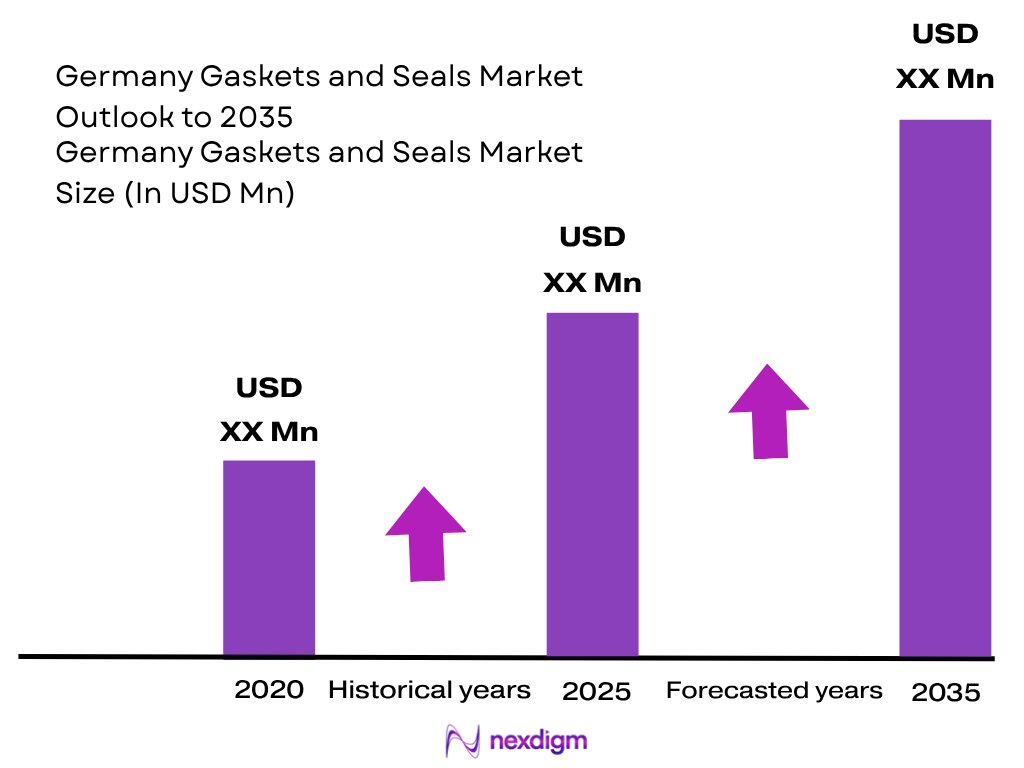
The Germany Gaskets and Seals Market is valued at approximately USD ~X.X billion, based on historical market assessment. Demand is supported by Germany’s large automotive, machinery, chemical, pharmaceutical and process-equipment industries. Passenger-car manufacturing remained at approximately 4.1 million units in both consecutive benchmark periods, while exports in the earlier benchmark reached 3.1 million vehicles. This production base generates recurring requirements for static gaskets, O-rings, shaft seals, mechanical seals and engineered sealing systems.
Baden-Württemberg, Bavaria, North Rhine-Westphalia, Lower Saxony and the Rhine-Neckar/Ludwigshafen industrial corridor represent Germany’s most important sealing-demand locations. Baden-Württemberg alone generated around EUR 88 billion in mechanical-engineering revenue in the earlier benchmark and hosts more than 40% of German machine-tool and precision-tool manufacturers. Germany’s chemical-pharmaceutical sector subsequently generated approximately EUR 221 billion in sales and supported roughly 480,000 employees, reinforcing intensive demand for high-specification flange, pump, compressor and process seals.
Market Segmentation
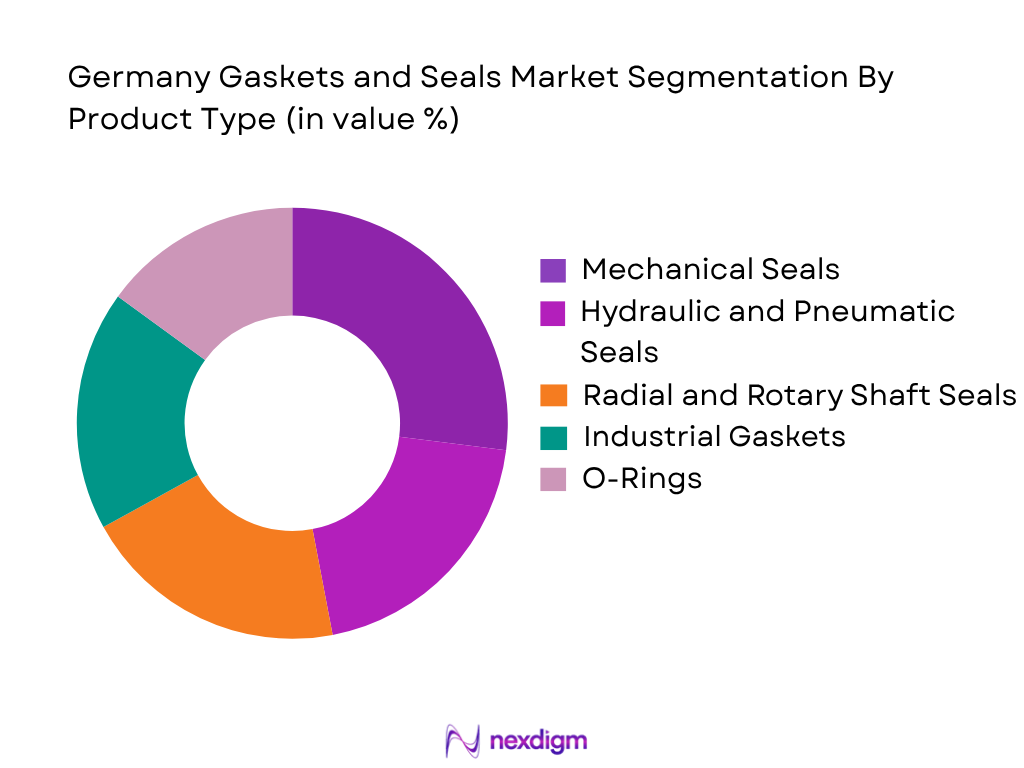
By Product Type
The Germany Gaskets and Seals Market is segmented by product type into mechanical seals, industrial gaskets, O-rings, hydraulic and pneumatic seals, and radial/rotary shaft seals. Mechanical seals hold the dominant individual product position because Germany has a large installed base of pumps, compressors, mixers and rotating process equipment in chemicals, pharmaceuticals, power, water treatment and industrial manufacturing. Mechanical seals are also higher-value products than standardized elastomer seals because their configuration can incorporate carbon, silicon carbide, tungsten carbide, metal bellows and engineered secondary sealing materials. German operators increasingly prioritize leakage reduction, equipment reliability and lower lifecycle maintenance costs, supporting cartridge seals and application-specific designs. Process plants also require recurring replacement during shutdowns and maintenance cycles, creating a substantial aftermarket. Public industrial-seal analysis places mechanical seals at approximately one-quarter to three-tenths of German demand, consistent with their leading position.
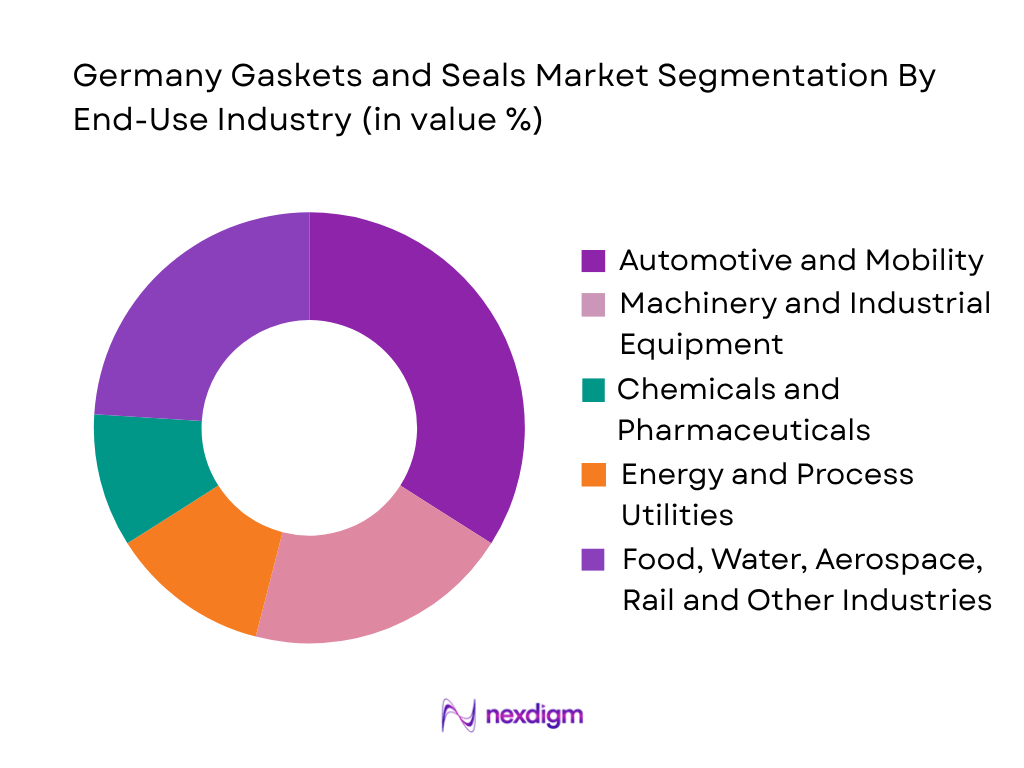
By End-Use Industry
The Germany Gaskets and Seals Market is segmented by end-use industry into automotive and mobility, machinery and industrial equipment, chemicals and pharmaceuticals, energy and process utilities, and other industrial applications including food processing, water, aerospace and rail. Automotive and mobility represents the largest individual demand segment because Germany combines large vehicle assembly volumes with one of Europe’s densest automotive supplier ecosystems. Around 4.07 million passenger cars were manufactured domestically in the benchmark period identified by Germany Trade & Invest, creating demand throughout engines, transmissions, braking systems, thermal management, e-axles, battery packs and auxiliary systems. Electrification changes the mix rather than eliminating sealing demand: conventional cylinder-head and engine gaskets decline, whereas battery enclosure seals, cooling-system seals, e-drive shaft seals and electrical protection components increase in relevance.
Competitive Landscape
The Germany Gaskets and Seals Market combines large German engineering groups, global polymer-sealing suppliers and specialized mechanical-seal companies. Freudenberg Sealing Technologies, EagleBurgmann, ElringKlinger, Trelleborg Sealing Solutions and Parker Hannifin occupy prominent positions through broad product portfolios, engineering capabilities, OEM relationships and application-specific material expertise. Competition is increasingly based on reliability, lifecycle performance, regulatory qualification, hydrogen compatibility, electrification applications and rapid MRO support rather than unit price alone.
| Company | Establishment | Headquarters | Core Sealing Portfolio | Key Materials | Major German Demand Exposure | EV/Hydrogen Capability | Engineering Model | Aftermarket/Service Strength |
| Freudenberg Sealing Technologies | 1849 roots | Weinheim, Germany | ~ | ~ | ~ | ~ | ~ | ~ |
| EagleBurgmann | 2004 current entity | Wolfratshausen, Germany | ~ | ~ | ~ | ~ | ~ | ~ |
| ElringKlinger | 1879 roots | Dettingen/Erms, Germany | ~ | ~ | ~ | ~ | ~ | ~ |
| Trelleborg Sealing Solutions | 1905 group roots | Trelleborg, Sweden | ~ | ~ | ~ | ~ | ~ | ~ |
| Parker Hannifin | 1917 | Mayfield Heights, USA | ~ | ~ | ~ | ~ | ~ | ~ |
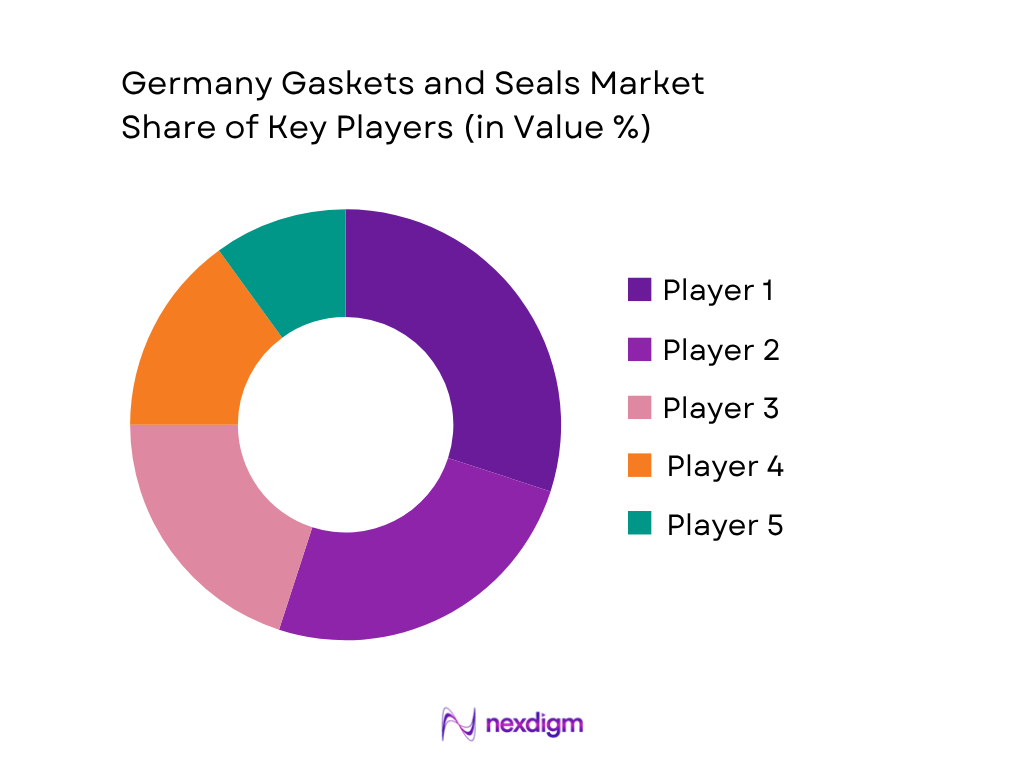
Germany Gaskets and Seals Market Analysis
Growth Drivers
Large Automotive and Industrial Manufacturing Base
Germany’s extensive automotive and industrial manufacturing ecosystem creates sustained demand for gaskets, radial shaft seals, O-rings, hydraulic seals, mechanical seals and customized elastomer components. Germany produced 4,069,222 passenger cars in 2024 and 4,148,836 passenger cars in 2025, demonstrating the scale of sealing-intensive vehicle assembly. The automotive and automotive-component manufacturing industry employed 783,096 people in 2024, while automotive manufacturing facilities generated EUR 544.78 billion in turnover. Germany’s machinery sector added another major demand base, comprising 2,272 operating establishments and 418,596 employees in 2024, with turnover of EUR 108.30 billion. Machinery such as pumps, compressors, machine tools, hydraulic cylinders, gearboxes and process equipment requires multiple static and dynamic sealing elements throughout original equipment production and maintenance cycles. Germany’s wider manufacturing economy contained 209,815 legal manufacturing units, employed 7,471,915 people, and generated approximately EUR 2.56 trillion in turnover in 2024. These industrial fundamentals are supported by Germany’s USD 4.69 trillion GDP in 2024, reinforcing the depth of the manufacturing economy that underpins sealing demand.
Large Chemical, Process and Export-Oriented Industrial Economy
Germany’s chemicals, pharmaceuticals, machinery and export-oriented processing industries constitute another structural growth driver for industrial gaskets and seals because these operations rely on pumps, reactors, compressors, valves, flange joints and rotating equipment that require continuous leakage control. German chemical manufacturing comprised 1,710 establishments and 346,685 employees in 2024, with operating turnover of approximately EUR 163.44 billion. Germany also exported EUR 262.8 billion of motor vehicles and automotive components, EUR 217.4 billion of machinery, and EUR 138.9 billion of chemical products in 2024, illustrating the scale of industries using precision sealing products before finished equipment reaches domestic or overseas customers. Overall German goods exports amounted to approximately EUR 1.56 trillion in 2024, providing gasket and seal producers with indirect exposure to international capital-equipment demand through German OEMs. The country’s macroeconomic scale further supports this industrial ecosystem, with World Bank data showing GDP per capita of USD 56,103.7 in 2024. Consequently, suppliers with validated mechanical seals, graphite gaskets, PTFE components and high-performance elastomer solutions can serve a diversified industrial customer base rather than depending on a single downstream application.
Market Challenges
Weakness in Seal-Intensive Machinery and Chemical Manufacturing
Demand conditions for gaskets and seals are challenged by subdued operating activity across several German industries that are intensive users of mechanical seals, hydraulic seals, rotary seals and flange gaskets. Machinery manufacturing recorded 2,272 establishments and 418,596 employees in 2024, compared with 2,255 establishments and 416,908 employees in 2025, indicating continuing pressure on the industrial production base supporting sealing consumption. Machinery-sector turnover stood at approximately EUR 108.30 billion in 2024 and EUR 110.57 billion in 2025, while Germany’s chemical manufacturing sector recorded approximately EUR 163.44 billion in turnover with 346,685 employees in 2024 and EUR 158.44 billion with 342,066 employees in 2025. The reduction in chemical activity is particularly relevant because chemical facilities are intensive users of mechanically engineered seals, graphite gaskets, PTFE components and chemically resistant elastomers used in pumps, compressors, piping and reaction equipment. Against a national economy valued at USD 4.69 trillion in 2024, weakness in these industrial verticals can materially affect gasket and seal order volumes, particularly for suppliers heavily dependent on new machinery rather than aftermarket maintenance.
Powertrain Transition is Reshaping Traditional Automotive Sealing Demand
Germany’s transition from combustion-engine vehicles toward electrically powered vehicles creates a structural product-mix challenge for established automotive gasket and seal suppliers. German factories manufactured 1.35 million electrically powered passenger cars in 2024, including 1.06 million battery-electric vehicles and 290,000 plug-in hybrid vehicles. Total domestic passenger-car production reached 4,069,222 vehicles in 2024 and increased to 4,148,836 units in 2025. This means sealing suppliers remain exposed to a very large automotive production base, but the components demanded by OEMs are changing. Conventional cylinder-head gaskets, exhaust-system seals, engine oil seals and combustion-related sealing interfaces face declining relevance as battery-electric production expands, whereas battery housing seals, thermal-management seals, e-drive shaft seals, coolant seals and electrical-protection components become more important. Germany also exported 881,000 battery-electric passenger cars in 2024, demonstrating that this technological shift is embedded in its manufacturing and export structure. With national GDP at USD 4.69 trillion in 2024, the transition is occurring within one of the world’s largest industrial economies, requiring sealing manufacturers to redirect engineering capacity toward electrified mobility rather than relying on traditional ICE portfolios.
Market Opportunities
Hydrogen Infrastructure Creates New High-Performance Sealing Applications
Germany’s emerging hydrogen infrastructure creates a significant future opportunity for specialized gaskets, valve seals, compressor seals, O-rings, flange gaskets and low-permeation engineered sealing systems. The Federal Network Agency approved a hydrogen core network comprising 9,040 kilometres of pipelines in 2024, supported by 291 MW of compressor capacity and infrastructure designed to connect major hydrogen production, storage, industrial-consumption and import locations. These assets will require sealing solutions capable of handling hydrogen permeation, pressure cycling, gas tightness and material compatibility across valves, compressors, pipeline flanges and auxiliary systems. Germany’s broader energy infrastructure also provides a large technical base for suppliers: installed renewable electricity capacity reached just under 190 GW in 2024, including 99.3 GW of solar capacity, while renewable generation reached 254.9 TWh. This combination of hydrogen-network development and renewable electricity deployment expands the range of energy-transition equipment requiring static and dynamic sealing components. Germany’s economy generated USD 4.69 trillion in GDP in 2024, providing a large industrial platform for commercialization. Sealing companies with hydrogen-qualified elastomers, PTFE systems, metallic gaskets and engineered compressor seals are therefore positioned to address an expanding application pool.
Electrification and Advanced Manufacturing Expand Engineered Sealing Demand
Germany’s accelerating electrification of mobility offers a substantial opportunity for suppliers capable of transferring sealing expertise from traditional powertrains into batteries, e-axles, thermal-management circuits and electric-drive systems. German plants produced 1.35 million electric passenger cars in 2024, comprising 1.06 million battery-electric vehicles and 290,000 plug-in hybrids, while overall passenger-car output reached 4,069,222 vehicles. In addition, Germany exported approximately 3.4 million newly manufactured passenger cars in 2024, including 881,000 battery-electric vehicles, giving local sealing suppliers access to components incorporated into vehicles sold worldwide. Electric platforms require large-format battery enclosure seals, coolant-system O-rings, shaft seals for electric drives, dielectric-compatible elastomer components and sealing systems protecting sensitive power electronics from moisture and contamination. The opportunity extends beyond automotive production because Germany’s manufacturing sector included 209,815 legal units and 7,471,915 employees in 2024, providing a broad customer base for automated equipment and precision sealing technologies. World Bank figures place Germany’s 2024 GDP at USD 4.69 trillion and GDP per capita at USD 56,103.7, supporting continued high-value industrial specialization. These conditions favor gasket and seal suppliers focused on engineered materials, validation capabilities and customized system design.
Future Outlook
The Germany Gaskets and Seals Market is forecast to expand at approximately ~X.X% CAGR during the forecast period, supported by advanced industrial automation, aftermarket maintenance requirements, tightening leakage standards, EV production and emerging hydrogen infrastructure. Growth will increasingly shift away from conventional engine-related sealing toward high-performance dynamic seals, battery and thermal-management solutions, electrolyzer gaskets and low-fugitive-emission process sealing.
Germany’s industrial installed base will remain one of the market’s largest structural advantages. Unlike purely OEM-led markets, Germany generates significant recurring MRO demand from pumps, compressors, hydraulic equipment, machine tools, process lines and power equipment. Aging assets can further favor higher-performance replacement seals as plant operators seek longer mean time between failures and reduced shutdown costs. Electrification will reshape automotive sealing demand. Germany manufactured 4,069,222 passenger cars in the recent benchmark period, and the country’s vehicle industry continues to invest in electrified powertrains. Radial shaft seals for electric drive units, dielectric-compatible materials, battery housing seals, coolant seals and thermal barriers are therefore becoming strategically important product categories.
Major Players
- Freudenberg Sealing Technologies
- EagleBurgmann Germany
- ElringKlinger
- Trelleborg Sealing Solutions
- Parker Hannifin
- SKF
- KLINGER Germany / KLINGER Kempchen
- Garlock Sealing Technologies
- James Walker
- Flexitallic
- Dana / Victor Reinz
- Bruss Sealing Systems
- Saint-Gobain / Omniseal Solutions
- ERIKS
- Hutchinson
Key Target Audience
- Gasket and Seal Manufacturers
- Automotive OEMs and Tier-1 Component Suppliers
- Industrial Machinery and Rotating Equipment Manufacturers
- Chemical, Pharmaceutical and Process-Plant Operators
- Industrial MRO Distributors and Sealing Service Providers
- Investments and Venture Capitalist Firms
- Government and Regulatory Bodies (Federal Environment Agency – UBA; Federal Ministry for the Environment, Climate Action, Nature Conservation and Nuclear Safety – BMUKN; Federal Office for Economic Affairs and Export Control – BAFA)
- Private Equity Firms, Strategic Investors and Industrial Conglomerates
Research Methodology
Step 1: Identification of Key Variables
The research begins with mapping the Germany Gaskets and Seals Market ecosystem, including elastomer compound suppliers, gasket-sheet manufacturers, seal producers, OEMs, industrial distributors and MRO service providers. Secondary research is used to identify key variables including automotive production, machinery output, chemical-sector activity, installed equipment, replacement frequency, sealing material mix and average selling prices.
Step 2: Market Analysis and Construction
Historical demand is assessed through both top-down and bottom-up approaches. The top-down model analyzes output across automotive, mechanical engineering, chemicals, pharmaceuticals, energy and other seal-intensive industries, while the bottom-up model estimates demand from product volumes, installed equipment, seal replacement cycles, supplier revenues, imports and domestic manufacturing activity.
Step 3: Hypothesis Validation and Expert Consultation
Market hypotheses are validated through structured interviews with seal manufacturers, gasket converters, distributors, plant maintenance professionals, OEM procurement teams and application engineers. Computer-assisted telephone interviews can be used to verify product penetration, pricing, replacement behavior, material transitions, competitive intensity and changing demand from electrification and hydrogen-related applications.
Step 4: Research Synthesis and Final Output
The final research stage reconciles supplier-side and demand-side findings through triangulation. Automotive production, process-equipment populations, MRO activity, company revenues, import-export flows and industry interviews are cross-checked to prevent double counting. Forecast scenarios are then developed around industrial output, electrification, hydrogen deployment, plant maintenance, material substitution, regulatory requirements and average selling-price development.

- Executive Summary
- Research Methodology (Market Definition and Scope, Germany Gaskets and Seals Market Classification, Industrial Gasket Demand Assessment, Mechanical Seal Consumption Mapping, Automotive Seal Consumption Assessment, Hydraulic and Pneumatic Seal Demand Assessment, O-Ring and Rotary Shaft Seal Consumption Mapping, Domestic Gaskets and Seals Manufacturing Capacity Assessment, Imported Gaskets and Seals Dependency Analysis, Elastomer-PTFE-Graphite-Metal Raw Material Assessment, Installed Pump-Compressor-Valve-Hydraulic Equipment Mapping, Automotive OEM and Tier-Supplier Demand Assessment, Machinery and Plant Engineering Demand Assessment, Chemical and Process Industry Sealing Assessment, Replacement and MRO Demand Mapping, Hydrogen-Electrolyzer-Fuel Cell Sealing Assessment, Primary Industry Interviews, Top-Down Market Sizing, Bottom-Up Company Revenue and Sales Volume Assessment, Trade Flow Analysis, Data Triangulation, Pricing Assessment, Forecasting Framework)

- Definition and Scope
- Evolution and Development of Germany’s Sealing Technology Industry
- Automotive Sealing, Industrial Gaskets, Mechanical Seals, Hydraulic Seals, O-Rings, Rotary Shaft Seals and High-Performance Polymer Sealing Ecosystem
- Automotive Sealing Manufacturing, Industrial Gasket Conversion, Mechanical Seal Engineering, Elastomer Compounding and Precision Polymer Processing Industry Structure
- Germany Gaskets and Seals Value Chain Analysis
- Germany Gaskets and Seals Supply Chain and Industry Ecosystem Analysis
- Sealing Technology Integration Across Automotive & E-Mobility, Chemicals, Machinery, Power Generation, Hydrogen, Pharmaceuticals, Food Processing, Water, Semiconductor Equipment, Pulp & Paper, Marine and General Industrial Applications

- Growth Drivers (Large Automotive and Industrial Manufacturing Installed Base, E-Mobility Sealing Requirements, Machinery and Equipment Manufacturing Demand, Chemical and Process Industry Maintenance, Pump and Compressor Seal Replacement, Hydrogen and Electrolyzer Sealing Requirements)
- Market Challenges (Weakness in Energy-Intensive Industrial Production, Automotive Powertrain Transition, PFAS Regulatory Uncertainty, Fluoroelastomer and Fluoropolymer Material Substitution Requirements, High Qualification Barriers for Critical Applications, Raw Material and Specialty Polymer Dependency)
- Market Opportunities (PFAS-Free Sealing Material Development, Hydrogen-Compatible Seals, Electrolyzer Gaskets, Fuel Cell Sealing Components, EV Battery Pack Seals, Thermal-Management Seals, High-Performance Semiconductor Equipment Seals, Low-Emission Flange Gaskets, Mechanical Seal Retrofit and Refurbishment, Smart Condition Monitoring)
- Market Trends (PFAS-Free Elastomer Development, Low-Emission Gasket Systems, Metal-Elastomer Composite Seals, High-Temperature Polymer Materials, Cartridge Mechanical Seal Adoption, Digital Seal Condition Monitoring, Predictive Maintenance, Custom Engineering and Rapid Prototyping, Hydrogen Qualification, Electrified Powertrain Sealing)
- Regulatory and Standards Landscape (EU Pressure Equipment Directive, TA Luft Leakage Requirements, VDI 2290, DIN EN 13555 Gasket Parameters, DIN EN 1591-1 Flange Calculation, DIN EN 1514, DIN EN 12560, DVGW Requirements, KTW-BWGL Drinking-Water Requirements, REACH, PFAS Regulatory Development)
- SWOT Analysis
- Porter’s Five Forces Analysis
- PESTLE Analysis
- Stakeholder Ecosystem
- Competition Ecosystem

- By Market Value (2020-2025)
- By Industrial Gasket Consumption Volume (2020-2025)
- By Mechanical Seal Consumption Volume (2020-2025)
- By Automotive Sealing Component Consumption Volume (2020-2025)
- By Hydraulic and Pneumatic Seal Consumption Volume (2020-2025)
- By O-Ring and Elastomeric Seal Consumption Volume (2020-2025)
- By Domestic Gaskets and Seals Production Volume (2020-2025)
By Average Selling Price (2020-2025)

- By Product Category (In Value %)
Industrial Gaskets
Mechanical Seals
Automotive Engine and Drivetrain Seals
E-Mobility Battery and Thermal-Management Seals
Hydraulic Seals
Pneumatic Seals
O-Rings and Backup Rings
Rotary Shaft and Radial Oil Seals
Compression and Gland Packings
Custom-Moulded and Specialty Sealing Products - By Gasket Type (In Value %)
Compressed Fibre Gaskets
Flexible Graphite Gaskets
PTFE and Expanded PTFE Gaskets
Spiral Wound Gaskets
Kammprofile Gaskets
Ring Type Joint Gaskets
Metal Jacketed Gaskets
Metal Bead Gaskets
Metal-Elastomer Gaskets
Mica High-Temperature Gaskets
Rubber and Elastomeric Flange Gaskets
Heat Exchanger Gaskets
Flange Insulation Gasket Kits - By Dynamic Seal Type (In Value %)
Pump Mechanical Seals
Compressor Mechanical Seals
Agitator and Mixer Seals
Cartridge Mechanical Seals
Split Mechanical Seals
Dry Gas Seals
Metal Bellows Seals
Hydraulic Piston Seals
Hydraulic Rod Seals
Pneumatic Cylinder Seals
Rotary Shaft Seals
Radial Shaft Seals
O-Rings and Backup Rings
Wipers and Scrapers - By Material Type (In Value %)
NBR
HNBR
EPDM
FKM and Fluoroelastomers
FFKM
Silicone and VMQ
Polyurethane
PTFE
Modified and Filled PTFE
PEEK and High-Performance Thermoplastics
Flexible Graphite
Aramid Fibre-Based Materials
Mica
Stainless Steel
Carbon Steel
Nickel-Based Alloys
Carbon-Graphite
Silicon Carbide
Tungsten Carbide - By End-Use Industry (In Value %)
Passenger Vehicle Manufacturing
Commercial Vehicle Manufacturing
E-Mobility and Battery Systems
Automotive Tier-Supplier Manufacturing
Chemical Manufacturing
Petrochemical and Refining Operations
Machinery and Equipment Manufacturing
Industrial Pump and Compressor Manufacturing
Power Generation
Renewable Energy and Wind Power
Hydrogen Production and Electrolyzers
Fuel Cell Systems
Pharmaceutical and Biotechnology Manufacturing
Food and Beverage Processing
Water and Wastewater Treatment
Semiconductor and Electronics Equipment
Pulp and Paper
Mining and Materials Processing
Marine and Shipbuilding
General Manufacturing

- Market Share of Major Players (By Germany Revenue, Industrial Gasket Sales Volume, Mechanical Seal Sales Volume, Automotive and Polymer Seal Sales Volume, End-Use Industry Exposure, Material Technology, Germany Manufacturing Footprint, Distribution and MRO Service Coverage)
- Cross Comparison Parameters (Germany Gaskets and Seals Revenue, Static and Dynamic Sealing Product Portfolio Breadth, Germany Manufacturing and Precision Polymer Processing Capability, High-Temperature High-Pressure Chemical and Hydrogen Service Capability, Automotive E-Mobility Chemical Machinery and Energy Customer Exposure, DIN-EN TA Luft DVGW and Critical Application Qualification Coverage, Germany Distribution Repair and MRO Service Footprint, Application Engineering Material Development Failure Analysis and Technical Support Capability)
- SWOT Analysis of Major Players
- Competitive Positioning Matrix
- Pricing and Product Category Benchmarking
- Detailed Profiles of Major Companies
Freudenberg Sealing Technologies – Simmerring Rotary Shaft Seals, O-Rings, Hydraulic and Pneumatic Seals, Process-Industry Seals, E-Mobility, Electrolyzer and Renewable-Energy Sealing Solutions
EagleBurgmann Germany GmbH & Co. KG – Pump and Compressor Mechanical Seals, Dry Gas Seals, Seal Supply Systems, Carbon Floating Ring Seals, Packings, Gaskets, Retrofit and Reverse Engineering
Trelleborg Sealing Solutions Germany GmbH – O-Rings, Hydraulic Seals, Pneumatic Seals, Rotary Shaft Seals, PTFE and Polyurethane Seals, Mechanical Seals and Custom Polymer Solutions
REINZ-Dichtungs-GmbH / Dana – Automotive Sealing Systems, Industrial Gasket Materials, Graphite, PTFE, Metal-Elastomer Gaskets, High-Temperature Seals and Hydrogen-Fuel-Cell Components
ElringKlinger AG – Metal Bead Gaskets, Cylinder-Head Gaskets, Elastomer and Metal-Elastomer Seals, Hot-Gas Gaskets, Transmission Seals and High-Performance Plastic Sealing Systems
Frenzelit GmbH – Fibre, Graphite, Mica and PTFE Gaskets, Metal Bead Gaskets, Liquid Gaskets, CIPG Systems and High-Temperature Industrial Sealing Solutions
KLINGER GmbH – Fibre-Reinforced Gasket Sheets, PTFE Gaskets, Graphite Laminates, Mica Gaskets, Rubber-Steel Seals, Automotive Components and Infrastructure Sealing Solutions
Garlock GmbH – Industrial Gaskets, Compression Packings, Rotary Seals, Hydraulic Components, Hygienic Diaphragms, Expansion Joints and Engineering Services
C. Otto Gehrckens GmbH & Co. KG – O-Rings, FKM FFKM EPDM and Specialty Elastomer Seals, Custom Moulded Components and High-Performance Industrial Sealing Materials
IDT Industrie- und Dichtungstechnik GmbH – Fibre Graphite PTFE and Metallic Gaskets, Packings, Mechanical Seals, Engineering Plastics, Expansion Joints, Flange Engineering and Turnaround Services
Parker Hannifin GmbH / Prädifa – Hydraulic and Pneumatic Piston Seals, Rod Seals, Polymer Sealing Systems and Process-Industry Sealing Materials
John Crane – Pump, Compressor and Agitator Mechanical Seals, Seal Support Systems, Seal-Face Technologies, Packings, Couplings and Rotating-Equipment Reliability Services
Dätwyler Sealing Solutions Deutschland GmbH & Co. KG – O-Rings, Custom-Moulded Seals, Rubber-to-Metal Components, Liquid Silicone Components, Thermoplastic Precision Parts and Industrial Sealing Solutions
Mechanical Seals Germany GmbH / MSG Dichtungswerk – Standard, Special and Cartridge Mechanical Seals, Agitator Seals, Carbon-Graphite Components, Seal Supply Systems and Mechanical Seal Repair Services
Saint-Gobain Omniseal Solutions – Engineered Polymer Seals, Metal Seals and Advanced Sealing Material Solutions for High-Performance Industrial Applications

- Automotive OEM Sealing Requirement Assessment
- E-Mobility Battery and Thermal-System Seal Procurement Assessment
- Automotive Tier-Supplier Seal Integration Assessment
- Chemical Plant Gasket and Mechanical Seal Requirement Analysis
- Machinery Manufacturer Hydraulic and Pneumatic Seal Procurement Assessment
- Pump and Compressor OEM Mechanical Seal Integration Assessment
- Hydrogen and Electrolyzer Manufacturer Sealing Requirement Assessment
- Power and Renewable Energy Operator Seal Requirement Assessment
- Pharmaceutical and Biotechnology Hygienic Seal Assessment
Food and Beverage Processor Seal Requirement Assessment

- By Market Value (2026-2035)
- By Industrial Gasket Consumption Volume (2026-2035)
- By Mechanical Seal Consumption Volume (2026-2035)
- By Automotive Sealing Component Consumption Volume (2026-2035)
- By Hydraulic and Pneumatic Seal Consumption Volume (2026-2035)
- By O-Ring and Elastomeric Seal Consumption Volume (2026-2035)
- By Domestic Gaskets and Seals Production Volume (2026-2035)
- By Average Selling Price (2026-2035)


 Request a Sample
 Ask for Customization
 Get a Quote
 Enquire Now