
 Download PDF
Market Overview
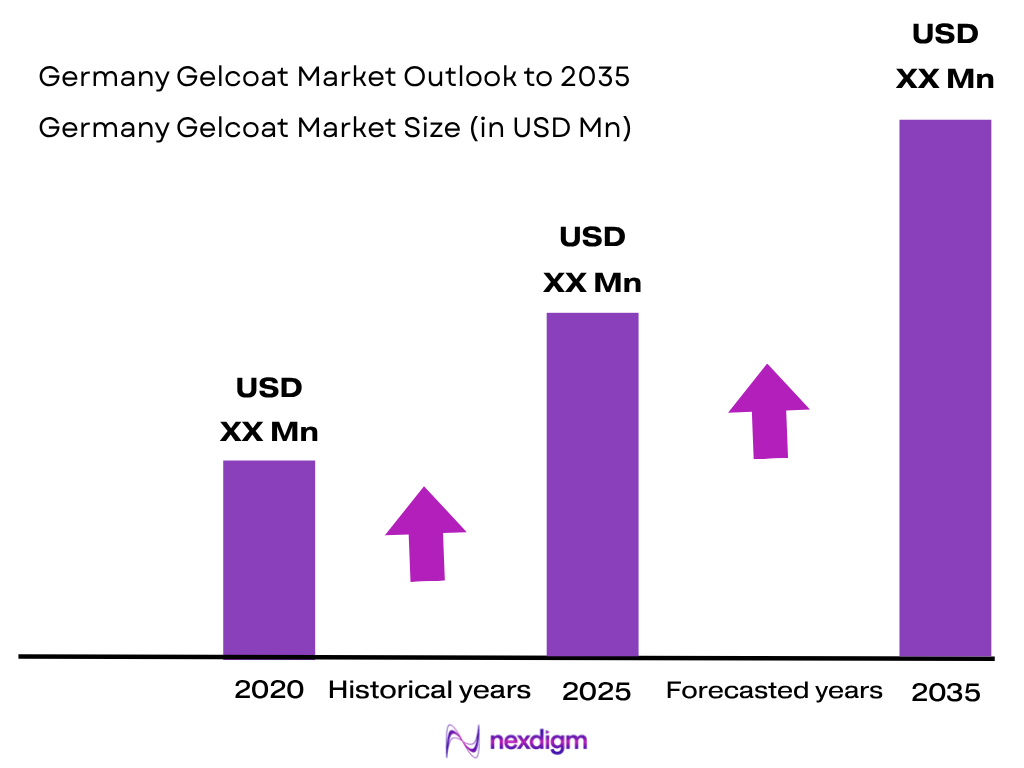
Germany represents a technically advanced market for gelcoat because of its concentration of composite-intensive industries and high requirements for surface durability, appearance, chemical resistance and environmental performance. Germany produced 4,069,222 passenger cars domestically in 2024, while the country’s automotive industry generated €541.9 billion in turnover and employed 772,949 people. These industrial activities create demand for composite components and protective surface systems, particularly where lightweighting, corrosion resistance and high-quality surface finishing are required.
The strongest gelcoat demand is concentrated around Germany’s established manufacturing and composites clusters rather than being evenly distributed nationally. Bavaria, Baden-Württemberg and North Rhine-Westphalia are particularly relevant because of their automotive, machinery, chemicals and advanced-materials manufacturing bases, while Lower Saxony, Schleswig-Holstein and Hamburg provide additional demand through marine, wind-energy and industrial applications. Germany’s automotive sector alone recorded €443.8 billion in vehicle-manufacturing turnover in 2024, while automotive R&D expenditure reached €59.4 billion, supporting continued development of lightweight composite components and specialty surface technologies.
Market Segmentation
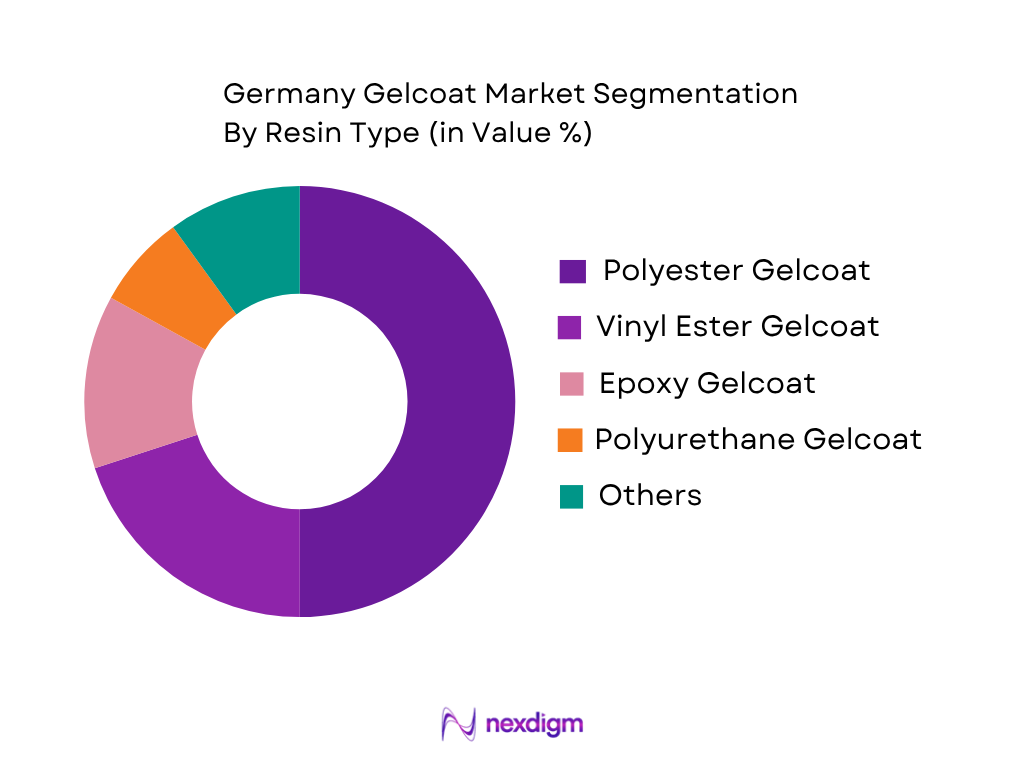
By Resin Type
Germany Gelcoat Market is segmented by resin type into polyester gelcoat, vinyl ester gelcoat, epoxy gelcoat, polyurethane gelcoat, and hybrid and specialty resin gelcoat. Polyester gelcoat is expected to represent the dominant segment because it combines established FRP-processing compatibility, broad availability, versatile pigmentation, relatively straightforward application and suitability for marine, construction, industrial and recreational components. Vinyl ester systems occupy an important position where higher chemical and corrosion resistance is required, while epoxy gelcoats are relevant for high-performance tooling and demanding composite structures. Germany’s sophisticated chemical and composite-processing ecosystem also supports specialty formulations with improved UV resistance, low emissions, fire performance and surface durability. The country’s chemical-pharmaceutical industry produced 2 additional units of output on a year-on-year index basis in 2024, although overall chemical output remained materially below earlier levels, reinforcing the importance of higher-value specialty formulations rather than commodity-only applications.
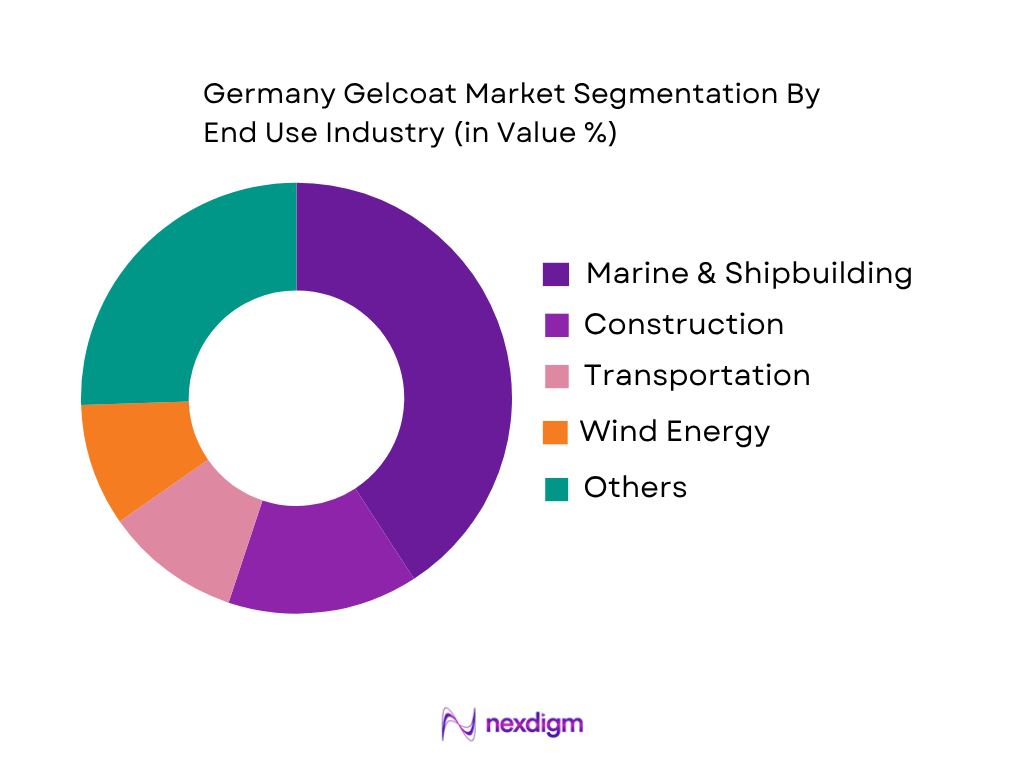
By End-Use Industry
Germany Gelcoat Market is segmented by end-use industry into marine and shipbuilding, construction and infrastructure, automotive and transportation, wind energy, industrial equipment, chemical processing, oil & gas and offshore, electrical and electronics, sanitaryware and recreational products, and other composite applications. Industrial equipment and marine-related composite applications remain important because gelcoat provides a protective, decorative and functional surface over FRP structures exposed to moisture, chemicals, abrasion and weathering. Automotive and wind-energy applications provide additional opportunities as manufacturers seek lightweight and durable composite components. Germany’s domestic passenger-car production reached 4,069,222 units in 2024, while the automotive sector invested €43.7 billion in tangible assets, demonstrating the scale of the industrial ecosystem supporting composite-material development and component manufacturing.
Competitive Landscape
The Germany Gelcoat Market includes global composite-material and specialty-chemical suppliers competing through resin technology, application support, marine-grade products, tooling systems, low-emission formulations and distribution networks. Competition is influenced not only by product availability but also by technical formulation support, colour matching, cure performance, regulatory compliance and compatibility with German composite manufacturing processes. Major international suppliers are supported by Germany’s mature industrial customer base and European distribution infrastructure.
| Company | Establishment Year | Headquarters | Core Gelcoat Positioning | Resin Portfolio | Key Application Focus | Technical Support | Distribution Reach |
| Scott Bader | 1921 | United Kingdom | ~ | ~ | ~ | ~ | ~ |
| Polynt Group | 1955 | Italy | ~ | ~ | ~ | ~ | ~ |
| BÜFA Composite Systems | 1920 | Germany | ~ | ~ | ~ | ~ | ~ |
| Allnex | 1947 | Germany/Global | ~ | ~ | ~ | ~ | ~ |
| Gurit | 1835 | Switzerland | ~ | ~ | ~ | ~ | ~ |
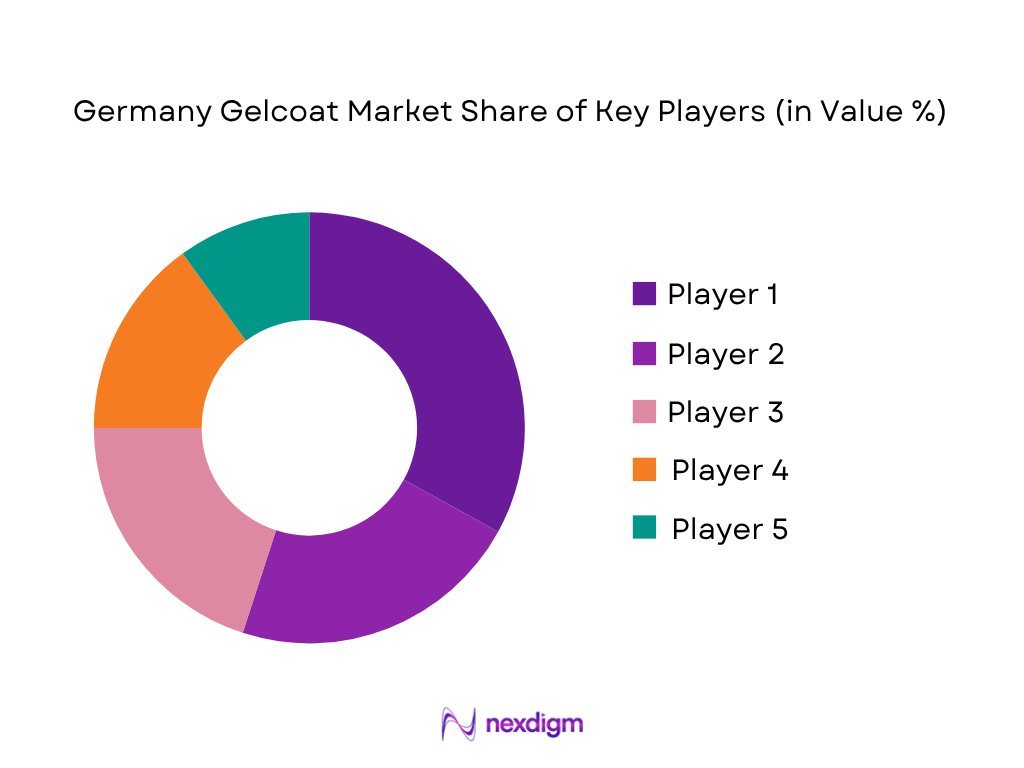
Germany Gelcoat Market Analysis
Growth Drivers
Advanced Composite Manufacturing
Germany’s advanced manufacturing base supports demand for gelcoats used as protective and decorative surface layers on FRP components, tooling and composite structures. The country produced 4,069,222 passenger cars in 2024, according to the German Association of the Automotive Industry (VDA), while domestic production in 2023 stood at 4,109,371 units. Germany’s automotive industry also recorded €541.9 billion in turnover in 2024 and employed 772,949 people, demonstrating the scale of the industrial ecosystem that supports lightweight-material development and composite component manufacturing. The Federal Statistical Office reported that manufacturing gross value added declined by 3.0 billion euros equivalent in real terms in 2024, reflecting industrial weakness but also reinforcing the importance of higher-value applications capable of improving component performance. Gelcoats are particularly relevant where manufacturers require UV resistance, chemical resistance, surface durability and controlled appearance. Germany’s established automotive, machinery, transportation and industrial-processing clusters provide a broad customer base for specialty gelcoat systems. Demand is therefore increasingly connected with engineered FRP applications rather than only conventional hand-lay-up products, creating opportunities for technically differentiated polyester, vinyl ester, epoxy and specialty gelcoat formulations.
Marine and Yacht Construction
Germany’s marine engineering, recreational boating and industrial composite ecosystem provides a specialized demand base for gelcoats, particularly for hulls, decks, interiors, tooling and repair applications requiring water resistance, UV stability and high-quality surface finishing. The German shipbuilding industry recorded approximately €6.9 billion in shipbuilding turnover in 2024, according to the German Shipbuilding and Ocean Industries Association (VSM), while the sector maintained approximately 18,000 direct employees. Germany also recorded €1.65 trillion in goods exports in 2024, according to Destatis, supporting a highly integrated industrial and logistics environment for marine equipment and specialized materials. Gelcoat demand benefits from the country’s concentration of premium boatbuilding, ship repair, marine equipment and composite fabrication capabilities. Polyester and vinyl ester gelcoats remain relevant for conventional FRP construction, while higher-performance systems address demanding marine exposure. Germany’s shipbuilding capabilities also support refurbishment and maintenance demand, where gelcoat restoration can extend the service life and appearance of composite structures. This creates a market pathway beyond new-build vessels, encompassing repair yards, component manufacturers, recreational boats and specialty marine structures.
Market Challenges
Stringent Chemical and Environmental Compliance
Germany’s gelcoat industry operates within a highly regulated chemical environment, creating compliance requirements around volatile organic compounds, styrene exposure, worker protection, emissions and chemical registration. The challenge is particularly relevant for conventional polyester and vinyl ester gelcoats because their formulations can involve reactive diluents and emissions during processing. Germany’s chemical-pharmaceutical industry generated €221 billion in turnover in 2024, while its production increased by 2 units on the relevant production index, according to the German Chemical Industry Association (VCI). However, average capacity utilization across chemical and pharmaceutical production was only 75 units, demonstrating continued pressure on industrial operations. The German Federal Statistical Office also reported a 3.0% decline in manufacturing gross value added in 2024, highlighting the difficult operating environment facing industrial customers. For gelcoat manufacturers, regulatory compliance therefore has implications for formulation development, documentation, workplace controls and application processes. Demand is increasingly moving toward low-styrene, reduced-emission and technically optimized systems that can satisfy stringent industrial requirements. Suppliers that cannot provide compliant formulations and application guidance may face qualification barriers, particularly among automotive, industrial and other sophisticated German composite customers.
Dependence on Specialty Resin Feedstocks
Germany’s gelcoat supply chain remains exposed to the availability and production economics of polyester, vinyl ester, epoxy, pigments, additives and other specialty chemical inputs. This exposure is significant because gelcoat formulations depend on consistent resin chemistry and additive performance to achieve surface appearance, curing behavior, UV stability and chemical resistance. VCI reported that Germany’s chemical-pharmaceutical industry produced 2 additional units of output in 2024, while polymer production increased by 4 units after substantial reductions in preceding years. At the same time, Germany’s chemical industry operated at approximately 75 units of capacity utilization, indicating continued pressure on production economics and asset utilization. Destatis reported that Germany’s real manufacturing gross value added declined by 3.0% in 2024, while energy-intensive industries such as chemicals remained at low production levels. These conditions can complicate procurement planning for gelcoat formulators and composite processors. The challenge extends beyond feedstock availability to maintaining consistent formulation specifications across batches and suppliers. German customers in automotive, marine, wind-energy and industrial applications often require qualified materials with repeatable technical performance, making substitution difficult when a specialty resin or additive becomes constrained.
Market Opportunities
Low-Styrene and Low-Emission Gelcoats
Germany provides a strong opportunity for low-styrene and low-emission gelcoats because manufacturers are operating within an increasingly demanding chemical and workplace-environment framework while continuing to use FRP materials in industrial applications. Germany’s chemical-pharmaceutical industry recorded €221 billion in turnover in 2024, according to VCI, illustrating the scale of the country’s chemical-processing ecosystem and the importance of compliant specialty materials. VCI also reported average chemical-industry capacity utilization of 75 units, indicating pressure to improve operational efficiency and prioritize higher-value products. Meanwhile, Germany produced 4,069,222 passenger cars in 2024, creating a substantial industrial base where surface quality, weight reduction and material performance remain relevant. Low-emission gelcoats can address requirements associated with controlled manufacturing environments while retaining the protective properties needed for FRP components. The opportunity extends across automotive components, marine products, industrial equipment, tooling and construction composites. Formulators can differentiate through reduced emissions, improved cure characteristics, application consistency, surface quality and compatibility with automated or controlled processing. Demand can therefore shift toward technically optimized gelcoats rather than commodity formulations, particularly where manufacturers need to reconcile composite performance with environmental and occupational requirements.
Wind Energy Composite Applications
Germany’s renewable-energy infrastructure creates an opportunity for specialized gelcoats used on wind-energy composite components, particularly where surface protection, UV resistance, weatherability and long service life are important. The German Wind Energy Association reported that Germany added 2,405 megawatts of onshore wind capacity during 2024, while the country’s total installed onshore wind capacity reached approximately 63,000 megawatts. Offshore wind development adds another technically demanding composite application environment requiring durable materials capable of withstanding moisture, ultraviolet exposure and mechanical stresses. Germany also remains a major industrial manufacturing center, with 4,069,222 passenger cars produced domestically in 2024, according to VDA, demonstrating the country’s broader capability in lightweight materials, engineered polymers and precision manufacturing. For gelcoat suppliers, wind-energy applications create opportunities for high-performance surface systems designed for large composite structures and demanding environmental exposure. Fire-retardant, UV-resistant, erosion-resistant and low-emission formulations can provide additional differentiation. The opportunity also extends to maintenance and refurbishment, where protective coatings and gelcoat-based surface restoration can support component longevity. Consequently, Germany’s existing wind-energy installation base provides a substantial installed-composite ecosystem for specialized gelcoat technologies without relying solely on new composite manufacturing.
Future Outlook
The Germany Gelcoat Market is expected to benefit from the continued use of FRP and advanced composites in lightweight transportation, renewable-energy equipment, marine structures and industrial components. Germany’s automotive industry recorded €59.4 billion in R&D expenditure in 2024, indicating substantial ongoing investment in material and manufacturing technologies. Wind-energy development, industrial modernization and demand for corrosion-resistant composite structures should support specialty gelcoat applications. Future growth is expected to increasingly favor low-styrene, low-emission, fire-retardant, UV-resistant and high-performance formulations rather than commodity products alone. Manufacturers with technical application support, customized colour systems and compatibility with vacuum infusion, RTM and automated spray processes are likely to be better positioned to capture higher-value applications.
Major Players
- Scott Bader Company Limited
- Polynt Group
- BÜFA Composite Systems
- Allnex
- Gurit
- AOC
- Mäder Group
- Sika AG
- INEOS Composites
- Interplastic Corporation
- Ashland
- Reichhold Industries
- Nord Composites
- ALTROPOL
- Reichhold Specialty Products
Key Target Audience
- Gelcoat and Composite Resin Manufacturers
- Marine and Boatbuilding Composite Manufacturers
- Wind Energy Component Manufacturers
- Automotive OEMs and Composite Component Suppliers
- Industrial FRP Component Manufacturers
- Investments and Venture Capitalist Firms
- Government and Regulatory Bodies (Federal Ministry for Economic Affairs and Energy, Federal Ministry for the Environment, Nature Conservation, Nuclear Safety and Consumer Protection)
- Chemical and Specialty Materials Distributors
Research Methodology
Step 1: Identification of Key Variables
The research begins by mapping Germany’s gelcoat ecosystem across resin manufacturers, composite formulators, distributors, fabricators and end-use industries. Variables include resin chemistry, product grade, application method, consumption volume, domestic production, imports, exports and end-use demand.
Step 2: Market Analysis and Construction
Historical market information is compiled through supply-side and demand-side assessment. The analysis evaluates gelcoat consumption by resin type, product type, application method, composite process and end-use industry, with import-export reconciliation used to strengthen domestic market calculations.
Step 3: Hypothesis Validation and Expert Consultation
Market hypotheses are validated through discussions with composite manufacturers, marine fabricators, industrial FRP processors, distributors and resin-system specialists. Interviews focus on purchasing patterns, product specifications, application technologies, supplier selection and changing formulation requirements.
Step 4: Research Synthesis and Final Output
The final analysis integrates secondary research, industry interviews, trade-flow assessment and bottom-up calculations. Market estimates are cross-checked against Germany’s automotive, chemical, manufacturing, marine and renewable-energy indicators to establish a consistent market framework and identify future application opportunities.

- Executive Summary
- Research Methodology (Market Definition and Scope, Product Boundary, Market Sizing Framework, Top-Down Market Assessment, Bottom-Up Market Assessment, Demand-Side Analysis, Supply-Side Analysis, Import-Export Reconciliation, Primary Research, Distributor Interviews, Composite Fabricator Interviews, Marine Industry Interviews, Industrial End-User Validation, Data Triangulation, Forecasting Framework, Scenario Analysis, Research Limitations)

- Definition and Scope
- Gelcoat Composition, Resin Chemistry and Functional Characteristics
- Functional Role of Gelcoat in Fiberglass-Reinforced Plastic and Advanced Composite Manufacturing
- Germany Gelcoat Industry Evolution and Development Path
- German Composite Materials Manufacturing Ecosystem
- Gelcoat Industry Value Chain

- Growth Drivers (Advanced Composite Manufacturing, Marine and Yacht Construction, Wind Energy Composite Demand, Automotive Lightweighting, Industrial FRP Applications, Infrastructure Renovation, Chemical-Resistant Composite Components, High-Performance Surface Protection)
- Market Challenges (Stringent Chemical and Environmental Compliance, Styrene and VOC Exposure Requirements, Dependence on Specialty Resin Feedstocks, Energy-Intensive Composite Processing, Skilled Composite Workforce Requirements, Raw Material Supply Volatility, Product Qualification Requirements, Complex Regulatory Requirements)
- Market Opportunities (Low-Styrene and Low-Emission Gelcoats, High-Performance Marine Gelcoats, Wind Energy Composite Applications, Automotive Lightweight Components, Fire-Retardant Composite Surface Systems, Advanced Tooling Gelcoats, Sustainable Resin-Based Gelcoats, Local Colour-Matching and Formulation Services, Composite Repair and Refurbishment)
- Market Trends (Low-Emission Formulations, Sustainable Composite Materials, Bio-Based Resin Systems, Premium Marine Finishes, Automated Spray Application, Vacuum Infusion Adoption, Lightweight FRP Structures, Higher UV Resistance, Fire-Retardant Surface Systems, High-Performance Specialty Gelcoats)
- Government Regulations (REACH Chemical Requirements, CLP Classification and Labelling Requirements, VOC and Industrial Emission Controls, Workplace Chemical Safety, Waste Management Requirements, Extended Producer Responsibility, Packaging and Chemical Transport Requirements, European Union Product Compliance)
- SWOT Analysis
- Porter’s Five Forces Analysis
- PESTLE Analysis

- By Market Value (2020-2025)
- By Consumption Volume (2020-2025)
- By Domestic Production Volume (2020-2025)
- By Imported Gelcoat Volume (2020-2025)
- By Export Volume (2020-2025)

- By Resin Type (In Value %)
Polyester Gelcoat
Vinyl Ester Gelcoat
Epoxy Gelcoat
Polyurethane Gelcoat
Hybrid and Specialty Resin Gelcoat - By Product Type (In Value %)
Standard Gelcoat
Marine Gelcoat
Tooling Gelcoat
Pigmented Gelcoat
Clear Gelcoat
Fire-Retardant Gelcoat
UV-Resistant Gelcoat
Chemical-Resistant Gelcoat
Low-Styrene Gelcoat
High-Performance Gelcoat - By Application Method (In Value %)
Hand Application
Brush Application
Roller Application
Spray Application
In-Mould Application - By End-Use Industry (In Value %)
Marine and Shipbuilding
Construction and Infrastructure
Automotive and Transportation
Wind Energy
Industrial Equipment
Chemical Processing
Oil & Gas and Offshore
Electrical and Electronics
Sanitaryware and Recreational Products
Other Composite Applications - By Application (In Value %)
Boat Hulls and Decks
Passenger and Recreational Boats
Yachts and High-Performance Boats
Marine Components and Interiors
Ship Repair and Refurbishment
Wind Turbine Components
Architectural and Construction Components
Automotive Body and Structural Components
Industrial Tanks and Pipes
Electrical and Electronic Components
Sanitaryware and Recreational Products

- Market Share Analysis of Major Players (By Resin Type, Product Type, Application Method, End-Use Industry, Application, Domestic Supply, Imported Supply)
- Cross Comparison Parameters (Gelcoat Product Portfolio Breadth, Polyester and Vinyl Ester Formulation Capability, Marine-Grade Product Coverage, Low-Styrene Product Availability, Fire-Retardant Gelcoat Capability, Technical Application Support, Colour Customization Capability, Germany and European Distribution Reach)
- SWOT Analysis of Major Players
- Detailed Profiles of Major Companies and Market Participants
Scott Bader Company Limited
Polynt Group
AOC
BÜFA Composite Systems
Allnex
Gurit
Mäder Group
Sika AG
INEOS Composites
Interplastic Corporation
Ashland
Reichhold Industries
Duglas Coatings
Nord Composites
ALTROPOL

- End-User Consumption Behavior
- Customer Segmentation by End-Use
- Geographic Consumption Concentration
- Purchase Decision Factors
- Emerging Customer Requirements

- By Market Value (2026-2035)
- By Consumption Volume (2026-2035)
- By Domestic Production Volume (2026-2035)
- By Imported Gelcoat Volume (2026-2035)
- By Export Volume (2026-2035)


 Request a Sample
 Ask for Customization
 Get a Quote
 Enquire Now