
 Download PDF
 Download PDF
Market Overview
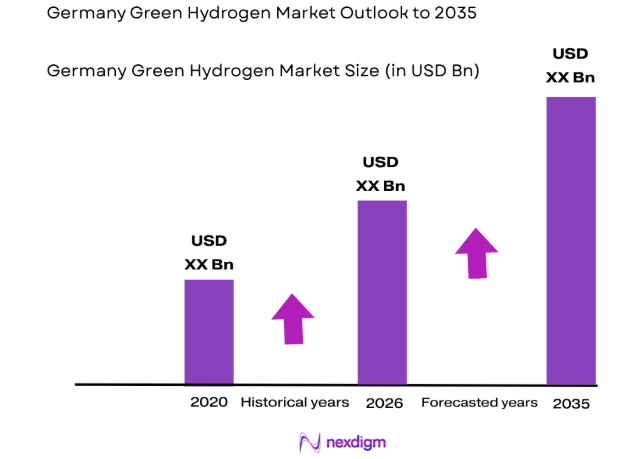
The German green hydrogen market is projected to be valued at approximately USD ~ billion based on a recent historical assessment. The market is primarily driven by Germany’s commitment to achieving carbon neutrality by 2050, backed by strong government support and policies such as the National Hydrogen Strategy. The reduction in production costs for green hydrogen, along with the increasing investments in electrolysis technology and infrastructure, is expected to fuel growth in this sector. Additionally, the industrial sector’s demand for clean fuels to decarbonize manufacturing processes further accelerates market growth.
Germany’s leadership in the green hydrogen market is attributed to its robust industrial base, large-scale renewable energy capacity, and strong political will. Cities like Berlin and Hamburg, along with industrial regions such as the Ruhr area, play a central role in the country’s green hydrogen push. These regions are hubs for technological innovation, manufacturing, and energy production, which align well with the goals of green hydrogen integration into Germany’s decarbonization efforts. The country’s favorable geographic conditions, including significant wind and solar power resources, also contribute to its dominance in green hydrogen production.
Market Segmentation
By Hydrogen Production Method
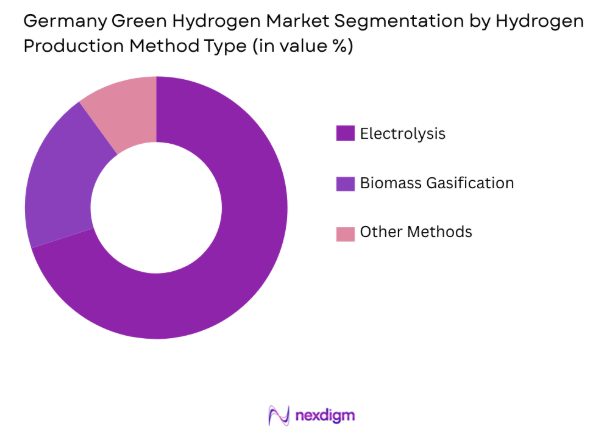
The German green hydrogen market is segmented by production method into electrolysis, biomass gasification, and others. Recently, electrolysis has emerged as the dominant production method due to its ability to use renewable electricity, such as from wind and solar power, to produce hydrogen. The decreasing cost of renewable electricity, combined with improvements in electrolysis technology, has made this method more economically viable and scalable. Additionally, government incentives, such as funding for electrolysis plants and the integration of renewable energy sources, are helping to drive the market forward, positioning electrolysis as the leading method for green hydrogen production in Germany.
By End-Use Industry
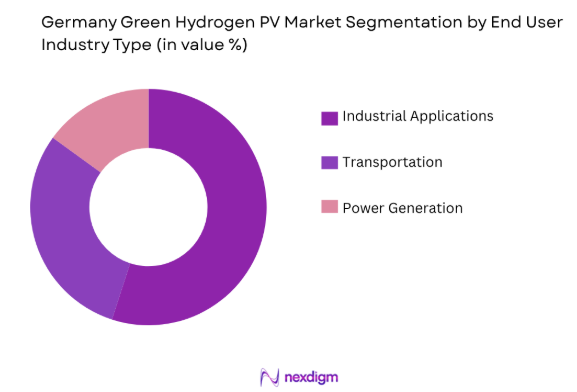
The German green hydrogen market is segmented by end-use industry into transportation, industrial applications, and power generation. Recently, industrial applications have dominated the market due to the high demand for green hydrogen in sectors such as steel, chemicals, and refining. The steel industry, in particular, is exploring green hydrogen as a replacement for coal in the production of steel, aiming to significantly reduce carbon emissions. The growing focus on industrial decarbonization, supported by government incentives and global pressure for sustainability, has made industrial applications the largest segment in the green hydrogen market.
Competitive Landscape
The German green hydrogen market is rapidly growing with a combination of established energy companies, start-ups, and industry innovators leading the charge. Major energy firms, including those with a long history in hydrogen and renewables, are driving the development of large-scale green hydrogen projects. Partnerships between private companies and the government are crucial in scaling up green hydrogen infrastructure, including electrolysis plants and storage systems. Collaboration across industries, including energy, transportation, and heavy industry, is enhancing the market’s competitive dynamics. While international players are involved, local companies are at the forefront of technology development and project implementation, often receiving government backing to advance Germany’s green hydrogen agenda.
| Company Name | Establishment Year | Headquarters | Technology Focus | Market Reach | Key Products | Revenue | Market-specific Parameter |
| Siemens Energy | 2008 | Germany | ~ | ~ | ~ | ~ | ~ |
| Linde | 1879 | Germany | ~ | ~ | ~ | ~ | ~ |
| Uniper | 2006 | Germany | ~ | ~ | ~ | ~ | ~ |
| Nel ASA | 1927 | Norway | ~ | ~ | ~ | ~ | ~ |
| Thyssenkrupp | 1811 | Germany | ~ | ~ | ~ | ~ | ~ |
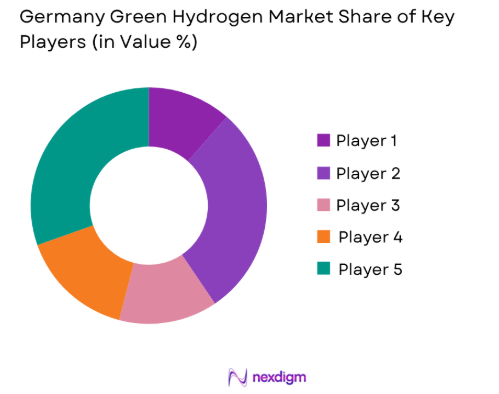
Germany Green Hydrogen Market Analysis
Growth Drivers
Government Support and Policy Framework
The German government’s strong commitment to decarbonization is one of the primary drivers of the green hydrogen market. Germany has established the National Hydrogen Strategy, which aims to make the country a global leader in hydrogen production and technology. This strategy includes significant investments in hydrogen production infrastructure, including subsidies and tax incentives for hydrogen technologies such as electrolysis. The government is also focusing on integrating green hydrogen into the energy, industrial, and transportation sectors, making it a cornerstone of Germany’s transition to a low-carbon economy. Funding for large-scale hydrogen projects, research and development, and the creation of hydrogen-based supply chains is expected to drive the green hydrogen market forward. As the demand for clean energy grows, government policies are expected to create a favorable environment for green hydrogen adoption, enabling both industrial and residential sectors to benefit from this clean energy source.
Technological Advancements in Electrolysis
Technological innovations in electrolysis have played a critical role in the growth of the green hydrogen market. Electrolysis allows for the production of hydrogen from water by using renewable electricity, making it a key method for producing green hydrogen. Over the past few years, advancements in electrolyzer technology have significantly improved efficiency and reduced costs. As the cost of renewable energy continues to decrease, the overall economics of green hydrogen production through electrolysis is becoming increasingly favorable. These advancements in electrolysis technology, combined with better energy storage solutions, enable the production of hydrogen at scale, which is necessary for meeting Germany’s energy demands. The German government, alongside private sector investments, continues to fund R&D efforts in electrolysis, aiming to make green hydrogen competitive with traditional fuels. Technological progress in electrolysis, therefore, plays a central role in scaling up green hydrogen production in Germany and expanding its role in decarbonizing the economy.
Market Challenges
High Production Costs of Green Hydrogen
One of the main challenges facing the growth of the green hydrogen market in Germany is the high cost of production. Although the cost of producing renewable electricity has decreased significantly, the electrolyzer technology used to produce green hydrogen is still relatively expensive. The large capital investment required for building electrolyzer plants, along with the operational costs of maintaining these systems, makes the price of green hydrogen higher compared to conventional hydrogen produced from natural gas (gray hydrogen). Moreover, the lack of sufficient infrastructure for hydrogen production, storage, and distribution further increases costs. These factors present a significant challenge for widespread adoption, particularly in industries where cost competitiveness is critical. To address these issues, continued technological innovations, increased production scale, and policy support will be essential to drive down costs and make green hydrogen more affordable for industrial and commercial applications.
Limited Infrastructure for Hydrogen Storage and Distribution
The lack of a comprehensive hydrogen infrastructure remains a significant barrier to the widespread adoption of green hydrogen in Germany. While large-scale hydrogen production plants are being developed, the infrastructure for storing, transporting, and distributing hydrogen is still underdeveloped. Hydrogen is a highly volatile substance and requires specialized storage and transportation systems, which increases costs and complexity. Additionally, the existing natural gas infrastructure is not fully compatible with hydrogen, making it difficult to integrate green hydrogen into the country’s energy supply chain. Expanding the infrastructure for hydrogen storage and distribution is essential for scaling up green hydrogen production and ensuring that it can be utilized effectively across various industries, from transportation to power generation. Without a reliable and cost-effective hydrogen infrastructure, the transition to a hydrogen-based economy in Germany will remain constrained.
Opportunities
Expansion of Hydrogen for Industrial Decarbonization
One of the most promising opportunities for the green hydrogen market in Germany lies in its use for industrial decarbonization, particularly in sectors like steel production, chemicals, and refining. Germany’s industrial sector is a major emitter of CO2, and green hydrogen presents a viable alternative to fossil fuels in key industrial processes. For example, green hydrogen can replace coke in steel manufacturing, helping to reduce the carbon emissions associated with this energy-intensive process. The German government has been actively supporting the transition to green hydrogen in industries like steel, cement, and chemicals, as these sectors contribute significantly to the country’s overall carbon footprint. In the coming years, further investments in hydrogen-powered industrial facilities, along with advancements in hydrogen-based production methods, are expected to drive market growth. This opportunity is particularly important for achieving Germany’s decarbonization goals and transitioning to a net-zero economy by 2050.
Exporting Green Hydrogen to Global Markets
Another key opportunity for the German green hydrogen market is the potential for exporting green hydrogen to other countries. Germany is well-positioned to become a global leader in hydrogen production, leveraging its strong renewable energy capacity, technological expertise, and existing hydrogen research. Several countries in Europe and beyond, such as Japan, South Korea, and those in the Middle East, are keen to import green hydrogen to meet their own decarbonization targets. Germany’s hydrogen export strategy is centered around establishing hydrogen export hubs and building international supply chains that can transport large quantities of green hydrogen via pipelines, ships, or as ammonia. By tapping into the growing global demand for green hydrogen, Germany can boost its economy, expand its renewable energy sector, and play a significant role in global decarbonization efforts.
Future Outlook
The German green hydrogen market is expected to experience significant growth over the next five years, supported by technological advancements, favorable government policies, and increasing demand for sustainable energy. As the cost of green hydrogen production continues to decrease and electrolysis technology improves, green hydrogen will become more competitive with traditional fossil fuels, driving greater adoption. Additionally, the development of infrastructure for hydrogen storage and distribution will enable the market to scale. With an increasing focus on decarbonizing hard-to-abate sectors, Germany’s green hydrogen market will play a central role in the country’s transition to a low-carbon economy.
Major Players
- Siemens Energy
- Linde
- Uniper
- Nel ASA
- Thyssenkrupp
- Air Liquide
- Enel Green Power
- Shell
- BP
- RWE Renewables
- Ørsted
- Iberdrola
- Vattenfall
- Plug Power
- Mitsubishi Power
Key Target Audience
- Investments and venture capitalist firms
- Government and regulatory bodies
- Energy infrastructure developers
- Renewable energy companies
- Manufacturing and industrial companies
- Research institutions
- International energy suppliers
Research Methodology
Step 1: Identification of Key Variables
Key market variables such as hydrogen production methods, government policies, and industrial decarbonization needs were identified for analysis.
Step 2: Market Analysis and Construction
Data from industry reports, government energy policies, and market surveys were used to estimate the market size, trends, and forecasts for green hydrogen in Germany.
Step 3: Hypothesis Validation and Expert Consultation
Consultations with industry experts, including government officials and hydrogen producers, validated market assumptions and key growth drivers.
Step 4: Research Synthesis and Final Output
The data was synthesized into a comprehensive report that covers market size, segmentation, growth drivers, challenges, and opportunities for stakeholders in the German green hydrogen market.

- Executive Summary
- Research Methodology (Definitions, Scope, Industry Assumptions, Market Sizing Approach, Primary & Secondary Research Framework, Data Collection & Verification Protocol, Analytic Models & Forecast Methodology, Limitations & Research Validity Checks)

- Market Definition and Scope
- Value Chain & Stakeholder Ecosystem
- Regulatory / Certification Landscape
- Sector Dynamics Affecting Demand

- Growth Drivers
Government initiatives for carbon neutrality and renewable energy goals
Increasing demand for green hydrogen in industrial decarbonization
Technological advancements in electrolysis and hydrogen storage - Market Challenges
High capital investment and operational costs for green hydrogen production
Limited infrastructure for hydrogen transportation and storage
Regulatory hurdles and challenges in scaling up production capacity - Market Opportunities
Increasing private sector investments and partnerships in green hydrogen
Potential for green hydrogen in powering heavy transport and industry
Expansion of hydrogen infrastructure in the EU and Germany’s role as a leader - Trends
Rising focus on hydrogen as a clean alternative to natural gas and coal
Integration of green hydrogen in the energy mix alongside solar and wind power - Government Regulations
- SWOT Analysis
- Porter’s Five Forces

- By Market Value, 2020-2025
- By Installed Units, 2020-2025
- By Average System Price, 2020-2025
- By System Complexity Tier, 2020-2025

- By Production Method (In Value%)
Electrolysis-based Green Hydrogen
Biomass Gasification
Power-to-Gas Technology
Photo-electrochemical Hydrogen Production - By Storage Technology (In Value%)
Compressed Hydrogen Storage
Liquefied Hydrogen Storage
Hydrogen in Solid State Storage
Ammonia-based Hydrogen Storage - By Distribution Method (In Value%)
Pipeline Distribution
Liquefied Hydrogen Shipping
Hydrogen by Road Transport
Storage and Recharging Stations - By End User Segment (In Value%)
Industrial Sector (Refineries, Steel Production)
Transportation (Fuel Cell Vehicles, Trucks)
Power Generation & Grid Balancing

- Market Share Analysis
- Cross Comparison Parameters (Production Efficiency, Energy Cost, Technology Adoption, Storage Capacity, Distribution Network, Regulatory Compliance, Infrastructure Development)
- SWOT Analysis of Key Competitors
- Pricing & Procurement Analysis
- Key Players
Air Products and Chemicals Inc.
Siemens Energy
Nel ASA
ITM Power plc
Plug Power
Linde plc
SABIC
Ballard Power Systems
Hydrogenics Corporation
Shell Hydrogen
Uniper SE
E.ON
Enel Green Power
Thyssenkrupp Uhde Chlorine Engineers
RWE AG

- Adoption of green hydrogen in the steel and cement industries for decarbonization
- Expansion of hydrogen fuel cell vehicles and infrastructure in Germany
- Growth in green hydrogen usage for grid stabilization and energy storage
- Increased focus on the energy sector for balancing renewable energy generation

- Forecast Market Value, 2026-2035
- Forecast Installed Units, 2026-2035
- Price Forecast by System Tier, 2026-2035
- Future Demand by Platform, 2026-2035


 Request a Sample
 Ask for Customization
 Get a Quote
 Enquire Now